

Page 1
ACM250
250w Mixer Amplifier
Operating Manual
Page 2
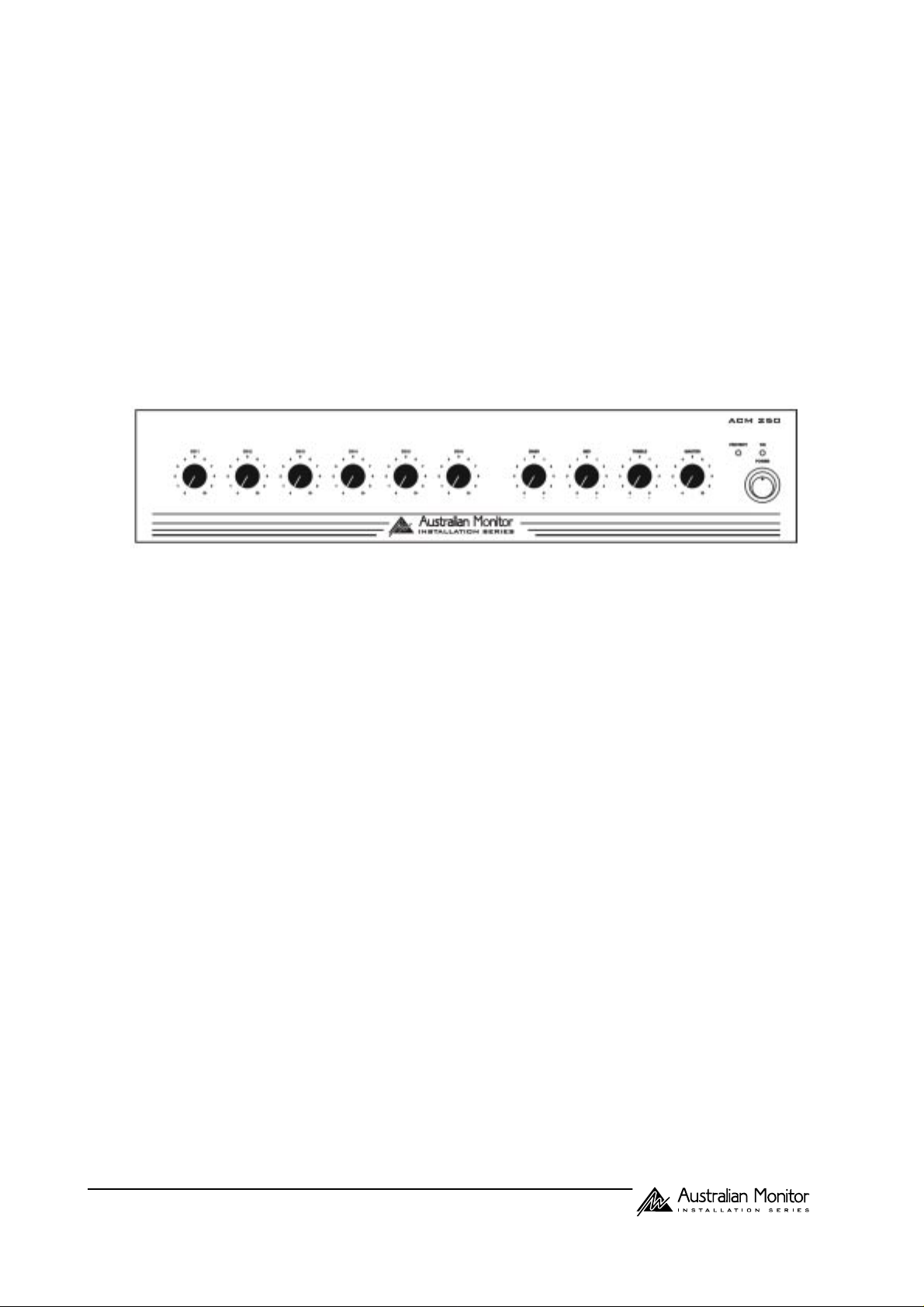
ACM250, 250 Watt Mixer Amplifier
Product Description
The ACM250 mixer amplifier is designed for commercial installations. It operates on 230/240 V AC, 50Hz (or 1 15 VAC,
60Hz with factory modification) and may be desk or rack mounted (rack mount kit supplied). The ACM250 delivers 250
watts into a load of 4 ohms, 70 or 100 volt line. As standard, the ACM250 is supplied self standing with rubber feet. They
may be stacked to a maximum of four units high.
.
Front Panel Features
Microphone/Line Level Controls
The 6 dual mic/line input controls are labelled Ch 1 through to Ch 6 and should be adjusted to provide the required level
mix for each individual channel. Start with the controls set to level 0 and turn the controls clockwise until the desired mix
level for each channel is reached.
Bass Control
Setting this control in the centre position will give an overall flat bass response. Adjusting the bass control in a
clockwise direction will provide up to 12 dB of bass boost @ 100 Hz. Adjusting the bass control in a counter-clockwise
direction will provide up to -12 dB of bass cut @ 100 Hz.
Middle Control
Setting this control in the centre position will give an overall flat middle response. Adjusting the mid control in a
clockwise direction will provide up to 12 dB of mid boost @ 600 Hz. Adjusting the mid control in a counter-clockwise
direction will provide up to -12 dB of mid cut @ 600 Hz.
Treble Control
Setting this control in the centre position will give an overall flat treble response. Adjusting the treble control in a
clockwise direction will provide up to 9 dB of treble boost @ 10kHz. Adjusting the treble control in a counter-clockwise
direction will provide up to -9 dB of treble cut @ 10 kHz.
Master Output Control
The Master level pot controls the overall output level of the amplifier depending on the levels set for the individual input
channels as detailed above. Start with the control set to level 0 and turn clockwise until the desired output level of the
amplifier is reached.
Page 3
Power Switch
This switch controls the switching of AC power to the amplifier. A blue On LED will indicate whether the amplifier is
switched on or off.
Protect LED
A feature of the ACM250 is high temperature protection. In most applications, the internal cooling fan will most
probably never switch on. When used with demanding speaker loads or in difficult operating environments, the fan may
regularly switch on to cool the amp down and then switch off again. This switching on and switching off is quite normal.
The “Protect” function is there to protect the amplifier from a high temperature problems which would only occur if the
fan stopped working or became clogged up. In this very rare occurance, the amplifier will shut down and the protect LED
will illuminate. The amplifier will automatically restart once it’s internal temperature has fallen within “safe” limits. If the
protect LED illuminates, it is best to switch the amplifier off, let it cool down and then try it again. If the protect LED
illuminates again, please contact the company who supplied or installed the equipment.
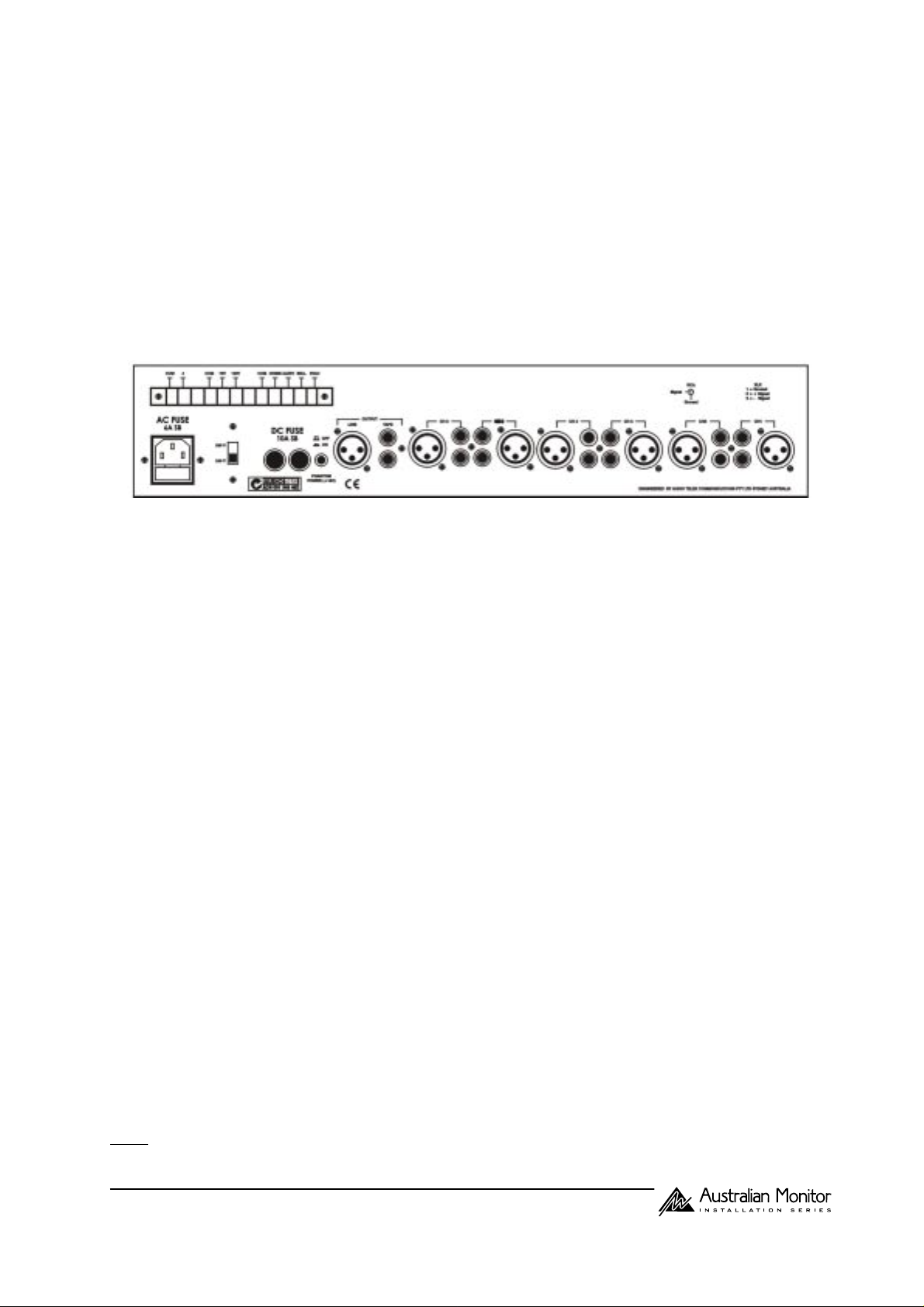
Rear Panel Features
AC Power Inlet
The operating voltage is 230/240 V AC @ 50 Hz or 1 15 V AC @ 60 Hz (with factory modification). The 3 pin IEC power inlet
is located on the bottom left of the rear panel and accepts a standard mains power lead fitted with an IEC connector.
Before plugging in a power lead, please check the rear panel of the amplifier to ensure that the voltage switch is set
correctly for your part of the world.
The inlet is equipped with an in-built AC fuse holder fitted with a 6 amp fuse plus a spare within the holder. Power
consumption is 400 watts.
---- Please ensure that the mains power cord is disconnected before attempting to check or replace this fuse----
230V/240V Slide Switch
The operating voltage of the amplifier is user selectable between 230V and 240V via a slide switch located on the right
of the AC inlet. This switch should be set to match the AC voltage of your country.
Speaker Output Terminal Strip
The screw terminals on the left hand side of the strip allow access to the direct speaker outputs of the amplifier. The
screw terminals on the right hand side are for activation of the in-built 4 tone generator. Reading from left to right the
terminals are: Low Impedance Common (use with 4 or 8 ohms)
4 Ohms
Spare
Constant V oltage Common (use with 70v or 100v)
70 V olt Line
100 V olt Line
Spare
T one Generator Common (use with one of the 4 tones listed below)
Pre-Announce Chime
Alert T one
Bell Chime
Evacuation T one
Note: The minimum impedance (or maximum load) at 100 Volt line should be no less than 40 Ohms.
Page 4

Phantom Power
This button enables or disables the 18 volts DC phantom power which is available on all microphone inputs (XLR’s). The
“in” position indicates that phantom power is on for all mics. The “out” position means that phantom power is switched
off for all mics. Phantom power is required for electret condenser microphones which require DC power to operate. While
some of these microphones can operate from an internal battery, having phantom power available on the amplifier
eliminates the need to regularly change batteries in the microphone. While phantom power is not required for the more
common Dynamic microphones, it will not damage them providing that they are balanced. Do not plug an unbalanced
microphone in any amplifier or mixer when phantom power is switched on.
Line Output
The balanced XLR line level output provides a maximum of 700mV to allow for connection to up to 6 power amplifiers.
Simply run a balanced cable from the line out of the ACM250 to the line input of the power amplifier. Pin connections are:
pin #1-earth; pin #2-signal (high, +); pin #3 -signal (low , -).
Tape Output
Dual RCA output connectors provide a line level output with a maximum of 350mV into 10K Ohms which is ideal for a
connection to most standard tape recorders. This output is sourced before the master gain control and as such, the tape
output level is not influenced by the operation of the master gain control.
Microphone Inputs
The mic input sensitivity is 1mV @ 200 ohms. Pin connections are: pin #1-earth; pin #2-signal (high, +); pin #3-signal
(low, -). Phantom power of +18 volts is available on all microphone inputs. Reading from left to right across the rear panel,
the connection are for microphone inputs 6, 5, 4, 3, 2, & 1 respectively .
Line Inputs
Line inputs 1, 2, 3, 4, & 5 have an input sensitivity of 75mV @ 47K ohms. Input 6 has an input sensitivity of 300mV @
47K ohms making it suitable for high level inputs such as a CD player. Reading from left to right across the rear panel,
the connections are for inputs 6, 5, 4, 3, 2, & 1 respectively .
Other Features
Tone Generator
Four separate tones are available from the in-built tone generator board. All four tones can be activated individually via
a contact closure connected to the screw terminals on the rear of the amplifier. T o activate the bell chime for example, just
run a pair of wires from the T one generator common and the Bell terminal to an external switch. Activating the switch, or
closing the pair of wires, will activate the bell. When any tone is activated, all inputs (except for inputs one and two) will
automatically mute. To adjust the level of the tone generator, disconnect the power lead, remove the amplifier lid and
locate the pot labeled R6. (located behind the Bass adjustment pot). This pot adjusts the level for all 4 tones.
T ones available on the ACM250 include:
Evacuation T one (to Australian Standard AS2220.1.2)
Alert T one (to Australian Standard AS2220.1.2)
Bell T one
Pre-Announce Chime
Muting
A VOX muting card is installed in the ACM250. This feature provides automatic muting of some channels when others
are active. It is normally used so that a paging microphone can have priority (by muting) over background music. VOX
muting is available from channels 1 and 2 meaning that any signal on channels 1 and 2 (mic or line) will mute channels 3,
4, 5 & 6. The muted channels will automatically ramp back up to normal volume when the signal on channels 1 and/or 2
is no longer active. The amplifier ships with the VOX muting function enabled. T o disable the VOX muting, disconnect
the mains power lead and remove the lid of the amplifier. Looking down from the front of the amplifier , a three position
jumper (labeled JP2) is located just to the left and behind the level pot for channel 1. T o disable VOX muting, move the
jumper to the middle and left pins.
(The factory setting is with VOX enabled with the jumper on the middle and right pins).
Page 5

Fuse Sizes
Mains, 240 V AC: 6 Amperes Slow Blow
DC: 10 Amperes Slow Blow
Page 6

Important Safety Information
1. Save the carton and packing material even if the equipment has arrived in good condition. Should you ever
need to ship the unit, use only the original factory packing.
2. Read all documentation before operating your
equipment. Retain all documentation for future reference.
3. Follow all instructions printed on unit chassis for
proper operation.
4. Do not spill water or other liquids into or on the
unit, or operate the unit while standing in liquid.
5. Make sure power outlets conform to the power
requirements listed on the back of the unit.
6. Do not use the unit if the electrical power cord is
frayed or broken. The power supply cords should be
routed so that they are not likely to be walked on or
pinched by items placed upon or against them, paying
particular attention to cords and plugs, convenience receptacles, and the point where they exit from the
appliance.
7. Always operate the unit with the AC ground wire
connected to the electrical system ground. Precautions
should be taken so that the means of grounding of a
piece of equipment is not defeated.
8. Mains voltage must be correct and the same as
that printed on the rear of the unit. Damage caused
by connection to improper AC voltage is not covered by
any warranty .
9. Have gain contr ols on amplifiers turned down dur-
ing power-up to prevent speaker damage if there are high
signal levels at the inputs.
10. Power down & disconnect units fr om mains volt-
age before making connections.
11. Never hold a power switch in the “ON” position
if it won’t stay there itself!
12. Do not use the unit near stoves, heat registers,
radiators, or other heat producing devices.
13. Do not block fan intake or exhaust ports. Do not
operate equipment on a surface or in an environment
which may impede the normal flow of air around the
unit, such as a bed, rug, weathersheet, carpet, or completely enclosed rack. If the unit is used in an extremely
dusty or smoky environment, the unit should be periodically “blown free” of foreign matter.
14. Do not remove the cover. Removing the cover will
expose you to potentially dangerous voltages. There
are no user serviceable parts inside.
15. Do not drive the inputs with a signal level greater
than that required to drive equipment to full output.
16. Do not connect the inputs / outputs of amplifiers
or consoles to any other voltage source, such as a
battery, mains source, or power supply, regardless of
whether the amplifier or console is turned on or off.
17. Do not run the output of any amplifier channel
back into another channel’s input. Do not parallel- or series-connect an amplifier output with any
other amplifier output.
Audio Telex Communications Pty Ltd is not responsible for damage to loudspeakers for any reason.
18. Do not gr ound any red (“hot”) terminal. Never
connect a “hot” (red) output to ground or to another “hot” (red) output!
19. Non-use periods. The power cord of equipment
should be unplugged from the outlet when left unused for a long period of time.
20. Service Information Equipment should be serviced by qualified service personnel when:
A. The power supply cord or the plug has been
damaged.
B. Objects have fallen, or liquid has been spilled into
the equipment
C. The equipment has been exposed to rain
D. The equipment does not appear to operate normally ,
or exhibits a marked change in performance
E. The equipment has been dropped, or the enclosure
damaged.
Page 7

Engineered by Audio Telex Communications Pty Ltd, Sydney, Australia
A.B.N. 78 001 345 482 Inc in NSW
www.audiotelex.com.au
Export Sales & Corporate Head Office
Private Bag 149, Silverwater NSW 1811
149 Beaconsfield Street, Silverwater NSW 2128
E-mail: ho@audiotelex.com.au
Australia
Ph: 61-2- 9647 1411
Fax: 61-2-9748 2537
Sydney (NSW & ACT Sales)
Private Bag 149, Silverwater NSW 1811
149 Beaconsfield Street, Silverwater NSW 2128
Ph: (02) 9647 1411
Fax: (02) 9648 3698
E-mail: nsw@audiotelex.com.au
Melbourne (Vic & Tas Sales)
P.O. Box 131, Blackburn South VIC 3130
22/277 Middleborough Road, Box Hill VIC 3128
Ph: (03) 9890 7477
Fax: (03) 9890 7977
E-mail: vic@audiotelex.com.au
Brisbane (Qld Sales)
P .O. Box 871, Fortitude Valley QLD 4006
42 Commerical Road, Fortitude V alley QLD 4006
Ph: (07) 3852 1312
Fax: (07) 3252 1237
E-mail: qld@audiotelex.com.au
Adelaide (SA & NT Sales)
P.O. Box 157, Hindmarsh SA 5001
31 Walsh Street, Thebarton SA 5031
Ph: (08) 8352 4444
Fax: (08) 8352 4488
E-mail: sa@audiotelex.com.au
Perth (WA Sales)
P.O. Box 404, North Perth WA 6906
299 Fitzgerald Street, West Perth WA 6005
Ph: (08) 9228 4222
Fax: (08) 9228 4233
E-mail: wa@audiotelex.com.au
Auckland (NZ Sales)
P.O. Box 512, Albany 1331
Unit B, 11 Piermark Drive, Albany 1331
Ph: (09) 415 9426
Fax: (09) 415 9894
E-mail: audiotlx@nznet.gen.nz
 Loading...