

Page 1
Home Audio
Equipment Review
April 2008
Audio Space Reference Two Preamplifier
by Ken Choi
Even though I usually favor a simple
tumbler of house plonk, I enjoy
reading the occasional wine review.
Unlike audio reviews, wine reviews
are near-ubiquitous, appearing as
they do in the weekend newspapers
and even on the all-news radio
station I listen to during my daily
commute. Like audio reviews, an
elaborate, descriptive vocabulary has
evolved that allows the reader to
savor secondhand the subject under
review – assuming, in this instance,
that his palate is intimate with the
flavors of gooseberry and buttery
oak. Interestingly, while they
probably exist, I’ve not seen reviews
of bottled waters, despite the wide
choices available, with some of
these in "fine" restaurants and
costing more than the wine I usually
order. Variously sourced or
processed, waters clearly differ in
taste, but putting these differences
into words would present an onerous
task, at least to me.
In theory, the preamplifier is audio’s
drinking water, but some are more
like wine. The preamp ideally serves
as a totally transparent conduit,
allowing the source signals to pass
largely unadulterated on their way to
the amp-speaker unit. But in practice
we all know that a preamp can exert
subtle or not-so-subtle and pervasive
effects on the system’s overall
sound, which is why so many are
available using diverse technologies
to provide the critical first stage of
gain.
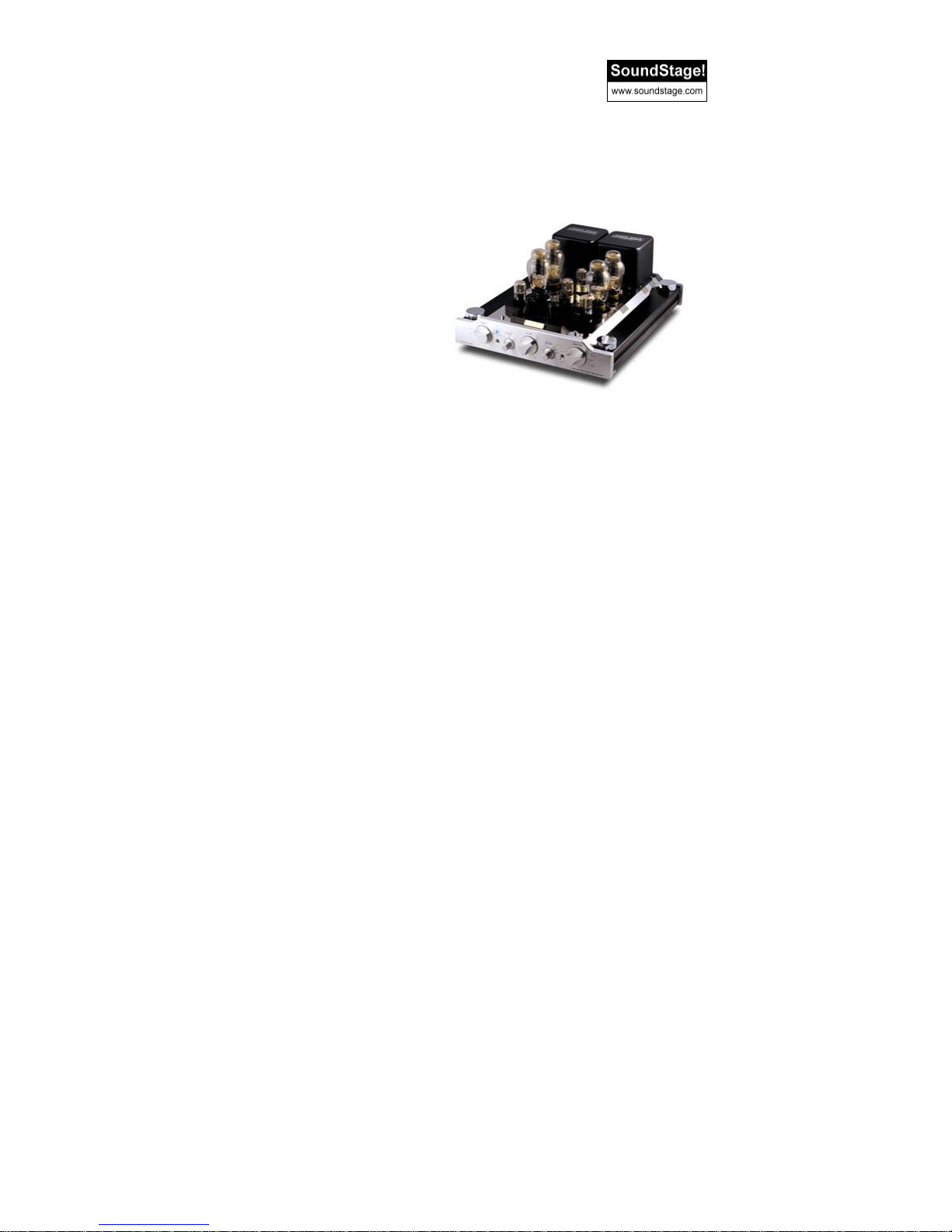
The $9900 USD Reference Two is
Hong Kong-based Audio Space’s
entry into the ultra-high-end
preamplifier sweepstakes. Released
at the beginning of 2007, it is the
second product in Audio Space’s
Reference series heralded by the introduction of the Reference One monoblock power
amplifiers, which I reviewed earlier. Built and voiced to standards aimed at competing in the
upper end of the worldwide marketplace, the Reference series has now grown to include the
Reference Three mono amplifiers and the Reference 3.1 integrated amplifier, both of which
offer the user a choice of output tubes.
The Reference Two is a full-function tube preamp that features preservation of the signal in a
fully balanced fashion from input to output. A pair of 6N9P high-gain octal tubes do duty in
an input/driver stage, and a pair of 300B tubes per channel serves in an output stage. Another
pair of 6N9Ps act as cathode followers, allowing for driving long cable runs and solid-state
amplifiers with low input impedance. The phono stage, which is not balanced, uses a pair of
more pedestrian 12AX7s for moving-magnet gain. Instead of requiring step-up transformers,
moving-coil signals are processed by 6922s in a gain stage that features adjustable input
impedance. Another 6922 is used as an output buffer to maintain signal strength. As with the
Reference One amplifiers, all tubes are culled from the cream of Shuguang’s crop. The
Reference Two is the world’s only truly balanced, 300B-based line driver.
The preamp’s output impedance is less than 2000 ohms. The line stage provides 18dB of
gain, and the moving-magnet phono stage 37dB. Moving-coil gain is an additional 20dB, for
a total of 75dB. Two additional 1.5dB steps of moving-coil gain are user selectable via a
front-panel knob. A front-panel knob also selects loading for moving-coil cartridges.
Review Summary
Sound "Allowed the music to breathe with utter ease
and naturalness," "created a remarkably open
and spacious sound" and reproduced voice
"with a kind of clarity that is a little difficult to
describe." "The soundstage expanded in all
dimensions but did not seem exaggerated.
Depth and layering were especially
impressive, with instrumental and vocal
images rendered with increased separation
and enhanced spatial resolution."
Features "The Reference Two is a full-function tube
preamp that features preservation of the
signal in a fully balanced fashion from input to
output. A pair of 6N9P high-gain octal tubes
do duty in an input/driver stage, and a pair of
300B tubes per channel serves in an output
stage. Another pair of 6N9Ps act as cathode
followers, allowing for driving long cable runs
and solid-state amplifiers with low input
impedance." "The line stage provides 18dB of
gain, and the moving-magnet phono stage
37dB. Moving-coil gain is an additional 20dB,
for a total of 75dB."
Use "I did have one operational issue with the
Reference One: Tube microphonics were
evident and a distraction at times. However, if
my experience with the Reference One
amplifiers is any indication, the ingenious
folks at Audio Space will come up with a
solution to this problem."
V
alue "I would urge anyone shopping for a world-
class preamp to use with digital sources or a
separate phono stage to give the Reference
Two a serious listen, because its line stage is
seriously good."
Page 1 of 4SoundStage! Equipment Review - Audio Space Reference Two Preamplifier (4/2008)
2011-5-24file://D:\Peter Files\Review-web\SoundStage! Equipment Review - Audio Space Reference Two Preamplifier (4-2008).htm
Page 2

The Reference Two is a top-shelf component in the literal sense due to its size (16 3/4"W W
x 10"D × 9"H) and semblance to a power amplifier. Its 46-pound weight is largely accounted
for by a massive onboard power supply that is subject to solid-state rectification. The
Reference Two shares the same dual-layer stainless-steel chassis construction that the
Reference One amps use. It also features similar dense, aluminum side rails with integral
spiked footers that serve more here to quell vibrations than to dissipate heat. Originally
designed "floating sockets" for the 300B tubes make use of a proprietary rubber compound to
further absorb vibrations and reduce the microphonics that these tubes are notoriously prone
to.
A velvety manual volume control based on a four-channel ALPS potentiometer takes center
stage on the front panel. In addition to the phono input, the Reference Two accepts two linelevel inputs, with one of these being single-ended only. When asked about the relative
paucity of inputs, the affable Canadian distributor of Audio Space products, Bernard Li,
explained that one set of fully balanced line inputs occupies four times the termination
sectors of a mechanical input selector that single-ended inputs would require. Audio Space
decided that they would stay with a mechanical selector rather than employ an electronic
input selector that could accommodate more inputs but potentially degrade the sound. The
Reference Two does provide both single-ended and balanced outputs to the amp. Additional
features include a rumble-cut switch for the phono stage and a phase-inversion switch at the
output.
What system?
The Reference Two was used in place of my longstanding reference, the Convergent Audio
Technology SL-1 Ultimate Mk 1. It took signals from an original EMM Labs CDSD and
DCC2 as well as an Oracle Delphi V turntable with SME V tonearm and Koetsu Onyx
cartridge. I used the Reference Two with Nagra VPA tube monoblocks, a solid-state Audio
Research 100.2 stereo amp, and Audio Space’s own Reference One monoblocks. Speakers
were Wilson Audio Watt/Puppy 7s.
All amps were driven via six meters of Purist Audio Designs Venustas interconnect. Due to
logistical problems (i.e., a lack of appropriate cabling) I could not run my system fully
balanced. However, there were no problems driving any of the amps through the six-meter
interconnects. The Reference Two was powered through a Shunyata Hydra Model-8 via an
Essential Sound Products The Essence power cord, which is what I usually use with the CAT
preamp.
What it does
The sonic impact that the Reference Two’s line stage made in my system was immediately
apparent and consistent irrespective of the amps with which it was partnered. I did most of
my auditioning with the Audio Research 100.2 stereo amplifier, however, as this amplifier
made it easiest to identify the preamp’s character and also because the combination just
sounded so darn good.
The overriding impression I had of the Reference Two was that it allowed the music to
breathe with utter ease and naturalness. It created a remarkably open and spacious sound. The
soundstage expanded in all dimensions but did not seem exaggerated. Depth and layering
were especially impressive, with instrumental and vocal images rendered with increased
separation and enhanced spatial resolution.
Although much of the music is electronic and the sound is heavily processed, albeit in a very
pleasing way, several tracks on Jennifer Warnes’ The Well [Cisco SCD2034] served to
illustrate the Reference Two’s character. Listen to the choir that appears near the end of
"Patriot’s Dream." Played through the Reference Two, the sound here engulfed me, the
voices swelled and soared. This was the stuff of goose bumps. The trumpet on "Invitation to
the Blues" and the piano on "The Well" appeared to be given more of their own space and
were presented with added body within these spaces. The overall result was a heightened
sense of realism.
Of course, it is really Warnes’
beautiful voice that is the focus of
this album, and the Reference Two
reproduced this with a kind of clarity
that is a little difficult to describe. A
varying amount of reverb was added
to her voice, and the production
notes indicate that some of this was
applied digitally and at other times
acoustically by singing in an echo
chamber. The Reference Two
resolved this reverberation so well
that I felt that I could discern how
the echo in Warnes' voice was
generated from song to song. While
we seldom consciously listen for
reverberation, the Reference Two’s
ability to resolve this correlated with
the production of a more enveloping
Reference One, round two
Shortly after my review of the Audio Space Reference
One mono amplifiers was published, Audio Space's
chief engineer, Peter Lau, happened to visit the dealer
to which the review amps were returned. Based on
feedback from the field, he spent the better part of a
day implementing updates to the amps. These included
replacing some of the capacitors with Zero Caps
sourced from Germany and readjusting the filament
voltages on some of the tubes. Additionally, new
circuitry was added to allow for automatic biasing of the
hum balance.
After a couple of weeks of showroom use, the amps
were returned to me for a listen. The transformation
was significant. There was no trace of the midrange
hardness or glare that I found so disquieting. More than
that, the overall sound of the amps changed such that
the presentation had become more relaxed and
Page 2 of 4SoundStage! Equipment Review - Audio Space Reference Two Preamplifier (4/2008)
2011-5-24file://D:\Peter Files\Review-web\SoundStage! Equipment Review - Audio Space Reference Two Preamplifier (4-2008).htm
Page 3

soundfield. Decay of instrumental
and vocal sounds was also enhanced,
which lead to a more textured and
dimensional rendering of all images.
For me, these attributes are
particularly appreciable on
minimally processed recordings of
acoustic instruments. Apollo [North
Star CD2390] features local Toronto
musicians Daniel and Carey Domb
performing music for cello accompanied by guitar. There was no echo added here apart from
the natural ambience of the church where the recording was made, which the Reference Two
reproduced very nicely. The sound of the cello was rendered with convincing body and
purity of tone. The decay produced as the guitarist gently tapped the body of her instrument
in time with the music on "50 Variations on a Theme of Corelli" was beautifully captured.
While the spaciousness of the sound and enhanced texture and dimensionality of images
were what the Reference Two most obviously brought to the sonic table, there was really
very little that it took away. It did not bleach or darken the overall tone, and instrumental
timbres were not only presented faithfully but also instilled with vibrancy. The music
appeared to remain true to the source without significant editorializing or artifact. Don’t let
those 300Bs fool you into thinking there was anything SET-like about this preamp’s sound.
Dynamics were lifelike without being exaggerated. There was satisfying extension at both
frequency extremes, although the midrange was where the preamp excelled.
However, all of this applied to the line stage. In contrast, the phono stage proved a little
disappointing. While there were no issues with noise and gain was more than adequate, the
soundstage seemed to collapse when I listened to Joni Mitchell’s Blue [Reprise MS 2038]
and the late Michael Hedges’ Aerial Boundaries [Windham Hill Records WH-1032].
Mitchell’s vocals sounded somewhat recessed and two-dimensional. Turning up the volume
knob did nothing to ameliorate the situation. Several cuts on Aerial Boundaries feature
startling dynamics and, like The Well, generously processed echo. Unfortunately these were
attenuated and truncated when played through the Reference Two’s phono stage. Without
having heard the line stage first, the performance of this phono stage could be considered
acceptable although not terribly involving. Knowing what the line stage was capable of,
however, elevated the standards by which the phono stage needed to be judged, and I found
the disparity between the performance of the two more than a little surprising. Perhaps
something was amiss with the review sample. I should note that these albums sounded
spectacular when played through a modest Bel Canto PHONO1 phono stage plugged into the
Reference Two’s line input.
I did have one operational issue with the Reference One: Tube microphonics were evident
and a distraction at times. However, if my experience with the Reference One amplifiers is
any indication, the ingenious folks at Audio Space will come up with a solution to this
problem.
What else?
I have owned and thoroughly enjoyed my CAT SL1 Ultimate Mk 1 preamp ($5950 when still
available) for over five years now. I am enamored of its ability to resolve musical detail and
nuance combined with its utterly neutral presentation, and it has a seriously good phono stage
that's equal to separate units that cost almost as much as the preamp itself.
When the CAT preamp was reinstalled in place of the Audio Space Reference Two, the
changes in the sound were subtle but at the same time obvious. The CAT preamp's line stage
provided for a drier, cleaner presentation lacking some of the harmonic richness that the
Reference Two offered up. However, the CAT is about dynamics, control and extension, and
while the Audio Space preamp was not left wanting in these areas, it is really more about
spaciousness and musical flow. The Jennifer Warnes CD demonstrated this ably, as the
Reference Two had the indescribable clarity that really brought Warnes' voice to life. In
terms of their phono reproduction, the SL1 Ultimate Mk 1 clearly bettered the Reference two
in terms openness and three-dimensionality.
If these preamps were the stock with which long-simmering stews were made, the CATbased dish would allow for a heightened appreciation of the individual ingredients that went
into the mix. The Audio Space-based ragout would allow all the individual flavors to
optimally meld together into a wonderful-tasting whole. Both are very satisfying.
Water to wine
Even with my reservations about its phono stage and microphonics, the Audio Space
Reference Two set a new standard in preamplification for me -- or rather line-stage
performance. A few seconds after first installing it, I made a mental note that I was listening
to something very special, and that impression remained after a lengthy evaluation. Listening
to it was as if a small dam had broken that allowed my line-level sources to flood the room
with previously pent-up sound in which I was happily awash.
In fact, the Reference Two so impressed me that it caused me to reevaluate my longstanding
relationship with the CAT SL1 Ultimate. I’ve yet to purchase any review item, and that string
transparent while retaining the amps' original sense of
effortless power and control.
They were so much more musically engaging that I
sorely regretted having them wrested from my room
after only a few days of listening. Such is the existence
of an audio reviewer!
...Ken Choi
Page 3 of 4SoundStage! Equipment Review - Audio Space Reference Two Preamplifier (4/2008)
2011-5-24file://D:\Peter Files\Review-web\SoundStage! Equipment Review - Audio Space Reference Two Preamplifier (4-2008).htm
Page 4

remains unbroken. The phono stage is very important to me, and the Reference 2 comes up
short here. Still, I would urge anyone shopping for a world-class preamp to use with digital
sources or a separate phono stage to give the Reference Two a serious listen, because its line
stage is seriously good.
...Ken Choi
Audio Space Reference Two Preamplifier
Price: $9900 USD.
Warranty: Two years parts and labor.
Audio Space Acoustic Laboratory Ltd.
10/F., Wah Yuen Factory Bldg., 16 Elm Street
Tai Kok Tsui, Kowloon, Hong Kong
Phone: +852 2851 0722
Fax: +852 2851 0121
E-mail: [email protected]
Website: http://www.audiospace
-hifi.com/
Canadian distributor:
Charisma Audio
Suite 86, 4261 Highway 7
Markham, Ontario Canada L3R 9W6
Phone: (905) 470-0825
Fax: (905) 470-7966
E-mail: [email protected]
Website: http://www.charismaaudio.com/
U.S. distributor:
Gini Systems
Suite 102, 1621 W. El Camino Real
Mountainview, CA 94040
Phone: (650) 210-8663
E-mail: [email protected]
Website: http://www.gini.com/
z Current Issue Equipment Reviews
All Contents
Copyright © 2008 SoundStage!
All Rights Reserved
Page 4 of 4SoundStage! Equipment Review - Audio Space Reference Two Preamplifier (4/2008)
2011-5-24file://D:\Peter Files\Review-web\SoundStage! Equipment Review - Audio Space Reference Two Preamplifier (4-2008).htm
 Loading...