

Page 1
• STUDIO RIBBON MICS
Audio Engineering
Associates
1029 N. Allen Ave., Pasadena, CA 91104 www.ribbonmics.com Phone: (626) 798-9128 Fax: (626) 798-2378
• M/S STEREO
• TALL STANDS
• MIC POSITIONERS
©May 2010
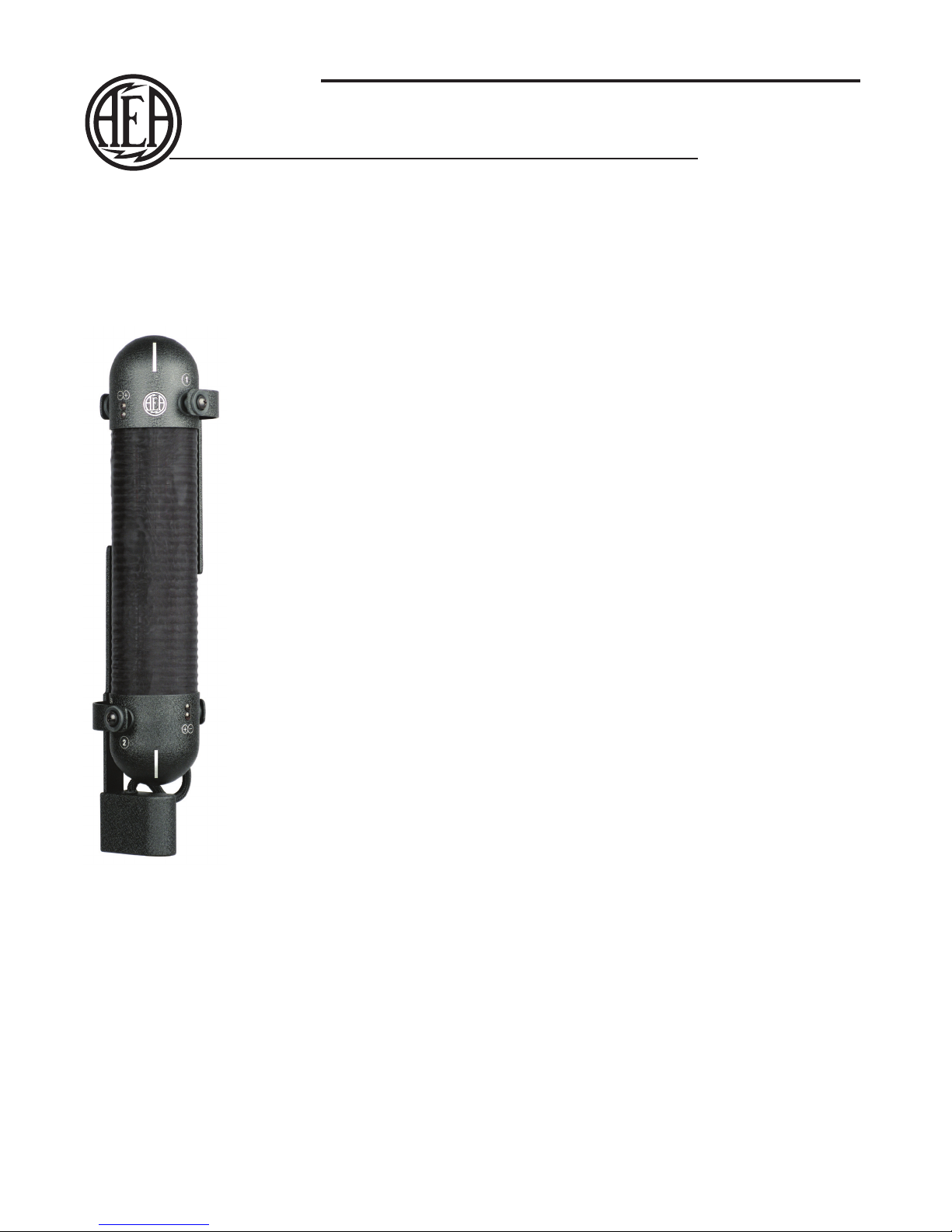
AEA R88 mk2 Stereo Ribbon Microphone
User’s Manual
Thank you for choosing an AEA R88 mk2 Stereo Ribbon Mic. There is no easier
way to track natural stereo than by using a stereo mic. From drum overheads to live
concert recordings, the R88 is convenient to use and aesthetically pleasing.
The natural soundstage and character of the R88’s Blumlein Stereo makes it a great
main mic. An excellent orchestral and choral recording microphone, it shines on
applications such as horn sections and drum overheads. The R88 accurately records
complex tones such as woodwinds, strings and cymbals.
The heart of the R88 are two mat
tuned to 16.5 Hz. They are 1.8 micron (7/100,000 inch) thin and match the air’s
acoustical impedance within 1 dB. This is a Pure Ribbontm minimum path design.
Only black technical-fabric and stainless stee
AEA Big Ribbonstm deliver extended highs and fast transient response without the
high-frequency, high-Q resonances characteristic of tightly stretched condenser. They
are native fi gure-8s with exceptional imaging, transient response, and sense of space.
The fi gure-8 pattern is highly useful for controlling bleed and room tone.
Appreciated for What You Hear Is What you Get, Blumlein stereo is the most three
dimensional coincident recording system. The ribbons are 90 degrees to each other
for convenient Blumlein and Mid/Side (M/S) stereo. M/S is an excellent technique
for solo instruments and situations needing post-production stereo width control.
Your AEA R88 Blumlein Stereo ribbon mic is unlike any other coincident stereo microphone.
1. Polar patterns are consistent at all frequencies whereas directional condenser mics become
omnidirectional at lower frequencies.
2. Low frequency response extends down to 20 Hz whereas
shorter ribbons roll off and/or eliminate lower frequencies.
3. Blumlein intensity stereo delivers a solid, stable and in-phase soundstage from their front and rear
quadrants, with an excellent sense of depth.
4. A properly positioned Blumlein pair also conveys a strong sense of spaciousness, reminiscent of
spaced omnis, which we attribute to the left and right and left quadrants being out-of-phase.
ched native pressure-gradient ribbon transducers
l separate the ribbons from the music
directional condenser capsules and
Page 2

The Blumlein Stereo “sweet spot” is the 90 degree angle between the principal axis of channels “1” and
“2”. Instruments in this front region are in-phase and in-polarity. When placing the R88, try to position it
so that instruments in front are + or - 45 degrees from the centerline. The rear “sweet spot” of an R88 is
the rear 90 degree quadrant, ie + or - 45 degrees from the rear centerline.
Sounds arriving from the right and left 90 degree quadrants are out-of-phase in the stereo image. Prominent
early reflections from these regions can cause an ill-defined and inaccurate stereo image. But this outof-phase low frequency material from the left and right quadrants is also responsible for the sense of
spaciousness, reminiescent of spaced omnidirectional mics, that good Blumlein Stereo is known for.
In the horizontal plane, the off-axis frequency response is quite consistent. In the vertical plane, the high
frequency response is progressively atttenuated as it moves away from the horizontal plane. Try to keep all
instruments within + or - 30 degrees of the horizontal plane for best high frequency response.
The R88’s extended and natural bass response is due to the very low resonance frequency (16.5 Hz) to
which our Big Ribbonstm are tuned. Such bass response can also pickup subsonic “rumble” from air
conditioning systems, subways, passing trucks, etc. All AEA ribbons have integrated shockmounts to
mechanically isolate them from structure borne vibration. Some “rumbly” sounds extend into the audio
band. So it can be helpful to use a high-pass (also called a low-cut) filter. Tuneable filters, as in the AEA
RPQ preamp, allow retaining useful bass content, while taming intrusive lows.
The R88 is a passive ribbon design and the 1:28 transformer between the .2 Ohm ribbon and the mic line
is its main electronics component. The R88 operates with very low distortion over a huge dynamic and
frequency range. Its SPL capability at 1kHz and above is greater than 165 dB SPL. This passive design
yields spectacular headroom bu also needs an appropriate preamp to achieve best overall performance.
High gain, low noise preamps that sound good at their highest gain settings are ideal. Here are some mic
preamp charcteristics that we consider suitable:
- Abundant gain. You need at least 60dB of clean gain, and quiet material may require more than
70dB. AEA’s TRP and RPQ mic preamps give you at least 80 dB of clean gain.
- Low noise (EIN -127dB or better)
- High input impedance (at least 1.2 k Ohm for adequate bass performance, higher is better).
RESPECT
1. Keep covered when not in use. The R88 uses powerful magnets, and “tramp iron” will eventually
accumulate and obstruct the ribbon if the microphone is not protected when slaid on desktop, cabinet
or shop surfaces. We supply an attractive protective bag for your R88 and suggest you cover it when
not in use. Careful magnetic and grill cloth design has greatly reduced “tramp iron” attraction with the
R88, but it is wise to keep your mic covered.
2. Protect from wind blasts. The R88 is a high performance studio microphone. Its streamlined shape
and speciality grill cloth is designed to pass audio frequencies down to 20 Hz while attenuating wind
and air blasts. It is impossible to completely protect studio microphones from wind blasts. Sneezes can
hit 50 to 100 miles per hour. We’ve known an R88 to survive outdoor festival use, but a furry zeplin
windscreen is recommended for such adventures. Joe Chicarelli says “If you feel air move on the back
of your hand, don’t place your ribbon there or use a popper stopper or a windscreen”.
3. Store the mic vertically. This recommendation is tribal lore. Long-ribbon mics, with the original
ribbon, can still sound good after 40 years of use. Old timers told us to store such mics vertically, and
so we do. With shorter, higher-tension ribbon mic designs we think storage orientation is unimportant.
Page 3

IF YOU HAVE OR USE PHANTOM POWER, READ THIS SECTION.
Never patch
ANY MIC through a patchbay with phantom power on. This puts 48 Volts DC across pins
two and three, and magnetizes microphone output transformers. Faulty or miswired cables, or a poorly
designed phantom supply can also cause such subltle magnetiation damage. Good practice is always to:
A. Turn power off for at least two minutes, so the phantom power capacitors are all fully discharged.
B. Connect all your microphones to the inputs while phantom power is off.
C. Turn the phantom power back on.
Not all gear can deliver full-spec phantom power: 10 mA of to each channel simultaneously. This occurs
more often with battery powered equipment. The Edirol R44 user manual specifies a total of 25mA current
for all four inputs. Not everyone reports such useful details. Some studio mics initially need lots of current
to get their DC to DC converters operating properly. They still pass signal if starved for current at startup,
but also won’t sound right. Their specification sheet only quotes the normal operating current numbers. So
we suggest turning mic power on in stages, if you have concerns about current capacity.
If DC is applied across pins two and three of a passive ribbon such as the R88, the ribbon accelerates out
of the gap, and often stretches or breaks. Moving coil and condenser mics are damaged in a more subtle
way as DC flows through their output transformers. DC magnetizes the core, and because of residual
magnetization, even after the voltage is removed the still mic sounds different. Phantom Power is not
supposed to damage mics and if used thoughtfully this is nominally true. But phantom power can damage
microphones in various ways, and even for mics that use it, some cautions are appropriate.
Coincident Stereo Microphone Techniques
The R88 is a coincident microphone system. Coincident mic techniques use two or more transducers placed
closely together. Coincident systems have good time coherence between their channels. This means that
sounds from the same sound source all arrive at close to the same time. One advantage of phase coherence
is that when channels are mono summed for television or radio, there is no comb-filtering effect.
Spaced techniques lie at the other end of an engineer’s continum of techniques. Spaced microphones
are noticeably separated, which can produce time-of-arrival differences for sound from the same source.
When mixed to mono these time delays sum in and out of phase, in a complex and identifiable pattern
called a “comb filter”. These frequency response aberrations change with the sound source location,
and equalization cannot correct them. Some engineers prefer spaced mic techniques regardless of
mono summing problems, because of the impression that the stereo field produced is “wider” and
more “enveloping.” A properly positioned Blumlein pair also conveys a strong sense of spaciousness,
reminiscent of spaced omnis, which we attribute to the left and right and left quadrants being out-of-phase.
Blumlein stereo uses two figure-8 microphones, vertically coincident, and angled
+ 45 degrees from the
centerline. Blumlein stereo creates a genuine stereo image, where instruments have both width and depth.
Intensity stereo cues across the front and rear quadrants are exceptionally precise. To use the R88 for
Blumlein stereo, align the AEA logo and vertical marks with the center of the instrument or ensemble you
would like to record. Keep the sound source or ensemble in the 90 degree angle found between the channel
indicators “1” and “2” to ensure consistency of phase information and an accurate stereo image. This front
quadrant is the in phase and positive polarity quadrant. The rear quadrant, on the opposite side of the mic,
is in phase, out of polarity and reversed image. There are no phase problems between channels, but as seen
in the diagram, the rear lobes of figure-8 microphones are opposite in polarity and angularity . The left and
right side quadrants are the out of phase quadrants, as sound arriving from those quadrants is picked up out
of phase. The R88 is the only coincident mic to maintains directionality down to 20 Hz and this provides
Page 4

low frequency phase cues in stereo similar to such
�
2
+
+
cues from spaced pressure-omni microphones.
The R88 works well with Mid-Side, (M/S)
recording. The + polarity of the Mid or M mic is
aligned on-axis to the primary sound source. The
Side or S mic (always a figure-8 pattern) is oriented
90 degrees to this axis. The positive polarity of
the S mic is typically aimed soundstage left. Such
an orientation yields L/R stereo from a sum and
difference matrix where L = M+S and R = M-S.
With ideal microphones, M/S and Blumein
should yield identical results. But no mics have
perfect polar response patterns, so M-S is worth
experimenting with as it has the ability to control
the stereo width by varying the M to S ratio. This
is especially convenient when recording a solo
sound source where the emphasis on the center
of the stereo image. M-S recording requires a
“decoding matrix” to process the M-S components
into a stereo. This is easy to implement in software,
and many M-S decoders are available in popular
plug-in formats. Since all software does not sound
the same, be willing to experiment with different
programs.
References and Recommended Reading:
BASIC STEREO MICROPHONE PERSPECTIVES
- A REVIEW, first published in the AES Journal,
vol. 33, no. 7/8, pp. 548-586, 1985 July/August;
republished in the STEREOPHONIC TECHNIQUES
ANTHOLOGY, pp. 297-305
THE BIDIRECTIONAL MICROPHONE: A
FORGOTTEN PATRIARCH, was first presented at the
113th AES Convention in Los Angeles, 2002 October,
Preprint no. 5646; it is scheduled for publication in the
AES Journal in the 2003 April issue (vol. 51, no. 4)
THE NEW STEREO SOUNDBOOK, second edition,
by Ron Streicher and F. Alton Everest, published
by Audio Engineering Associates, 1998; www.
stereosoundbook.com.
RIBBON MICROPHONE ESSAYS by Wes Dooley,
Ron Streicher and Philip Merrill published by Audio
Engineering Associates, June 2003; www.wesdooley.
com.
Page 5
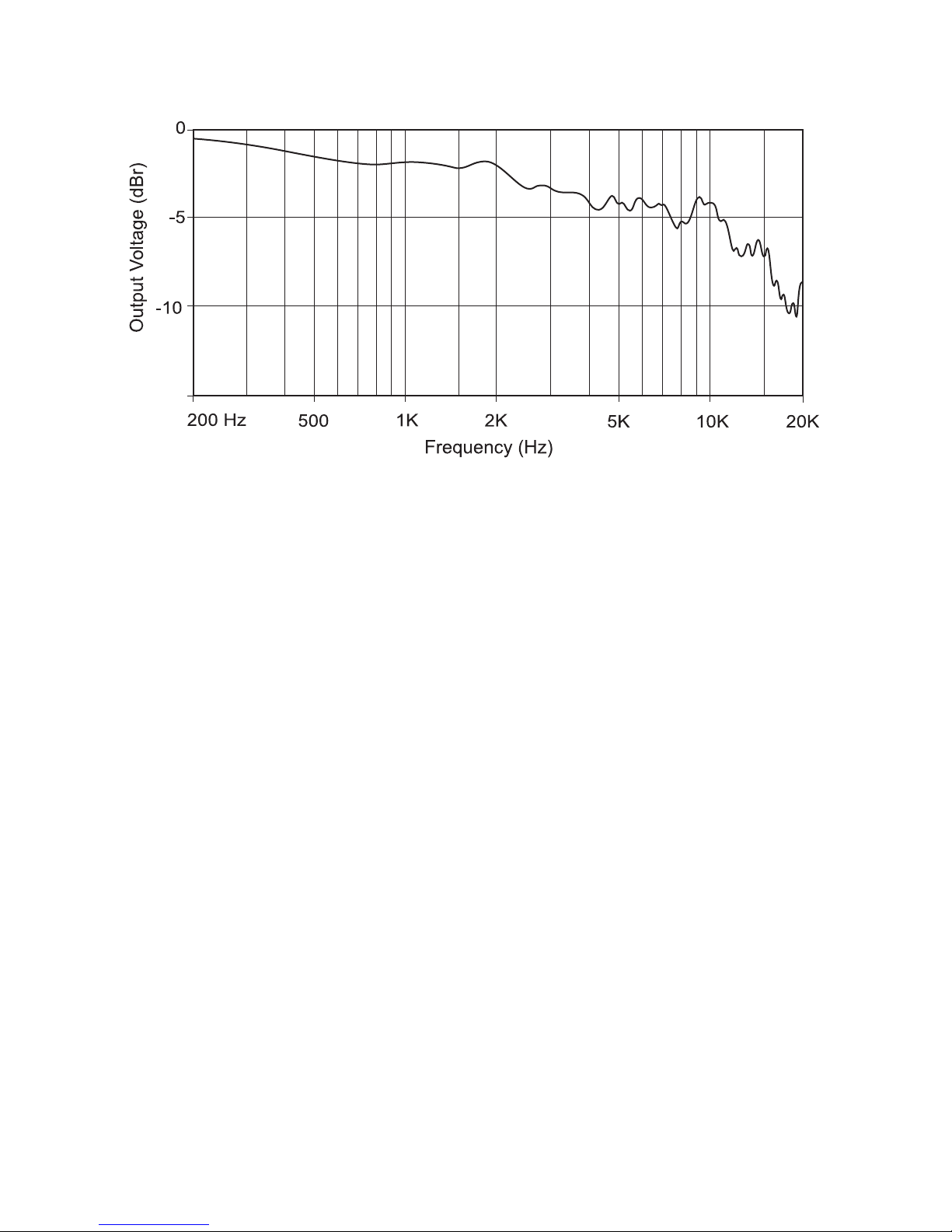
On-Axis Frequency Response (1 meter)
Specifications:
Operating Principle: Pressure Gradient
� Frequency Response: 20 Hz to 20 kHz
� Maximum SPL: 165 + dB SPL above 1 kHz for 1% third harmonic
� Output Sensitivity: -52 dBv/Pa
� Output Impedance: 270 ohms nominal
� Recommended Load: 1.2 K ohm or greater
� Powering: Not required or recommended
� Polarity: Pin 2 and 4 high
� Connector: XLR-5M connector
� Includes custom hard case with padded interior for storage and shipping and 4-meter breakout cable
to 2 XLR-3M connectors
� Operating manual for proper care and usage.
Off Axis Response:
� Polar Pattern: Native bi-directional
� Horizontal: Level changes with angle, frequency response is consistent, –35 dB null at 90 / 270
degrees
� Vertical: Level changes with angle, reduced HF response above and below 0 / 180 degree axis, null
at 90 / 270 degrees
Transducer element
� Ribbon Thickness: 1.8 microns ( .0000018 meter ) of pure aluminum
� Ribbon Width: 4.7 mm
� Ribbon Length: 59.7 mm
Page 6

Other Products by Audio Engineering Associates:
TRP - The Ribbon Pre
AEA/Fred Forsell collaboration preamp with no phantom power and 83dB of clean gain
RCA Working Reproduction Microphones and replacement parts
AEA R44C and CE Microphone - Tribute to the classic RCA 44B using NOS ribbons
AEA R44CX Microphone - 6db more output for critical digital recordings
AEA A440 Microphone - The old classic standard, but updated for the 21st century with active
electronics. A blazing hot signal makes it easier than ever to get that
“big ribbon” sound.
RCA44 and RCA77 microphones - Spare parts and prop shells
AEA Ribbon Microphones
AEA R92 Microphone - Large-ribbon optimized for guitar and other close-micing situations
AEA R84 Microphone - That big ribbon sound in a smaller more affordable package
AEA A840 Microphone - The award-winning R84 with active electronics
Modular Microphone Positioners
SMT - Stereo Microphone Template for Blumlein and ORTF spacing
SMP-17, 1M and 1.25M - Stereo bars in three lengths for the ultimate in positioning flexibility
Decca and Mini-Decca Trees - For microphone arrays including recording for multichannel
Modular Studio Microphone Stands and Booms
Flightweight Stands
Medium-Duty Vertical Stands and Booms
Heavy-Duty Stands and Booms
Crank-up Stands
Representatives for:
• Coles Ribbon Microphones - Manufacturers of the 4038 and 4104
• CB Electronics - Specialists in timecode, biphase, serial control and remote control
• Rosendahl Studiotechnik - Manufacturers of recorders, sync generators, and time code converters
• Josephson Microphones - U.S. manufacturer of quality condenser microphones
• Schoeps Microphones - German-manufactured condenser microphones
• Latch Lake - Quality studio stands
Audio Engineering Associates
1029 N. Allen Ave., Pasadena, CA 91104, USA
Phone: (626) 798-9128 Fax: (626) 798-2378
Visit us on the web at www.ribbonmics.com
 Loading...