

Page 1
OWNER’S MANUAL
Page 2

TABLE OF CONTENTS | 1
INTRODUCTION ................................................4
PLAY IT SAFE AND ENJOY! ...........................................................4
ATX TIPS FOR A SAFE, FUN DAY ON THE WATER ....................................4
OWNER’S KIT ..........................................................................4
INTENDED USE ........................................................................5
OWNER RESPONSIBILITY FOR WARRANTY PROCEDURE ..........................5
CERTIFICATIONS ......................................................................5
FEATURES AND TECHN OLOGY .......................................................5
SERIAL NUMBER LOCATIONS ........................................................7
OWNER/OPERATOR RESPONSIBILITIES .............................................7
QUALIFIED BOAT OPE R ATOR S .......................................................8
EDUCATION OPPORTUNITIES ........................................................8
FEDERAL, STATE AND LOCAL REGULATIONS .......................................8
REPORTING ACCIDENTS ..............................................................8
RENDERING ASSISTANCE ............................................................9
OUR ENVIRONMENT ..................................................................9
WARNING LABELS ..................................................................10
RESTRICTED AREAS ................................................................. 10
BOATING TERMINOLOGY ..........................................................10
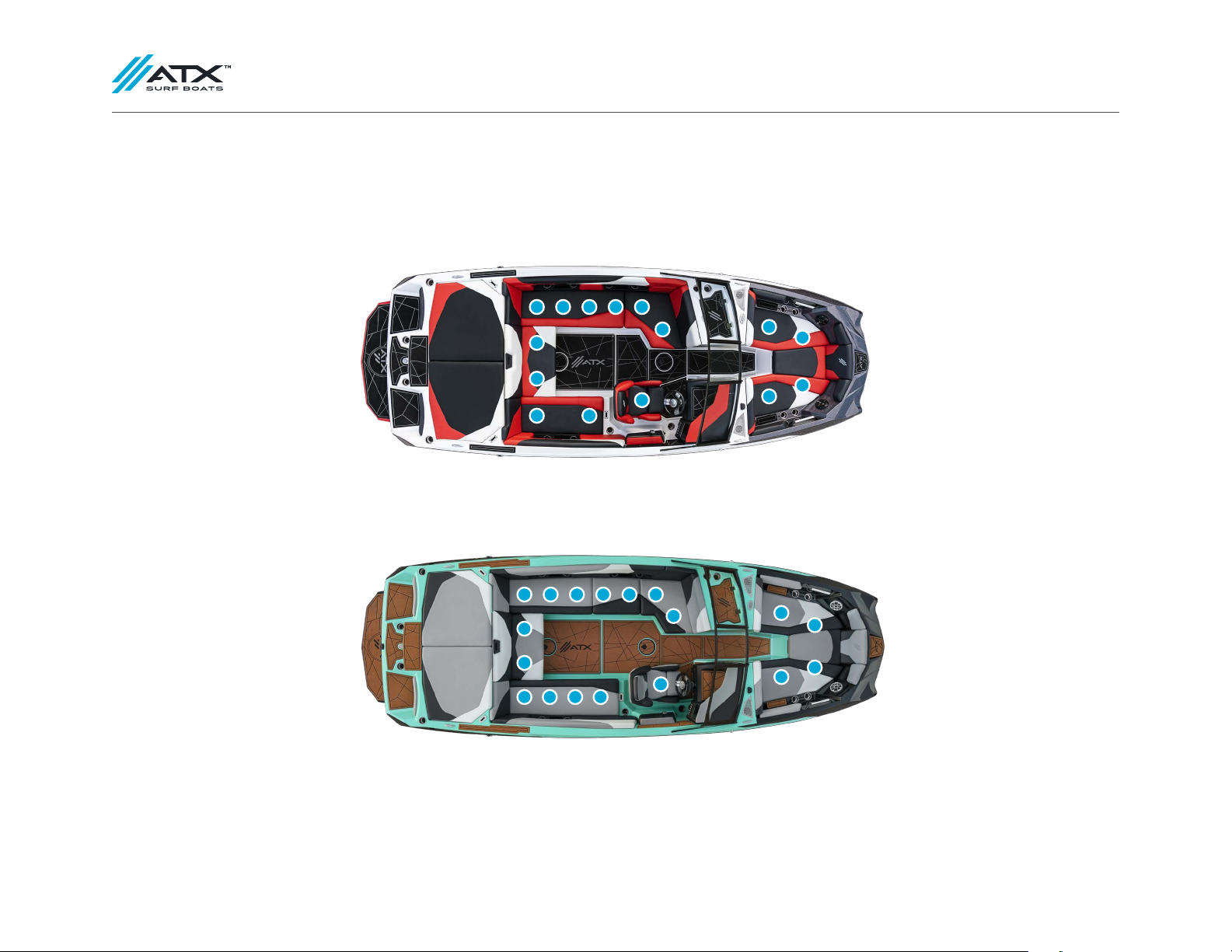
AMERICAN SEATING CHART ........................................................ 11
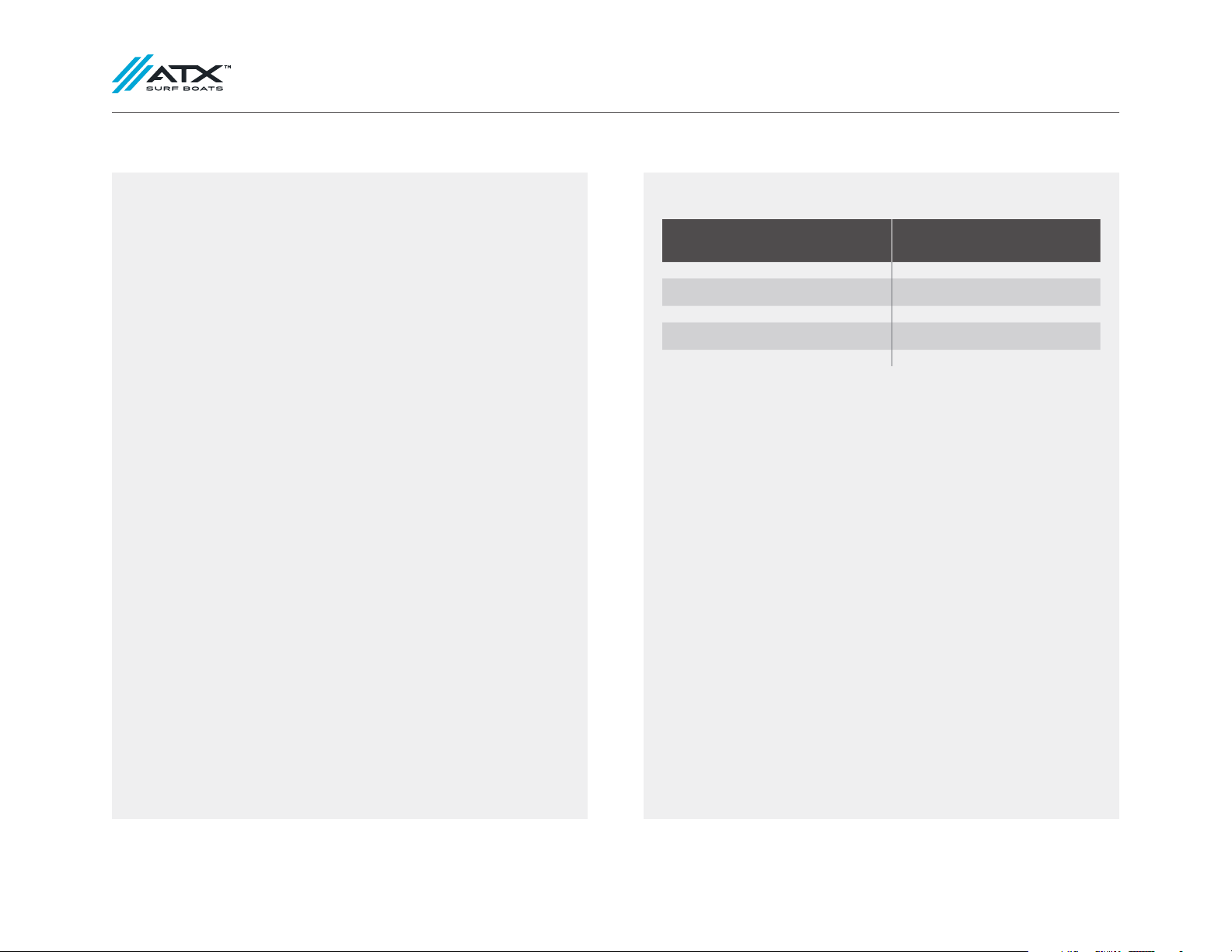
EUROPEAN SEATING CHART ........................................................12
2020 ATX SURF BOATS LIMITED WARRANTY .....................................13
BOATIN G SAFETY ............................................20
SAFETY WHILE BOATING ...........................................................20
GENERAL PRECAUTIONS ............................................................21
BOAT SAFETY LABELS ...............................................................21
SA F ETY STATEM ENT S ................................................................21
WARNINGS AND INSTRUCTIONS .................................................. 22
EMERGENCIES. . . . . . . . . . . . . . . . . . . . . . . . . . . . . . . . . . . . . . . . . . . . . . . . . . . . . . . . . . . . . . . . . . . . . . . .31
HAZARDOUS CONDITIONS ........................................................33
ENVIRONMENT .....................................................................33
WARNING MARKERS ...............................................................34
CARBON MONOXIDE ...............................................................34
WATERSPORT SAFETY. . . . . . . . . . . . . . . . . . . . . . . . . . . . . . . . . . . . . . . . . . . . . . . . . . . . . . . . . . . . . . 36
GENERAL WATERSPORT PRECAUTIONS FOR OPERATORS ...................... 37
GENERAL WATERSPORT PRECAUTIONS FOR TOWED SKIER/RIDER .............38
WATERSPORTS SAFETY CODE ..................................................... 39
RIGHT OF WAY ......................................................................42
FEATURES .....................................................45
GENERAL LAYOUTS .................................................................45
DAS H PAN ELS .......................................................................45
ATX LINE DASH ...................................................................... 45
SWITCHES, CONTROLS, PORTS, GAUGES AN D INDICATORS ..................... 46
CONTROLS ..........................................................................48
GAUGES ............................................................................. 49
FUSES ................................................................................50
COCKPIT AND EXTERIOR ...........................................................50
TOUCH SCREENS ..............................................45
ATX TOUCH SCREEN CONTROLS .................................................. 56
CARE AND MAINTENANCE .........................................................56
BASIC NAVIGATION FUNCTIONS ..................................................56
FIRST PAGE: MAIN/HOME SCREENS ............................................... 57
CRUISE CONTROL ..................................................................57
SECOND PAGE: STEREO SCREEN ................................................... 58
THIRD PAGE: GO TOUCH CONTROLS ..............................................60
FOURTH PAGE: SWITCHES SCREEN .................................................61
Page 3

TABLE OF CONTENTS | 2
OPERATION ...................................................63
PREFLIGHT CHECKLIST ............................................................. 63
FUELING .............................................................................64
SHIFTING/RUNNING ................................................................65
STEERING ............................................................................65
STOPPING ...........................................................................65
DOCKING. . . . . . . . . . . . . . . . . . . . . . . . . . . . . . . . . . . . . . . . . . . . . . . . . . . . . . . . . . . . . . . . . . . . . . . . . . . . 65
STA RTI NG ...........................................................................66
TAPS OPERATION ....................................................................67
TROUBLESHOOTING .................................................................67
SAFETY EQUIPMENT ................................................................ 68
BOAR DING ..........................................................................68
BOAT LOADING ..................................................................... 68
RUNNING ............................................................................68
MANEUVERING TECHNIQUES ......................................................69
SA LT WATE R ........................................................................ 69
WINTERIZATION ....................................................................69
TOWING PROCEDURE ..............................................................69
ANCHORING ........................................................................70
PERFORMANCE BOATING ..........................................................70
PROPELLERS .........................................................................71
BOAT SYSTEMS ...............................................73
STEERING ............................................................................ 73
ENGINE ..............................................................................73
TRANSMISSION ..................................................................... 73
STRUT AND BEARING ................................................................74
ELECTRICAL SYSTEM ................................................................74
FUEL SYSTEM .........................................................................74
BALLAST TANK SYSTEM (OPTIONAL) ...............................................74
BILGE SYSTEMS ..................................................................... 75
SHOWER SYSTEM ................................................................... 75
SCHEMATIC AND SYSTEM ILLUSTRATIONS .........................................76
CARE AND MAINTENANCE ....................................79
GENERAL MAINTENANCE ...........................................................79
INTERIOR .............................................................................79
EXTERIOR ........................................................................... 82
PROPELLER .......................................................................... 84
RUDDER ............................................................................. 84
SA LT WAT ER B OATI N G .............................................................. 84
BATTERY MAINTENANCE ...........................................................85
TRANSMISSION OIL LEVEL INSPECTION ..........................................85
STEERING ............................................................................ 86
UNSCHEDULED MAINTENANCE ....................................................86
SLINGING/LIFTING THE BOAT .......................................................87
STORAGE/WINTERIZATION .........................................................87
TROUBLESHOOTING AND SERVICE REQUIREMENTS ..........92
20-HOUR SERVICE REQUIREMENTS ............................................... 93
70-HOUR SERVICE REQUIREMENTS ...............................................93
120-HOUR SERVICE REQUIREMENTS .............................................. 94
170-HOUR SERVICE REQUIREMENTS .............................................. 94
220-HOUR SERVICE REQUIREMENTS .............................................. 95
270-HOUR SERVICE REQUIREMENTS ..............................................95
320-HOUR SERVICE REQUIREMENTS .............................................. 96
500-HOUR SERVICE REQUIREMENTS ............................................. 96
ORIGINAL OWNER INFORMATION .................................................97
SECOND OWNER INFORMATION ...................................................97
FUEL LOG ............................................................................ 98
FLOAT PLA N .........................................................................99
Page 4
INTRODUCTION
Page 5

INTRODUCTION
Congratulations on your purchase of a ATX, the world’s most versatile inboard!
We’re confident you will enjoy ATX’s extraordinary blend of world-class water
sports performance, incredible versatility and outstanding user convenience.
Before using your new ATX, we encourage you to thoroughly review this owner’s
manual and familiarize yourself with your boat’s operational and safety features.
We have made every effort to ensure the accuracy of this manual, providing the
most current information available. Since we are continuously refining features
and design, ATX periodically makes changes to models, systems and specifications. These changes are included in an updated online version of this owner’s
manual available at www.atxboats.com.
INTRODUCTION | 4
is also very important to regularly check and maintain the various systems and
equipment on your boat before you get underway.
To help you keep everything in good working order, refer to the Preflight Check-
list in Section 5 each time you go boating. Make it a habit and you’ll make the
most out of your time on the water.
OWNER’S KIT
The Owner’s Kit contains the owner’s manual and may include other information
about accessories or components offered with your ATX boat. This information is
provided by the manufacturers of those products and should be read, kept and
referred to whenever you are using the accessory or component, or before you
put it into use. Refer to these manufacturers’ manuals for additional operation
and maintenance instructions not covered in this manual.
If you have any questions concerning your new ATX or this manual, please contact your ATX dealer. Once again, thanks for choosing ATX. Have a great time!
PLAY IT SAFE AND ENJOY!
Safety is a top priority in the design and construction of every ATX boat. Before
use, we strongly encourage owners and operators to become familiar with ATX
safety features, safe operation, maintenance procedures and overall safe boat-
ing practices. In addition to ensuring your safety and that of your passengers,
proper maintenance and operation of your ATX greatly enhance your enjoyment
on the water.
ATX TIPS FOR A SAFE, FUN DAY ON THE WATER
A day on the water may be relaxing for you, but cruising through chop,
towing skiers and other normal boating activity puts significant stress on a boat.
Although your ATX is built tough to withstand the rigors of on-water activities,
you should check and tighten pylons, towers, accessories and other attachments
every time you go out to avoid injury and ensure safe reliable performance. It
Owner’s Manual
The owner’s manual contains information concerning the operation and care
of your boat. The descriptions contained within the manual will introduce you to
features of ATX and provide you the general knowledge of how the boat works.
Become familiar with the information in each section before you use your boat.
Even if everything has been planned and designed for the safety of the boat
and its users, boating is still highly dependent on the weather conditions, water
conditions, and the experience of you and your passengers. One can never
ensure full safety.
It is your responsibility as the owner or user to know the boat’s equipment,
capabilities and intended use. The specific information on the operation of the
equipment and systems on your boat should be supplied by that manufacturer.
Read, understand and keep all the information supplied, and familiarize yourself
and all users with the boat before you put it into use.
Page 6

INTRODUCTION | 5
INTENDED USE
Your ATX boat is intended for use as a pleasure and sport craft and a Craft
Design Category of:
Inshore—Category C
Craft designed to operate in winds up to Beaufort force 6 and the associated
wave heights and significant wave heights up to 6’6.7” (2 m). Such conditions may
be encountered in exposed inland waters, in estuaries, and in coastal waters in
moderate weather conditions.
OWNER RESPONSIBILITY FOR WARRANTY PROCEDURE
Before Operating
Before operating your new ATX boat, it is necessary that you read and understand this manual and the warranty, and that you take the time to read about
other accessories or components offered with your ATX boat.
Warranty Service Requirements
All ATX warranty service must be completed by an ATX Dealer. If you are not
able to return your boat to your dealership, contact them so they can assist you
in coordinating the warranty service. Any claims against ATX Surf Boats without
prior approval from ATX Surf Boats on repairs completed by an unauthorized
dealership may be denied.
If You Sell Your ATX Boat
Warranties are transferable. If you choose to sell your ATX boat to anyone other
than a ATX Dealer, contact ATX Surf Boats for the appropriate warranty transfer
information: www.atxboats.com or 325.676.7777. If the transfer procedures are
not followed, future warranty service may be denied.
CERTIFICATIONS
National Marine Manufacturers Association (NMMA)
ATX Surf Boats is a member of the NMMA. This independent organization’s
members include boat, engine and marine equipment manufacturers that are
focused on the improvement and safety of boating.
Your new ATX boat is NMMA certified. An NMMA certification not only satisfies
the U.S. Coast Guard (USCG) regulations but also the more rigorous equipment
and system standards based on those established by the American Boat
and Yacht Council, Inc. (ABYC). Your ATX boat meets or exceeds NMMA
safety-based certifications.
Engines
Our engine manufacturer works closely with ATX to ensure that its engines
deliver maximum performance, reliability and customer satisfaction. Part of this
commitment is a certification program that provides ATX dealers and service
technicians with ongoing training and information about our engines. Certified
engine service personnel must attend periodic service schools held at the ATX
headquarters. The training includes review of all manufacturing and installa-
tion processes, proper servicing procedures as well as existing and developing
engine technologies.
FEATURES AND TECHNOLOGY
Convex V Hull/TAPS
The unique, patented shape of the ATX Convex V hull combined with TAPS
technology are key ATX’s superior multi-sport versatility, incredible perfor-
mance and unmatched ride. All other inboard hulls curve down with a “hook”
toward the transom and must rely on heavy ballast or drag hardware to
produce even entry-level wakeboarding wakes. The Convex V hull curves up in
Page 7

INTRODUCTION | 6
a rocker shape like a wakeboard or slalom ski. ATX uses its breakthrough TAPS
technology to control hull running attitude and wake characteristics. At wake-
boarding speed with TAPS in the up position, the bow rises and the Convex V hull
settles naturally, creating tremendous water displacement and huge worldclass wakes without ballast or drag hardware. A push of a button adjusts TAPS
down, lowers the bow and creates instant planning and slalom type wakes.
Ride, handling and fuel efficiency are also dramatically enhanced, allowing ATX
to deliver outstanding overall performance unmatched by any other inboard.
ZeroO GPS Cruise Control
Standard on all ATX models, ZeroOff GPS Cruise Control is the most advanced
precision digital speed control in the marine industry. It is also the easiest to use.
The ZeroOff GPS Cruise Control control panel incorporates Touchpad and Touch
Screen Recognition for easy fingertip use without taking your eyes off the waterway. ZeroOff GPS Cruise Control readouts are displayed on the heads-up digital
monitor located on the dash, as well as our Touch Screen. For added safety, the
ZeroOff GPS Cruise Control control panel is conveniently located adjacent to
the throttle for quick, easy access with your throttle hand. ZeroOff GPS Cruise
Control operation is precise, multi-functional and simple. You can even preset a
preferred speed and precisely hit that speed set after set. Perfect double-ups
and consistent towing speeds are now at your fingertips.
Advanced CAN Bus Technology
ATXperience Control Center components are in constant communication with
the engine’s computerized ECM using advanced MEFI-5 electronics. State-of-theart CAN bus technology allows components to communicate hundreds of times
a second over a simple, reliable, two-wire system. Keeping the juice flowing
and the electronics humming is our Central Electronic Distribution Center (CEDC),
which increases electrical system reliability and efficiency through circuit simplification and load management. CEDC also stabilizes electrical output throughout
the boat, significantly reducing power spikes.
Product Improvement
Because of ATX’s commitment to continuous product improvement, the illustrations used in this manual may not exactly match your boat and are intended
only as representation for reference views. Some illustrations may also show
optional accessories, which may or may not be available for your boat. Some
optional accessories can only be installed at the time the boat is manufactured
and cannot be installed by your dealer. Your dealer can help with any questions
you may have on options, which can be added to your boat.
Page 8
INTRODUCTION | 7
SERIAL NUMBER LOCATIONS
Your ATX boat, its engine, propulsion unit and other equipment onboard are
identified with a serial number. These identification numbers associated with your
boat are extremely important. Prepare a list of all serial number items and store
it in a safe place other than onboard the boat. Refer to the equipment operator’s
manuals supplied in your owner’s kit for location of serial numbers.
Record these numbers below.
Hull Identification Number (HIN)
Located at the top, right (starboard) corner of the transom.
HIN:
Ignition Key, a key tag, is also provided with the keys; store tag or destroy.
Key Number:
Registration Number/State:
Date of Purchase:
Dealership Name and Address:
Phone:
Salesperson:
Engine
Engine Serial Number:
Engine Manufacturer:
Model:
Horsepower:
Transmission
Transmission Serial Number:
Model:
Trailer
Serial Number:
Manufacturer:
OWNER/OPERATOR RESPONSIBILITIES
At the time of delivery, the owner/operator is responsible for:
• Understanding warranty terms and conditions of both the engine and boat.
• Obtaining insurance.
• Examining boat to ensure proper operation of all systems.
Before operating the boat, the owner/operator is responsible for:
• Obtaining state registration of the boat.
• Providing the proper USCG-required safety equipment.
• Following proper break-in procedure for the engine.
• Understanding safety information and proper operating procedures within
this manual.
While operating the boat, the owner/operator is responsible for:
• Knowing that all safety equipment and personal flotation devices (PFDs)
are in good condition and suitable for your boat and passenger load.
• Having at least one other passenger who is capable of handling the boat
in an emergency.
• Following safe operating practices and the “Rules of the Road.”
• Understanding proper maintenance and knowledge of the boat’s
operating systems.
• Providing safety training for the passengers.
• Avoiding use of alcohol and other drugs.
• Providing assistance to other boaters.
Insurance
You must get insurance before operating your new boat. Insurance for loss
by fire, theft or other causes, or liability protection against accidents is a must
for responsible boaters. The boat owner is legally responsible for any damage or
injury caused when he, or someone else operating the boat, is involved in an
accident. Many states have laws detailing minimum insurance needs. Your insurance agent or dealer may be able to supply you with more information.
Page 9

INTRODUCTION | 8
Registration/Documentation
The USCG requires that all power boats operated on the navigable waters of the
U.S. be registered in the state of main use; also, many states require registration in
that state whenever boating on waters within their state boundary. Contact your
state boating authorities (and neighboring states) for registration information on
boats and trailers.
Your dealer can supply you with the appropriate forms.
QUALIFIED BOAT OPERATORS
This manual is not intended to provide complete training on all aspects of boat
operation. We strongly recommend that all operators of this boat seek additional training on boat handling and safety. Have all operators become familiar
with the handling characteristics and proper steering and control system usage
before attempting high-speed operation.
Some states require youths 16 years of age and younger to complete a boating
safety course before operating any watercraft. Many others require operators
under the age of 18 to be licensed in small boat operation.
EDUCATION OPPORTUNITIES
Be boat smart from the start, take a boating safety course and get a free vessel
safety check annually for your boat. For more information, contact:
• United States Coast Guard Auxiliary, www.cgaux.org;
• United States Power Squadrons, 888-FOR-USPS, www.usps.org.
Most boaters can enhance their enjoyment of boating experiences through increased knowledge of safe operation, navigation and regulation of pleasure boats.
The following is a list of some other agencies and organizations that offer Water
Safety, First Aid and CPR courses or information. To find boating safety courses
in your area, call your state’s local boating agency or the USCG boating safety
course line at 800-336-2628 (800-245-2628 in Virginia).
• American Red Cross
• State Boating Offices
• Canadian Power and Sail Squadrons
• Boat Owners Association of the United States
• National Safe Boating Council
• American Water Ski Association (AWSA)
FEDERAL, STATE AND LOCAL REGULATIONS
The U.S. Coast Guard (USCG) is the authority of the waterways; they are there
to help the boating public. State local authorities enforce boating regulations. You
are subject to marine traffic laws and “Rules of the Road” for both federal and
state waterways. You must stop if signaled to do so by enforcement officers, and
permit to be boarded as asked.
REPORTING ACCIDENTS
The USCG requires the owner or operator of a boat involved in an accident to
report the incident to the proper marine law enforcement agency for the state
in which the accident occurred.
Immediate notification to the nearest State boating authority is required if a person dies or disappears as a result of a recreational boating accident. If a person
dies or sustains injuries requiring more than first aid, a formal report must be filed
within 48 hours of the accident. A formal report must be filed within 10 days for
accidents exceeding $500 in property damage or complete loss of boat.
Page 10

INTRODUCTION | 9
RENDERING ASSISTANCE
If you see a distress signal or suspect a boat is in trouble, you must assume it is
a real emergency and render assistance immediately. By law, the operator in
charge of the craft is obligated to provide assistance to any individual in danger if such assistance can be provided safely. Failure to render assistance can
result in a fine and/or imprisonment.
The 1971 Boating Safety Act grants protection to a “Good Samaritan” boater
providing good faith assistance, and absolves a boater from any civil liability aris-
ing from such assistance.
OUR ENVIRONMENT
As a boater, you already have an appreciation for nature’s beauty and the
peace of the great outdoors. It is a boater’s responsibility to protect the natural
environment by keeping waterways clean.
Foreign Species
If you trailer your boat from lake to lake, you may unknowingly introduce a foreign aquatic species from one lake to the next. Thoroughly clean the boat and
trailer below the water line, remove all weeds and algae, and drain the bilge
and ballast tanks, if equipped, before launching the boat in a new body of water.
WARNING
Leaking Fuel is a fire and explosion hazard. Inspect system regularly.
Examine fuel System for Leaks or Corrosion at least annually.
The spilling of fuel or oil into our waterways contaminates the environment and is
dangerous to wildlife. DO NOT discharge or dispose of fuel, oil or other chemicals
into the water; it is prohibited and you can be fined.
DO NOT overfill the fuel tank, pump contaminated bilge water or discard soiled
rags into the water.
Discharge/Disposal of Waste
Waste means all forms of garbage, plastics, recyclables, food, wood, detergents,
sewage and even fish parts in certain waters, essentially anything. Bring back
everything you take out and dispose of in an environmentally friendly manner
ashore.
Excessive Noise
Noise means engine noise, radio noise or even voices. Many bodies of water
have adopted noise limits. Music and loud conversation can carry a considerable distance on water, especially at night. Make sure to follow regulations and
be courteous.
Wake/Wash
Be alert for NO WAKE zones. Prior to entering a NO WAKE zone, come off plane
to the slowest steerable speed. Use caution when operating around smaller
crafts, in channels and marinas, and in congested areas.
Exhaust Emissions
Increased exhaust (hydrocarbon) emissions pollute our water and air. Keep your
engine tuned and boat hull clean for peak performance.
Paints
If your boat is kept in water where marine growth is a problem, the use of
anti-fouling paint may reduce the growth rate. Be aware of environmental
regulations that may govern your paint choice. Contact your local boating
authorities for information.
Cleaning Agents
Household cleaners should be used sparingly and not discharged into waterways.
DO NOT mix cleaners and be sure to use plenty of ventilation in enclosed areas.
Page 11
INTRODUCTION | 10
DO NOT use products which contain phosphates, chlorine, solvents,
or non-biodegradable or petroleum-based products.
MARPOL Treaty
The USCG enforces the International Convention for the Prevention of Pollution
from ships, commonly referred to as the MARPOL Treaty (Marine Pollution). This
treaty prohibits the overboard dumping of all ship-generated plastics, chemicals,
garbage and oil.
WARNING LABELS
The warning labels on your ATX boat must remain legible. If a label
is damaged or you suspect a label is missing, contact your ATX Dealer
for immediate replacement.
There are several labels placed throughout the boat to warn you about
potential hazards.
All persons should wear a suitable life preserver/personal flotation device
when on deck, especially children, disabled people and non-swimmers. Inform
all passengers on the proper use of personal flotation devices and of the location of safety equipment, man overboard recovery equipment and the location
and deployment
of the ladder.
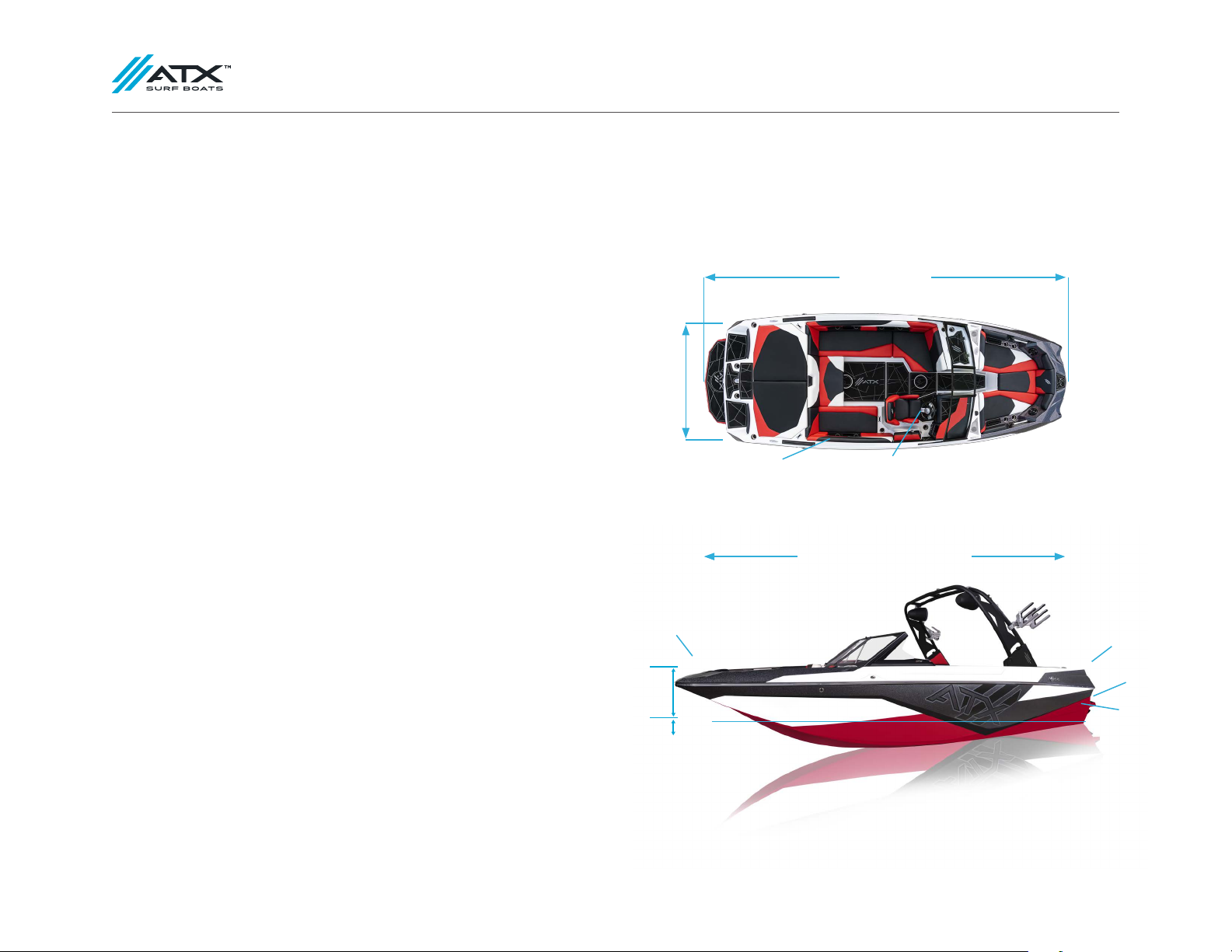
BOATING TERMINOLOGY
An easy way to remember PORT side from STARBOARD side is “PORT” and “LEFT”
both have four letters.
LENGTH OVERALL
PORT S IDE
BEAM
STARBOARD SIDE
AFTFORWARD
STERN
BOW
GU NWALE
HELM
In some countries it is a legal requirement to wear a suitable life preserver/personal flotation device that complies with those countries’ regulations at all times.
RESTRICTED AREAS
Before boating, check with local, state and federal authorities to identify restricted areas. Because of the threat of terrorism, the U.S. Coast Guard has implemented and will continue to enforce strict limits on watercraft near U.S. Navy
and Coast Guard ships and other potential targets.
FREE
BOARD
DRAFT
TRANSOM
WATERLINE
Page 12

AMERICAN SEATING CHART
INTRODUCTION | 11
22 Ty p e -S
24 Type - S
Page 13
EUROPEAN SEATING CHART
INTRODUCTION | 12
22 Ty p e -S
24 Type - S
Page 14
INTRODUCTION | 13
2020 ATX SURF BOATS LIMITED WARRANTY
ATX Surf Boats provides limited warranty coverage on its products sold
for use by retail (non-commercial) customers as described in this Limited
Warranty. Your dealer must submit the warranty registration of your boat
to ATX Surf Boats for your Limited Warranty to be recognized. Limited
Warranty coverage begins when you take delivery of your boat (or upon
the initial use of the boat), and applies to defects in factory materials and
workmanship which first arise and are reported to ATX Surf Boats within
the applicable warranty period. This warranty gives you specific legal
rights, and you may also have other rights which vary from state to state.
This Limited Warranty extends to the first retail customer, but can be
transferred to a second owner following ATX Surf Boats warranty transfer
procedures (see ATX Surf Boats Transferability document). ATX Surf Boats
construction is warranted the original retail purchaser (and remains in
effect so long as the original purchaser owns the boat). Engines, transmissions/powertrain and trailers are warranted by the component manufacturers, and you should refer to the warranties of those component
manufacturers for details regarding warranty coverage.
This Limited Warranty is the sole and exclusive warranty provided by ATX
Surf Boats, and ALL IMPLIED WARRANTIES AND CONDITIONS, INCLUD-
ING ANY IMPLIED WARRANTY OF MERCHANTABILITY OR FITNESS FOR A
PARTICULAR PURPOSE, ARE EXCLUDED AND DISCLAIMED (OR LIMITED)
TO THE FULLEST EXTENT ALLOWED BY APPLICABLE LAW. To the extent
that any implied warranties are required by applicable law, any implied
warranties are limited to the duration of the applicable provisions of this
Limited Warranty. Some states do not allow limitations on how long an
implied warranty lasts, so the above limitation may not apply to you.
Limited Warranty Summary
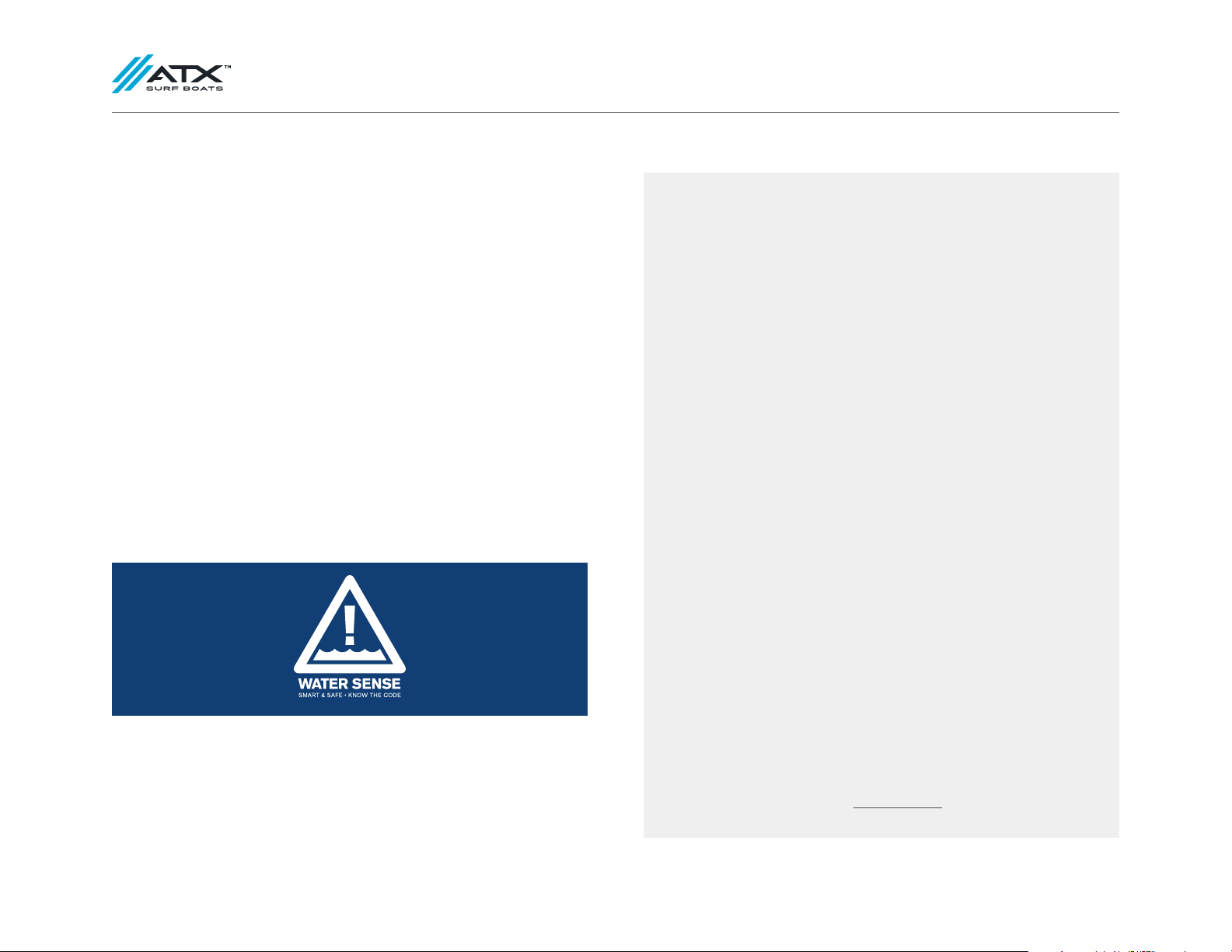
COVER AGE TY PE
Structural Limited Warranty Lifetime
Base Limited Warranty—Fresh Water Boats
Base Limited Warranty—Salt Water Boat s Thirty six (36) months
Gel Coat, Powder Coat and Other F inish es
Limited Warranty
Upholstery Limited Warranty Thirty-six (36) months
initial use of the boat, whichever fir st occurs)
The repair and/or replacement of components or parts under warranty
does not extend the warranty period beyond the original expiration date.
COVER AGE PERIO D
(from date of origina l retail purc hase or
Sixty (60) m onths or 500 hou rs,
whichever first occurs
Twelve (12) months
Structural Limited Warranty
For the life of the boat, ATX Surf Boats will repair structural materials or
structural workmanship supplied by it during the construction of the hull,
deck, floor liner, or stringer, which are determined by ATX Surf Boats
to contain substantial manufacturing defects. This Structural Limited
Warranty does not apply to the ATX Surf Boats’ gel coat or powder
coat (see below for Gel Coat & Powder Coat Limited Warranty), or any
cosmetic aspects of the hull, deck, liner, or stringer. The entirety of the
structural warranty is limited to the specific laminates or bonding of
laminates for the hull, deck, floor liner, or stringer only.
Base Limited Warranty
During the applicable Base Limited Warranty period ATX Surf Boats
will repair or replace materials or workmanship supplied by it during
construction of the ATX Surf Boat, including parts and labor, which are
determined by ATX Surf Boats to contain substantial manufacturing
defects. Salt water boats must be purchased with the Saltwater Package.
Page 15

INTRODUCTION | 14
If your Boat is operated in salt or brackish water, special precaution,
such as cleaning and flushing the boat after each use, both internally
and externally, are required. Failures or altered finishes due to salt water
exposure or corrosion are not covered by the ATX Surf Boats Limited
Warranty.
Towers are configured by ATX Surf Boats for factory-installed
components. The installation of any components onto the tower of
any ATX Surf Boat after it leaves ATX Surf Boats’ factory (“Non-Factory
Tower Components”) may require adjustments to the tower. Further,
certain Non-Factory Tower Components may not be suitable to be
installed on any ATX Surf Boat’s tower. If ATX Surf Boats determines that
any Non-Factory Tower Components have caused or contributed to the
need for any repairs to the tower of an ATX Surf Boat, or to any other
aspect of an ATX Surf Boat, ATX Surf Boats, in its sole discretion, may
deny coverage for such repairs. It is the sole and exclusive obligation
of the Purchaser to verify and ensure that all Non-Factory Tower
Components are suitable to be installed on any ATX Surf Boat’s tower,
and that all Non-Factory Tower Components are properly installed on
any ATX Surf Boat’s tower.
This Limited Warranty does not provide coverage for any component part
that is at any time covered by any warranty provided by any third party,
other than ATX Surf Boats, including, but not limited to the manufacturer
of the component part. Component parts shall include, but are not
necessarily limited to, any items that are fastened to the boat through
either mechanical means (screws/bolts) or chemical means (adhesives),
which may or not be manufactured by ATX Surf Boats. Some examples
of component parts include displays, carpet, floor panels, upholstery
substrates and bases, etc. In the event that any warranty coverage for
any component part is rendered or deemed void due to actions of
the Purchaser or any third party other than ATX Surf Boats, this Limited
Warranty will not provide warranty coverage for the component part.
Gel Coat, Powder Coat and Other Finishes Limited Warranty
Note: Minor distortions or imperfections resulting from the handcrafted application of the gel coat on an ATX Surf Boat are considered normal and
unavoidable. Gel coat, powder coat and other finishes maintenance is the
Purchaser’s responsibility. Conditioned on the Purchaser having provided
and performed all gel coat, powder coat and other finishes maintenance
and care described in this Owner’s Manual, for a period of twelve (12)
months, beginning on the date of the original retail purchase or the initial
use of the ATX Surf Boat, whichever occurs first, ATX Surf Boats will repair
materials, or workmanship supplied by it, in applying the gel coat and/or
powder coat finish to the boat, or other finishes to the boat, which are determined by ATX Surf Boats to contain substantial manufacturing defects.
This Gel Coat, Powder Coat and Other Finishes Warranty shall not include
or provide coverage for gel coat finish, blistering, discoloration, scratching,
cracks caused by negligence, impact or collision, stress crazing, fading
or osmosis, or damage caused by in-water storage, scratches and other
damage caused by trailering, including normal usage. Failures or finishes
due to salt water exposure or corrosion are not covered by the ATX Surf
Boats Limited Warranty.
Limited Warranty Exclusions and Limitations
In addition to any prior limitations and exclusions, the following are NOT
covered under this Limited Warranty:
• Normal maintenance of the ATX Surf Boat
or any component thereof;
• Normal wear-and-tear of the ATX Surf Boat,
or any component thereof;
Page 16

INTRODUCTION | 15
• Damages or needed adjustments caused by items that are added,
altered or changed after the ATX Surf Boat, leaves the possession of
ATX Surf Boats, including but not limited to installation of aftermarket
towers, tower accessories, ballast systems, barefoot booms, canvas
accessories, and hull bottom painting;
• Modification, alteration, unauthorized repair or replacement of
components, including but not limited to damages resulting from such
installations, on the ATX Surf Boat; any upholstery cracking, mold or
mildew, stains, fading or tears.
• Damages caused by accident (including impacts and collisions
with any object), abuse, misuse, neglect, negligence, mishandling
or alteration, including any damages caused by or during
trailering or towing;
• Damages caused by heat, fire, explosion or freezing (including the
failure to perform proper winterization or preparations for storage or
lack of use for periods in excess of thirty [30] days);
• Damages caused by atmospheric fallout, chemical treatments, tree
sap, salt, ocean spray, mold, or animal droppings, lightning, hail,
rain, flooding, wind, sand, floods or other environmental or natural
conditions or Acts of God; staining, blistering, or discoloration resulting
from failure to coat the hull with marine-grade hull paint on boats
that are allowed to remain in bodies of water for extended periods
(more than 14 days);
• Damages caused by vandalism or theft; corrosion or damage,
including oxidation, electrolysis including that which occurs to
chrome plated, stainless, anodized or aluminum finish or the
colorfastness of finish.
• Failure to follow the instructions within the Owner’s Manual regarding
corrosion prevention and operation in salt or brackish water may
result in or contribute to these types of damage and are not covered
under the Limited Warranty;
• Damages caused by aftermarket cleaning products or additives not
specifically approved by ATX Surf Boats;
• Damages due to insufficient or improper maintenance, lack of
maintenance, or delay of repair (unless specifically and directly
authorized by ATX Surf Boats warranty department in writing);
• Damage or contamination resulting from leaking or spilled fluids
including, but not limited to, fuel or drive train fluids;
• Conditions resulting from use of the boat for anything other than
recreational purposes
• Manufacturing variations or imperfections in cosmetic, convenience
or aesthetic components or features of the boat, including the gel
coat finish, which have no effect on use or safety;
• Damages caused by the use of any trailer purchased through any
entity other than ATX Surf Boats;
• Damages caused by improper support of the boat on davits, hoist
system or boat lift of any kind;
• Damages caused by improper weight distribution or excessive
weight combinations of persons aboard, ballast or simulated ballast
and gear;
• Any material, component or part of the boat that has a warranty
period and/or conditions as specified by the producing entity
which differs from this Limited Warranty unless such warranties are
administered directly by the producing entity;
• Damages caused by water intrusion into any part of the boat
(including, but not limited to, the glove box and various storage
compartments);
• Performance characteristics, such as speed, acceleration, fuel or oil
consumption, etc., as they are estimated and can vary as dictated
by individual conditions; any and all incidental and consequential
damages including, but not limited to, costs incurred for haul-out,
launching, towing, storage charges, telephone, expedited shipping of
replacement parts, or rental charges of any type (including slip fees),
inconveniences, or loss of time or income. Some states do not allow
the exclusion, so this limitation may not apply to you.
Page 17

INTRODUCTION | 16
• Components, such as surf system, trim plates not installed at the
time of manufacture. Post-manufacture installation of any of these
items, as well as any other component not installed at the time of
manufacture, will void the warranty and other components of the
boat that have their own warranty(ies) due to potential damage to
the boat and possible danger to occupants;
• Damage or injury resulting from failure to comply with recall notices,
service bulletins and advisories, or requests from ATX Surf Boats to
repair the boat or its components;
• Damage or injury resulting from speeding, demonstration or any type
of racing;
• Damages resulting from the failure to properly maintain and care
for the boat and its components in accordance with the instructions
found within the Owner’s Manual;
• Shop supplies used in correction work, such as, but not limited to,
sealants, lubricants, cleaning supplies;
• Damage resulting from water intrusion in the intake or
exhaust system;
• Damage resulting from the use of lubricants, gasoline, or other
fluids other than those specified in the Owner’s Manual or by
subsequent approval by ATX Surf Boats following publication
of the Owner’s Manual;
• Damage resulting from erroneous service by the customer or technician
not authorized by ATX Surf Boats to perform service or corrections;
• Damage that cannot be traced to material defects in materials or
workmanship, as determined by ATX Surf Boats;
• Damages resulting from the use of any non-ATX Surf Boats supplied
boat cover (The sole and exclusive approved color for boat covers
offered by ATX Surf Boats is black.); the use, even temporarily, of a
trailer that was not purchased with the ATX Surf Boat will void the
Gel Coat Limited Warranty.
Commercial Use Exclusions/Restrictions
The use of any ATX Surf Boat for commercial purposes, including but not
limited to as a demonstrator, or in connection with any promotional program, ski, wakeboard, or surf school or show (“Commercial Purposes”) will
void the ATX Surf Boats Limited Warranty.
Warranty Voiding Events
The following events will automatically void and discharge ATX Surf Boats
from its obligations under this Limited Warranty and discharge ATX Surf
Boats from any obligations herein:
• Using the boat for commercial purposes as stated above
• Using the boat in salt water without the salt water option package
the unauthorized disabling of any warning device or system installed
in any ATX Surf Boat;
• The unauthorized disconnection, disturbance or compromise of any
wires, hoses, tubes, cables, looms or other components of the ATX
Surf Boat’s electrical or fuel systems;
• The use of the ATX Surf Boat in any criminal enterprise or to perform
any criminal acts; and
• The determination by any state or federal entity or private insurance
carrier that the ATX Surf Boat is a total loss or fit only for salvage.
Other Matters Related to the Limited Warranty
In addition to the Limited Warranty terms and exclusions noted above,
the following are additional important considerations regarding the
Limited Warranty:
Page 18

INTRODUCTION | 17
Pre-Delivery
Defects and/or damage to the finish surfaces, trim, upholstery or other
observable cosmetic components of your ATX Surf Boat may occur during
production. These items are usually detected and corrected prior to shipment to the dealership or by the retail dealer prior to delivery to the retail
customer. Nonetheless, consumers are encouraged to inspect the ATX Surf
Boat for this type of damage prior to taking delivery, and all such defects
or damage must be reported to the retail ATX Surf Boat dealer at the time
of delivery to have any items covered by this Limited Warranty addressed,
and to have any covered defects repaired at no cost to the Purchaser.
Boat Operation, Care and Maintenance
To ensure the maximum benefit from ownership of this boat, ATX Surf
Boats requires that you follow all of the instructions in the Owner’s Manual, including all accompanying maintenance or service schedules and
support material. Because questions may sometimes arise relating to the
cause of a particular failure, ATX Surf Boats strongly recommends keeping
detailed records of any and all maintenance or service performed on the
boat, drive train and/or trailer to assist, if necessary, in the determination
of whether a failure is covered under this Limited Warranty. Damages to
an ATX Surf Boat caused by improper operation, care and maintenance
are not covered by this Limited Warranty.
Other Warranties
Some manufacturers of component parts included in an ATX Surf Boat,
may provide limited warranties. Please refer to component part manufacturer’s limited warranty disclosures, if any, for details, including their
terms, conditions and limitations, of which ATX Surf Boats makes no
representations or warranties. Among other warranties, note that certain
items including, but not limited to, biminis and boat covers are among
those components covered by individual, separate warranties, which are
explained and set forth in materials supplied by the component part manufacturer. Any and all claims or defects should be submitted directly to the
manufacturers of those particular component parts.
No Other Warranties
No oral or written information, advice or communication of any nature
by or from ATX Surf Boats or its representatives, employees, dealers,
agents, distributors or suppliers shall create a warranty or in any manner
increase or modify the scope of this Limited Warranty. The repair and/or
replacement of components or parts under warranty does not extend the
warranty period beyond the original expiration date.
Design and/or Manufacturing Changes
ATX Surf Boats reserves the right to implement changes
in the construction or components of any ATX Surf Boat at any time, without incurring any obligation to make the same or similar changes on ATX
Surf Boats previously built and/or sold.
Page 19

Transfer of Warranty
Upon the first sale of an ATX Surf Boat that has not been utilized for any
Commercial Purpose by the original, non-commercial, retail purchaser,
within the first sixty (60) months, beginning on the date of the original retail
purchase or the initial use of the ATX Surf Boat whichever occurs first, any
unexpired Limited Warranty coverage can be transferred to a second,
non-commercial, owner and remain in effect for the unexpired period
(except Gel Coat & Powder Coat or other finishes Limited Warranty, which
is twelve (12) months), and the Structural Warranty, which becomes ten
(10) years. The Limited Warranty on all other components is as previously
identified with this Limited Warranty Statement. This provision is pursuant
to the requirements set forth in the Warranty Transfer information. Only
one transfer of the Limited Warranty within the applicable time period(s)
established will be honored. All coverage under the Limited Warranty Statement will become null and void in totality with any subsequent
conveyance of ownership of the ATX Surf Boat or transfer of the ATX Surf
Boat’s title to any third party.
INTRODUCTION | 18
Contact your local ATX dealer for warranty claims or contact:
ATX Boats, Inc.
1801 Hwy 36
Abilene, TX 79602
Phone: 325.676.7777
[email protected]
Page 20

BOATING SAFETY
Page 21
BOATING SAFETY | 20
BOATING SAFETY
SAFETY WHILE BOATING
Boating-related accidents are generally caused by the operator’s failure to
follow basic safety rules or written precautions. Most accidents can be avoided if
the operator is completely familiar with the boat, its operation and can recognize potentially hazardous situations.
In addition to everyday safety, failure to observe the safety recommendations
may result in severe personal injury or death to you or to others. Use caution and
common sense when operating your boat. Don’t take unnecessary chances!
Drivers must be cognizant of their surroundings, other boats, their wake and
other environmental factors including safe turning speeds, people and obstacles
in the water, etc. Driver and boat owner assume all risks for themselves, their
guests and anyone in proximity to their boat as well as ensuring that all passengers understand risks and responsibilities.
Develop Watersense
WSIA Responsibility Code
Be aware that there are risks in boating and watersports
that good judgment and personal awareness can help reduce.
TO INCREASE YOUR ENJOYMENT OF WATERSPORTS, FOLLOW
THE TEN ELEMENTS OF THE CODE.
IT IS YOUR RESPONSIBILITY TO:
• A LWAY S familiarize yourself with applicable laws, waterways
and inherent risks
• A LWAY S have a capable observer in addition to driver
and agree on hand signals
• A LWAY S wear a USCG type III, ISO or other agency approved
(PFD) life jacket
• A LWAY S read user’s manual and inspect equipment before use
• A LWAY S ski or ride under control, at proper speeds
and within your limits
• A LWAY S turn ignition off when anyone is near watercraft
power drive unit
• A LWAYS stay clear of engine exhaust to avoid
Carbon Monoxide poisoning
• NEVER “Platform Drag” or touch swim platform while
the engine is running
What is water sense? Water Sense is developed by familiarizing yourself with the
boat, driving, water, equipment, and maintaining vigilance.
Familiarize yourself and follow The Watersport Responsibility Code.
• NEVER ski or ride near swimmers, shallow water, other boats,
or obstacles
• NEVER operate watercraft, ski or ride under the influence
of alcohol or drugs
—Water Sports Industry Association
For more resources please visit www.WSIA.net
Page 22
BOATING SAFETY | 21
GENERAL PRECAUTIONS
Your ATX boat has been constructed to meet all U.S. Coast Guard (USCG) and
National Marine Manufacturers Association (NMMA) requirements applicable
at the time of manufacture. However, it is still your responsibility as the boat
owner to ensure the boat is always operated in a safe fashion.
USCG regulations require certain safety equipment be present on your boat
during operation. Besides the USCG regulations, other local and/or international law enforcement agencies may have similar requirements. You should
check with your local marine enforcement agency regarding any such
requirements before using the waterways.
It is not intended for this manual to be a replacement for a course on boating safety. It is highly recommended that if you are unfamiliar with the use and operation
of a boat, you seek advice and training from a qualified individual or organization. Check with your local boating agency or dealer for more information about
boating safety classes in your area.
Your safety, the safety of your passengers, and other boaters are among your
responsibilities as operator or owner of this boat. Your boat must be in compliance
with (USCG), state, and country safety equipment regulations.
You should know how to react correctly to adverse weather conditions, have good
navigation skills, and follow the “Rules of the Road” as defined by the USCG and
state/county/local regulations.
Before each outing you should check all safety equipment, such as fire ex-
tinguishers, life jackets (PFDs), flares, distress flags, flashlights, and emergen-
cy cutoff switch. They should be operable, in good condition, readily visible, and
easily accessed.
BOAT SAFETY LABELS
Your ATX boat is affixed with various safety labels at the time of manufac-
ture. These labels appear at specific locations on the boat where safety is of
particular concern. Safety labels must be legible. If you suspect a label is missing
or one becomes damaged, contact your dealer for immediate replacement.
READ AND ADHERE TO ALL WARNING PLATES AND LABELS from bow to stern,
including those that are installed inside the engine compartment, lockers, and
under seating.
SAFETY STATEMENTS
Throughout this manual, specific precautions and symbols identify safety related
information. Follow these precautions as indicated.
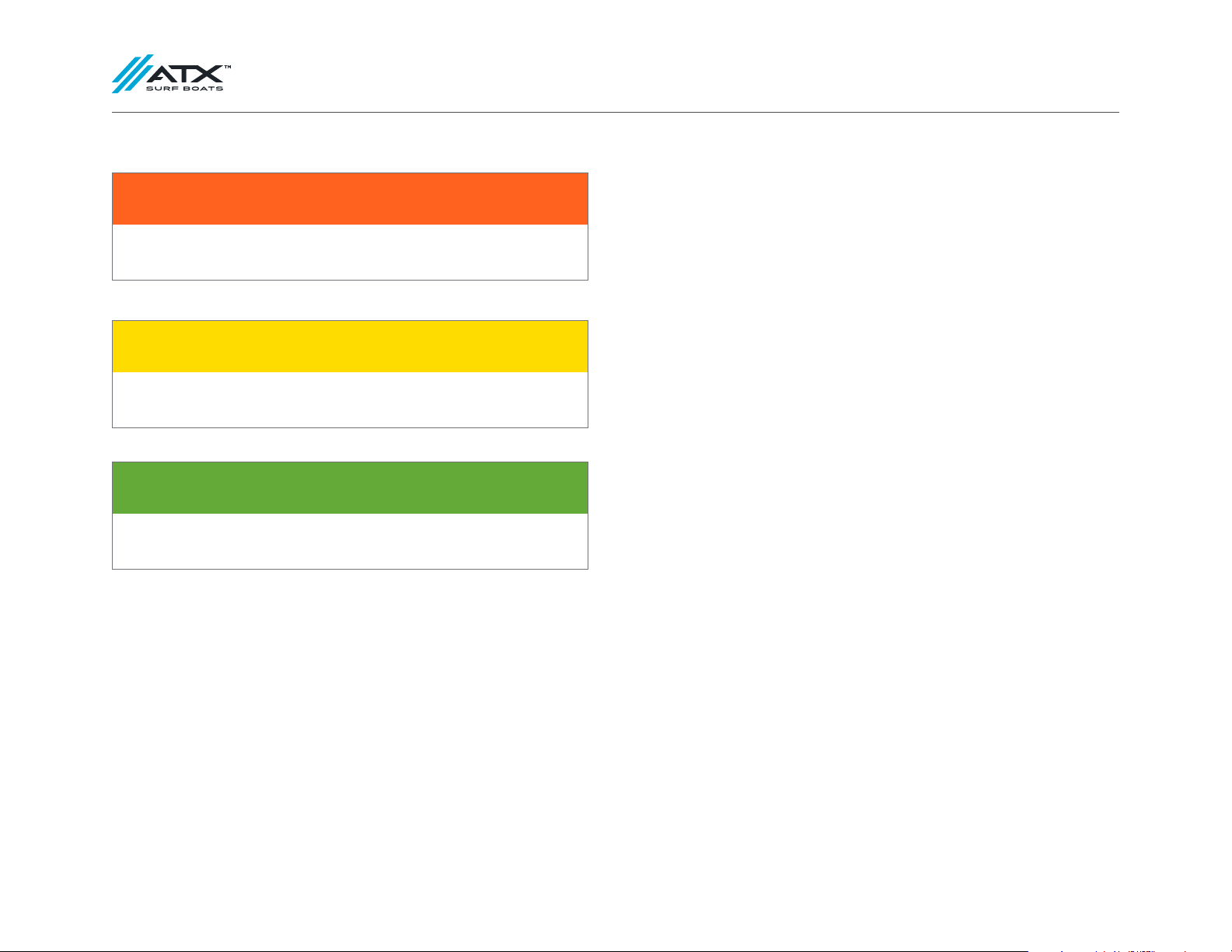
The Safety Alert Symbol means ATTENTION! BECOME ALERT!
YOUR SAFETY IS INVOLVED!
DANGER
DANGER indicates a hazardous situation which, if not avoided, will result in
death or serious injury.
Know the weight capacity of your boat. DO NOT overload your boat. Passengers
and equipment should be spread out evenly.
This section covers general boating safety information. Throughout this manual
specific precautions and symbols identify safety related information.
Page 23
BOATING SAFETY | 22
WARNING
WARNING indicates a hazardous situation which, if not avoided, could result
in a death or serious injury.
CAUTION
CAUTION indicates a hazardous situation which, if not avoided, could result in
minor or moderate injury.
NOTICE
NOTICE indicates a potentially hazardous situation which, if not avoided, may
result in property damage.
The precautions listed in this manual and on the boat are not all-inclusive. If
a procedure or method is not specifically recommended, you must satisfy
yourself that it is safe for you and your passengers, and that the boat will not be
damaged or made unsafe as a result of your decision. Remember—always use
common sense when operating your boat!
In an emergency situation, you may have to resort to measures, which are not
commonly practiced. Always assess the dangers of being in harm’s way versus
the protection of equipment. Keep a sound mind during an emergency and
always think safety.
Failure to adhere to and comply with the safety statements labeled as dangers,
warnings, and cautions that appear in this manual can lead to serious injury, or
death as well as property damage. Be sure to review the Boating Safety and
Rules of the Road sections of this manual
See appendix for warning labels.
It is the responsibility of the boat owner and occupants of the boat to understand and comply with all warning labels and safety recommendations/requirements. Remember the driver of the boat and owner are responsible for the
occupants of the boat and its safe operation.
WARNINGS AND INSTRUCTIONS
FAILURE TO ADHERE TO THESE WARNINGS MAY RESULT IN SEVERE INJURY OR
DEATH TO YOU AND / OR OTHERS.
• DO NOT swim near the boat when the engine is running. Being in
NEUTRAL is not enough, the propeller may still be turning and carbon
monoxide may be present.
• NEVER allow any type of spark or open flame on board. It may result in fire
or explosion.
• Engine exhaust contains carbon monoxide.
• DO NOT operate the engine in a confined space.
• DO NOT go under the boat cover with the engine running or shortly after
the engine has been running.
• DO NOT come into contact with boarding platform while the engine running.
• DO NOT “platform/teak” surf.
• NEVER operate the boat while under the influence of alcohol or other drugs.
• NEVER stand or allow passengers to stand in the boat, or sit on the transom,
seat backs, engine cover or sides of the boat while the engine is running.
• DO NOT allow any passenger to have legs or other body parts over the side
of the bow or the boarding platform while the engine is running. You or others
may be thrown from the boat. All passengers must be in designated seats.
• NEVER leave children in the boat without adult supervision.
Page 24

BOATING SAFETY | 23
• NEVER dive from the boat without being absolutely sure of the depth of the
water, otherwise severe injury or death may occur from striking the bottom
or submerged objects.
• NEVER climb on, sit on, stand on, jump off of or dive off the pull tower.
• NEVER sit in a position that obstructs the operator’s view.
• DO NOT remove or modify any components of the fuel system except for
maintenance by qualified personnel. Tampering with fuel components
may cause a hazardous condition.
• Battery electrolyte fluid is dangerous. It contains sulfuric acid, which is
poisonous, corrosive and caustic. If electrolyte fluid is spilled or placed
on any part of the human body, immediately flush the area with large
amounts of clean water and immediately seek medical attention.
• DO NOT replace your boat’s marine parts with automotive parts or parts
that were not designed for your boat.
Boating Regulations
The U.S. Coast Guard (USCG) is the governing authority of the United States
waterways and is there to help the boating public. State boating regulations are
enforced by local authorities. Owners and users outside of the United States
must be cognizant of that countries’ laws and regulations. You are subject to
marine traffic laws and “Rules of the Road” for both federal and state waterways; you must stop if signaled to do so by enforcement officers, and permit
them to board if asked.
There are many USCG pamphlets available to you. These pamphlets go beyond the contents of this manual and explain “Rules of the Road,” signal lights,
buoys, safety, international and inland regulations. An excellent example is the
Ultimate Watersports Handbook you should have received with your new boat,
or which can be ordered by contacting WSIA, go to: www.WSIA.net. For more
information, contact your local USCG Unit or visit www.uscgboating.org.
Boater Responsibilities
It is the owner’s responsibility to ensure that the operator of the boat has been
properly instructed in the lawful and safe operation of this vessel. Therefore, before operating the boat, read this owner/operator manual thoroughly. Be sure you
understand each item before operating it. Improper operation or trailering of the
boat could lead to severe damage, injury, or death.
At the time of delivery, the owner/operator is responsible for:
• Understanding warranty terms and conditions of your boat, your engine,
and your trailer.
• Obtaining insurance.
• Examining boat to ensure proper operation of all systems.
Before operating the boat, the owner/operator is responsible for:
• Registering the boat as required in the jurisdiction where the boat is
being operated.
• Providing the proper (USCG) safety equipment, check local, state, country
agency(ies) as to laws and regulations (USCG carriage requirements).
• Following proper break-in procedure for the engine.
• Carefully reading and understanding safety information and proper
operating procedures within this manual.
• Familiarize yourself with the navigable waters where you intend to
operate boat.
Additional instructions the owner and operator are responsible for:
• On-board equipment must always conform to the governing federal, state,
and local regulations.
• Knowing that all safety equipment and life jackets (PFDs) are in good
condition and suitable for your boat and passenger load.
• Prior to starting the engine, you must open the engine box and check the engine
compartment and bilge for gasoline and oil vapors. You MUST also operate the
blower for at least four minutes before starting the engine. Also, operate blower
while idling at slow speed, and after stopping boat. Failure to do so may result
in fire or explosion as well as serious injury or death to you and/or others. If you
smell gasoline vapor or see liquid gasoline, DO NOT start the engine.
Page 25

BOATING SAFETY | 24
• Prior to operation ensure that all passengers are aware of where safety
equipment is located and how to use it.
• Knowing that the load of persons, ballast, and equipment is within the limits
stated on the USCG Maximum Capacities Plate.
• Verifying that the emergency cutoff switch lanyard is in proper operating
condition and attached to driver’s wrist or part of clothing when operating boat.
• Avoiding use of alcohol and other drugs.
• Slow down when crossing waves or wake in order to minimize the impact
on passengers and the boat, but do not allow bow to submerge.
• When charging, batteries generate small amounts of dangerous hydrogen
gas. This gas is highly explosive. Keep all sparks, flames and smoking well
away from the area. Failure to follow instructions when charging a battery
may cause an electrical charge or even an explosion of the battery, which
could result in death or serious injury.
• Ensuring that all passengers are properly and securely seated in
appropriate seating locations.
• Remember your boat will handle differently depending on loading and
its distribution.
• Having at least one other passenger who is capable of operating the boat
safely in an emergency.
• Following safe operating practices and the “Rules of the Road”, and
the Watersports.
• Responsibility Code.
• Operate slowly in congested areas such as marinas and mooring areas.
• Maintain a safe speed at all times to avoid collisions.
• DO NOT wrap ski lines or mooring lines around any body part which may
become entangled in the line if you fall overboard and the boat is moving.
• Be sure to keep a watch for other boats, swimmers and obstructions in the
water. Stay away from other boats and personal watercraft.
• It is recommended you have an experienced operator at the helm and
present for safe towing—one to drive, one to observe (which is required in
some states) and one to ski or ride.
• Look before you turn the boat. As a boater you are obligated to maintain a
proper course and speed. Look before you turn.
• Keep track of ski lines and dock lines so they do not become entangled in
the propeller.
• Always watch for low obstacles such as tree limbs bridges or power lines in
boats with tow towers.
• Seek shelter from open water if there is threat of lightning.
• The engine box/cover serves as a machinery guard. The engine must be OFF
whenever the box is open. Clothing for body parts can get caught in moving
parts, causing death or serious injury. Keep away from moving parts.
• When you leave the boat take the keys with you. This will keep untrained
and unauthorized persons from operating the boat.
• Providing assistance to other boaters.
Registration
Federal Law requires that all motorboats be registered and that all motorcraft not
documented by the U.S. Coast Guard display registration numbers. In nearly all
states, this means registration with the designated state agency. In a few jurisdictions,
the Coast Guard retains registration authority. Your dealer will either supply registration forms or tell you where they may be obtained. The agency will supply you
with a certificate which must be carried with you when the boat is in operation.
International laws may vary as to registration required.
Insurance
The boat owner may be legally responsible for damages or injuries he or she
causes or the operator causes. Common sense dictates that you carry adequate
personal liability and property damage insurance on your boat, just as you would
on your automobile. You should also protect your investment from physical damage or theft. Many states have laws detailing minimum insurance needs. Your
insurance agent or your dealer may be able to supply you with more information.
Page 26

BOATING SAFETY | 25
Education Opportunities
If you have never owned a boat before, you can get an excellent introduction to
boat handling from organizations such as the U.S. Coast Guard, American Red
Cross or your local authority. Even if you are a veteran boater, these courses
will help sharpen your boating skills as well as bring you up to date on current
rules and regulations. See your local boating agency or dealer for information on
classes in your area.
This manual is not intended to provide complete training on all aspects of boat
operation. We strongly recommend that all operators of this boat seek additional training on boat handling and safety. Have all operators become familiar
with the handling characteristics, and proper steering and control system usage
before attempting high speed operation.
Some states require youths 16 years of age and younger to complete a boat-
ing safety course before operating any watercraft. Many others require operators under the age of 18 to be licensed in small boat operation. Boat smart
from the start, take a boating safety course and get a free vessel safety check
annually for your boat. For more information, contact: United States Coast
Guard Auxiliary, www.cgaux.org; United States Power Squadrons, 1-888-FOR-
USPS, www.usps.org.
The following is a list of some other agencies and organizations that offer Water Safety, First Aid and CPR courses or information. To find boating safety courses
in your area, call your state’s local boating agency or the USCG boating safety
course line at 1-800-336-2628 (1-800-245-2628 in Virginia).
• American Red Cross
• U.S. Coast Guard Auxiliary
• U.S. Power Squadrons
• State Boating Offices
• Canadian Power and Sail Squadrons
• Boat Owners Association of the United States
• National Safe Boating Council
• WSIA
• European or international organizations
Operation by Minors
If your boat will be operated by a minor, remember to have an adult present
at all times. Many states have laws regarding minimum age and licensing
requirements for minors. Contact state and local authorities for special
requirements that may apply in your area. NOTE: Some states require boat
training courses/certification.
Passenger Safety
Any time you take your boat out, make sure that there is at least one other
passenger aboard who is familiar with the operation of your boat. Passengers
should be well aware of emergency equipment and shown how to use it.
Passengers should also keep hands and feet in the boat and be safely seated
while the boat is in motion.
The operator of the boat is responsible for the safety of the passengers, all
skiers/riders as well as his/her own safety. The operator should ensure that all
passengers are properly and securely seated in appropriate seating locations
before starting and remain there whenever the boat is in motion. Place persons
and gear in a way that distributes weight evenly.
While the engine is running, and during the boat mooring, all occupants should be
properly seated. DO NOT sit on the engine box, seat backs, aft seating, sunpad,
boarding platform or gunnels. You could fall overboard and be hit by the propeller. DO NOT allow objects, arms or legs, or any other body parts to hang over the
bow or gunnels. DO NOT stand while the boat is moving.
The operator MUST sit in the driver’s seat while the boat is moving and all
passengers should remain properly seated.
Page 27
BOATING SAFETY | 26
Overloading
WARNING
An overloaded boat through passengers, non factory installed ballast, and
equipment can cause death or serious injury. It can cause loss of control,
capsizing, or swamping.
DO NOT overload your boat. Your boat is equipped with a maximum capacity
plate indicating the maximum acceptable load as determined by the manufacturer following certain Federal guidelines. Equally critical is how weight is distributed
throughout the boat. The weight must be distributed evenly throughout the boat,
besides the proper use of the ballast. If too much weight is placed in one area it can
have serious impact on boat handling and control.
The capacity plate is used by boat manufacturers participating in the National
Marine Manufacturers Association certification program. Your manufacturer has
submitted your model for inspection and compliance with their guidelines. The capacity plate has the following information permanently printed on it. It is attached
to the boat by the throttle for the operator to read before they drive the boat.
• The total weight of persons, gear and other items which the boat is capable
of carrying under normal conditions. This weight must include any added
ballast above and beyond manufacturer’s ballast system(s).
Be Advised
• Any non-factory installed ballast must be properly secured to prevent injury.
Non-factory ballast is not recommended.
• Death or serious injury can occur from overloading the boat. DO NOT
overload your boat.
• Do not fill the bilge area with water from any source.
• The maximum number of persons allowed on the boat. This information on
the capacity plate applies under normal conditions and special care must
be used in any abnormal conditions. Check the capacity plate on your
boat and abide by these limits.
• Remember DO NOT exceed capacity!
NOTICE
Your boat manufacturer installs wake enhancement ballast systems in
some models. The full weight of this system has already been considered
in the boat capacity calculation and therefore does not influence maximum
capacity, unlike non-factory ballast tanks or weights, which must be included as
part of the gear weight.
As wakeboarding has developed, we have witnessed the advent of ballast
systems which add weight and increase the size of the wake. The simplest
ballast system on the market is the water ballast type, such as the “FAT SAC.”
It is not uncommon to see operators use such systems and then put additional people in their boat. Please be advised that this practice can lead to
overloading your boat. Each boat has a maximum capacity label displaying
the maximum weight of people, gear and ballast that can be placed in the
boat. Always be aware of the load in your boat and do not load the boat in
excess of the listed capacity. The quest for the largest wake has caused some to
excessively overload their boats.
Overloading a boat may cause it to become unstable and adversely affect the
boat’s handling.
Page 28
BOATING SAFETY | 27
Visibility
WARNING
Obstructed visibility can cause death or serious injury. Maintain clear visibility
at all times. Arrange passengers and equipment for maximum visibility or
designate a passenger to assist when visibility is limited.
The operator of the boat is responsible by law to “maintain a proper lookout
by sight and hearing.” The operator must ensure that he/she has appropriate visibility for safe operation. No passengers or equipment should block the
operator’s view outward or of other boats, skier, rider, swimmer, or anyone in
the water. Even momentary interference can result in the driver’s inability to
respond to a situation that requires avoidance of another vessel or submerged
or partially-submerged objects. Look carefully before turning, especially when
you are turning around to pick up a fallen skier/rider. Someone else may not
be following the “Rules of the Road.” Keep a visual check for boats behind your
boat. This is an area where accidents can happen very quickly. The boat should
not be driven at a rate of speed faster than will allow it to be brought to a full
stop within the operator’s field of view.
Boating Under the Influence
Boating, alcohol, and the use of other drugs just do not mix. Boating under the
influence of alcohol or drugs can be deadly. Boating, coupled with alcohol and
other drugs results in many marine accidents and deaths accounting for approximately one third of all recreational boating fatalities. These substances decrease
your reaction time and impair your judgment. Combined with the sun, wind,
waves, and noise of other watercraft, the effects of drugs are increased and
will significantly increase your reaction time. As the owner/operator, you are
responsible for the alcohol/drug use and onboard behavior of your passengers.
WARNING
Federal and state laws prohibit operating a boat under the influence of
alcohol and other drugs. These regulations are actively enforced. Impaired
operation may result in severe personal injury or death.
WARNING
If the operator’s blood alcohol content is above the legal limit, violators are subject to fines and you can go to jail. You may also lose your automobile driving
privileges.
DANGER
Operating a boat under the influence of alcohol can cause serious
injury or death.
Additionally, civil lawsuits in cases of property damage or injury/death to others can
result in significantly higher verdicts when alcohol or drugs are allowed.
Reporting Accidents
Boat operators may be required by law to file a Boating Accident report with
their state boating law enforcement agency or local authority, the USCG, or
Page 29

BOATING SAFETY | 28
their countries’ agency when their boat is involved in certain boating accidents. A
boating accident must be reported if there is a loss or probable loss of life or personal injury requiring medical attention. In these situations a formal report must
generally be filed within 48 hours of the accident, and for accidents when damage
exceeding $500 is incurred, or there is a complete loss of the boat as well. A
formal report must generally be filed within 10 days. If any of these events occur,
seek further assistance from local law enforcement personnel.
Rendering Assistance
If you see a distress signal or suspect a boat is in trouble, you must assume it is
a real emergency and render assistance immediately. By law, the operator
in charge of the craft is obligated to provide assistance to any individual in
danger if such assistance can be provided safely. Failure to render assistance
can result in a fine and/or imprisonment.
The 1971 Boating Safety Act grants protection to a “Good Samaritan” boater providing good faith assistance, and absolves a boater from any civil liability arising
from such assistance.
Factory Provided Safety Equipment
The Federal Boat Safety Act of 1971 (FBSA/71) and the National Recreation Boat-
ing Safety Program have established minimum safety standards for boats and
associated equipment, specified by the USCG. In addition, the ABYC and the
NMMA work with boat builders to develop voluntary standards that exceed base
requirements. The included safety equipment on your boat meets or exceeds
the standards of the USCG, ABYC and the NMMA. Some required safety equipment such as life jackets (PFDs) are not included with your boat. Your dealer can
help you choose the appropriate equipment.
NOTICE
Many states’ equipment requirements go beyond USCG requirements. Con-
tact your state boating office for further information.
Equipment requirements for coastal and inland waters differ. Check with
local authorities and/or the USCG for further information about coastal water
requirements. The following equipment may or may not be required by
federal/local regulations.
Owner Provided Safety Equipment
U.S. Coast Guard regulations require certain accessory equipment on each
boat. For a detailed description, obtain “Federal Requirements for Recreational Boats” published by the Coast Guard. 1) Personal Flotation Devices (PFDs):
PFDs must be Coast Guard approved, in good and serviceable condition and
the appropriate size for the user. It is recommended that you wear PFDs while
your boat is underway. Boats more than 16 feet 9 (4.8 meters) in length must be
equipped with one type I, II, III or V and one type IV. PFDs are intended to save
lives; you and your passengers should wear them while in the boat. Learn how
to use them and adjust as necessary to make comfortable to wear. The type II
PFD is recommended for near shore or inland water use. Some PFDs are specially
made for use while waterskiing or wakeboarding and are not U.S.C.G. approved.
Please check local law with respect to their use.
Life Saving Equipment
Federal law requires at least one Type I, II, III,or V Personal Flotation Device (PFD),
of the proper size, for each person on board or being towed, and at least one
Type IV throwable PFD in the boat. There are four types of PFDs to wear and one
type used for throwing in emergency situations.
Page 30
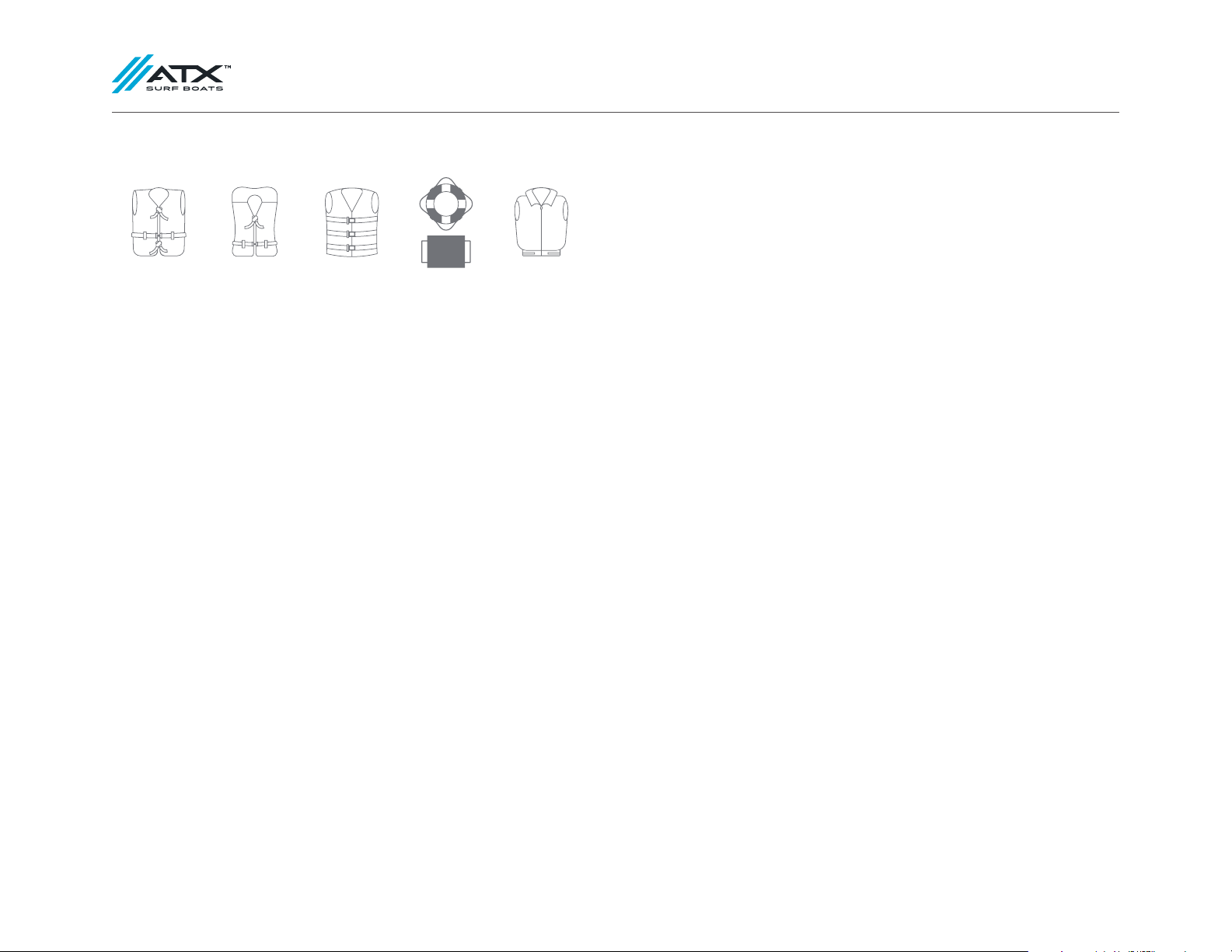
TYPE I
LIFE PRESERVERS
TYPE II
BUOYANT VESTS
TYPE III
FLO TATION AI DS
TYPE IV
THROWABLE
DEVICES
TYPE V
HYBRID PFD MUST
BE WOR N WHE N
UN DE RWAY
Type I Life Preserver: Most buoyant PFDs are effective on all waters, especially
open, rough water.
Type II Buoyant Vest: Good for calm water
Type III Flotation Aid: Good for most inland water applications where quick
rescue is likely. Comes in various styles and some are designed for water
sport activities.
Type IV Throwable Device: Intended for heavy traffic inland waters where
help is available. Designed to be thrown to a person in the water.
Type V Hybrid PFD: Inflatable design for special use activities and may be
used instead of a Type I, II, or III PFD with non-towed participants if used in
accordance with the approval conditions on the label and if worn when the
boat is underway. Some Type V PFDs provide increased protection against
hypothermia.
• A Type V PFD must be worn to be counted toward the minimum carriage
requirements.
• Special lifejackets are available for skiing and other water sports. These
non-Coast Guard approved lifejackets do not count as PFDs.
Lifejackets (PFDs) are intended to help save lives. The operator should set
an example by wearing one. Wear a life jacket (PFD) whenever boating. It is
BOATING SAFETY | 29
especially important that children and non-swimmers wear a life jacket (PFD) at all
times. Make certain all passengers know how to put on and properly adjust their
life jackets (PFDs) and that they are readily accessible. Check local, state, country
agency(ies) as to laws and regulations. Also, selecting the proper type life jacket
(PFD) for your kind of outing helps ensure your time on the water can be safer. RE-
MEMBER—The best life jacket (PFD) is the one that is worn–that is, the one that
can save your life.
At the beginning of each season, check life jackets (PFDs) for damage and test for
proper flotation. Refer to the lifejacket (PFD) manufacturer’s information. To meet
requirements, each lifesaving device must have a current, legible USCG approval
stamp permanently affixed.
Your dealer can help you select appropriate life jackets (PFDs) and throwable
lifesaving devices for your area.
Navigation Lights
Your boat is equipped with navigational lights. Recreational boats are required
to display navigational lights between sunset and sunrise and other periods of
reduced visibility (fog, rain, haze, etc.). Your navigation lights are provided to
keep other boats informed of your presence and course. It is up to you to make
sure they are operational and turned on when required.
Tower Lights
Coast Guard regulations do not permit the use of tower side panel lights while the
vessel is underway. The lights may be in use when the vessel is not in motion.
Horn or Whistle
All boats over 16 feet (4.8 meters) in length must be equipped with an
operable horn or whistle. The following are standard signals when using
a whistle or a horn:
• One prolonged blast: warning.
• One short blast: Pass on my port side.
Page 31

BOATING SAFETY | 30
• Two short blasts: pass on my starboard side.
• Three short blasts: my engines are in reverse.
• Five or more blasts: danger!
Fire Extinguisher
A fire extinguisher is required if your boat has an inboard engine, or when fuel is
stored in closed stowage compartments.
Approved fire extinguishers are classified by a letter symbol, either B-1 or B-II
with the B designating that the material will extinguish flammable liquids such as
gasoline, oil, etc. B-1 extinguishers are required for boats less than 26 feet in length.
Check periodically to ensure that the extinguisher is in working condition and fully
charged. Check local, state, country agency(ies) as to laws and regulations.
Emergency Safety Lanyard
Your boat is equipped with an emergency cutoff switch (safety lanyard.) We
strongly recommend that the lanyard be secured to the operator and the lock
plate attached to the emergency cutoff switch prior to starting the engine
and anytime the engine is operating. The cutoff lanyard is designed to turn off
the engine whenever the operator moves far enough away from the helm to
activate the switch.
WARNING
• Attach the safety lanyard to a secure place on your clothing, your arm or
leg while operating.
• DO NOT attach the lanyard to clothing that could tear loose.
• DO NOT route the lanyard where it could become entangled, preventing it
from functioning.
• Avoid accidentally pulling the lanyard during normal operation.
• Loss of engine power means loss of most steering control. Also, without
engine power, the boat could slow rapidly. This could cause people and
objects in the boat to be thrown forward.
There are practical limitations to what the Emergency Safety Lanyard can do.
It can take several seconds for the engine and propeller to stop turning. The
boat can continue to coast for several hundred feet depending on the velocity at
the time the switch was activated, and the degree of any turn. While the boat is
coasting, it can cause injury to anyone in its path as seriously as if the boat operated under power. Accidental loss of power can be hazardous particularly when
docking or in heavy seas, strong current or high winds.
Visual Distress Signals
All vessels used on coastal waters, the Great Lakes, territorial seas, and those
waters connected directly to them up to a point where a body of water is
greater than two miles wide, must be equipped with USCG approved visual
distress signals. Your dealer or local authorities can help you select appropriate
visual distress signals for your area.
It is strongly recommended you use the Emergency Safety Lanyard system as
failure to do so can cause death or serious injury. DO NOT operate the boat if
the Emergency Safety Lanyard system does not function properly.
If you are required to carry distress signals, you must have three USCG
approved pyrotechnic devices. Be sure they are in serviceable condition, not
exceeding the expiration date and stored in a cool, dry location in a red
or orange waterproof container.
Page 32
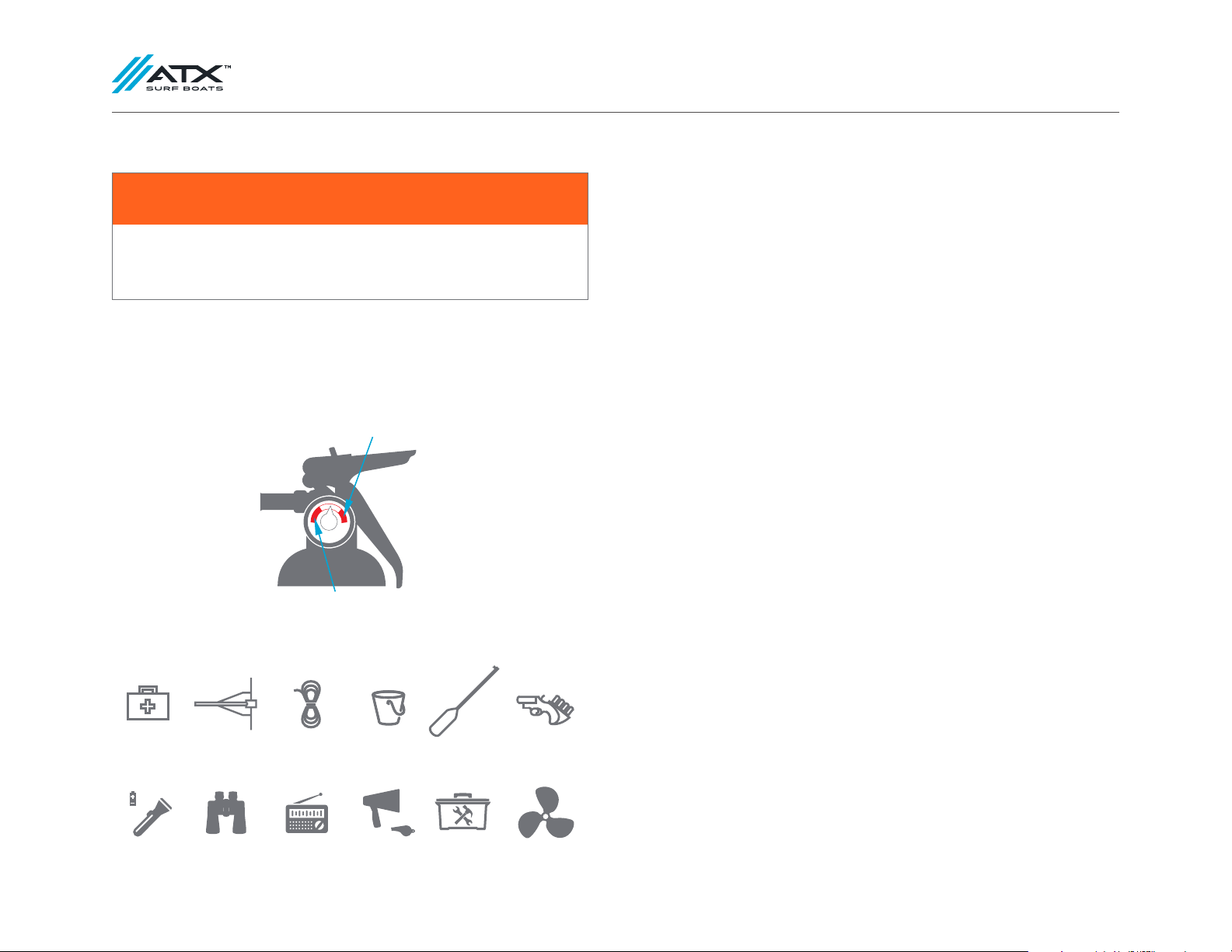
BOATING SAFETY | 31
WARNING
Pyrotechnic signaling devices can cause fire and / or explosion, death, seri-
ous injury, and property damage if improperly handled. Follow the pyrotech-
nic manufacturer’s directions.
Recommended Safety Equipment
As a precaution, a good boater will avoid potential problems on an outing by
having additional equipment on board. Normally, this equipment is dependent
on the body of water and the length of the trip; your dealer can assist you.
OVERCHARGED
RECHARGE
We recommend the following equipment:
• First aid kit and manual
• Anchor with at least 75 feet (23 meters) of line
• Mooring lines and fenders
• Bailing device (bucket, hand pump)
• Combination paddle/boat hook
• Local charts and compass
• Day/night distress signals
• Waterproof flashlight and spare batteries
• Cellular phone
• Binoculars
• Portable AM/FM radio with weather band
• A non-electric horn or whistle
• Extra engine oil
• Tool kit
• Spare propeller and mounting hardware
• Spare fuses
• Spare keys
• Sunglasses and sun block lotion
EMERGENCIES
Fire/Explosion
Many boat fires involve flammable liquids such as gas or oil. Many inboard fires
start in the bilge area which at times can be filled with gas vapors. Since gas vapors
cannot be seen, boat fires tend to travel very fast. If you encounter a fire on board,
turn off the engine immediately. If you have a fire extinguisher on board and access
to the fire, it may be controllable. Direct the contents of the extinguisher at the base
of the flames. Throw burning materials overboard if possible. Put on PFDs, if not
already on, signal for help and prepare to abandon the boat if necessary.
Page 33
BOATING SAFETY | 32
WARNING
BURN HAZARD
Gasoline floating on water which is ignited can cause death or serious injury.
Gasoline will float on top of water and can burn. If the boat is abandoned,
swim upwind, far enough to avoid fuel that can spread over the surface of
the water.
Capsizing and Swamping
A boat may capsize or swamp when least expected. Formulate a plan in advance
on what to do if it should happen. Keep in mind the following guidelines:
• Try to turn the engine OFF to prevent damage.
• If others were on board, try to locate them, make sure they are conscious
and that they can swim.
• Immersion in water speeds the loss of body heat and can lead to
hypothermia. This is the abnormal lowering of internal body temperature.
If a leak is discovered, immediately determine the cause. A collision with an
underwater object could cause the hull to develop a leak. A loose fitting hose
clamp on a piece of equipment could cause a leak. Try to repair the leak if
possible. If a leak is threatening the safety of you and your passengers, call or
signal for assistance.
Staying Afloat
• Remain calm. Do not thrash about or try to remove clothing or footwear.
This leads to exhaustion and increases the loss of air that may keep
you afloat.
• Keep your lifejacket (PFD) on.
• Keep your knees bent.
• Float on your back and paddle slowly to safety.
Collisions
If a collision occurs, immediately account for all passengers. Assess the hull
for damage and activate the bilge pumps to reduce any water intake. Try to
operate the boat to keep the damaged area above water. If necessary, call or
signal for assistance.
Grounding
In the event you run aground, assess the situation before proceeding. Immediately stop any water from entering the boat. Inspect the rudder and rudder
control system, the hull, propeller and strut for damage. Maneuver the boat to
safe water only if the hull and all operating systems are in satisfactory operat-
ing condition. Otherwise, call or signal for assistance.
Water Rescue (Man Overboard)
Immediately react to a person who has fallen overboard. Keep the victim
constantly in your sight. Safely return to the victim as soon as possible. Throw the
person a life preserver. Turn off the engine and help the person into the boat if
someone is thrown or washed overboard. It may be possible to revive a drown-
ing victim who has been under water for some time and shows no sign of life.
Start CPR immediately and get the victim to a hospital as quickly as possible.
Reporting Accidents
Boat operators are required by law to file a Boating Accident report with
their state boating law enforcement agency or local authority when their
boat is involved in certain boating accidents. A boating accident must be
reported if there is a loss or probable loss of life, personal injury requiring
medical attention, damage exceeding $500, or there is a complete loss of the
boat. If any of these conditions arise, seek further assistance from local law
enforcement personnel.
Medical Emergency
Be prepared in the event of an emergency. Know how to use your first aid kit. Be
aware of any special medical conditions of your passengers.
Page 34

BOATING SAFETY | 33
Operation Failure
If you experience a propulsion, steering or control failure, immediately turn OFF
the engine. Try to determine the failure and repair, if qualified to do so. Otherwise,
call or signal for assistance.
HAZARDOUS CONDITIONS
Every waterway poses hazards that should be avoided. The following information outlines some of the hazards which may be encountered.
Shallow Water Operation
Shallow water brings on obvious hazards such as sand bars, stumps, rocks, etc.
Know the area you will be operating the boat in. Hitting objects at high speeds
can cause severe damage to people and the boat. If you know you will be
navigating the boat in shallow water, post a lookout and proceed slowly.
Know the minimal depth your boat can safely travel.
Warning Markers
Learn to recognize the different buoys and day markers; they are used as the
signposts of the waterways identifying navigable routes and water hazards. It
is a good idea to ask local authorities about hazard areas and if they are
marked. Stay within boundaries and clear of hazards.
Weeds
Weeds can generally be a threat to a boat’s engine and other components on
the boat. If weeds wrap around the propeller, they can create vibration in the
engine. They also restrict water intake, causing the engine to overheat.
NOTICE
Weeds can sometimes be removed by shifting to NEUTRAL, pausing for a mo-
ment, then shifting to REVERSE to unwind the weeds from the propeller.
Dam Spillways
The area around dam spillways is very hazardous and conditions can change
rapidly. Stay clear of the spillways and areas below dams.
Restricted Areas
Before boating, check with Local, State, and Federal authorities to identify
restricted areas. Because of the threat of terrorism, the U.S. Coast Guard has and
will continue to implement strict limits on watercraft near U.S. Navy and Coast
Guard ships and other potential targets.
Weather/Seas
Learn and understand weather patterns and signs of change. Bad weather can
cause an uncomfortable and unsafe situation. If a storm approaches, seek a
safe harbor.
ENVIRONMENT
As a boater, you already appreciate nature’s beauty and the peace of the great
outdoors. It is a boater’s responsibility to protect the natural environment by
keeping waterways clean. DO NOT put anything in the water you would not
want to eat or drink!
Page 35
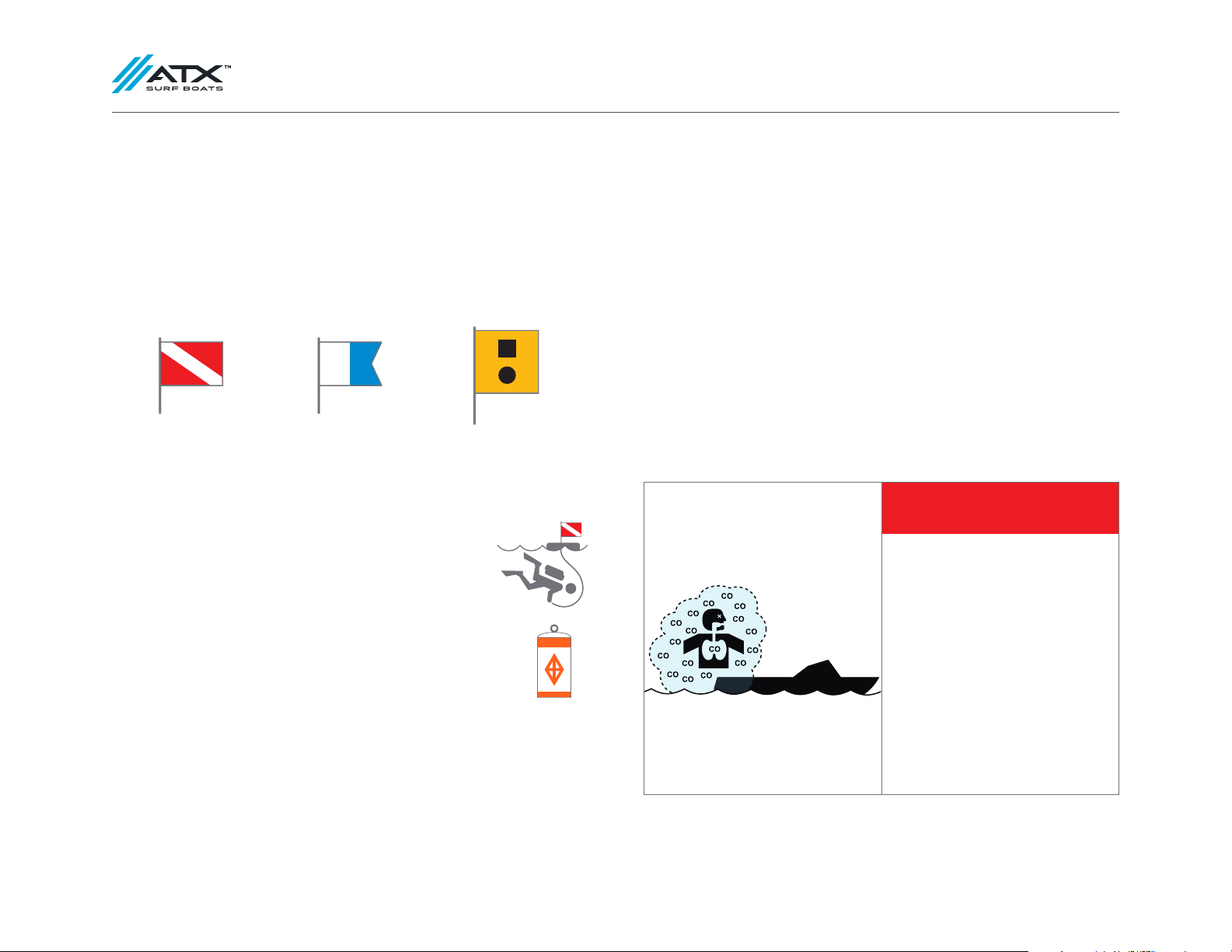
BOATING SAFETY | 34
WARNING MARKERS
It is a good idea to ask local authorities if there are hazardous areas and how
they are marked. Boaters must also recognize the flag designs, which indicate
that skin divers are present and keep well clear of the area.
DIVERS FLAG ALPHA FLAG DIS TRESS FLAG
USED BY RECREATIONAL
DIVERS—INDICATES
DIVER’S POSITION
Skin Diver Warning Flag
Watch for swimmers. Swimming areas may not be marked.
Steer clear from the area and remain alert.
Swim Area Warning Buoy
Navigation markers serve as a means of identifying navigable
routes, and indicate water hazards. Boaters should become
familiar with navigation markers and stay within marked
boundaries and clear of hazards.
WORLDWIDE VESS ELS
ENGAGED IN D IVING
OPERATIONS—DOES NOT
INDICATE DIVER’S POSITION
IND ICATES FELLOW BOATER IS
IN NE ED OF ASSI STANCE
CARBON MONOXIDE
Carbon Monoxide (CO) is a colorless and odorless gas produced by all engines and
fuel burning appliances. Even with the best boat design and construction, plus
the utmost care in inspection, operation and maintenance, hazardous levels
of CO may still be present in accommodation spaces under certain conditions.
To reduce CO accumulation, always ventilate the boat interior and avoid boating
situations which cause increased exposure. The boat owner, as well as all boat
occupants, must ensure that they understand the dangers of carbon monoxide
and comply with all safety recommendations/requirements.
No one should be allowed to stand or sit in any area of the boat that is not a des-
ignated seat while the boat is running. It is the responsibility or the boat owner
and occupants of the boat to understand and comply with all warning labels
and safety recommendations/requirements.
DANGER
Carbon monoxide (CO) can cause
brain damage or death.
• Engine and generator exhaust contains orderless and colorless carbon
monoxide gas.
• Carbon monoxide will be around
the back of the boat when engine
is running and after the engine is
turned off.
• Move to fresh air, if you feel nausea,
headache, dizziness,
or drowsiness.
Page 36
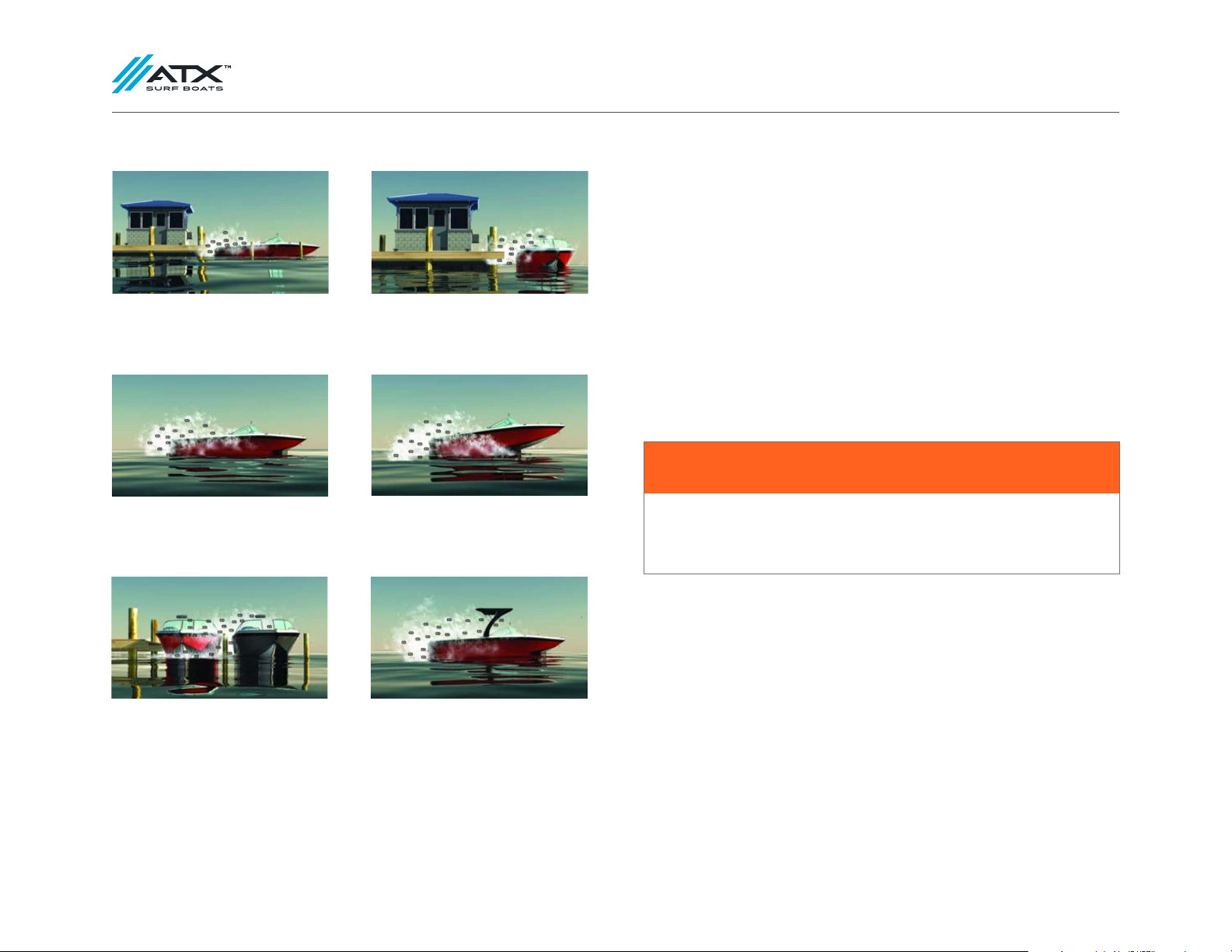
Blockage of boat exhausts
by obstruction.
Exhausts traveling along obstruction.
BOATING SAFETY | 35
ENSURE ADEQUATE VENTILATION FOR CORRECT AIR MOVEMENT
THROUGH BOAT!
Have a suspected CO victim deeply breathe fresh air and immediately seek
medical attention.
Foreign Species
If you trailer your boat from lake to lake, you may unknowingly introduce a
foreign aquatic species from one lake to the next. Thoroughly clean the bottom of
the boat, below the water line, remove all weeds and algae, and drain the bilge,
ballast, and livewells before launching the boat in a new body of water. Check
local, state, country agency (ies) as to laws and regulations.
Fuel/Oil Spillage
WARNING
Operating at slow speed or while
dead in the water.
Exhausts from other vessels in
confined areas.
Operating with high bow angle.
Operating with canvas tops and side
curtains in place without ventilation.
Fire or explosion hazard exists from fumes accumulating from rags being
stored in bilge area. DO NOT store rags used to wipe up fuel or solvent spills
in the boat. Dispose of rags properly ashore.
The spilling of fuel or oil into our waterways contaminates the environment
and is dangerous to wildlife. DO NOT EVER discharge or dispose of fuel, oil or
other chemicals into the water; it is prohibited and you can be fined. These are
three common, accidental types of discharge:
• During initial fueling of a nearly empty tank
• Overfilling the fuel tanks
• Pumping contaminated bilge water
Discharge/Disposal of Waste
Waste means all forms of garbage, plastics, recyclables, food, wood, detergents, sewerage and even fish parts in certain waters—in short, nearly everything.
We recommend you bring back everything you take out with you for proper
disposal ashore.
Page 37

BOATING SAFETY | 36
Excessive Noise
Noise means engine noise, radio noise, or even yelling. Many bodies of water have
adopted noise limits. Music and loud conversation can carry a considerable distance on water, especially at night. Be sure to follow regulations and be courteous.
Speed/Wake/Wash
Be alert for NO WAKE zones. You are responsible for any damage or injury
caused by your wake/wash. Prior to entering a NO WAKE zone, come off plane
to the slowest steerable speed.
Some states and boating areas have imposed speed limits for operation of
boats, including but not limited to no-wake zones. Check local, state, country agency(ies) as to laws and regulations. The U.S. Coast Guard and local boating authorities are excellent sources for this information, which include penalties for failure to
observe the requirements. Use caution when operating around smaller crafts, in
channels and marinas, and in congested areas.
Exhaust Emissions
Increased exhaust (hydrocarbon) emissions pollute our water and air. Keep
your engine tuned and boat hull clean for peak performance. Consult your ATX
dealer for information.
Paints
If your boat is kept in water where marine growth is a problem, the use of
anti-fouling paint may reduce the growth rate. Be aware of environmental regulations that may govern your paint choice. Contact your local boating authorities
for information.
Cleaning Agents
Household cleaners should be used sparingly and not discharged into
waterways. Never mix cleaners and be sure to use plenty of ventilation in enclosed areas. DO NOT use products which contain phosphates, chlorine, solvents,
non-biodegradable or petroleum based products. Refer to CARE AND MAINTENANCE in this manual for more information.
MARPOL Treaty
The USCG enforces the International Convention for the Prevention of Pollution
from ships, commonly referred to as the MARPOL Treaty (Marine Pollution).
This treaty prohibits the overboard dumping of all ship- generated plastics,
chemicals, garbage and oil.
WATERSPORT SAFETY
Skiers or riders are obligated to be aware of the same fundamental safety rules as
operators. If you are new to water skiing, wakeboarding, wakesurfing, and other
towed watersports, seek certified training before starting. You will find it especially
helpful to join a local ski club, World Wakeboard Association, and/or the USA Water
Ski, when possible.
Always remember that the majority of water skiing/wakeboarding and other
towed watersports injuries are the result of impacts with other objects. Always
look where you are going and be aware of what is going on around you.
Teak/Ski Platform/Drag Surfing
READ, UNDERSTAND and be FAMILIAR with the information contained on any warn-
ing labels or any label on equipment and adhere to the boat operation practic-
es described on them. The United States Coast Guard issued a SAFETY ALERT on
August 28, 2001 that covers some of the issues of improper use of teak boarding
platform. The SAFETY ALERT and portions of the accompanying information follow:
SAFETY ALERT from August 28, 2001
The United States Coast Guard advised boaters not to “Teak/Drag Surf.” Recent
boating fatalities revealed that carbon monoxide (CO) emitted from a vessel’s ex-
haust resulted in CO poisoning and the death of at least six teak surfers. “Teak/Drag
Surfing” places the individual in position directly exposed to the CO in the engine’s
exhaust. This may result in a loss of coherent responses and even death. In addition,
“Teak/Drag Surfing” dangerously exposes the individual to a possible propeller injury,
and since it is often done without a life jacket (PFD), it significantly increases the
probability of drowning. Therefore, the Coast Guard stresses, “Teak/Drag Surfing” is
a very dangerous activity and advises boaters not to participate in it.
Page 38
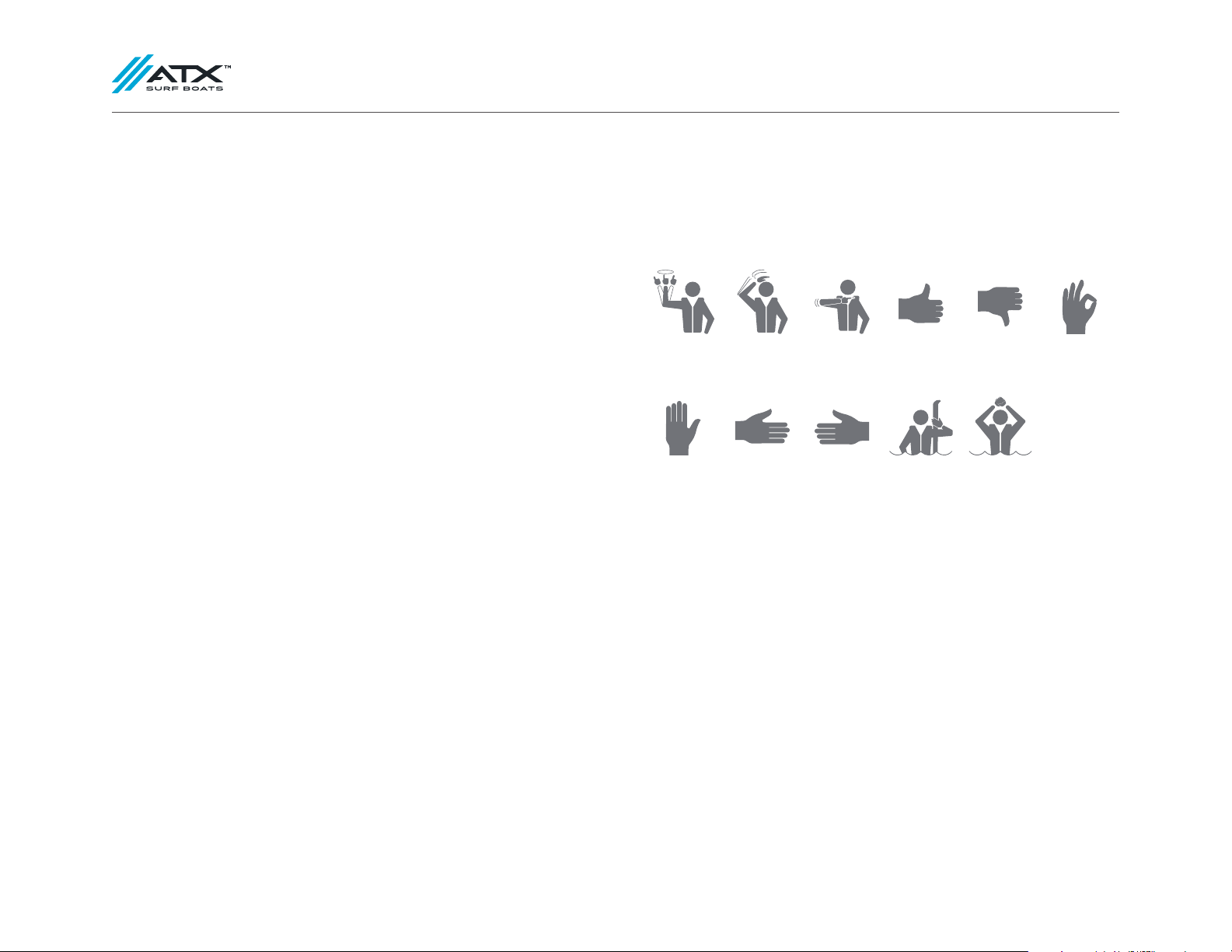
BOATING SAFETY | 37
The Coast Guard pointed out that carbon monoxide is one of the most dangerous gases. It strikes before you know you are exposed and it impairs in a way
that can and too often does lead to death. That is why it is so important to the
Coast Guard that in every circumstance where it can be avoided, it is.
Every year tragic deaths occur from the negligence of unsafe boating and
dangerous activities. Experts say, “many of these deaths may have been caused
by an invisible hazard, carbon monoxide poisoning.” Taking the risk of swimming
under a boarding platform when the engine is running, skiing within 20 ft (6.1
meters), “teak surfing” or “dragging” behind a moving boat can be fatal.
As a concerned Manufacturer we do not consider any dangerous activities
which can result in a serious injury or death a watersport. Your manufacturer is
concerned for all boaters’ safety and DOES NOT promote unsafe boating risks,
and STRONGLY recommends that boaters refrain from ANY unsafe or dangerous activities. Boaters/users assume all risks for such actions.
DO NOT use the boarding platform for any other purpose than boarding the
boat or preparation of entering the water, and DO NOT be on or near the
boarding platform when the engine is running.
The boat owner, as well as all boat occupants, must ensure that they understand
the dangers of carbon monoxide and comply with all safety recommendations/
requirements. No one should be allowed to stand or sit in any area of the boat
that is not a designated seat while the boat is running.
GENERAL WATERSPORT PRECAUTIONS FOR OPERATORS
• Make sure that everyone knows and uses approved skiing hand signals
and common skiing courtesy.
CIRCLE BACK TO
DOCK
STOP TURN LEFT TURN RIGH T SKI ER IN
• Propeller strikes may cause serious injury or death.
• The operator should know the ability level of the skier/rider.
• The operator should look ahead before starting.
• The engine MUST be shut down (OFF) before a skier/rider enters or exits the
boat, boarding platform, or ladder.
• Observer in the boat should keep operator appraised of skier/rider status.
• Communicate skiing speed with the skier/rider before starting.
• Aft located seating of various names are not to be occupied while the
engine is running.
• Be sure to have an experienced operator in the boat while skiing/riding.
• When people are putting on or taking off watersports equipment, always
turn the engine off.
• NEVER allow tow rope loose ends to endanger passengers.
• NEVER allow passengers to sit in the path of the rope.
• The operator should always watch the skier/rider as the line is tightened to
start (in case rope wraps around ski or skier/rider).
CUT ENGINE SPEED
FAST ER
WATE R
SPEED
SLOWER
SKI ER O.K.
SPEED OK
Page 39

BOATING SAFETY | 38
• The operator should look ahead before starting.
• Start from a safe place with good forward and peripheral visibility.
• The operator should check direction of the rudder before starting (in gear,
slowly making sure the boat goes straight).
• The operator should be primarily aware of what is occurring in front of the
boat, but be aware of skier/rider’s progress.
• DO NOT “back up” to anyone in the water.
• DO NOT follow directly behind another boat or skier/rider without leaving an
adequate safe distance.
• Look before you turn the boat to pick up a fallen skier/rider.
• Give immediate assistance to anyone who falls as they are vulnerable and
may not be seen by other boaters.
• The operator should always keep the skier/rider in view when the skier/
rider is entering or exiting the boat.
• The operator should never retrieve or pick up an article from the water
while the engine is running. The engine MUST be shut OFF.
• Have ship to shore communication devices if operating at a significant
distance off shore.
• When approaching a skier/rider, always turn the engine off before allowing
the skier/rider to come onboard. This will help keep a propeller that is
rotating under engine power from injuring the skier/rider.
• Be sure to approach a downed skier/rider on the operator’s side, keeping
the skier/rider in view.
• Display a skier/rider down flag where required whenever the skier/rider is
in the water and not skiing.
• Be sure to follow the approved towing pattern on each lake or waterway.
• Never climb, sit or stand on a wakeboard tower. The wakeboard tower is
intended for towing only as noted. Do not tow more than two (2) persons at
one time off a wakeboard tower. The wakeboard tower approved for use on
your boat should be used only for water skis, wakeboards or recreational
towables, and not for parasailing, kite flying or towing other boats.
• Maintain a distance of at least 100 feet from all other objects, including
other boats, piers, rafts, mooring and navigational buoys, pilings, abutments or
any other obstacles.
• NEVER lift or trailer the boat with water in the bilge or in ballast tanks, lift or
trailer per manufacturer’s instructions.
GENERAL WATERSPORT PRECAUTIONS FOR
TOWED SKIER/RIDER
• Always inspect watersports equipment for wear, fraying, etc., before use.
DO NOT use if they show signs of wear or fraying.
• Be sure to wear wet suits or protective shorts when engaging in high
energy skiing/riding to prevent abrasions, hypothermia and injuries to
orifices (rectal and vaginal) from impact with the water surface.
• Every skier/rider should always wear a USCG-approved Type III personal
flotation device (lifejacket).
• NEVER attach ski/wakeboard rope to anything but approved pylons and
wakeboard towers.
• Be sure to inspect the tow point before use and make sure it is seated
correctly, if removable. If there is any evidence of corrosion or other
damage, do not use until it has been inspected by your boat dealer.
• The skier/rider should indicate he/she is clear of the boat prior to starting
the boat or putting the boat into gear and tightening the rope.
• Never put your arm, head or any other part of your body through the
handle/bridle of the ski or wakeboarding line, nor wrap the line around
any part of the body at any time.
• DO NOT ski near swimming areas, beaches or personal watercraft.
• DO NOT jump from a boat that is moving at any speed, nor enter or exit the
water when the engine is running.
• DO NOT ski at night or directly in front of other boats.
• DO NOT ski with multiple skier/riders with different length ropes.
• DO NOT ski in limited visibility conditions.
• DO NOT approach the boat or the rear of the boat while the engine
is running.
• When in the water around docks where electrical current is present exercise
caution to avoid electrocution.
Page 40

BOATING SAFETY | 39
WATERSPORTS SAFETY CODE
Before you get in the water: Skiing or riding instruction is recommended before
use. Instruction will teach general safety guidelines and proper skiing or riding
techniques, which may reduce your risk of injury. For more information on skiing
or riding schools, contact your dealer, Association, or local ski club.
• Know the federal, state and local laws that apply to your area.
• If you are not familiar with a waterway, ask someone who is, to tell you
about any hidden dangers or things to avoid.
• Whether you plan to be in a watercraft, or skiing/riding behind one it is
important you are wearing a properly fitted life jacket (PFD) approved by
your country’s agency, USCG Type III, ISO, etc.
• Inspect all equipment prior to each use, check bindings, fins, tube,
attachment, tow rope and flotation device. Do not use if damaged.
Watercraft Safety: A knowledgeable and responsible driver is the most
important safety device on any watercraft.
• Never operate a watercraft, ski or ride under the influence
of alcohol or drugs.
• Only use water ballast and people for additional weight.
• Never exceed the passenger or weight limitations of the watercraft.
• Never allow passengers to hang outside the watercraft or towed device or
sit on the gunwales or anywhere outside of the normal seating area.
• Never allow water to overflow the bow or gunwales of the watercraft.
• Uneven weight distribution or additional weight may affect the handling
of the watercraft.
Carbon Monoxide: The exhaust from the engine on a watercraft contains Carbon
Monoxide (CO) which is a colorless, odorless and poisonous gas. Excessive exposure to CO can cause severe injury or death. Follow this advice to avoid injury.
• Never “Platform Drag” by holding onto the boarding platform or be
dragged directly behind the watercraft. This is where CO will be.
• Do not sit on the watercraft transom or boarding platform while
the engine is running.
• Make sure the engine is properly tuned and running well. An improperly
tuned engine produces excessive exhaust and CO.
• If you smell engine exhaust do not stay in that position.
• Go to the United States Coast Guard’s website: www.uscgboating.org for
more information on how to help protect yourself and others from the
dangers of CO.
Tow Ropes: Tow ropes come in different lengths and strengths for different activ-
ities. Make sure any rope you are using is suited for skiing or riding and that it is in
good condition.
• Never use a rope that is frayed, knotted, unraveling or discolored from use
or being left in the sun. If a rope breaks while in use it can recoil at the skier/
rider being towed or into the watercraft where it might strike passengers.
Replace tow ropes with any sign of damage.
• Never use a tow rope with elastic or bungee material to pull skiers or riders.
• Rope should be attached to the watercraft in an approved fashion with
hardware designed for towing. Refer to your watercraft manual for
instructions on proper tow rope attachment.
• Always keep people and tow ropes away from the propeller, even when idling.
• If a tow rope should become entangled in a propeller, shut off engine,
remove the key and put it in your pocket before retrieving the rope. Tow
ropes should be neatly stowed in the boat when not in use.
Preparing to ski or ride: It is recommended and in some states required that
you have a person other than the driver as an observer to look out for the
skier/rider. Be sure the driver is aware of the experience and ability level of
the skier/rider.
• The driver, observer and skier/rider need to agree on hand signals before
skiing or riding. Signals should include READY, STOP, SPEED UP, and SLOW
DOWN.
• Start the engine only after making sure that no one in the water is near
the propeller.
Page 41

BOATING SAFETY | 40
• Turn the engine off when people are getting into or out of the watercraft, or
in the water near the watercraft.
• Always make sure the tow rope is not wrapped around anyone’s hands,
arms, legs, or other parts of the body.
• Start the watercraft and move slowly to remove slack until the tow rope is
tight.
• When the skier/rider signals READY and there is no traffic ahead, take off
in a straight line. Adjust the speed according to the signals given by the
skier/rider.
Skiing or Riding: The watercraft and skier/rider should always maintain a suffi-
cient distance from obstacles so a skier/rider falling or coasting and/or watercraft will not encounter any obstacle.
• Do not use in shallow water or near shore, docks, pilings, swimmers, other
watercraft, or any other obstacles.
• Use only on water.
• Never attempt land or dock starts. This will increase your risk of injury
or death.
• Always wear a properly fitted life jacket (PFD) approved by your country’s
agency, USCG Type III, ISO, etc.
• The faster you ski or ride, the greater your risk of injury.
• Never make sharp turns that may cause a slingshot effect on the skier/
rider’s speed.
• Skier/Rider should be towed at an appropriate speed for their ability level.
Fallen skier or rider: Falling and injuries are common in skiing or riding.
• Circle a fallen skier/rider slowly to return the tow rope handle or pick up the
fallen skier/rider.
• Put the watercraft in neutral when near a fallen skier/rider.
• Always keep the fallen skier/rider in view and on the driver’s side
of the watercraft.
• Display a red or orange skier/rider down flag to alert other vessels that a
skier/rider is down.
The Warnings and practices in the Watersports Safety Code represent common risks encountered by users. The code does not cover all instances of risk
or danger. Please use common sense and good judgment.
When participating in watersports, be safe and courteous and follow
these guidelines:
• Be considerate to fishermen and others you share the water with.
• DO NOT perform watersports in congested areas.
• Stay away from navigation markers.
• Stay away from other boats and watersports participants
Basic Rules On The Road
WARNING
COLLISION HAZARD
Collisions between boats can cause death or serious injury. Follow the nautical “Rules of the Road.”
The nautical rules of the road must be followed to prevent collisions between
vessels. Like traffic laws for automobiles, the operator is legally required to
follow the rules.
The following information outlines only the most basic of the nautical rules of the
road. For more information, contact your local U.S. Coast Guard Auxiliary or local
maritime authority.
The operator is legally required to follow the rules. The following information
outlines only the most basic of the nautical “Rules of the Road.” For more information, contact your local USCG Auxiliary.
Page 42

BOATING SAFETY | 41
Aids to Navigation
Learn to recognize the different buoys and day markers; they are the signposts
of the waterways. The United States Aids to Navigation System (USATONS) is the
primary marking system used on inland water, coastal waters and rivers in the
United States. This system is maintained by the U.S. Coast Guard (USCG).
There are two primary marking systems in use in the U.S.: the Uniform State
Waterway Marking System (USWMS), used on inland waters and maintained by
each state, and the Federal Waterway Marking System (FWMS), used on coastal waters and rivers and maintained by the USCG. In addition, the FWMS has two
modified systems: the Western River Buoyage, and the Intercoastal Waterway
Buoyage. Be sure to check with local authorities on the buoyage system in use.
The type of hazard/warning buoys and markers depends on the area of jurisdiction. Check with local boating authorities.
USWMS System
In the USWMS Lateral System, well-defined channels are marked with red and
black buoys. Lateral means the sides of the channel are marked and the boat
should pass between them. The USWMS Cardinal System is used when there
is no well-defined channel or where an obstruction may be approached from
more than one direction. With the cardinal system:
• Pass north or east of BLACK-TOPPED WHITE buoy.
• Pass south or west of RED-TOPPED WHITE buoy.
• RED and WHITE VERTICALLY STRIPED buoy indicates boat should pass
outside of the buoy (away from shore).
The right side (starboard) of the channel is marked with RED,
even numbered buoys.
The left (port) side of the channel is marked with GREEN, odd numbered buoys.
The middle of the channel is marked with RED and WHITE vertically striped
buoys; pass close to these buoys.
Obstructions, channel junctions, etc. are marked with RED and GREEN horizontally striped buoys. A RED band at the top means the preferred channel is to
the left of the buoy; a GREEN top band means the preferred channel is to the
right of the buoy.
Day markers are colored and numbered the same as buoys. RED, triangular day
markers with even numbers mark the starboard side of the channel. GREEN,
square day markers with odd numbers mark the port side of the channel.
Lights, bells and horns are used on buoys for night or poor visibility conditions.
Buoys with unique light flashing characteristics are identified on nautical charts
with the specific flashing pattern.
Types of Buoys
There are several types and shapes of buoys. Buoys may be unlighted, lighted,
with sound or may have both an audible and a visual signal. Lights, bells and
horns are used on buoys for night or poor visibility conditions. Different shapes of
buoys are shown below.
FWMS System
The FWMS Lateral System is for use on navigable waters except Western Rivers and Intercoastal Waterways. The markings on these buoys are oriented from
the perspective of being entered from seaward (the boater is going toward
the port). This means that red buoys are passed on the starboard (right) side
of the vessel when proceeding from open water into port, and green buoys to
the port (left) side.
UNLIGHTED
BE LL BUOY
SPA R BU OY CAN BUOY LIGHTED
BUOY
NUN BUOY SPH ERICAL
SAFE WATER
MARKER
Page 43
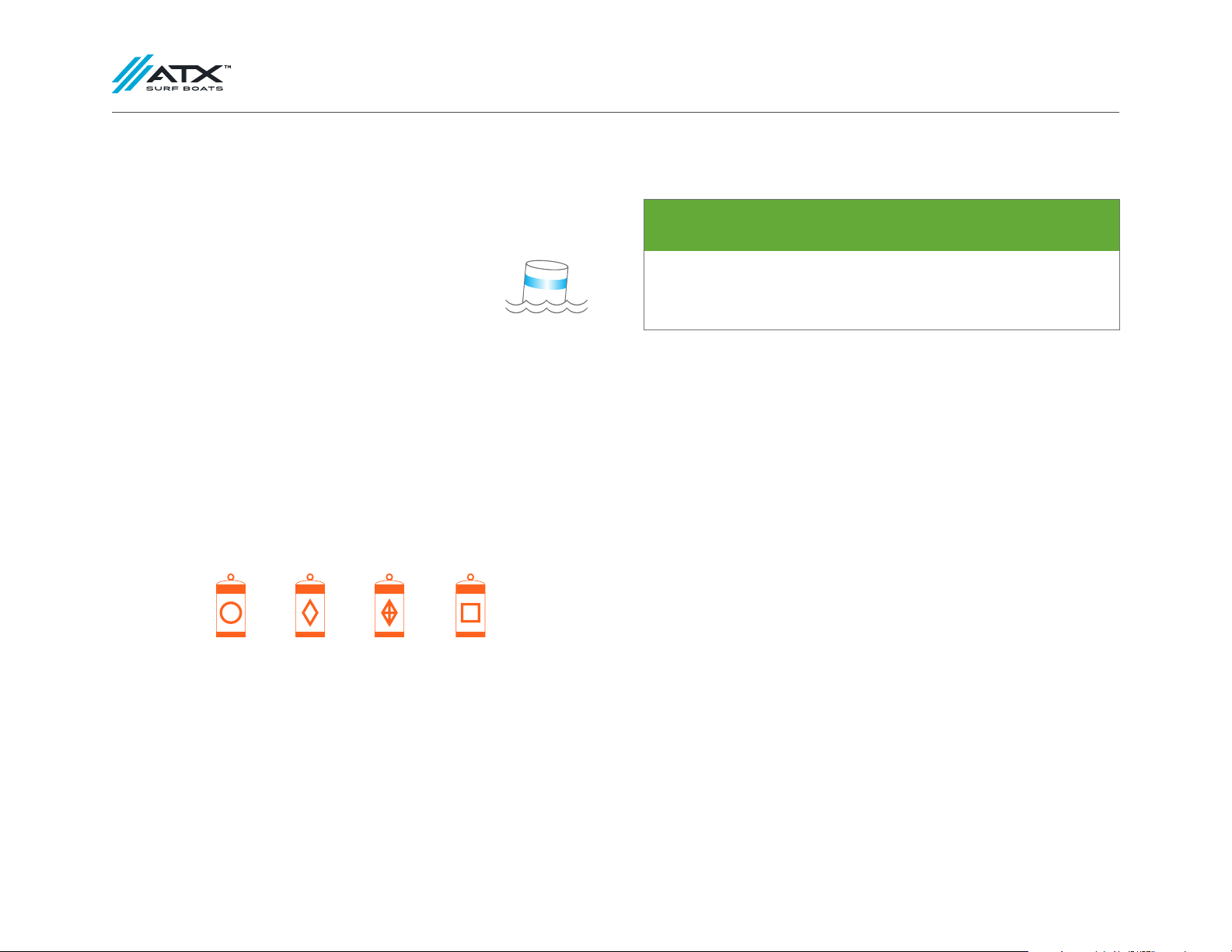
BOATING SAFETY | 42
FWMS Marking System
Buoys with unique light flashing characteristics are identified on nautical charts
with the specific flashing pattern.
Mooring Buoys
The only buoys you are permitted to moor are mooring buoys.
Mooring buoys are white with a blue horizontal stripe. Mooring to a navigation buoy, regulatory markers or lateral markers is illegal. Ko.1901
Uniform State Regulatory Markers
Regulatory markers indicate dangerous or restricted controlled areas. These
markers are used to indicate speed zones, areas set aside for particular use,
general information and directions.
Regulatory markers are white with orange geometric shapes and also have
orange bands near the top and at the water line of the buoy. You must obey
regulatory markers.
RIGHT OF WAY
NOTICE
In general, boats with less maneuverability have right of way over more
agile crafts. You must stay clear of the vessel with right of way and pass
to his stern.
Privileged Boats
Privileged boats have right of way and can hold course and speed. Sailboats and
boats paddled or rowed have the right of way over motor boats. Sailboats under
power are considered motorboats. Small pleasure craft must yield to large commercial boats in narrow channels.
Burdened Boats
The burdened boat is the boat that must make whatever adjustment to course
and speed necessary to keep out of the way of the privileged boat.
Crossing
In crossing situations, the boat to the right from the 12 o’clock to the 4 o’clock
position has the right-of-way.
CONTROLLED
AREA
DANG ER B OATS
KEEP OUT
INFORMATION
It must hold course and speed. The burdened boat keeps passes behind the
privileged boat. Boats going up and down a river have the privilege over boats
crossing the river.
Page 44
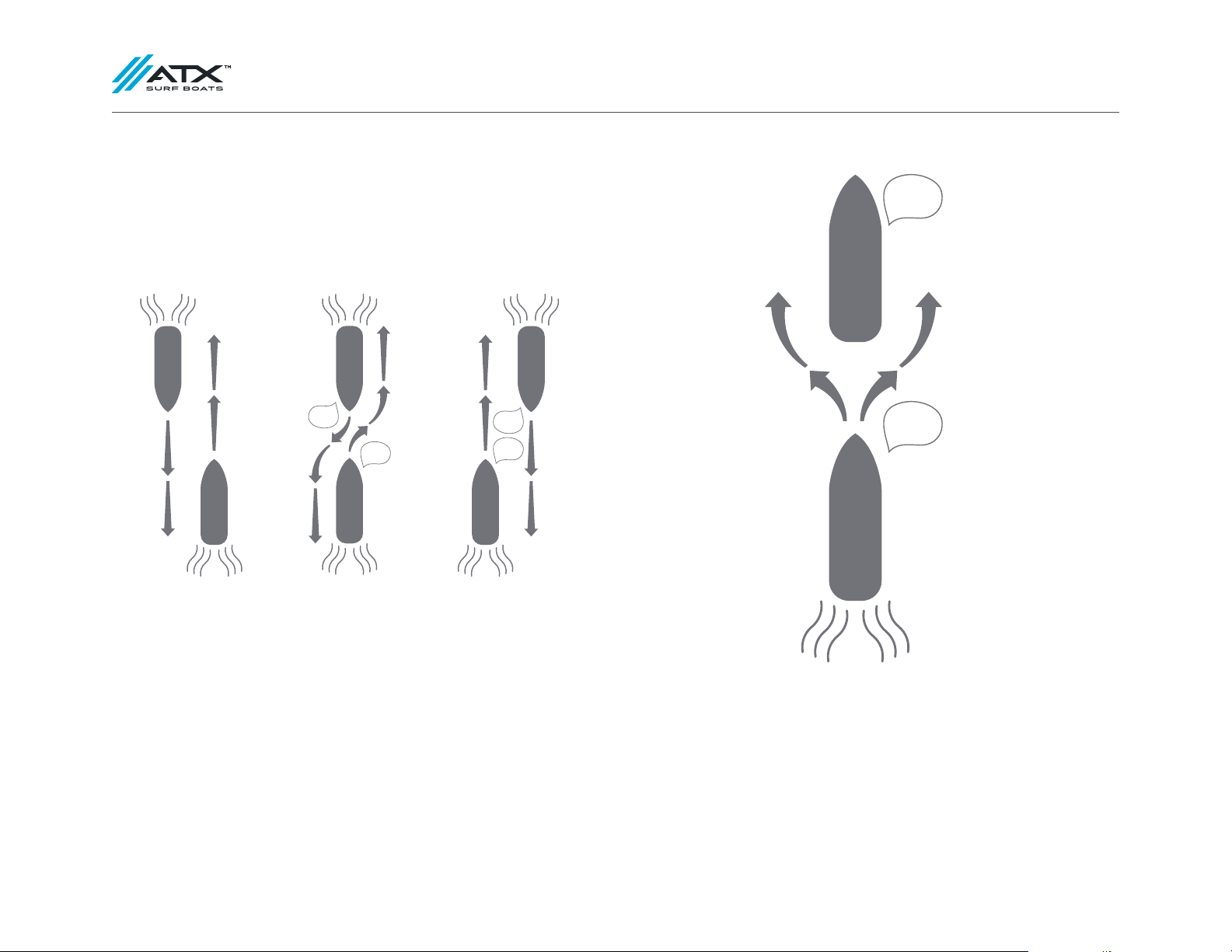
BOATING SAFETY | 43
Meeting Head-On
Neither boat has the right of way in this situation. Both boats should decrease
speed, turn to the right and pass port-to-port. However, if both boats are on the
left side of the channel, each vessel should sound two short blasts and pass
starboard-to-starboar
HONK
HONK
PASSI NG PORT TO PORT MEE TIN G HEA D TO HEA D PASSING STARBOARD TO
HONK
HONK
STARBOARD
HONK
STAND-ON (PRIVILEGED)
VESSEL BEING OVERTAKEN
HONK
GIVE-WAY (BURDENE D)
VESSEL OVERTAKING
Overtaking
The boat that is overtaking one ahead of it is the burdened boat and must make
any adjustments necessary to keep out of the way of the privileged boat.
The General Prudential Rule
The General Prudential Rule regarding right of way, is that if a collision appears
unavoidable, neither boat has right of way. As prescribed in the “Rules of the
Road," both boats must act to avoid collision.
Night Running
Boats operating between sunset and sunrise (hours vary by state) must use
navigational lights. Nighttime operation, especially during bad weather or fog can
be dangerous. All “Rules of the Road” apply at night, but it is best to slow down
and stay clear of all boats, regardless of who has right of way. Protect your
night vision by avoiding bright lights and have a passenger, if possible, help keep
watch for other boats, water hazards and aids to navigation.
Page 45
F E AT U R E S
Page 46

FEATURES
GENERAL LAYOUTS
The General Layout illustration shows the dash panel and the location
of components and accessories. All of these components or accessories
may not be included on your ATX boat.
3-7
9-11
FEATURES | 45
DASH PANELS
The Dash Panel illustration is used to help you identify the location of switches,
controls, ports, gauges and V-drive indicator. Your boat may not be equipped
with all of the features or options.
ATX LINE DASH
1. Steering Tilt Lever
2. Ignition Key Switch, Horn
1
2
8
3. ATX 7" Touch Screen
4. Fuel Gauge
5. Tachometer
6. Speedometer
7. Oil Temperature/Pressure and Battery Gauge
8. Switches (Ballast, Lights, Bilge, Blower)
9. Shifter/Throttle Control Handle
10. TAPS Rocker Switch
11. Emergency Stop Switch
Page 47
FEATURES | 46
SWITCHES, CONTROLS, PORTS, GAUGES AND INDICATORS
Switches
The switches are fitted with LEDs, which will illuminate when power is being
supplied to the corresponding switch and its function.
BILGE (Bilge Pump)
This switch operates the bilge pump to remove excess water from the bilge area
of the boat manually. When the switch is pressed on, the bilge will turn on. When
the bottom is pressed off, the bilge will turn off.
Your ATX boat is equipped with an automatic bilge pump which detects excess
water accumulation and will turn the bilge pump on automatically. The switch
does not have to be on for the automatic system to work. This switch can also
be used to test the bilge pump, by listening to hear that the pump is operating.
It may not pump water unless water is present. Do not operate the bilge pump
continuously when it is dry.
Inspect the bilge area frequently for evidence of excessive water. Continuous
operation of the bilge pump can mean there is excess water in the bilge. Test the
bilge pump at regular intervals. Debris can also prevent the pump from operating or make it operate continuously. Make sure no debris is blocking the bilge
pump float. See your ATX Dealer if you have any questions.
DANGER
Gasoline vapors can explode resulting in serious injury or death.
• Before starting engine, check the engine compartment for gasoline or gasoline vapors, then run blower for 4 minutes.
• Run blower below cruising speed.
COURTESY (Courtesy Lights)
This switch operates the courtesy lights. When the switch is pressed on, the lights
will turn on. When the switch is pressed off, then the lights will turn off.
DOCKING (Docking Lights
This switch operates the docking lights. The docking lights are to be used
for docking only; DO NOT use them while cruising. When the switch is pressed
on, the lights will turn on. When the switch if pressed off, the lights will turn off.
NAV (Navigation Lights)
This switch operates the navigation lights. When the switch is pressed on, the
lights will turn on. When the switch is pressed off, then the lights will turn off.
BLOWER (Engine Compartment/Bilge Area Blower)
This switch operates the engine compartment ventilation blower to remove
explosive fumes from the area. When the blower switch is pressed on, the blower
will turn on. When the blower switch is pressed off, then the blower will turn off.
The blower must be operated for a minimum of four minutes before starting the
engine. Also, the blower should be operated continuously when at idle or running
at slow speeds.
WARNING
LOSS OF CONTROL AND UNSAFE BOAT HAZARD
An emergency stop switch system that is not used or does not function
properly can cause death or serious injury. DO NOT operate the boat if the
emergency stop switch system does not function properly.
Page 48

FEATURES | 47
The emergency stop switch will stop the engine when the lanyard is pulled
far enough to disconnect the clip from the switch. Attach the lanyard to the
boat operator whenever the engine is running, but be aware of loss of engine
power if the switch is activated.
If the operator is thrown from the seat, or moves too far from the dash, the
lanyard will disconnect the clip from the switch, shutting off the engine.
To attach a lanyard, connect the clip to the emergency stop switch and the
hook
to a strong piece of clothing on the operator, such as a belt loop.
IMPORTANT
The engine will not start unless the clip is attached to the emergency
stop switch.
The emergency stop switch can only be effective when it is in good
working condition.
Observe the following:
• DO NOT remove or modify an emergency stop switch and/or its lanyard.
• Keep the lanyard free from obstructions that could interfere with
its operation.
Check the emergency stop switch once a month for proper operation. With the
engine running, pull lanyard to pull the clip from the switch. If the engine does
not stop, see your ATX Dealer for service immediately.
TOWER (Tower Lights)
This switch operates the tower lights. When the switch is pressed on, the lights
will turn on. When the switch is pressed off, then the lights will turn off.
Horn
The “HORN” button is a momentary switch. The horn will operate when the but-
ton is pressed and stop when the button is released.
Ignition Key Switch
This key switch starts and stops the engine. A built-in protection system prevents
the engine from starting in any gear and only in NEUTRAL. Refer to Shifter/
Throttle Control in this section and refer to the engine owner’s manual for more
information.
There is an accessory position on the ignition key switch. A terminal on the back
of the switch is provided to control power to add-on accessories. Even though
power to this terminal is protected by a 20-amp fuse, do not connect any accessory that draws more than 10 amps. Attaching an accessory to this terminal
should only be done by a qualified technician.
NOTICE
DO NOT connect an accessory drawing more than 10 amps to the key
switch accessory terminal. A hazardous situation or damage to the electrical system can occur.
Page 49
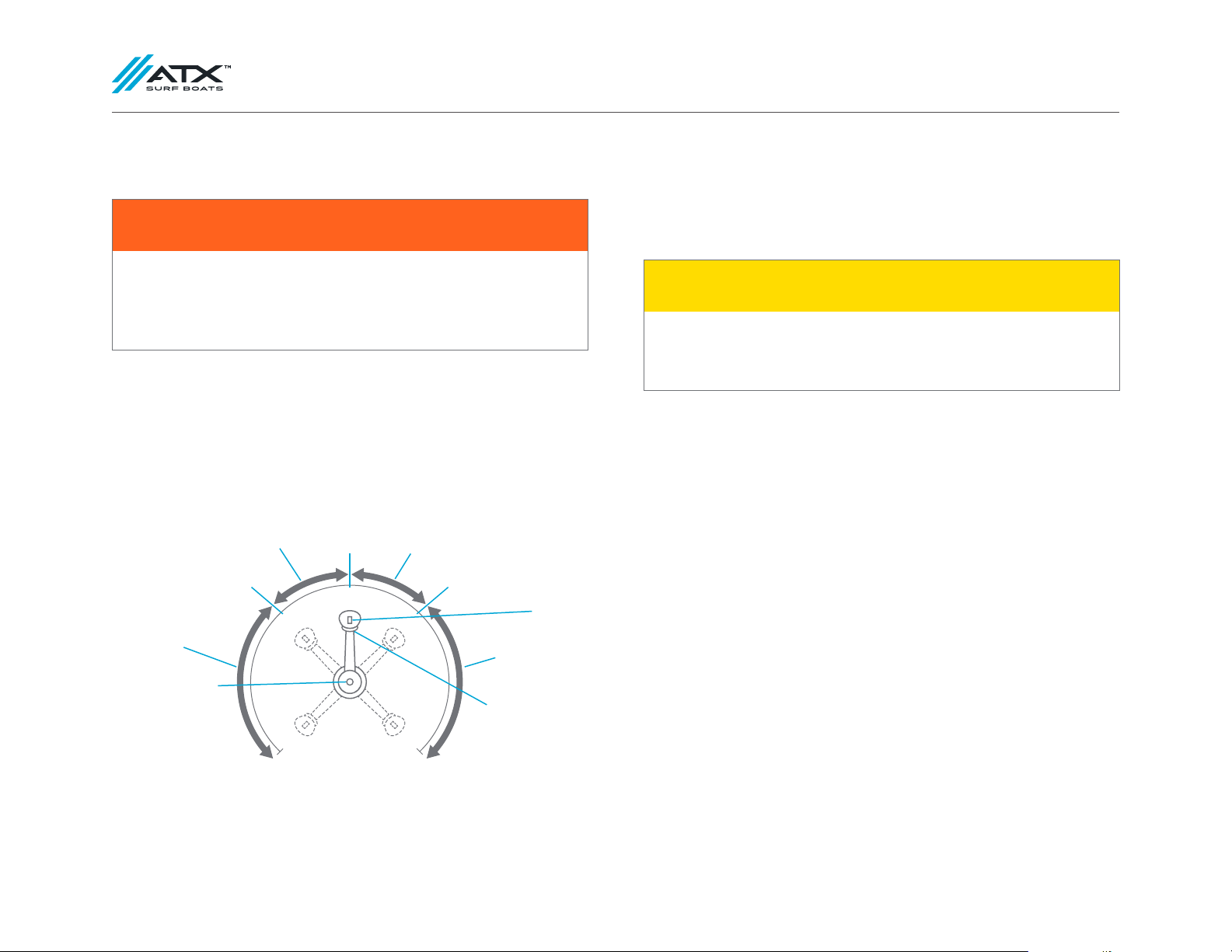
FEATURES | 48
CONTROLS
WARNING
COLLISION HAZARD
An overspeeding engine, from loss of throttle control, can cause collision resulting in death or serious injury. Make sure all control systems are regularly
inspected and properly maintained.
Shifter/Throttle Control
This single-lever control operates both the gearshift and throttle. The control
can only be moved from the neutral position by lifting the safety ring under the
throttle handle. Moving the control forward from the NEUTRAL position will
advance the throttle FORWARD. Moving the control aft from the neutral position
will advance the throttle REVERSE.
FORWARD
THROTTLE RANGE
NEUTRAL
THROTTLE RANGE
FORWARD
SHI FT RANGE
IDLE IDLE
NEUTRAL
REVERSE
SHI FT RANGE
TAP S
ROCKER
SWITCH
REVERSE
THROTTLE RANGE
SAFETY
LOCKOUT
RING
IMPORTANT
The engine will only start in NEUTRAL. If engine does turn over and battery is
charged, make sure the throttle handle is in NEUTRAL and try again.
CAUTION
DO NOT shift too quickly from FORWARD to REVERSE. Stay in NEUTRAL or idle
position until the boat has lost most of its headway before completing the shift
to REVERSE, or engine/transmission damage can occur.
Shifter/Throttle Control Handle: Shifts from NEUTRAL to FORWARD or RE-
VERSE and controls throttle position.
Safety Lockout Ring (Shift Lockout): Detent to prevent shifter from going into
gear without driver action.
Neutral Throttle Button: Allows the throttle to be advance without being
engaged in gear.
TAPS Rocker Switch: This controls the TAPS system. View the TAPS position by
looking at the top and center of the ATXperience Control Center screen. TAPS
can also be controlled through the ATXperience Control Center screen.
FULL
THROTTLE
To “rev” the engine without engaging the transmission from NEUTRAL, push in
the neutral throttle button and advance the throttle handle. To return to normal
operation, return the throttle to the NEUTRAL position.
Page 50
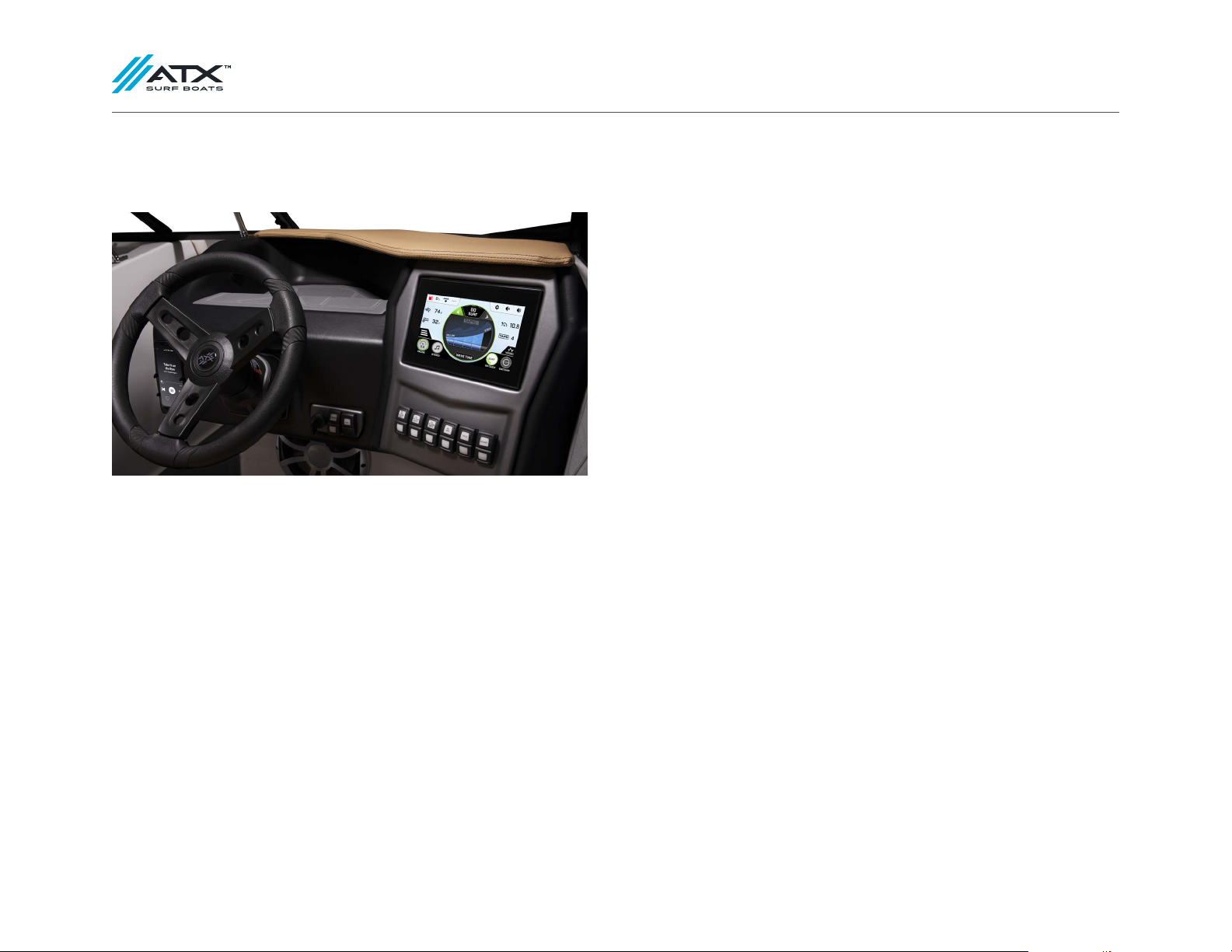
FEATURES | 49
GAUGES
FUEL GAUGE: Indicates the approximate amount of fuel in the tank. The igni-
tion switch must be in the RUN position to activate the gauge.
SPEEDOMETER: Indicates forward speed of the boat in miles per hour (MPH).
ENGINE HOUR METER: Keeps a running total of engine hours while engine is
running. The hour meter is located in the vessel menu of our ATXperience Control
Center screen.
IMPORTANT
The hour meter will log time whenever the engine is running.
TACHOMETER: Indicates engine speed in crankshaft revolutions per minute, or
RPM.
DIGITAL DEPTH FINDER/AIR/WATER TEMPERATURE DISPLAY: Water depth, air,
and water temperature are located on the second page of your ATXperience
Control Center screen.
Setting the ZeroO GPS Cruise Control Display:
1. Turn the ignition key to the ON position.
2. On the ATXperience Control Center screen select SWITCHING
on the home screen.
3. Next select SYSTEM SETTINGS.
4. Then select USER SETTINGS.
5. Select Gauge Units and use the up and down arrows on the screen to
change between US STD and METRIC.
6. When finished, press the ATX Logo button on the bottom left of the screen
to bring you back to the home screen.
TAPS GAUGE: Indicates the position of the TAPS plate located on the top of the
ATXperience Control Center home screen.
Make sure the key is in the OFF position when the engine is not running. Accessory equipment (stereos, showers, etc.) should not be installed to operate
when the key is in the ON position.
Page 51

FEATURES | 50
NOTICE
DO NOT connect an accessory drawing more than the breaker’s amperage capacity. A hazardous situation or damage to the electrical system can
occur.
FUSES
Fuses protect the circuit by limiting the amount of current which can flow. If a
fuse should “blow,” it usually indicates a problem. See your ATX Dealer.
Use only an identical replacement when replacing the fuse.
COCKPIT AND EXTERIOR
Battery Disconnect Switch
The battery disconnect switch allows you to isolate all power to the boat. This
switch provides positive disconnection of the battery to protect against tamper-
ing, electrical fire hazards and battery rundown. Rotate the switch to the OFF
position when the boat is not in use.
Swim Platform
DANGER
The swim platform is a convenient feature to enjoy water sports and provide a
means of safety to boating. The swim platform is required for exiting and enter-
ing your boat and protects you from underwater components of your boat.
There are very serious safety concerns regarding the use of the platform and
safety labels are used to convey safety around the platform. For more information, refer to Section 2, BOATING SAFETY.
Bow Features of Your ATX
The open bow section of your boat may have cushions which can be raised to
access storage. Storage areas are for storage only and should not be occupied
by passengers. These areas do not provide adequate ventilation and can accu-
mulate CO.
Store the cushion in the trunk or under the observer’s seat when it is not in use or
before getting underway.
The Lexan® Walk-thru Windscreen can be installed by sliding it into position
and closing the windshield. Keep the windscreen in its protective boot and stow
when it is not in use. The windscreen will not float.
Walk-thru Windshield Opening/Latching
The two latches on the inside starboard side of the walk-thru windshield must
be latched when the boat is underway or trailered. Rotate both of the window
locks to secure or unlock the window.
Exposure to carbon monoxide or a spinning propeller will cause death or serious injury. DO NOT use the swim/boarding platform for any other purpose
than boarding the craft or preparation for entering the water, and DO NOT
use the swim/boarding platform when the engine is running.
CAUTION
Glass door must be closed and secured with both locks when the boat
is underway.
Page 52

FEATURES | 51
Cockpit Seating
WARNING
DROWNING OR LOSS OF CONTROL HAZARD
Ejection or sudden loss of control can cause death or serious injury from
improper use of seating. DO NOT stand while driving above the engine idle
speeds and make sure cockpit seat is in the locked/secured position and all
passengers are seated when the boat is underway.
EIDB Dual-Battery System—If Equipped
The EIDB dual-battery system protects your starting battery from discharging
when high amperage accessories, like a high-output stereo system, are being
used. The system allows the amperage to be drawn from the accessory battery
only, without drawing from the starter battery. When the engine is restarted,
both batteries will be charged, but will direct the charge to the weaker bat-
tery first.
Batteries
The standard battery is a heavy duty, marine grade 12 V battery. This battery
primarily serves as the cranking battery and can operate standard equipment. A
cranking battery is not designed to fully discharge like a deep cycle battery which
can be fully discharged more often. It is not recommended to fully discharge
the cranking battery. Do not have the battery switch on Combine while operating the boat. The battery switch should only be on Combine in case of an
emergency.
The EIDB Dual-Battery System includes a cranking battery and a deep cycle battery. A Deep Cycle Battery is designed specifically for providing constant power
to high-output stereo systems for extended periods of time.
Engine Compartment Cover
The engine compartment cover is a machinery guard and must be in place and
closed whenever the engine is running. DO NOT operate your boat without the
cover in place or closed unless you are performing a check or maintenance.
WARNING
MOVING PARTS HAZARD
Contact with moving parts can entangle, cut and cause death or serious
injury. Never get close enough to make contact with any running machinery
moving parts, i.e. engine or propeller. Contact can result in loss of body parts,
strangulation, burns and/or severe loss of blood resulting in serious injury or
death.
V-Drive Models
To open the engine cover, first open both rear storage compartments by lifting.
Next remove the storage tub. To close, place the storage tub back over the
engine and slowly lower the back hatches. Keep hands, fingers or any other
obstructions clear when closing.
Observer’s Seat
Lift up on the bottom of the observer’s seat to access storage under the glove
box. Leave the seat up periodically to help keep the storage area dry.
Reversible Bench — Reversible Bench
The rear bench seat can be turned to an aft facing position. To do this, lift the
port and starboard bench cushions. Grab the handle in the reversible bench,
pick up the seat, and turn it around. Insert the black plastic tabs into the open-
ings on either side of the cockpit, ensuring that the plastic slides underneath the
aluminum retainers on both sides. If the tabs of the bench are not beneath the
retainers, the bench could tip backwards, causing injury. Lower the port and
starboard bench cushions.
Page 53

FEATURES | 52
Retractable Pylon
This pylon is extended by lifting the latch and pulling the pylon upward. To lock
the pylon turn it counter clockwise until it stops. To put the pylon away, turn it
clockwise and then push it back down.
WATER SPORTS TOW PYLON SAFETY
WARNING
IMPROPER USE OF TOWER MAY OVERSTRESS THE TOWER, IMBALANCE THE
BOAT OR ALLOW THE TOW ROPE TO CONTACT PASSENGERS POTENTIALLY
CAUSING PERSONAL INJURY OR DEATH
DO NOT
• Tow more than one (1) person at a time
• Tow parasails, kites, inflatable towables or other watercraft
• Allow passengers to sit behind rope attachment point when tower is in use
• Fold or remove tower without assistance
• Use the tower of bolts are loose or missing
• Use tower if tower shows any signs of stress
DO
• Before each use check to be certain all bolts are tight and in place
• Before each use check to be certain tower has no signs of stress
• Watch for low bridges and hanging obstacles
• Watch for electrical lines that may come in contact with the tower
• Make certain your vision and line of sight are unobstructed
• Ensure proper use of tower to avoid over stressing tower or unbalancing boat
• Make certain tow rope does not contact any passengers.
WARNING
CHECK TIGHTNESS OF FIXTURES, DO NOT EXCEED ONE (1) PERSON
OR 300 LBS, USE CORRECT TOW ROPE
FAILURE CAN CAUSE SERIOUS INJURY OR DEATH, READ OWNER’S MANUAL.
Improper use of the tow pylon can overstress the pylon, imbalance the boat or
allow the tow rope to come into contact with passengers.
• DO NOT use the tow pylon for towing parasails, kites or other watercraft.
• DO NOT tow more than one person at a time or exceed a load of 300 lbs
(136 kg).
• DO NOT allow passengers to sit behind the tow pylon when it is in use.
• Check that the tow pylon is secure before every use.
The tow pylon is designed for towing a wakeboard or a ski device only.
Misuse of the tow-point can cause death or serious injury. The pylon was designed for water sports only. DO NOT use the parasailing, kite flying, towing other
watercraft and/or using pylon extensions. DO NOT sit behind (aft) the pylon
when tow pylon is in use.
The water sports tow pylon is manufactured from high-strength aluminum alloy,
engineered for durability. The tow pylon is rated to tow one person and not to
exceed the weight of 300 lbs (136 kg). If the load limit is exceeded or becomes
loose when towing, the tow pylon could separate from the boat. If the pylon
separates from the boat and because of its mass, it could become a missile hazard and strike someone, causing death or serious injury.
Make sure the tow pylon is secured to the boat before each use and the tower is tight. Tow pylons can loosen over time, and must be inspected and tightened
Page 54

FEATURES | 53
before every use. If the tow pylon is loose when towing, it could separate
from the boat.
Although pylon extensions and barefoot booms have become popular additions to many tournament inboards, most boat manufacturers object and
oppose the use of any pylon extension, whether up or to the side of any of their
products. The use of pylon extensions can alter the handling characteristics
of the boat, possibly resulting in dangerous instability, which can lead to loss of
control or a situation which can cause death or serious injury to the boat driver,
passengers, skiers and anyone else who might be in the vicinity.
WARNING
DO
• Before each use check to be certain all bolts are tight and in place.
• Before each use check to be certain tower has no signs of stress.
• Watch for low bridges and hanging obstacles.
• Watch for electrical lines that may come in contact with the tower.
• Make certain your vision and line of sight are unobstructed.
• Ensure proper use of tower to avoid over-stressing tower or
unbalancing boat.
• Make sure tow rope does not contact any passengers.
Back Up Camera—If Equipped
This camera allows the driver to see a rider in the water without having to turn
around and look back at them. The camera video will be seen on the ATXperience Control Center screen. To access the camera feed select VIDEO on the
home screen. This will bring you to the camera feed. If there is no video, try se-
lecting the other input located on the left side of the screen. To leave the video
screen press the bottom left button to bring you back to the home screen.
Pull-out Cleats
The pull-out cleats allow the cleats to be stowed into the boat’s exterior when
they are not in use. Pull the cleats out when they are to be used and return
them when they are not in use. DO NOT use the cleats for towing or tying
as an anchoring point.
DO NOT
• Tow more than one (1) person at a time.
• Tow parasails, kites, inflatable towables or other watercraft.
• Jump from, dive off, climb on, ride, hang onto or sit on tower at any time.
• Allow passengers to sit behind rope attachment point when tower is in use.
• Use tower if bolts are loose or missing.
• Use tower if tower show any signs of stress.
Page 55

Lockdown Boat Cover—If Equipped
The lockdown boat cover is designed to protect your boat during trailering and
short-term storage.
Start by installing the cover from the stern of the boat and unfold the cover
as you move it fore. The cover has a label “REAR” to identify the stern end of
the cover.
After the cover is installed, use the clamp strap to draw the cover snug
around the boat, below the rub rail. Pull the excess strap aft, and winch the
clamp to draw the cover. Lock the clamp. Position any excess strap into the
protective boot and zip closed to protect the clamp from possibly making
contact with your boat.
Boat Cover warranty is covered by OEM manufacturer.
FEATURES | 54
Page 56
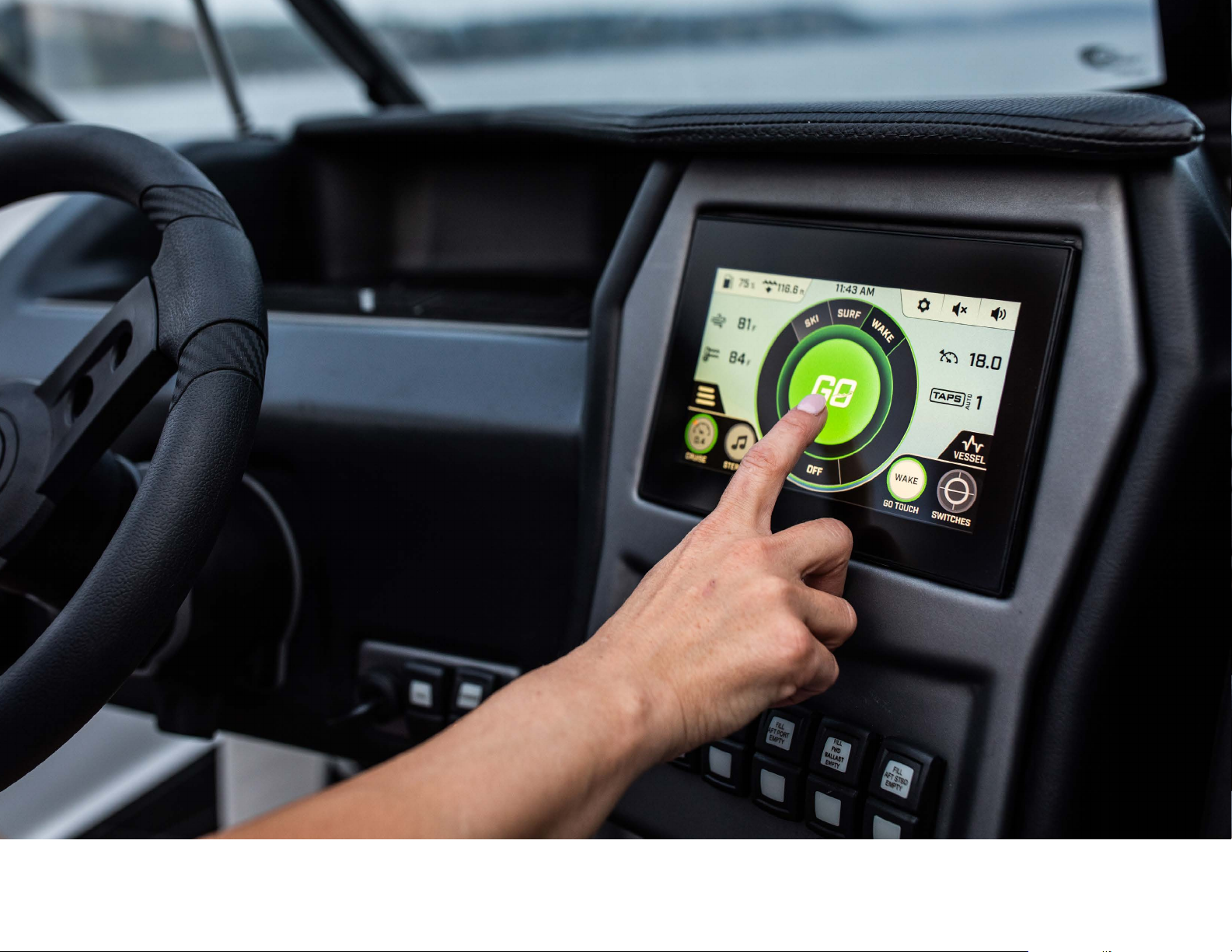
TOUCH SCREENS
Page 57
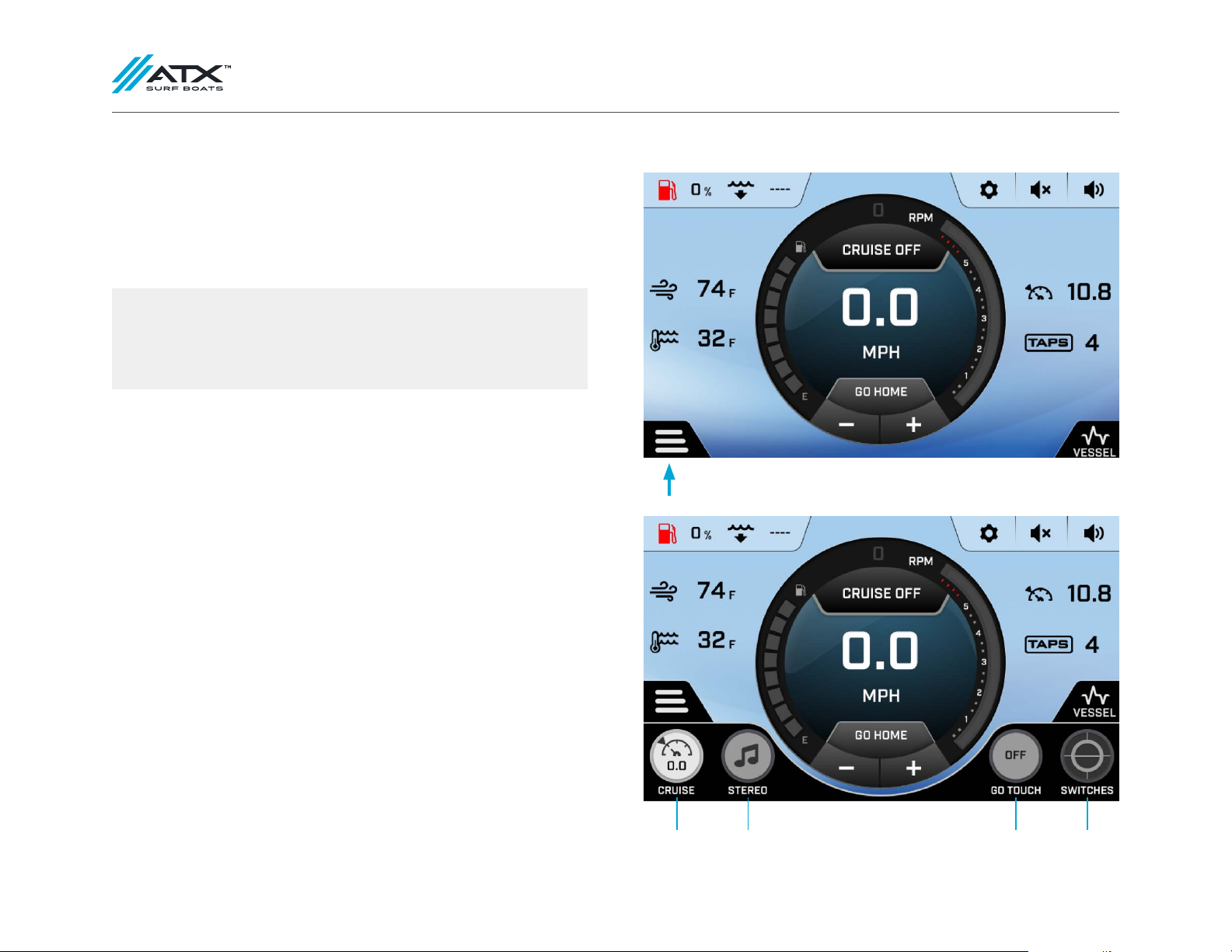
ATX TOUCH SCREEN
CONTROLS
We continually strive to bring you the highest quality, full-featured
products. As a result, you may find that your actual display screens may
be slightly different than what is represented in this manual at the time
of printing.
CARE AND MAINTENANCE
General maintenance is not required; however, a soft cloth can be used for
cleaning the unit. Window cleaner or alcohol can also be used to clean the glass
portion of the display. Do not use harsh or abrasive cleaners on the unit.
TOUCH SCREENS | 56
BASIC NAVIGATION FUNCTIONS
Press the menu button in the lower left hand corner on any screen to switch
between the Cruise, Stereo, Go Touch and Switches screens.
CRUISE STEREO GO TOUCH SWITCH ES
Page 58
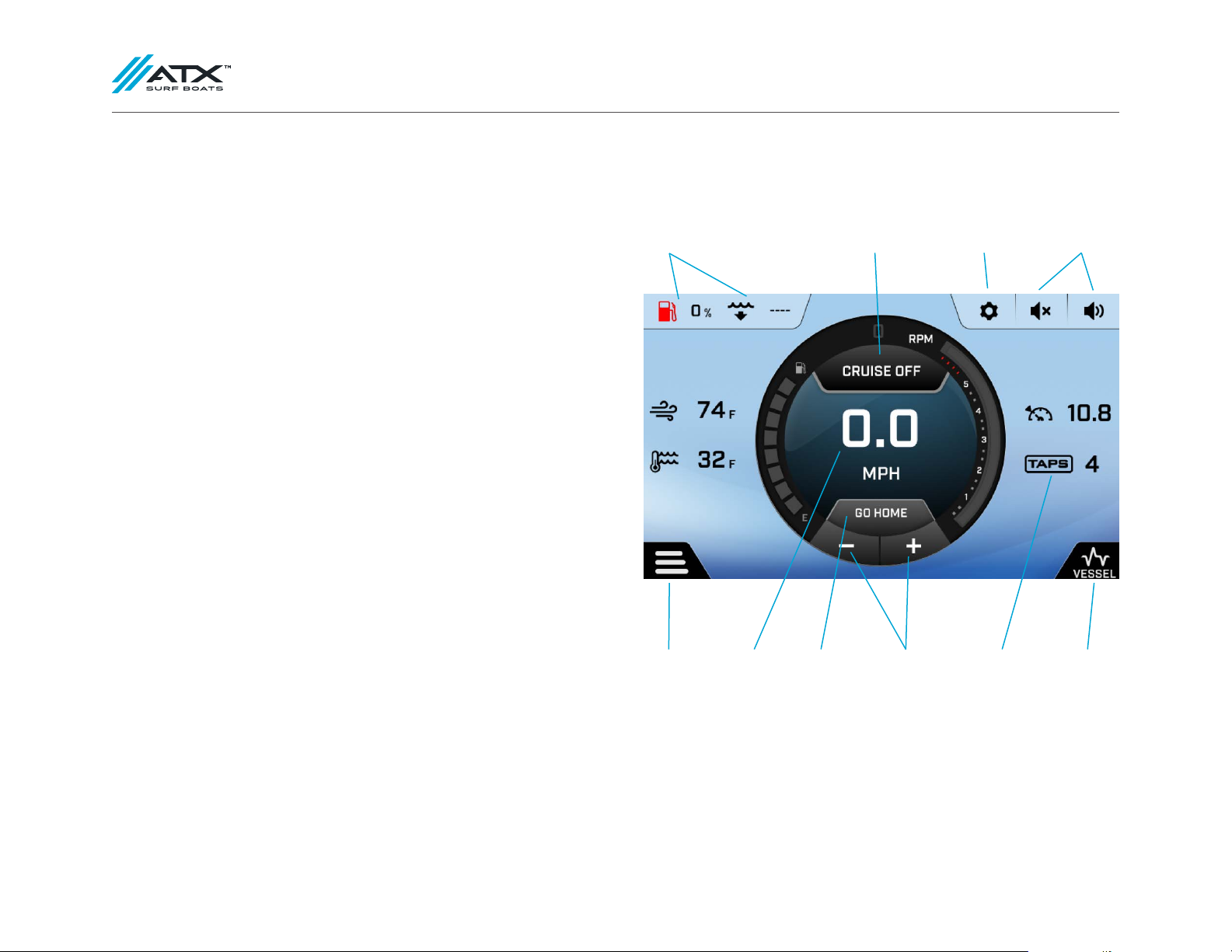
FIRST PAGE: MAIN/HOME SCREENS
When the screen is powered on, the cruise control screen will pop up by default.
This screen contains the following information and controls:
• Paddlewheel Cruise Control Settings
(ZeroOff GPS Cruise Control available as an option)
• Configurable settings (Persists on all pages)
• Fuel Level (Persists on all pages)
• Water Depth (Persists on all pages)
• Air and Water Temperature (Persists on all pages except stereo)
• Volume level and mute button (Persists on all pages)
• Current speed
• Go Home Button
• Cruise Control Set Speed (Persists on all pages except stereo)
• TAPS Position (Persists on all pages except stereo)
• Screen menu button (Persists on all pages)
• Vessel information (Oil Pressure, Engine Temp, Battery Voltage(s),
and Engine Hours) (Persists on all pages)
FUE L LEVE L AND
DEPTH
CRUISE
ON/OFF
TOUCH SCREENS | 57
CONFIGURABLE
SETTINGS
VOLU ME
CONTROLS
CRUISE CONTROL
The cruise control can be toggled off using the Cruise On/Off button. The button
displays the current state of the cruise control. To adjust the set speed, use the +/buttons below the speedometer.
SCREEN
MEN U BUTTON
CURRENT
SPEED
GO HOME
BUTTO N
PADDLEWHEEL
CRUISE CONTROL
SETTINGS
TAP S
POSITION
VESS EL
INFORMATION
Page 59
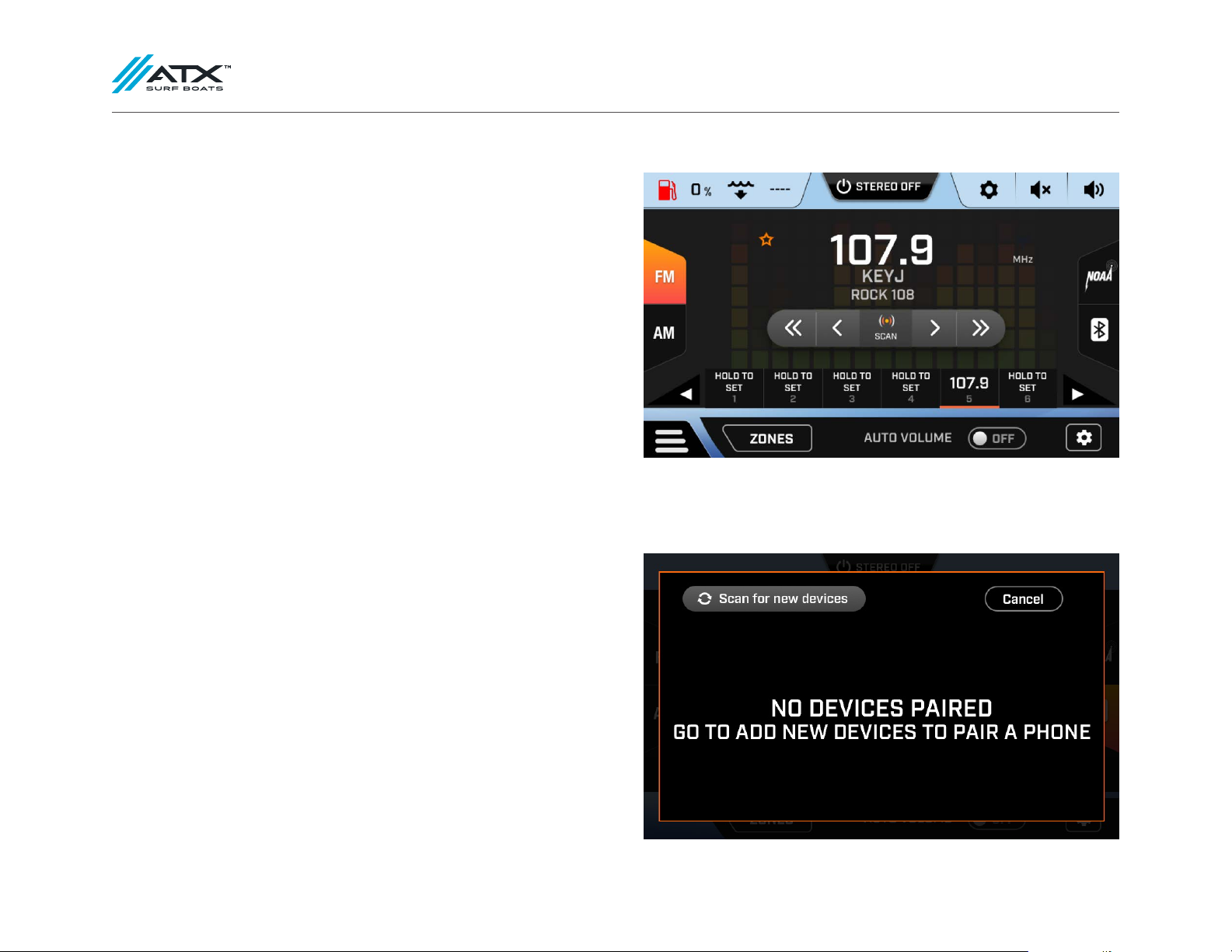
SECOND PAGE: STEREO SCREEN
To turn on your stereo, navigate to the stereo screen through the screen menu
button and press the stereo on/off button at the top of the screen.
The ATX stereo can play music from a Bluetooth device, AM/FM Radio, or NOAA
weather radio. The sources are selectable by pressing the appropriate button on
the edges of the screen.
AM/FM Radio
AM/FM radio stations can be saved as favorites. To do this, tune to the station
of your choice, and press and hold the number you would like to associate with
that station.
Bluetooth
To pair a Bluetooth device, turn on the stereo and select the Bluetooth input on
the right side of the screen. Press the “Connect a Device” button in the center of
the screen. Either choose a device from the list of previously paired devices, or
scan for a new device. If you are pairing a new device, make sure you have the
Bluetooth settings open on the device and it is discoverable. When the screen
finds your device, press the + button next to its name, then press pair on your
device when prompted.
TOUCH SCREENS | 58
Devices can be forgotten from the same list where they are added. Simply press
the X next to the devices name to forget it.
Page 60

Zone Controls
There are 3 possible stereo zones on your ATX sound system: Interior, Sub and
Tower (if equipped). Each zone’s volume can be controlled individually. To do this,
select zones at the bottom of the stereo screen.
The volume of each zone can be adjusted using the sliders. You are also able to
mute each zone individually by pressing the mute/unmute button to the right of
each zone slider.
There is also a master volume slider that works as a multiplier for the zones. For
example, if your interior volume is at 50%, and your master volume is at 50%,
your interior speakers are at 25% of their possible output. For maximum volume,
ensure all sliders are set to 100%.
Auto Volume
A useful feature for using the stereo while enjoying watersports is Auto Volume.
Auto Volume allows the stereo to be at a low volume while the boat is moving at
a slow speed, and a higher volume while the boat is moving at a faster speed.
To adjust the set volumes and speeds, press the settings button in the bottom
right hand corner of the stereo screen. In this menu, you can choose your maximum and minimum speeds, as well as maximum and minimum volumes. Once
you have adjusted your settings, toggle Auto Volume to on. The volume will now
automatically adjust according to your speed.
TOUCH SCREENS | 59
Page 61
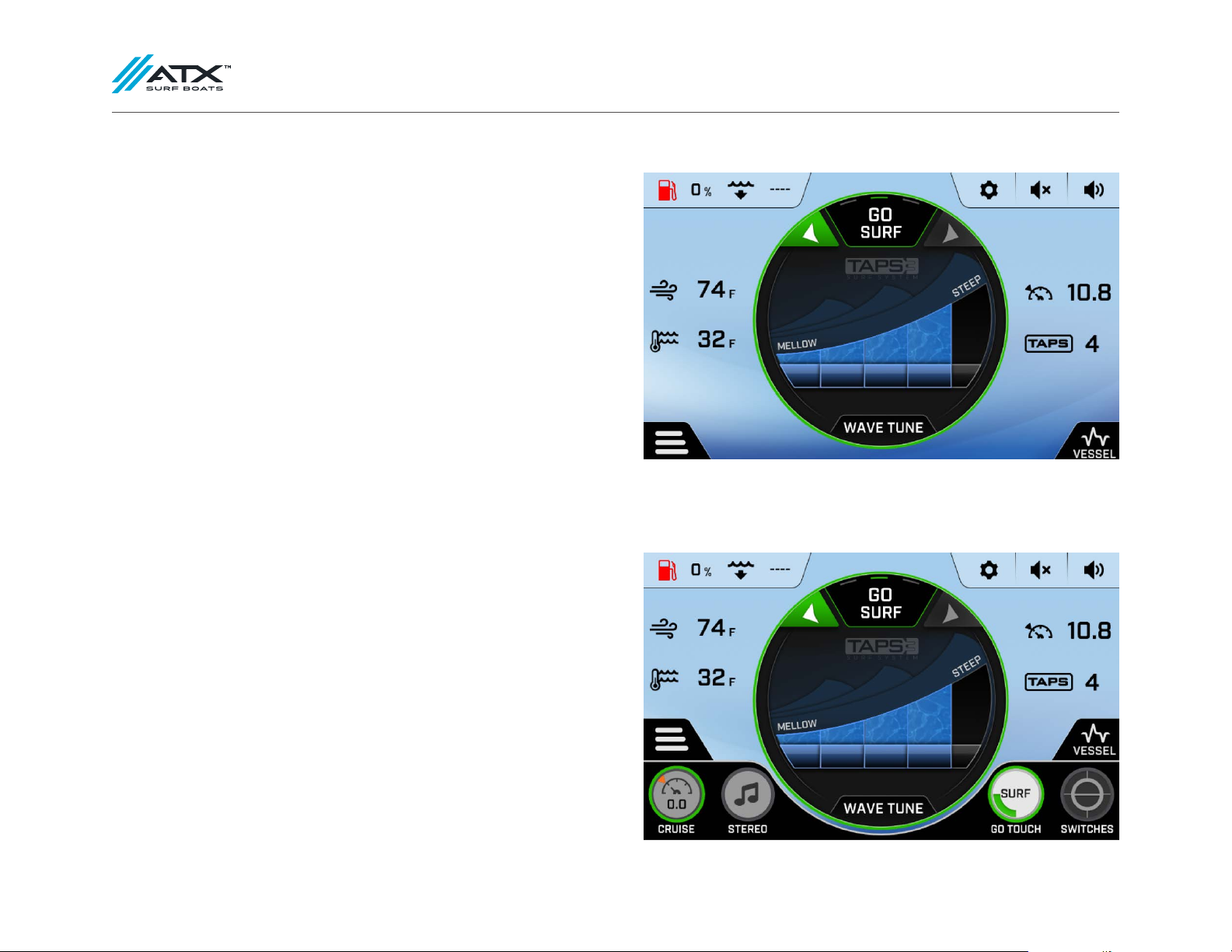
THIRD PAGE: GO TOUCH CONTROLS
To enable the Go Wake, Go Ski, or Go Surf system, navigate to the Go Touch
screen through the screen menu button. When you first navigate to this screen,
you will see 3 options above the word go. Select what you would like to do, and
then press go.
Go Wake/Go Ski
When Go Wake is enabled, the first choice you will need to make is Beginner,
Intermediate, or Pro. Your choice affects the initial speed and TAPS plate position.
Speeds and positions vary by model. Once a selection is made, the system will
automatically set your cruise control and TAPS plates. The Go Ski setting is very
similar to the Go Wake setting. Choose beginner, intermediate or pro and the
system will set your TAPS and cruise control appropriately.
Go Surf
When Go Surf is enabled, the default is set up to surf the port side of the boat. To
switch sides, press the right arrow near the Go Surf indicator. The default values
for the Go Surf system will yield a steeper, larger wave. The height/length of the
wave can be adjusted using the Mellow-Steep keys or the Wave Tune button.
The Mellow-Steep keys alter the position of the outer TAPS 3 plates and Wave
Tune adjusts the position of the center TAPS plate. To adjust the center TAPS plate,
you can either use the rocker switch on the throttle or press “Wave Tune” and use
the +/- buttons. The Go System is set up to give a good starting point for each
watersport.
TOUCH SCREENS | 60
Depending on boat loading and personal preference, you may need to adjust
from the default settings provided. Cruise control can still be manually adjusted
on the cruise page.
To exit out of the Go System and regain manual control of the boat, press the
icon at the top of the circle that shows which Go System you are using. This will
bring you back to the initial Go Touch screen where you can then select off.
Page 62

FOURTH PAGE: SWITCHES SCREEN
This screen contains the controls for many of the optional accessories on your
ATX. See the full list of potential options below. Contact your ATX dealer if you
would like to add any of these options to your boat.
• Courtesy lights (Standard)
• Docking lights (Option)
• Heater (Option)
• Speaker lights (Option)
• Underwater lights (Option)
The brightness of the courtesy lights can be adjusted by using the +/- buttons.
TOUCH SCREENS | 61
Page 63
OPERATION
Page 64

OPERATION
There are many things to consider when planning a safe and enjoyable boating
trip. This section describes the basics on fueling, starting, shifting/running, steer-
ing, docking and stopping your boat. This section also includes a safety preflight
checklist, boarding guidelines, boat loading information and other important top-
ics on handling your boat. Knowing and understanding all of these fundamentals
will give you confidence in using your boat.
Read and understand the contents of this section before casting off. Remember,
if you have a problem during your outing, you cannot get out and fix it, or walk
to safety or for help. You are responsible for the safety of all passengers, the boat
and any damage your boat or its wake may cause. Always keep passengers from
blocking your view so that you do not run into other boats, swimmers, water skiers,
personal water vehicles or aids to navigation.
PREFLIGHT CHECKLIST
The following checks are essential to safe boating and must be performed before starting the engine. Get in the habit of performing these checks in the same
order each time so that it becomes routine.
DO NOT launch the boat if any problem is found during the safety check. A
problem could lead to an accident during the outing causing severe injury or
death. Have any problem attended to immediately; see your dealer.
OPERATION | 63
Energize Electrical System. Energize system by:
• Turning on the Battery Disconnect Switch located near the battery (for 22
Type-S and 24 Type-S models the switch is located in the glove box.
• Check fuel level. If possible, fill tank at a land-based fueling station. Marina
gas sometimes contains water and is usually more expensive. Highest
octane gas available is recommended.
• Make sure the Saltwater Flush Kit shut-off valve (if equipped), and/or
seacock on water pickup (seacock applies to all models sold in Canada), is
open (handle in-line [OPEN] with hose, not perpendicular [CLOSED]).
• Check engine oil level.
• Check transmission fluid level.
• Check battery charge.
• Check and operate the blower.
• Check that bilge drain plug is installed properly.
• Check the propeller, strut and rudder for damage.
• Check the weather report, wind and water conditions.
• Lift engine compartment cover for to check for evidence of gasoline fumes.
• Check that the required safety equipment is on board.
• Check that the fire extinguisher is fully charged.
• Check that all required maintenance has been performed.
• Check bilge pump operation and make sure bilge is free of debris.
• Check steering and rudder movement.
• Make sure adequate number of PFDs and all other Coast Guard-required
items are onboard and accessible.
Before towing
• Check trailer tire pressure and tire wheels.
• Ensure trailer is securely connected to tow vehicle. Check safety wires and
pin. Check bow hook to ensure boat is hooked on trailer.
Before launch
• Check and tighten all hardware including pylons, towers, speakers and
other accessories.
Launch
• Operate the blower for at least four minutes before starting engine.
• Check bilge for leaks.
• Stow gear and clothing.
Page 65
OPERATION | 64
Pre-Operation
• Check that no fuel, oil or water is leaking or has leaked into the
bilge compartment.
• Check all hoses and connections for leakage and damage.
• Check the engine cooling water intake pick-up for blockage.
• Check that battery terminals are clean and tight.
• Check electrical circuits (lights, pumps, horn, etc.) for proper operation.
• Check that shifter/throttle control handle is in NEUTRAL.
• Check that the steering system operates properly.
During Operation
• Monitor gauges frequently for signs of abnormal behavior.
• Check that controls operate smoothly.
• Check for excessive vibration.
After Operation
• Fill fuel tank to prevent moisture from condensation.
• Check for fuel, oil and water leakage.
• Check the propeller for damage.
FUELING
WARNING
Try not to spill gasoline. If gasoline is spilled, wipe up all traces of it with dry rags
and immediately dispose of the rags properly onshore.
When fueling
1. Close all doors, hatches, windows and other compartments.
2. Extinguish cigarettes, pipes and all other flame-producing items.
3. Make sure all power is off, and DO NOT operate any electrical switches.
4. Open fuel fill cap and insert hose nozzle.
5. Add fuel in accordance with the engine owner’s manual. DO NOT fill to
capacity to allow for fuel expansion.
6. Tighten the fuel filler cap completely after refueling.
7. Check oil level.
NOTICE
Each time you fill up, inspect fuel lines for leaks and hose deterioration.
After fueling, make sure fuel and oil caps are tightened securely and wipe up
any spillage.
CAUTION
FIRE/EXPLOSION HAZARD
Gasoline vapors are highly explosive when exposed to open flame or spark
resulting in death or serious injury. Run blower for at least four minutes before
turning on any electrical devices or starting the engine.
• Stop all engines, motors and fans before refueling.
• Do not smoke or allow open flames or sparks nearby, within 50 ft (15 m) of
the fueling area.
• Maintain contact between the fuel nozzle and the fuel tank to prevent electrostatic spark. DO NOT use a plastic funnel.
To prevent engine damage, refer to the engine’s owner’s manual for man-
ufacturer’s recommended fuel.
Page 66

OPERATION | 65
SHIFTING/RUNNING
When shifting your boat, follow these guidelines:
Pause in neutral before shifting from FORWARD to REVERSE, or REVERSE
to FORWARD.
• Avoid shifting into reverse while the boat is traveling forward at speed.
• Keep the shifter control clean and clear of obstructions.
To shift into forward: Push shifter/throttle control handle forward to go forward.
To shift into reverse: Push shifter/throttle control handle back for reverse.
STEERING
Practice steering your boat. Make sure the steering system is working correctly
and is properly maintained. Have the steering system checked regularly.
WARNING
LOSS OF CONTROL AND UNSAFE BOAT HAZARD
Hazard from improper maintenance of steering system is hazardous and
can cause death or serious injury from sudden loss of control. Make sure
all steering hardware, cables and fluid levels are regularly inspected and
maintained.
STOPPING
1. Slowly bring the shifter/throttle control handle to the idle position. If the
boat has been driven for a long period of time at high speed, allow the
engine a two- to three-minute cooldown period at idle.
2. Turn the ignition key to the OFF position.
3. If any problems were encountered during the outing, have the boat
inspected by your dealer and request any necessary repairs before the
next outing.
DO NOT use the emergency stop switch to shut off the engine.
DOCKING
Practice docking before attempting it for the first time. Use a float, like
a plastic milk jug with a line and small weight, as your docking target.
Remember, your boat is steered with a rudder and maneuvering at slower
speeds takes practice.
WARNING
CRUSH HAZARD
Using your hand, arm, or other part of your body to attempt to keep the boat
from hitting the dock can result in serious injury. DO NOT use any body part to
keep the boat from hitting the dock.
Boats have a tendency to wander at slow speeds and steering the boat back and
forth will result in over-steer. Keep the steering wheel in the center position and
make slight adjustments.
Dock and Mooring Lines
Use enough fenders to protect the craft from damage and good quality dou-
ble-braided nylon line. Only use the cleats, bow eye and stern eyes to secure
the craft. DO NOT use the handrails or windshield. The foredeck handrails
should only be used for tying a “jackline” in an emergency situation.
Page 67
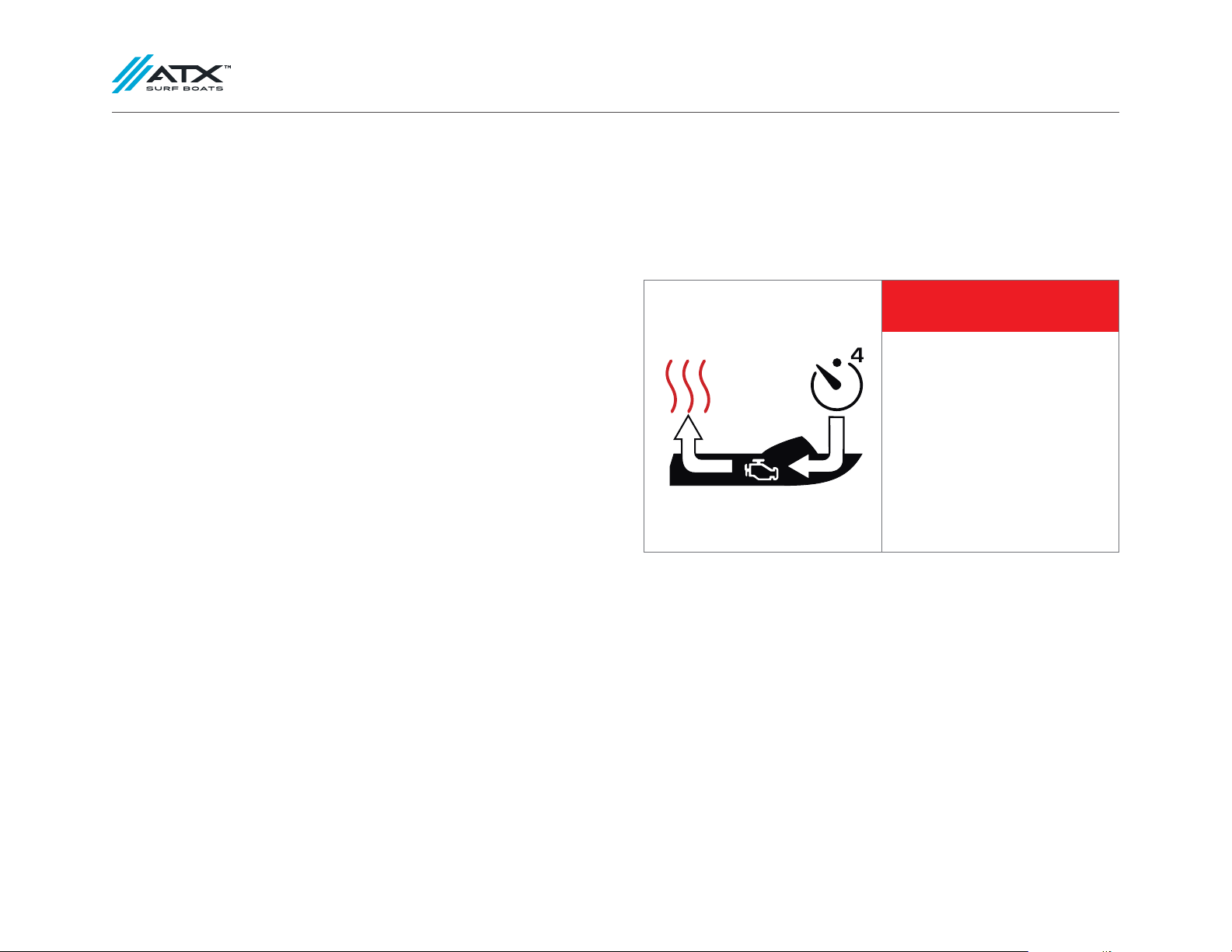
OPERATION | 66
Follow these guidelines when docking:
• Approach docks slowly with the starboard side of the boat if possible.
• Come to a stop a short distance from the dock, then proceed slowly.
• Have fenders, mooring lines and crew ready.
• Observe how the wind and current are moving your boat. Approach the
dock with the boat pointed into the wind, if possible. If the wind or current is
pushing you away from the dock, use a sharper angle of approach. If you
must approach the dock downwind or down current, use a slow speed and
shallow angle. Be ready to reverse to stop and maintain position.
• If there is no wind or current, approach the dock at a 10- to 20-degree angle.
• If possible, throw a line to a person on the dock and have that person
secure a bow line.
• With the bow secure, swing the stern in with the engine, or pull it in with a boat
hook.
If the boat is to be moored for a long period of time, use chafing protectors on
lines to protect the gelcoat finish. Leave slack in the lines to allow for some wave
movement or tidal action if applicable.
Follow these guidelines when departing:
• Very slowly shift into forward at idle speed.
• When the stern moves away from the dock, turn the engine away from
the dock.
• Cast off bow line and back away.
If the wind or current is pushing away from the dock, cast off all lines and allow
to drift until you are clear.
STARTI N G
• Run the blower for at least four minutes before starting the engine. If you
smell gasoline fumes, do not start the engine. Continue to run the blower
until fumes have dissipated.
DANGER
GASOLINE VAPORS CAN EXPLODE
RESULTING IN SERIOUS INJURY
OR DEATH
• Before starting engine, check the
engine compartment for gasoline or
gasoline vapors, then run blower for
4 minutes.
• Run blower at idle or below cruising
speed and after stopping to clear
vapors from engine compartment.
• Make sure the Saltwater Flush Kit shut-off valve (if equipped) and
seacock on water pickup are open (handle in-line [OPEN] with hose,
not perpendicular [CLOSED]).
• Make sure the emergency stop switch is attached to the switch and the
lanyard is attached to the operator.
• Make sure the shifter/throttle control handle is in NEUTRAL.
• Turn the key clockwise to the STA RT position. After the motor starts, release
the key.
• Push shifter/throttle control handle forward to go forward, pull back
for reverse.
Always pause in NEUTRAL before going into REVERSE to avoid taking water
in over the transom.
Page 68
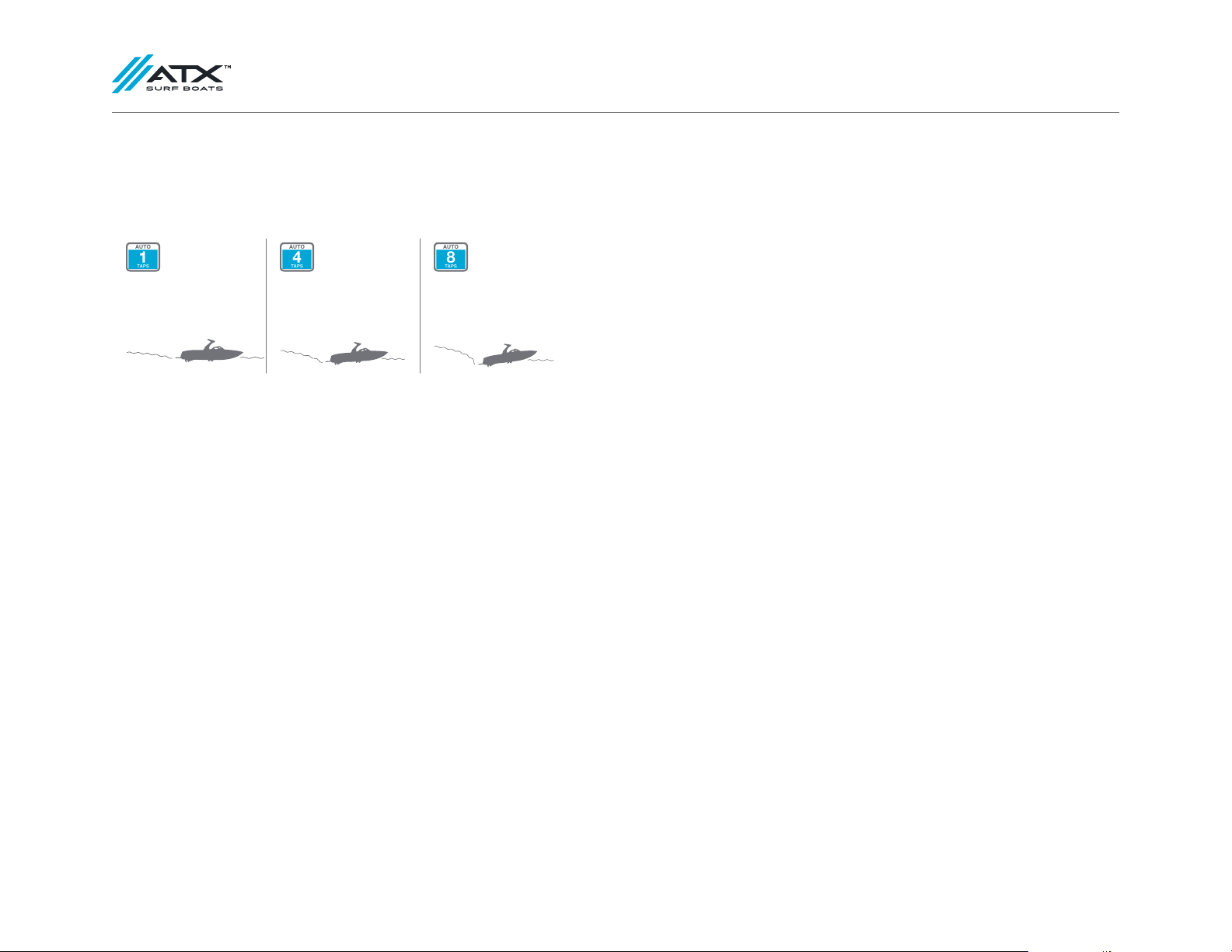
OPERATION | 67
TAPS OPERATION
For instant planing and c lean,
faint slalom wakes.
Working in conjunction with the patented Convex V hull, TAPS allows variable-hull
trim capability that dramatically enhances wake characteristics, ride and overall
boat performance. With the push of a button, TAPS instantly modifies the hull’s running angle for optimum watersport wake enhancement, a smoother ride in rough
water, better fuel economy and increased safety and comfort.
TAPS adjustments are made using the rocker switch located on the throttle
handle. Always keep your left hand on the steering wheel and your right hand
on the throttle.
The location of the TAPS switch allows operation with the right thumb, maintaining safe, hands-on control of the throttle.
TAPS switch adjustments can be made while stopped or while underway at
any speed. The position of TAPS plate is indicated on the TAPS gauge located top
center of the ATXperience Control Center home screen.
Settings range from 1, a flat, bow-low running angle to 8, a bow-high running
angle. To move the bow to a higher running attitude, push the top of the TAPS
rocker switch (the TAPS will raise). The TAPS gauge will begin moving toward a
higher number. To lower the bow, push the bottom of the TAPS rocker switch.
The bow angle will lower and the TAPS gauge will move to a lower number.
Adjust wake size or trim
for optimum cruis ing, fuel
eiciency, top speed or
performance.
Convex V hull settles
naturally at boa rding an d
surfing speeds.
Although the effects of the various TAPS settings depend on ATX model, passen-
ger load, water conditions, speed and other factors, the following guidelines are
provided as a starting point as you learn to use TAPS to optimize your performance needs. Practice and experience using TAPS can also optimize your performance needs.
Ride, Safety and Boat Performance
The variable-hull TAPS system also dramatically enhances boat performance,
comfort and safety. To eliminate bow rise on take-off, set TAPS at 1. As soon as the
boat reaches planing speed, adjust TAPS to 3 or higher, depending on water
conditions. If the water is choppy, less than 6 in. (152.4 mm) waves, the optimum
ride setting will be from 2 to 5, depending on ATX model and passenger load. If
the water is rougher, 6 to 12 in. (152.4 to 304.8 mm) waves, the optimum ride setting
will be from 5 to 8, depending on ATX model and passenger load.
Raising the bow in rougher water will provide a safer, drier ride while maximizing the hull’s “entry vee” to reduce the effects of the chop. This higher running
attitude will also provide bow passengers with a smoother, drier ride.
To maximize top speed in your ATX, set TAPS between 5 and 8. When the boat
reaches top speed, bring the TAPS setting down slightly to achieve the optimum
running attitude. Top speed should be achieved at a TAPS setting of 5 to 6.
TROUBLESHOOTING
No throttle power when you start your boat engine:
Move throttle to neutral and verify that the dash Cruise Control switch
is toggled OFF.
Boat does not seem to maintain speed on turns or in rough waters:
Verify that you have given your boat plenty of throttle authority (move the
throttle forward).
Page 69

OPERATION | 68
Engine power cuts out and then in:
This usually occurs when the throttle is positioned at, or near, the set speed. Move
the throttle to the full forward position after the speed is set, giving ZeroOff GPS
Cruise Control adequate throttle authority.
SAFETY EQUIPMENT
Federal and local laws require certain safety equipment to be onboard at all
times. In addition, responsible boaters carry other equipment in case of emergency. Check with local boating authorities for any additional requirements
over and above federal requirements.
Refer to Section 2, SAFETY, Required Safety Equipment.
BOARDING
When boarding the boat, always step in. Do not jump. Avoid stepping on fiberglass or other potentially slippery surfaces. Board one person at a time.
DO NOT board the boat while carrying gear. Set gear on the dock, board the
boat and then pick up the gear.
When boarding once in the water, swim towards the back of the boat to the
swim platform. Grab ahold of the grab handle located above the swim platform
and pull your body up onto the swim platform. Step up from the swim platform
onto the boat. Avoid stepping on the fiberglass or other potentially slippery
surfaces.
All passengers should be carefully seated and not be riding on the deck, gun-
wale or rear sun deck while underway. Passengers riding in the bow should
exercise extreme caution. Do not overload the open bow area. Never seat more
than three people in the open bow area (See seating chart on page 10). Refer to
the Capacity Label and Seating Chart for number of people allowed in the bow
area. Children under 11 years of age should not use the open bow area unless
accompanied by an adult. During rough water operation, passengers in the bow
should move to the aft passenger seats.
• DO NOT allow your passengers to ride with their feet dangling over the side;
floating debris can cause serious injury.
• Avoid excess weight in the bow or stern.
• Securely stow all extra gear in stowage areas to prevent load shifting.
Do not stow gear on top of safety equipment; safety equipment must be
quickly accessible.
In adverse weather, reduce the load in the boat. People/load capacity ratings are
based upon normal boating conditions.
RUNNING
We urge you and all others operating the boat to seek certified instruction from
local boating authorities.
This section is designed to present the most basic operational principles. It is not
intended to cover all conditions encountered during operation.
BOAT LOADING
The performance of your boat is dependent on load weight and distribution.
Passengers should board one at a time and should distribute themselves to maintain
trim. Remember to distribute weight from right to left, and also from front to back.
The principles presented in this manual are limited to the facts related directly
to the operation of the boat, while the responsibility for the proper application of
these principles belongs to you.
Page 70

OPERATION | 69
MANEUVERING TECHNIQUES
Steering response depends on three factors: engine position, motion
and throttle.
High-speed maneuvering is relatively easy and takes little practice to learn.
Slow-speed maneuvering is more difficult and requires time and practice
to master.
When making tight maneuvers, it is important to understand the effects of
turning. Since both thrust and steering are at the stern of the boat, the stern
will push away from the direction of the turn. The bow follows a smaller turning
circle than the stern.
The effects of unequal propeller thrust, wind and current must also be kept in
mind. While wind and current may not always be present, an experienced boater will use them to their advantage. A counterclockwise rotation propeller tends to
cause the boat, steering in the straight ahead position, to drift to port slightly when
going forward, and to starboard when going backward. At high speed, this
effect is usually unnoticed, but at slow speed, especially during backing, it can
be powerful. More experienced boaters approach the dock with the starboard
side of the boat toward the dock, if possible.
Stopping (checking headway) is a technique that must be developed. Since a
boat has no brakes, reverse thrust is used to slow and stop the boat. The mo-
mentum of the boat will vary according to the load as well as the speed.
Make it a practice to slow to idle (no-wake) speed before shifting into reverse.
It is best to learn maneuvering skills in open water away from traffic. Practice is
the only way to develop your boating skills.
SALT WATE R
If boat is used in salt water or brackish water, allow the cooling system to drain
thoroughly after removing the boat from the water. Hose down the entire hull with
fresh water and wipe dry.
Today’s engines are built for operation in either fresh or salt water. Fresh water
internal flushing is not normally required; however, it is highly recommended
after use in salt, polluted, or brackish water. Your ATX Dealer or engine manufacturer will assist you in securing the appropriate engine flushing device.
WINTERIZATION
At the end of the season and before the temperatures drop below freezing,
drain the engine completely when the boat is removed from the water. Your ATX
Dealer can provide the service.
TOWING PROCEDURE
If water is rough, it may not be easy to extend the tow line from one boat to another. In these cases, use a light throwing line with a weight on one end and with
the heavier towing line secured to it.
Never attempt to tow a much larger or grounded vessel. Because of the
tremendous stress caused by towing, use a tow line that is rated at least four
times the gross weight of the boat being towed. Tow ropes must always be in
good condition, free of any cuts or abrasions.
Attach tow line to the bow lifting eye on the disabled boat. Attach the opposite end
of the bridle only to the stern lifting eyes of the tow boat. Wrap the bridle with
chafing gear where it rubs against the boat or any corners. Leave at least two
boat lengths between the boats for adequate movement.
When towing, use only the bow and stern eyes; never use cleats, handrails, etc.
Do not allow anyone to be in line with the tow rope. If the rope should break or
pull free, a dangerous recoil could occur.
Adjust the tow line to match wave action. Keep the boats on the crest or in the
trough of the waves at the same time. In protected, calm waters, shorten the
line for better handling. Always tow at moderate speed, allowing for adverse
wind and wave conditions. Have the operator of the towed boat steer with
you if possible.
Page 71

OPERATION | 70
If you need a tow, or wish to tow another boat, use great care. The boat structure can be damaged by excessive pulling strain. You should always offer
help to a boat in trouble; however, towing a capsized, grounded, or hull-damaged boat is dangerous. Give assistance to the occupants, and then call the
proper authorities.
ANCHORING
Dropping Anchor
There are many types of anchors available on the market. The choice of one
anchor over another depends on many factors. An anchor will usually hold
best in a mixture of mud and clay or in hard sand. A lightweight Danforth
anchor is recommended for general boating. For more information on anchors,
see your dealer.
WARNING
SINKING OR DROWNING HAZARD
Anchoring at the stern can pull a boat under water and keep it there.
DO NOT anchor at the stern.
• Make sure the line is tied to the anchor and tie the other end of the line to
the bow lifting eye. Having approximately 2 feet of heavy chain between
the line and anchor will help the anchor place.
• Head the boat into the wind or current over the spot where you want to
lower the anchor.
• Stop the boat before lowering the anchor.
• When the anchor hits bottom, slowly back up the boat, keeping tension on
the line. Let out an anchor line that is four to six times the depth of the water.
For example, if you are in 10 ft (3 m) of water, let out 40 to 60 ft (12 to 18 m)
of line.
• Secure anchor line to the bow-lifting eye. Pull on line to make sure
anchor is holding.
• Occasionally check your position against the shoreline. If the anchor is
dragging and you are drifting, reset the anchor.
Weighing (Pulling In) Anchor
Start engine and move forward until anchor line is straight up and down.
Pull hard to lift anchor from the bottom material. If the anchor is stuck, allow the
up and down motion of the bow from wave action to loosen the anchor from
the bottom. If the anchor remains stuck, slowly maneuver the boat around
the anchor until the anchor pulls loose. Be sure to keep the line tight during this
procedure.
PERFORMANCE BOATING
Some boat models, especially those with high horsepower engines, are capa-
ble of truly exhilarating performance. Do not be tempted to push your boat to its
limits until you are completely familiar with the boat’s operating characteristics.
The operator should have at least 10 hours of experience with the boat before
any extended full throttle operation.
Here are some guidelines for performance operation. Read and practice them,
and soon you will be operating your boat to its full capability.
Before Running
• Keep the bottom clean and free of scum, barnacles and other growth.
Growth on the hull can slow the boat down considerably.
• Prepare the boat. Be sure all gear is properly stowed and compartments
are latched.
• Keep weight in the boat low and evenly distributed. Remove unnecessary
eight and keep it onshore. Weight distribution affects performance.
• The propeller should be of the proper pitch to turn the recommended RPM
rating for the engine and of the proper type for your average load and
individual requirements. Your ATX boat is already equipped with the proper
propeller to achieve maximum performance with an average load for your
boat. If you have questions, see your ATX Dealer.
Page 72

OPERATION | 71
When Underway
If the boat begins to operate in an unsafe way, pull back on the throttle. Monitor the gauges when operating at full throttle.
As the boat begins to get on plane, acceleration will increase since less boat will
be in the water.
WARNING
LOSS OF CONTROL AND UNSAFE BOAT HAZARD
Failure to maintain control can cause death or serious injury. Keep one hand
on the wheel and the other on the shifter/throttle control handle.
High-speed operation on smooth water is very stable, but quick reactions and
adjustments are needed to maintain control. Know your limits and stay within
them. Always keep one hand on the steering wheel and the other on the throttle; constant adjustments are necessary for rapidly changing conditions. Small
inputs of throttle and steering are exaggerated at high speeds. Depending on
the speed, keep watch well ahead so that you may have enough time to react.
PROPELLERS
The propeller converts the engine’s power into the thrust needed to propel the boat.
Care and selection of your propeller is very important to proper boat operation.
Propellers are identified by two numbers, such as 13 x 19. In the number sequence,
the first number is the diameter of the propeller and the second is the pitch.
Pitch is the angle of the blades expressed in the theoretical distance a propeller travels in each revolution. In the above example, the pitch is 19, or each
revolution of the propeller pushes the boat 19 in. (483 mm) through the water.
A 19 pitch is considered “higher” pitched and a 15 pitch propeller is considered
“lower” pitched.
Your ATX boat is already equipped with the proper propeller to achieve maxi-
mum performance with an average load, for your boat. If you have questions,
see your ATX Dealer.
Keep these guidelines in mind when selecting a propeller:
• Engine RPM must be within the recommended operating range. Refer to the
engine owner’s manual.
• Higher propeller pitch reduces: RPM, acceleration and engine noise, and
usually improves fuel economy and top speed.
• Lower propeller pitch increases: RPM, acceleration and engine noise, and
reduces fuel economy and top speed.
Refer to Section 7, CARE AND MAINTENANCE, Propeller, for information
on removal and installation.
Page 73

BOAT SYSTEMS
Page 74

BOAT SYSTEMS | 73
BOAT SYSTEMS
Knowing the systems on your ATX boat is as important as knowing the switches,
controls and indicators on your boat. System knowledge is essential for safe and
proper operation and integrity.
When replacement parts are required, DO NOT substitute marine-grade parts
with anything other than parts with equivalent characteristics, including
type, strength and material.
Marine-grade parts are specifically designed for the conditions and environment which marine products are exposed to. Using substandard parts could
result in injury and product failure.
WARNING
FIRE OR EXPLOSION HAZARD
Gasoline and other fuels are extremely flammable and highly explosive
under certain conditions.
• DO NOT smoke or allow open flame or sparks nearby when refueling.
• DO NOT block fuel vents.
• DO NOT store fuel in any containers or compartments which are not
designated for fuel storage and DO NOT use these storage areas for any
other purpose.
WARNING
WARNING
FLOODING OR DROWNING HAZARD
A water system component failure is a flooding or drowning hazard which
can cause death or serious injury. Maintain all water system components and
keep seacocks closed during periods of inactivity.
STEERING
Your ATX boat has a mechanical steering system. When the steering wheel is
turned, the dash unit transfers rotary motion of the wheel to linear motion in the
cable which pushes or pulls the rudder arm.
Boat steering is not self-centering. Always keep a secure grip on the steering
wheel to maintain control. Improperly maintained controls are dangerous.
Check steering operation and visually inspect for loose or missing hardware
before operating the craft. If you suspect the steering system is damaged,
see your dealer. DO NOT operate the craft if you suspect the steering system is
malfunctioning.
ENGINE
Your ATX boat is powered by a single inboard engine. The specific operation,
specifications, maintenance and troubleshooting information is contained in the
engine owner’s manual included in your Owner’s Kit. Familiarize yourself with
the information contained in the engine owner’s manual. Following the manufacturer’s recommendations and guidelines will provide you with continued
boating pleasure and engine integrity.
LOSS OF CONTROL AND UNSAFE BOAT HAZARD
Improper maintenance of boat systems is hazardous and can cause death
or serious injury from sudden loss of control. Make sure all systems are
regularly inspected and maintained.
TRANSMISSION
The transmission has one forward and one reverse speed, and is shifted by the
shifter/throttle control handle.
Page 75

BOAT SYSTEMS | 74
V-Drives
The power generated by the engine is transmitted as a combination of the
straight inboard and the V-drive transmission (a series of gears), which drives the
shaft coupling and the propeller shaft assembly. The propeller shaft is supported and aligned with the engine by a thru-hull shaft log and an outside strut.
Propellers
The propeller installed on your ATX boat was selected because of its diameter and pitch to provide the optimum speed and performance under average
conditions of load. The propeller selection must be based on the ability of the
engine to turn the propeller and achieve the manufacturer’s recommended
RPM at full throttle.
STRUT AND BEARING
The propeller shaft is supported on the outside of the hull by a strut. The strut
is equipped with a water-lubricated plastic bearing to allow the propeller shaft
to rotate in the strut.
NOTICE
The strut bearing is lubricated by water. DO NOT shift the transmission and
run the propeller out of water even if the water is supplied to the engine’s
cooling system. Damage to the shaft and bearing can occur.
The electrical system is controlled by the battery disconnect switch, with loca-
tion varying based on model. The electrical system is protected by circuit breakers
on the breaker box. The breaker box is located under the dash. Make sure the
battery disconnect switch and the MAIN switch on breaker box are both ON and
make sure no breakers are tripped. Run fingers over breaker face and reset any
tripped circuit breakers.
WARNING
FIRE OR EXPLOSION HAZARD
An AC/DC car create sparks. In the presence of explosive gases, fire or explosion can occur. Check for explosive gases or run the blower.
DO NOT work on an energized system. Disconnect the negative cable from the
battery before performing any service.
FUEL SYSTEM
The fuel system consists of a built-in fuel tank, a fuel tank vent, a port and/or
starboard fuel fill on V-drive models.
The fuel tank is located mid-ship, fore of the engine. To inspect the hose con-
nections, raise the floor panels. Your ATX Dealer or a qualified service technician
should perform all fuel system service.
ELECTRICAL SYSTEM
Your ATX boat is equipped with a direct current (DC) system which is bat-
tery-powered and supplies electricity to lights, pumps, blowers, engine ignition
and accessories. The alternator from the engine produces alternating current
(AC) and converts it to DC, which provides power while the engine is running and
also charges the battery or batteries, if your boat is equipped with more than
one battery.
BALLAST TANK SYSTEM (OPTIONAL)
Our systems throw the right size wake or wave for every rider—on both sides
of the boat. But the size of the wake isn’t all that matters. With TAPS, anyone can
achieve outrageous levels of wake-shaping and can go from a wakeboard
wake to a slalom wake in just five seconds. Because every ATX model is built on
the patented Convex V hull, you get the biggest wake imaginable with greater
fuel efficiency and less drag than with any other inboard. Ballast settings are
controlled by the ATXperience Control Center.
Page 76
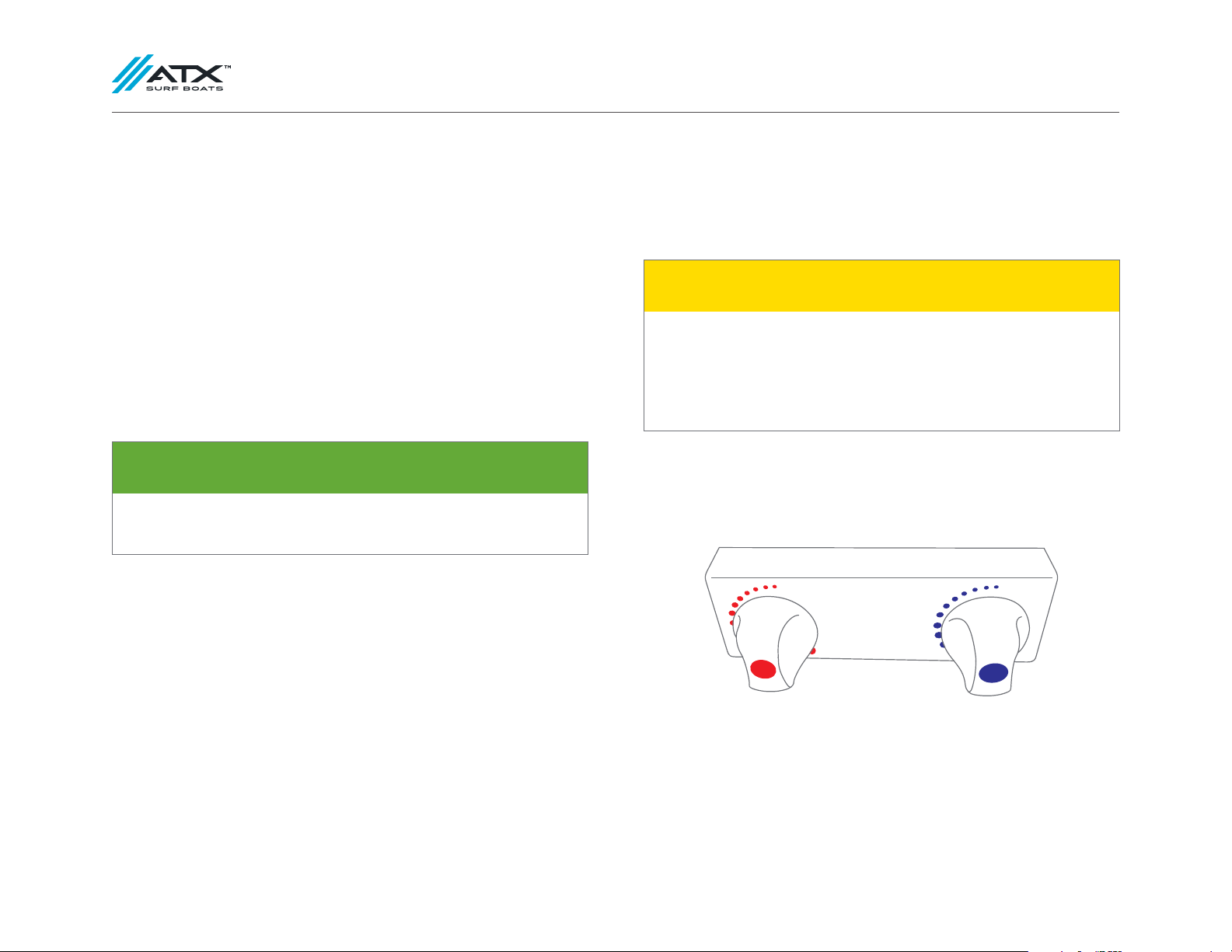
BOAT SYSTEMS | 75
Under any circumstance, do not fill all ballast tanks to 100% at one time.
Do not exceed coast guard capacity at any time.
For prime wakesurfing performance (first consider passenger weight and distribution) then most likely you will add rear ballast and no front ballast. For surfing
more weight needs to be distributed aft.
For prime wakeboarding performance (first consider passenger weight and
distribution) then add ballast to even out total weight distribution.
IN ALL CASES NEVER EXCEED COAST GUARD CAPACITY
BILGE SYSTEMS
NOTICE
The Federal Water Pollution Control Act prohibits the discharge of oil or oily
waste into the water. Violators can be fined $5,000.
IMPORTANT
Bilge pumps and bilge pumping systems are not designed for damage control. Check the function of all bilge pumps at regular intervals. Debris can
also prevent pumps from functioning or also make it operate continuously.
Make sure no debris is blocking the bilge pump float. Continuous operation
of the bilge can mean a leak or a drain plug is installed incorrectly, make sure
all drain plugs are installed. See your ATX Dealer if you have any questions.
DO NOT allow water to accumulate in the bilge area of your boat. When the
boat is in use, check the bilge area often. Your ATX boat is equipped with an automatic bilge pump which detects excess water accumulation and will turn the bilge
pump on automatically. Bilge water normally accumulates from weather, wet
water sports gear, getting into your boat from the water and draining coolers.
The engine and other parts of the drive system could be damaged and there is
a risk of personal injury as increasing water level will affect the handling and
maneuverability of the boat.
CAUTION
The risk of personal injury from excess water in the bilge area will adversely af-
fect the handling and maneuverability of the boat. Also, damage to the engine
and other parts of the drive system can occur from the additional water. DO
NOT allow the bilge pump to operate after all the water has been cleared from
the bilge area. Damage to the pump will occur.
SHOWER SYSTEM
The shower system consists of a pump for water pressure, a “manifold” for water,
and a five-setting nozzle with an ON/OFF valve.
WARNING
HOT WATER MAY REACH
TEMPERATURES IN EXCESS OF 120° F
DO NOT run the engine when using the shower at the boarding platform.
Page 77
BOAT SYSTEMS | 76
WARNING
CARBON MONOXIDE POISONING OR ROTATING PARTS HAZARD
Poisonous CO gases are present at the rear of the craft when the engine is
running. Exposure to CO gases can cause death or serious injury. A rotating
propeller can cut or entangle causing death or serious injury. DO NOT use the
swim/boarding platform when the engine is running.
Use the swim/boarding platform only for boarding the craft or entering the water.
WARNING
BURN HAZARD
Hot water from the shower may reach temperatures in excess of 120°F
(49°C). Use both the cold and hot water control knobs when testing water
temperature.
The shower manifold has a control knob. Turn the knob counterclockwise to
increase pressure and control the temperature.
Use the nozzle to turn the water stream on and select the desired setting,
SHOWER/FULL/STREAM/FLAT/MIST.
After using the shower, turn off the water control knobs. Relieve the pressure
from the shower hose by opening the ON/OFF valve at the nozzle and then
closing it.
During off-season storage or below freezing temperatures, the shower system
must be winterized. Your ATX Dealer can assist you with winterization of the
shower system.
SCHEMATIC AND SYSTEM ILLUSTRATIONS
The Schematic and System illustrations show models with the maximum
components and accessories, which may not be included on your ATX boat.
Page 78
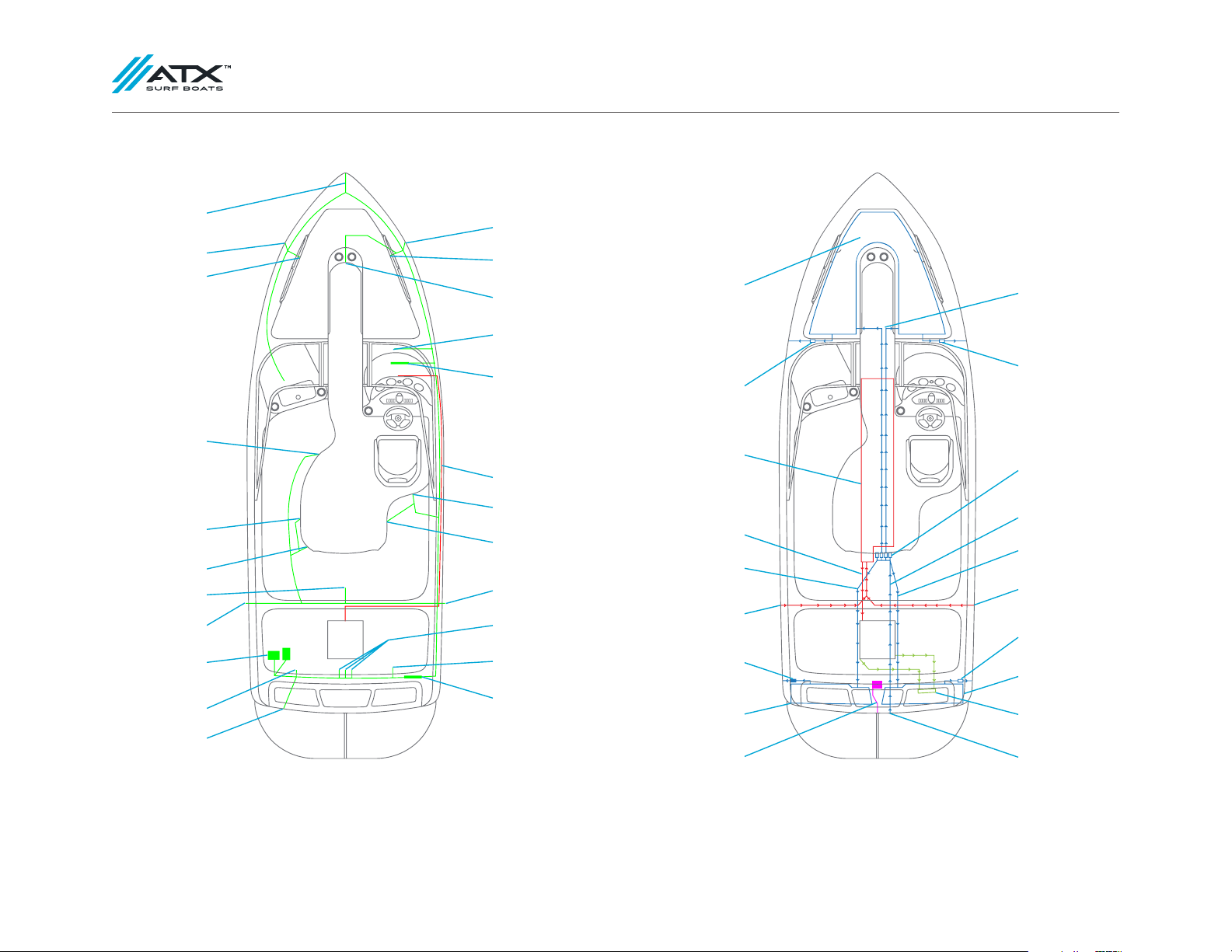
BOAT SYSTEMS | 77
BOW LIGHT
SHARK EYE
SPEAKER
SPEAKER
COURTESY LIGHT
SPEAKER
STERN LIGHT
FUEL GROUND
BATTERIES/BATTERY
DISCONNECT SWITCH
COURTESY LIGHT
TRANSOM REMOTE
SHARK EYE
SPEAKER
COURTESY LIGHT
HE ATER
CIRCUIT
BREAKER PANEL
ENGINE HARNESS
SPEAKER
COURTESY LIGHT
FUEL GROUND
BLOWER
COURTESY LIGHT
BILGE PUMP
SHOWE R
BUSS BAR
BOW BALLAST BAG
PORT BOW BALL AST
DRAIN PUMP
FU EL TAN K
FUE L LINE TO EN GINE
PORT A LT BALLAST
FILL HOSE
PORT F UEL F ILL
PORT A LT BALLAST
DRAIN PUMP
PO RT ALT
BALLAST TANK
BILGE PUMP
AND H OSE ASSE MBLY
BOW BALLAST BAG
FILL HOSES
STARBOA RD BOW
BALL AST DR AIN
PUMP
BALL AST FI LL PUMPS
BALLAST FILL
PICK UP HO SE
STARBOARD
BALL AST FI LL HOSE
STARBOARD
FUEL FILL
STARBOARD
ALT BALLAST
DRAIN PUMP
STARBOARD
ALT BALLAST TANK
SHOW ER IN
STARBOARD COOLER,
PUM P BELOW
BALLAST FILL
PICKUP INLET
Typical V-Drive Electrical Schematic Typical V-Drive Fuel and Water System
Page 79
CARE AND MAINTENANCE
Page 80

CARE AND MAINTENANCE
This section describes how to take care of and maintain your ATX boat. Periodic
inspection and maintenance of items listed in this section are absolutely necessary.
Winterization of major components and some engine maintenance procedures are best performed by your ATX Dealer. Some maintenance procedures
also require special tools which only a dealer may have. Refer to the engines
owner’s manual for maintenance information for the engine.
CARE AND MAINTENANCE | 79
5. When servicing the ignition switch or any wiring, disconnect
the battery cables from the battery.
6. Check for water circulation when the engine is running.
Exhaust should contain steady flow of water. In closed cooling systems, make sure
the coolant in the cooling system is at the proper level.
INTERIOR
If your boat has CoolTouch/Chil Cool™ Technology, please refer
to the CoolTouch Vinyl Interior Instructions.
Some maintenance items that can be done by you or your dealer are listed in this
section. We suggest that you become familiar with these even if you have your
dealer service your boat.
GENERAL MAINTENANCE
1. Read engine owner’s manual carefully and completely.
2. Check and make sure all drain plugs are installed correctly every time you
use your boat.
3. Check the fuel system for leaks every time you use your boat.
4. DO NOT start your engine if you smell gasoline or an odor is present. Gasoline
fumes are highly explosive. Before starting your engine, always operate the
blower for at least four minutes or open the engine cover and inspect the engine
compartment for gasoline fumes. Run your blower when operating at slow
speeds. If fuel vapors are present, DO NOT start the engine. Check all hoses and
fittings to determine the source of the vapor. Make the necessary repairs or take
the boat to a qualified service technician to eliminate the fuel vapor.
WARNING
GASOLINE VAPORS CAN EXPLODE
Before starting engine, run blower 4 minutes and check engine comp. Bilge
for gasoline vapors. Run blower below cruising speed.
The interior fabric of your ATX boat is designed to take the tough punishment of
the elements and usage of an active boater. Keep sharp objects away from the
interior to prevent cuts or damage to your interior.
The interior of your ATX boat can be cleaned easily, over and over, without
showing signs of wear. Certain ingredients in products can contribute to staining of your interior, such as sunscreens. Some of these ingredients are:
• Aminobenzoic acids—e.g. PABA
• Hydroxy benzophenones—e.g. Oxybenzone
• P-methoxycinnamic acid
• Octylmethoxycinnamate
This list is not inclusive, but does represent a large selection of sunscreens which
are known to stain vinyls. Almost any sunscreen with a high percentage (two
percent or more) of active ingredients can stain.
The interior manufacturer or ATX Surf Boats warranties do not cover
staining from sunscreens.
Special care should be taken to prevent dark-colored rubber products from
coming in contact with your interior upholstery. Regular vacuuming and general
cleaning of carpets is recommended. Washing with warm soap and water
is recommended for cleaning hard to remove spots and dirt. Under no circumstances should any solvents normally associated with the dry cleaning of
apparel be used on the interior carpet of your ATX.
Page 81
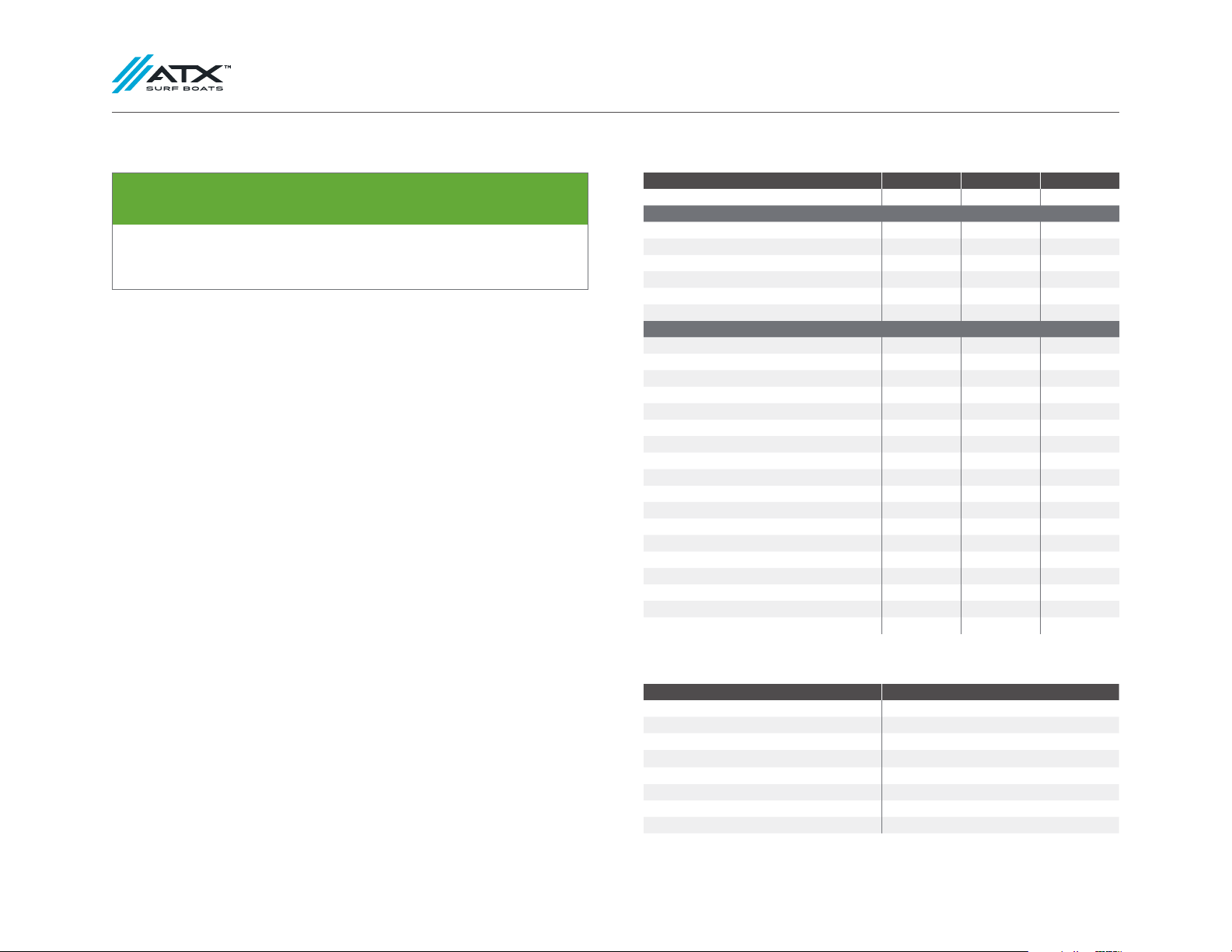
NOTICE
It is extremely important to clean the stained area as quickly as possible, making sure the recommended cleaning steps are followed in order.
Care and Cleaning of Interior—CoolTouch/Chil Cool™ Vinyl
On CoolTouch/Chil Cool™ vinyl Use only mild NON -BLEACH soap and water. DO
NOT use these or similar cleaners: 409®, 303®, Babe's®, Boat Bling®, Star brite®,
Meguiar's®, or Fantastik®. They are very harmful to your upholstery and will damage its surface and cooling properties. Failure to care for your vinyl properly or use
of improper cleaners will void your warranty and damage your vinyl.
CoolTouch/Chil Cool™ vinyl upholstery cleaning & care instructions:
A – Mix a solution 30:1, (30 parts warm water and 1 part mild N ON-BLEACH
liquid dish soap).
B – Apply and rub with a soft, damp cloth.
C – Rinse with clean, warm water and wipe dry.
Care and Cleaning of Interior—Standard Vinyl
Remove ordinary dirt and light smudges with a mild soap and warm water
solution. Pay special attention to crevices. Dry it with a soft, lint-free cloth or towel.
Always allow upholstery to dry completely. Cover the boat when not in use,
allowing for adequate venting. Never use a pressure washer as it may damage
the surface of the upholstery. For more difficult stains, use a stronger detergent.
Follow the detergent manufacturer’s instructions closely. All cleaning methods
must be followed with a thorough rinse with clean warm water.
Step-by-step cleaning instructions:
A – Medium-soft brush, warm soapy water. Rinse/dry.
B – Vinyl Finish Vinyl Cleaner®. Rinse/dry.
C – 1 tsp of ammonia, ¼ cup of hydrogen peroxide and ¾ cup of water. Rinse/dry.
D – Wipe or scrape off excess. (Chill gum with ice.)
E – Hemisphere Ink Remover. Rinse/dry.
CARE AND MAINTENANCE | 80
TYPE O F STAIN STEP 1 STEP 2 STEP 3
General Care A B -
FOODS
Chewing Gum D A -
Chocol ate, Coee, Tea B - -
Grape Juice A C -
Ketch up A B -
Olive Oil A - -
Yellow Musta rd A B C
MISCELLANEOUS
Ballpoint Ink E B A
Bird Droppings A B -
Blood A C -
Dirt Buildup A B -
Grease D B -
Hair O il Tonic A - -
Household Soil A B -
Latex Paint A B -
Lipstick A B -
Mild ew Or Wet Leaves C B A
Motor Oil B - -
Oil Base Paint D B -
Oily Sp ot A B -
Permanent Marker E B C
Spray Paint B - -
Suntan Lot ion A B -
Tar / Asphal t D B -
Urine A C -
Cleaner Recommendations
DOs DO N’Ts
Vinyl Finish Vinyl Cleaner® Fantastik®
Dish Soap Formula 409®
Dawn® Murphy’s® Oil Soap
Ivory® Simple Green®
303 Aerospace Protectant Armor All®
Sun-of-a-Gun®
Bleach/Baking Soda®
Turtle® Wax/Tar Remover
Page 82
CARE AND MAINTENANCE | 81
Non-Skid Flooring Cleaning Instructions
A. To clean dirt, footprints, etc., use an all purpose cleaner, such as Formula
409, and warm water along with a medium bristled deck brush. Put the
cleaner in warm water. Take a medium bristled brush and dunk into
the soapy water. Work around on non-skid flooring until dirt or other
substance comes up. Rinse with water. Repeat if necessary.
B. To remove suntan lotion, use the all purpose cleaner alone with a medium
bristled deck brush. Put small amounts of the all purpose cleaner on oil. Dip
medium bristled boat brush in warm water and work around until oil is out.
Rinse with water. Repeat if necessary
C. To remove fish blood, use 1 cup bleach to 1 gallon of warm water and
soft bristled boat brush. Mix bleach and water. Take soft bristled brush
and dunk in water/bleach mixture. In a circular motion clean non-skid
flooring until fish blood is up. Rinse with water. Repeat if necessary. If not
effective, see item D.
D. To remove rust stains, use a cap full of MaryKate On & Off Hull & Bottom
Cleaner for fiberglass. Apply on the rust stain and allow to soak for 3-5
minutes. If necessary, use latex/nitrile gloves to massage the cleaner into the
brush or embossed texture of the non-skid flooring. Rinse with water. Repeat
if necessary, the rust stain will eventually be removed.
With MaryKate Hull Cleaner, be careful to avoid getting this solvent on the sides
of the flooring pad, it could damage the lamination or PSA.
DO NOT USE:
• Mineral Spirits
• MaryKate Hull Cleaner (as a general cleaner, okay for Item D application
ON LY)
• Acetone (if it must be used, avoid the adhesives as best as possible)
• Bleach (if used, dilute with 1 cup bleach to 1 gallon of water)
WARNING
LEAKING FUEL IS A FIRE AND EXPLOSION HAZARD. INSPECT SYSTEM REGULARLY.
EXAMINE FUEL SYSTEM FOR LEAKS OR CORROSION AT LEAST ANNUALLY.
Dark Stowage Areas
When a boat is stored completely covered or in a dark building, the vinyl will
darken or become “dingy” looking. If this happens, simply place the boat in direct
sunlight for a few hours and the vinyl will brighten up.
Bilge Pump and Bilge Area
Check your bilge pump often to make sure it is functioning properly. The BILGE
switch can be used to test the bilge pump, by listening to hear that the pump is operating. It may not pump water unless water is present. The bilge pump is located
in the bilge area. Keep it from getting clogged by removing any debris you find in
the bilge area. Debris can also block the pump float from functioning or make it
operate continuously. Make sure no debris is blocking the bilge pump float.
Wash the bilge with a good biodegradable household detergent or a bilge cleaner available at your ATX Dealer or a marine supply store. Rinse with water while
your bilge pump is running. If your pump seems too slow, remove the top of the
pump from the base and check the impeller to make sure there is no debris inside.
See your dealer if there is still a problem or you suspect a problem with the pump.
IMPORTANT
DO NOT discharge oil or cleaners into the water. Refer to Section 1, OUR
ENVIRONMENT, Fuel/Oil Spillage. Bilge pumps and bilge pumping systems are
not designed for damage control. Check the function of all bilge pumps at regular
intervals. Continuous operation of the bilge can mean a leak or a drain plug in-
stalled incorrectly. Make sure all drain plugs are installed. See your ATX Dealer
if you have any questions.
Page 83
CARE AND MAINTENANCE | 82
EXTERIOR
Use quality boat care product when protecting the exterior of your ATX boat. The
exterior of your boat is as important as protecting the engine. A little effort today
will keep your boat looking good in the future and show the pride every time you
use your boat.
WARNING
FIRE/EXPLOSION/ASPHYXIATION HAZARD
Cleaning agents and paint ingredients can be flammable and/or explosive, or
dangerous to inhale. Make sure ventilation is adequate, wear proper personal protection and dispose of tags properly ashore.
Vapors from flammable solvents can cause fire, explosion or asphyxiation resulting in death or serious injury. Keep open flame or spark away from work
area. DO NOT paint unless in a well-ventilated area.
WARNING
SLIPPERY SURFACE HAZARD
Cleaning craft surfaces can generate slippery conditions which can result in
death or serious injury. Use caution when cleaning with detergents and rinse
thoroughly.
To help maintain the shine of your boat, wash the hull with a mild biodegradable, non-abrasive detergent after each use to help to remove any debris and
waterborne materials. Use a soft sponge or towel and dry with a chamois cloth
to prevent water spots. Give your boat a fresh water wash after saltwater use.
Cover if possible to keep you boat looking its best. Never place a non-breathable cover on a boat that is still wet. Store in a dry, covered area.
Remove any unintentional fuel or oil spills from the gel-coated surfaces as
quickly as possible.
Wax the hull sides and deck at least twice a year with a high-performance
marine wax. Waxes and polishes can be obtained from your ATX Dealer or a
marine supply store. Always follow the directions of the manufacturer of these
products before you use them.
In certain areas, sudden changes in temperature can affect gelcoat. When planning on moving your boat from outdoors to a heated location, allow the change
of temperature to be gradual. Heat the location after the boat is brought inside
to allow the boat to change temperature slowly as the location is heated. Also, if
you are planning on moving your boat from a warmer area to a colder one, wait
for the outside temperature to be closer to the warmer area’s temperature or
allow the warmer area and the boat to cool down before moving your boat.
If your boat’s gelcoat develops a chalky look over a period of time due to
exposure to sun, there are gelcoat buffing and polishing compounds available
from your ATX Dealer or a marine supply store. DO NOT use common household scouring pads or powders.
Gel Coat Maintenance
Regular maintenance will keep your exterior surfaces in good condition. Exposure to the sun, sand, sap or staining properties from trees and minerals in the
water affect your boat’s finish.
Remove any small scratches or scuffs using a fine rubbing compound. For any
major repairs, consult your ATX dealer.
The hull bottom is also an important area to keep clean since buildup of water
scum and algae will reduce the boat’s efficiency. If you leave your boat in the
Page 84

CARE AND MAINTENANCE | 83
water, compounds to remove algae buildup on your hull are available. Use
care when choosing these products since some can be caustic. Pay special
attention to the cautions on the labels of these coatings. Ask your ATX Dealer for
advice on which products work best in your area.
Deck and Hull
The finish on your ATX boat is known as gelcoat. Our gelcoat and lamination processes are among the finest available. Even though we take all the precautions
during manufacturing, the finish on your boat is susceptible to the elements and
many types of water conditions.
Cleaning Deck and Hull
A multipurpose boat soap* should be used to clean exterior fiberglass/gelcoat
surfaces on your ATX boat after each use. This product, depending upon the
ratio mixed, is designed to clean anything from dirty hulls and decks to greasy
engines. Always rinse and wipe off the finish with a damp towel or chamois.
A fiberglass restorer/wax* should be used to remove heavy oxidation, rust
and exhaust stains. This product will not only restore the look but will also leave a
wax protection on the cleaned surface.
Deck and Hull Care
Paste wax* will help protect against UV light damage. A coat should be applied at
the beginning, middle and end of the boating season.
To extend the life of your gelcoat finish, use a ATX marine mooring cover to cover
the top deck of the boat for maximum protection. If your boat is to be stored
where the sun is constantly on the side or transom of the boat, you should consider protecting those surfaces.
Tonneau covers will supply adequate short-term protection to the interior,
but will not protect the gelcoat finish.
*3M and your ATX Dealer carry a complete line of fiberglass care products.
Stainless Steel and Chrome
Stainless steel is highly resistant to marine environments, but is still capable of
rusting. Signs of rust and corrosion when left untreated can result in permanent
damage. You can keep your stainless steel looking new by cleaning monthly with
a good quality stainless steel cleaner or polish. Clean and polish in the direction of
the grain or finish.
Clean and wax metal prior to extended storage. In saltwater or other harsh
environments, clean and wax more often. High-quality stainless steel cleaners and
conditioners are commercially available. Rinse with fresh water and wipe dry with
towel or chamois after each use.
Cleaning Stainless Steel
If rust or corrosion does appear use a good metal cleaner/polish immediately to
protect from permanent damage. DO NOT use steel wool or other coarse abra-
sives, or clean with citrus cleaners, acids or bleach. DO NOT use cleaners
that are not for use on stainless steel, such as glass, tile or counter cleaners.
These types of cleaners can damage the surface permanently. Apply metal
or automotive wax, such as GEMLUX® Cleaning Wax, after cleaning for
additional protection and to maintain the finish. Always test any product in an
inconspicuous area before applying to the complete surface.
If you have to replace hardware or fasteners, make sure the replacement components are made of the correct materials. See your ATX Dealer if you have any
questions.
DO NOT store soiled rags onboard. Store or dispose of rags properly ashore.
NOTICE
Use caution in cleaning around stitching, wood or other decorative trim
since solvents could seriously damage these materials.
Page 85

CARE AND MAINTENANCE | 84
PROPELLER
WARNING
CUT HAZARD
A propeller can be sharp and can cause death or serious injury. Wear a pair
of protective gloves when handling any propeller. Prevent accidental starting
of the engine by:
• Removing key from the ignition.
• Removing emergency stop switch clip from the switch.
DO NOT reuse the nylon locknut or the cotter pin, or use a damaged propeller. A
damaged propeller can damage your engine and boat.
To remove:
1. Remove the cotter pin from the propeller shaft and discard.
2. Wedge a piece of 1" x 4" wood between the propeller blade
and the port side of the strut and rudder.
3. Remove the nylon locknut and discard.
Use a propeller puller to remove the propeller and then remove the key from
the keyway. Make sure the keyway in the propeller and on the shaft are free
of any damage.
See your ATX dealer for service to ensure the prop has been removed properly
and that the shaft seal has not been damaged.
1. Rotate the shaft until the keyway is up.
2. Place the key in the shaft keyway. Rotate the propeller so the keyway
in the propeller is aligned with the keyway on the shaft. The propeller
will only slip on in one direction. Once everything is aligned, push the
propeller solidly onto the shaft and make sure the propeller is seated.
3. Wedge a piece of 1" x 4" wood between the propeller blade and the
starboard side of the strut and rudder.
4. Install a new nylon locknut and torque the nut to maximum of 30 ft-lbs (40.7
N·m).
5. Install a new cotter pin and bend the retaining ends of the cotter pin in
opposite directions.
RUDDER
If you experience trouble turning your steering wheel then it could be caused
by the rudder having issues turning. If your rudder port is equipped with a zerk
fitting you are required to use Lubriplate Synxtreme FG-2 grease or an equivalent food grease.
The use of any petroleum based product will pollute the environment and lead
to failure of the part. DO NOT USE PETROLEUM BASED GREASE.
SA LT WATE R BOATING
NOTICE
If you use your boat in salt water or other unusual water conditions, freshwater flushing is recommended for your engine and the cooling system.
To install:
Look at the keyway on the shaft and in the propeller and make sure the key
slides freely in the propeller keyway and shaft keyway. If the key has burrs,
remove them by filing the flat sides or replace the key. DO NOT file the key
beyond its normal shape or size.
ATX offers an optional freshwater flush kit. The ATX freshwater flush kit has a relief
valve to prevent excess water pressure to your engine. Excess water pressure can
damage the engine. This is the only system ATX recommends. Running the boat in
fresh water is another good way to flush the engine, but it must be done immediately.
Page 86

CARE AND MAINTENANCE | 85
BATTERY MAINTENANCE
WARNING
FIRE/EXPLOSION HAZARD
Explosion or fire from hydrogen gases produced by lead acid batteries will
cause death or serious injury.
• Wear personal protective equipment when working on or
around batteries.
• DO NOT charge or use a battery booster to start your engine.
Charge the battery outside the craft.
• DO NOT smoke or bring a flame near a battery.
• DO NOT have your head directly above a battery when making or
breaking electrical connections.
• If ignited by a spark or flame gas may explode violently, causing
spraying of battery acid or fragmentation of the battery.
• DO NOT use a metal object to spark between battery posts to check
if the battery is charged.
Use care when connecting or disconnecting a battery charger. Make sure the
charger is turned OFF and unplugged from power source when you clip ON/OFF
the connecting clamps.
Make sure the connection is solid with the charging clamps.
Remove the battery cables from the battery when the boat is placed in storage,
on display or in transit, to eliminate the possibility of the engine accidentally starting without a supply of cooling water.
The battery and cables are identified:
+ = red positive
– = black negative
To clean your battery, remove and wash down the battery case with a diluted
ammonia or baking soda/water solution to neutralize the acid, then flush with
fresh water. Keep the fill/vent caps tight so the neutralizing solution does not get
into the battery cells.
The electrolyte level should be checked every 30 days. Use distilled water only
if any water is required. Maintain the level between the top of the plates and
the bottom of the fill/vent cap. DO NOT overfill. Batteries contain sulfuric acid
which can cause severe burns.
TRANSMISSION OIL LEVEL INSPECTION
Refer to engine manual or your authorized ATX dealer.
Check the oil with the boat level and the engine off.
Remove the oil level dipstick. The oil level should be between the “FULL LEVEL” and
the “LOW LEVEL” indicator marks on the dipstick.
Poor connections are common causes of electrical arcs, engine problems and
errant signals to the engine’s ECM.
DO NOT make or break electrical circuits at the battery terminals; a spark will
occur when a circuit is live and opened or made. Turn off all components.
Use a voltmeter or hydrometer to check the battery charge condition.
Verify the oil level with the gauge fully inserted into the transmission housing.
DO NOT overfill. Use fresh recommended fluid only. To add or fill, use the
dipstick opening. Refer to the transmission owner’s manual for type of fluid,
changing fluid intervals and more detailed information.
Page 87

CARE AND MAINTENANCE | 86
STEERING
All steering systems require periodic maintenance to be trouble-free and safe.
Check steering operation and visually inspect for loose or missing hardware
before operating the craft. If you suspect the steering system is damaged, see
your dealer.
WARNING
LOSS OF CONTROL AND UNSAFE BOAT HAZARD
Improper maintenance of steering system is hazardous and can cause
death or serious injury from sudden loss of control. Make sure all steering
hardware, cables and fluid levels are regularly inspected and maintained.
UNSCHEDULED MAINTENANCE
A problem with any electrical or mechanical equipment can occur anytime.
Be aware of a malfunction if one occurs, or if you suspect a problem. Have the
problem serviced immediately by your ATX Dealer.
Engine/Propulsion/Cooling System
If a problem occurs with your engine, propulsion unit or the cooling system
between the scheduled maintenance cycle, immediately notify your ATX Dealer to
have the problem resolved. DO NOT allow a problem to go unattended.
WARNING
FIRE OR EXPLOSION HAZARD
An AC/DC can create sparks. In the presence of explosive gases, fire or explosion can occur. Check for explosive gases or run the blower.
DO NOT work on an energized system. Turn the battery disconnect switch OFF.
Fuel System
DO NOT operate your boat if you know you have a fuel system problem.
When you discover or suspect a fuel system problem, immediately notify your ATX
Dealer for repair.
WARNING
FIRE OR EXPLOSION HAZARD
Fuels are extremely flammable and highly explosive under certain conditions. DO NOT smoke or allow open flame or sparks nearby when inspecting
the fuel system.
Electrical System
Have your ATX Dealer repair all electrical problems. Electrical problems must
be treated seriously and repaired immediately. Whenever checking for electrical problems, use extreme caution. Fuel and fumes are extremely flammable
and explosive.
Page 88

CARE AND MAINTENANCE | 87
SLINGING/LIFTING THE BOAT
To prevent structural damage to your ATX boat, the proper procedure must be
used when lifting your boat. Only use appropriate style lifting slings or lift rings
with a spreader bar. Protect the rub rail to prevent any part of the lift device
from making contact with the boat.
If the boat is to be removed from the water without a trailer, follow
these guidelines:
• Never attach lifting cables to cleats, ski tow eyes or handrails. Attach cables
only to the bow and stern eyes.
• Cover lifting cables with rubber hose or other protectors to prevent
damage to the finish.
• Attach guide lines to the bow and stern to control movement.
• Use spreader bars and keep lifting pressure vertical to prevent
gunwale damage.
• Keep the bow slightly higher than the stern to prevent engine damage.
Using Lifting Slings
This method should only be used by a qualified person with knowledge on
how to use lifting slings, or your ATX Dealer. Slings must be the flat, widebelting type. DO NOT use cable-type slings.
The spreader bars used with the slings must be wide enough to avoid pressure to the gunwales.
Contact your ATX Dealer to identify the proper location for slings. Slings may need
to be adjusted fore or aft for your particular boat.
Storage Cradle
If you are planning on storing your ATX boat on a cradle, only use a storage cradle. You may also use the trailer designed for your boat to store your boat when
it is not in the water. A storage cradle or your boat’s trailer will provide proper
support and prevent stress on the hull.
Position the storage cradle as close to the sling locations as possible. Use caution not to damage any underwater components.
The storage cradle must completely touch the hull for proper support. Be sure
there are no gaps between the cradle and the hull. Store your boat with the bow
slightly elevated to the same attitude as if the boat were floating. If the boat is
stored with the bow down, moisture cannot move to the engine bilge area and
out of the boat. Remove the transom drain plug.
Make sure all compartments in the bilge area completely drain. Mold and mildew can form as a result of moisture.
After the boat has been properly positioned on a storage cradle, thoroughly
wash the interior, hull, deck and interior compartments. Allow a couple of days
of air drying before covering the boat, store all cushions in the open position
and open all storage areas to help prevent mold/mildew.
Cover the boat with the storage cover. If a temporary poly cover such as
shrink wrap is used, your ATX Dealer will install vents to provide ventilation to
help prevent mold or mildew.
STORAGE/WINTERIZATION
Preparing for winter lay-up is important. In frigid zones, be particularly attentive
to items that can be damaged by freezing. Damage to your boat from improper
storage is not covered by the warranty.
Without proper preparation, storage for long periods of time can cause internal parts of the engine and drive system to rust because of lack of lubrication.
Or, if the boat is stored in below freezing temperatures, water inside the bilge or
cooling system can freeze, causing damage. The following procedures should help
prevent damage to your boat.
Perform all annual maintenance at this time.
Page 89
CARE AND MAINTENANCE | 88
The following items require special attention for winterization. Your ATX boat
may not include all the features described. Have your ATX Dealer perform
winterization procedures for the following:
• Engine cooling and exhaust systems
• Fuel system
• Batteries
• Drain Ballast System
• Drain shower
Storage Preparation
While the boat is still in the water:
1. Fill fuel tank and add the proper amount of fuel stabilizer and conditioner
according to the engine manufacturer’s recommendations.
2. Operate boat for at least 15 minutes to be sure the treated fuel has
reached the engine.
NOTICE
If the boat is to be stored for more than five months, stored in a high-moisture (humidity) environment, in temperature extremes or outdoors, “fog” the
engine with a rust preventive fogging oil according to the manufacturer’s
recommendations. See your ATX Dealer.
When the boat is removed from the water:
NOTICE
Remove the bilge drain plug immediately after taking the boat out of the
water. After washing, raise the bow of the boat high to allow as much water
as possible to drain while performing other storage preparations.
• Flush the engine cooling system with clean fresh water. DO NOT exceed
1500 RPM when flushing.
• Drain the ballast tank system
IMPORTANT
It is extremely important to drain ballast system during freezing temperatures
and during long periods of non-use. Protect our natural resources by using
environmentally friendly products and always discard in an environmentally
friendly manner.
1. Drain the system completely after your boat is out of the water and keep the
intake/drain valves open.
2. Use a 50/50 mixture of an environmentally friendly antifreeze and
fresh water.
3. Pour an even amount, approximately 1 gallon (3.8 liters) of the antifreeze
mixture into each tank’s vent.
4. Make sure you catch any spilled mixture by placing a container under the
intake/drain of the tank you are winterizing.
5. Operate the pump in the drain mode for two seconds; then shut off.
Repeat procedure for other tank(s).
6. Close the water intake/drain valves in the ballast tank(s). When returning
your boat back to service, make sure to drain the remainder of the mixture
before getting onto the water.
7. Thoroughly wash the interior, interior compartments, deck and hull as
soon as your boat is removed from the water. Cleaning the hull at this time is
easier because the marine growth is still wet. Allow a couple of days of air
drying before covering the boat. Store all cushions in the open position and
open all storage areas to help prevent mold/mildew.
8. Apply a coat of wax to the entire surface of the boat and rust inhibitor on
all metal parts.
9. Clean all traces of dirt, oil, grime and grease from the engine and bilge.
Touch up areas of engine where paint has been removed.
Page 90

CARE AND MAINTENANCE | 89
10. Prepare the engine for storage according to the instructions contained in
the engine owner’s manual.
11. Store the bilge drain plug and any other drain plugs removed in a plastic
bag and tape it to the throttle control lever or near the dash so it is easy to
find after being stored.
12. Remove the battery from the boat. Clean, fully charge and store the
battery in an area not subject to freezing temperatures or directly
on cement. DO NOT store batteries close to heat, spark or flameproducing devices.
13. Repack trailer wheel bearings with water-resistant wheel bearing
grease. If the trailer is equipped with bearing protectors, apply grease into
hubs with a grease gun.
14. Park trailer and boat in a protected area on cement if possible. If your
boat and trailer are left outside, install a boat cover. Cover the boat with
the storage cover. If a temporary poly cover such as shrink wrap is used,
your ATX Dealer will install vents to provide ventilation to help prevent
mold or mildew.
15. Loosen tie-downs and winch line, but make sure the boat is resting
properly on hull supports.
16. Jack up trailer and place blocks under trailer frame to relieve weight on
trailer tires and springs.
What to do after Boat Storage
Have your ATX Dealer prepare your boat for the next boating season. It is very
important for the fuel system and exhaust system to be thoroughly inspected and
repaired, if necessary, before operating the boat.
There are many steps required to ensure your boat is in proper operating
condition. Avoid the risk of fire or explosion. Inspect the fuel system. Failure to
inspect the fuel system and allow fuel leaks to go undetected will contribute to a
fire or explosion hazard.
If your swim platform was removed for storage, reinstall it. The removable feature
is for boat storage only. The boat must not be operated without the swim platform.
WARNING
FIRE OR EXPLOSION HAZARD
Fuels are extremely flammable and highly explosive under certain
conditions. DO NOT smoke or allow open flame or sparks nearby when
inspecting the fuel system.
NOTICE
DO NOT use your tonneau cover or bimini top for long-term storage. These
are not designed for long-term storage and do not provide good protection.
Adequate ventilation is not possible and mold/mildew will form. For more
information on appropriate long-term storage, see your ATX Dealer.
Page 91

Make sure these steps are followed before using your boat:
• Check and inspect the fuel and exhaust systems, the engine cooling and
lubrication systems.
• If the swim platform was removed for storage, reinstall it.
• Charge and reinstall battery into boat.
• Check engine and bilge for signs of nesting animals; clean as necessary.
• Check entire engine for cracks and leaks caused by freeze damage.
• Check hose condition and all hose clamps for tightness.
• Install bilge drain plug or any other drain plugs removed. Make sure all
plugs are installed correctly.
• Perform daily maintenance. If not performed during lay-up, perform
annual maintenance.
• Check and lubricate steering system.
• Remove blocks from under trailer frame.
• Tighten tie-downs and trailer winch line.
• Check tire pressure and lug nuts on trailer.
• Take the boat to the water and start it. It may take a minute of cranking to
allow the fuel system to prime. Allow a one-minute cooldown period for
every 15 seconds of cranking. When the engine starts, keep a close watch
over the gauge readings, and check for leakage and abnormal noises. Keep
speeds low for the first 15 minutes until the engine has reached normal
operating temperature.
CARE AND MAINTENANCE | 90
Page 92

TROUBLESHOOTING AND SERVICE REQUIREMENTS
Page 93
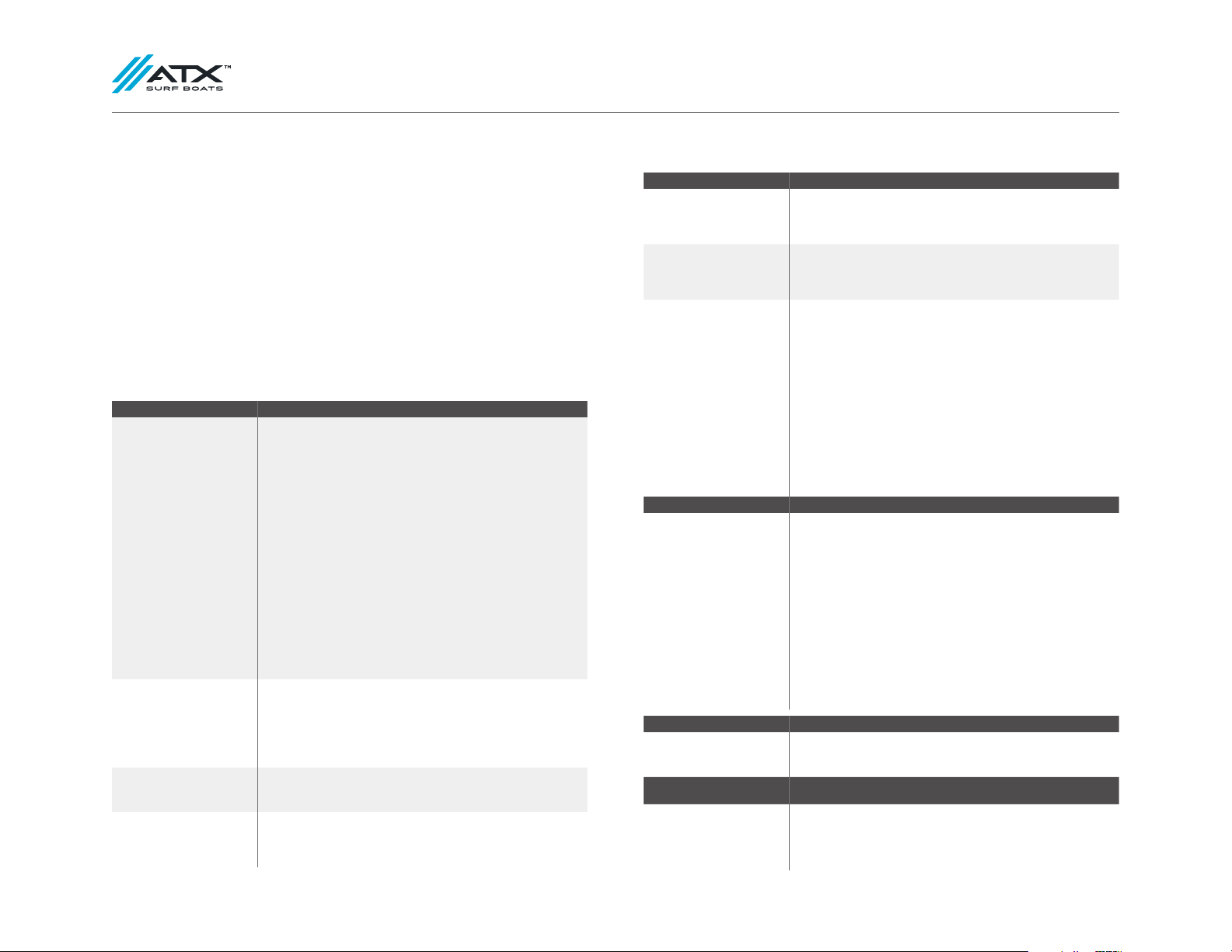
TROUBLESHOOTING AND SERVICE REQUIREMENTS | 92
ENGI NE SYMPTOM (con’ t) P OSSI BLE CAUSE
TROUBLESHOOTING AND
SERVICE REQUIREMENTS
The following chart will assist you in finding and correcting minor problems
with your ATX boat. Refer to your engine owner’s manual for more detailed information concerning a problem starting, shifting or operating the engine. Some
problems may require the skills of a trained technician and special service
tools. Contact your ATX Dealer for assistance.
ENGINE SYMPTOM POSSIBLE C AUSE
Ignition safety switch not in p lace. Install i gnition safety swi tch.
Battery discon nect switch located in engi ne compartment is o.
Turn switch ON.
MAIN sw itch on breaker box loca ted unde r dash is o. Turn switch ON.
Circuit b reaker is tripped . Run fingers over bre aker face and reset any
tripped circuit breakers.
Engine will not crank
Low starter sp eed.
Engine cranks but will not sta rt.
Bad star ter connection s. Check connection s and tig hten. If s tarter so lenoid
clicks when attem pting to start engine, check b attery connections . If
condition persists, co ntact your ATX Dealer.
Engin e circuit breaker op en. Make sure brea ker is in operati ng position.
Faulty i gnition switch or engine problem. See you r ATX Dealer.
Shift p ositio n not in NEUTRAL. Make su re shi fter is NEUTRAL.
Starting procedure not followed.
Weak or bad battery. Se e your ATX Dealer.
Fuel level low o r empty. Add fu el.
Contami nated fuel. See your ATX Deale r.
Engine runs but boat makes
little o r no progress
Performance loss
Engine overheating
ELECTRICAL SYMPTOM POSSIBLE C AUSE
Electrical problem
STEERING SYMPTOM POSSIBLE C AUSE
Steering problems Corroded steering cable or wo rn rudder. See your ATX Dealer.
Fouled or damaged propeller. Check for weeds on propeller, bent or
broken prop eller, or conta minated fuel. See your ATX Dealer.
Throttle not fully open. Make sure throttle open s fully at engines .
Improper fuel . Fill tank with correct fuel.
Turn o engi ne immediate ly. Contac t your ATX Deal er.
Boat overloaded . Reduce load or distrib ute boat load evenly.
Improper propeller selection. See your ATX Dealer.
Excessive bilge wate r. Check for excessi ve water. Drain bi lge.
Boat hu ll buildup or blocked wate r pick-up. Clea n if marine growth
is prese nt.
Saltwate r Flush K it shut- o valve (if eq uipped), or water pickup seacock
(seacoc k appli es to all models so ld in Canada), i s CLOSED. Open shut-o
valve or seacock (handle in-line [OPEN] with hose, not p erpendi cular
[CLOSED])
Battery discon nect switch located in engi ne compartment is o.
Turn switch ON.
MAIN sw itch on breaker box loca ted unde r dash is o. Turn switch ON.
Circuit b reaker is tripped . Run fingers over bre aker face and reset any
tripped circuit breakers.
Loose wiring connection. Check connections.
Defective swi tch or gau ge. See you r ATX Dea ler.
Dim or no lights, circuit b reaker trip ped or in OFF position.
Check breaker. Battery d ischarged. C harge battery.
Engine runs erratically Contami nated fuel. See your ATX Deale r.
Engine vibrates
Propeller damaged. Check for bent, broken or damaged propeller,
misaligned propeller shaft, or weeds on propeller.
THROTTLE/SHIFTING
SYM PTOM
Throttle/shifting problems.
POSSIBLE C AUSE
Low transmission fluid level. Chec k level. Corroded cab les, defective
throttle return spri ng or stic king transmission sh ift lever. See your
ATX Dealer.
Page 94
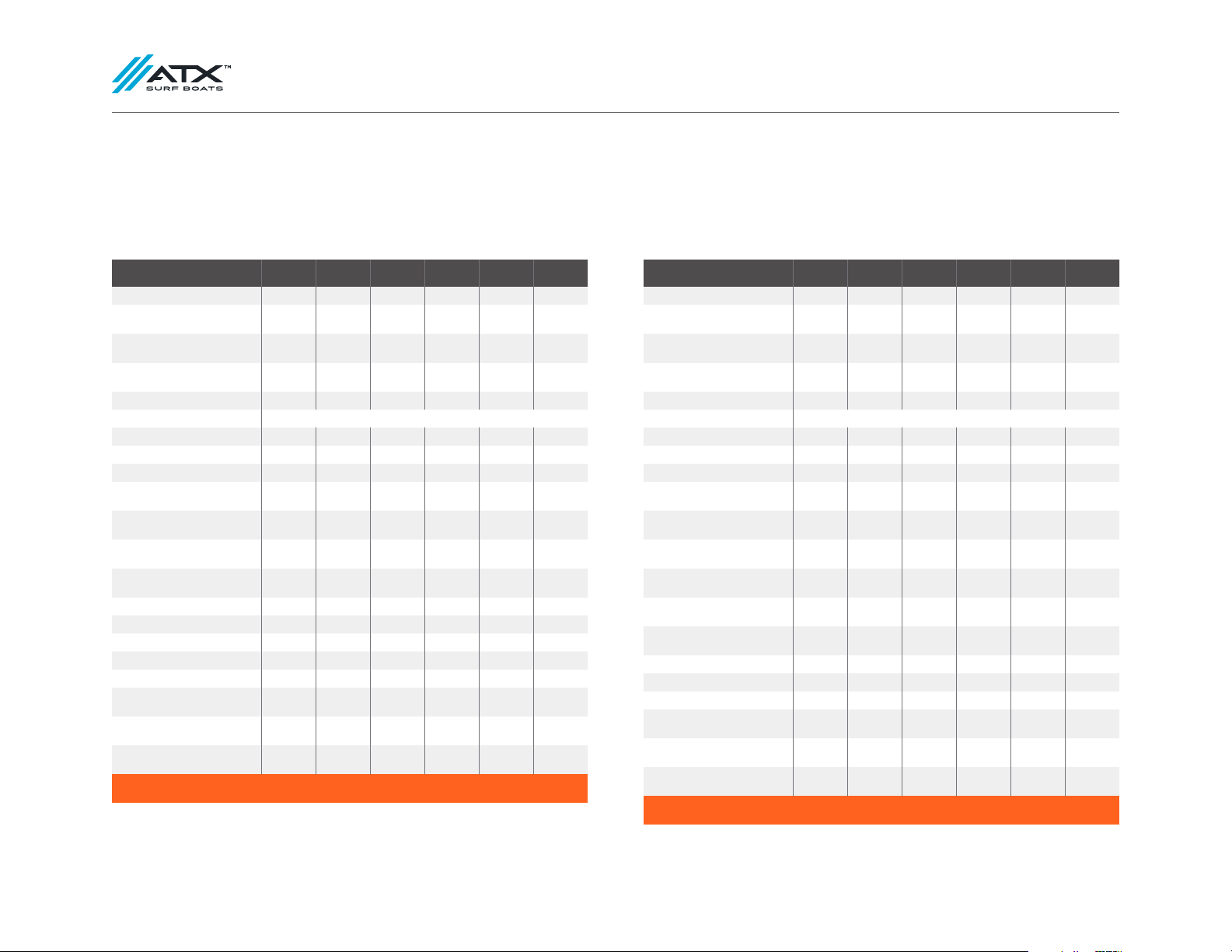
TROUBLESHOOTING AND SERVICE REQUIREMENTS | 93
20-HOUR SERVICE REQUIREMENTS
This service must be performed to keep warranty active.
Engine oil and filter must be changed every 50 hours. Please see your dealer.
ATX MAINTENANCE SCHEDULE DA ILY WEEKLY REGU LAR ANNUAL
Smell b ilge area for fuel vap ors
Check and tighte n all steering
system bolt s and connecti ons
Check rudder, tiller arm bolt
and safety setscrew
Lubricate rudde r stuing box
and steering support tube
Lubricate cables
Replace cables If stiness continues after lubricating
Check bilge pu mp operation
Check blower operation
Inspect shaft seal
Check shaft alignment/ensure
it is within .003
Check and tighte n motor
mounts
Tighten pylon and tower
mounting bolts
Tighten a ll hardware and
fasteners
Change engine oil and filter
Change transmission fluid
Change engine coolant
Check engine oil
Check transmission
Check wate r pickup s for debris
or marine grow th
If equ ipped with a strai ner,
check a nd clean
If opera ted in salt water, flush
engine/cooling system and boat
IF PROPELLER STRIKES AN OBJECT, INSPECT DRIVE TRAIN IMMEDIATELY!
EVERY 2
YEARS
20-HRS .
70-HOUR SERVICE REQUIREMENTS
This service must be performed to keep warranty active.
Engine oil and filter must be changed every 50 hours. Please see your dealer.
EVERY 2
YEARS
ATX MAINTENANCE SCHEDULE DA ILY WEEKLY REGU LAR ANNUAL
Smell b ilge area for fuel vap ors
Check and tighte n all steering
system bolt s and connecti ons
Check rudder, tiller arm bolt
and safety setscrew
Lubricate rudde r stuing box
and steering support tube
Lubricate cables
Replace cables If stiness continues after lubricating
Check bilge pu mp operation
Check blower operation
Inspect shaft seal
Check shaft alignment/ensure
it is within .003
Check and tighte n motor
mounts
Tighten pylon and tower
mounting bolts
Tighten a ll hardware and
fasteners
Change engine oil and filter
(every 50 hrs . or annually)
Change transmission fluid every
300 hrs
Change engine coolant
Check engine oil
Check transmission
Check wate r pickup s for debris
or marine grow th
If equ ipped with a strai ner,
check a nd clean
If opera ted in salt water, flush
engine/cooling system and boat
IF PROPELLER STRIKES AN OBJECT, INSPECT DRIVE TRAIN IMMEDIATELY!
75-H RS.
Page 95
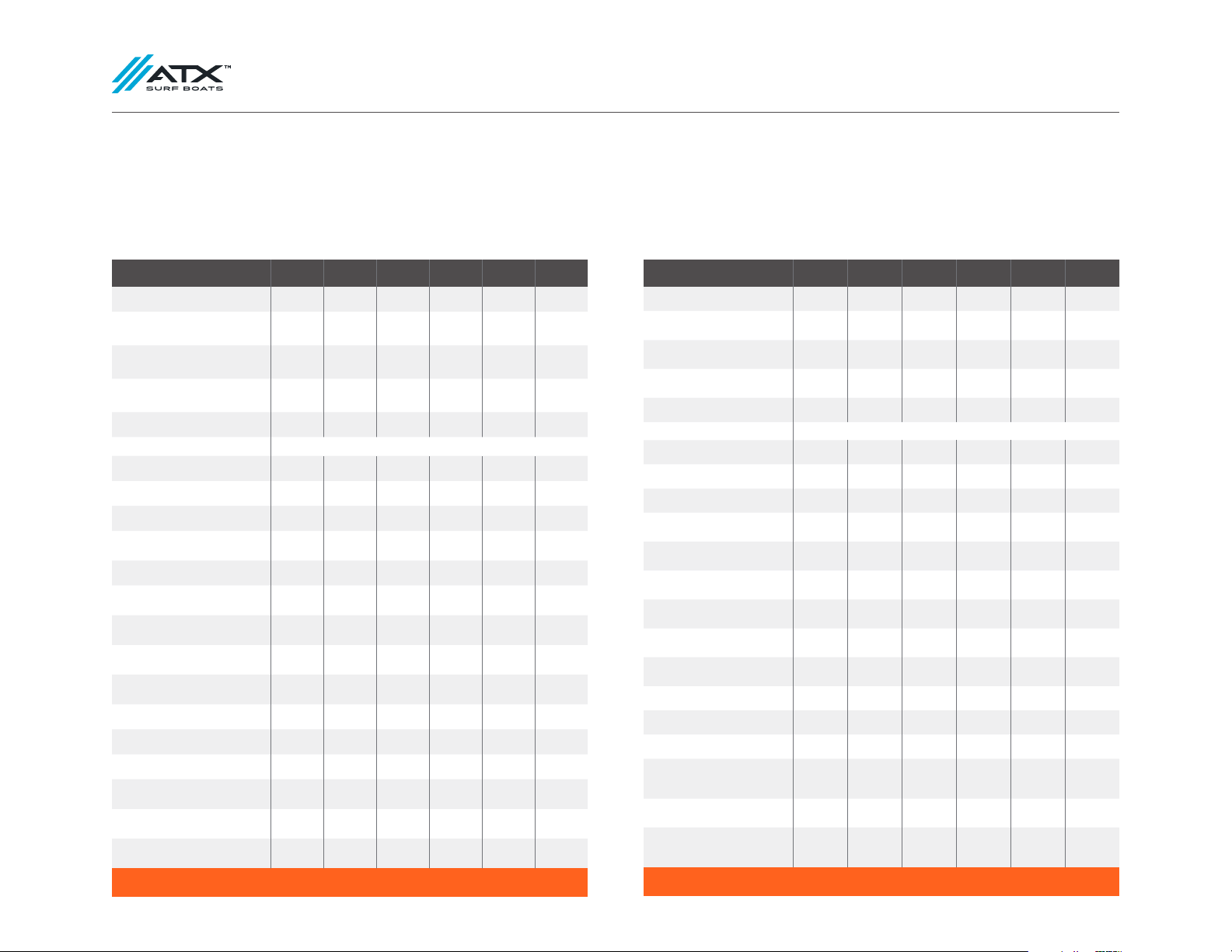
TROUBLESHOOTING AND SERVICE REQUIREMENTS | 94
120-HOUR SERVICE REQUIREMENTS
This service must be performed to keep warranty active.
Engine oil and filter must be changed every 50 hours. Please see your dealer.
EVERY 2
YEARS
ATX MAINTENANCE SCHEDULE DA ILY WEEKLY REGU LAR ANNUAL
Smell b ilge area for fuel vap ors
Check and tighte n all steering
system bolt s and connecti ons
Check ru dder, tiller arm bol t and
safety setscrew
Lubricate rudde r stuing box and
steering support tube
Lubricate cables
Replace cables If stiness continues after lubricating
Check bilge pu mp operation
Check blower operation
Inspect shaft seal
Check shaft alignment/ensure it
is withi n .003
Check and tighte n motor mou nts
Tighten pylon and tower
mounting bolts
Tighten a ll hardware and
fasteners
Change engine oil and filter
(every 50 hrs . or annually)
Change transmission fluid every
300 hrs
Change engine coolant
Check engine oil
Check transmission
Check wate r pickup s for debris
or marine grow th
If equ ipped with a strai ner, chec k
and clean
If opera ted in salt water, flush
engine/cooling system and boat
IF PROPELLER STRIKES AN OBJECT, INSPECT DRIVE TRAIN IMMEDIATELY!
150-HRS.
170-HOUR SERVICE REQUIREMENTS
This service must be performed to keep warranty active.
Engine oil and filter must be changed every 50 hours. Please see your dealer.
EVERY 2
YEARS
ATX MAINTENANCE SCHEDULE DA ILY WEEKLY REGU LAR ANNUAL
Smell b ilge area for fuel vap ors
Check and tighte n all steering
system bolt s and connecti ons
Check rudder, tiller arm bolt
and safety setscrew
Lubricate rudde r stuing box
and steering support tube
Lubricate cables
Replace cables If stiness continues after lubricating
Check bilge pu mp operation
Check blower operation
Inspect shaft seal
Check shaft alignment/ensure
it is within .003
Check and tighte n motor
mounts
Tighten pylon and tower
mounting bolts
Tighten a ll hardware and
fasteners
Change engine oil and filter
(every 50 hrs . or annually)
Change transmission fluid every
300 hrs .
Change engine coolant
Check engine oil
Check transmission
Check wate r pickup s for
debris or
marine growth
If equ ipped with a strai ner,
check a nd clean
If opera ted in salt water, flush
engine/cooling system and
boat
IF PROPELLER STRIKES AN OBJECT, INSPECT DRIVE TRAIN IMMEDIATELY!
225-HRS .
Page 96
TROUBLESHOOTING AND SERVICE REQUIREMENTS | 95
220-HOUR SERVICE REQUIREMENTS
This service must be performed to keep warranty active.
Engine oil and filter must be changed every 50 hours. Please see your dealer.
ATX MAINTENANCE SCHEDULE DA ILY WEEKLY REGU LAR ANNUAL
Smell b ilge area for fuel vap ors
Check and tighte n all steering
system bolt s and connecti ons
Check rudder, tiller arm bolt
and safety setscrew
Lubricate rudde r stuing box
and steering support tube
Lubricate cables
Replace cables If stiness continues after lubricating
Check bilge pu mp operation
Check blower operation
Inspect shaft seal
Check shaft alignment/ensure
it is within .003
Check and tighte n motor
mounts
Tighten pylon and tower
mounting bolts
Tighten a ll hardware and
fasteners
Change engine oil and filter
(every 50 hrs . or annually)
Change transmission fluid every
300 hrs .
Change engine coolant
Check engine oil
Check transmission
Check wate r pickup s for debris
or marine grow th
If equ ipped with a strai ner,
check a nd clean
If opera ted in salt water, flush
engine/cooling system and boat
IF PROPELLER STRIKES AN OBJECT, INSPECT DRIVE TRAIN IMMEDIATELY!
EVERY 2
YEARS
300-
HRS.
270-HOUR SERVICE REQUIREMENTS
This service must be performed to keep warranty active.
Engine oil and filter must be changed every 50 hours. Please see your dealer.
ATX MAINTENANCE SCHEDULE DA ILY WEEKLY REGU LAR ANNUAL
Smell b ilge area for fuel vap ors
Check and tighte n all steering
system bolt s and connecti ons
Check rudder, tiller arm bolt
and safety setscrew
Lubricate rudde r stuing box
and steering support tube
Lubricate cables
Replace cables If stiness continues after lubricating
Check bilge pu mp operation
Check blower operation
Inspect shaft seal
Check shaft alignment/ensure
it is within .003
Check and tighte n motor
mounts
Tighten pylon and tower
mounting bolts
Tighten a ll hardware and
fasteners
Change engine oil and filter
(every 50 hrs . or annually)
Change transmission fluid every
300 hrs .
Change engine coolant
Check engine oil
Check transmission
Check wate r pickup s for debris
or marine grow th
If equ ipped with a strai ner,
check a nd clean
If opera ted in salt water, flush
engine/cooling system and boat
IF PROPELLER STRIKES AN OBJECT, INSPECT DRIVE TRAIN IMMEDIATELY!
EVERY 2
YEARS
500-
HRS.
Page 97
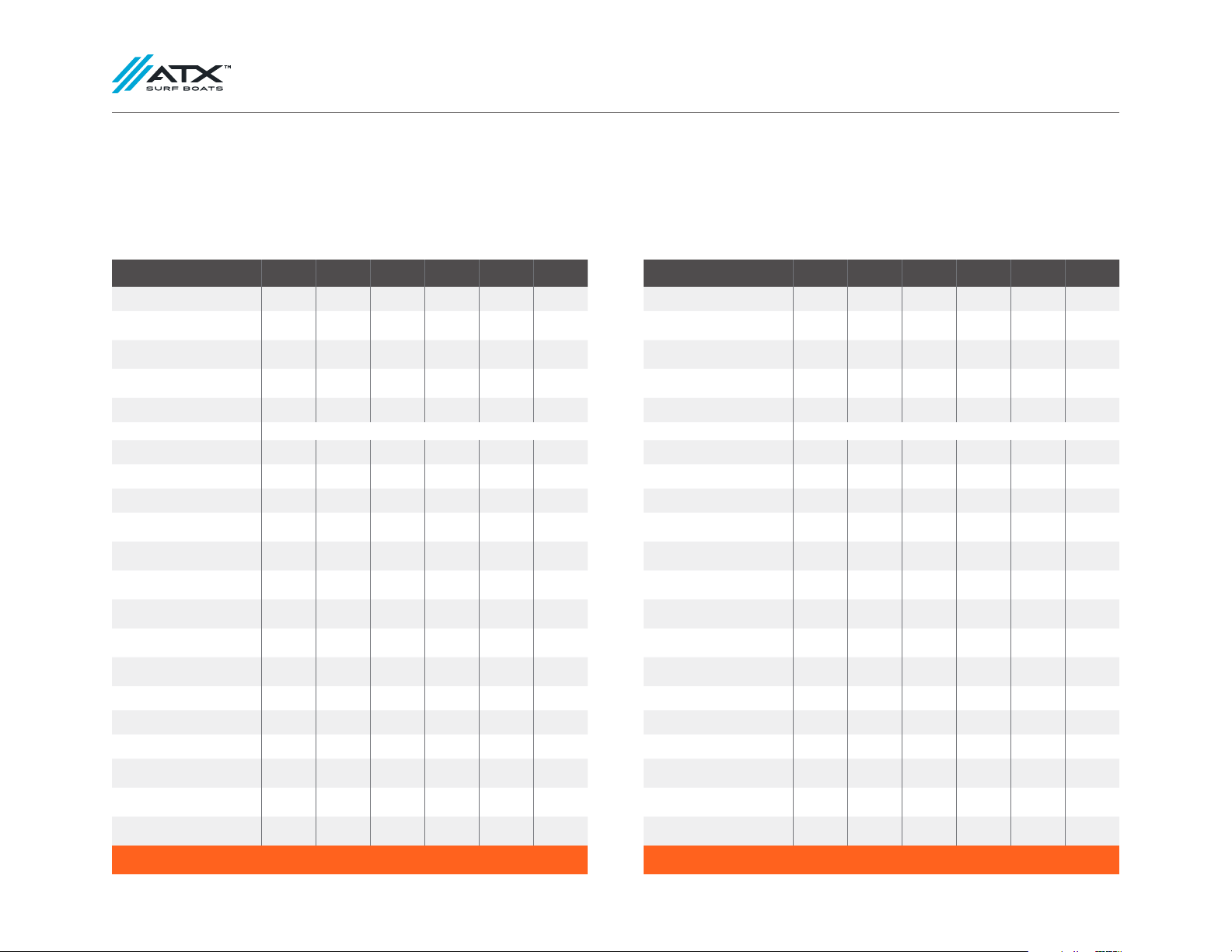
TROUBLESHOOTING AND SERVICE REQUIREMENTS | 96
320-HOUR SERVICE REQUIREMENTS
This service must be performed to keep warranty active.
Engine oil and filter must be changed every 50 hours. Please see your dealer.
ATX MAINTENANCE SCHEDULE DA ILY WEEKLY REGU LAR ANNUAL
Smell b ilge area for fuel vap ors
Check and tighte n all steering
system bolt s and connecti ons
Check rudder, tiller arm bolt
and safety setscrew
Lubricate rudde r stuing box
and steering support tube
Lubricate cables
Replace cables If stiness continues after lubricating
Check bilge pu mp operation
Check blower operation
Inspect shaft seal
Check shaft alignment/ensure
it is within .003
Check and tighte n motor
mounts
Tighten pylon and tower
mounting bolts
Tighten a ll hardware and
fasteners
Change engine oil and filter
(every 50 hrs . or annually)
Change transmission fluid every
300 hrs .
Change engine coolant
Check engine oil
Check transmission
Check wate r pickup s for debris
or marine grow th
If equ ipped with a strai ner,
check a nd clean
If opera ted in salt water, flush
engine/cooling system and boat
IF PROPELLER STRIKES AN OBJECT, INSPECT DRIVE TRAIN IMMEDIATELY!
EVERY 2
YEARS
300-
HRS.
500-HOUR SERVICE REQUIREMENTS
This service must be performed to keep warranty active.
Engine oil and filter must be changed every 50 hours. Please see your dealer.
ATX MAINTENANCE SCHEDULE DA ILY WEEKLY REGU LAR ANNUAL
Smell b ilge area for fuel vap ors
Check and tighte n all steering
system bolt s and connecti ons
Check rudder, tiller arm bolt
and safety setscrew
Lubricate rudde r stuing box
and steering support tube
Lubricate cables
Replace cables If stiness continues after lubricating
Check bilge pu mp operation
Check blower operation
Inspect shaft seal
Check shaft alignment/ensure
it is within .003
Check and tighte n motor
mounts
Tighten pylon and tower
mounting bolts
Tighten a ll hardware and
fasteners
Change engine oil and filter
(every 50 hrs . or annually)
Change transmission fluid every
300 hrs .
Change engine coolant
Check engine oil
Check transmission
Check wate r pickup s for debris
or marine grow th
If equ ipped with a strai ner,
check a nd clean
If opera ted in salt water, flush
engine/cooling system and boat
IF PROPELLER STRIKES AN OBJECT, INSPECT DRIVE TRAIN IMMEDIATELY!
EVERY 2
YEARS
500-
HRS.
Page 98
TROUBLESHOOTING AND SERVICE REQUIREMENTS | 97
ORIGINAL OWNER INFORMATION
Owner Name:
Address:
City:
State:
Zip:
E-mail:
Boat Number:
Date of Purchase:
Dealer:
SECOND OWNER INFORMATION
Owner Name:
Address:
City:
State:
Zip:
E-mail:
Boat Number:
Date of Purchase:
Dealer:
Ask about the transferable warranties.
Page 99
FUEL LOG
DATE GALLONS HOURS GALLONS/HOUR DATE GALLONS HOURS GALLONS/HOUR
TROUBLESHOOTING AND SERVICE REQUIREMENTS | 98
Page 100
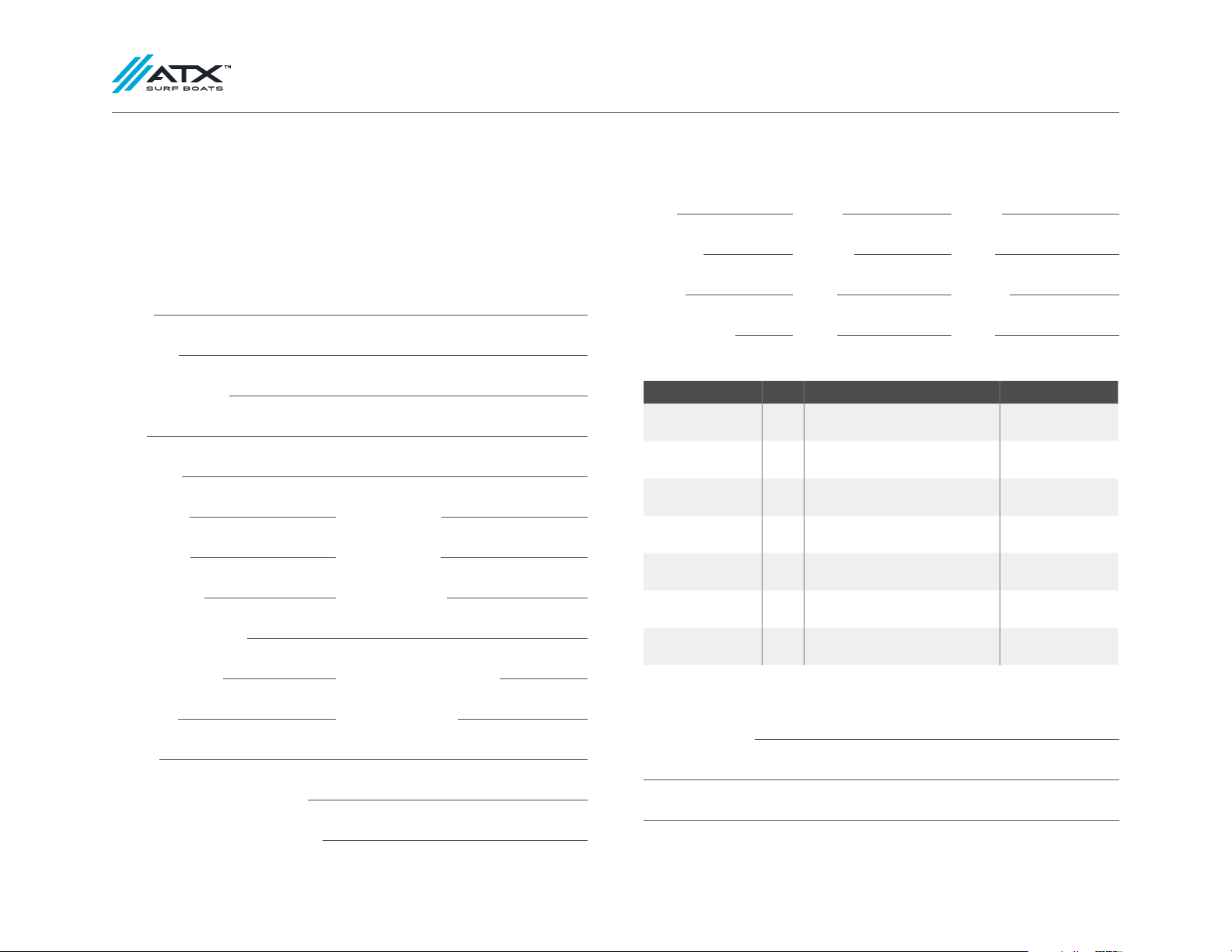
TROUBLESHOOTING AND SERVICE REQUIREMENTS | 99
FLOAT P L A N
Copy this page and fill out the copy before you boat. Leave the filled out copy
with a reliable person who can be depended upon to notify the USCG or other
rescue organization, should you not return as scheduled. Do not file this plan with
the USCG.
Name:
Telephone:
Description of Boat:
Type:
Color/Trim:
Engine Type: No. of Engines:
Horsepower: Fuel Capacity:
Destination Est.: Time of Arrival:
Expected to Return By:
Survival Equipment
PFDs: Flares: Mirror:
Flashlight: Paddles: EPIRB:
Water: Food: Anchor:
Radio (Yes/No): Type: Freq.:
Persons Aboard
NAME AGE ADDRESS TELEPHON E
If Not Returned By: Call the Coast Guard, or:
Auto Type: License Plate No.:
Parked:
Coast Guard Telephone Number:
Local Authority Telephone Number:
Other Information:
 Loading...