

Atlantic Boilers TR 80, TR 300, TR 105, TR 150, TR 200 Installation, Operating And Maintenance Manual
...Page 1
ATLANTIC BOILERS, PO BOX 11, ASHTON UNDER LYNE, OL6 7TR T: 0161 621 5960 E: [email protected] www.atlanticboilers.com
FOR TECHNICAL HELP/ADVICE Call 0161 621 5960
or email [email protected]
FOR FULL PRODUCT RANGE & LITERATURE
Visit www.atlanticboilers.com
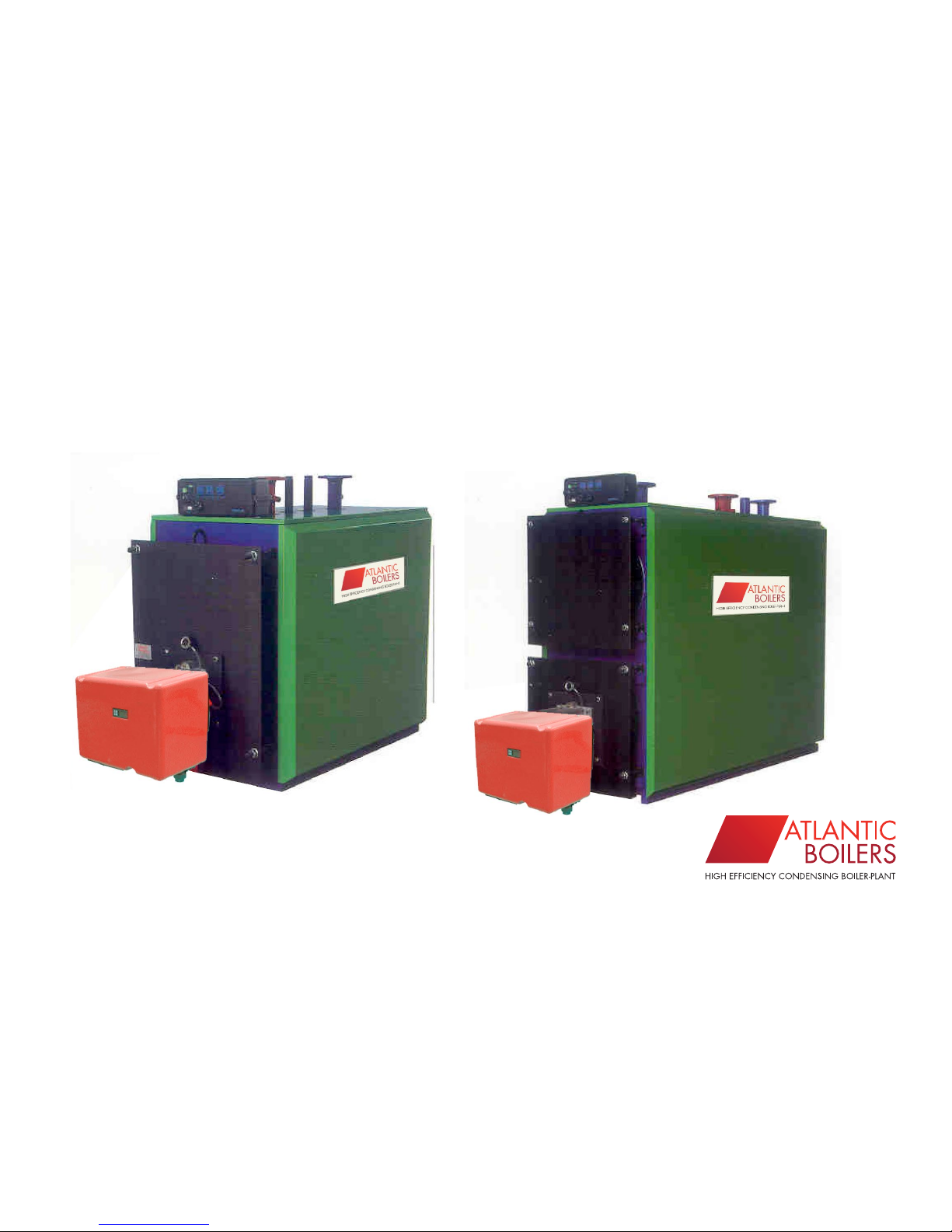
TR 3 PASS HOT WATER BOILERS
INSTALLATION, OPERATING AND MAINTENANCE
INSTRUCTION MANUAL
Page 2

°
“The Heating Engineer”
06042007
5
CONTENTS
o Properties of liquid/gas fuelled boilers…………………………………….. 6
o Manufacturing and testing standards applied………………………….. 6
o Introduction……………………………………………………………………………….. 7
o Boiler dimensions……………………………………………………………………….. 9
o Boiler operating personnel………………………………………………………... 10
o Transportation and temporary storage……………………………………... 10
o Boiler installation…………………………………………………………………………. 11
o Expansion tank and safety pipes…………………………………………………. 12
o Burner selection and installation…………………………………………………. 17
o Combustion chamber dimensions……………………………………………….. 18
o Fuel selection and storage ………………………………………………………….. 19
o Filling the system with water……………………………………………………….. 19
o Preparation of the boiler for operation………………………………………… 20
o Safety rules
……………………………………………………………………………………………………………………………………….
21
o Putting boiler in operating……………………………………………………………. 23
o Heating system adjustments
……………………………………………………………………………………………
25
o Discharging the boiler water……………………………………………………….. 26
o Taking boiler out operation…………………………………………………………. 26
o Prevention of low temperature corrosion…………………………………… 27
o Inspection and maintenance of boiler……………………………………….. 28
o General maintenance………………………………………………………………….. 28
o Hydrostatic test……………………………………………………………………………. 29
o General boiler malfunctions………………………………………………………… 30
o Boiler control panel installation
.................................................... ................
32
o Control panel dimensions
.................................................... .................................
34
o Boiler control panel electrical schema…………………………
………………………..
35
o Installation circuit diagram………………………………………………………….. 37
o Boiler feed water and boiler water chemical characteristics ……… 38
o Boiler life span………………………………………………………………………………. 39
o Authorized services………………………………………………………………………. 40
erensan
Page 3
erensan°
“The Heating Engineer”
06042007
7
INTRODUCTION
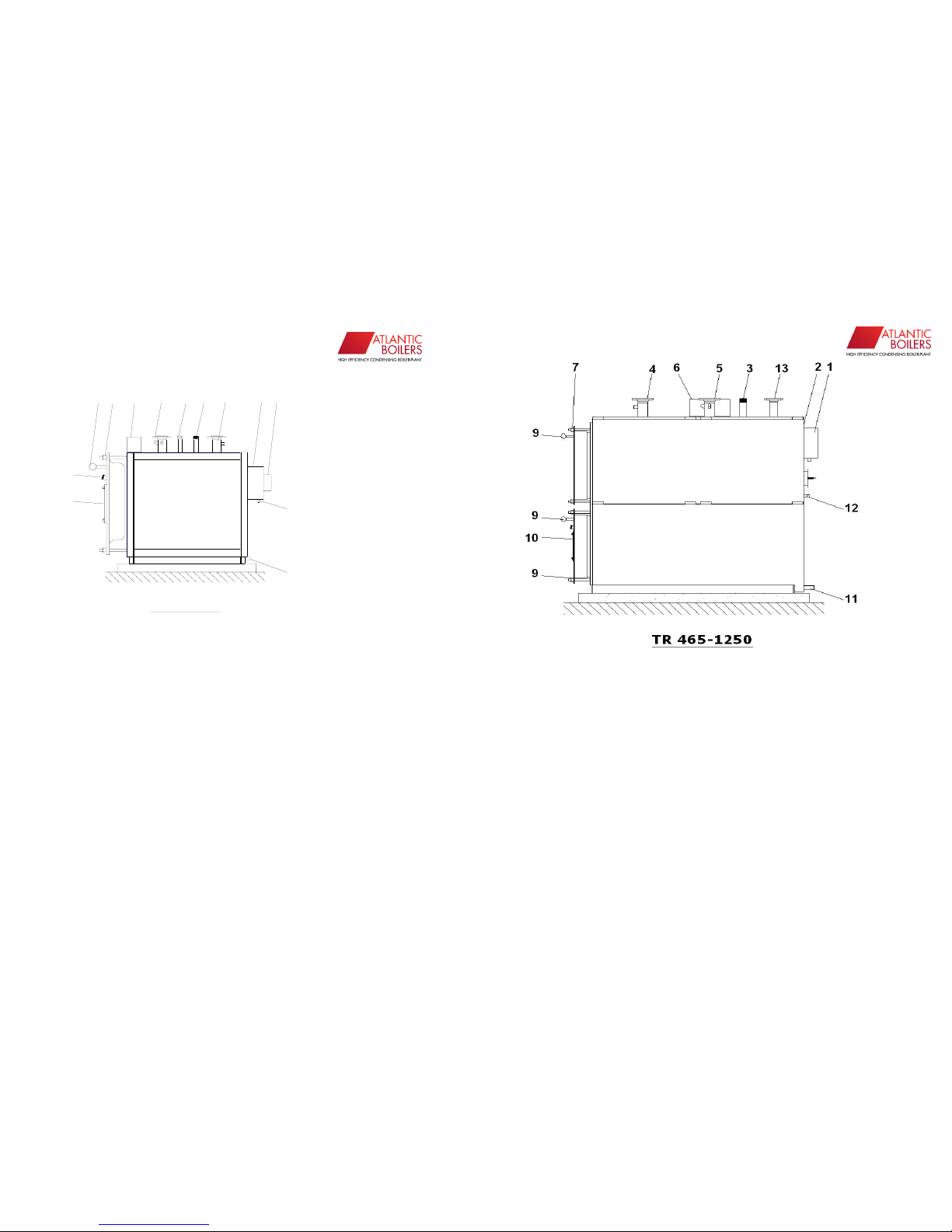
TR 80-350
10
9
8
7
6
5
4
3
12
12
11
13
1. Chimney duct
2. Smoke chest
3. Expansion tank connection sleeve
4. Boiler return
5. Boiler outlet
6. Control panel (CP)
7. Door nuts
8. Handle
9. Flame observation port
10. Burner adapter flange
11. Boiler filling&discharge
12. Condensation water sleeve
13. Sanitary hot water connection sleeve
erensan°
“The Heating Engineer”
06042007
8
1. Chimney duct
2. Smoke chest
3. Expansion tank connection sleeve
4. Boiler return
5. Boiler outlet
6. Control panel (CP)
7. Door nuts
8. Handle
9. Flame observation port
10. Burner adapter flange
11. Boiler filling discharge
12. Condensation water sleeve
13. Sanitary hot water connection sleeve
Page 4
erensan°
“The Heating Engineer”
06042007
9
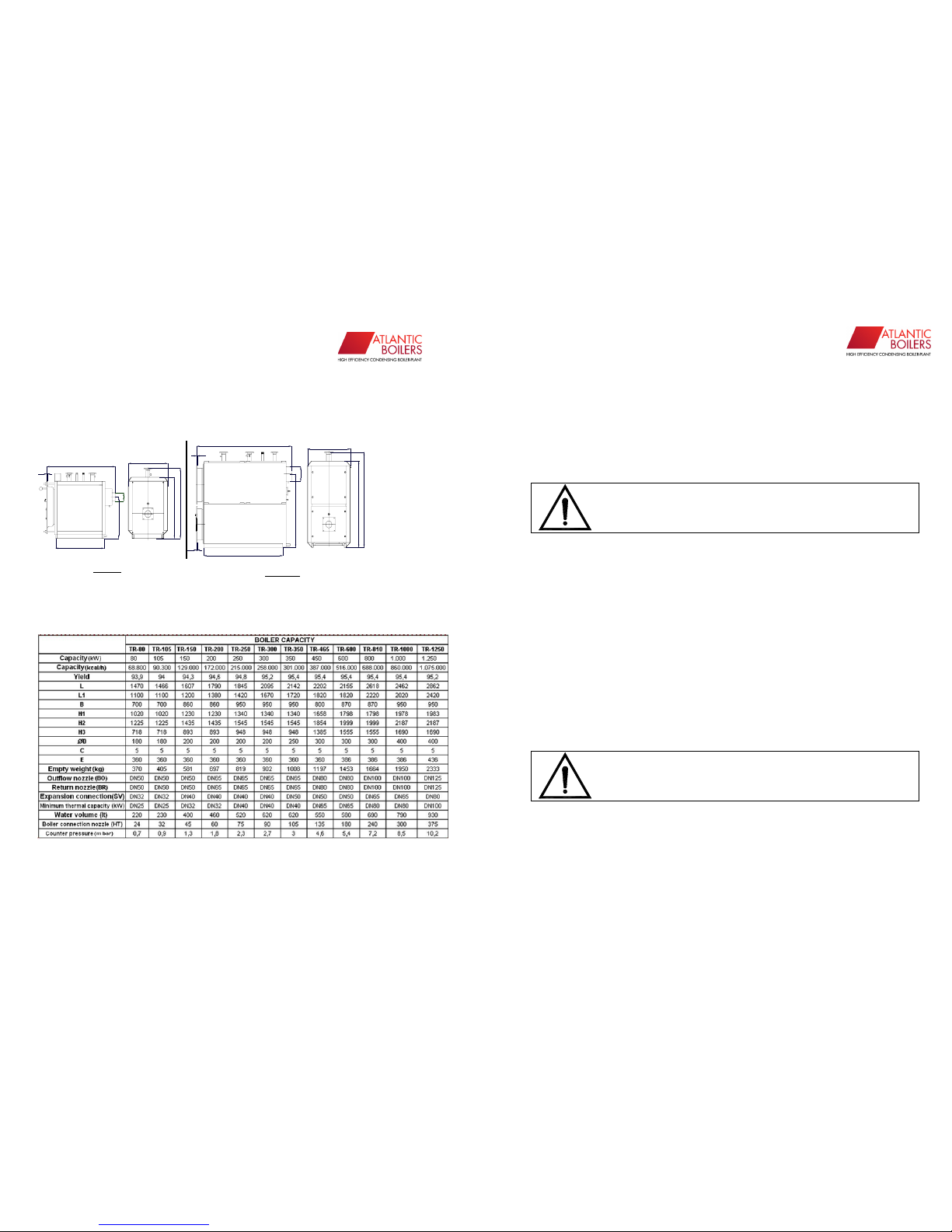
BOILER DIMENSIONS
TR 80-350
TR 450-1250
ØD
KD KG EV S.K
H3
L1
L
C
B
H2
H1
H3
ØD
B
H1
H2
L1
C
C
L
erensan°
“The Heating Engineer”
06042007
10
BOILER OPERATING PERSONNEL
Boiler operating personnel (boiler operator) should be knowledgeable
about general boiler failures and their reparation, as well as the tasks
and working principles of all measurement, adjustment, control and
safety devices on the system.
The boiler operator should have an official document (boiler operator
certificate) verifying his expertise on the abovementioned issues.
TRANSPORTATION AND TEMPORARY STORAGE:
• The boiler should be transported using the lifting and transportation
points by detaching the top cladding sheet and appropriate equipment.
• For horizontal movement; where it is not possible to utilize a winch,
horizontal displacement is possible through controlled sliding on pipes.
• The boiler should be protected against mechanical blows and collisions
during loading, transportation and unloading.
• It must be protected against damages resulting from moisture and
external mechanical factors that may arise during temporary storage
before transportation and installation.
MAKE SURE THAT THE BOILER
PERSONNEL POSSESS BOILER OPERATOR
USE THE BOILER COMPLYING WITH
WARNINGS AND RECOMMENDATIONS IN
THIS
PROCEDURE !
Page 5

erensan°
“The Heating Engineer”
06042007
11
BOILER INSTALLATION
• Install the boiler in the boiler room at the installation site on a
foundation elevated from the floor.
• Make the boiler mechanical connections as per the installation circuit
diagram.
• Boiler installation site should comply with the related standards and
procedures. It must have a door opening towards the outside, a fresh air
inlet duct at floor level and a polluted air discharge chimney duct at ceiling
level (apart from the boiler chimney). The door and the window frames
must be of non-flammable material.
• The burner, the boiler control panel (if any) and the pre-heater
connections should be performed by eligible technical personnel in
compliance with the burner user manual and vendor installation diagram.
• The boiler must be used with the boiler control panel. (We also
recommend a thermometer to be placed on the ½” sleeve located on the
boiler return pipe.)
A hydrometer (open expansion) or manometer (closed expansion) should
be placed on the boiler outlet pipe or collector.
• The boiler may be used in an open or closed expansion system. In case
it is used in a closed expansion system; a closed expansion tank suitable
for the total boiler and central heating water volume should be used at
building static water level pressure and with adjusted gas side pressure.
The closed expansion tank should be connected to the expansion nozzle
directly on the boiler or to the boiler main outlet or return pipe provided
that there is no stop gate valve. A pressure relief valve with opening
pressure of 1,05 bars over the boiler operating pressure should be used.
• More than one boiler should not be connected to the same chimney.
• The boiler must be provided with a chimney and smoke channel in
compliance with the regulations and standards of the authorized
institutions regarding the fuel and smoke gas debit used.
• Our boiler has been designed for 90-70 C, stabilizing collector and
secondary circulation pump must be used in the system for different
temperature applications.
• The number 12 condensation water sleeve located in the figures of
pages 7 and 8 must be plugged with the boiler room output by attaching a
hose nippel and a hose to it.
erensan°
“The Heating Engineer”
06042007
12
In order to prevent battery corrosion, the boiler must be
grounded with,
a) 0.5m
2
, 2mm thick copper sheet,
b) 0.5m
2
, 3mm thick hot dip galvanized sheet
c) Massive copper bar electrodes.
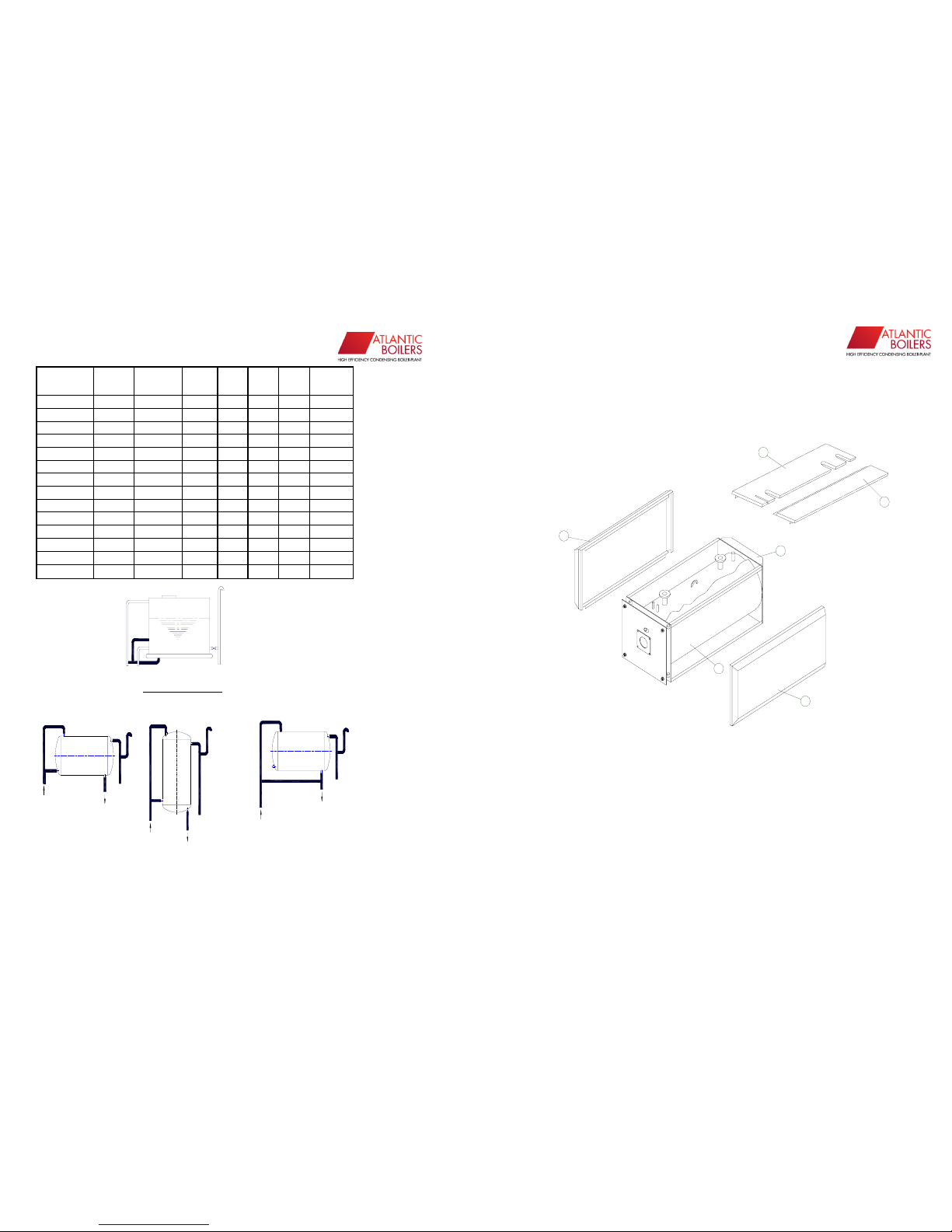
EXPANSION TANK AND SAFETY PIPES
It is essential for the water not to be in direct contact with the air and the
temperature not to rise above 100°C in open expansion hot water heating
system. There should be outflow and return safety pipes between the
boiler and the expansion container fully and independently, without any
valves interrupting it in order to ensure the contact of water with the air
and to ensure that this connection is not cut off by mistake or due to
negligence. The safety valves should be installed without narrowing and
continually rising towards the expansion tank.
Access to the outflow safety pipe and the expansion tank can be either
from top or bottom. However the return safety pipe must be connected
from the bottom. The diameters for both pipes based on tank capacity can
be obtained from the table below. The safety pipes should never be
smaller than 1”.
Page 6
erensan°
“The Heating Engineer”
06042007
13
Their diameters can be calculated by the following formula.
df = 15+1,5*(Qk /1000)½ [mm]
d
g = 15+(Qk /1000)
½
[mm]
Monitor = ½"
It is strongly recommended to place a circulation connection and tap
between the outflow safety pipe and expansion tank.
No hardware such as valve or check valve that clog the circulation should
be placed on the safety valves.
The volume of the expansion tank is calculated based on the expansion as
a result of the temperature rise of the water in the entire system from
10°C to tm °C. The expansion tank volume in systems with normal hot
water of 90/70 °C
can be taken as Vi = 0,06*V
S
(liter)
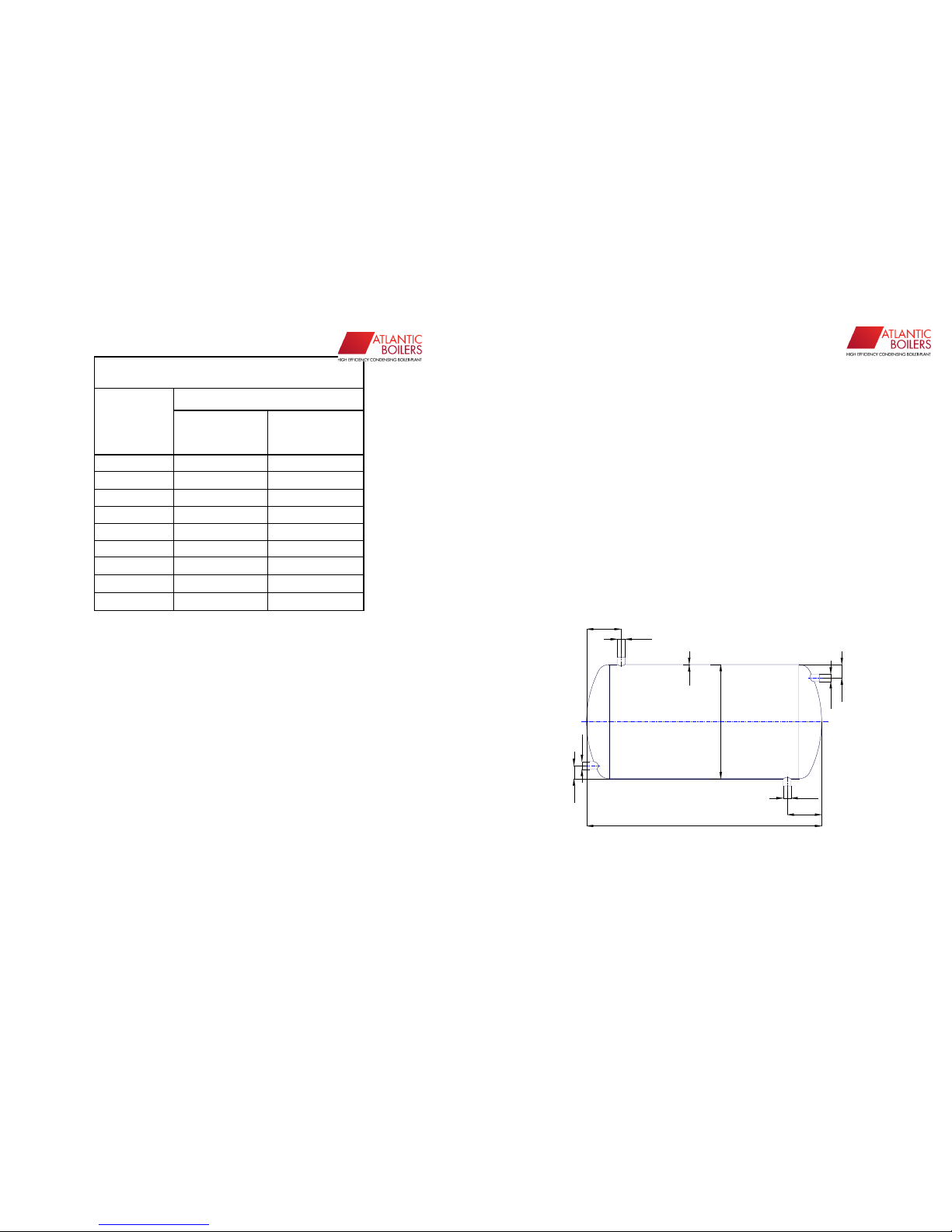
Safety Pipe Diameters
Boiler capacity (kcal/h)
DIAMETER
Outflow pipe
Return pipe
25 - 1" 50.000 100.000
32 - 1 1/4" 130.000 209.000
40 - 1 1/2" 280.000 630.000
50 - 2" 550.000 1.230.000
60 - 2 1/2" 900.000 2.000.000
70 1400.000 3.000.000
80 1900.000 4.200.000
90 2500.000 5.600.000
100 3200.000 7.200.000
°
“The Heating Engineer”
06042007
14
(Vs, is the total water amount in the system in liters)
V
S
= W * Qk (liter)
Qk = Boiler heating power (kW)
W= Specific water amount;
When convector is used : 5.20 lt/kW
When panel radiator is used : 8.33 lt/kW
When cast radiator is used : 12.00 lt/kW
With heating from flooring : 18.50 lt/kw
are the values.
The empirical volume of the expansion tank can be calculated roughly as
follows.
Vi = 0.002 * Qk (liter)
Note: The volumes obtained are the useful volume of the tank, and the
volume of the tank will be taken as 25% above than this volume.
The expansion tanks should conform to TS 713.
(DIN 4806 should be referred to for the matters that are not addressed by
TS 713.)
d1
d2
l3
l2
d2
l1
l2
d2
l3
d2
s
Page 7
erensan°
“The Heating Engineer”
06042007
15
Volume Weight
(liters)
d1
(mm)
d2
l1
(mm)
l
2
(mm)
l
3
(mm)
S
(mm)
(kg)
30 300 R 1" 500 50 100 3 14
50 350 R 1" 580 50 105 3 19
75 400 R 1 1/4" 670 50 115 3 25
100 400 R 1 1/4" 870 60 115 3 31
125 500 R 1 1/4" 710 60 130 3 34
150 500 R 1 1/4" 850 60 130 3 40
200 500 R 1 1/2" 1110 60 140 3 49
250 500 R 1 1/2" 1350 60 140 3 57
300 600 R 1 1/2" 1180 60 150 3 63
400 650 R 2" 1310 70 170 3 77
500 700 R 2" 1420 70 180 3 89
600 700 R 2 1/2" 1660 80 190 3 103
800 800 R 2 1/2" 1700 80 200 4 158
1000 800 R 2 1/2" 2125 80 200 4 190
SSR
Ü
K
SV
U = Taşkan
K = Kısa devre sirkül asyon bağlantısı
S = Haberci
SR = Emniyet dönüş borusu
SV = Emniyet gidi ş borusu
E = Havalandırma
a
b
c
d
a
d
c
b
a
d
b
c
a = Gidiş borusu
b = Sirkülasyon
c = Dönüş
d = Taşma ve
havalandırma
Sirkül asyon : İmbisat
deposu vasıtasıyla
Sirkül asyon : İmbisat
deposu dönüş
borusundan
İMBİSAT DEPOSU
SV = Safety outlet pipe
SR = Safety return pipe
E = Ventilation
U = Outflow
K = Short circuit circulation connection
S = Monitor
EXPANSION TANK
Circulation: Via expansion
Tank
a = Outlet pipe
b = Circulation
c = Return
d = Outflow and
ventilation
Circulation: From the
expansion tank return pipe
erensan°
“The Heating Engineer”
06042007
16
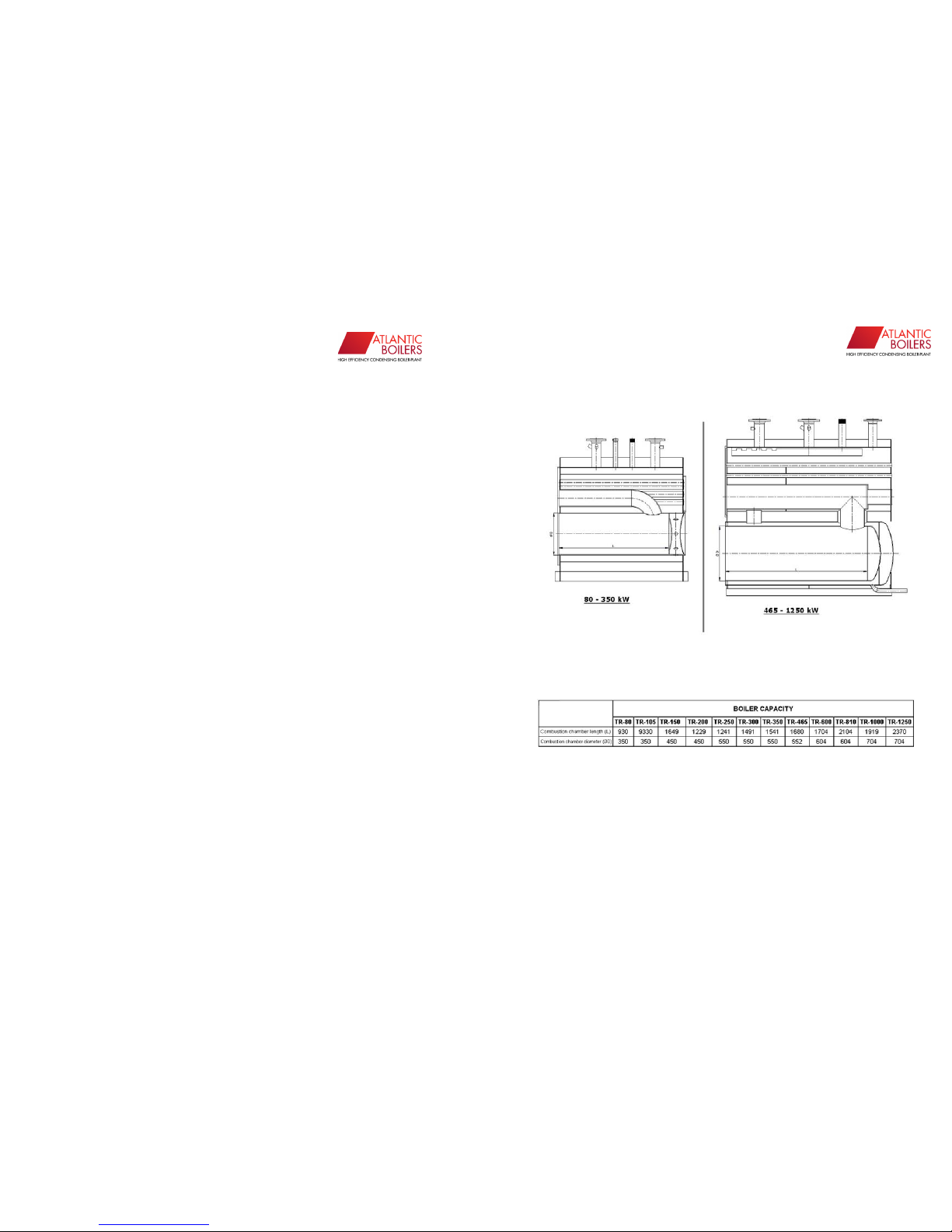
INSULATION CLADDING INSTALLATION
2
5
4
3
1
6
• Attach the side insulation claddings numbered 2 and 3 to the
boiler. Make sure that they appropriately fitted into the slots on
the skirts of the side cladding.
• Attach the No.4 upper insulation cladding onto the bottom slot
and fit it in completely.
• Upon attaching the No.4 cladding, attach No.5 upper insulation
cladding the same way.
Page 8
erensan°
“The Heating Engineer”
06042007
17
BURNER SELECTION AND INSTALLATION
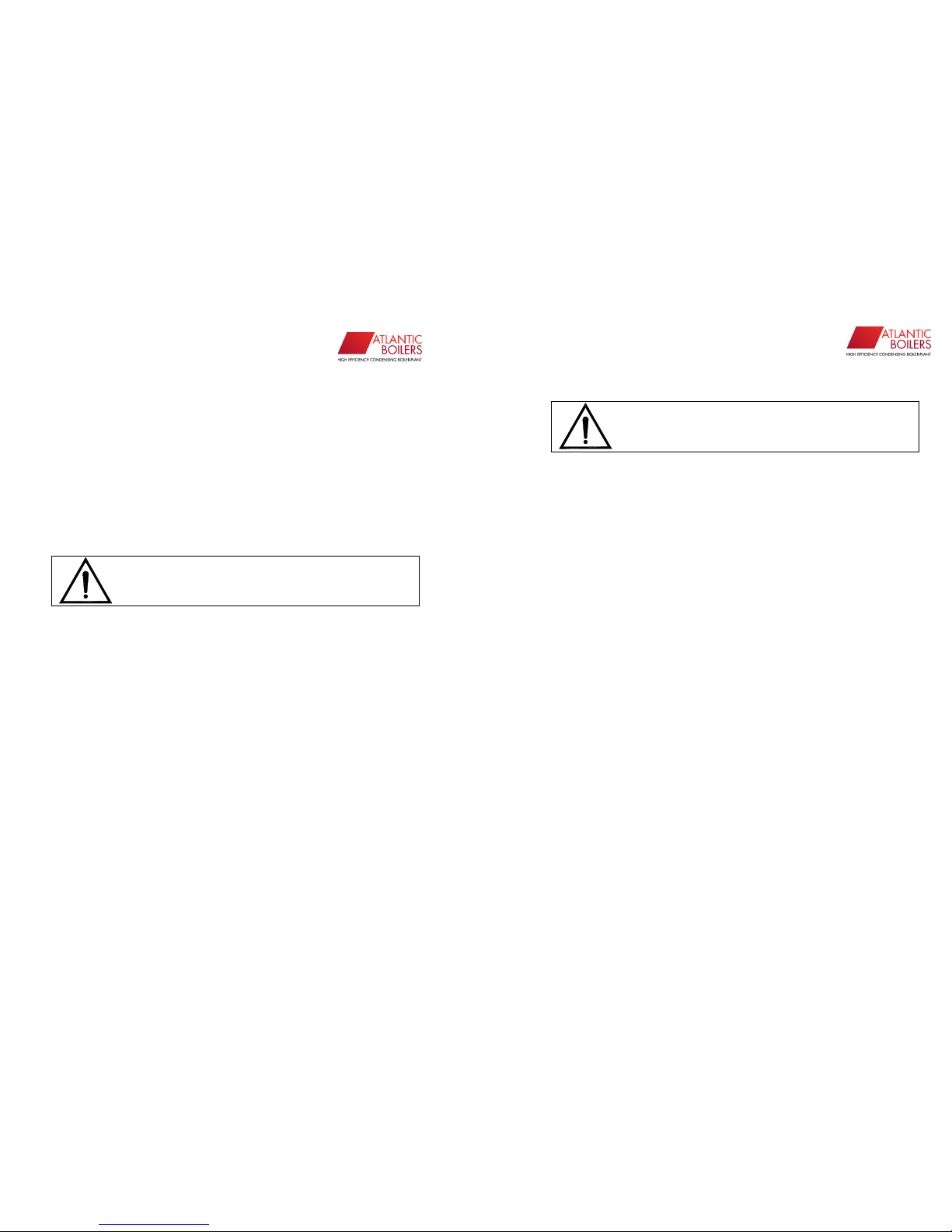
To achieve efficient combustion, the burner to be attached to the boiler
should be selected in compliance with forming an appropriate flame for
the combustion chamber defined in the boiler technical specifications
section.
During the installation of the burner, care should be shown to match
burner nozzle axis with combustion chamber axis.
To prevent entry of excess air into the combustion chamber from
outside, the burner installation should performed carefully to prevent
leakage.
The fuel used for operating should comply with burner manufacturer
recommendations.
It should be calculate as; Burner firing power = Boiler capacity/Boiler
efficiency. Choose an appropriate burner with this capacity that
overcomes the boiler counter pressure. When ordering a boiler, inform
the related sales personnel about the burner type selected, to ensure
that the boiler door and connection flange is designed in compliance with
the burner.
Use a burner with an appropriate head length in your boiler.
The burner head tip must enter the combustion chamber for a minimum
of 30mm.
Burner operation and safety system must conform to the boiler control
panel.
Our boiler can be used with single stage, double increment or double
stage or modulating burner.
erensan°
“The Heating Engineer”
06042007
18
COMBUSTION CHAMBER DIMENSIONS
Page 9
erensan°
“The Heating Engineer”
06042007
19
FUEL SELECTION AND STORAGE:
• Fuel complying with the characteristics indicated in the burner user
manual or burner vendor catalogues should be obtained.
• Fuel transfer lines should conform to current technical specifications,
regulations and standards. The fuel tank-burner axis levels should not
exceed figures specified in the burner user manual.
• Fuel tanks should conform to standards. A wall must exist between the
fuel tank and the boiler.
• If fuel-oil is being used (especially of a heavier group), the necessary
arrangements (RING LINE) and heating installation should be prepared
for flow of fuel from the tank to the burner.
FILLING THE SYSTEM WITH WATER
The boiler should be filled with water before operation. The boiler should
not be operated before it is filled with water.
To fill the boiler with water, the main distribution and collection pipes,
the boiler feeding pipes, installation column valves should be opened
fully, water should be let in from the filling/discharge tap and it should
be filled slowly until water starts coming from the monitor pipe of the
Expansion Tank. In closed expansion systems, during water filling from
boiler filling/discharge tap, the air discharge tube valves and mechanical
purgers should be opened and then closed when it is observed that the
incoming water does not have bubbles. When the air tube at the top
most level of the installation or at the roof is completely filled with
water, filling will be completed.
BEFORE OPENING THE FRONT DOOR,
SHUT OFF THE BURNER AND SHUT
DOWN BURNER ELECTRICITY !
erensan°
“The Heating Engineer”
06042007
20
The circulation pump should not be operated during the filling process.
The expansion tank connections should conform to the installation circuit
diagram.
PREPARATION OF BOILER FOR OPERATION
The boiler room must be designed to meet the combustion air requirements
of the boiler.
The boilers should be completely cleaned from internal and external dust,
soot, etc.
The smoke channel, smoke pipe and chimney cleaning doors should be
checked and leakages should be prevented.
The fuel heaters (when used with liquid fuel) and burner fuel connections
should be checked for leakage. In gas fuel applications, the conformance of
the provided pressure to the relevant burner and boiler, and if it has a seal,
the functional operation of the control system should be checked.
The fuel filters should be cleaned, heater thermostats should be set to
correct value, fuel valves should be set full and open.
The fuel combustion system should be reviewed with respect to the system's
working principles and each element should be controlled for proper
operation.
The boiler explosion door should be checked for proper operation.
Boiler safety devices (manometer, hydrometer, safety valve, visual and
sound warning system etc.) should be reviewed to ensure proper operation.
DO NOT OPERATE BOILER WITHOUT
WATER.
Page 10

erensan°
“The Heating Engineer”
06042007
21
SAFETY RULES
• Use the boiler only for hot water production for the closed circuit
heating system.
• Use the boiler complying with warnings and recommendations in this
procedure.
• Have the heating system installed by authorized personnel.
• Have the boiler electrical connections made by authorized personnel.
• Do not operate boiler without water.
• When opening the front door and the front smoke chest door , shut off
the burner and shut down burner electricity.
• Make sure the boiler personnel are certified boiler operators.
• Make sure that water conforming to EN 12953-10 is used in the boiler.
(See page 41.)
• Boiler water temperature is designed for 90-70
0
C. Install a safety
system to prevent water the temperature from exceeding 1000C.
• Perform the inspection and maintenance activities of the boiler
thoroughly.
• The boiler chimney should be built in compliance with chimney building
rules. Airbrick and briquette should not be used in boiler chimneys.
The fuel used must conform to the standards and regulations in effect.
• The conformance of the chimney gas emission values to the national
and international standards and regulations in effect must be ensured
and checked.
erensan°
“The Heating Engineer”
06042007
22
• In closed expansion systems, the expansion tank gas pressure should be
checked to be equal to that of the building static water height and the
operation of the safety valve should be tested at opening pressure.
• Have the initial operation of the burner performed by authorized service of
related burner company. The burner capacity adjustment should be made
as per the label capacity of the boiler and the boiler efficiency value stated
by the manufacturer firm for the boiler. A burner adjustment above the
boiler capacity label value should not be allowed.
• If abnormal noises are heard from the boiler or the installation, the burner
should be stopped immediately and the fuel inlet should be closed. The
investigation and repair of the malfunction should then be made.
• If leakages are observed on the burner fuel attachments and transfer lines,
the burner should be immediately stopped and line valves should be
closed. If natural gas or LPG is used, use a leakage detector device in the
boiler room and an automatic fuel cut-off system on the main inlet.
• If LPG is used, when icing and dew is observed on the fuel pipes due to the
liquidizing of residual gas in fuel pipes from the previous night especially
on cold days, the burner should absolutely not be used. The LPG should be
carefully discharged from the drain tap. (Liquidizing may also form at
normal times due to gasification level control or line regulator problem.)
• In cold climate regions, measures should be taken to prevent the
installation water temperature from falling to freezing temperature.
Circulation pump should be operated continuously at workplaces that are
closed at night and during weekends. If heating is to be stopped for a long
period of time, the boiler and system water should be discharged.
Antifreeze should not be used. (Antifreeze causes corrosion and a decrease
in water heating capacity.)
• If the burner malfunctions, burner computer reset button should not be
pressed more than two times. If the burner still does not work, the related
authorized service should be called.
Page 11
erensan°
“The Heating Engineer”
06042007
23
PUTTING BOILER IN OPERATION
• Before the liquid/gas fuel heater boiler is operated, the existence of
the following conditions should be controlled:
• The liquid fuel in main fuel tank or the daily fuel tank should be heated
to the required temperature turning on the heater circuit.
• The valves on the liquid fuel circuit should not be opened fully.
• Burner nozzle should be selected to suit burner and boiler capacity.
• The pre-heater on the burner should be filled with liquid fuel and any
air in it should be discharged.
• The boiler thermostats should be adjusted to the suitable value.
• It should be made sure that the heating system is filled with water.
• The system should be filled with water and all the valves should be
checked to be open. Air should be discharged from the air valves and
purgers in the system. Circulation pump should not be operated during
air discharge.
• Circulation pump should be started.
• The burner should be started from the switch on burner power panel.
• After the burner is running, nozzle pressure should be adjusted to
burner and boiler power.
• When the boiler is in steady state (1-1.5 hours after the burner has
started), burner air adjustment should be made using the chimney gas
analysis device.
• In the case of gas fuel burner, fuel cut-off valves are opened and the
burner is started. In fuel-oil usage, the burner is started after the fuel
is heated in the pre-heater tank.
• Hourly fuel consumption is calculated with the formula of
B=Qk/(Hu*v).
B : Fuel quantity per hour [kg/h],[Nm
3
/h]
Q
k:
Boiler output [kcal/h]
H
u:
Fuel lower heating value [kcal/kg],[kcal/Nm3]
erensan°
“The Heating Engineer”
06042007
24
v : Boiler efficiency must be obtained from table on page 9.
• In liquid fuel applications, appropriate nozzle (45°), pump pressure
(see burner catalog) should be selected.
• In gas fuel applications, the type of fuel (Natural gas, LPG) and gas
consumption according to line pressure must be checked from the
relevant gauge.
• If the boiler water is overheated, the circulation pump should be
checked. (It may be turning in reverse due to misplaced connectors.)
If that does not bring a solution, the burner should be stopped and the
installation should be checked.
• Open the boiler door carefully.
• Protect the front door and the front smoke chest fire cement surface
from collusion with hard objects (skewer, brush arm, turbulence
makers, etc.).
• During the initial firing of the boiler after manufacturing, run it at a 25-
30% capacity setting for about 2 hours to let the moisture in the cover
fire cement be disposed.
HAVE THE
HEATING SYSTEM INSTALLED
BY AUTHORIZED
PERSONEL !
Page 12

erensan°
“The Heating Engineer”
06042007
25
HEATING SYSTEM ADJUSTMENTS:
The boiler circulation pump should be checked for proper selection and
adjustment.
a- Pump flow should be calculated with the formula below:
Q
p:
Pump flow rate.
Q
p:Qk
/[Cp*(tg-td)] : [lt/h].
Qk:Boiler output [kcal/h]
C
p:
Specific heat capacity of water [1 kcal/(kg.°C)]
∆T is taken as tg-td=20 °C (in 90/70
0
C system)
b-Pump pressure;
H
p
:[mWC] Should be greater than the calculated critical circuit pressure
loss of the building circuit.
The pump selection should be approved by the (Mech. Eng.) responsible
for the building project and the technical application. Where a project
and calculations do not exist or are not available, regulations can be
made by placing thermometers, one each, on the boiler outflow and
return lines, a manometer to the circulation pump exit and by
adjustments with the help of the related pump curve, through the
circulation pump valves so that the water temperature difference
between outflow and return lines is 20
0
C. In the case of big pump
selection, the outflow-return temperature difference will stay below 20
o
C and boiler outflow temperature may not rise, and in the case of small
pump selection, the outflow return temperature difference will be over
20
0
C and the high and remote radiators may not function efficiently
enough.
Every morning, the water level and pressure should be controlled from
the hydrometer or manometer in the heating system. If it is below the
normal value, water should be added while the boiler is cool. If it is a
closed expansion system, the closed expansion tank gas pressure should
be controlled to be equal to the static water height of the building. This
control should be done on the expansion tank manometer if it is present,
if not, it should be done from the gas side valve with a manometer.
erensan°
“The Heating Engineer”
06042007
26
If the pressure is excessive, it should be discharged from the related
valve, if it is insufficient, nitrogen gas should be added by the expansion
tank authorized service.
If water comes out from the valve during the check instead of gas or air,
this means the tank diaphragm is torn and it should be changed by
contacting an authorized service.
DISCHARGE OF BOILER WATER
• After a season’s utilization, the boilers should be cleared of gasket
remains, mud and residue in the heating system.
• The blind flanges at the lowest level of the main distribution and
collection reservoir and boiler filling-discharge tap are opened, and the
system and boiler water is rapidly flushed out.
• After cleaning the system should be filled with water (as described the
article filling the system with water).
• The boiler water should not be discharged at any time except pre-
operation cleaning and water should not be added to the boiler except
for the purpose of compensating any depletion in the expansion tank.
TAKING BOILER OUT OF OPERATION
The taking of boiler out of operation should be as follows:
• The burner is stopped and boiler surfaces are cooled.
• The soot and smut in the boiler (the cover, smoke chest and the
smoke pipes) should be cleaned.
• The cleaned surfaces should be checked under strong light to detect
damages like leakages, oozing, cracks, etc. If such damages exist, the
authorized services are notified and the necessary repairs are done.
Page 13
erensan°
“The Heating Engineer”
06042007
27
• The liquid fuel between the burner and the main fuel tank should be
discharged and the fuel system should be cleaned with kerosene.
• Active lime should be sprinkled into the combustion chamber, smoke
pipes and smoke channels.
• The chimney cleaning flap should be brought to fully open position. It
should be closed down after the chimney cleaning.
• The damaged heat insulators should be repaired.
• The burner maintenance should be done as per manufacturer
recommendations.
• During non-operational period, the boiler room temperature should be
kept at min. +5
o
C.
• The boiler and system water should not be discharged if it is not a
necessity. Corrosion formation should be prevented. In long term idle
states and at end of the heating season, appropriate chemical
protective additive should be added to system water, to prevent
negative effects of the oxygen in water on the metal surfaces.
PREVENTION OF LOW TEMPERATURE CORROSION:
• The boiler pipes should not be allowed to burst due to low temperature
corrosion formation. To prevent this:
• Liquid fuel with low sulphur content should be used.
• To prevent condensation of the gasses that pass from the boiler
surfaces and the smoke pipes, boiler water outlet temperature should
not drop below 60
o
C and smoke gas temperature below 70o C.
• 3-Way Valve or 4-way Valve should be used in the heating system.
• Soot and smut gathering on the heating surfaces (combustion
chamber, smoke pipes, smoke chest) should not be allowed, cleaning
process should be performed as frequently as possible.
• The burner should not be stopped and started frequently.
• Combustion should be controlled and ensured to be efficient. The
PERFORM THE INSPECTION AND
MAINTENANCE ACTIVITIES OF THE
BOILER THOROUGHLY!
erensan°
“The Heating Engineer”
06042007
28
burner settings should be done by the authorized service and if a resetting is required, the related burner service should be contacted.
INSPECTION AND MAINTENANCE OF BOILER
1. General Maintenance
Heating system boilers should be subjected to general maintenance at
least once a year. The following points should be checked during general
maintenance.
• The operation of boiler armatures (thermostat, thermometer,
hydrometer/manometer) should be observed continuously and in case
of malfunction the required controls should be done and if needed,
they should be changed. Heat transfer should be improved by filling
the thermometer wells with thin lubricant.
• All connections in the system should be controlled for proper
insulation, leakages and oozing should be repaired and if needed, the
valve gaskets should be replaced.
• The boiler front big door and the front and rear smoke chest insulation
elements should be checked continuously; if leakage exists, the
tightening elements and nuts should be tightened in balance; if
leakage is not stopped, gasket/sealant should be changed or our
authorized services should be contacted. Grease the bolt screws and
nuts of tightening elements.
• Perform the cleaning of the boiler combustion room, smoke pipes and
smoke chest at least every 15 days in the case of liquid fuel usage,
and at least every 60 days in the case of gas fuel usage. The
turbulators should be taken out and all pipes should be cleaned with a
suitable mop. Turbulators should be reinstalled in place after cleaning.
For full boiler efficiency, all turbulators should be installed.
• At the end of season, the boiler should be cleaned fully, as in
periodical cleaning. Boiler heating metallic surfaces should be
protected against oxidation by applying transformer oil or a thin
metallic lubricant.
• The boiler and system water should not be discharged if it is not a
necessity. At end of season, appropriate chemical protective additive
should be added to system water, to prevent negative effects of the
oxygen and similar corrosive elements in water on the metal surfaces.
• Temperature gages are compared to a calibrated thermometer.
Page 14

erensan°
“The Heating Engineer”
06042007
29
• Safety elements, outlet and return safety pipes and safety valves are
checked for proper operation.
• The mud and residuals at bottom of liquid fuel tanks are cleaned.
• The controls described in article on taking boiler out of operation, are
performed.
2. Hydrostatic Test
Boiler parts such as the smoke pipe, nozzle, tube-sheet should pass a
hydrostatic test under an authorized mechanical engineer’s supervision,
when replaced or every 5 years for control purposes.
For boilers under 1000kW (including 1000 Kw):
• Close all outlets and inlets with blind flanges except one outlet/return
pipe left open.
• Let water into the boiler from the filling/discharge tap until water
comes from the vent left open.
• Also plug the open vent with a blind flange.
• Pressure the boiler to 1.3 times the design pressure. Wait 20
minutes and then check for drop in pressure, leakage and
permanent form changes.
For boilers over 1000kW:
The procedures described above are applied; test pressure is
taken as 1.5 times the design pressure.
erensan°
“The Heating Engineer”
06042007
30
GENERAL BOILER MALFUNCTIONS
Malfunction
Symptom
Reason Solution
No firing • Burner
malfunctio
n
• Follow burner
manufacturer
recommendations.
Dark black
smoke from
chimney
(in liquid
fuel)
• Air excess
coefficient
is low
• Circuit
voltage
low
• Low fuel
quality
• Check the fresh air
entering the boiler
room or burner air
setting.
• Voltage drop will
cause motor
revolutions to drop
and result with a low
fuel-air mixture.
• Get your fuel
checked.
Drumming
noise in
boiler water
compartmen
t
• Air in
system.
• Wiring and
installatio
n error
• Discharge the air.
• Check the
connections
according to the
system installation
circuit diagram.
Overheating
in boiler
water
• Circulation
pump
malfunctio
n.
• Thermosta
t
malfunctio
n
• Check circulation
pump for reverse
turning.
• Check boiler
thermometer for
proper operation.
Page 15
erensan°
“The Heating Engineer”
06042007
31
For malfunctions listed above, boiler operator personnel
intervention is sufficient. For malfunctions apart from these,
contact our authorized services.
Malfunction
Symptom
Reason Solution
Boiler output
water
temperature not
rising
• High water
speed
• Burner
selection
and/or
capacity not
conforming
• If the circulation pump is set for
cycle, the cycle should be reduced,
if it has one cycle the valve should
be reduced and regulation should
be conducted or should be replaced
with an appropriate pump.
• Get an authorized service to check
your burner.
Water
accumulation or
leakage in
smoke chest
• Water wapor
condensation
in smoke gas
• The boiler should not be operated
with low heat, the smoke gas at the
boiler output should not be below
70°C, a valve with 3 or 4 ways
should be used, the thermostat
settings of the boiler should be
high. The condensed water should
be drained from the lowest level of
the smoke chest via a connection.
Dye burn, heat
rise, fire cement
or turbulence
maker
deformation on
the front door
• Incorrect
burner
selection and
high setting
• Burner replacement, repair to
appropriate barrel measurement
and burner adjustment are
necessary. In liquid fuel, leakage
and accumulation into the
combustion chamber should be
prevented.
Chimney gas
temperature
rising
• Operation
without or with
deficient
turbulence
maker,
incorrect
burner setting
and selection
• Turbulence maker should be
attached or its deficiencies should
be completed, the burner setting
should be done correctly and
appropriate burner should be
provided
HAVE THE BOILER ELECTRICAL
CONNECTIONS MADE BY AUTHORIZED
PERSONEL !
erensan°
“The Heating Engineer”
06042007
32
BOILER CONTROL PANEL INSTALLATION INSTRUCTIONS
• Flax the 2 pieces of ½” brass cartridges supplied with the CP and
install them on the sleeves on the outlet pipe of the boiler with proper
insulation. Stop the empty sleeves with ½” blind plugs.
• Disassemble the CP body into two pieces, removing the 4 connection
screws. Check that the marked 375x48 mm section at the base is
drained. Pass the thermometer and thermostat sensors through this
gap and place them (at most 3 each) in the cartridges. Put thin engine
oil inside the casings and seal the upper part with silicon.
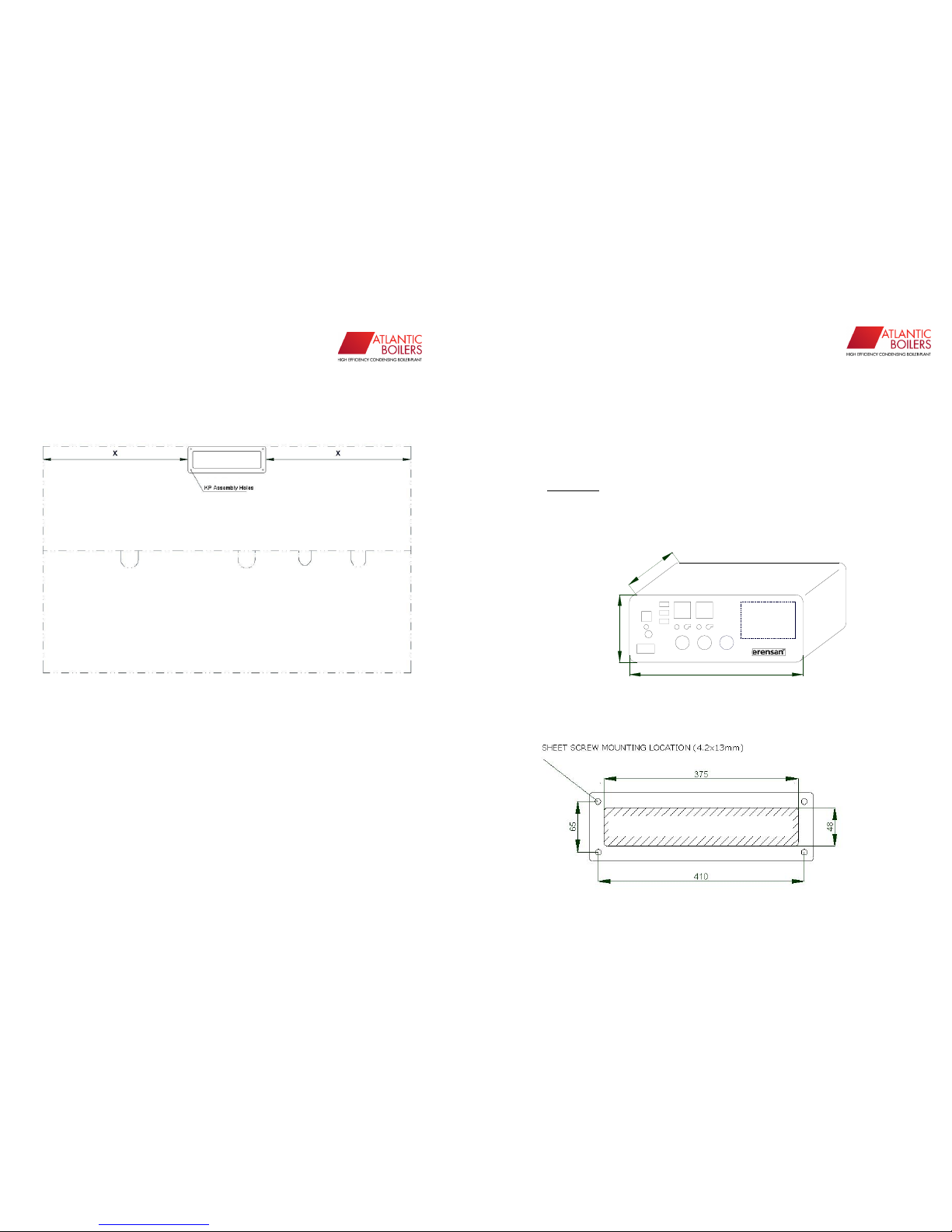
For TR 80 – TR 350 Types;
• Drill the CP lower body as below, from the screw points marked on 410
x 65mm axis measures with a 4mm tip, concurrently with the upper
insulation sheet.
Page 16
erensan°
“The Heating Engineer”
06042007
33
For TR 465 – TR 1250 Types;
• Drill the CP lower body as below, from the screw points marked on 410
x 65mm axis measures with a 4mm tip, concurrently with the upper
insulation sheet.
• Make the electrical connection between the CP exit contact and burner
contact, complying with the wiring diagram (with the number of
connections) with 0.75mm
2
cable. Open enough positions in the cross
sectional area behind the CP for cable pass-through and use bushings.
• Securely screw the CP lower body onto the upper isolator sheet of the
boiler with 4 4.2x13mm metal sheet screws.
• Put the upper body of the CP in place and close it by tightening with 4
screws.
• Ask the operating personnel to fill the boiler and system with water.
When the boiler and system is filled with water, expansion system is
controlled, the circulation pump is seen to be operational, you may
power the control panel.
erensan
Authorized Service.
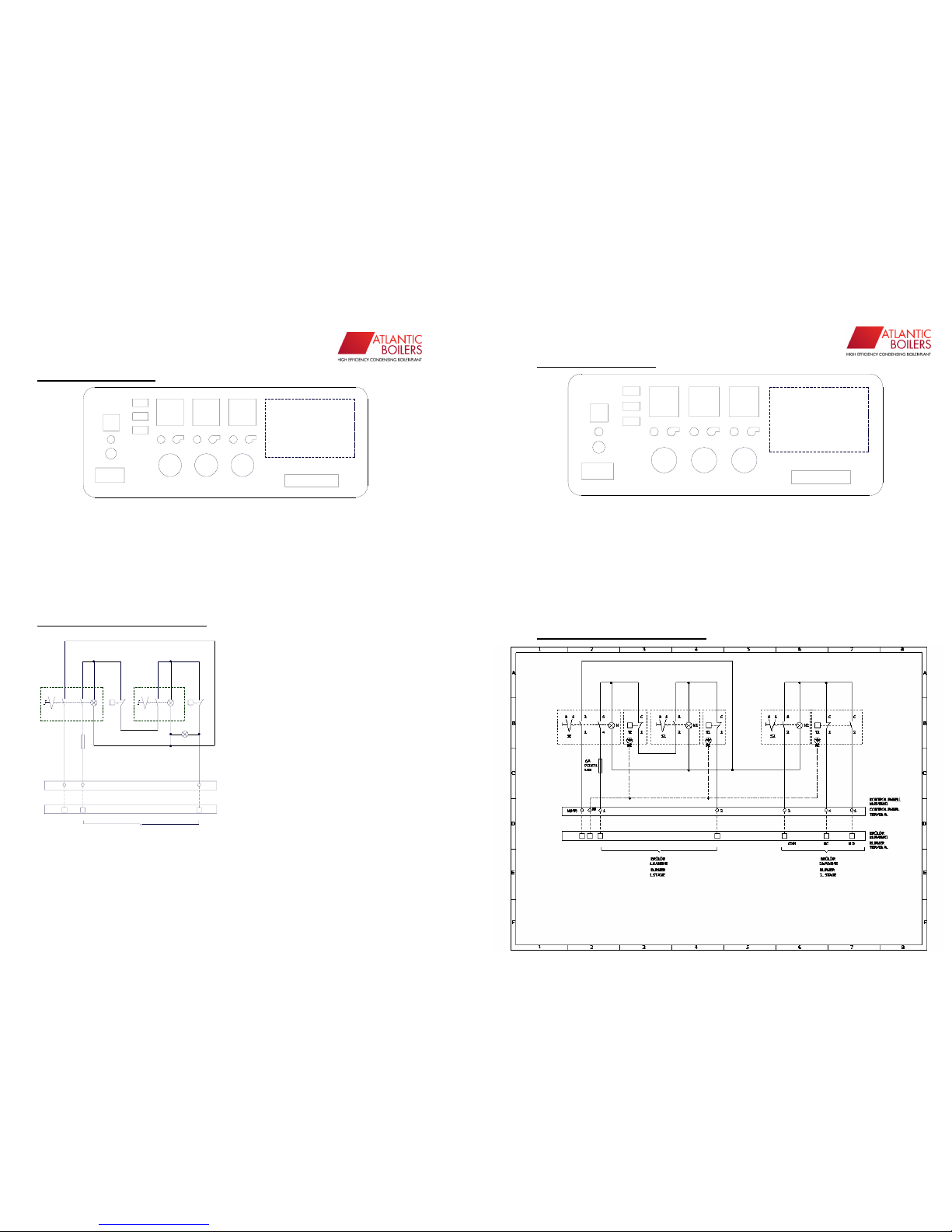
CONTROL PANEL DIMENSIONS
Control panel external dimensions
480
1
4
7
1
7
5
Control panel lower base installation dimensions
SHEET SCREW MOUNTING LOCATION (4.2x13mm)
Page 17
erensan°
“The Heating Engineer”
06042007
35
BOILER CONTROL PANEL ELECTRICAL SCHEMA
KP-1 control panel
4
5
2
1
3
7
6
1. Manual on - off switch
2. Fuse (6A)
3. Safety thermostat (With manual reset)
4. Boiler water thermometer
5. Burner ON-OFF switch (1. Level)
6. Thermostat in service signal
7. Thermostat Limit
KP-1 ELECTRICAL SCHEMA
KONTROL PANELI
S1
BRÜLÖR EMNÝYET DEVRESÝ
1
N(MP)
N(MP)
4
5
F
1
SE
1
02 0
C
1TE
BRÜLÖR
KLEMENSI
KLEMENSI
2
T112
1C
1
TH1:LiMiT TERMOSTATI DEVREDE SiNYALi
T1 :LiMiT TERMOSTATI
TE :EMNIYET TERMOSTATI (Resetli)
S1 :iSLETME SALTERi
SE :MANUEL ON-OFF ANAHTAR
TH1
F :SiGORTA
F: Fuse
SE: Manuel on—off switch
TE: Safety Thermostat (Reset)
SI: Operation switch
TI: Limit Thermostat
THI: Limit Thermostat in Service signal
Control Panel Connector
Boiler Connector
Boiler Safety Circuit
erensan°
“The Heating Engineer”
06042007
36
KP-2 control panel
4
5
6
2
1
3
8
7
9
10
1. Manual on - off switch
2. Fuse (6A)
3. Safety thermostat (With manual reset)
4. Boiler water thermometer
5. Burner ON-OFF switch (1. Level)
6. Burner ON-OFF switch (2. Level)
7. 1
st
Level in service signal
8. I. Level thermostat
9. 2
nd
Level in service signal
10. II. Level thermostat
KP-2 ELECTRICAL SCHEMA
Page 18
erensan°
“The Heating Engineer”
06042007
37
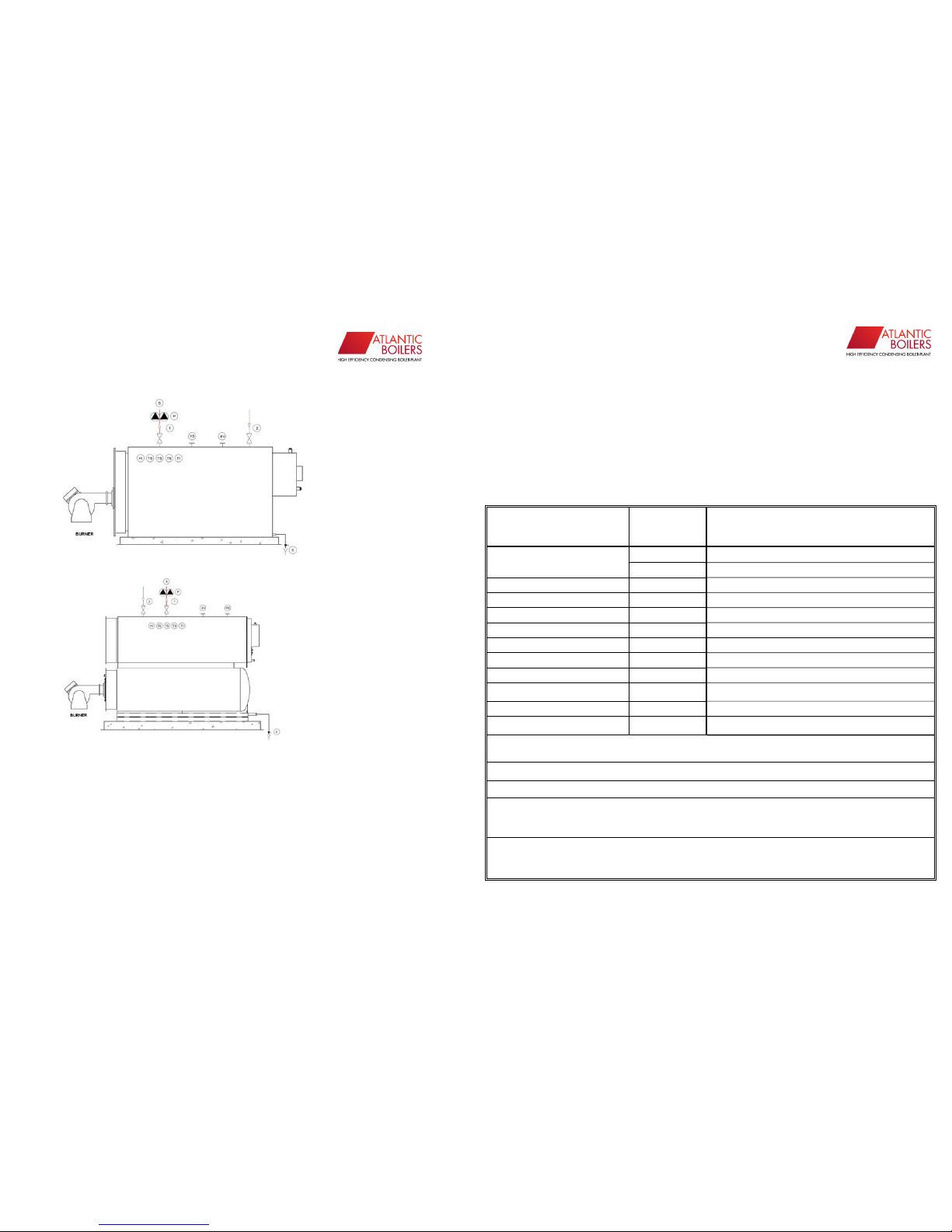
INSTALLATION CIRCUIT DIAGRAM (EXAMPLE)
TR 80 - 350
TR 465-1250
HI Hydrometer
TS Thermostat 30-90 °C
TI Thermometer 0-120 °C
EV Expansion tank connection sleeve
YS Sanitary hot water connection sleeve
P Pump
S
Supplying to the system
1. Supplying to the installation
2. Returning from the installation
3. Drain valve
erensan°
“The Heating Engineer”
06042007
38
BOILER FEED WATER AND BOILER WATER CHEMICAL
CHARACTERISTICS
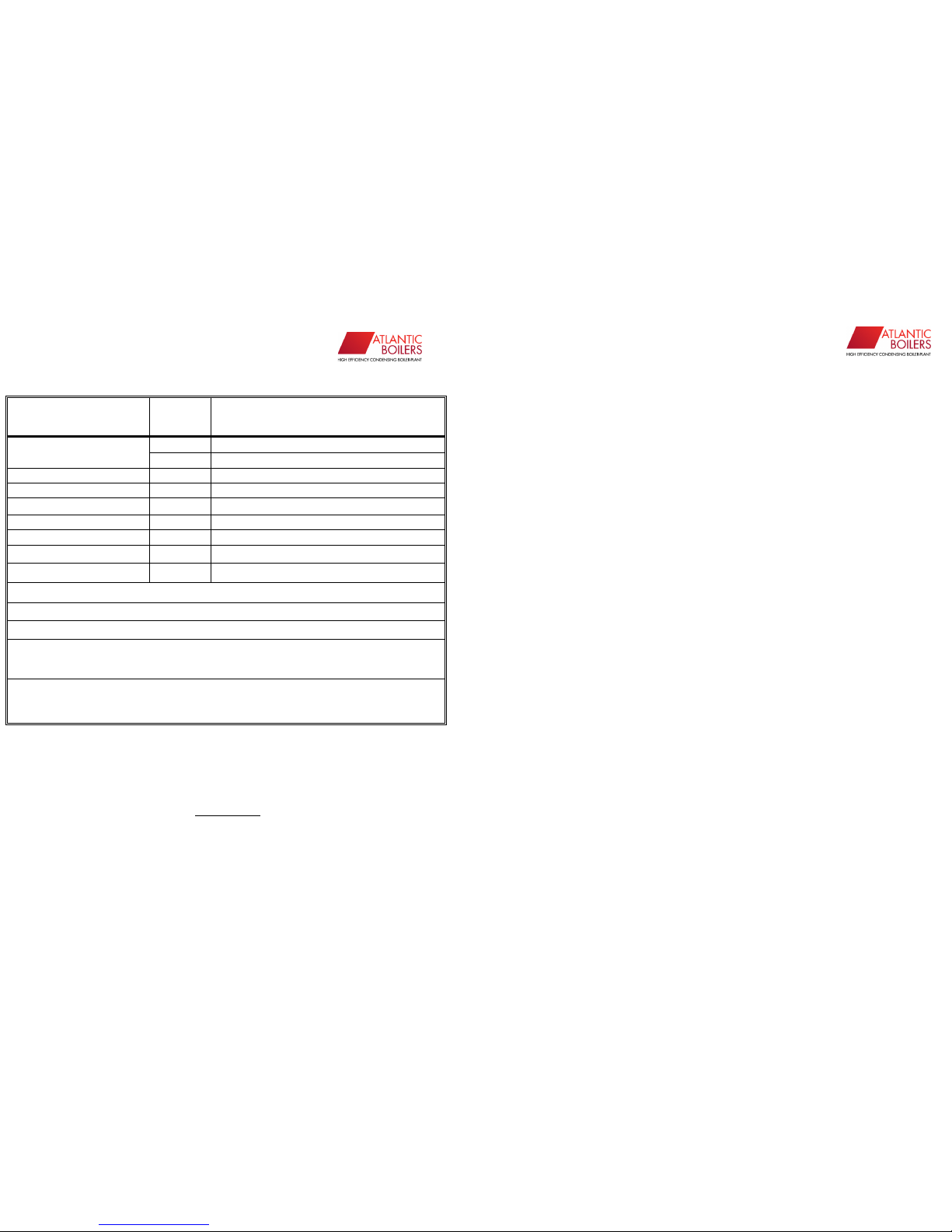
The water to be used in Hot Water boilers should conform to the table values
indicated below.
The boiler feed water and boiler water should be checked constantly and the
chemical conditions required for the water should be ensured in order to
operated the boiler efficiently and economically.
FEEDWATER FOR HOT WATER
BOILERS
Parameter Unit
Make-up water for hot water &
superheated water boilers
bar total range
Operating Pressure
MPa total range
Appearance - clear, free from suspended solids
Conductivity at 25 °C µS/cm < 1500
pH value at 25 °C ¹) - > 7,0
Total hardness (Ca + Mg) mgl/liter(ppm) < 5 [=0,5 Fr.H]
Iron (Fe) mgl/liter(ppm) < 0,2
Copper (Cu) mgl/liter(ppm) < 0,1
Silica (SiO2) mgl/liter(ppm)
-
Oxygen (O2) mgl/liter(ppm) -
Oil/grease mgl/liter(ppm) < 1
Organic substances - See clause 5
1
) With copper alloys in the system the pH value shall be maintained in the range 8,7
to 9,2
2
)
3
)
4) If non-ferrous materials are present in the system, e.g. Aluminium, they may
require lower pH value and conductivity, however, the protection of the boiler has
priority.
5
) If Phosphate is used; considering all other values higher PO4-concentrations are
acceptable, for instance with balanced or coordinated phosphate treatment (see also
clause 4).
Page 19
erensan°
“The Heating Engineer”
06042007
39
Ref : prEN 12953-10, Table 5-1, 5-2; 1998
BOILER LIFE SPAN
The Ministry of Trade and Trade has determined the life span of hot
water boilers as 10 years. If Atlantic
brand boilers are utilized in
compliance with operating and maintenance instructions, it is possible
to go well over the ministry stated life span. Therefore, make sure
that this operating and maintenance procedure is read and fully
applied by operating personnel.
When the boiler has reached unusable state, remove the junk
from usage area in compliance with environmental procedures.
BOILERWATER FOR HOT WATER BOILERS
Parameter Unit
Boiler water for hot water &
superheated water boilers
bar total range
Operating Pressure
MPa total range
Appearance - clear, no stable foam
Conductivity at 25 °C µS/cm < 1500
pH value at 25 °C - 9,0 to 11,5 4)
Acid Capacity up to pH 8,2 mmol/liter < 5
Silica (SiO2) mg/liter
-
Phosphate (PO4) 5) mg/liter -
Organic substances - -
1
)
2
)
3
)
4
) If non-ferrous materials are present in the system, e.g. Aluminium, they may
require lower pH value and conductivity, however, the protection of the boiler has
priority.
5
) If Phosphate is used; considering all other values higher PO4-concentrations are
acceptable, for instance with balanced or coordinated phosphate treatment (see also
clause 4).
 Loading...