

Page 1
98 MARCH 2010 WWW.RCMODELWORLD.COM
JETiger
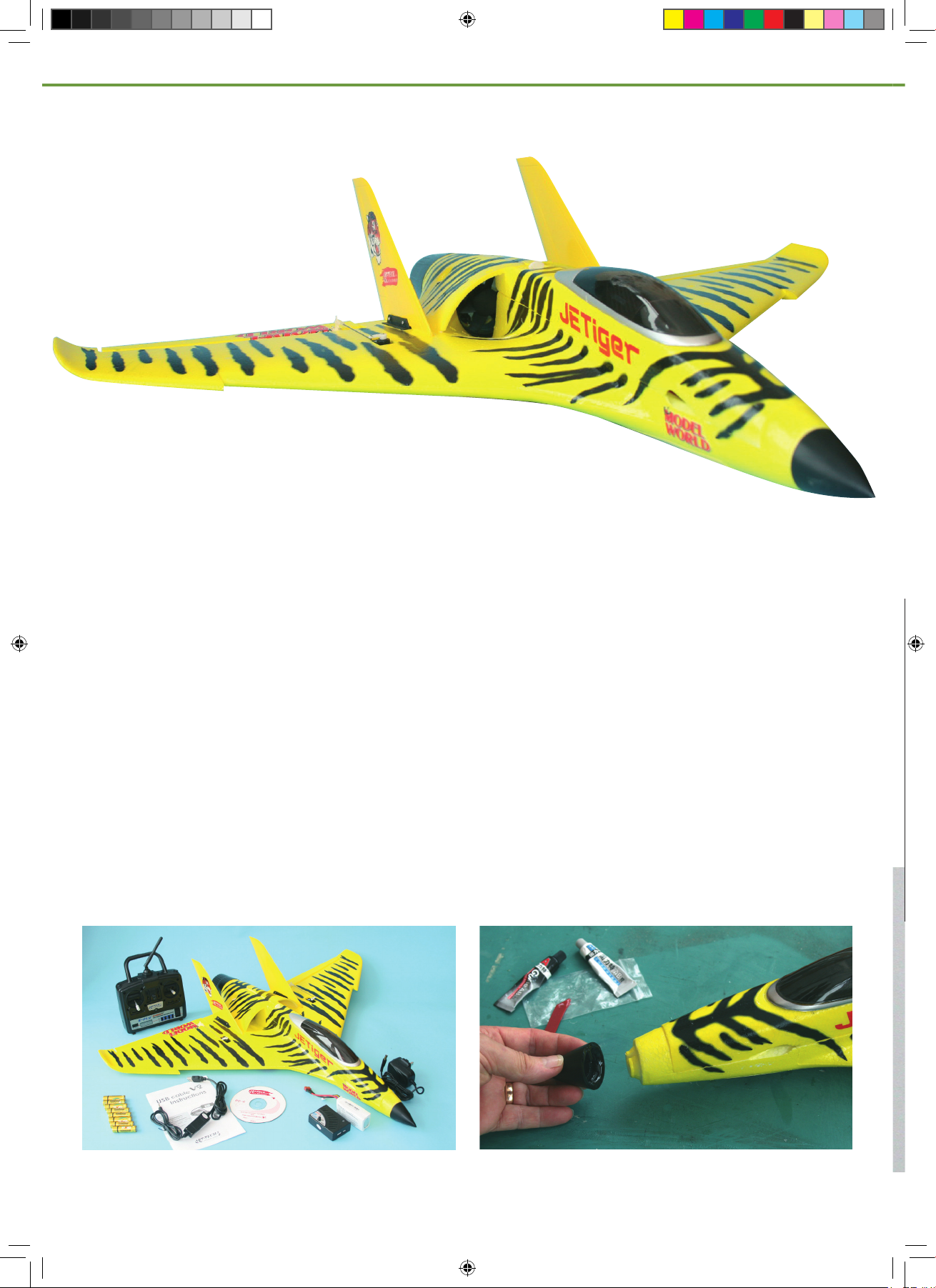
This tough 820 mm span EDF
delta with 2.4 GHz radio
included, is tested by the
Editor
E
asily distinguishable by its large, flat box and bright
artwork, the JETiger from Art-Tech looks fast before
you even open the box.
Inside there is an almost ready to fly model that
just requires final fitment of a few pieces and off you
go. To be really honest this model could be taken straight from
the shop to the club airfield and flying within 15-minutes after
arrival. Let’s see why…
Model Description
The JETiger is moulded from tough EPO foam and comes ready
assembled apart from the rubber nose and two tail fins to be
fitted. A 64 mm EDF unit is installed with a 6-blade fan and the
brushless 4000 rpm/V motor is pre wired to a 30 A ESC.
When first launched onto the market the model had 35 MHz
radio included with it, and the inset aerial tube along the spine of
the outer moulding is a telltale sign of this. The more recent
versions such as this review example have an E-Fly ER61-2.4
GHz Rx installed. 2.4 GHz Spread Spectrum technology has
been slowly revolutionising the R/C community over the past few
years, and the latest 2.4 GHz technology used here is DSSS
(Direct Sequence Spread Spectrum).
Included also in the box is a basic 4-channel E-Fly ETB41-2.4
GHz DSSS (with DSM shown on the front) transmitter that
features four reversing switches recessed in the front panel, plus
a two-position push ‘Bind’ button and a sliding On/Off switch. A
typical short 90-degree aerial is mounted at the top with a carry
handle. Eight AA batteries are included to power the Tx. The two
control sticks are adjustable in length and tension to suit your
preferred ‘feel’, and a Simulator socket at the rear allows the
connection of the flight simulator cable (included). This socket
can also be doubled as a Trainer Jack socket as referred to in the
instructions.
Author: Tony van Geffen/Photos: Tony van Geffen
An Art-Tech AS-090
9 g servo is mounted in
each wing for the electronicallymixed elevons.
A full-length hatch is located at the front with a
ply tongue and to the rear with a ‘quick-lock’ 1/2 turn
interlocking key. You are instructed to “circumvolving the quick-
lock by 90-degrees.”
Thoughtfully this manufacturer has included a flight simulator
cable and CD-Rom for those who have a computer, and this will
enable fixed wing or helicopter training on various model types,
and is ideal for some indoor ‘entertainment’ during the non-flying
days.
A DC LiPo balance charger with an AC adaptor is supplied to
charge the 3s 1800 mAh LiPo battery, terminated with a Deans
plug.
Three self-explanatory printed Instruction Manuals are also
included, along with 2-part foam-safe glue.
‘you can’t go wrong’
Assembly
The first of these instruction A4 leaflets covers the safety,
assembly and flying guide, printed in Chinese and Chino/English
languages detailing the simple procedures for gluing the rubber
nose with the 2-part adhesive supplied, and also fitting two
vertical fins and rear tail-cone. These instructions are mainly in
clear picture form with a short accompanying descriptive, and
Here’s what you get Gluing on the rubber nose cone
p98-100 RCMWMAR_JETiger.indd 98 27/1/10 15:16:09
Page 2
WWW.RCMODELWORLD.COM MARCH 2010 99
PRODUCT REVIEW
you can’t go wrong if you study them first. Some ‘quirky’
translations indicate the nosecone as the canopy, and you are
also told to “dilacerate the double-sided glue to install the tail
spout”, but disregarding this the images make it quite clear. The
fins are attached with four tiny 1.7 x 12 mm screws for each fin
and the tail cone is attached with double-sided tape supplied.
Two spare clevises are also included for the elevons.
Of course, you could be charging the LiPo battery while you
complete the assembly, and the model is now ready to fly.
The second A4 Instruction Manual relates to the operation of the
E-Fly ETB41-2.4 GHz radio. Printed in English language only it
deals with binding the Tx to the receiver (already done for you)
and runs through the controls in Mode 1 or 2. A section on the
receiver and operation of the ESC are included, plus a section
explaining the connection, setting up and operation of the flight
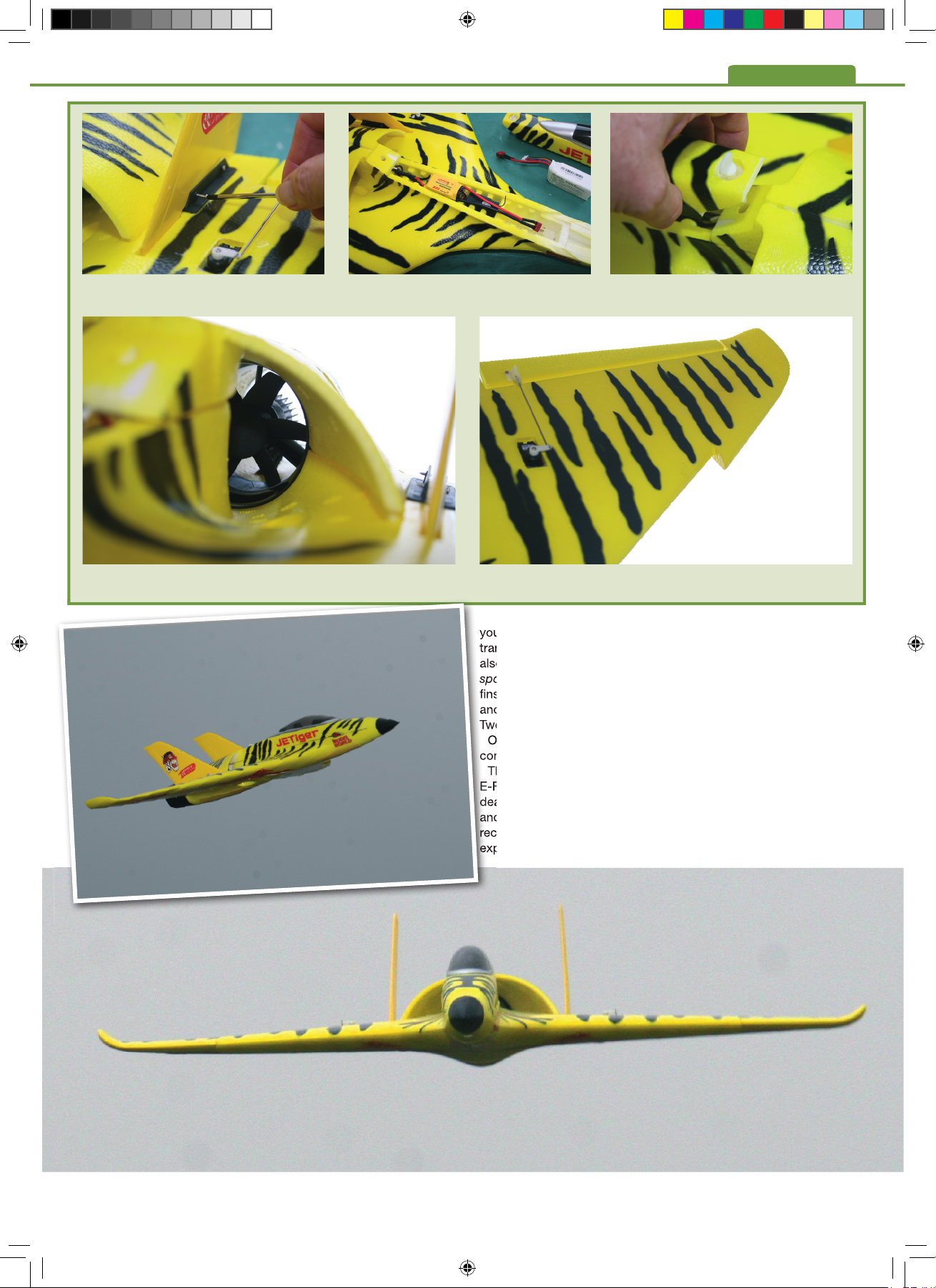
Attaching the fins with the screws supplied
The 6-blade fan assembly deep inside Stepped leading edge assists slow flying stability and also helps
prevent tip-stalling
Receiver, ESC and battery compartments
are recessed in the fuselage
Access hatch has a quick-lock catch
WWW.RCMODELWORLD.COM MARCH 2010 99
Head on this is a very sleek and slippery model
you can’t go wrong if you study them first. Some ‘quirky’
translations indicate the nosecone as the canopy, and you are
also told to
spout”
fins are attached with four tiny 1.7 x 12 mm screws for each fin
and the tail cone is attached with double-sided tape supplied.
Two spare clevises are also included for the elevons.
Of course, you could be charging the LiPo battery while you
complete the assembly, and the model is now ready to fly.
The second A4 Instruction Manual relates to the operation of the
Slow and low for
the camera
p98-100 RCMWMAR_JETiger.indd 99 27/1/10 15:17:06
Page 3
100 MARCH 2010 WWW.RCMODELWORLD.COM
JETiger
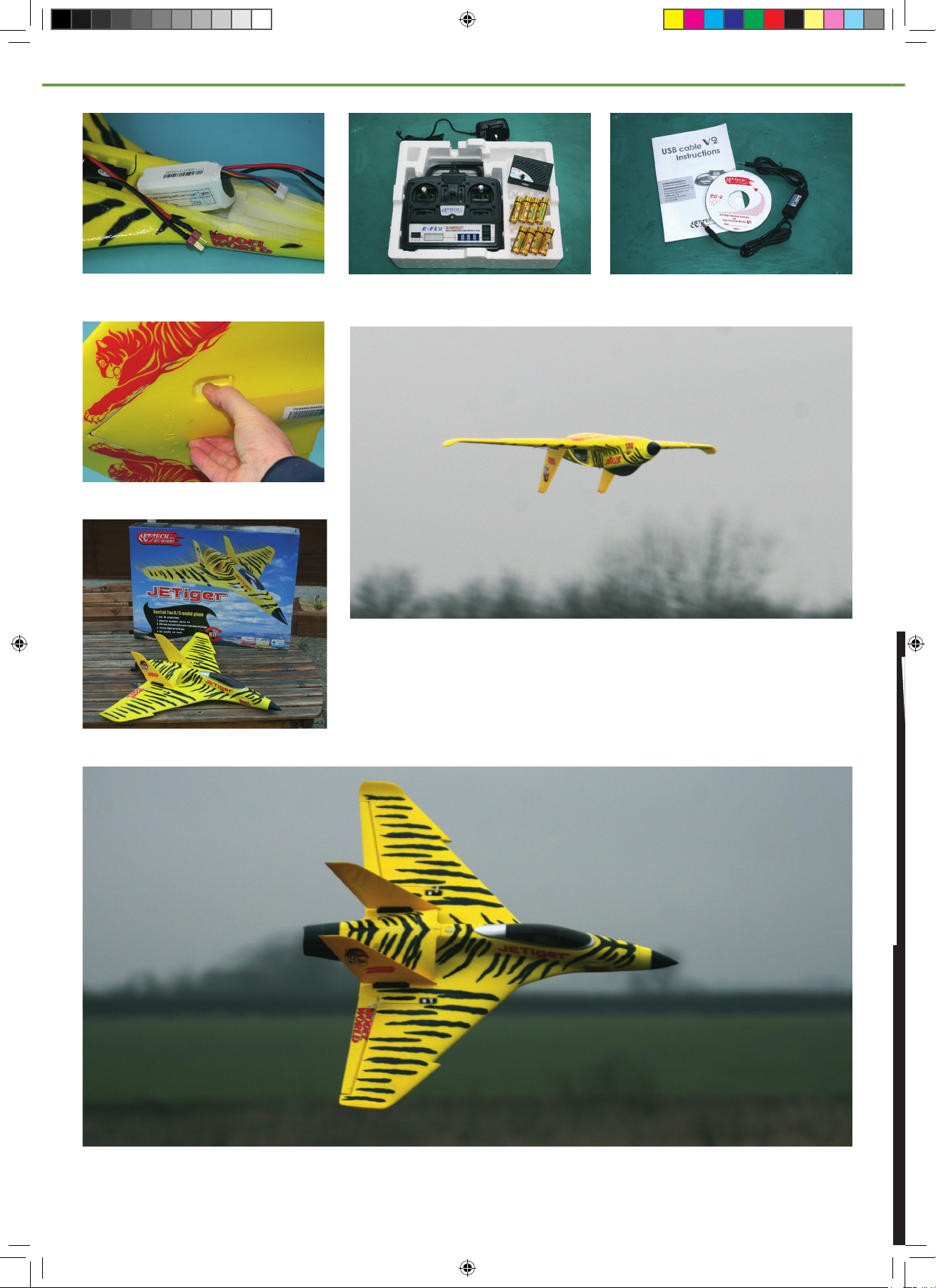
Inserting the battery into its recess
Hand launch finger holes are moulded into
the underside
The basic 4-channel transmitter is
adequate and comes with AA dry cells and
LiPo mains charger
Decorative box and completed model after
final assembly
Flight Sim’ CD, USB cable and instructions
Low and inverted; required full down trim to prevent
nose from dropping
Low and fast you can see the JETiger really is great fun to fly – and watch!
simulator software and coded USB cable.
The third smaller A5-size manual also covers the ‘flight sim’ operation, but in much
more detail.
Flying the JETiger
Running up the motor indicates that there is ample power for this model to be hand-
launched without much effort; it has no wheels!
My trusty pilot Brian Cooper was again on hand to do the business as I took the
pictures.
p98-100 RCMWMAR_JETiger.indd 100 27/1/10 15:18:34
Page 4
WWW.RCMODELWORLD.COM MARCH 2010 101
PRODUCT REVIEW
Summary
With the Art-Tech JETiger being moulded in EPO foam it is
strong enough to withstand some hard landings and still be easily
repaired to fly again. With its optimised design the JETiger can fly
safely at low speed while at the same time providing excellent
handling characteristics at high speed for the experienced pilot.
Being available as RTF means that it can be in the air in a very
short time, and is easily transported in one-piece. I’m sure this will
be a popular model. RCMW
At full power a gentle hand launch had the JETiger soon
climbing rapidly into the skies. A circuit to trim was necessary,
and Brian was fighting to keep the nose up so a landing was
quickly had, more up elevator wound in on the clevises and off
again. Much better this time and after another circuit he was in to
low passes and basic aerobatics for the camera.
At height the model was slowed right up to test the stall, which
was found to be non existent as it simple settled into a gentle flat
descent With the power back on the JETiger climbed for more
aerobatics, with a performance that was far outreaching the
expected performance expected, which made the flight much
more interesting. Inverted flight is a cinch and prolonged inverted
soon saw several circuits completed without hesitation. The
controls were precise and some down elevator trim was used to
hold the model level.
As this is not a computer radio it was appreciated that
differential and other adjustments are not available here, but it
wasn’t needed as the JETiger is well trimmed and balanced, with
the controls requiring the gentlest touch for a smooth and
satisfying flight.
For a landing it is best to burn off a lot of speed as it comes in
rather fast and slippery, and slowing it up too soon results in it
sinking gently to the ground too early. Adding throttle as required
will liven up the approach and keep it on track for a perfect
touchdown on the protective plastic plates mounted on the
fuselage underside (I like that!).
‘far outreaching the expected
performance’
Name: JETiger
Manufacturer: Art-Tech R/C Hobby
Distributor: Century UK
Price UK: £149.99
Model Type: Sports EDF jet
Motor: B2040-14L-2 brushless 4000 rpm/V
ESC: Art-Tech 30 A/50 A max (factory fitted)
EDF: 64 mm; 6-blade fan
Battery: LiPo 11.1 V 1800 mAh
Construction: Moulded EPO foam
SPECIFICATION
Century UK
www.centuryuk.com
01795 437056
Contact
R/C FUNCTIONS
Two 9 g servos fitted;
1: Aileron – mixed
2: Elevator – Elevon
3: Throttle
R/C System: E-Fly ETB41-2.4
GHz
Dislikes
Poor English instructions
translation
Likes
Handy carry box and
presentation
Very quick to assemble
Hi-vis scheme (especially in
snow)
Tough and durable airframe
Flying is truly exhilarating
Excellent value for money!
SPEC
Wingspan: 32¼" (820 mm)
Length: 24½" (620 mm)
Weight: 18.3 oz (520 g)
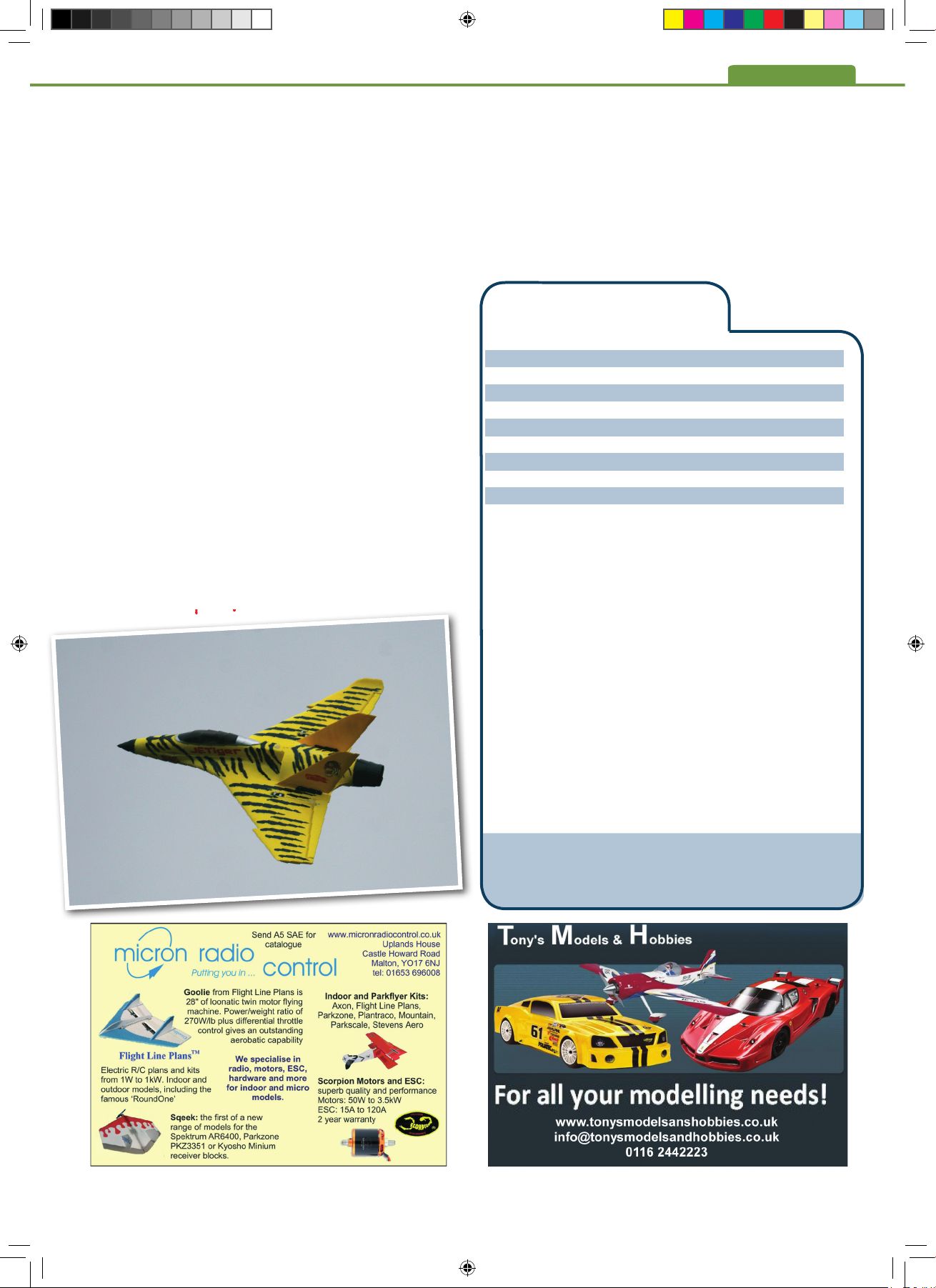
Low banked flypast and the
JETiger is really smooth
p98-100 RCMWMAR_JETiger.indd 101 1/2/10 12:11:30
 Loading...