

Page 1
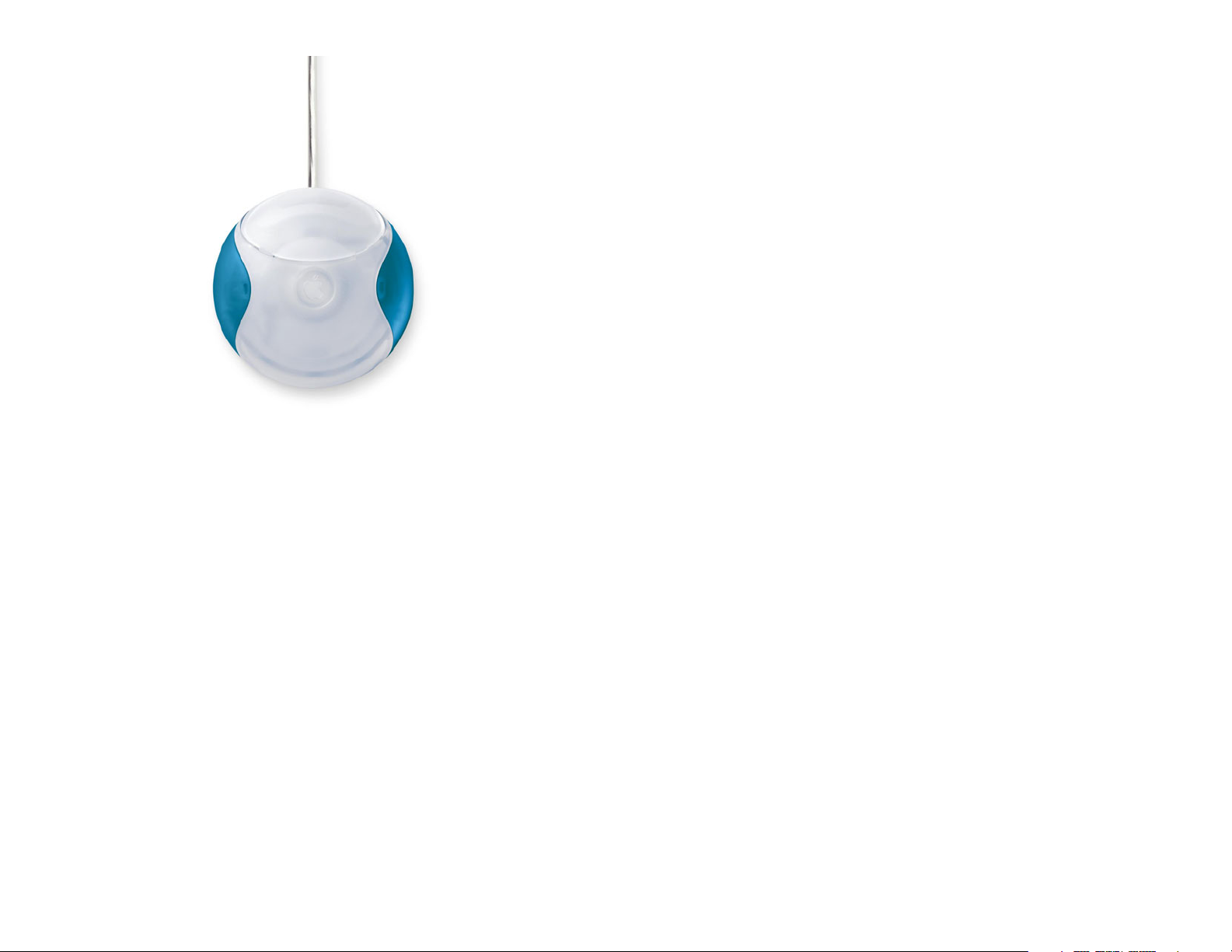
After you’ve set up your iMac and followed the
onscreen guide to register your computer and
set up an Internet account and e-mail address,
what’s next? Read this booklet to learn more about
using your iMac:
2 Features
4 Basics
6 Internet and e-mail
12 Software
18 Installing memory and an AirPort Card
20 Learning more and solving problems
24 Ergonomic and safety information
1
Page 2
2
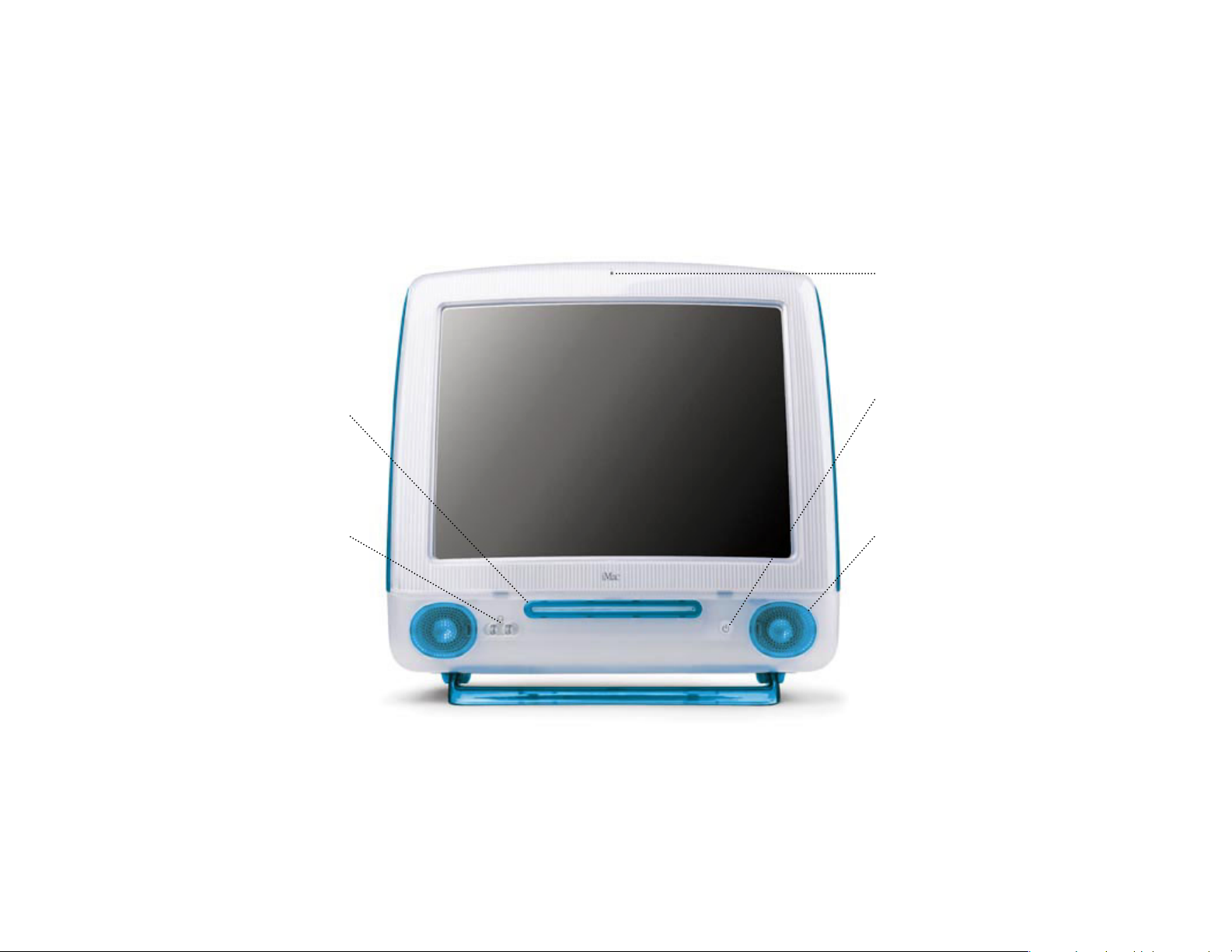
What are the features of my iMac?
Your computer has these built-in capabilities:
f Two headphone
ports
Connect one or two
pairs of headphones to
your computer.
CD-ROM or
DVD-ROM drive
Install software, use
applications, and listen to
music CDs. If your computer
has a DVD drive, you can
also play DVD videos.
Two internal
stereo speakers
Listen to CD-quality
music or movies, games,
and multimedia.
® Power button
Press this to turn your
computer on.
Microphone
Record sound and give
spoken commands to
your computer.
Page 3
3
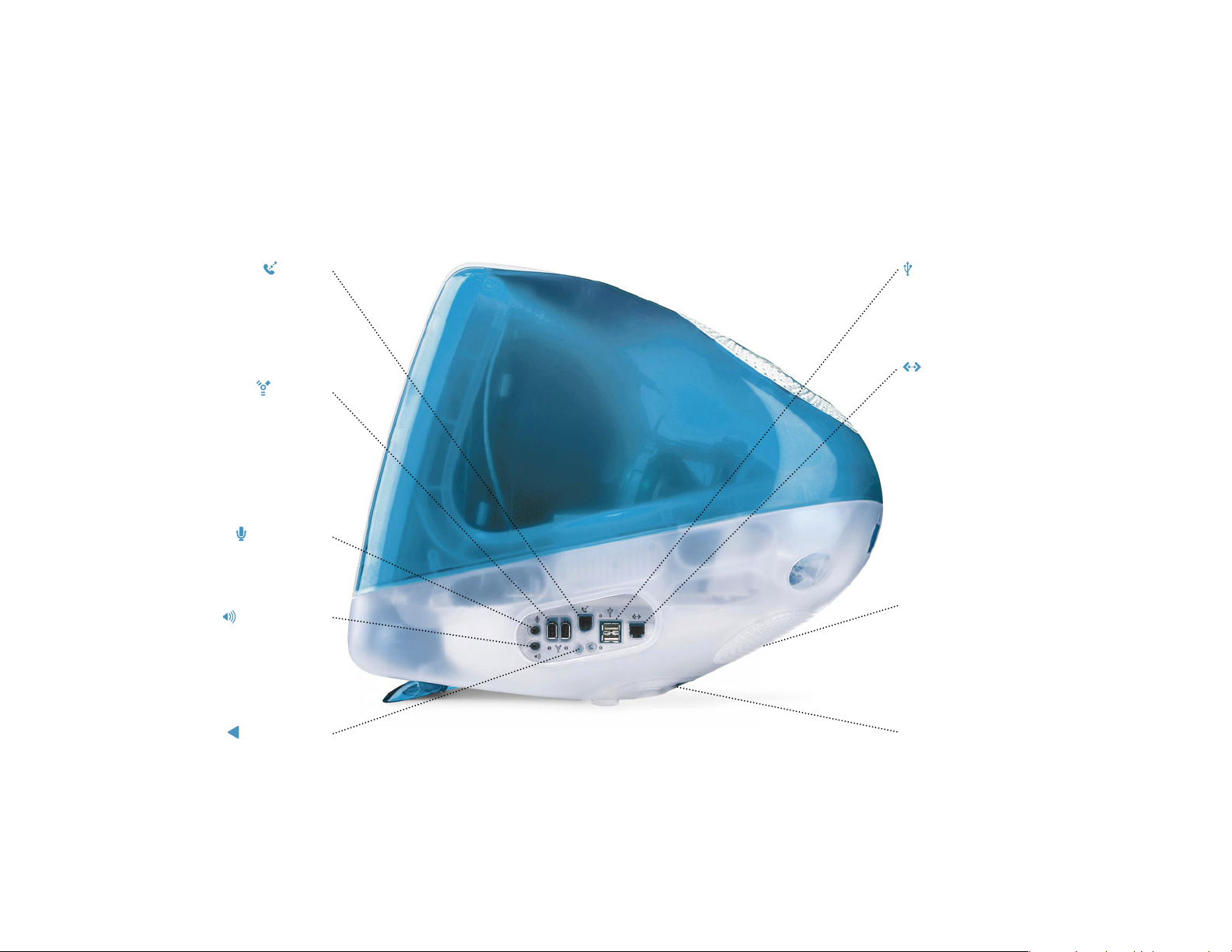
Modem
Connect to the Internet,
browse the World Wide
Web, and send and
receive electronic mail.
FireWire
(on some models)
Connect high-speed
devices such as digital
video cameras, disk
drives, printers, and
scanners.
USB
Connect printers, disk
drives, digital cameras,
speakers, joysticks,
and more.
Ethernet
Share files with another
computer and access
a computer network,
printer, or the Internet.
VGA output
(on some models)
Connect an external
monitor or television for
video mirroring. Some TVs
may require a scan rate
converter.
Access door
Install additional memory
and an AirPort Card for
wireless networking.
Reset button
Use during
troubleshooting to restart
your computer.
Sound input
Record sounds using
an analog microphone or
other audio device.
Sound output
Connect headphones,
external speakers, and
analog audio devices.
Page 4
4
What are the basics?
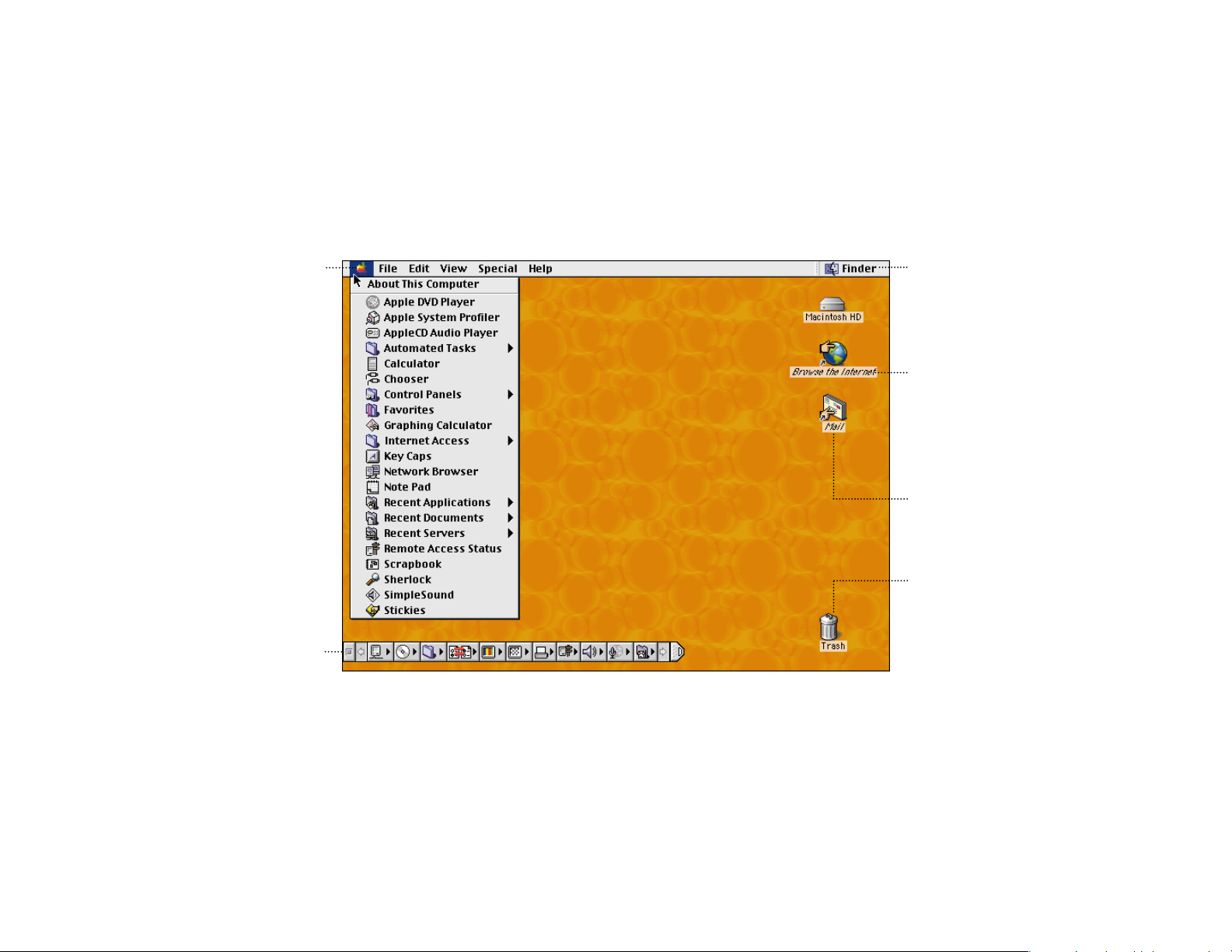
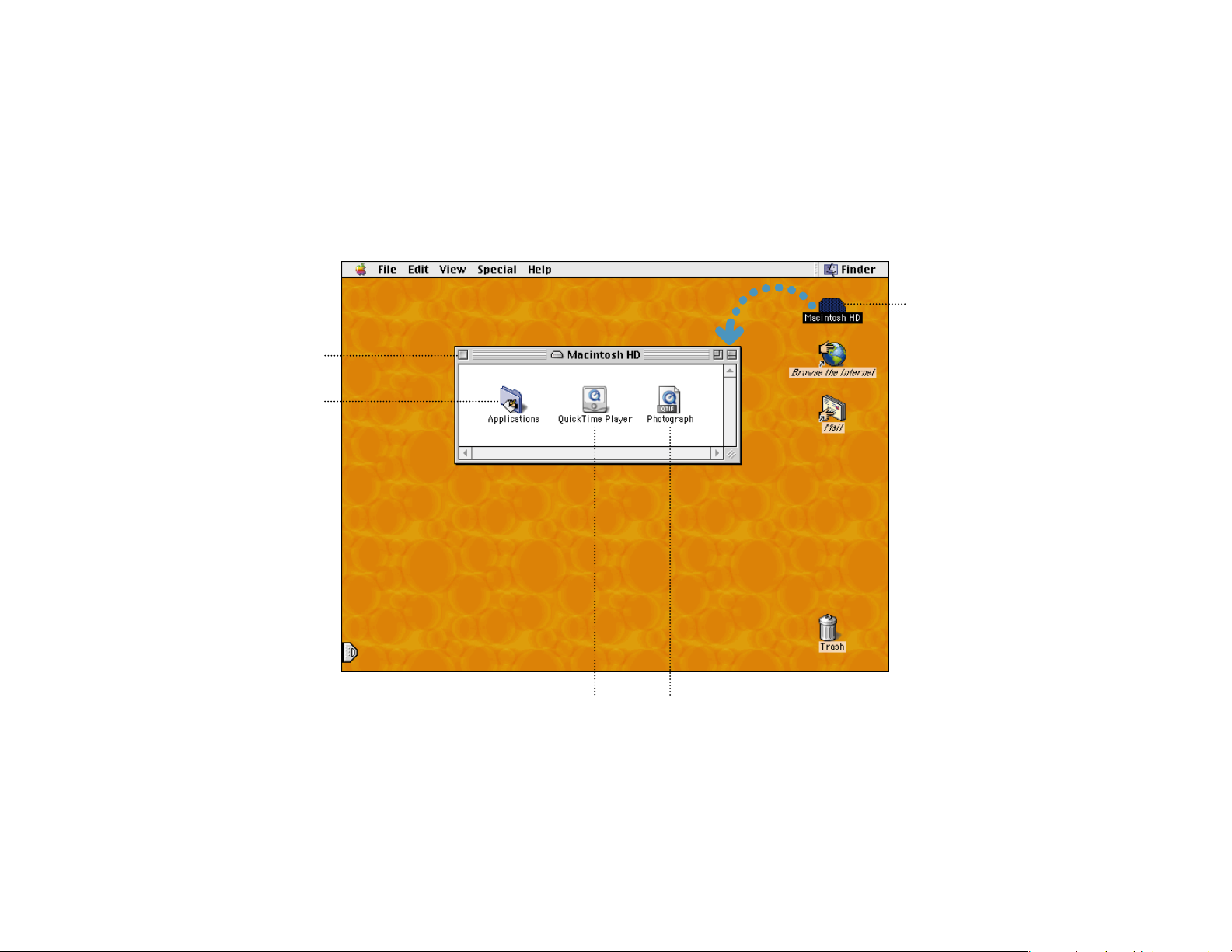
The Macintosh desktop is your starting place.
Apple menu
Use this to select
commonly used
applications and tools.
To see the menu, press
the apple (K) in the
menu bar.
Browse the
Internet
Double-click (click two
times quickly) this icon
to open your preferred
World Wide Web
browser.
Mail
Double-click this icon
to open your preferred
e-mail application.
Trash can
Drag items here to
delete them. Items will
remain here until you
choose Empty Trash
from the Special menu.
Control Strip
Use this for convenient
access to commonly
used settings.
Application menu
Look here to see which
application you are using
or to switch between
open applications.
Page 5
5
Application
Applications are software programs
(such as a game or word processor)
that you use with your computer.
Double-click an application’s icon
to open the application.
Document
Documents are files that you create with
an application (such as a letter you create
with your word processor). Double-click
a document’s icon to open the file and to
view, edit, or print it.
Close box
Click this to close
a window.
Folder
You create folders
to help organize your
files and programs.
Double-click a folder
to open it.
Hard disk
All of your files and
applications are kept
here. Double-click the
icon to open it.
Page 6
6
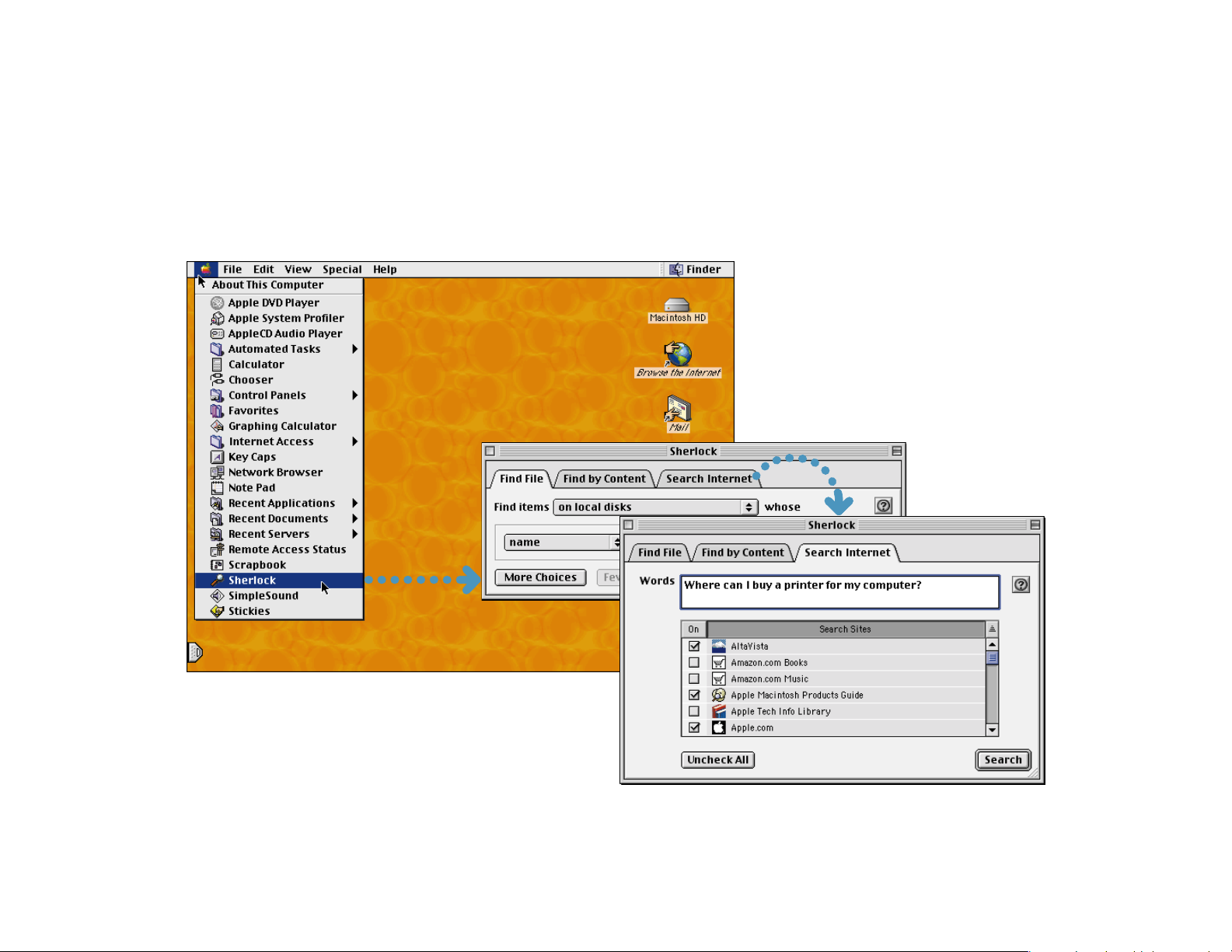
How do I find something on the Internet?
Use Sherlock to quickly search the Internet.
6
1
Open the Apple (K) menu and
choose Sherlock. Then click the
Search Internet tab.
2
Type what you want to find
and click Search.
Page 7
7
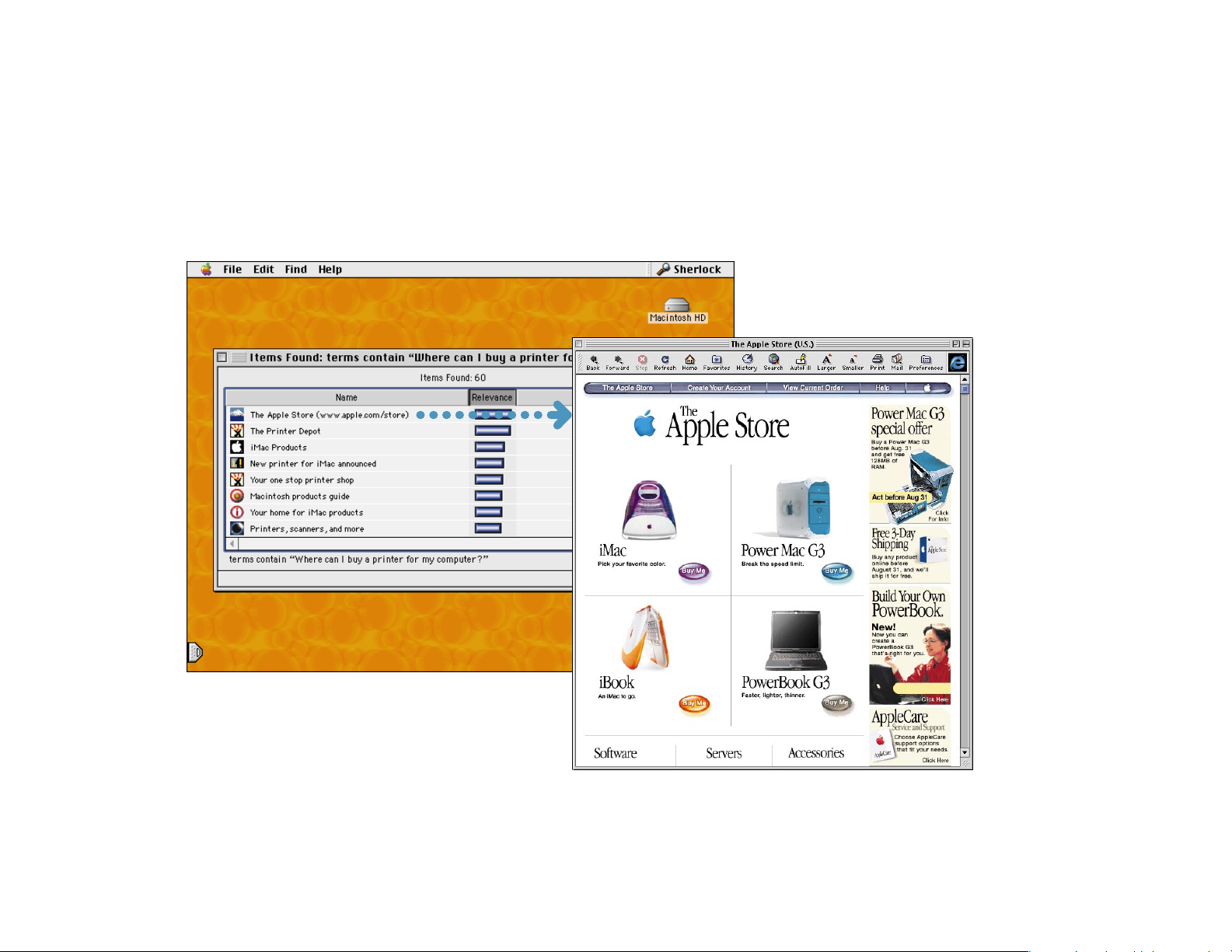
. Listed items are ranked by relevance.
The longer the bar, the more likely an item
is to contain what you’re looking for.
3
Double-click an item in
the list of Internet sites that
Sherlock finds.
Page 8
8
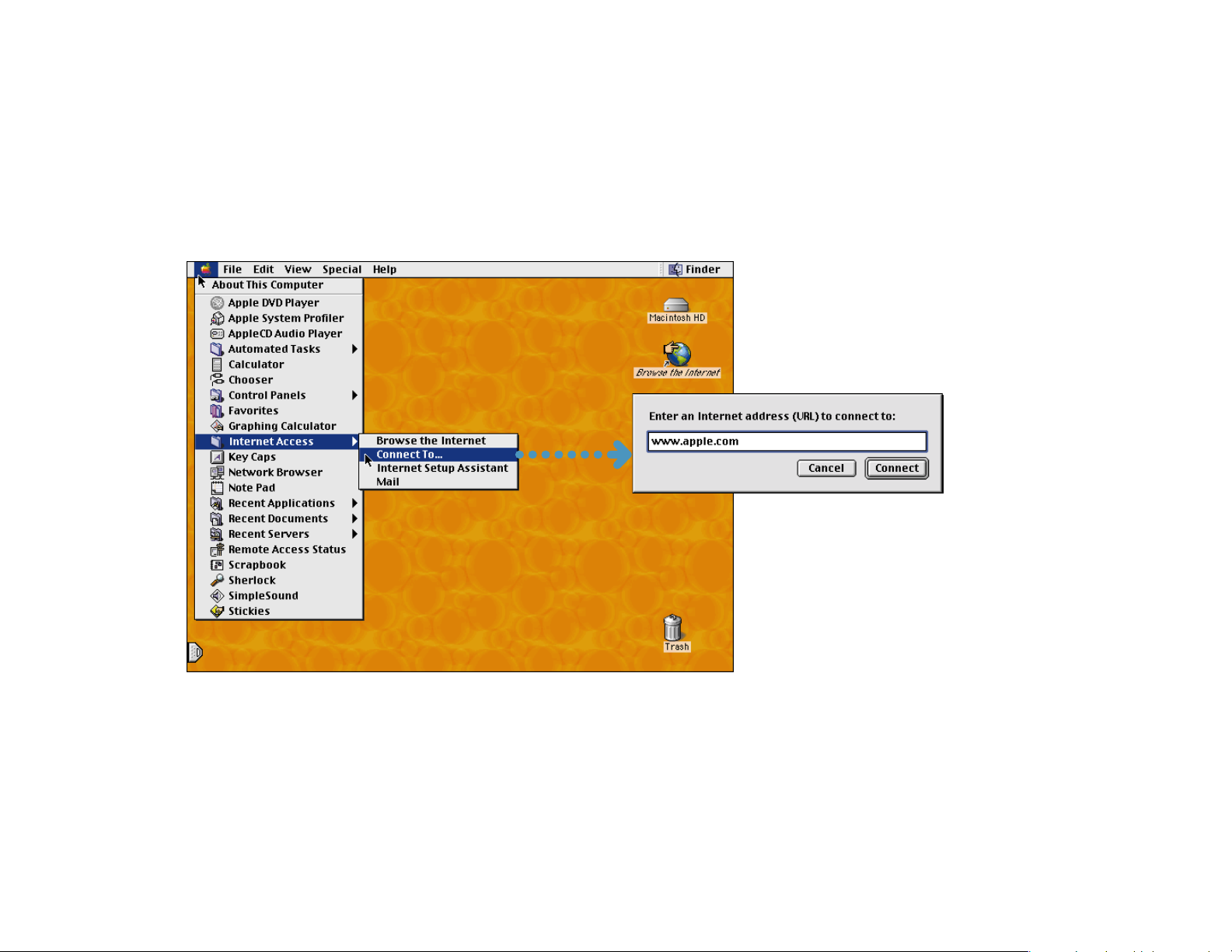
How do I go to a place on the Internet?
All you need to know is the Internet address.
1
Open the Apple (K) menu
and choose Internet Access,
then choose Connect To.
2
Type the Internet
address and click Connect.
Page 9
9
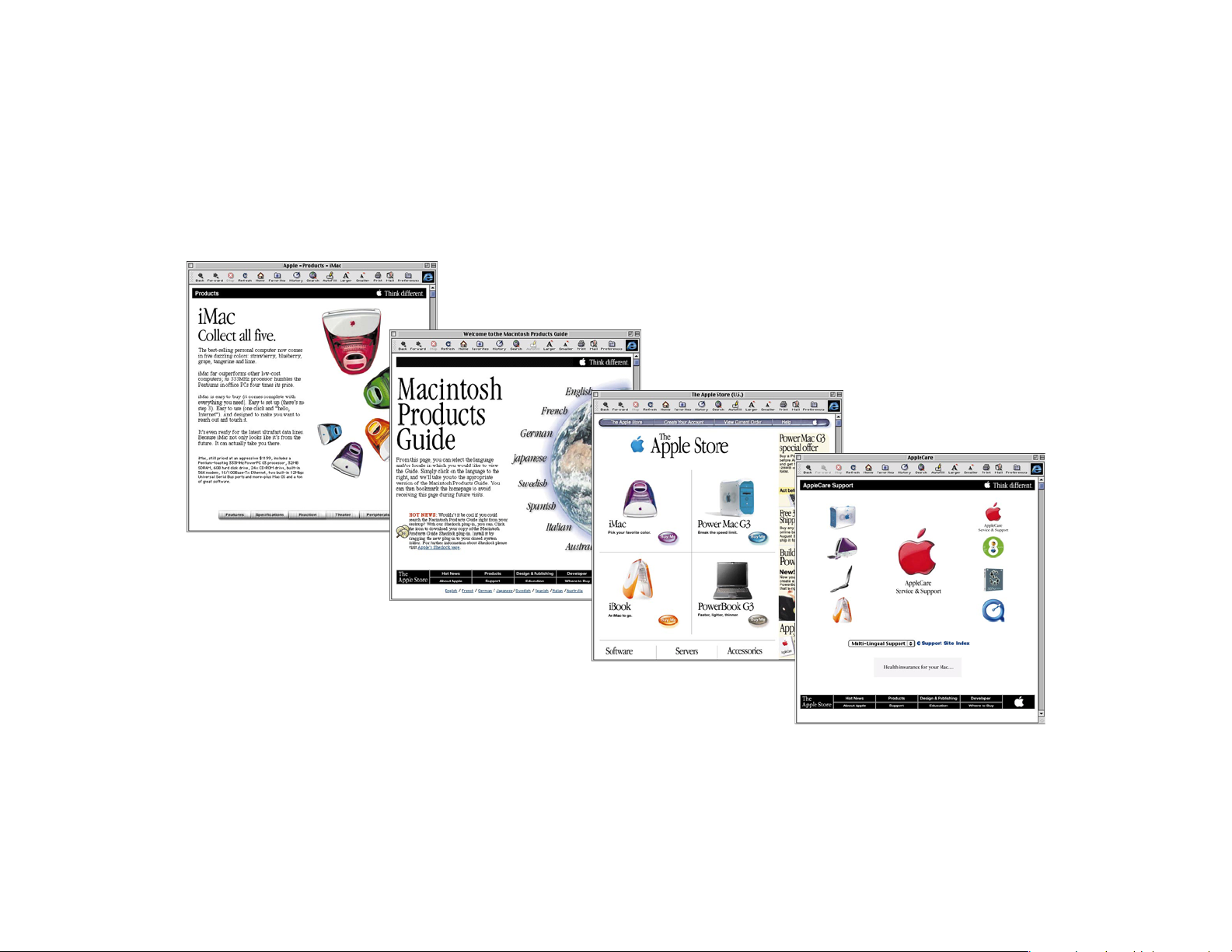
These Apple Web sites will help you get the most out of your computer.
www.apple.com/imac
News and information specifically
for iMac users.
www.apple.com/guide
Find out about over 12,000
hardware and software products
available for the Macintosh.
www.apple.com/store
The latest Apple hardware,
software, and accessories.
. To visit interesting and popular places
on the Internet, look in the Favorites
menu of your Web browser.
www.apple.com/support
Visit here for product support, software
updates, and technical information.
Page 10
10
How do I use e-mail?
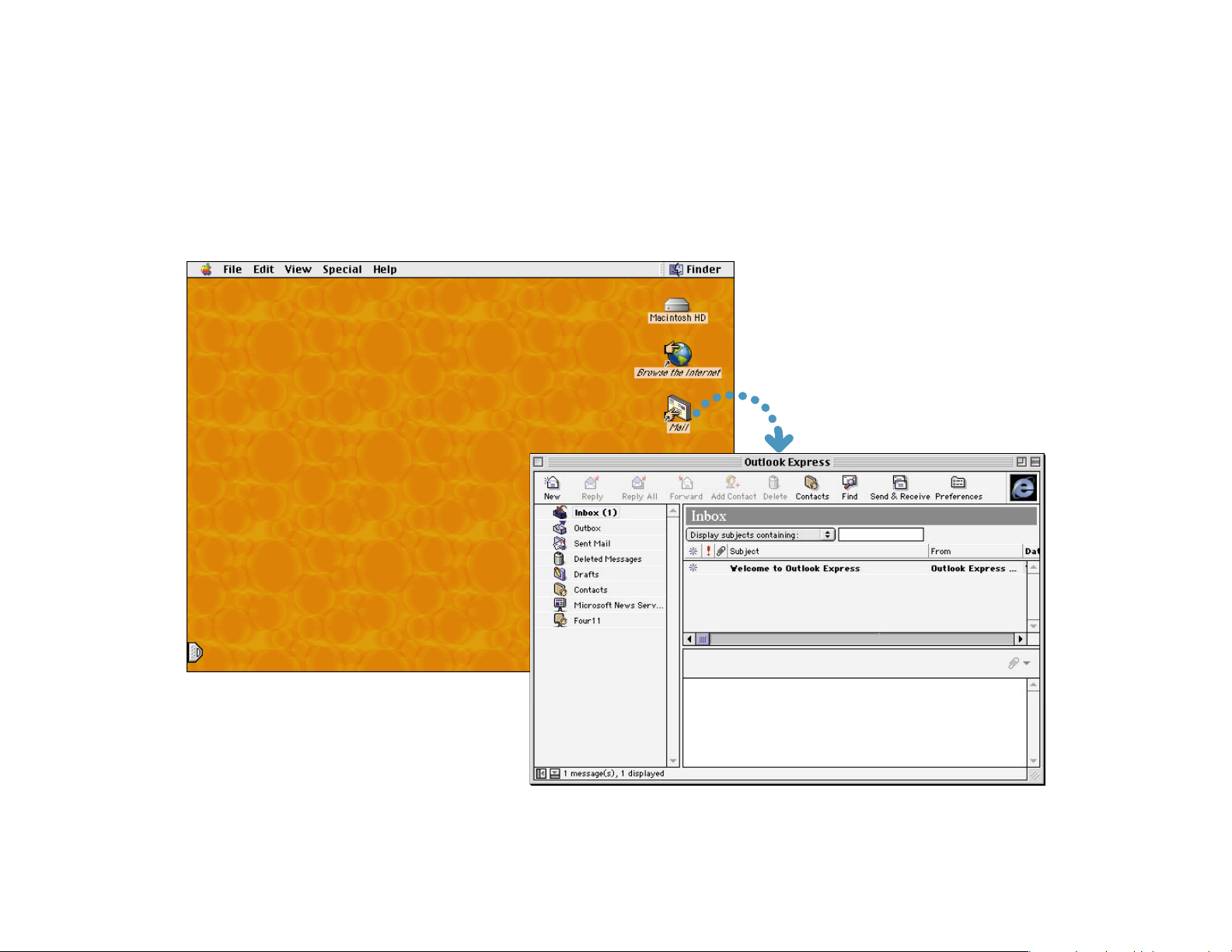
Follow these steps to create and send a message:
1
Double-click the Mail icon on the
desktop to open your preferred
e-mail application.
. To check for new messages, click
the Send & Receive button. To view a
message, click its subject.
Page 11
11
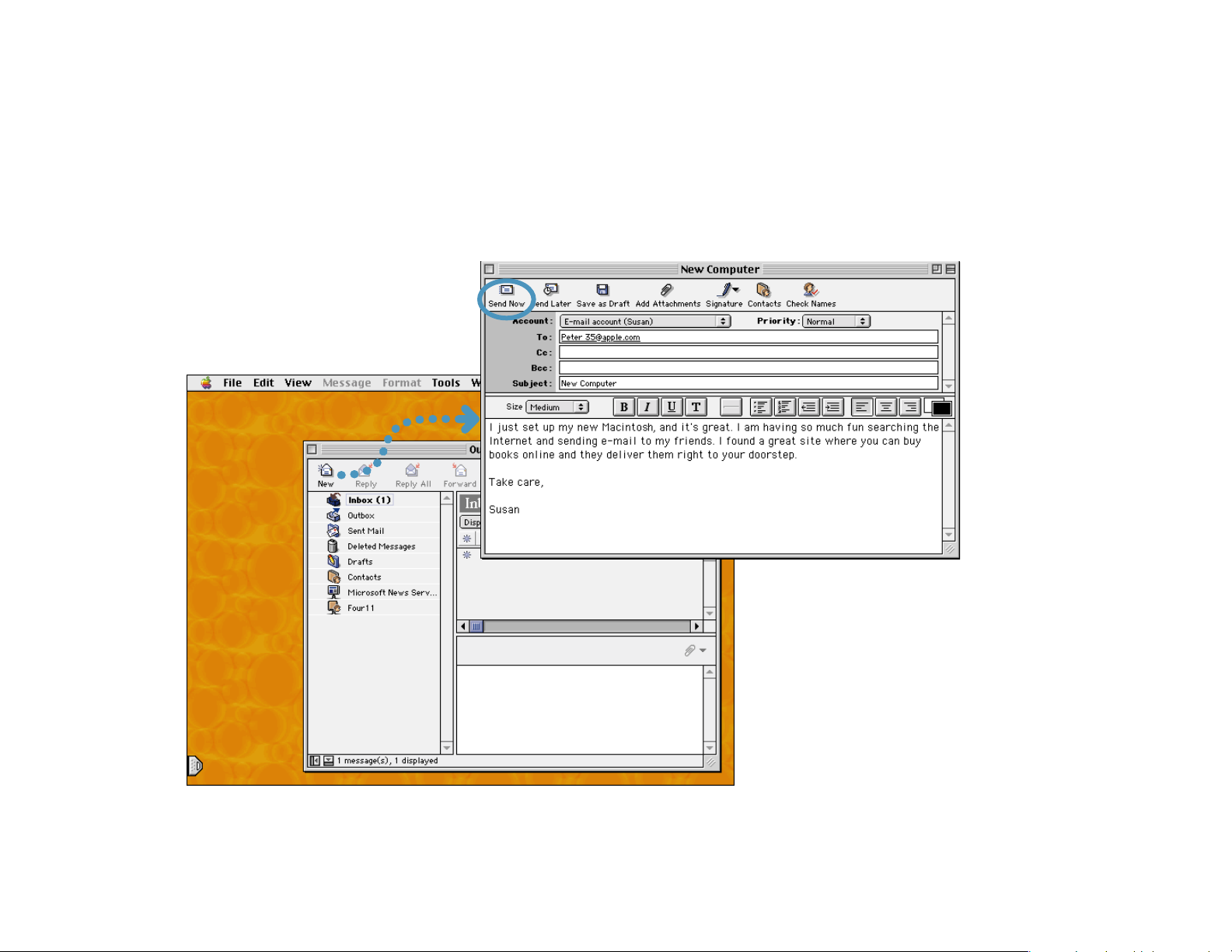
2
To create a new e-mail message,
click the New button.
3
Type the e-mail address and a brief
subject. Then type your message and
click Send Now.
Page 12
12
What about software?
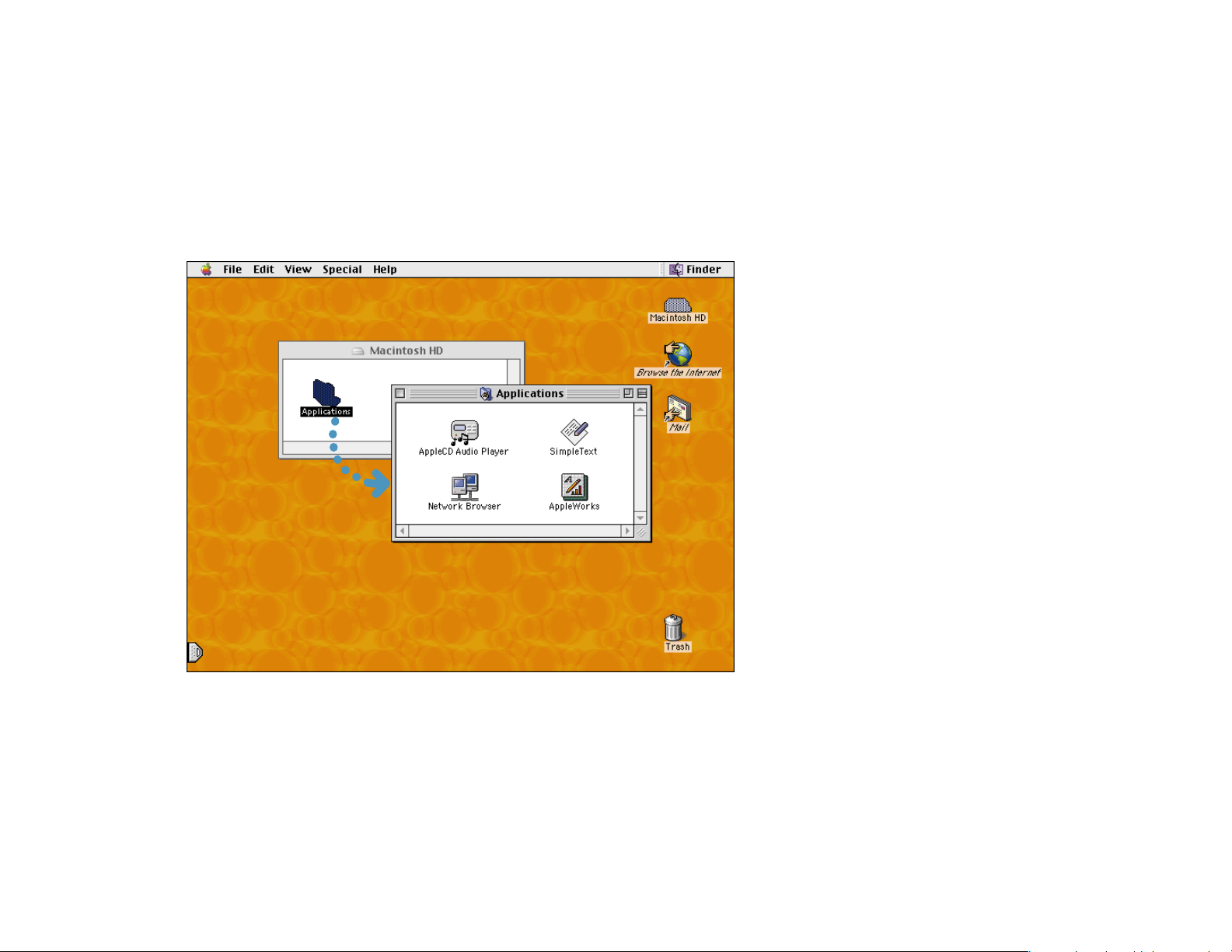
Your computer comes with many software applications.
1
Open the Applications folder
on your hard disk.
2
Double-click the application you
want to open.
. Some applications are preinstalled in the
Applications folder; you need to install others
yourself. See the software list in your
accessory kit.
. To use some applications, you need to
insert the disc in the CD or DVD drive slot.
. On models with a DVD drive, the Apple
DVD Player is preinstalled and accessible
from the Apple (K) menu.
Page 13
13
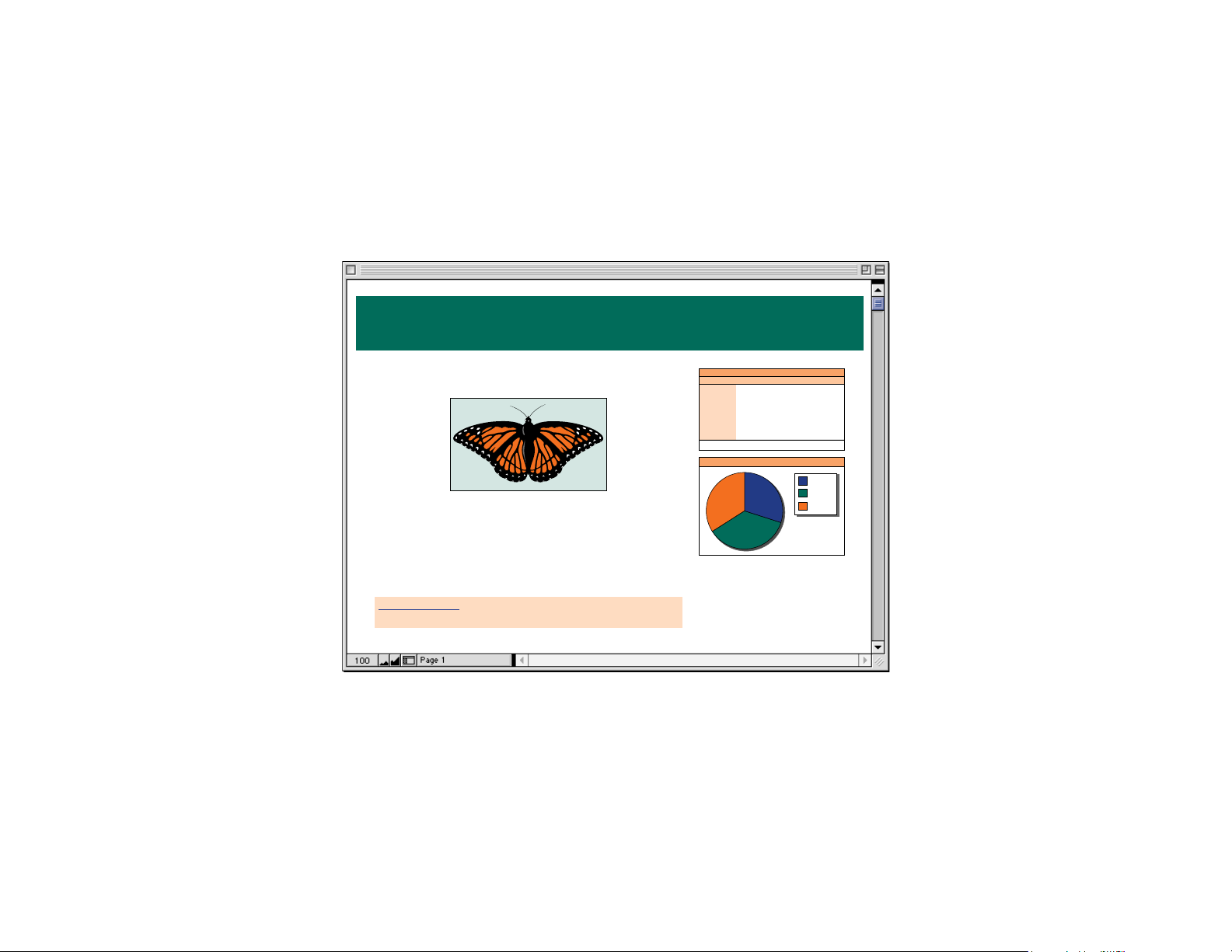
You can use AppleWorks for writing, drawing, painting, and much more.
Sophisticated
layout capabilities
Add photos, tables,
charts, and sidebars.
Link text frames,
layer graphics, and
wrap text like a pro.
Extensive clip art
libraries
Easily add compelling
graphics and photos to
your document.
State-of-the-art
word processing
Enjoy everything from a
built-in thesaurus to
automatic hyphenation.
Hypertext linking
Create hypertext links
within or between
documents, and even
link to the Web.
Customizable
templates
Choose from a wide
range of predesigned
document types and
modify them as needed.
Powerful
spreadsheets
Compute data easily
using over 100 built-in
functions, then use
advanced formatting
options to make your
data really stand out.
Professional charts
and graphs
Create great-looking
line, bar, and pie charts
with ease.
Butterfly Society News
Butterfly Society News
Butterflies retur n to Mon tere y
Monarch Viceroy Satyr
Butterfly
March 304 178 254
April 78 39 75
May 140 315 266
June 148 253 316
July 234 208 310
August 261 291 336
Sub-total 1265 1284 1557
Total 4106
Butterfly Counts
Monarch
Satyr
Viceroy
37.9 30.8
31.3
Nam cum antea per aetatem nondum huius auctoritatem loci attingere auderem, statueremque nihil
huc nisi perfectum. Putatisne vos illis rebus frui posse, nisi eos qui vobis fructui. sunt.
Vident et sentiunt hoc idem quod vos, — unum virum esse, in quo
summa sint omnia, et eum propter esse, quo etiam carent aegrius;
cuius adventus ipso atque nomine, tametsi ille ad maritimum bellum
venerit, tamen impetus hostium repressos esse intellegunt ac
retardatos. His vos, quoniam libere loqui non licet, tacite rogant, ut se
quoque, sicut ceterarum provinciarum socios, dignos existimetis,
quorum salutem tali viro commendetis; atque hoc etiam magis, quod
ceteros in provinciam eius modi homines cum imperio mittimus, ut
conservaritis non solum (ut ante dixi) calamitate, sed etiam calamitatis
Cuius adventus ipso atque
nomine, uvate vos tametsi ille
ad maritimum bellum venerit,
tamen magist impetus hostium
repressos esse intellegunt ac
retardatos. His ille vos, quoniam
libere loqui non licet, tacite
rogant, ut se neve quoque, sicut
ceterarum provinciarum socios,
dignos ille existimetis, quorum
salutem tali viro commendetis;
atque hoc etiam magis, quod
ceteros in provinciam eius modi
Cuius adventus ipso atque nomine, tametsi ille ad maritimum bellum
venerit, tamen impetus hostium repressos esse intellegunt ac
retardatos. His vos, quoniam libere loqui non licet, tacite rogant, ut se
quoque, sicut ceterarum provinciarum socios, dignos existimetis,
quorum salutem tali viro commendetis; atque hoc etiam magis, quod
ceteros in provinciam eius modi homines cum imperio mittimus, ut
etiam veste dilutet si ab hoste defendant, tamen ipsorum adventus in
sociorum non multum ab hostili expugnatione diffe.
Nam in ceteris rebus cum venit calamitas, tum adventus dot
detrimentum accipitur; at in vectigalibus nonn solum ut adventus mali,
sed etiam metus ipse adfert venit calamitatem. Nam cum hostilum
copliace non longe absunt, etiam si inruptio nulla faccta est, tamen
Cuius non adventus ipso atque
nomine, uvate vos tametsi ille
ad maritimum bellum venerit,
tamen magist impetus hostium
repressos esse intellegunt ac
retardatos. His ille vos, quoniam
libere loqui non licet, tacite
rogant, ut se neve quoque, sicut
ceterarum provinciarum socios,
dignos ille existimetis, quorum
salutem tali viro commendetis;
atque hoc etiam magis, quod
ceteros in provinciam eius modi
Cuius adventus ipso atque nomine, tametsi ille ad maritimum bellum
venerit, tamen impetus hostium repressos esse intellegunt ac
retardatos. His vos, quoniam libere loqui non licet, tacite rogant, ut se
quoque, sicut ceterarum provinciarum socios, dignos existimetis,
quorum salutem tali viro commendetis; atque hoc etiam magis, quod
ceteros in provinciam eius modi homines cum imperio mittimus, ut
etiam veste dilutet si ab hoste defendant, tamen ipsorum adventus
insociorum non multum ab hostili expugnatione diffe.
Nam in ceteris rebus cum venit calamitas, tum adventus dot
detrimentum accipitur; at in vectigalibus nonn solum ut adventus mali,
sed etiam metus ipse adfert venit calamitatem. Nam cum hostilum
copliace non longe absunt, etiam si inruptio nulla faccta est, tamen
Page 14
14
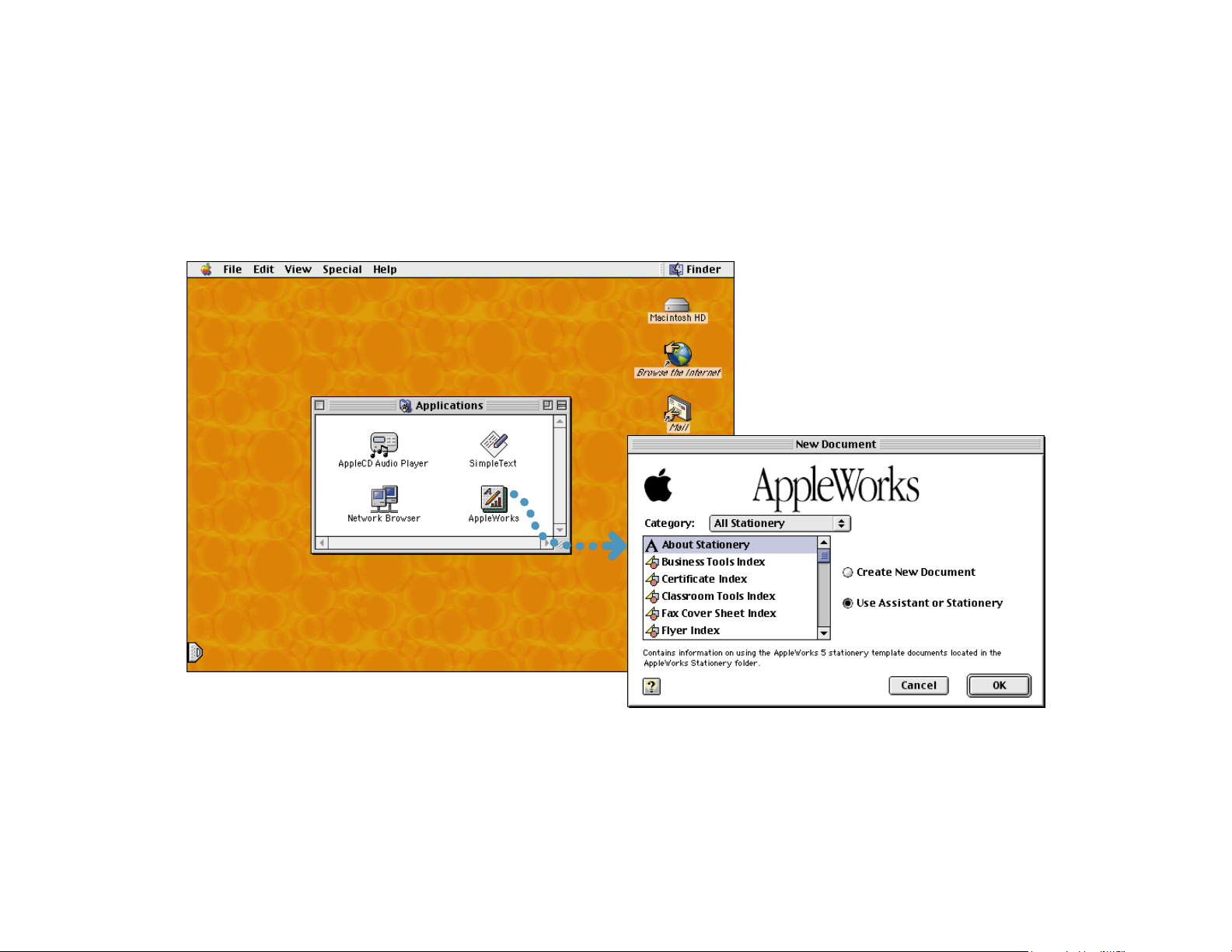
To get started using applications such as AppleWorks:
To learn more about AppleWorks, look
m at the AppleWorks electronic manual
(on your hard disk in the AppleWorks folder)
m at the AppleWorks information in the Help menu
m on the AppleWorks Web site (www.apple.com/appleworks)
1
Double-click an application’s icon
to open the application.
. When you first use AppleWorks, you’ll be
asked to enter your name and company; your
version doesn’t require a serial number.
2
Select the type of document
you want to create.
Page 15
15
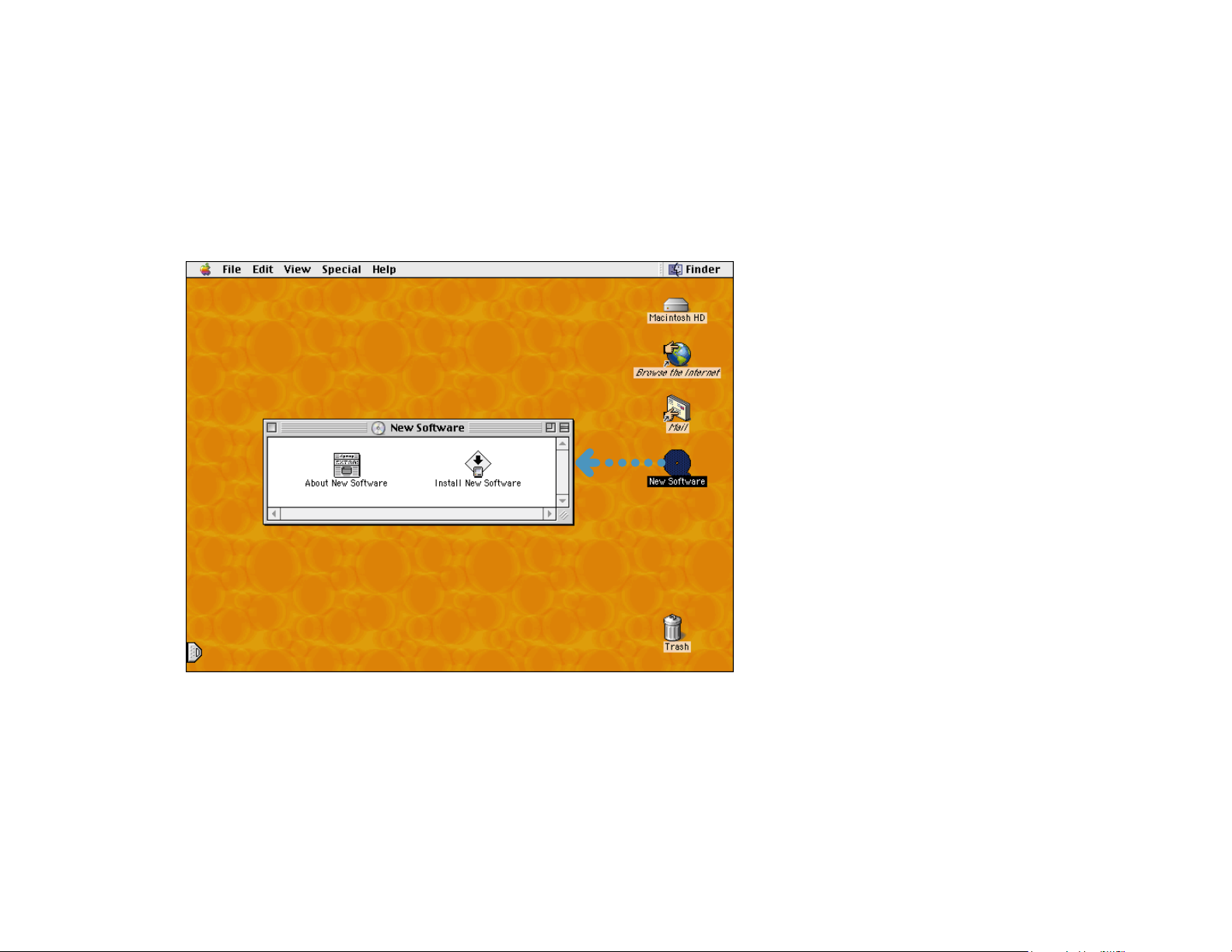
To install software that’s on a CD:
1
Insert the disc in the drive slot with the
label facing up, then double-click the
disc’s icon to open it.
. CD-ROM discs can be used in DVD-ROM
drives.
. Use only circular discs with your CD or DVD
drive. Apple does not recommend the use of
specially shaped discs.
2
Double-click the installation
application to install the new
software on your computer.
3
When you’re ready to eject the disc,
drag the disc’s icon to the Trash.
Page 16
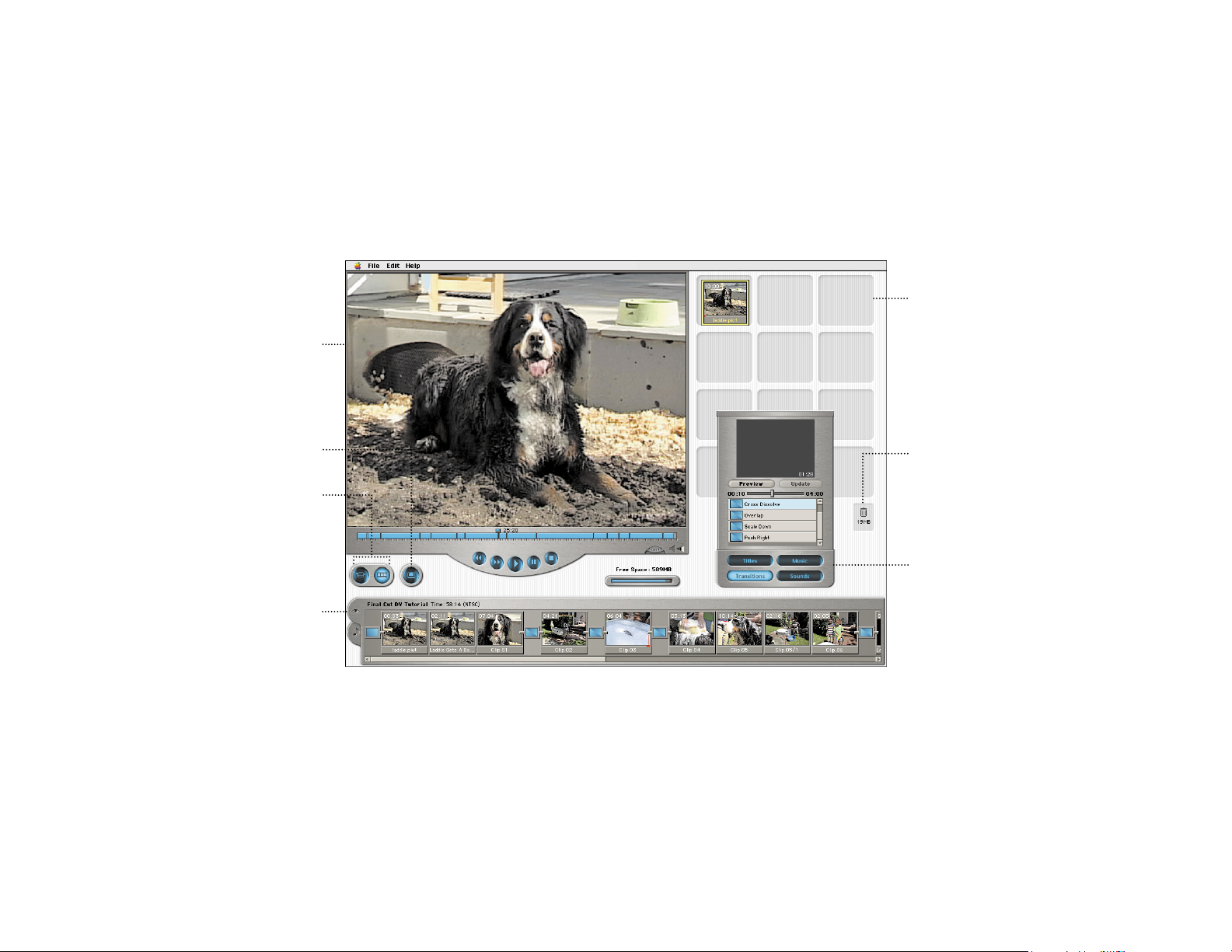
If your computer has FireWire:
You can connect a DV camcorder and create your own movies.
Monitor window
Preview your movie or
view video directly from
a DV-format camera
using the controls at the
bottom of the window.
Shelf
Store clips you may
want to use in your
movie. To add a clip to
your movie, drag it to
the Clip Viewer.
Viewer
Click the Clip Viewer tab
to edit and place clips.
Click the other tab to
open the Audio Viewer
and edit sound effects.
Mode switch
Use this to switch
between camera and
edit mode.
Trash can
Place unwanted clips
here to delete them and
create more hard disk
space on your
computer.
Effects palettes
Easily add titles,
transitions, music,
and sound effects.
Full screen button
Click this to play your
movie on the entire
computer screen.
To learn more about the preinstalled
video-editing application:
m open the application, then see the information in
the Help menu
m go through the application’s tutorial
. This video-editing application is
preinstalled in the Applications folder on
your computer’s hard disk (see page 12).
16
Page 17
17
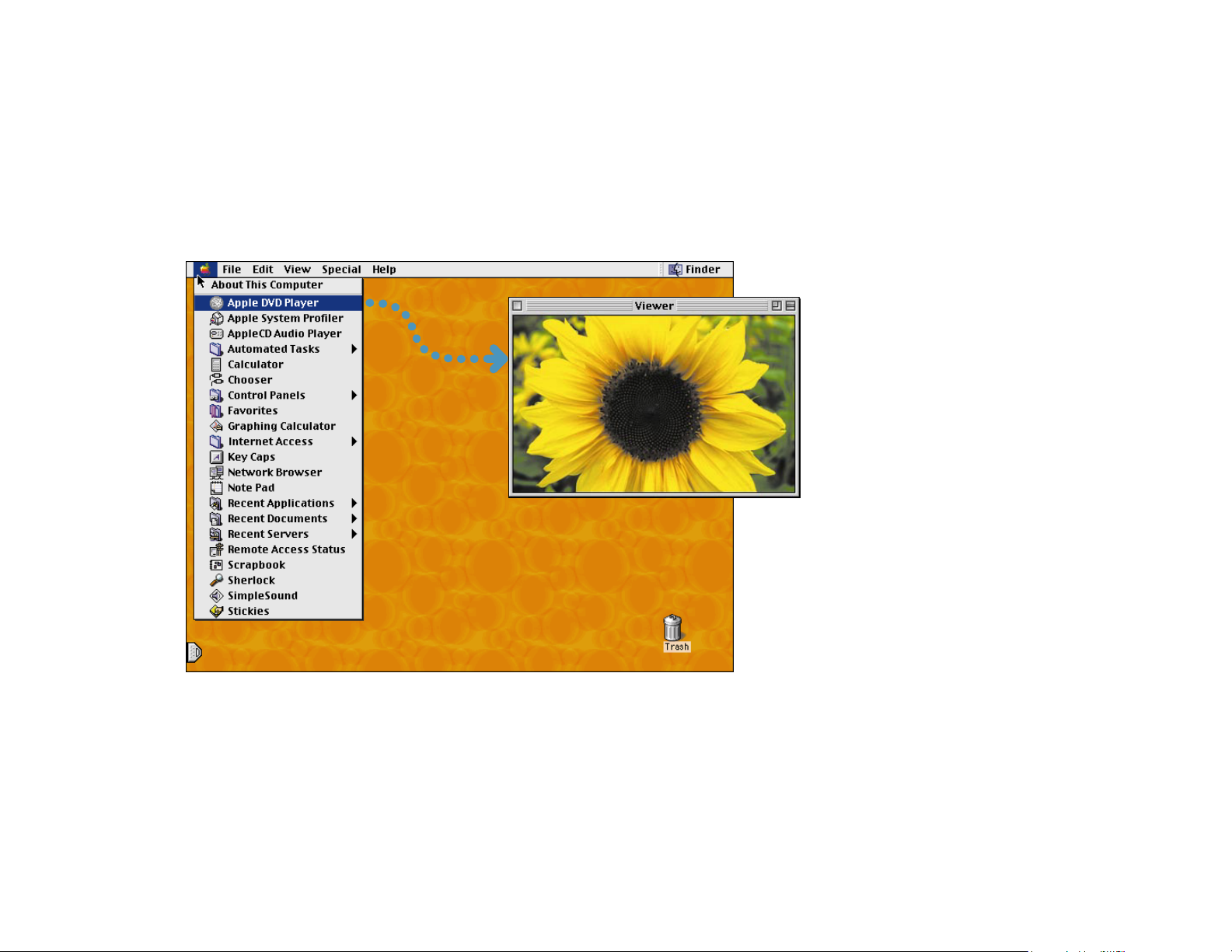
The Apple DVD Player lets you view DVD movies.
1
Insert a disc in the drive slot.
Then open the Apple (K) menu
and choose Apple DVD Player.
2
Use the controller to play the
movie in the Viewer window.
. You also use the controller to access
special features of the movie.
. To learn more about the Apple DVD Player,
look at the Apple DVD Player information in the
Help menu.
Page 18
18
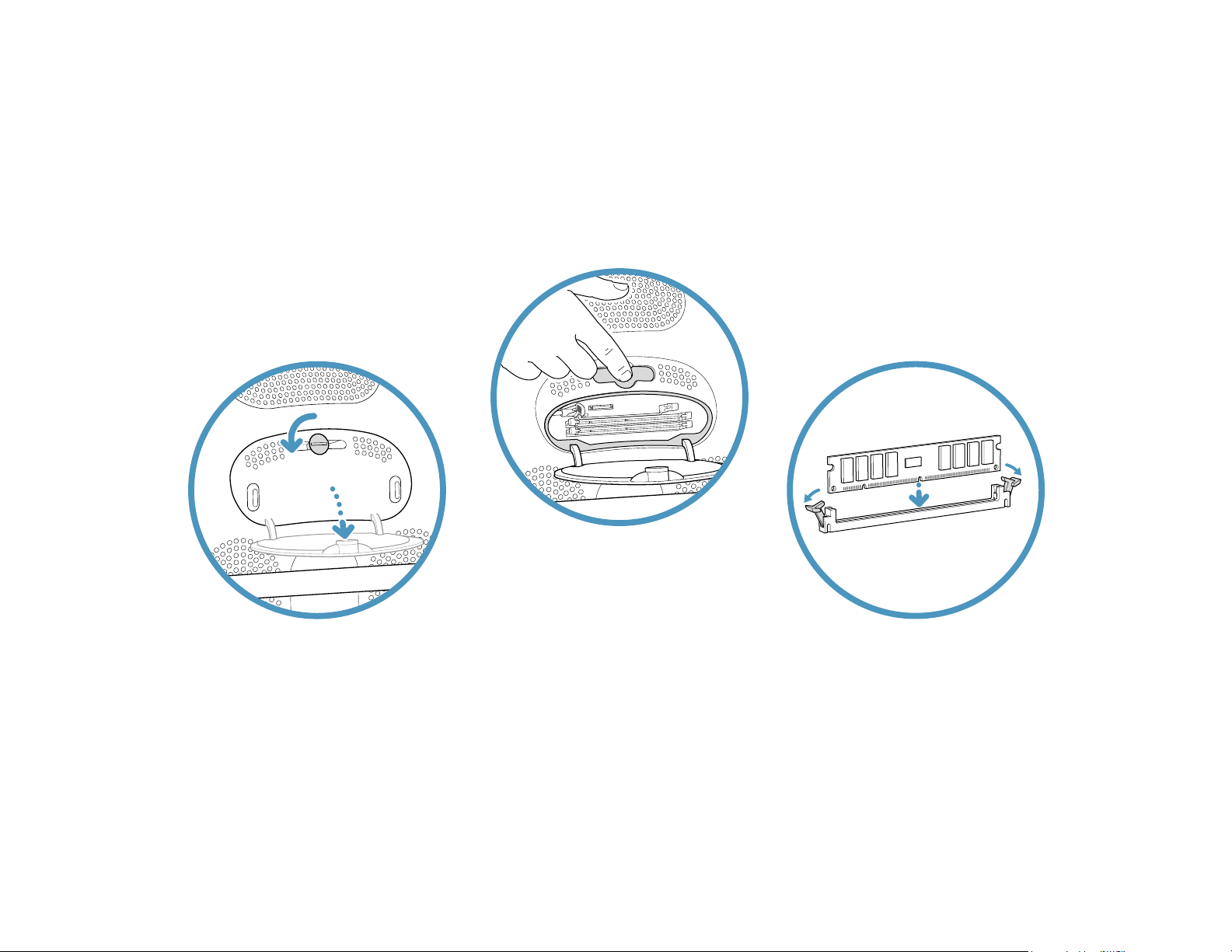
How do I add memory and an AirPort Card?
For detailed instructions, refer to Mac Help (see page 20).
Before installing:
m shut down the computer
m unplug all cables, except the power cord
m place the computer face down on a soft cloth
1
Open the access door using
a coin to turn the latch.
2
Touch the metal shield inside
the recessed latch area. Then
unplug the power cord.
. Touch this metal before you touch
any parts inside the computer. Don’t
walk around the room until you’ve
finished installing memory or an
AirPort Card.
3
To install memory, insert
a memory module into one of
the two lower slots.
. Be sure to align the notches on the
module with the small notches inside
the slot.
Page 19
19
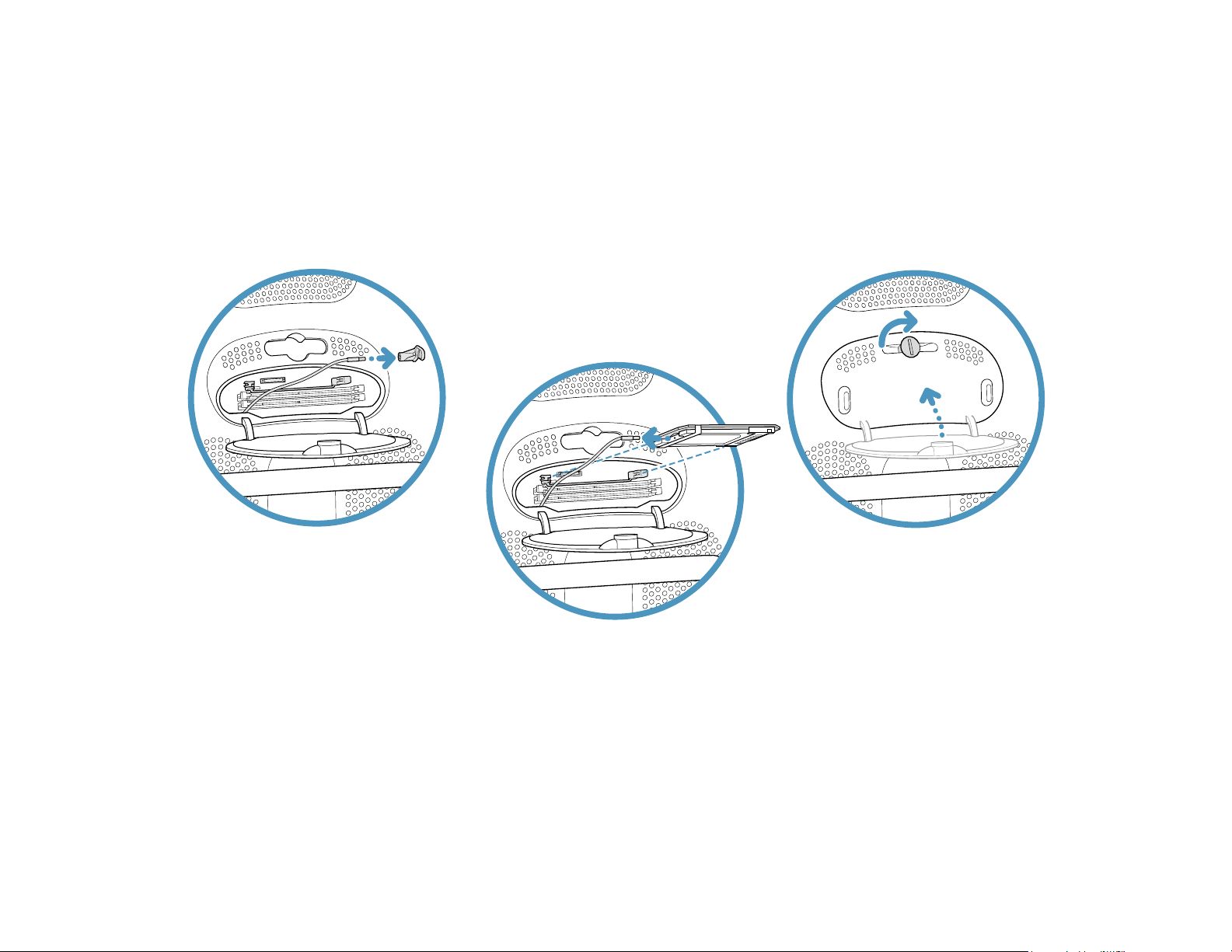
4
To install an AirPort Card, detach
the antenna from the upper slot,
then remove the protective
plastic cap.
5
Then connect the antenna to the
AirPort Card and insert the card
sideways into the slot.
. For instructions on using the AirPort
software, look in Mac Help, available in
the Help menu.
6
Close the access door and use
a coin to close the latch.
. Never turn your computer on unless
all of its internal and extra parts are in
place.
Page 20
20
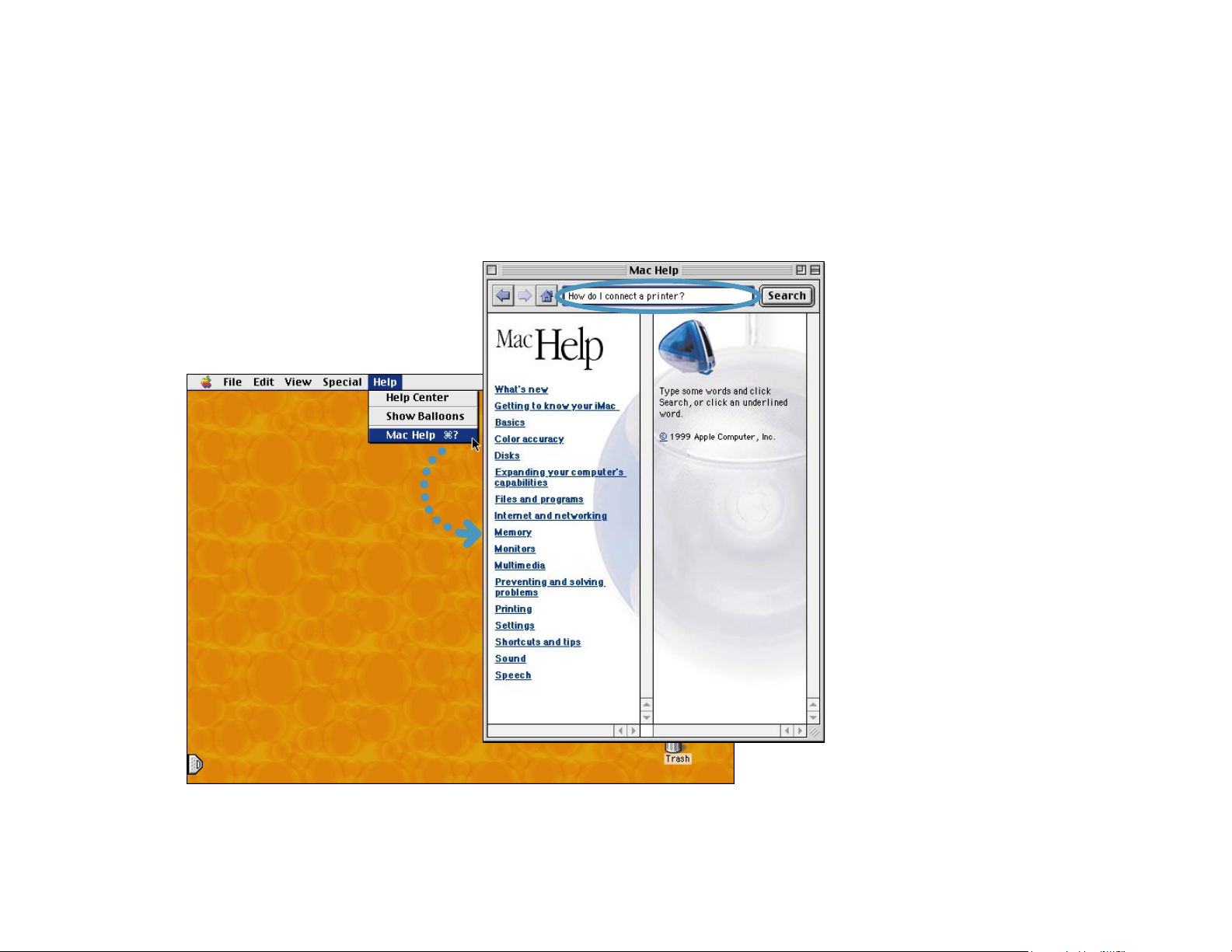
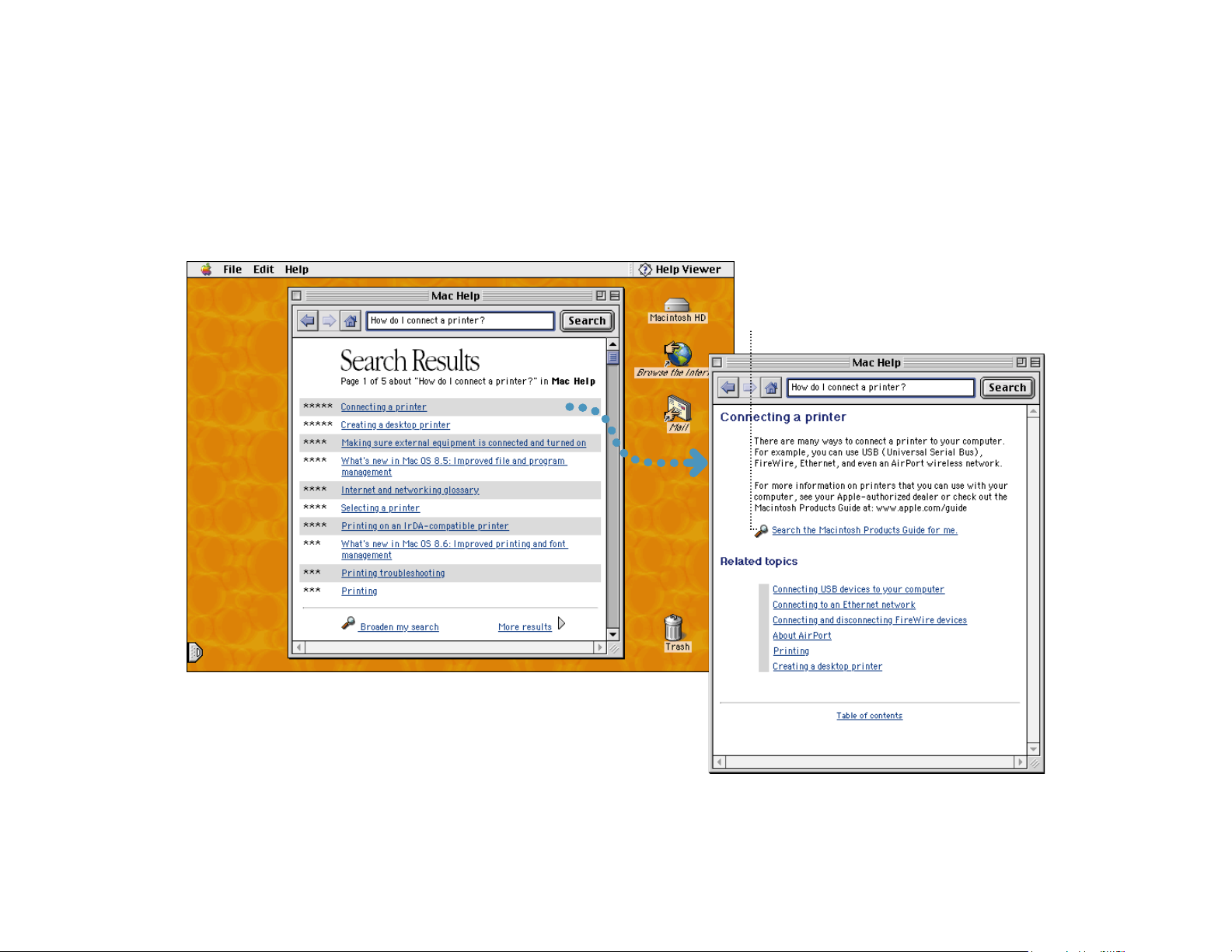
Where do I go to learn more?
Look in Mac Help for more information on using your computer.
2
Open the Help menu
and choose Mac Help.
1
Choose Finder from the Application
menu (see page 4).
3
Type a question or
keywords, then click
Search.
. You can also browse
through information about
your computer by clicking
one of the blue underlined
items in the window.
. To view Help for other
applications, choose Help
Center from the Help menu.
Page 21
21
. Underlined items are links. When you click a link,
it will go to another topic, automatically do something
for you, or take you to more information on the
Internet.
4
Click an item in the list of available
Help topics.
. If you didn’t find what you were
looking for, try rewording your question.
Page 22

If the computer won’t respond
or the pointer won’t move:
First, make sure the mouse and keyboard are connected.
m Unplug and then plug in the connectors and make sure they are
firmly seated.
Then try to cancel what the computer is doing.
m Press the Command (x) and period (.) keys at the same time. If a
dialog box appears, click Cancel.
m If that doesn’t work, hold down the Option and Command (x)
keys, then press the Esc key. If a dialog box appears, click Force
Quit. If you return to the Finder (the Finder is checked in the
Application menu; see page 4), restart your computer.
If the computer still doesn’t respond, restart it.
m Press the Power button on the computer.
m If that doesn’t work, hold down the Control and Command (x)
keys, and then press the Power button on the computer.
m If that doesn’t work, press the Reset button (see page 3).
m If that doesn’t work, hold down the Power button on the computer
for 5 seconds. After your computer turns off, press the Power
button on the computer to turn it on again.
m If that doesn’t work, unplug the power cord from the computer.
Then plug the power cord back in and press the Power button on
the computer to turn it on.
Then do this:
If the problem occurs frequently when you use a particular
application:
m Check with the application’s manufacturer to verify that it is
compatible with your computer and the version of system software
your computer is using.
If the problem occurs frequently:
m Choose Finder in the Application menu (see page 4). Then open
the Help menu and choose Mac Help. Look at the section on how
to prevent and solve problems. You may need to check for
extension conflicts or reinstall your computer’s system software.
If the computer “freezes” during startup
or you see a flashing question mark:
Turn off system extensions.
m Start up your computer while holding down the Shift key.
If that does not work, start up using the software install CD.
m Insert the software install CD that came with your computer and
start up while holding down the C key. (Make sure the Caps Lock
key is not engaged.)
22
What if I have a problem?
Page 23

Then do this:
After the computer starts up:
m Make sure that the hard disk that contains the System Folder is
selected, or highlighted, in the Startup Disk control panel.
m Then open the Help menu and choose Mac Help. Look at the
section on how to prevent and solve problems. You may need to
check for extension conflicts or reinstall your computer’s system
software.
If you notice that the background picture is different:
m You probably started up your computer using the system software
on a CD instead of your hard disk. If this is the only way that you
can get your computer started up, you should reinstall the system
software on your hard disk. Look for instructions in Mac Help or
use the Installer application on your software install CD.
If the computer won’t turn on or start up:
First, make sure the power cord is connected.
m The plug on the power cord must be completely inserted into the
computer’s power socket and firmly seated for your computer to
operate correctly. Make sure the power cord is plugged into a
working electrical outlet.
m If your computer is plugged into a power strip, make sure the
power strip is turned on.
If that does not work, reset your computer.
m Start up the computer and immediately hold down the
Command (x), Option, P, and R keys until you hear the startup
sound a second time. Then release the keys.
If that does not work or if you hear musical tones during
startup:
m You may have a problem with RAM (random-access memory). If
you recently installed additional memory, make sure that it is
correctly installed and that it is compatible with your computer.
m Contact an Apple-authorized service provider.
Other problems
If you have a problem with your dial-up Internet connection:
m Make sure the telephone line is properly connected to your
computer and the line is functioning properly.
m Wait a while, then try connecting again.
m Choose Finder in the Application menu (see page 4). Then open
the Help menu and choose Mac Help. There you can find your
Internet settings and the contact information for your Internet
service provider.
If you have a problem with a software program:
m To resolve problems with software, contact the software
manufacturer.
If you have a problem using your computer:
m Look at the information in Mac Help for instructions and
troubleshooting information.
m Go to the Apple Support Web site on the Internet
(www.apple.com/support) for the latest troubleshooting
information and software updates.
23
Page 24

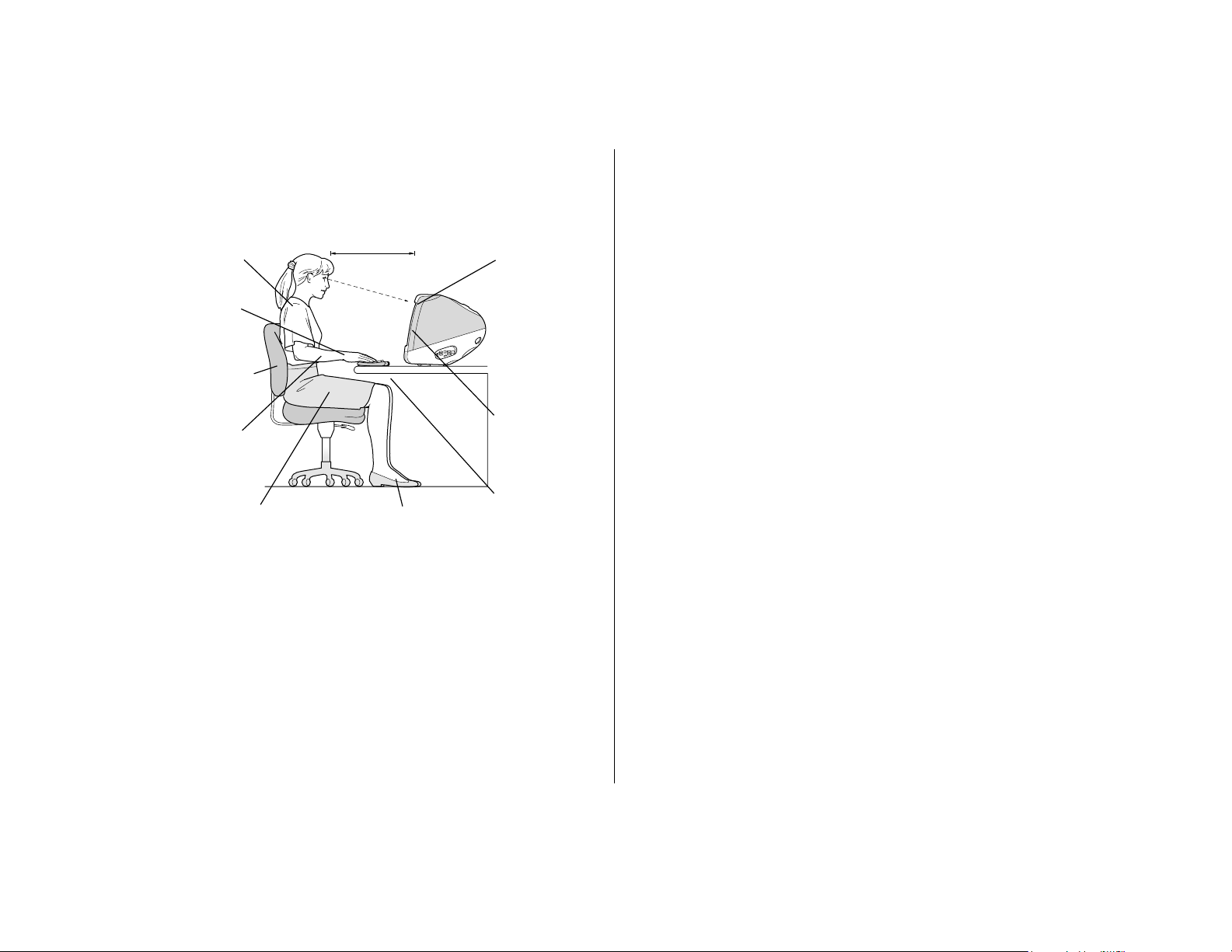
The guidelines in this section can help you work more comfortably
with your computer. For detailed information about ergonomics, see
Apple’s Environmental Health and Safety Web site at:
www.apple.com/about/ergonomics
Keyboard
m When you use the computer keyboard, your shoulders should be
relaxed. Your upper arm and forearm should form an approximate
right angle, with your wrist and hand in roughly a straight line.
m You may have to raise your chair so your forearms and hands are at
the proper angle to the keyboard. If this makes it impossible to rest
your feet flat on the floor, you can use a footrest with adjustable
height and tilt to make up for any gap between the floor and your
feet. Or you may lower the desktop to eliminate the need for a
footrest. Another option is to use a desk with a keyboard tray that
is lower than the regular work surface.
m Use a light touch when typing and keep your hands and fingers
relaxed. Avoid rolling your thumbs under your palms.
Mouse
m Position the mouse at the same height as your keyboard. Allow
adequate space to use the mouse comfortably.
Chair
m An adjustable chair that provides firm, comfortable support is best.
Adjust the height of the chair so your thighs are horizontal and
your feet flat on the floor.
m The back of the chair should support your lower back (lumbar
region). Follow the manufacturer’s instructions for adjusting the
backrest to fit your body properly.
Computer
m Arrange the computer so the top of the screen is slightly below
your eye level when you’re sitting at the keyboard. The best
distance from your eyes to the screen is up to you, although most
people seem to prefer 18 to 28 inches (45 to 70 cm).
m Position the computer to minimize glare and reflections on the
screen from overhead lights and windows.
24
How do I work comfortably?
Page 25
Important Don’t lift the computer using the flip-out foot. You could
damage your computer. To move your computer, grab the handle on
the top of the computer with one hand; with your other hand, hold
the bottom of the computer.
Avoiding fatigue
m Change your seated position, stand up, or stretch whenever you
start to feel tired. Frequent short breaks are helpful in reducing
fatigue.
m Use a light touch when typing or using a mouse and keep your
hands and fingers relaxed.
m Some computer users may develop discomfort in their hands,
wrists, or arms after periods of intensive work without breaks.
If you begin to develop chronic pain or discomfort in your hands,
wrists, or arms, consult a qualified health specialist immediately.
m Allow adequate workspace so that you can use your keyboard and
mouse comfortably. Place papers or other items so you can view
them easily while using your computer. A document stand may
make reading papers more comfortable.
m Eye muscles must work harder to focus on nearby objects.
Occasionally focus your eyes on a distant object, and blink often
while you work.
m Clean your screen regularly. Keeping the screen clean helps reduce
unwanted reflections (see page 27).
Thighs tilted slightly
Shoulders
relaxed
Screen positioned
to avoid reflected
glare
Forearms
and hands in
a straight line
Forearms
level or tilted
down slightly
Lower back
supported
Feet flat on the floor
Top of the screen
at or slightly below
eye level (You may
need to adjust
the height of your
monitor by raising
your work
surface.)
Clearance under
work surface
45–70 cm (18–28 in.)
25
Page 26

Safety
Make sure that you
m keep these instructions handy for reference by you and others who
may use your computer
m follow all instructions and warnings regarding your system
When setting up and using your computer, remember the following:
m Place your computer in a location with adequate ventilation. Never
block the vents on the computer.
m Your computer has a three-wire grounding plug that will only fit a
grounded AC outlet. If you are unable to insert the plug into the
outlet, contact a licensed electrician to replace the outlet with a
properly grounded outlet.
m Make sure you only connect the modem to an analog phone line,
the type commonly used in residences. Do not connect a digital
telephone line to the modem, because it could damage the
modem.
m Never turn on your computer unless all of its internal and external
parts are in place. Operating the computer when it is open or
missing parts can be dangerous and damage your computer.
Important The only way to disconnect power completely is to
unplug the power cord. Make sure at least one end of the power cord
is within easy reach so that you can unplug the computer when you
need to.
For your own safety and that of your equipment, always disconnect the
power plug (by pulling the plug, not the cord) if any of the following
conditions exists:
m you want to remove any parts (leave the cord disconnected as long
as the computer is open)
m the power cord or plug becomes frayed or otherwise damaged
m you spill something into the case
m your computer is exposed to rain or any other excess moisture
m your computer has been dropped or the case has been otherwise
damaged
m you suspect that your computer needs service or repair
m you want to clean the case (use only the recommended procedure
discussed in Mac Help)
Be sure that you always do the following:
m Keep your computer away from sources of liquids, such as drinks,
washbasins, bathtubs, shower stalls, and so on.
m Protect your computer from dampness or wet weather, such as
rain, snow, and so on.
Warning Electrical equipment may be hazardous if misused.
Operation of this product must always be supervised by an adult.
Do not allow children access to the interior of this product and do
not permit them to handle any cables.
26
Is there anything else I need to know?
Follow these instructions for using your iMac safely and wisely.
Page 27

Cleaning your computer equipment
To clean your computer equipment, use only the recommended
procedures discussed in Mac Help.
Power supply
The power supply in your computer is a high-voltage component and
not user-serviceable. If you suspect the power supply needs service,
contact your Apple-authorized dealer or service provider.
Power-saving and environmental features
Your display is equipped with energy-saving features that allow the
display to conserve energy when the computer is not in use. For
instructions on adjusting the system and display sleep settings and
additional energy-conservation information, see Mac Help.
ENERGY STAR
®
compliant: As an ENERGY STAR partner, Apple
Computer has determined that this product meets the ENERGY STAR
guidelines for energy efficiency. The United States Environmental
Protection Agency’s ENERGY STAR program is a partnership with
office product equipment manufacturers to promote energy-efficiency.
Reducing energy consumption of office products saves money and
reduces pollution by eliminating wasted energy.
Warning Do not attempt to access the high-voltage area or
power supply. If you suspect the power supply needs service,
contact your Apple-authorized dealer or service provider.
Warning Do not clean the screen with a cleaner that contains
alcohol or acetone. Never spray cleaner directly onto the screen.
Liquid could drip inside the screen and cause an electrical shock.
27
Page 28

Communications regulation information
FCC compliance statement
This device complies with part 15 of the FCC rules. Operation is subject to the
following two conditions: (1) This device may not cause harmful interference, and
(2) this device must accept any interference received, including interference that may
cause undesired operation. See instructions if interference to radio or television
reception is suspected.
Radio and television interference
The equipment described in this manual generates, uses, and can radiate radiofrequency energy. If it is not installed and used properly—that is, in strict accordance
with Apple’s instructions—it may cause interference with radio and television
reception.
This equipment has been tested and found to comply with the limits for a Class B
digital device in accordance with the specifications in Part 15 of FCC rules. These
specifications are designed to provide reasonable protection against such interference
in a residential installation. However, there is no guarantee that interference will not
occur in a particular installation.
You can determine whether your computer system is causing interference by turning
it off. If the interference stops, it was probably caused by the computer or one of the
peripheral devices.
If your computer system does cause interference to radio or television reception, try
to correct the interference by using one or more of the following measures:
m Turn the television or radio antenna until the interference stops.
m Move the computer to one side or the other of the television or radio.
m Move the computer farther away from the television or radio.
m Plug the computer into an outlet that is on a different circuit from the television or
radio. (That is, make certain the computer and the television or radio are on
circuits controlled by different circuit breakers or fuses.)
If necessary, consult an Apple-authorized service provider or Apple. See the service
and support information that came with your Apple product. Or, consult an
experienced radio/television technician for additional suggestions.
Changes or modifications to this product not authorized by Apple Computer, Inc.,
could void the FCC Certification and negate your authority to operate the product.
Important This product was tested for FCC compliance under conditions that
included the use of Apple peripheral devices and Apple shielded cables and
connectors between system components. It is important that you use Apple
peripheral devices and shielded cables and connectors between system components
to reduce the possibility of causing interference to radios, television sets, and other
electronic devices. You can obtain Apple peripheral devices and the proper shielded
cables and connectors through an Apple-authorized dealer. For non-Apple peripheral
devices, contact the manufacturer or dealer for assistance.
Responsible party (contact for FCC matters only): Apple Computer, Inc., Product
Compliance, 1 Infinite Loop M/S 26-A, Cupertino, CA 95014-2084, 408-974-2000.
Exposure to radio frequency energy
The radiated output power of the optional AirPort Card is far below the FCC radio
frequency exposure limits. Nevertheless, it is advised to use the wireless equipment in
such a manner that the potential for human contact during normal operation is
minimized.
Industry Canada statement
This Class B device meets all requirements of the Canadian interference-causing
equipment regulations.
Cet appareil numérique de la Class B respecte toutes les exigences du Règlement sur
le matériel brouilleur du Canada.
Europe-EU Declaration of Conformity
This device complies with the specifications ETS 300 328 and ETS 300 286, following
the provisions of the EMC Directive 89/336/EEC.
VCCI Class 2 statement
28
Where’s the fine print?
Page 29

29
Telephone and modem information
Some telephone companies require that you notify the local business office when you
hook up a modem to their lines.
Information you need in the United States
The internal modem complies with Part 68 of the FCC rules. On the back of this
equipment is a label that contains, among other information, the FCC registration
number and ringer equivalence number (REN). If requested, provide this information
to your telephone company.
m Ringer equivalence number (REN): 0.8–0.9 The REN is useful to determine the
quantity of devices you may connect to your telephone lines and still have all those
devices ring when your telephone number is called. In most, but not all areas, the
sum of the RENs of all devices connected to one line should not exceed five (5.0).
To be certain of the number of devices you may connect to your line, as
determined by the REN, you should contact your local telephone company to
determine the maximum REN for your calling area.
m Telephone jack type: USOC, RJ-11 An FCC-compliant telephone cord and modular
plug are provided with this equipment. This equipment is designed to be
connected to the telephone network or premises wiring using a compatible
modular jack that complies with Part 68 rules. See the installation instructions for
details.
Telephone line problems
If your telephone doesn’t work, there may be a problem with your telephone line.
Disconnect the modem to see if the problem goes away. If it doesn’t, report the
problem either to your local telephone company or to your company’s
telecommunications people.
If disconnecting the modem eliminates the problem, the modem itself may need
service. See the service and support information that came with your Apple product
for instructions on how to contact Apple or an Apple-authorized service provider for
assistance.
If you do not disconnect your modem when it is adversely affecting the telephone
line, the telephone company has the right to disconnect your service temporarily until
you correct the problem. The telephone company will notify you as soon as possible.
Also, you will be informed of your right to file a complaint with the FCC.
The telephone company may make changes in its facilities, equipment, operations, or
procedures that could affect the operation of your equipment. If this happens, the
telephone company will provide advance notice in order for you to make the
necessary modifications to maintain uninterrupted service.
The optional internal modem will not work with party lines, cannot be connected to a
coin-operated telephone, and may not work with a private branch exchange (PBX).
Telephone Consumer Protection Act
The Telephone Consumer Protection Act of 1991 makes it unlawful for any person to
use a computer or other electronic device to send any message via a telephone fax
machine unless such message clearly contains in a margin at the top or bottom of
each transmitted page or on the first page of the transmission, the date and time it
was sent and an identification of the business or other entity, or individual sending the
message and the telephone number of the sending machine of such business, entity,
or individual.
Information you need in Canada
The Industry Canada (IC) label identifies certified equipment. This certification means
that the equipment meets certain telecommunications network protective,
operational, and safety requirements. The Department does not guarantee the
equipment will operate to a user’s satisfaction.
Before installing this equipment, make sure that you are permitted to connect to the
facilities of the local telecommunications company. Be sure you use an acceptable
method of connection to install the equipment. In some cases, you may extend the
company’s internal wiring for single-line individual service by means of a certified
telephone extension cord. Be aware, however, that compliance with these conditions
may not prevent degradation of service in some situations.
Repairs to certified equipment should be made by an authorized Canadian
maintenance facility designated by the supplier. Any equipment malfunctions or
repairs or alterations that you make to this equipment may cause the
telecommunications company to request that you disconnect the equipment.
In Canada, contact Apple at: 7495 Birchmount Road, Markham, Ontario, L3R 5G2,
800-263-3394
Users should ensure for their own protection that the electrical ground connections of
the power utility, telephone lines, and internal metallic water pipe system, if present,
are connected together. This precaution may be particularly important in rural areas.
Warning Users should not attempt to make such connections themselves, but
should contact the appropriate electric inspection authority or electrician.
m Load number: 0.3 The load number (LN) assigned to each terminal device denotes
the percentage of the total load to be connected to the telephone loop that is used
by the device, to prevent overloading. The termination of a loop may consist of any
combination of devices, subject only to the requirement that the sum of the load
numbers of all devices does not exceed 100.
m Telephone jack type: CA-11
Page 30

Informations destinés aux utilisateurs Canadiens
L’étiquette d’Industrie Canada identifie un matériel homologué. Cette étiquette
certifie que le matériel est conforme à certaines normes de protection, d’exploitation
et de sécurité des réseaux de télécommunications. Le Ministère n’assure toutefois pas
que le matériel fonctionnera à la satisfaction de l’utilisateur.
Avant d’installer ce matériel, l’utilisateur doit s’assurer qu’il est permis de le raccorder
au réseau de l’entreprise locale de télécommunication. Le matériel doit également
être installé en suivant une méthode acceptée de raccordement. Dans certains cas, le
cablage appartenant à l’entreprise utilisé pour un service individuel à ligne unique
peut être prolongé au moyen d’un dispositif homologué de raccordement (cordon
prolongateur téléphonique).
L’abonné ne doit pas oublier qu’il est possible que la conformité aux conditions
énoncées ci-dessus n’empechent pas la dégradation du service dans certaines
situations. De fait, les entreprises de télécommunication ne permettent pas que l’on
raccorde un matériel aux prises d’abonné, sauf dans les cas précis prévus par les tarifs
particuliers de ces entreprises.
Les réparations de matériel homologué doivent être effectuées par un centre
d’entretien canadien autorisé désigné par le fournisseur. La compagnie de
télécommuncations peut demander à l’utilisateur de débrancher un appareil suite à
des réparations ou des modifications effectuées par l’utilisateur ou à cause de mauvais
fonctionnement.
Veuillez contacter le fournisseur suivant pour des informations supplémentaires :
Apple Canada, Inc.
7495 Birchmount Road
Markham, Ontario
Canada L3R 5G2
Apple Canada Customer Assistance Line: 800-263-3394
Pour sa propre protection, I’utilisateur doit s’assurer que tous les fils de mise à la terre
du secteur, des lignes téléphoniques et les canalisations d’eau métalliques, s’il y en a,
soient raccordés ensemble. Cette précaution est particulièrement importante dans les
régions rurales.
Avertissement L’utilisateur ne doit pas tenter de faire ces raccordements lui-
même; il doit avoir recours à un service d’inspection des installations électriques ou à
un électricien, selon le cas.
m Numéro de charge : 0.3 L’indice de charge (IC) assigné à chaque dispositif
terminal indique, pour éviter toute surcharge, le pourcentage de la charge totale
qui sera raccordée à un circuit téléphonique bouclé utilisé par ce dispositif. La
terminaison du circuit bouclé peut être constituée de n’importe quelle
combinaison de dispositifs pourvu que la somme des indices de charge de
l’ensemble des dispositifs ne dépasse pas 100.
m Type de prise téléphonique : CA-11
Information you need in the United Kingdom
This terminal equipment is intended for direct connection to the analogue Public
Switched Telecommunications Network and is approved for use within the United
Kingdom with the following features:
m Modem facility
m Autocalling facility
m Autoanswer facility
m DTMF signaling
m Operation in the absence of proceed indication or upon detection of proceed
indication
This product is in conformity with relevant regulatory standards following the
provisions of European Council Directives 73/23/EEC (Low Voltage Directive) and
89/336/EEC amended by 92/31/EEC (EMC Directive).
Information you need in Germany
Diese Modem-Karte ist als Endeinrichtung vorgesehen und muss an ein TAE mit FKodierung angeschlossen werden.
Diese Endeinrichtung ist in Konformität gemäss Niederspannungsrichtlinie 73 / 23 /
EWG sowie EMC-Richtlinien
89 / 336 / EWG und 92 / 31 / EWG.
Information you need in France
Ce matériel est conforme aux normes applicables de sécurité éléctrique d’après la
directive 73 / 23 / CEE et aux normes applicables de comptabilité éléctromagnétique
d’après la directive 89 / 336 / CEE, modifié par la directive 92 / 31 / CEE.
Information you need in Australia
All telecommunications devices are required to be labelled as complying to the
Australian telecommunications standards, ensuring the health and safety of the
operator and the integrity of the Australian telecommunications network. To provide
compliance with the Australian Communications Authority’s technical standards,
please ensure that the following AT commands are maintained:
30
Page 31

m ATB0 (ITU/CCITT operation)
m AT&G0 (no guard tone)
m AT&P1 (33/66 pulse dial make/break ratio)
m ATS0 = 0 or ATS0 = 1 (no answer or answer greater than one ring)
m ATS6 = 95 (DTMF period between 70–255 ms)
m ATS11 = 95 (DTMF period between 70–255 ms)
For calls that are automatically generated, a total of three call attempts are allowed to a
telephone number, with a minimum period between calls of 2 seconds. If the call does
not connect after three attempts, 30 minutes must expire before automatic redialing
may be initiated. Failure to set the modem (and any associated communications
software) to the above settings may result in the modem being non-compliant with
Australian telecommunications standards. Under these circumstances a user could be
subject to significant penalties under the Telecommunications Act 1997.
This modem must be properly secured in order for you to use it. Telecommunications
network voltages exist inside the computer and the telecommunications line
connection must be removed before opening the computer.
Information you need in New Zealand
This modem is fully approved to operate on the New Zealand telecommunications
network under Telepermit number PTC 211/98/119. All telecommunications devices
are required to hold a Telepermit and be labelled accordingly with the approved
Telepermit number to comply with the New Zealand telecommunications standards,
ensuring the health and safety of the operator and the integrity of the New Zealand
telecommunications network.
Customers in New Zealand who are prompted to choose a country for their modem
should choose the “Australia” country code setting.
To ensure compliance, all calls that are automatically generated should not make
more than 10 call attempts to the same number within any 30 minute period with a
minimum period between calls of 30 seconds. Failure to adhere to these standards
may result in the modem being non-compliant with New Zealand Telecom standards.
Under these circumstances a user could be subject to significant penalties.
If pulse dialing is required for any reason, the communications software must be set
up to record numbers according to the following translation list.
m Number to be dialed: 0; number to be entered into computer: 0
m Number to be dialed: 1; number to be entered into computer: 9
m Number to be dialed: 2; number to be entered into computer: 8
m Number to be dialed: 3; number to be entered into computer: 7
m Number to be dialed: 4; number to be entered into computer: 6
m Number to be dialed: 5; number to be entered into computer: 5
m Number to be dialed: 6; number to be entered into computer: 4
m Number to be dialed: 7; number to be entered into computer: 3
m Number to be dialed: 8; number to be entered into computer: 2
m Number to be dialed: 9; number to be entered into computer: 1
m Number to be dialed: 0; number to be entered into computer: 0
The preferred method of dialing is to use DTMF tones as this is faster than pulse
(decadic) dialing and is readily available on almost all New Zealand telephone
exchanges.
Laser information
Warning Making adjustments or performing procedures other than those specified
in your equipment’s manual may result in hazardous radiation exposure.
Do not attempt to disassemble the cabinet containing the laser. The laser beam used
in this product is harmful to the eyes. The use of optical instruments, such as
magnifying lenses, with this product increases the potential hazard to your eyes. For
your safety, have this equipment serviced only by an Apple-authorized service
provider.
Service warning label
High-risk activities warning
This computer system is not intended for use in the operation of nuclear facilities,
aircraft navigation or communications systems, or air traffic control machines, or for
any other uses where the failure of the computer system could lead to death, personal
injury or severe environmental damage.
Mouse information
This product complies with the requirements of European Directives 72/23/EEC and
89/336/EEC. Complies with the Canadian ICES-003 Class B specification.
31
Page 32

iMac
Benutzerhandbuch
Manuale Utente
Handbok
Käsikirja
Page 33

www.apple.com
© 1999 Apple Computer, Inc. All rights reserved. Apple, the Apple logo, AppleWorks, FireWire, the FireWire logo, Mac, and Macintosh are trademarks of Apple Computer, Inc.,
registered in the U.S.A. and other countries. AirPort, Finder, iMac, and Sherlock are trademarks of Apple Computer, Inc. ENERGY STAR is a U.S. registered trademark.
034-0872-A Printed in U.S.A.
 Loading...