

Page 1

APG
PT-510 and PT-510W Series
User Manual
4-20 mA
R
Doc #9005031
Rev A, 02/2017
Page 2

Table of Contents
Introduction ................................................................................................................ iii
Warranty and Warranty Restrictions .................................................................... iv
Chapter 1: Specications and Options.....................................................................1
Dimensions ........................................................................................................................................1
Specications ...................................................................................................................................2
Model Number Congurator ...................................................................................................... 3-4
Electrical Pinout Table and Supply Power Table ...................................................................... 5
Chapter 2: Installation and Removal Procedures and Notes ..............................5
Tools Needed .....................................................................................................................................5
Mounting Instructions ................................................................................................................... 5
Electrical Installation ..................................................................................................................... 5
Removal Instructions .....................................................................................................................6
Chapter 3: Maintenance .............................................................................................6
General Care ...................................................................................................................................... 6
Vent Tube Drying ............................................................................................................................. 7
Repair and Returns .......................................................................................................................... 8
ii
Tel: 1/888/525-7300 • Fax: 1/435/753-7490 • www.apgsensors.com • [email protected]
Page 3

Introduction
Thank you for purchasing a PT-510/PT-510W series submersible pressure transmitter from APG. We
appreciate your business! Please take a few minutes to familiarize yourself with your PT-510 and this
manual.
PT-510/PT-510W series submersible pressure transmitters oer reliability in harsh industrial conditions. The
small size, and all welded, all stainless steel body make the durable PT-510/PT-510W the perfect instrument
for static and dynamic pressure measurement. The PT-510 comes with a Delrin nose cone, suitable for clean
water use, while the PT-510W has a stainless steel cage for additional transducer protection in wastewater
environments.
Reading your label
Every APG instrument comes with a label that includes the instrument’s model number, part number, serial
number, and a wiring pinout table. Please ensure that the part number and pinout table on your label
match your order.
Tel: 1/888/525-7300 • Fax: 1/435/753-7490 • www.apgsensors.com • [email protected]
iii
Page 4

Warranty and Warranty Restrictions
This product is covered by APG’s waranty to be free from defects in material and workmanship under
normal use and service of the product for 24 months. For a full explanation of our Warranty, please visit
https://www.apgsensors.com/about-us/terms-conditions. Contact Technical Support to recieve a Return
Material Authorization before shipping your product back.
Scan the QR code below to read the full explanation of our Warranty on your tablet or smartphone.
iv
Tel: 1/888/525-7300 • Fax: 1/435/753-7490 • www.apgsensors.com • [email protected]
Page 5
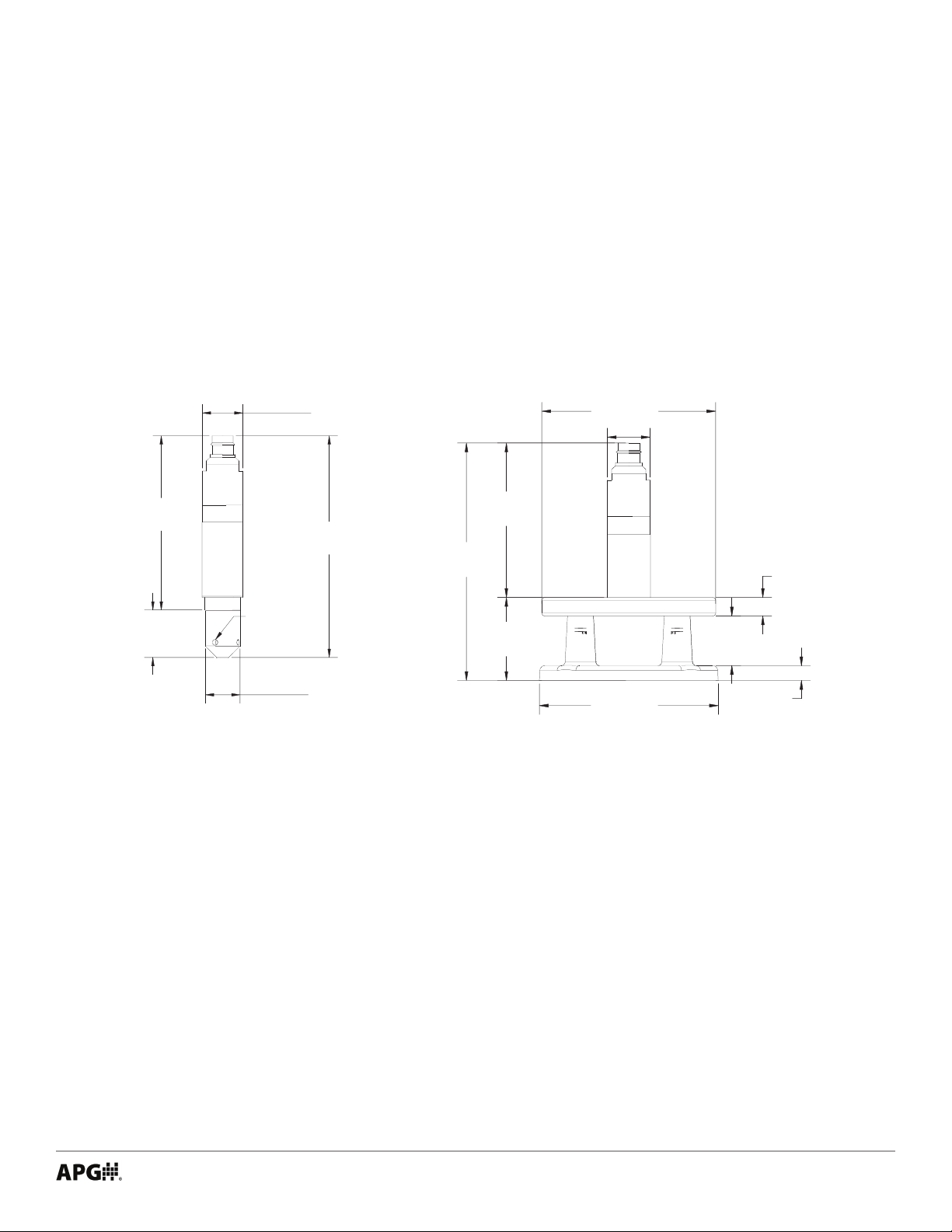
Chapter 1: Specications and Options
• Dimensions
ø 0.9"
[21.9mm]
3.7"
[94.2mm]
ø 0.1"
1.0"
[25.7mm]
[2.6mm]
ø 0.7"
[18.8mm]
PT-510 with Removable Plastic
Nose Cone
4.7"
[119.8mm]
[79.0mm]
4.8"
[121.4mm]
[42.4mm]
3.1"
1.7"
ø 3.5"
[88.9mm]
ø 3.6"
[91.4mm]
ø 0.9"
[21.9mm]
[25.4mm]
PT-510W with Welded Cage
0.4"
[9.4mm]
1.0"
0.3"
[7.6mm]
Tel: 1/888/525-7300 • Fax: 1/435/753-7490 • www.apgsensors.com • [email protected]
1
Page 6

• Specications
Performance
Pressure Ranges 0 to 20 PSIG
Analog Output 4-20mA
Over Pressure 2X FS
Burst Pressure 3X FS
Accuracy
Overall ±0.5% of Full Scale (BFSL)
Linearity ±0.25% of Full Scale (BFSL)
Hysteresis ±0.15% of Full Scale
Repeatability ±0.20% of Full Scale
Span ±1% of Full Scale
Zero ±1% of Full Scale
Environmental
Operating Temperature -4 to 185°F (-20 to 85°C)
Maximum Submersible Depth 46 ft / 14 m / 20 psig
Electrical
Supply Voltage (at sensor) 11-30 VDC
Current Draw 3-30 mA
Materials of Construction
Wetted Materials 18-8 Stainless Steel, Stycast
Cable PVC, Hytrel, or Polyurethane
Seal Neoprene Rubber
Nose Cone (PT-510 only) PVC
Cage (PT-510W only) 18-8 Stainless steel
Mechanical
Cable Tensile Strength Up to 200 pounds
2
Tel: 1/888/525-7300 • Fax: 1/435/753-7490 • www.apgsensors.com • [email protected]
Page 7

• Model Number Congurators
Part Number: PT-510 - _____ - _____ - _____ - _____
A B C D
A. Cable Type
□ B Hytrel 0.31” Ø - Black (with vent tube)
□ C▲ PVC - Black (with vent tube
□ E Polyurethane - Black (with vent tube)
B. Pressure Range - PSI
□ 5
□ 10
□ 15
□ 20
C. Output
▲
□ L01
4-20 mA, 2-wire (+ ground)
D. Cable Length
□ XXX (specify length of cable needed in feet)
040▲ 40 foot length standard for 5 & 10 PSI
060▲ 60 foot length standard for 15 & 20 PSI
▲
Note:
Indicates this option is standard.
Tel: 1/888/525-7300 • Fax: 1/435/753-7490 • www.apgsensors.com • [email protected]
3
Page 8

Part Number: PT-510W - _____ - _____ - _____ - _____
A B C D
A. Cable Type
□ B Hytrel 0.31” Ø - Black (with vent tube)
□ C▲ PVC - Black (with vent tube
□ E Polyurethane - Black (with vent tube)
B. Pressure Range - PSI
□ 5
□ 10
□ 15
□ 20
C. Output
▲
□ L01
4-20 mA, 2-wire (+ ground)
D. Cable Length
□ XXX (specify length of cable needed in feet)
040▲ 40 foot length standard for 5 & 10 PSI
060▲ 60 foot length standard for 15 & 20 PSI
Note:
▲
Indicates this option is standard.
4
Tel: 1/888/525-7300 • Fax: 1/435/753-7490 • www.apgsensors.com • [email protected]
Page 9

• Electrical Pinout Table and Supply Power Table
PT-510/PT-510W Series Pin Out Table
4-20 mA
Red + Power/Signal
Pigtail
PT-510/PT-510W Series Supply Power Table
Power Supply 11-30 VDC
White - Power/Signal
Green Case Gnd
4-20 mA
Chapter 2: Installation and Removal Procedures and Notes
• Tools Needed
• Tools necessary to make electrical connection.
• Mounting Instructions
Your PT-510/PT-510W series submersible pressure transducer is designed to be free-hanging.
• Electrical Installation
• Connect the wires of your PT-510 to your control system according to the pinout table above.
NOTE: If your PT-510 has a vent tube, do not seal, cover, or close the vent tube with
anything other than an APG-provided venting cap or desiccant drying cartridge (See Figure 3.1 and 3.2). Unapproved seals or covers will prevent proper sensor operation.
Tel: 1/888/525-7300 • Fax: 1/435/753-7490 • www.apgsensors.com • [email protected]
5
Page 10

• Removal Instructions
Removing your PT-510/PT-510W from service must be done with care. It’s easy to damage your sensor if you
are not careful to follow these guidelines:
• Retrieve the sensor from the vessel. Follow any and all procedures for safely isolating any media contained inside the line or vessel.
• Carefully clean the sensor’s tting and diaphragm of any debris (see General Care) and inspect for
damage.
• Store your sensor in a dry place, at a temperature between -40° F and 180° F.
Chapter 3: Maintenance
• General Care
Your PT-510/PT-510W series pressure transmitter is very low maintenance and will need little care as long as
it is installed correctly. However, in general, you should:
• Avoid applications for which the transmitter was not designed, such as extreme temperatures, contact
with incompatible corrosive chemicals, or other damaging environments.
• Avoid touching the diaphragm. Contact with the diaphragm, especially with a tool, could permanently
shift the output and ruin accuracy.
• Clean the diaphragm or the diaphragm bore only with extreme care. If using a tool is required, make
sure it does not touch the diaphragm.
IMPORTANT: Any contact with the diaphragm can permanently damage the sensor.
Use extreme caution.
6
Tel: 1/888/525-7300 • Fax: 1/435/753-7490 • www.apgsensors.com • [email protected]
Page 11
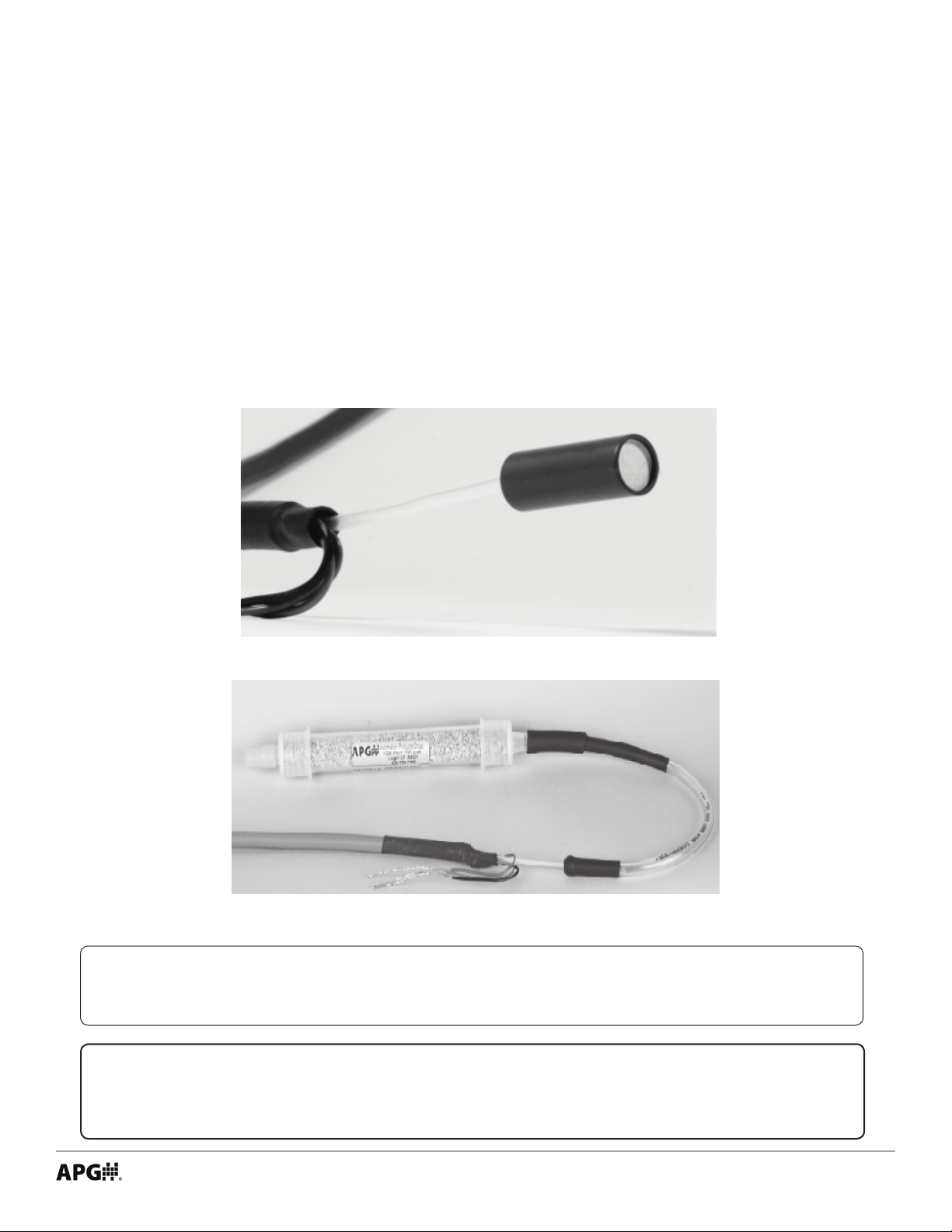
• Vent Tube Drying
Condensation in the vent tube can damage the electronics in your sensor, resulting in unreliable readings.
APG oers two methods of preventing vent tube condensation: a venting cap, and a desiccant drying
cartridge.
The venting cap is a PVC tube with a hydrophobic patch that allows moisture to pass out of the tube without
allowing water in (See Figure 3.1). The cap is sealed by an o-ring, and is easily installed in the eld.
The desiccant drying cartridge with vent tube adapter absorbs any moisture in the vent tube to keep vapor
from condensing (See Figure 3.2). The installation of the desiccant drying cartridge is quick and easy.
Common installation methods are cable tie, Velcro, and cable clamps.
Figure 3.1
Figure 3.2
NOTE: Desiccant crystals change from blue to pink as they become saturated. Car-
tridge must be replaced when all crystals have saturated.
IMPORTANT: Do NOT use desiccant cartridge in the presence of vapors or liquids con-
taining phosphate esters, synthetic lubricants, hydrocarbon solvents, methanol, acetone,
lacquer solvents, or other organics.
Tel: 1/888/525-7300 • Fax: 1/435/753-7490 • www.apgsensors.com • [email protected]
7
Page 12

• Repair and Returns
Should your PT-510 series pressure transmitter require service, please contact the factory via phone, email,
or online chat. We will issue you a Return Material Authorization (RMA) number with instructions.
• Phone: 888-525-7300
• Email: [email protected]
• Online chat at www.apgsensors.com
Please have your PT-510/PT-510W’s part number and serial number available. See Warranty and Warranty
Restrictions for more information.
8
Tel: 1/888/525-7300 • Fax: 1/435/753-7490 • www.apgsensors.com • [email protected]
Page 13

Page 14

APG
R
Tel: 1/888/525-7300 • Fax: 1/435/753-7490 • www.apgsensors.com • [email protected]
Automation Products Group, Inc.
 Loading...