

Page 1

WHICH OIL
IS RIGHT
FOR YOU?
MotorOilMatters.org
Page 2
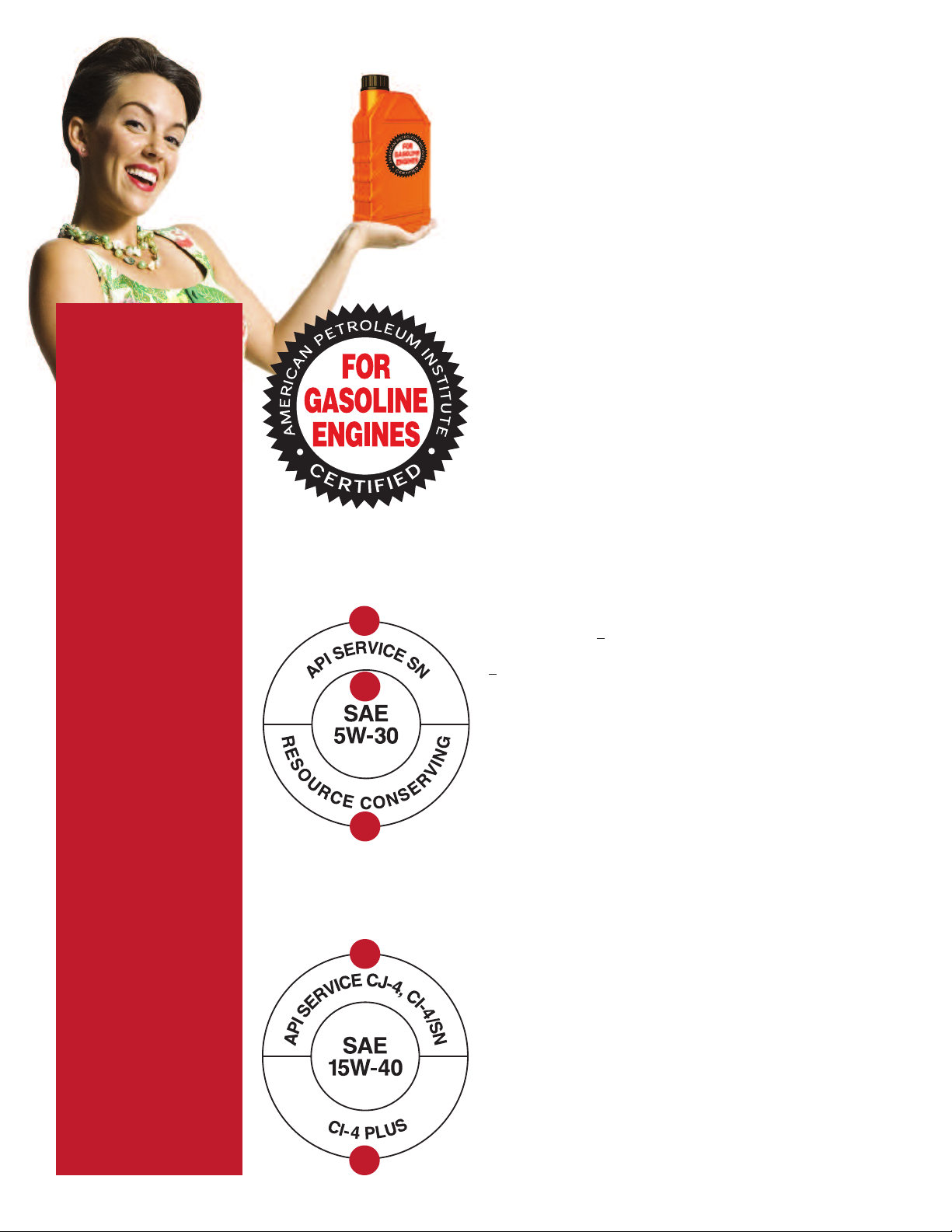
API’s Certification
Mark and Service
GET MORE
FROM YOUR
MOTOR OIL.
Follow your vehicle
manufacturer’s oil change
recommendations. This
includes using recommended
SAE oil viscosity and ILSAC
or API performance standard.
If you find it necessary
to mix brands of oil, use
same viscosity grade and
API service category to
maintain performance.
Properly dispose of used
oil. Learn more about
recycling used oil at
www.recycleoil.org.
Go to www.earth911.com/
recycling/used-motor-oil-
and-filters for used oil
collection center locations.
Ask for API-
licensed oil
whenever you
have your oil
changed.
Look for
API Certification
Marks every time
you buy motor oil.
1
2
3
4
Symbol
identify quality motor oils for gasolineand diesel-powered vehicles. Oils displaying these marks meet
performance requirements set by U.S. and international vehicle
and engine manufacturers and the lubricant industry. More
than 500 companies worldwide participate in this voluntary
program, which is backed by a marketplace sampling and
testing program.
TheAPI Certification Mark,
also known as the “Starburst”
An oil displaying this mark meets the current engine protection standard
and fuel economy requirements of the International Lubricant Specification
Advisory Committee (ILSAC), a joint effort of U.S. and Japanese automobile
manufacturers. Automobile manufacturers recommend oils that carry
the API Certification Mark. See the
CAR ENGINE OILS
obsolete ILSAC standards.
®
chart on the next page for descriptions of current and
ILSAC STANDARD FOR PASSENGER
TheAPI Service Symbol, also
known as the “Donut”
1. Performance Level
Motor oils designed for cars, vans, and light trucks with gasoline engines
fall under API’s “S” (Service) categories. Motor oils designed for heavyduty trucks and vehicles with diesel engines fall under API’s “C”
(Commercial) categories. Please see the
Engines
obsolete API service categories.
charts on the next pages for descriptions of current and
Gasoline Engines
2. Viscosity Grade
The measure of an oil’s ability to flow at certain temperatures.
Vehicle requirements may vary. Follow your vehicle manufacturer’s
recommendations on SAE oil viscosity.
®
3. Resource Conserving and Energy Conserving
These designations apply to oils intended for gasoline-engine cars, vans,
and light trucks. Widespread use of “Resource Conserving” or “Energy
Conserving” oils may result in an overall savings of fuel in the vehicle
fleet as a whole.
4. Multiple Performance Levels
Oils designed for diesel engine service might also meet gasoline engine
service. For these oils the designation is “C” category first followed by
the “S” category. “C” category oils have been formulated primarily for
diesel engines and may not provide all of the performance requirements
consistent with vehicle manufacturers’ recommendations for gasolinefueled engines.
and
Diesel
For more information
visit MotorOilMatters.org.
Learn about chemical
additives in motor oil at
AmericanChemistry.com
5
5. The API Service Symbol with CI-4 Plus
The “CI-4 PLUS” designation identifies oils formulated to provide a higher
level of protection against soot-related viscosity increase and viscosity
loss due to shear in diesel engines. When originally introduced, CI-4
PLUS identified CI-4 oils meeting a higher level of performance. CJ-4 oils
®
include all CI-4 PLUS performance requirements. CI-4 PLUS appears in
the lower portion of the API Service Symbol “Donut.”
Page 3
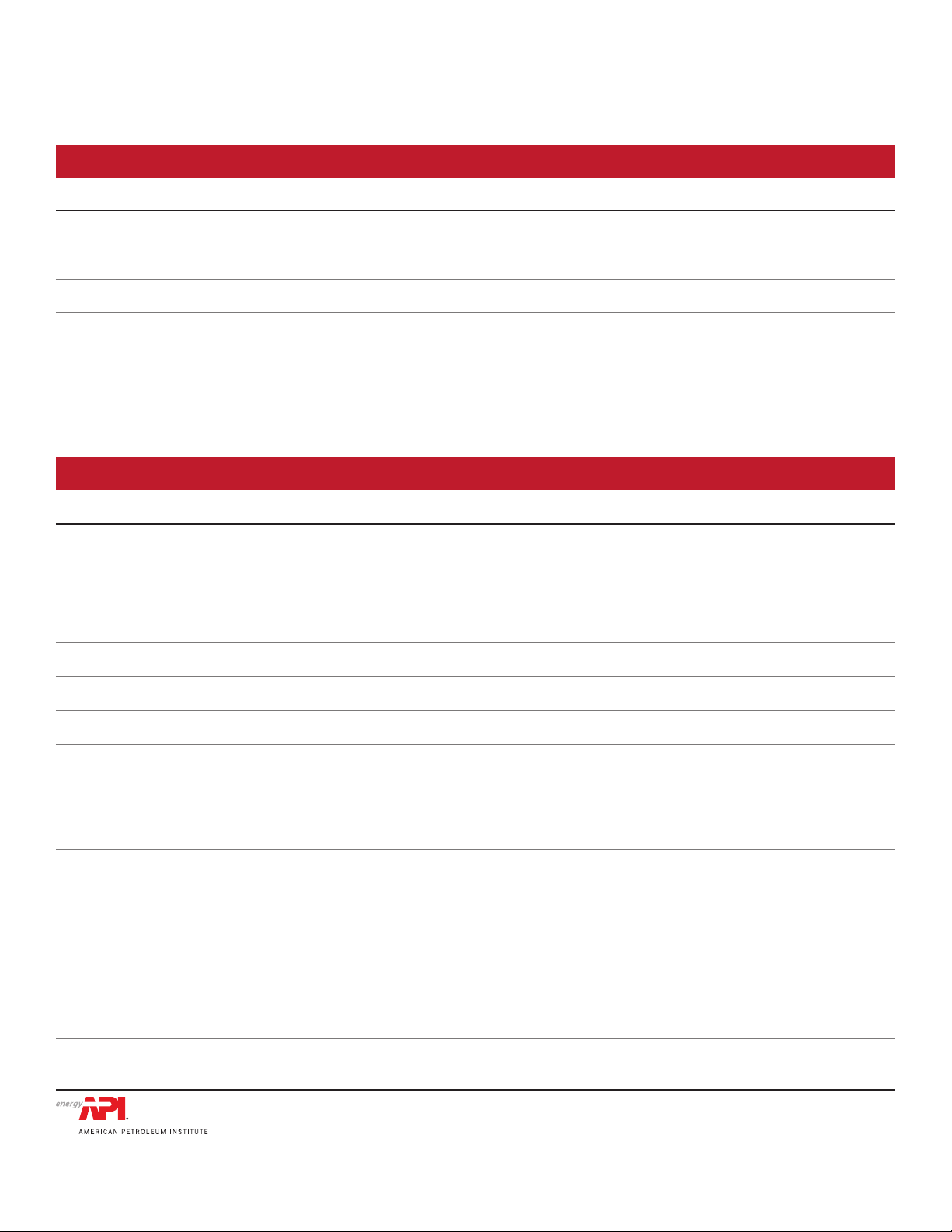
The current and previous ILSAC standards and API Service Categories are listed here. Vehicle owners should refer to their owner’s manuals before
onsulting these charts. Oils may have more than one performance level.
c
For automotive gasoline engines, the latest ILSAC standard or API Service Category includes the performance properties of each earlier category and
can be used to service older engines where earlier category oils were recommended.
ILSAC STANDARD FOR PASSENGER CAR ENGINE OILS
Name Status Service
GF-5 Current
Introduced in October 2010, designed to provide improved high temperature deposit protection for pistons and
turbochargers, more stringent sludge control, improved fuel economy, enhanced emission control system compatibility,
seal compatibility, and protection of engines operating on ethanol-containing fuels up to E85.
GF-4 Obsolete
GF-3 Obsolete
GF-2 Obsolete
GF-1 Obsolete
Use GF-5 where GF-4 is recommended.
Use GF-5 where GF-3 is recommended.
Use GF-5 where GF-2 is recommended.
Use GF-5 where GF-1 is recommended.
GASOLINE ENGINES
Category Status Service
SN Current
SM Current
SL Current
Introduced in October 2010, designed to provide improved high temperature deposit protection for pistons, more
stringent sludge control, and seal compatibility. API SN with Resource Conserving matches ILSAC GF-5 by combining
API SN performance with improved fuel economy, turbocharger protection, emission control system compatibility, and
protection of engines operating on ethanol-containing fuels up to E85.
For 2010 and older automotive engines.
For 2004 and older automotive engines.
(Follow your vehicle manufacturer’s recommendations on oil performance levels)
SJ Current
For 2001 and older automotive engines.
SH Obsolete OBSOLETE:
SG Obsolete CAUTION:
SF Obsolete CAUTION:
SE Obsolete CAUTION:
SD Obsolete CAUTION:
SC Obsolete CAUTION:
SB Obsolete CAUTION:
SA Obsolete CAUTION:
For 1996 and older automotive engines.
Not suitable for use in most gasoline-powered automotive engines built after 1993. May not provide
adequate protection against build-up of engine sludge, oxidation, or wear.
Not suitable for use in most gasoline-powered automotive engines built after 1988. May not provide
adequate protection against build-up of engine sludge.
Not suitable for use in most gasoline-powered automotive engines built after 1979.
Not suitable for use in most gasoline-powered automotive engines built after 1971. Use in more modern
engines may cause unsatisfactory performance or equipment harm.
Not suitable for use in most gasoline-powered automotive engines built after 1967. Use in more modern
engines may cause unsatisfactory performance or equipment harm.
Not suitable for use in most gasoline-powered automotive engines built after 1951. Use in more
modern engines may cause unsatisfactory performance or equipment harm.
Contains no additives. Not suitable for use in most gasoline-powered automotive engines built after 1930.
Use in modern engines may cause unsatisfactory performance or equipment harm.
Engine Oil Licensing and Certification System| 1220 L Street, NW| Washington, DC 20005-4070| USA
Copyright 2013 – American Petroleum Institute, all rights reserved. API, the API logo, the Motor Oil Matters Seal, the API Service Symbol (Donut), the API Service Symbol with CI-4 PLUS logo, the API Certification Mark (Starburst), and the
“Mom Knows Best” and “Motor Oil Matters” phrases are either trademarks or registered trademarks of API in the United States and/or other countries. API GIS Creative: 2013-072 | 06.13 | PDF
| Telephone:
202-682-8516| Email: [email protected]| www.api.org/eolcs
Page 4

DIESEL ENGINES
Category Status Service
(Follow your vehicle manufacturer’s recommendations on oil performance levels)
CJ-4 Current
CI-4 Current
CH-4 Current
CG-4 Obsolete OBSOLETE:
CF-4 Obsolete OBSOLETE:
For high-speed four-stroke cycle diesel engines designed to meet 2010 model year on-highway and Tier 4 nonroad
exhaust emission standards as well as for previous model year diesel engines. These oils are formulated for use in all
applications with diesel fuels ranging in sulfur content up to 500 ppm (0.05% by weight). However, the use of these oils
with greater than 15 ppm (0.0015% by weight) sulfur fuel may impact exhaust aftertreatment system durability and/or
rain interval. CJ-4 oils are especially effective at sustaining emission control system durability where particulate filters
d
and other advanced aftertreatment systems are used. Optimum protection is provided for control of catalyst poisoning,
particulate filter blocking, engine wear, piston deposits, low- and high-temperature stability, soot handling properties,
oxidative thickening, foaming, and viscosity loss due to shear. API CJ-4 oils exceed the performance criteria of API CI-4
with CI-4 PLUS, CI-4, CH-4, CG-4 and CF-4 and can effectively lubricate engines calling for those API Service Categories.
When using CJ-4 oil with higher than 15 ppm sulfur fuel, consult the engine manufacturer for service interval.
Introduced in 2002. For high-speed, four-stroke engines designed to meet 2004 exhaust emission standards implemented
in 2002. CI-4 oils are formulated to sustain engine durability where exhaust gas recirculation (EGR) is used and are
intended for use with diesel fuels ranging in sulfur content up to 0.5% weight. Can be used in place of CD, CE, CF-4,
CG-4, and CH-4 oils. Some CI-4 oils may also qualify for the CI-4 PLUS designation.
Introduced in 1998. For high-speed, four-stroke engines designed to meet 1998 exhaust emission standards. CH-4 oils
are specifically compounded for use with diesel fuels ranging in sulfur content up to 0.5% weight. Can be used in place
of CD, CE, CF-4, and CG-4 oils.
Introduced in 1995. For severe duty, high-speed, four-stroke engines using fuel with less than 0.5% weight
sulfur. CG-4 oils are required for engines meeting 1994 emission standards. Can be used in place of CD, CE,
and CF-4 oils.
Introduced in 1990. For high-speed, four-stroke, naturally aspirated and turbocharged engines. Can be used
in place of CD and CE oils.
CF-2 Obsolete OBSOLETE:
CF Obsolete OBSOLETE:
CE Obsolete CAUTION:
CD-II Obsolete CAUTION:
CD Obsolete CAUTION:
CC Obsolete CAUTION:
CB Obsolete CAUTION:
CA Obsolete CAUTION:
Introduced in 1994. For severe duty, two-stroke-cycle engines. Can be used in place of CD-II oils.
Introduced in 1994. For off-road, indirect-injected and other diesel engines including those using fuel with
over 0.5% weight sulfur. Can be used in place of CD oils.
Not suitable for use in most diesel-powered automotive engines built after 1994.
Not suitable for use in most diesel-powered automotive engines built after 1994.
Not suitable for use in most diesel-powered automotive engines built after 1994.
Not suitable for use in most diesel-powered engines built after 1990.
Not suitable for use in most diesel-powered engines built after 1961.
Not suitable for use in most diesel-powered engines built after 1959.
SAE VISCOSITY GRADES: PASSENGER CAR MOTOR OIL
Multigrade oils such as SAE 5W-30 and 10W-30 are widely used because, under all but extremely hot or cold conditions, they are thin enough to flow
at low temperatures and thick enough to perform satisfactorily at high temperatures. Note that vehicle requirements may vary.
manufacturer’s recommendations on SAE oil viscosity grade.
Follow your vehicle
If lowest expected outdoor temperature is
0°C (32°F)
–18°C (0°F)
Below –18°C (0°F)
Typical SAE viscosity grades for passenger cars
0W-20, 0W-30, 5W-20, 5W-30, 10W-30, 10W-40, 20W-50
0W-20, 0W-30, 5W-20, 5W-30, 10W-30, 10W-40
0W-20, 0W-30, 5W-20, 5W-30
 Loading...