

Page 1
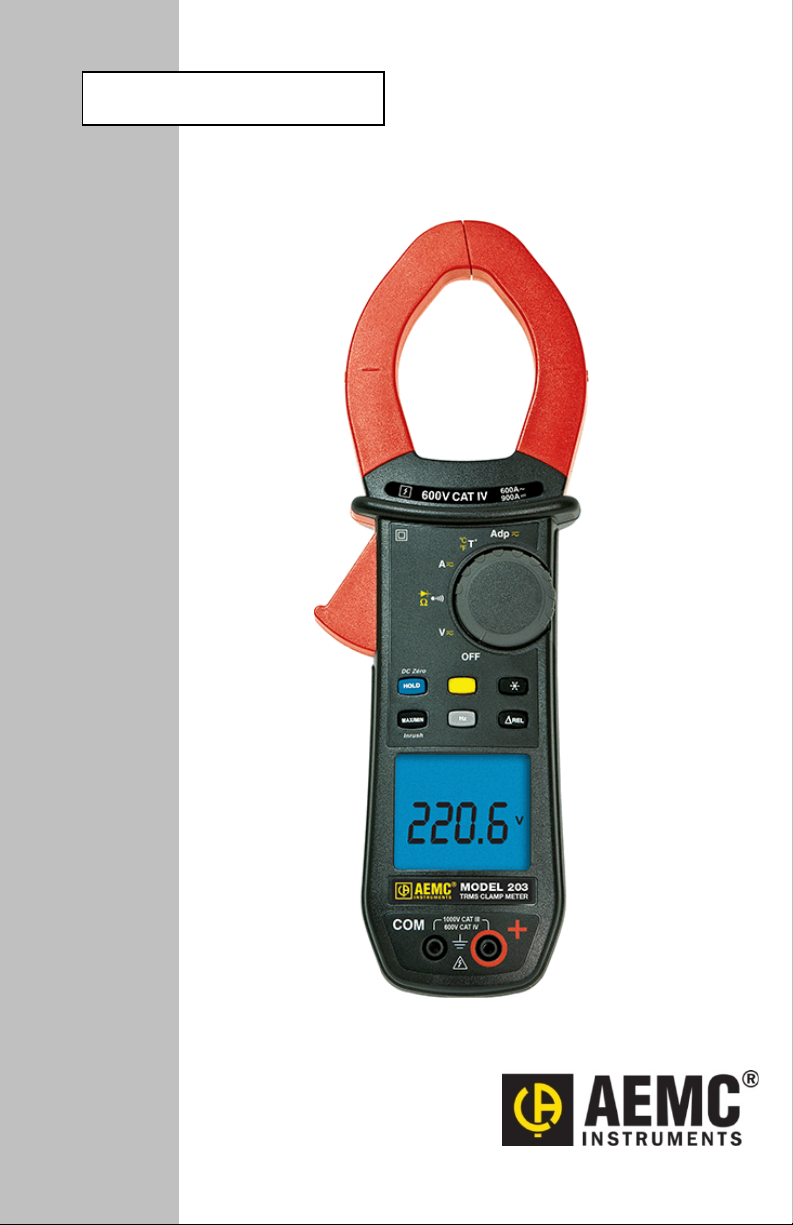
CLAMP-ON METER
User Manual
ENGLISH
203
Page 2
2
Page 3
CONTENTS
RECEIVING YOUR SHIPMENT ........................................................................... 7
ORDERING INFORMATION ................................................................................ 7
1 PRESENTATION .......................................................................................... 8
1.1 ROTARY SWITCH ......................................................................................... 9
1.2 FUNCTION BUTTONS ................................................................................ 10
1.3 DISPLAY ...................................................................................................... 11
1.3.1 Display Symbols ........................................................................... 11
1.3.2 Measurement Capacity Exceeded (OL) ........................................ 12
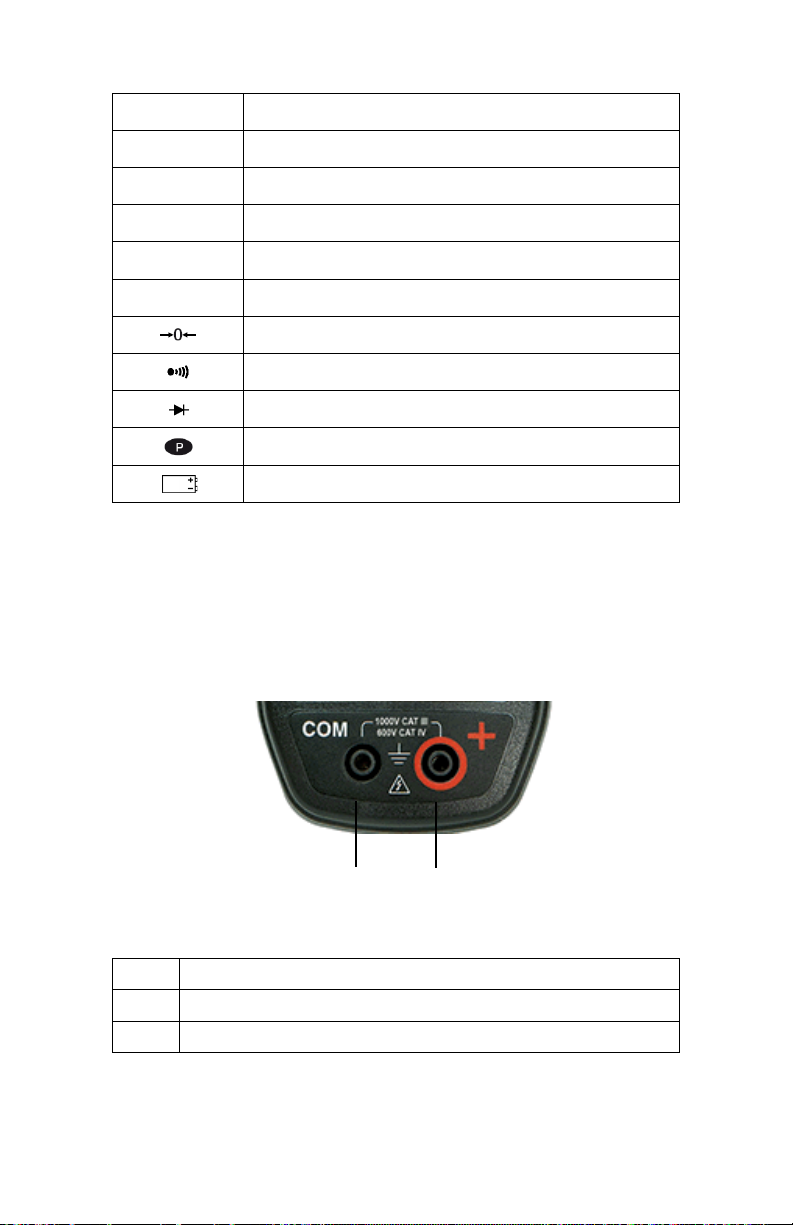
1.4 TERMINALS................................................................................................. 12
2 BUTTONS ................................................................................................... 13
2.1
2.2 (YELLOW) BUTTON (SECOND FUNCTION) ............................................ 14
2.3 BUTTON ............................................................................................. 14
2.4 BUTTON ........................................................................................... 15
2.4.1 Normal Mode ................................................................................ 15
2.4.2 The MAX/MIN Mode + Activation of the HOLD Mode ................... 16
2.4.3 Access to the True Inrush® Mode ( set switch to ) ........ 16
2.5
2.5.1 Normal Mode ................................................................................ 17
2.5.2 The Hz Function + Activation of the HOLD Mode ......................... 17
2.6 BUTTON ........................................................................................... 18
3 USE ............................................................................................................. 19
3.1 INSTALLING THE BATTERY ...................................................................... 19
3.2 TURNING THE CLAMP-ON METER ON .................................................... 19
3.3 TURNING THE CLAMP-ON METER OFF .................................................. 19
3.4 CONFIGURATION ....................................................................................... 20
3.4.1 Configuring the Maximum Resistance for Continuity .................... 20
3.4.2 Auto Power OFF ........................................................................... 20
3.4.3 Configuring the Current Threshold for True InRush® Measurement20
3.4.4 Changing the Default Temperature Unit ....................................... 21
3.4.5 Configuring the Adapter Function Scale Factor ............................ 21
3.4.6 Default Configuration .................................................................... 22
3.5 VOLTAGE MEASUREMENT (V) ................................................................. 22
3.6 CONTINUITY TEST ............................................................................... 23
3.6.1 Lead Resistance Compensation ................................................... 23
3.7 RESISTANCE MEASUREMENT ................................................................ 24
3.8 DIODE TEST ......................................................................................... 24
3.9 CURRENT MEASUREMENT (A) ................................................................ 25
3.9.1 AC Measurement .......................................................................... 25
3.9.2 DC Measurement .......................................................................... 26
BUTTON ............................................................................................... 13
BUTTON ............................................................................................. 17
3
Page 4

STARTING CURRENT OR OVERCURRENT (TRUE INRUSH
3.10
®
)
MEASUREMENT .................................................................................................... 27
3.11 FREQUENCY MEASUREMENT (HZ) ......................................................... 27
3.11.1 Frequency Measurement (V) ........................................................ 27
3.11.2 Frequency Measurement (A) ........................................................ 28
3.12 TEMPERATURE MEASUREMENT ............................................................ 29
3.12.1 Measurement without External Sensor ......................................... 29
3.12.2 Measurement with External Sensor .............................................. 29
3.13 ADAPTER FUNCTION MEASUREMENT ................................................... 30
4 SPECIFICATIONS ...................................................................................... 31
4.1 REFERENCE CONDITIONS ....................................................................... 31
4.2 SPECIFICATIONS UNDER THE REFERENCE CONDITIONS ................. 31
4.2.1 DC Voltage Measurement ............................................................. 31
4.2.2 AC Voltage Measurement ............................................................. 32
4.2.3 DC Current Measurement ............................................................. 32
4.2.4 AC Current Measurement ............................................................. 33
4.2.5 True Inrush® Measurement ........................................................... 33
4.2.6 Continuity Measurement ............................................................... 33
4.2.7 Resistance Measurement ............................................................. 34
4.2.8 Diode test ...................................................................................... 34
4.2.9 Frequency Measurements ............................................................ 34
4.2.10 Temperature Measurement ........................................................... 35
4.2.11 Adapter Function Measurement .................................................... 36
4.3 ENVIRONMENTAL CONDITIONS .............................................................. 37
4.4 MECHANICAL SPECIFICATIONS .............................................................. 37
4.5 POWER SUPPLY ........................................................................................ 37
4.6 COMPLIANCE WITH INTERNATIONAL STANDARDS ............................. 37
4.7 ENVIRONMENTAL VARIATIONS ............................................................... 38
5 MAINTENANCE .......................................................................................... 39
5.1 WARNING .................................................................................................... 39
5.2 CLEANING ................................................................................................... 39
5.3 REPLACEMENT OF THE BATTERY ........................................................... 39
6 REPAIR AND CALIBRATION .................................................................... 40
7 TECHNICAL AND SALES ASSISTANCE .................................................. 40
8 LIMITED WARRANTY ................................................................................ 41
9 WARRANTY REPAIRS .............................................................................. 41
4
Page 5
Thank you for purchasing a Model 203 Clamp-on Meter.
For best results from your instrument and for your safety, read the enclosed
operating instructions carefully and comply with the precautions for use. These
products must be only used by qualified and trained users.
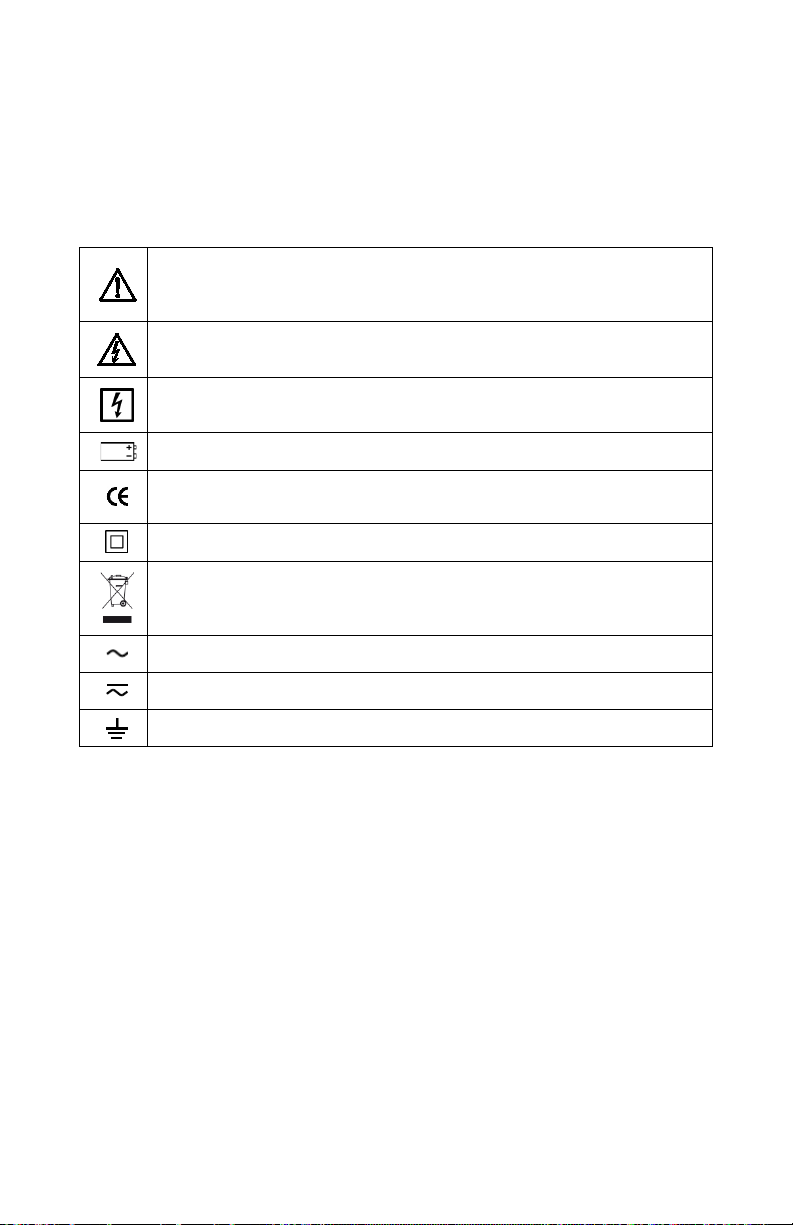
Meanings of the symbols used on the device
CAUTION - Risk of Danger! Indicates a WARNING and that the operator
must refer to the user manual for instructions before operating the
instrument in all cases where this symbol is marked.
Risk of electric shock. The voltage at the parts marked with this symbol
may be dangerous.
Refers to a type A current sensor. This symbol signifies that application
around and removal from HAZARDOUS LIVE conductors is permitted.
9V battery
The CE marking indicates compliance with European directives
Double insulation or reinforced insulation
In the European Union, this product is subject to a separate collection
system for recycling electrical and electronic components In accordance
with directive WEEE 2002/96/EC
AC – Alternating current
AC and DC – Alternating and direct current
Ground/Earth
5
Page 6

PRECAUTIONS FOR USE
This device complies with safety standards IEC-61010-1 and 61010-2-032 for voltages of
1000V in category IV at an altitude of less than 2000m, indoors, with a degree of pollution
not exceeding 2. These safety instructions are intended to ensure the safety of persons and
proper operation of the device.
The operator and/or the responsible authority must carefully read and clearly
understand the various precautions to be taken in use.
If this instrument is used other than as specified, the protection it provides may be
compromised, thereby endangering you.
Do not use the instrument in an explosive atmosphere or in the presence of flammable
gases or fumes.
Do not use the instrument on networks of which the voltage or category exceeds those
mentioned.
Do not exceed the rated maximum voltages and currents between terminals or with
respect to earth.
Do not use the instrument if it appears to be damaged, incomplete, or not properly
closed.
Before each use, check the condition of the insulation on the leads, housing, and
accessories. Any element of which the insulation is deteriorated (even partially) must
be set aside for repair or scrapped.
Use leads and accessories rated for voltages and categories at least equal to those of
the instrument. If not, an accessory of a lower category lowers the category of the
combined Clamp + accessory to that of the accessory.
Observe the environmental conditions of use.
Do not modify the instrument and only use factory replacement parts. Repairs and
adjustments must be done by approved qualified personnel.
Replace the batteries as soon as the symbol appears on the display of the unit.
Disconnect all leads before opening the battery compartment cover.
Use personal protective equipment when conditions require.
Keep your hands away from the unused terminals of the instrument.
When handling the test probes, alligator clips, and clamp ammeters, keep your fingers
behind the physical guard.
As a safety measure, and to avoid repeated overloads on the inputs of the device,
configuration operations should only be performed when the device is disconnected
from all dangerous voltages.
6
Page 7

MEASUREMENT CATEGORIES
Definitions of the measurement categories :
CAT II: Circuits directly connected to the low-voltage installation.
Example: power supply to household electrical appliances and portable tools.
CAT III: Power supply circuits in the installation of the building.
Example: distribution panel, circuit-breakers, fixed industrial machines or
devices.
CAT IV: Circuits supplying the low-voltage installation of the building.
Example: power lines, meters, and protection devices.
RECEIVING YOUR SHIPMENT
Upon receiving your shipment, make sure that the contents are consistent with the
packing list. Notify your distributor of any missing items. If the equipment appears
to be damaged, file a claim immediately with the carrier and notify your distributor
at once, giving a detailed description of any damage. Save the damaged packing
container to substantiate your claim.
ORDERING INFORMATION
Clamp-on Meter Model 203 ............................................................ Cat. #2139.12
Includes set of 2, 5 ft. (1.5m) needle tip color-coded leads with 4mm right angle
plug, K-thermocouple with 4mm integrated adapter,soft carrying case, 1x9V
battery and user manual.
Replacement Parts:
Soft Carrying Case ........................................................................... Cat. #2118.65
K-thermocouple with 4mm integrated adapter .................................. Cat. #2139.71
Set of 2, 5 ft. (1.5m) Needle Tip Color-coded (Rd/Bk) Leads w/4mm
Right-angle Plug
(600V CAT IV w/shield on Needle Tip, 1000V CAT II w/o shield) ..... Cat. #2154.74
Accessories:
Set of 2, Color-coded (Rd/Bk) Leads, Test Probes & Alligator .......... Cat #2152.05
7
Page 8
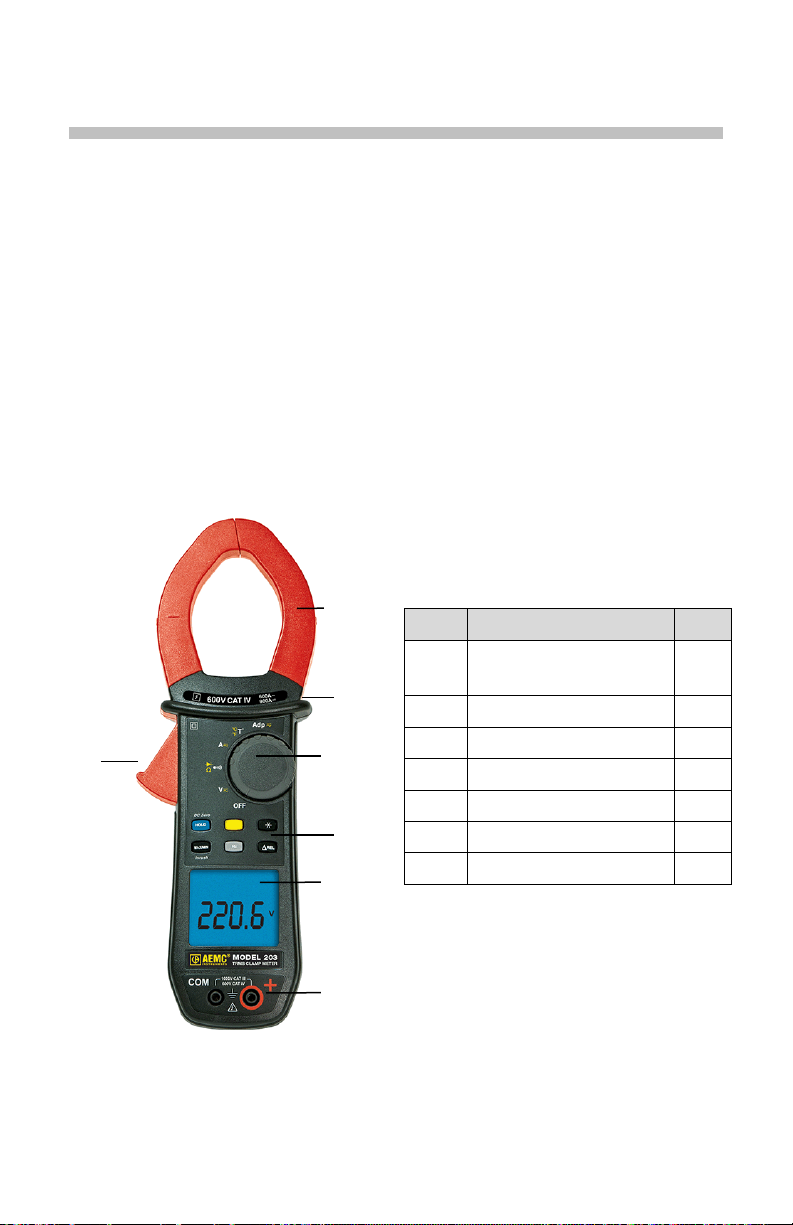
1
3
4
2
7
ring marks
1 PRESENTATION
The Clamp-on Meter Model 203 is a professional electrical measuring instrument
that combines the following functions:
Current measurement
Measurement of InRush current / overcurrent (True InRush
Voltage measurement
Frequency measurement
Continuity test with buzzer
Resistance measurement
Diode test
Temperature measurement
Adapter function (for use with external transducers/measurement
devices)
Item Designation See §
Jaws with cente
1
(see connection principles)
2 Physical Guard -
3 Rotary Function Switch 1.1
4 Function Buttons 2
5 Backlit Display 1.3
6 Input Terminals 1.4
5
7 Trigger -
®
)
3.5 to
3.12
6
Figure 1: Clamp-on Meter Model 203
8
Page 9
6 5 4 3 2
1.1 ROTARY SWITCH
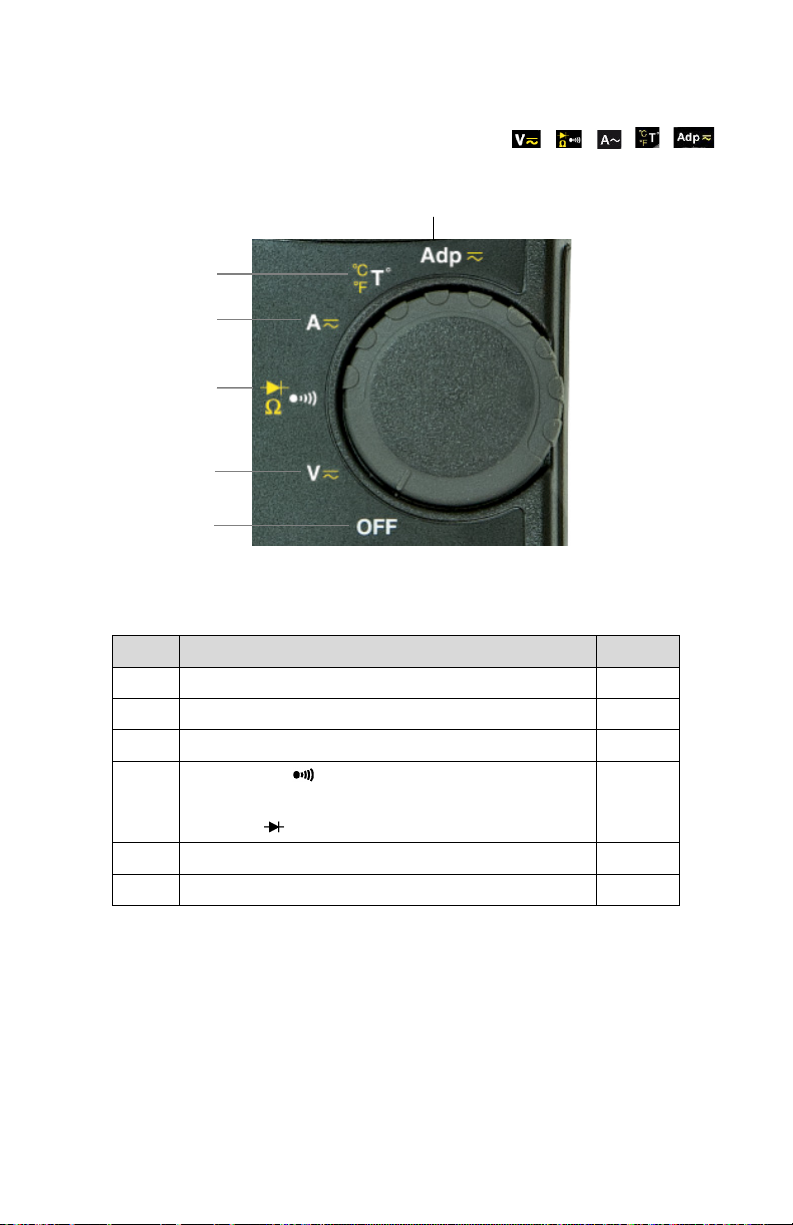
The rotary switch has six positions. To access the , , , , ,
functions, set the switch to the desired function. The functions are described in
the table below.
1
Figure 2: Function Rotary Switch
Item Function See §
1 Adapter function 3.13
2 Temperature measurement (°C/°F) 3.12
3 AC, DC current measurement (A) 3.9
4 Continuity test
Resistance measurement Ω
Diode test
5 AC, DC voltage measurement (V) 3.5
6 OFF mode – Turns the clamp-on meter off 3.3
3.6
3.7
3.8
9
Page 10
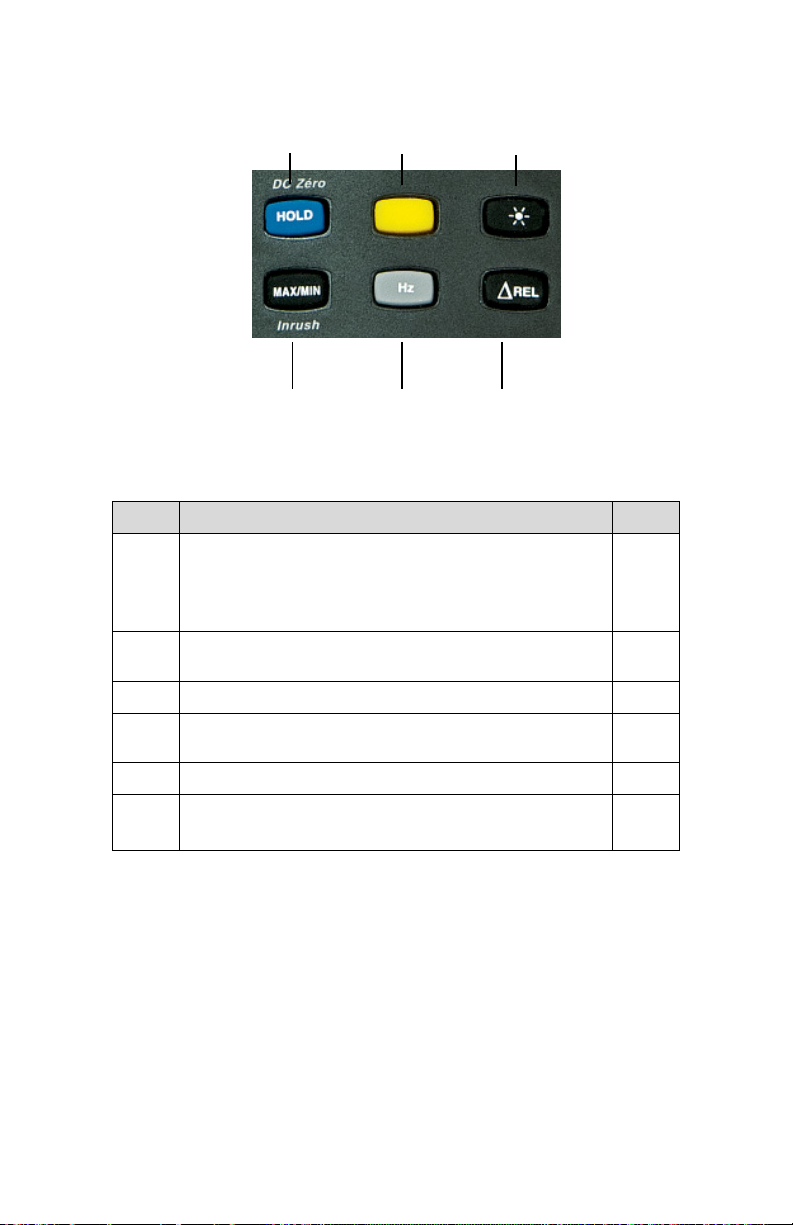
1.2 FUNCTION BUTTONS
1 2 3
6 5 4
Figure 3: Function Buttons
Item Function See §
1 Holds the last value on the display
Zero correction A
Lead resistance compensation in the continuity and
ohmmeter functions
2 Selects the type of measurement and configuration
functions (AC, DC)
3 Enables/disables display backlighting 2.3
4 Activation of ΔREL mode – Displays differential and
relative values
5 Performs Frequency measurements (Hz) 2.5
6 Enables/disables the MAX/MIN mode
Enables/disables the True InRush
DC
®
mode
2.1
3.9.2
3.6.1
2.2
2.6
2.4
10
Page 11
∆
∆
3
4
5
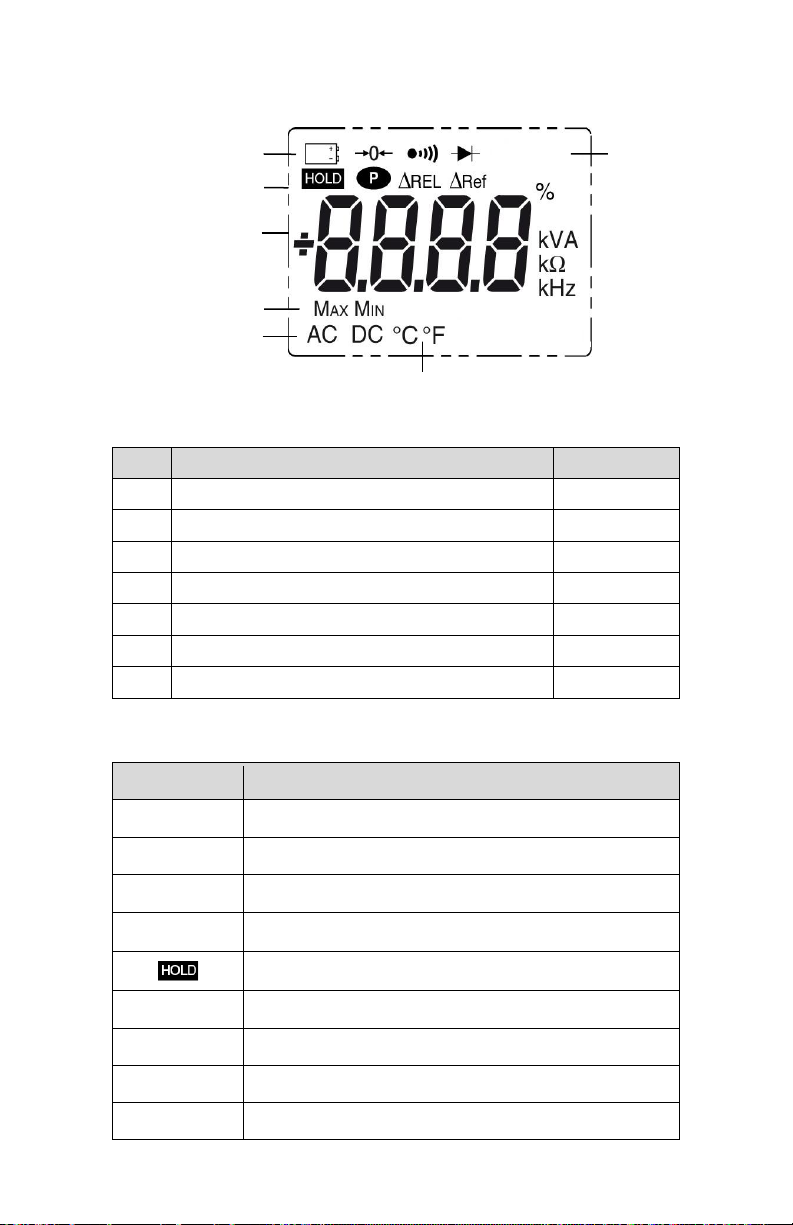
1.3 DISPLAY
1
2
6
Figure 4: Display
Item Function See §
1 Low battery indication 5.3
2 Mode selection display 2
3 Active measurement value and unit display 3.5 to 3.12
4 Display of the MAX/MIN modes 2.4
5 Type of measurement (AC or DC) 2.2
6 Temperature unit display 3.4.4
7 Selected resistance measurement display 1.1
1.3.1 Display Symbols
Symbol Designation
7
AC Alternating current or voltage
DC Direct current or voltage
REL
Ref
Relative value, with respect to a reference
Reference value
Storage of the values and display hold
Max Maximum DC or RMS value
Min Minimum DC or RMS value
V Volt
Hz Hertz
11
Page 12
A Ampere
°C/°F Temperature unit Celsius or Fahrenheit
% Percentage
Ω Ohm
m Milli- prefix
k Kilo- prefix
Lead resistance compensation
Continuity test
Diode test
Auto Power Off disabled
Low battery indicator
1.3.2 Measurement Capacity Exceeded (OL)
The OL (Over Load) symbol is displayed when the display capacity is exceeded.
1.4 TERMINALS
The terminals are used as follows:
1 2
Figure 5: Terminals
Item Function
1
COM (black) Input Terminal Jack
2 + Positive (red) Input Terminal Jack
12
Page 13
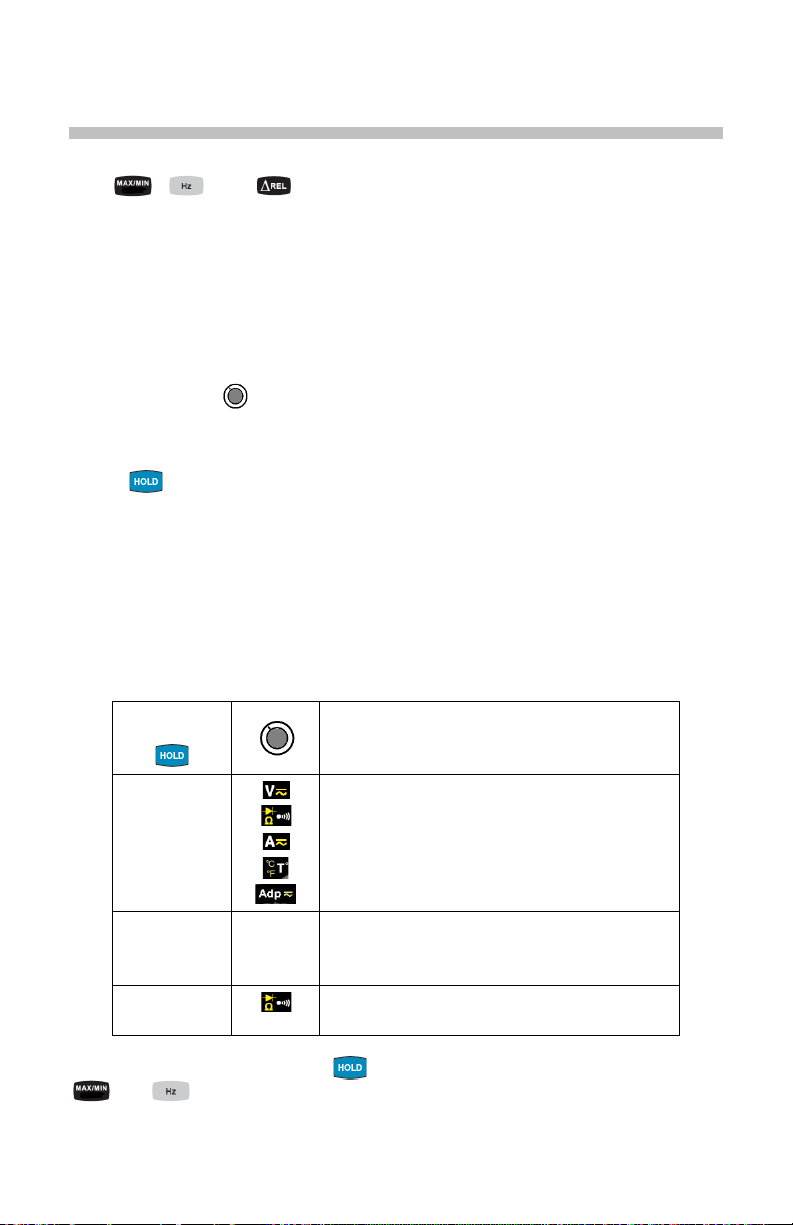
This mode operates if the MAX/MIN or
2 BUTTONS
The buttons respond differently to short, long, and sustained presses.
The , and keys provide additional functions as well as the
detection and acquisition of parameters complementary to the basic
measurements.
• Each of these buttons can be used independently of the others or in
conjunction with each other. This makes navigation simple and intuitive
when reviewing measurement results.
• It is possible, for example, to either look up in turn sequence the MAX,
MIN, etc. values of the RMS voltage alone, then display relative values
in parallel
In this section, the icon represents the possible positions of the switch for the
button’s functionality.
2.1
BUTTON
This button is used to:
Store and look up the last values acquired specific to each function (V, A,
Ω, T°, Adp) according to the specific modes previously activated (MAX/MIN,
Hz, ΔREL). The present display is then maintained while the detection and
acquisition of new values continues.
Perform automatic lead resistance compensation (see § 3.6.1).
Perform automatic zero correction in A
Successive
presses on
long
(> 2 sec)
long
(> 2 sec)
First press: Holds the display of the last value
displayed
Second press: Returns to normal display mode
(the value of each new measurement is
displayed)
ADC Performs automatic zero correction (see
NOTE:
HOLD modes (short press) are first de activated
Performs automatic lead resistance
compensation (see 3.6.1)
DC (see § 3.9.2).
Function
3.9.2)
See § 2.4.2 and § 2.5.2 for the button functionality in combination with the
and buttons.
13
Page 14

2.2 (YELLOW) BUTTON (SECOND FUNCTION)
This button is used to select the type of measurement (AC, DC) and the second
functions marked in yellow next to the relevant positions of the switch.
It can also be used to modify the default values in the configuration mode
(see § 3.4).
NOTE: This button is invalid in the MAX/MIN, HOLD and ΔREL modes.
Successive
presses on
- Selects AC or DC. Depending on your
choice, the screen displays AC or DC
- Cycles through the continuity , Ω and
diode test modes and returns to the
continuity test
- Selects °C or °F as the temperature unit
Function
2.3 BUTTON
presses on
Successive
- Enables/disables the backlighting of the
display
Function
NOTE: The backlighting is automatically disabled at the end of 2 minutes.
14
Page 15

he MAX and MIN symbols are
If MIN has been selected, MIN
f the HOLD function is activated,
mode. The HOLD function must first be
2.4 BUTTON
2.4.1 Normal Mode
This button activates the detection of the MAX and MIN values of the
measurements made. Max and Min are the extreme mean values in DC and the
extreme RMS values in AC.
NOTE: In this mode, the Auto Power Off function of the device is automatically
disabled. The symbol is displayed on the screen.
Successive presses on
short
First press: Activates detection of the
MAX/MIN values
Second press: Displays the MAX or MIN
value successively
Third press: Returns to the display of the
present measurement without exiting from
the mode (the values already detected are
not erased)
NOTE: T
both displayed, but only the symbol of the
measurement selected blinks.
Example:
blinks and MAX is lit steadily.
Function
long (> 2 sec)
NOTE : ΔREL function can be used with the functions of the MAX/MIN mode.
- Exits the MAX/MIN mode. The values
previously recorded are then erased.
NOTE: I
it is not possible to exit from the MAX/MIN
disabled first.
15
Page 16

detected.
2.4.2 The MAX/MIN Mode + Activation of the HOLD Mode
Successive presses on
short
- Displays the MAX/MIN values detected
before the button was pressed.
- When the button is pressed, the
last value is held on the display.
Function
NOTE: The HOLD function does not interrupt the acquisition of new MAX, MIN values
2.4.3 Access to the True Inrush® Mode ( set switch to )
This button allows measurement of the True Inrush® current (starting current, or
overcurrent in steady-state operation) for AC or DC current.
Successive presses on
long (>2 sec)
short (<2 sec)
Note: A short press
is functional only if a True
InRush value has been
- First press: Enters the True InRush
mode
- "Inrh" is displayed for 3s (the
backlighting blinks)
- The triggering threshold is displayed for
5s (the backlighting is steady)
- "------" is displayed and the "A" symbol
flashes (backlighting turns off)
- After detection and acquisition, the
InRush current measurement is
displayed, after the calculations stage "--
----" (backlighting off)
NOTE: The A symbol flashes to indicate
"surveillance" of the signal.
- Second press: Exits the True InRush®
mode (returns to simple current
measurement).
- Displays the PEAK+ value of the current
- Displays the PEAK- value of the current
- Displays the RMS True InRush
NOTE: The A, AC and PEAK values flash
during this sequence.
Function
®
®
current
16
Page 17

2.5
This button is used to display the frequency measurements of a signal.
NOTE: This button is not functional in the DC mode.
BUTTON
2.5.1 Normal Mode
Successive
presses on
Displays:
- The frequency of the signal measured
- The present voltage (V) or current (A)
measurement
Function
2.5.2 The Hz Function + Activation of the HOLD Mode
presses on
Successive
- Holds the last frequency reading
- Successively displays the last held
frequency, then the voltage or the current
- NOTE: Pressing the button a second
time returns to realtime measurement
updates.
Function
17
Page 18

2.6 BUTTON
This button is used to display and store the reference value in the unit of
magnitude measured, or to display the differential and relative values, in %.
Successive
presses on
short
long (>2 sec)
NOTE: The “Relative mode
the MAX/MIN mode.
Enters the ΔREL mode, to store, then display the reference
value. The ΔRef symbol is displayed.
- Displays the differential value:
(current value – reference (∆))
The ΔREL symbol is displayed.
- Displays the relative value in %
(current value – reference (∆))
The ΔREL and % symbols are displayed.
- Displays the reference. The ΔRef symbol is displayed
- Displays the current value. The ΔRef symbol blinks.
- Exits from the ΔREL mode
ΔREL” function can also be used with the functions of
Function
18
Page 19

3 USE
3.1 INSTALLING THE BATTERY
Insert the battery supplied with the device as follows:
1. Using a screwdriver, unscrew the battery compartment cover (item 1)
from the back of the housing.
2. Insert the 9V battery supplied (item 2), observing polarities.
3. Close the battery compartment cover and screw it onto the housing.
2
1
Figure 6 : Battery Compartment
3.2 TURNING THE CLAMP-ON METER ON
• With the rotary switch set in the OFF position, turn the switch to the
desired function. The display lights (all symbols) for a few seconds (see
§1.3), then the screen of the function chosen is displayed.
• The clamp-on meter is now ready to make measurements.
3.3 TURNING THE CLAMP-ON METER OFF
The clamp-on meter can be turned off in two ways:
• Manually - Turn the switch to the OFF position.
• Automatically - After ten minutes with no activity, the instrument will turn
OFF. Thirty (30) seconds before the device is switched off, an audible
signal sounds intermittently. To re-activate the device, press any button
or turn the rotary switch.
19
Page 20

3.4 CONFIGURATION
As a safety measure, and to avoid repeated overloads on the inputs of the
device, configuration operations should only be performed when the device is
disconnected from all dangerous voltages.
3.4.1 Configuring the Maximum Resistance for Continuity
To configure the maximum resistance allowed for a continuity:
1. With the switch in the OFF position, hold the (yellow) button down
while turning the switch to until the "full screen" display ends and a
beep is emitted. The display will indicate the value below which the
buzzer is activated and the symbol is displayed. The value stored by
default is 40Ω. The possible values range between 1Ω and 999Ω.
2. To change the threshold, press the (yellow) button. The right-hand
digit flashes; each press on the (yellow) button increments it. To
shift to the next digit, apply a long press (>2s) to the (yellow)
button.
When the desired value is displayed, turn the switch to another setting. The
detection threshold chosen is stored and a double beep is emitted.
3.4.2 Auto Power OFF
The Auto Power OFF feature is enabled by default. To disable it, perform the
following:
1. In the OFF position, hold the button down while turning the switch
to until the "full screen" display ends and a beep is emitted. The
symbol is displayed.
2. When the button is released, the device is in the voltmeter function
in the normal mode.
3. To return to Auto Power OFF, turn the clamp-on meter OFF and then
back ON again.
3.4.3 Configuring the Current Threshold for True InRush® Measurement
To configure the triggering current threshold of the True InRush
1. In the OFF position, hold the button down while turning the switch
to until the "full screen" display ends and a beep is emitted. The
display will indicate the percentage overshoot to apply to the measured
current to determine the measurement triggering threshold.
The value stored by default is 10%, representing 110% of the
established current measured. The possible values are 5%, 10%, 20%,
50%, 70%, 100%, 150%, and 200%.
20
®
measurement:
Page 21

2. To change the threshold, press the (yellow) button. The value
flashes; each press on the (yellow) button displays the next value.
To record the chosen threshold, apply a long press (>2s) on the
(yellow) button. A confirmation beep is emitted.
When the desired value is displayed, turn the switch to another setting. The
chosen threshold is stored and a double beep is emitted.
NOTE: The starting (InRush) current measurement triggering threshold is fixed at
1% of the least sensitive range. This value is 1% of 99.99A or 1A. This threshold
is not adjustable.
3.4.4 Changing the Default Temperature Unit
To change the measurement unit, °C or °F:
1. In the OFF position, hold the (yellow) button down while turning
the switch to until the "full screen" display ends and a beep is
emitted. The display will indicate the currently assigned unit (°C or °F).
The default unit is °C.
2. Pressing the (yellow) button toggles between °C and °F.
When the desired unit is displayed, turn the switch to another setting. The unit
chosen is stored and a double beep is emitted.
NOTE: Pressing the (yellow) button during an active temperature
measurement will toggle between °C and °F.
3.4.5 Configuring the Adapter Function Scale Factor
To configure the Adapter function scale factor :
1. From the OFF position, hold the (yellow) button down while
turning the switch to until the "full screen" display ends and a
beep is emitted, to enter configuration mode. The display unit indicates
the stored scale factor value.
The default stored value is 10. The possible values are, in order:
1, 10k, 100k, 100m, 10m, 1m, 100, 10. (see §3.13)
2. To change the value of the scale factor, press the (yellow) button.
The currently active scale factor is displayed. Each press of the
(yellow) button displays the next value in the list above.
Once the scale factor displayed has been chosen, turn the switch to another
position. The value chosen is stored and a double beep is emitted.
21
Page 22

3.4.6 Default Configuration
To reset the clamp-on meter to its default parameters (factory configuration):
1. In the OFF position, hold the (yellow) button down while turning the
switch to , until the "full screen" display ends and a beep is emitted.
The "rSt" symbol is displayed.
2. After 2 s, the clamp-on meter emits a double beep, then all of the digital
symbols of the screen are displayed until the (yellow) button is
released. The default parameters are then restored:
• Continuity detection threshold = 40Ω
• True InRush triggering threshold = 10%
• Temperature measurement unit = °C
• Adapter function scale factor = 1
3.5 VOLTAGE MEASUREMENT (V)
To measure voltage, proceed as follows:
1. Set the switch to .
2. Connect the black lead to the COM terminal and the red lead to the "+"
terminal.
3. Connect the test probes or the alligator clips to the circuit to be
measured. The device selects AC or DC automatically according to
which measured value is larger. The AC or DC symbol displays blinking
in auto detect mode.
4. To select AC or DC manually, press the (yellow) button to toggle
between them. The symbol corresponding to the choice will then
display.
The measured value is displayed on the screen.
22
Page 23

3.6 CONTINUITY TEST
Warning: Before performing the test, make sure that the circuit is off and all
capacitors have been discharged.
1. Set the switch to ; the symbol is displayed.
2. Connect the black lead to the COM terminal and the red lead to the "+"
terminal.
3. Connect the test probes or the alligator clips to the circuit or component
to be measured.
An audible signal is emitted if there is continuity (resistance value is below the
maximum threshold, see § 3.4.1) and the measured value is displayed on the
screen.
3.6.1 Lead Resistance Compensation
Warning: Before the compensation is executed, the MAX/MIN and HOLD modes
must be de-activated.
To perform automatic compensation of the test lead resistance, proceed as
follows:
1. Short-circuit the leads connected to the meter.
2. Hold the button down until the display unit indicates the lowest
value. The device measures the resistance of the leads.
3. Release the button. The correction and the symbol are
displayed. The value displayed is stored.
NOTE: The correction value is stored only if it is ≤ 2Ω.
Above 2Ω, the value displayed blinks and is not stored.
23
Page 24

3.7 RESISTANCE MEASUREMENT Ω
Warning: Before making a resistance measurement, make sure that the circuit is
off and all capacitors have been discharged.
1. Set the switch to and press the (yellow) button. The Ω symbol
is displayed.
2. Connect the black lead to the COM terminal and the red lead to the "+"
terminal.
3. Connect the test probes or the alligator clips to the circuit or component
to be measured.
The measured value is displayed on the screen.
NOTE: To measure low resistance values, first perform lead resistance
compensation (see § 3.6.1).
3.8 DIODE TEST
Warning: Before performing the diode test, make sure that the circuit is off and
all capacitors have been discharged.
1. Set the switch to and press the (yellow) button twice. The
symbol is displayed.
2. Connect the black lead to the COM terminal and the red lead to the "+"
terminal.
3. Connect the test probes or the alligator clips to the component to be
tested.
24
Page 25

The measured value is displayed on the screen.
4. Reverse the leads on the diode and repeat the test.
3.9 CURRENT MEASUREMENT (A)
The jaws are opened by pressing the trigger on the body of the meter. The arrow
on the jaws of the clamp-on meter (see the diagram below) should point in the
presumed direction of current flow, from the generator to the load. Make sure that
the jaws have closed correctly after clamping around the conductor.
NOTE: The measurement results are optimal when the conductor is centered in
the jaws (aligned with the centering marks).
The device selects AC or DC automatically according to which measured value is
larger. The AC or DC symbol displays blinking in auto detect mode.
3.9.1 AC Measurement
For an AC current measurement, proceed as follows:
1. Set the switch to and select AC by pressing the (yellow
button). The AC symbol is displayed.
2. Clamp the jaws around the conductor to be measured. The device
selects AC or DC automatically.
The measured value is displayed on the screen.
25
Page 26

3.9.2 DC Measurement
Set the switch to and select DC if the display does not indicate "0"; the DC
zero must be corrected first.
Step 1: Correction of DC Zero
Important: The clamp must not be closed on the conductor during the DC zero
correction. Hold the clamp in the same position during the whole procedure so
that the correction value will be exact.
Press the button until the device emits a double beep and displays a value
near "0". The correction value is stored until the clamp is powered down.
NOTE: The correction is effected only if the value displayed is < ±10A, otherwise
the value displayed blinks and is not stored. The clamp must be recalibrated (see
§ 5.3).
Step 2 : Make a Measurement
1. The switch is set to . Select DC by pressing the (yellow) button
until the desired choice is reached.
2. Clamp the jaws around the conductor to be measured.
The measured value is displayed on the screen.
26
Page 27

3.10 STARTING CURRENT OR OVERCURRENT (True InRush®) MEASUREMENT
To measure a starting current or overcurrent, proceed as follows:
1. Set the switch to , correct the DC zero (see §3.9.2), then clamp the
jaws around the conductor to be measured.
2. Perform a long press on the button. The InRh symbol is
displayed, along with the triggering threshold. The clamp then awaits
detection of the True InRush® current. "------" is displayed and the A
symbol flashes.
3. After detection and acquisition for 100 ms, the RMS value of the True
®
InRush
current is displayed. Pressing the button will display the
PEAK+/PEAK- values subsequently.
4. A long press on the button or a change of function on the rotary
switch will exit the True InRush
®
mode.
NOTE: The triggering threshold in A is 10A if the initial current is zero (starting of
installation). For an established current (overload in an installation) see §3.4.3.
3.11 FREQUENCY MEASUREMENT (HZ)
The frequency measurement is available in V and A for AC measurements. The
measurement is based on a count of zero crossings (positive-going edges).
3.11.1 Frequency Measurement (V)
To measure the frequency in voltage, proceed as follows:
1. Set the switch to and press the button. The Hz symbol is displayed.
2. Select AC by pressing the (yellow) button until the desired choice
is reached.
3. Connect the black lead to the COM terminal and the red lead to the "+"
terminal.
4. Connect the test probes or the alligator clips to the circuit to be
measured.
27
Page 28

The measured value is displayed on the screen.
3.11.2 Frequency Measurement (A)
1. Set the switch to and press the button. The Hz symbol is
displayed.
2. Select AC by pressing the (yellow) button until desired choice is
reached.
3. Clamp the jaws around the conductor to be measured.
The measured value is displayed on the screen.
28
Page 29

3.12 TEMPERATURE MEASUREMENT
3.12.1 Measurement without External Sensor
1. Set the switch to .
The temperature (blinking) displayed is the internal temperature of the device. It
will be equal to the ambient temperature after a sufficiently long thermal
stabilization time (at least one hour).
3.12.2 Measurement with External Sensor
The device measures the temperature using a K-thermocouple.
1. Connect the K-thermocouple to the COM and “+” input terminals of the
device observing the red and black banana plug polarity.
2. Set the switch to .
3. Place the K-thermocouple on the element or environment to be
measured. It must not be at a dangerous voltage.
The temperature will be displayed on the screen.
To change the unit to either °F or °C, press the (yellow) button.
NOTE:
- If the external sensor is defective, the temperature displayed blinks.
- If there are large variations of the initial temperature environment of the
meter and the measurement environment, the measurement must be
preceded by a stabilization time.
29
Page 30

10 mV/kX (0.01 mV/X)
10 k
100 mV/kX (0.1 mV/X)
100 k
1 mV/X
1
10 mV/X
10
100 mV/X
100
1000 mV/X (1 mV/mX)
1 m
10 mV/mX
10 m
100 mV/mX
100 m
3.13 ADAPTER FUNCTION MEASUREMENT
This function makes it possible to connect any adapter or sensor that converts a
measured electrical or physical quantity into a voltage (either DC or AC). A direct,
immediate reading is obtained without applying a conversion factor.
The measurement mode, AC or DC (the default), must be chosen manually using
the yellow button.
The scale factor for the adapter or sensor must be chosen in advance in the
instrument’s set-up (§3.4.5). The table below indicates the various
adapter/sensor sensitivities that allow a direct reading once the scale factor has
been chosen.
Adapter/Sensor
Sensitivity
NOTE: The value represented as (X) is valid for any quantity:
humidity (%RH), illumination (lux), speed (m/s), flow, (GPM) etc.
1. Connect the black lead to the COM terminal and the red lead to the "+"
terminal.
2. Set the switch to .
3. Select the AC or DC mode.
4. Connect the adapter according to its directions for use.
Scale Factor to be
Programmed
30
Page 31

Measurement range
0.00 to 59.99V
60.0 to 599.9V
600 to 1000V
(1)
Specified
measurement range
from 0.00V to 5.99V
±(1% R +3cts)
Resolution
0.01V
0.1V
1V
Input impedance
10MΩ
4 SPECIFICATIONS
4.1 REFERENCE CONDITIONS
Quantities of Influence Reference Conditions
Temperature: 23°C ±2°C
Relative humidity: 45% to 75%
Supply voltage: 9.0V ±0.5V
Frequency range of the applied signal: 45 to 65Hz
Sine wave: pure
Peak factor of the applied alternating signal: √2
Position of the conductor in the clamp: centered
Adjacent conductors: none
Alternating magnetic field: none
Electric field: none
4.2 SPECIFICATIONS UNDER THE REFERENCE CONDITIONS
Accuracy is expressed in ± (x% of the reading (R) + y counts (ct)).
4.2.1 DC Voltage Measurement
Accuracy
Note (1) The display indicates "+OL" above + 2000V and "-OL"
below – 2000V, in REL mode. The "-" and "+" signs are managed.
Above 1000V, a repetitive beep indicates that the voltage being
0 to 100% of the measurement range
±(1% R + 10cts)
from 6.00V to 59.99V
±(1% R +3cts)
measured is greater than the safety voltage for which the device is
guaranteed. The display indicates "OL.”
31
Page 32

Measurement
range
600 to 1000V RMS
1400V peak (1)
Specified
range (2)
0.15 to 5.99V
± (1% R +3cts)
Resolution
0.01V
0.1V
1V
Input impedance
10MΩ
Measurement
Range (2)
0.00 to
59.99A
60.0 to
599.9A
Specified
measurement range
Accuracy (2)
(zero corrected)
Resolution
0.01A
0.1A
1A
4.2.2 AC Voltage Measurement
0.15 to 59.99V 60.0 to 599.9V
measurement
Accuracy
± (1% R + 10cts)
6.00 to 59.99V
0 to 100% of the measurement range
± (1% R +3cts)
Note (1) Above 1000V (RMS), a repetitive beep indicates that the voltage
being measured is greater than the safety voltage for which the
device is guaranteed. The display indicates "OL".
- Bandwidth in AC = 3 kHz
Note (2) Any value between zero and the min. threshold of the measurement
range (0.15V) is forced to show "----" on the display.
Specific Specifications in MAX/MIN mode (from 10Hz to 1kHz, and from
0.30V in AC):
• Accuracy: add 1% R to the values of the table above.
• Capture of the extreme: approximately 100ms.
4.2.3 DC Current Measurement
600 to 900A (1)
0 to 100% of the measurement range
Note (1) The display indicates “+OL” above 1800A and “-OL” below -1800A
Note (2) The residual current at zero depends on the remanence. It can be
± (1% R + 10cts) ± (1% R +3cts)
in REL mode. The "-" and "+" signs are displayed.
corrected by the “DC zero” function of the HOLD button.
32
Page 33

Measurement
Range
Specified
Range
Accuracy
± (1% R + 10cts)
± (1% R +3cts)
Resolution
0.01A
0.1A
1A
Measurement Range
6 to 600AAC
6 to 900ADC
Specified Measurement Range
0 to 100% of the measurement range
Accuracy
± (5% R + 5cts)
Resolution
1A
Measurement Range
0.0 to 599.9Ω
Open-circuit Voltage
≤ 3.6V
Measurement Current
550µA
Accuracy
± (1% R +5cts)
Buzzer Triggering Threshold
Adjustable from 1 to 599Ω (40Ω is the default)
4.2.4 AC Current Measurement
0.15 to 59.99A 60.0 to 599.9A 600A
(1)
Measurement
(2)
Note (1) Bandwidth in AC = 3kHz
0 to 100% of the measurement range
Note (2) In AC, any value between zero and the min. threshold of the
measurement range (0.15A) is forced to show “----“ on the display.
Residual current at zero <150mA.
Specific Specifications in MAX/MIN mode (from 10Hz to 1kHz, and from
0.30A in AC):
• Accuracy (with zero corrected): add 1% R to the values of the table
above.
• Capture of the extreme: approximately 100ms.
4.2.5 True Inrush® Measurement
Specific Specifications in PEAK mode in True InRush
®
(from 10Hz to 1kHz):
• Accuracy: add ± (1.5% R +0.5A) to the values in the table above.
• PEAK capture time: 1ms min. to 1.5ms max.
4.2.6 Continuity Measurement
33
Page 34

0.0 to
599.9Ω
600 to
5999Ω
6.00 to
59.99kΩ
Specified Measurement
Range
1 to 100% of the
measurement range
0 to 100% of the
measurement range
Accuracy
± (1% R +5cts)
Resolution
0.1Ω
1Ω
10Ω
Open-circuit Voltage
≤ 3.6V
Measurement Current
550µA
100µA
10µA
Measurement Range
0.000 to 3.199VDC
Specified Measurement Range
1 to 100% of the measurement range
Accuracy
± (1% R + 10cts)
Resolution
0.001V
Measurement Current
0.55mA
Indication: junction reversed or
open-circuit
"OL" is displayed when the measured
voltage >3.199V
Measurement Range
(1)
5.0 to 599.9Hz
600 to 5999Hz
6.00 to 19.99kHz
1 to 100% of the
range
Accuracy
± (0.4% R + 1ct)
Resolution
0.1Hz
1Hz
10Hz
4.2.7 Resistance Measurement
Measurement Range
(1)
Note (1) Above the maximum display value, the display unit indicates "OL”.
The "-" and "+" signs are not managed.
Specific Specifications in MAX/MIN mode:
• Accuracy: add 1% R to the values of the table above.
• Capture of the extreme: approximately 100ms.
4.2.8 Diode test
Note: The "-" sign is disabled for the diode test function.
4.2.9 Frequency Measurements
4.2.9.1 Voltage
Specified Measurement
Range
measurement
34
0 to 100% of the
measurement range
Page 35

Measurement Range (1)
5.0 to 599.9Hz
600 to 2999Hz
Specified Measurement
Range
1 to 100% of the
measurement range
0 to 100% of the
measurement range
Accuracy
± (0.4% R + 1ct)
Resolution
0.1Hz
1Hz
Function
External temperature
Type of Sensor
K-thermocouple
-60.0° to +599.9°C
-76.0° to +1111.8°F
+600° to +1200°C
+1112° to +2192°F
Specified Measurement
Range
1 to 100% of the
measurement range
0 to 100% of the
measurement range
1% R ±3°C
1% R ±5.4°F
1% R ±3°C
1% R ±5.4°F
0.1°C
0.1°F
1°C
1°F
4.2.9.2 Current
Note (1) In MAX/MIN mode, the operating range is limited to 1kHz.
If the level of the signal is too low (<10% of the range, or V<3V or
I<3A) or if the frequency is less than 5Hz, the device cannot
determine the frequency and displays "----".
Specific Specifications in MAX/MIN mode (from 10Hz to 1kHz):
• Accuracy: add 1% R to the values of the table above.
• Capture of the extreme: approximately 100ms.
4.2.10 Temperature Measurement
Measurement Range
Accuracy (1)
Resolution
Note (1) The stated external temperature measurement accuracy does not take
Note 2 Use of the thermal time constant (0.7min/°C):
If there is a sudden variation of the temperature of the clamp, by 10°C
Specific Specifications in MAX/MIN mode:
the accuracy of the K-thermocouple into account.
for example, the clamp will be at 99% (cnst = 5) of the final
temperature after 0.7min/°Cx10°Cx5 = 35 min (the time constant of the
external sensor must be added to this value).
• Accuracy: add 1% R to the values of the table above.
• Capture of the extreme: approximately 100ms.
35
Page 36

4.2.11 Adapter Function Measurement
Measurement Range (1)
0.0 to 599.9mV
0.60 to 5.999V
Specified Measurement Range (2)
0 to 100% of the measurement range
Accuracy
1% R ±3cts
Resolution
0.1mV
1mV
Input Impedance
10MΩ
Measurement Range (1)
5.0 to 599.9mV
0.600 to 5.999V
Specified Measurement
Range (2)
1 to 100% of the
measurement range
0 to 100% of the
measurement range
5.0 to 59.9mV
± (1% R +3cts)
Resolution
0.1mV
1mV
Input Impedance
10MΩ
4.2.11.1 In DC mode
4.2.11.2 In AC mode
Accuracy
Note (1) The basic display is 6000 counts. The position of the decimal count
and the display of multiples (m and k) depend on the programming of
the scale factor.
•
In DC, the display indicates "+OL" above +5999 counts and "-
OL" below -5999 counts. The "-" and "+" signs are managed
(polarity).
•
In AC, the display indicates "OL" above 5999 counts.
Note (2) - The max. bandwidth is 1kHz.
Specific specifications in MAX/MIN mode (from 10Hz to 1kHz):
± (1% R + 10cts)
60.0 to 599.9mV
1% R ±3cts
• Accuracy: add 1% R to the values of the table above.
• Capture of the extreme: approximately 100ms.
36
Page 37

Polycarbonate
Clamping diameter: 1.34" (34mm)
LCD display unit
Dimension: 1.1 x 1.7" (28 x 43.5mm)
4.3 ENVIRONMENTAL CONDITIONS
Conditions Operating Storage
Temperature -4° to +131°F
(-20° to +55°C)
Relative Humidity (RH) ≤90% up to 131°F (55°C) ≤90% up to 158°F (70°C)
-40° to +158°F
(-40° to +70°C)
4.4 MECHANICAL SPECIFICATIONS
Housing Rigid polycarbonate shell with molded elastomer covering
Jaws
Screen
Dimension 8.7 x 3.1 x 1.65" (222 x 78 x 42mm)
Weight 12 oz (340g) with the battery
Opening: 1.34" (34mm)
Blue backlighting
4.5 POWER SUPPLY
Battery 1x9V LF22
Battery life >130 hours (without backlighting)
Auto Power Off After 10 minutes with no switch and/or button activity
4.6 COMPLIANCE WITH INTERNATIONAL STANDARDS
Compliant with standards IEC-61010-1,
Electric Safety
Electromagnetic
Compatibility
IEC-61010-2-30, and IEC-61010-2-32:
1000V CAT III or 600V CAT IV
Compliant with standard EN-61326-1
Classification: residential environment
Mechanical strength
Level of Protection
Free fall: 2m (in accordance with standard
IEC-68-2-32)
Housing: IP40 (per standard IEC-60529)
Jaws: IP40
37
Page 38

Influence
VAC
Ω Hz
0.1% R/10°C
0.1% R/10°C + 3ct
V
A
10Hz to 1kHz
400Hz to 3kHz
1% R
4% R
1% R + 1ct
5% R + 1ct
Position of
the conductor
(f≤400Hz)
Adjacent
RMS
Conductor
the clamp
Application of
the clamp
1.4 to 3.5,
1400V peak
4.7 ENVIRONMENTAL VARIATIONS
Condition of
Influence
Temperature
Humidity 10 to 90% RH
Frequency
in the
jaws
conductor
carrying a
current of
150A
DC or
enclosed by
a voltage on
Range of
Influence
-4° to +131°F
(-20° to +55°C)
1kHz to 3kHz
10Hz to 400Hz
Any position
on the internal
perimeter of
the jaws
Conductor
touching the
external
perimeter of
the jaws
0 to 500ARMS V
0 to 1000VDC
or RMS
Measurement
Influenced
VDC
A
T°C
V
A
A 2% R 4% R + 1ct
A 42dB 35dB
A
Typical MAX
-
0.1% R/10°C
1% R/10°C
(0.2% R +1°C)/10°C
0.1% R/10°C + 2ct
0.1% R 0.1% R + 1ct
8% R
1% R
< 1ct
< 1ct
0.5% R/10°C + 2ct
1.5% R/10°C + 2ct
(0.3% R +2°C)/10°C
9% R + 1ct
1% R + 1ct
1ct
3% R + 1ct
Peak factor
limited
to 1500A peak
A (AC)
V (AC)
38
1% R
1% R
3% R + 1ct
Page 39

5 MAINTENANCE
5.1 WARNING
• Remove the test leads on any input before opening the case.
• Do not operate the clamp-on meter without a battery case cover.
• To avoid electrical shock, do not attempt to perform any servicing
unless you are qualified to do so.
• To avoid electrical shock and/or damage to the instrument, do not get
water or other foreign agents into the probe.
5.2 CLEANING
Disconnect everything connected to the device and set the switch to
•
OFF.
Use a soft cloth moistened with soapy water. Rinse with a damp cloth
•
and dry quickly using a dry cloth or forced air.
Dry completely before putting back into use.
•
5.3 REPLACEMENT OF THE BATTERY
The symbol indicates that the battery is low. When this symbol appears on
the display unit, the battery must be replaced. The measurements and
specifications are no longer guaranteed.
To replace the battery, proceed as follows:
1. Disconnect the measurement leads from the input terminals.
2. Set the switch to OFF.
3. Using a screwdriver, unscrew the battery compartment cover from the
back of the housing (see §3.1).
4. Remove the used battery and replace it with a 9V LF22 battery,
observing the polarities.
5. Close the battery compartment cover and screw it onto the housing.
39
Page 40

6 REPAIR AND CALIBRATION
To ensure that your instrument meets factory specifications, we recommend
that it be submitted to our factory Service Center at one-year intervals for
recalibration, or as required by other standards or internal procedures.
For instrument repair and calibration:
You must contact our Service Center for a Customer Service Authorization
number (CSA#). This will ensure that when your instrument arrives, it will be
tracked and processed promptly. Please write the CSA# on the outside of
the shipping container. If the instrument is returned for calibration, we need
to know if you want a standard calibration, or a calibration traceable to
N.I.S.T. (includes calibration certificate plus recorded calibration data).
Chauvin Arnoux
15 Faraday Drive
Dover, NH 03820 USA
Tel: (800) 945-2362 (Ext. 360)
(603) 749-6434 (Ext. 360)
Fax: (603) 742-2346 or (603) 749-6309
repair@aemc.com
(Or contact your authorized distributor)
Costs for repair, standard calibration, and calibration traceable to N.I.S.T. are
available.
NOTE: All customers must obtain a CSA# before returning any
instrument.
7 TECHNICAL AND SALES ASSISTANCE
®
, Inc. d.b.a. AEMC® Instruments
If you are experiencing any technical problems, or require any assistance
with the proper operation or application of your instrument, please call, mail,
fax or e-mail our technical support hotline:
Chauvin Arnoux
®
, Inc. d.b.a. AEMC® Instruments
200 Foxborough Boulevard
Foxborough, MA 02035, USA
Phone: (800) 343-1391
(508) 698-2115
Fax: (508) 698-2118
techsupport@aemc.com
www.aemc.com
NOTE: Do not ship instruments to our Foxborough, MA address.
40
Page 41

8 LIMITED WARRANTY
The Model 203 is warranted to the owner for a period of three years from
the date of original purchase against defects in manufacture. This limited
warranty is given by AEMC
®
Instruments, not by the distributor from
whom it was purchased. This warranty is void if the unit has been
tampered with, abused or if the defect is related to service not performed
by AEMC
®
Instruments.
Full warranty coverage and product registration is available on our
website at www.aemc.com/warranty.html
.
Please print the online Warranty Coverage Information for your
records.
If a malfunction occurs within the three-year period, you may return the
instrument to us for repair, provided we have your warranty registration
information on file or a proof of purchase. AEMC
option, repair or replace the faulty material.
®
Instruments will, at its
REGISTER ONLINE AT: www.aemc.com
9 WARRANTY REPAIRS
What you must do to return an Instrument for Warranty Repair:
First, request a Customer Service Authorization Number (CSA#) by
phone or by fax from our Service Department (see address below), then
return the instrument along with the signed CSA Form. Please write the
CSA# on the outside of the shipping container. Return the instrument,
postage or shipment pre-paid to:
®
Chauvin Arnoux
, Inc. d.b.a. AEMC® Instruments
15 Faraday Drive • Dover, NH 03820 USA
Tel: (800) 945-2362 (Ext. 360)
(603) 749-6434 (Ext. 360)
Fax: (603) 742-2346 or (603) 749-6309
repair@aemc.com
Caution: To protect yourself against in-transit loss, we recommend you
insure your returned material.
NOTE: All customers must obtain a CSA# before returning any
instrument.
41
Page 42

NOTES:
42
Page 43

Page 44

Chauvin Arnoux®, Inc. d.b.a AEMC® Instruments
99-MAN 100420 v2 04/16
15 Faraday Drive • Dover, NH 03820 USA
www.aemc.com
 Loading...