

Page 1

AIK1341R
KÜHLSCHRANK BENUTZERINFORMATION
DE
RÉFRIGÉRATEUR NOTICE D'UTILISATION
FR
FRIGORIFERO ISTRUZIONI PER L’USO
IT
REFRIGERATOR USER MANUAL
EN
20
37
54
2
Page 2
2
FÜR PERFEKTE ERGEBNISSE
Danke, dass Sie sich für dieses AEG Produkt entschieden
haben. Wir haben es geschaffen, damit Sie viele Jahre von
seiner ausgezeichneten Leistung und den innovativen
Technologien, die Ihnen das Leben erleichtern, profitieren
können. Es ist mit Funktionen ausgestattet, die in
gewöhnlichen Geräten nicht vorhanden sind. Nehmen Sie
sich ein paar Minuten Zeit zum Lesen, um seine Vorzüge
kennen zu lernen.
ZUBEHÖR UND VERBRAUCHSMATERIALIEN
Im AEG Webshop finden Sie alles, was Sie für ein
makelloses Aussehen und perfektes Funktionieren Ihrer
AEG Geräte benötigen. Wir bieten auch ein
umfangreiches Zubehörsortiment, das Ihre höchsten
Qualitätsansprüche erfüllt, vom Profi-Kochgeschirr bis zu
Besteckkörben, von Flaschenhaltern bis hin zu
Wäschebeuteln für empfindliche Wäsche...
Besuchen Sie den Webshop unter
www.aeg.com/shop
Page 3

INHALT
Inhalt
4 Sicherheitshinweise
7Bedienfeld
8 Erste Inbetriebnahme
8 Täglicher Gebrauch
9 Praktische Tipps und Hinweise
11 Reinigung und Pflege
13 Was tun, wenn …
16 Technische Daten
16 Montage
17 Geräusche
19 Hinweise zum Umweltschutz
3
In dieser Benutzerinformation werden
folgende Symbole verwendet:
Wichtige Hinweise zur Sicherheit von
Personen und Informationen zur
Vermeidung von Geräteschäden
Allgemeine Hinweise und Ratschläge
Hinweise zum Umweltschutz
Änderungen vorbehalten
Page 4
4 Sicherheitshinweise
SICHERHEITSHINWEISE
Lesen Sie zu Ihrer Sicherheit und für die optimale Geräteanwendung vor der Installation
und dem Gebrauch des Gerätes die vorliegende Benutzerinformation aufmerksam durch,
einschließlich der Ratschläge und Warnungen. Es ist wichtig, dass zur Vermeidung von Fehlern und Unfällen alle Personen, die das Gerät benutzen, mit der Bedienung und den Sicherheitsvorschriften vertraut sind. Heben Sie die Benutzerinformation gut auf und übergeben
Sie sie bei einem Weiterverkauf des Gerätes dem neuen Besitzer, so dass jeder während der
gesamten Lebensdauer des Gerätes über Gebrauch und Sicherheit informiert ist.
Halten Sie sich zu Ihrer Sicherheit und zum Schutz Ihres Eigentums strikt an die Vorsichtsmaßnahmen der vorliegenden Benutzerinformation, da der Hersteller bei Missachtung derselben von jeder Haftung freigestellt ist.
Sicherheit von Kindern und hilfsbedürftigen Personen
• Das Gerät darf von Personen (einschließlich Kindern), deren physische, sensorische Fähigkeiten und deren Mangel an Erfahrung und Kenntnissen einen sicheren Gebrauch des
Gerätes ausschließen nur unter Aufsicht oder nach ausreichender Einweisung durch eine
verantwortungsbewusste Person benutzt werden, die sicherstellt, dass sie sich der Gefahren des Gebrauchs bewusst sind.
Kinder müssen beaufsichtigt werden, damit sie nicht am Gerät herumspielen können.
• Halten Sie das Verpackungsmaterial unbedingt von Kindern fern. Erstickungsgefahr!
• Ziehen Sie vor der Entsorgung des Gerätes den Netzstecker, schneiden Sie das Netzkabel
(so nah wie möglich am Gerät) ab und entfernen Sie die Tür, so dass spielende Kinder vor
elektrischem Schlag geschützt sind und sich nicht in dem Gerät einschließen können.
• Wenn dieses Gerät mit magnetischer Türdichtung ein älteres Modell mit Schnappverschluss (Türlasche) an der Tür oder auf dem Deckel ersetzt, machen Sie den Schnappverschluss vor dem Entsorgen des Altgerätes unbrauchbar. So verhindern Sie, dass das Gerät
nicht zu einer Todesfalle für Kinder wird.
Allgemeine Sicherheitshinweise
WARNUNG!
Achten Sie darauf, dass die Belüftungsöffnungen im Gehäuse um das Gerät oder in der Einbaunische nicht blockiert sind.
• Das Gerät ist für die Aufbewahrung von Lebensmitteln und/oder Getränken in einem
normalen Haushalt bestimmt, wie in der vorliegenden Gebrauchsanweisung beschrieben
wird.
• Benutzen Sie keine mechanischen oder sonstigen Hilfsmittel, um den Abtauprozess zu
beschleunigen.
• Verwenden Sie keine anderen Elektrogeräte (wie Speiseeisbereiter) in Kühlgeräten, wenn
solche Geräte nicht ausdrücklich vom Hersteller für diesen Zweck zugelassen sind.
• Achten Sie darauf, den Kältekreislauf nicht zu beschädigen.
• Das Kältemittel Isobutan (R600a) im Kältekreislauf des Gerätes ist ein natürliches und
sehr umweltfreundliches Gas, das jedoch leicht entflammbar ist.
Page 5
Sicherheitshinweise 5
Achten Sie beim Transport und bei der Aufstellung des Gerätes darauf, nicht die Komponenten des Kältekreislaufs zu beschädigen.
Bei einer eventuellen Beschädigung des Kältekreislaufs:
– Offene Flammen und Zündfunken vermeiden
– Den Raum, in dem das Gerät installiert ist, gut lüften
• Technische und anderweitige Änderungen am Gerät sind gefährlich. Ein defektes Netzkabel kann Kurzschlüsse und einen Brand verursachen und/oder zu Stromschlägen führen.
WARNUNG!
Elektrische Bauteile (Netzkabel, Stecker, Kompressor) dürfen zur Vermeidung von Gefahren
nur vom Kundendienst oder einer Fachkraft ausgewechselt werden.
1. Das Netzkabel darf nicht verlängert werden.
2. Vergewissern Sie sich, dass der Netzstecker nicht von der Geräterückseite ge-
quetscht oder beschädigt wird. Ein gequetschter oder beschädigter Netzstecker
überhitzt und kann einen Brand verursachen.
3. Vergewissern Sie sich, dass der Netzstecker des Geräts frei zugänglich ist.
4. Ziehen Sie nicht am Netzkabel.
5. Stecken Sie den Netzstecker nie in eine lockere Steckdose. Es besteht Brand- und
Stromschlaggefahr.
6.
Betreiben Sie das Gerät nicht ohne Lampenabdeckung
1)
der Innenbeleuchtung.
• Dieses Gerät ist schwer. Vorsicht beim Transport.
• Entnehmen oder berühren Sie nie mit nassen/feuchten Händen Tiefkühlgut, da dies zu
Hautverletzungen oder Kälteverbrennungen führen kann.
• Das Gerät nicht über eine längere Zeit direkter Sonneneinstrahlung aussetzen.
•
Die Leuchtmittel
2)
für dieses Gerät sind Speziallampen, die ausschließlich für Haushalts-
geräte geeignet sind. Sie eignen sich nicht zur Raumbeleuchtung.
Täglicher Gebrauch
• Stellen Sie keine heißen Töpfe auf die Kunststoffteile des Gerätes.
• Lagern Sie keine feuergefährlichen Gase oder Flüssigkeiten in dem Gerät. Explosionsgefahr.
•
Legen Sie Lebensmittel nicht direkt vor den Luftauslass auf der Rückwand.
• Ein aufgetautes Produkt darf nicht wieder eingefroren werden.
• Abgepackte Tiefkühlkost immer entsprechend den Herstellerangaben aufbewahren.
• Die Lagerempfehlungen des Geräteherstellers sollten strikt eingehalten werden. Halten
Sie sich an die betreffenden Anweisungen.
• Keine kohlensäurehaltigen Getränke oder Sprudel in den Tiefkühlschrank stellen, da der
Druckanstieg in den Behältern zur Explosion führen und das Gerät beschädigen kann.
• Eis am Stiel kann Kälteverbrennungen verursachen, wenn es direkt nach der Entnahme
aus dem Gefrierschrank gegessen wird.
1) Falls Lampenabdeckung vorhanden.
2) Falls Lampe vorhanden.
3) Wenn das Gerät mit dem Frost-Free-System ausgestattet ist.
3)
Page 6
6 Sicherheitshinweise
Reinigung und Pflege
• Schalten Sie vor Wartungsarbeiten immer das Gerät ab und ziehen Sie den Netzstecker
aus der Steckdose.
• Reinigen Sie das Gerät nicht mit Metallgegenständen.
• Keine scharfen Gegenstände zum Entfernen von Reif und Eis im Gerät verwenden. Verwenden Sie einen Kunststoffschaber.
• Kontrollieren Sie den Tauwasserabfluss im Kühlraum in regelmäßigen Abständen. Reinigen Sie den Ablauf, falls nötig. Bei verstopftem Wasserabfluss sammelt sich das Wasser
auf dem Boden des Geräts an.
Montage
Halten Sie sich für den elektrischen Anschluss strikt an die Anweisungen der betreffenden
Abschnitte.
• Kontrollieren Sie nach dem Auspacken das Gerät auf eventuelle Beschädigungen. Nehmen Sie das Gerät nicht in Betrieb, wenn es beschädigt ist. Melden Sie die Schäden umgehend dem Händler, bei dem Sie es erworben haben. Bewahren Sie in diesem Fall die
Verpackung auf.
• Lassen Sie das Gerät mindestens vier Stunden stehen, bevor Sie es elektrisch anschließen,
damit das Öl in den Kompressor zurückfließen kann.
• Ausreichenden Freiraum zur Luftzirkulation um das Gerät lassen; anderenfalls besteht
Überhitzungsgefahr. Halten Sie sich für die Belüftung an die Installationsanweisungen.
• Das Gerät sollte zur Vermeidung von Verbrennungen durch Berührung von heißen Bauteilen (Kompressor, Kondensator) möglichst mit der Rückseite gegen eine Wand aufgestellt werden.
• Das Gerät darf nicht in der Nähe von Heizkörpern oder Kochern installiert werden.
• Vergewissern Sie sich, dass der Netzstecker des Gerätes nach der Installation frei zugänglich ist.
•
Verbinden Sie das Gerät ausschließlich mit einer Trinkwasserzuleitung.
4)
Kundendienst
• Sollte die Wartung des Gerätes elektrische Arbeiten verlangen, so dürfen diese nur von
einem qualifizierten Elektriker oder einem Elektro-Fachmann durchgeführt werden.
• Wenden Sie sich für Reparaturen und Wartung nur an Fachkräfte der autorisierten Kundendienststellen und verlangen Sie stets Original-Ersatzteile.
Umweltschutz
Das Gerät enthält im Kältekreis oder in dem Isoliermaterial keine ozonschädigenden Gase.
Das Gerät darf nicht wie normaler Hausmüll entsorgt werden. Die Isolierung enthält entzündliche Gase: das Gerät muss gemäß den geltenden Vorschriften entsorgt werden; sie erhalten diese bei Ihrer Gemeindeverwaltung. Nicht das Kälteaggregat beschädigen, insbesondere nicht in der Nähe des Wärmetauschers. Die Materialien, die bei der Herstellung dieses
Geräts verwendet wurden und mit dem Symbol
4) Falls ein Wasseranschluss erforderlich ist.
markiert sind, können recycelt werden.
Page 7
Bedienfeld
BEDIENFELD
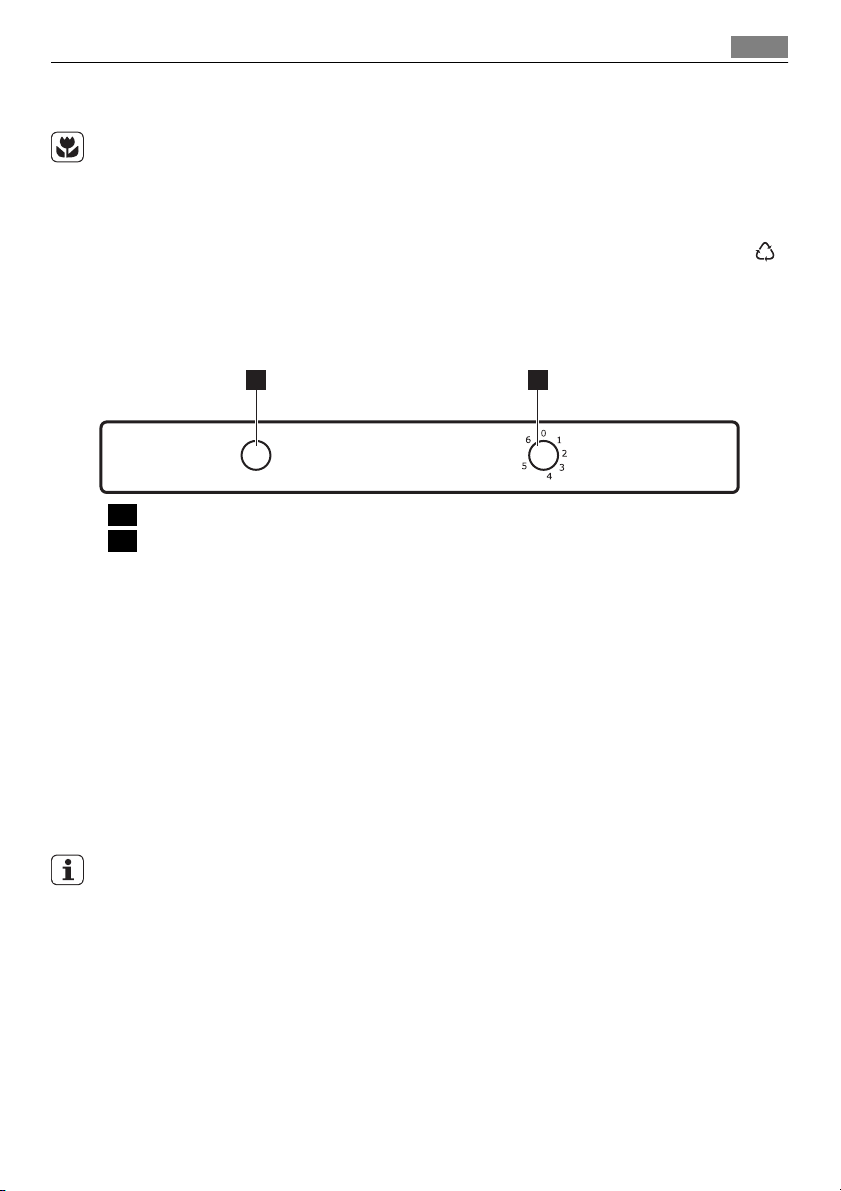
1 2
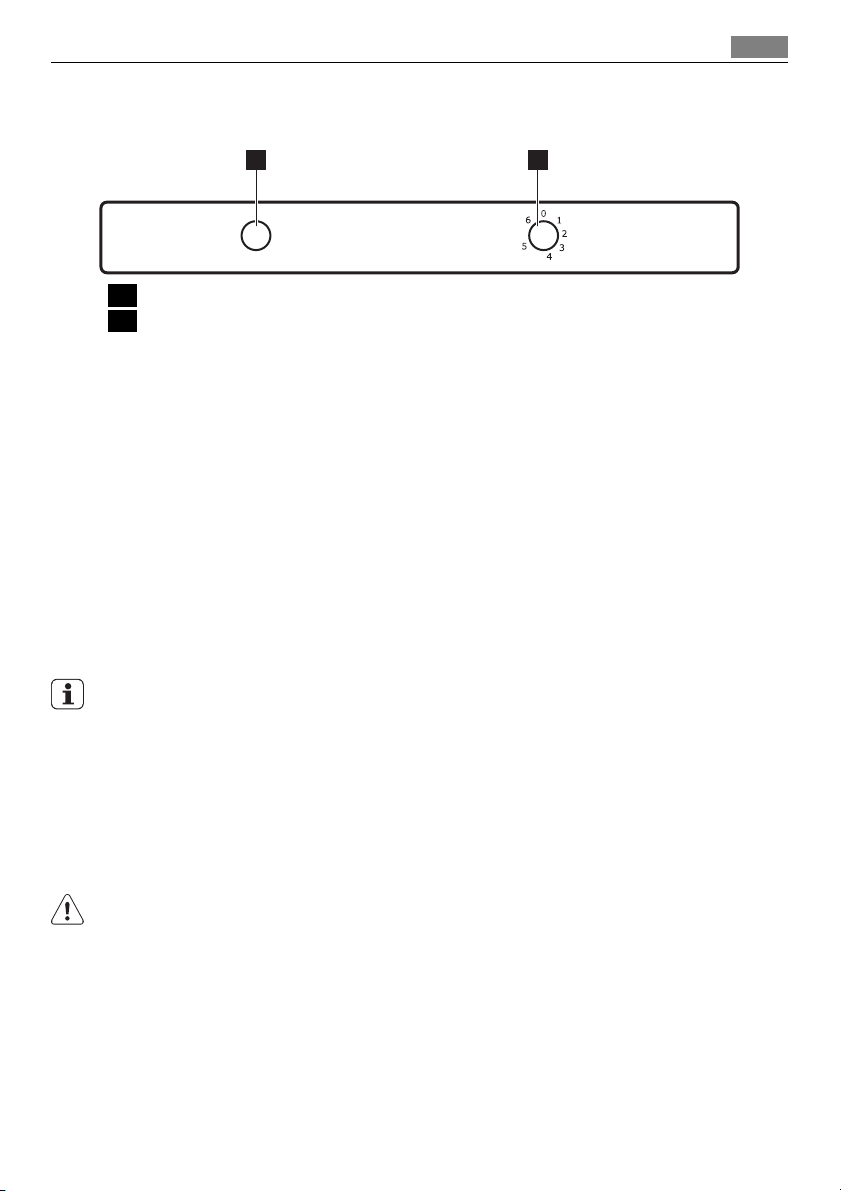
1 Lichtschalter
2 Temperaturregler
Einschalten des Geräts
Stecken Sie den Stecker in die Netzsteckdose.
Drehen Sie den Temperaturregler im Uhrzeigersinn auf eine mittlere Einstellung.
Ausschalten des Geräts
Drehen Sie den Temperaturregler zum Ausschalten des Geräts in die Position „O“.
Temperaturregelung
Die Temperatur wird automatisch geregelt.
Bedienen Sie das Gerät wie folgt:
• drehen Sie den Temperaturregler auf eine niedrigere Einstellung, um die minimal mögliche Kühlung zu erreichen.
• drehen Sie den Temperaturregler auf eine höhere Einstellung, um die maximal mögliche
Kühlung zu erreichen.
eine mittlere Einstellung ist im Allgemeinen am besten geeignet.
7
Allerdings muss für eine exakte Einstellung berücksichtigt werden, dass die Temperatur im
Innern des Gerätes von verschiedenen Faktoren abhängt:
• von der Raumtemperatur
• von der Häufigkeit der Türöffnung
• von der Menge der eingelagerten Lebensmittel
• und vom Standort des Geräts.
Ist die Umgebungstemperatur hoch oder das Gerät voll beladen, dieses aber auf die niedrigste Temperatur eingestellt, so kann es bei andauerndem Betrieb des Geräts an der Rückwand zu Frostbildung kommen. In diesem Fall muss eine höhere Temperatur gewählt werden, die ein automatisches Abtauen ermöglicht und damit auch einen niedrigeren Energieverbrauch.
Page 8
8 Erste Inbetriebnahme
ERSTE INBETRIEBNAHME
Reinigung des Innenraums
Bevor Sie das Gerät in Betrieb nehmen, beseitigen Sie den typischen "Neugeruch" am besten
durch Auswaschen der Innenteile mit lauwarmem Wasser und einem neutralen Reinigungsmittel. Sorgfältig nachtrocknen.
Verwenden Sie keine Reinigungsmittel oder Scheuerpulver, da hierdurch die Oberfläche beschädigt wird.
TÄGLICHER GEBRAUCH
Einfrieren frischer Lebensmittel
Das Gefrierfach eignet sich zum Einfrieren von frischen Lebensmitteln und zum Lagern von
gefrorenen und tiefgefrorenen Lebensmitteln für einen längeren Zeitraum.
Für das Einfrieren frischer Lebensmittel ist eine Änderung der mittleren Einstellung nicht erforderlich.
Möchten Sie den Gefriervorgang beschleunigen, drehen Sie bitte den Temperaturregler auf
eine höhere Einstellung, um die maximal mögliche Kühlung zu erreichen.
In diesem Fall kann die Temperatur im Kühlschrank unter 0°C fallen. Ist dies der Fall, drehen
Sie den Temperaturregler auf eine wärmere Einstellung.
Lagerung gefrorener Produkte
Lassen Sie das Gerät vor der ersten Inbetriebnahme oder nach einer Zeit, in der das Gerät
nicht benutzt wurde, mindestens zwei Stunden lang auf den höheren Einstellungen laufen,
bevor Sie Lebensmittel in das Gefrierfach hinein legen.
Kam es zum Beispiel durch einen Stromausfall, der länger dauerte als der in der Tabelle mit
den technischen Daten angegebene Wert (siehe "Ausfalldauer") zu einem ungewollten Abtauen, dann müssen die aufgetauten Lebensmittel sehr rasch verbraucht oder sofort gekocht und (nach dem Abkühlen) erneut eingefroren werden.
Auftauen
Tiefgefrorene oder gefrorene Lebensmittel können vor der Verwendung je nach der zur Verfügung stehenden Zeit im Kühlschrank oder bei Raumtemperatur aufgetaut werden.
Kleinere Gefriergutteile können unter Umständen sogar direkt aus dem Gefrierschrank entnommen und anschließend sofort gekocht oder gegart werden: in diesem Fall dauert der
Garvorgang allerdings etwas länger.
Page 9
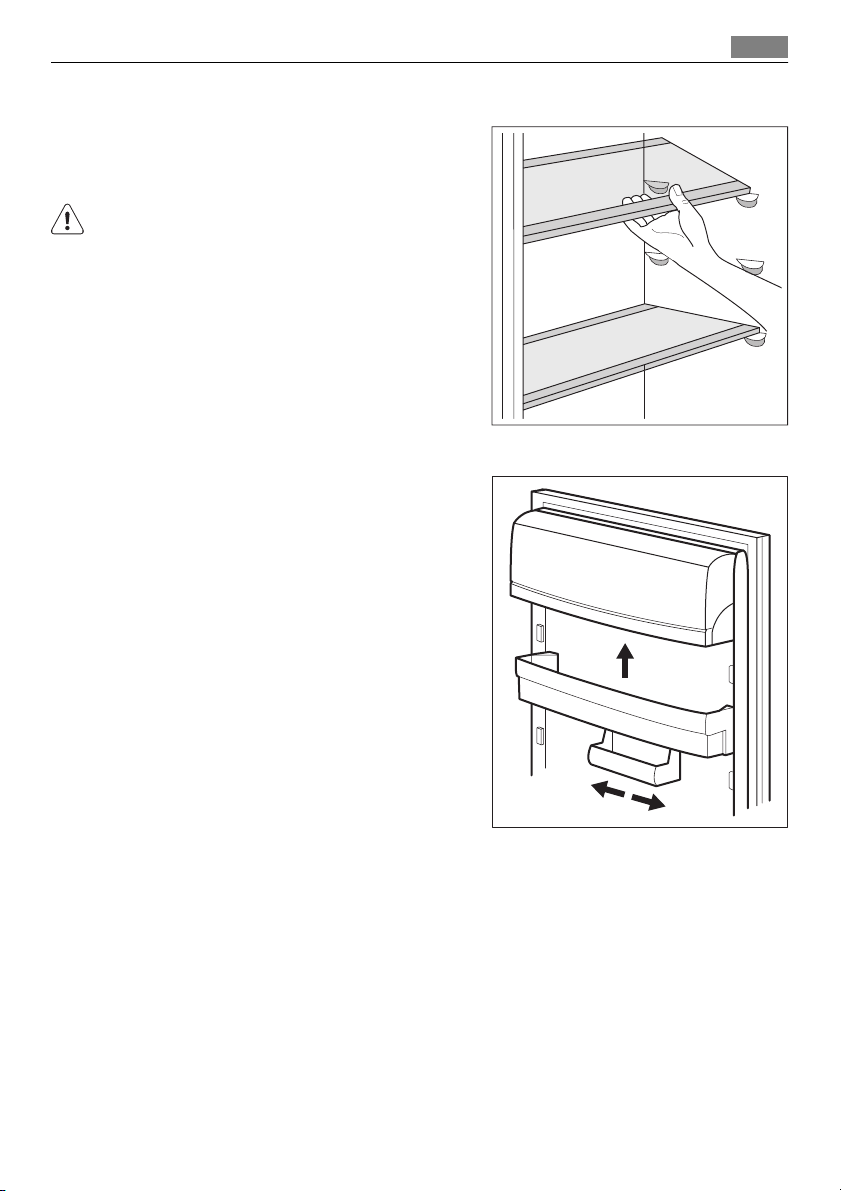
Verstellbare Ablagen
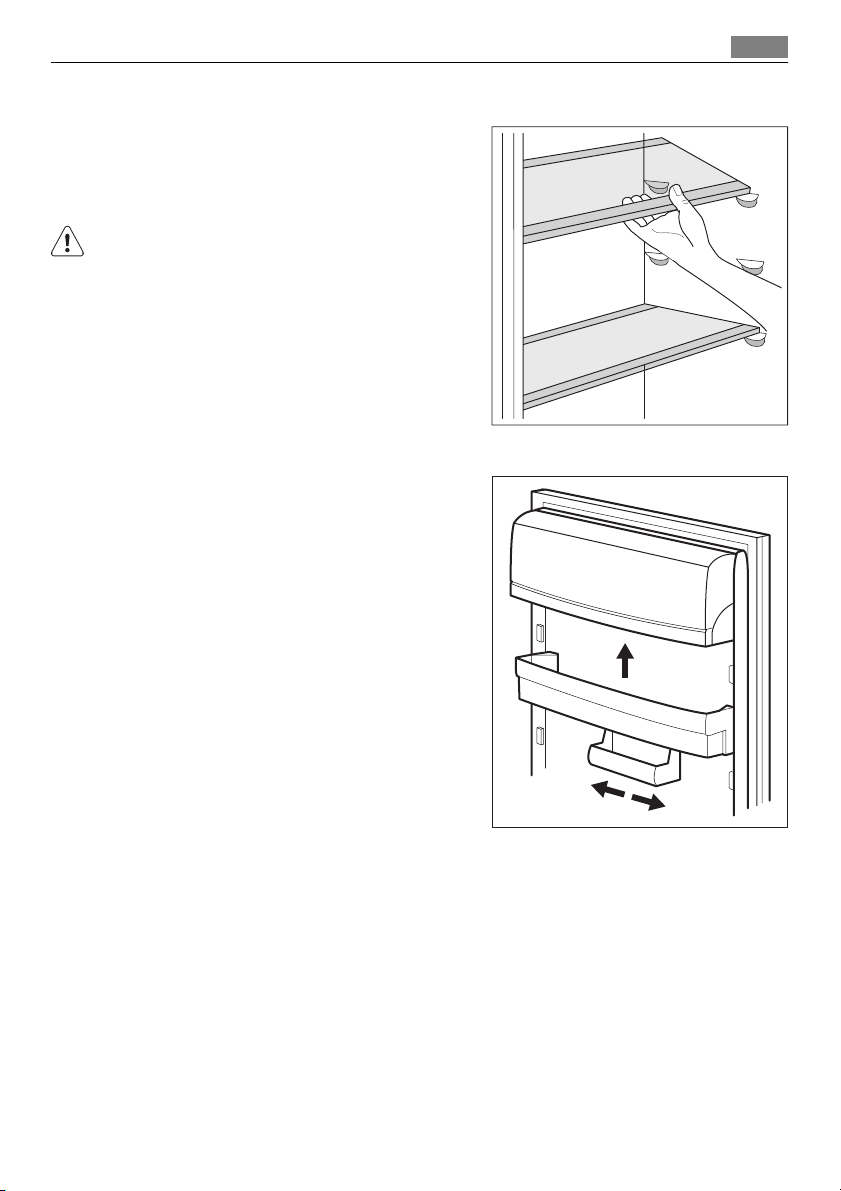
Die Wände des Kühlschranks sind mit einer Anzahl
von Führungsschienen ausgestattet, die verschiedene Möglichkeiten für das Einsetzen der Ablagen
bieten.
Die Glasablage über der Gemüseschublade und die
Flaschenablage sollten jedoch nicht verstellt werden, um eine korrekte Luftzirkulation zu gewährleisten
Positionierung der Türeinsätze
Die Türeinsätze können in verschiedener Höhe positioniert werden, um Lebensmittelpackungen unterschiedlicher Größe zu lagern.
Gehen Sie dazu wie folgt vor:
Ziehen Sie den Einsatz langsam in Pfeilrichtung,
bis er sich herausheben lässt, und setzen Sie ihn
dann nach Wunsch wieder ein.
Das Modell ist mit einem variablen Lagerfach ausgerüstet, das sich unter einer Türablage befestigen
und seitlich verschieben lässt.
Praktische Tipps und Hinweise 9
PRAKTISCHE TIPPS UND HINWEISE
Normale Betriebsgeräusche
• Unter Umständen ist ein leichtes Gurgeln und Blubbern zu hören, wenn das Kältemittel
durch die Leitungen gepumpt wird. Das ist normal.
• Bei eingeschaltetem Kompressor wird das Kältemittel umgewälzt und Sie hören ein Surren und ein pulsierendes Geräusch vom Kompressor. Das ist normal.
• Die thermische Ausdehnung kann ein plötzliches Krachen verursachen. Das ist eine natürliche und nicht gefährliche physikalische Erscheinung. Das ist normal.
• Beim Ein- oder Ausschalten des Kompressors ist ein leises "Klicken" des Temperaturreglers zu hören. Das ist normal.
Page 10
10 Praktische Tipps und Hinweise
Energiespartipps
• Öffnen Sie die Tür nicht zu häufig, und lassen Sie diese nicht länger offen als unbedingt
notwendig.
• Wenn die Umgebungstemperatur hoch ist und der Temperaturregler auf eine niedrige
Temperatur eingestellt und das Gerät voll beladen ist, kann es zu andauerndem Betrieb
des Kompressors und damit zu Reif- oder Eisbildung am Verdampfer kommen. Stellen Sie
in diesem Fall den Temperaturregler auf eine höhere Einstellung ein, die ein automatisches Abtauen und damit auch einen niedrigeren Energieverbrauch ermöglicht.
Hinweise für die Kühlung frischer Lebensmittel
So erzielen Sie beste Ergebnisse:
• Legen Sie bitte keine warmen Lebensmittel oder dampfende Flüssigkeiten in den Kühlschrank.
• Decken Sie die Lebensmittel ab oder verpacken Sie diese entsprechend, besonders wenn
diese stark riechen.
• Legen Sie die Lebensmittel so hinein, dass um sie Luft frei zirkulieren kann.
Hinweise für die Kühlung
Tipps:
Fleisch (alle Sorten): wickeln Sie Fleisch in lebensmittelechte Tüten und legen Sie diese auf
die Glasablage über der Gemüseschublade.
Bitte lagern Sie Fleisch aus Sicherheitsgründen nur einen oder maximal zwei Tage auf diese
Weise.
Gekochte Lebensmittel, kalte Gerichte usw.: diese können abgedeckt auf eine Ablage gelegt
werden.
Obst und Gemüse: bitte waschen Sie Obst und Gemüse gründlich und legen Sie es in die
speziell dafür vorgesehene(n) Schublade(n).
Butter und Käse: diese sollten stets in speziellen luftdichten Behältern verpackt sein oder in
Aluminiumfolie bzw. in lebensmittelechte Tüten eingepackt werden, um so wenig Luft wie
möglich in der Verpackung zu haben.
Milchflaschen: bitte bewahren Sie Milchflaschen stets mit Deckel im Flaschenregal in der
Tür auf.
Bananen, Kartoffeln, Zwiebeln und Knoblauch sollten nicht im Kühlschrank aufbewahrt
werden, außer diese sind dafür speziell verpackt.
Hinweise zum Einfrieren
Im Folgenden finden Sie einige wertvolle Tipps für einen optimalen Gefriervorgang:
• die maximale Menge an Lebensmitteln, die innerhalb von 24 Stunden eingefroren werden kann. ist auf dem Typschild angegeben;
• der Gefriervorgang dauert 24 Stunden. Legen Sie während dieses Zeitraums keine weiteren einzufrierenden Lebensmittel in das Gefrierfach;
• frieren Sie ausschließlich frische und gründlich gewaschene Lebensmittel von sehr guter
Qualität ein;
• teilen Sie die Lebensmittel in kleinere Portionen ein, damit diese schnell und vollständig
gefrieren und Sie später nur die Menge auftauen müssen, die Sie gerade benötigen;
Page 11
Reinigung und Pflege 11
• die einzufrierenden Lebensmittelportionen sollten stets luftdicht in Aluminiumfolie oder
in lebensmittelechte Gefrierbeutel verpackt werden, um so wenig Luft wie möglich in der
Verpackung zu haben;
• achten Sie beim Hineinlegen von frischen, noch ungefrorenen Lebensmitteln darauf, dass
diese keinen Kontakt mit Gefriergut bekommen, da dieses sonst antauen kann;
• weniger fetthaltige Lebensmittel lassen sich besser lagern als fetthaltigere; Salz verkürzt
die Lagerzeit von Lebensmitteln im Gefrierfach;
• werden Gefrierwürfel direkt nach der Entnahme aus dem Gefrierfach verwendet, können
Sie zu Frostbrand auf der Haut führen;
• es empfiehlt sich, das Einfrierdatum auf jeder einzelnen Packung zu notieren, um einen
genauen Überblick über die Lagerzeit zu haben.
Hinweise zur Lagerung gefrorener Produkte
So erzielen Sie die besten Ergebnisse mit Ihrem Gerät:
• Prüfen Sie sorgfältig, dass die im Handel erworbenen gefrorenen Lebensmittel sachgerecht gelagert wurden.
• Achten Sie unbedingt darauf, die eingekauften gefrorenen Lebensmittel in der kürzest
möglichen Zeit in Ihren Gefrierschrank zu bringen.
• Öffnen Sie die Tür nicht zu häufig, und lassen Sie diese nicht länger offen als unbedingt
notwendig.
• Abgetaute Lebensmittel verderben sehr schnell und eignen sich nicht für ein erneutes
Einfrieren.
• Das Haltbarkeitsdatum auf der Tiefkühlkostverpackung sollte nicht überschritten werden.
REINIGUNG UND PFLEGE
VORSICHT!
Ziehen Sie bitte vor jeder Reinigungsarbeit immer den Netzstecker aus der Steckdose.
Der Kältekreis des Gerätes enthält Kohlenwasserstoffe; Wartungsarbeiten und Nachfüllen
von Kältemittel dürfen daher nur durch vom Hersteller autorisiertes Fachpersonal ausgeführt werden.
Regelmäßige Reinigung
Der gesamte Kühlschrank muss regelmäßig gereinigt werden:
• Reinigen Sie die Innenseiten und die Zubehörteile mit lauwarmem Wasser und etwas
Neutralseife.
• Prüfen und säubern Sie die Türdichtungen in regelmäßigen Abständen und kontrollieren
Sie, dass diese sauber und frei von Verunreinigungen sind.
• Spülen und trocknen Sie diese sorgfältig ab.
Page 12

12 Reinigung und Pflege
Ziehen Sie nicht an Leitungen und/oder Kabeln im Innern des Kühlschranks und achten Sie
darauf, diese nicht zu verschieben oder zu beschädigen.
Benutzen Sie zur Reinigung des Innenraums keinesfalls Putzmittel, Scheuerpulver, stark
parfümierte Reinigungsmittel oder Wachspolituren, da diese die Oberfläche des Innenraums
beschädigen und einen starken Eigengeruch hinterlassen können.
Bitte achten Sie darauf, das Kühlsystem nicht zu beschädigen.
Viele Haushaltsreiniger für Küchen enthalten Chemikalien, die den im Gerät verwendeten
Kunststoff angreifen können. Aus diesem Grund ist es empfehlenswert, das Gerät außen nur
mit warmem Wasser und etwas flüssigem Tellerspülmittel zu reinigen.
Schließen Sie das Gerät nach der Reinigung wieder an die Netzversorgung an.
Abtauen des Kühlschranks
Bei normalem Betrieb wird Frost bei jedem Anhalten des Motorkompressors automatisch
aus dem Verdampfer des Kühlschranks entfernt. Das Tauwasser läuft durch eine Rinne in
einen speziellen Behälter an der Rückseite des Geräts über dem Motorkompressor, wo es
verdampft.
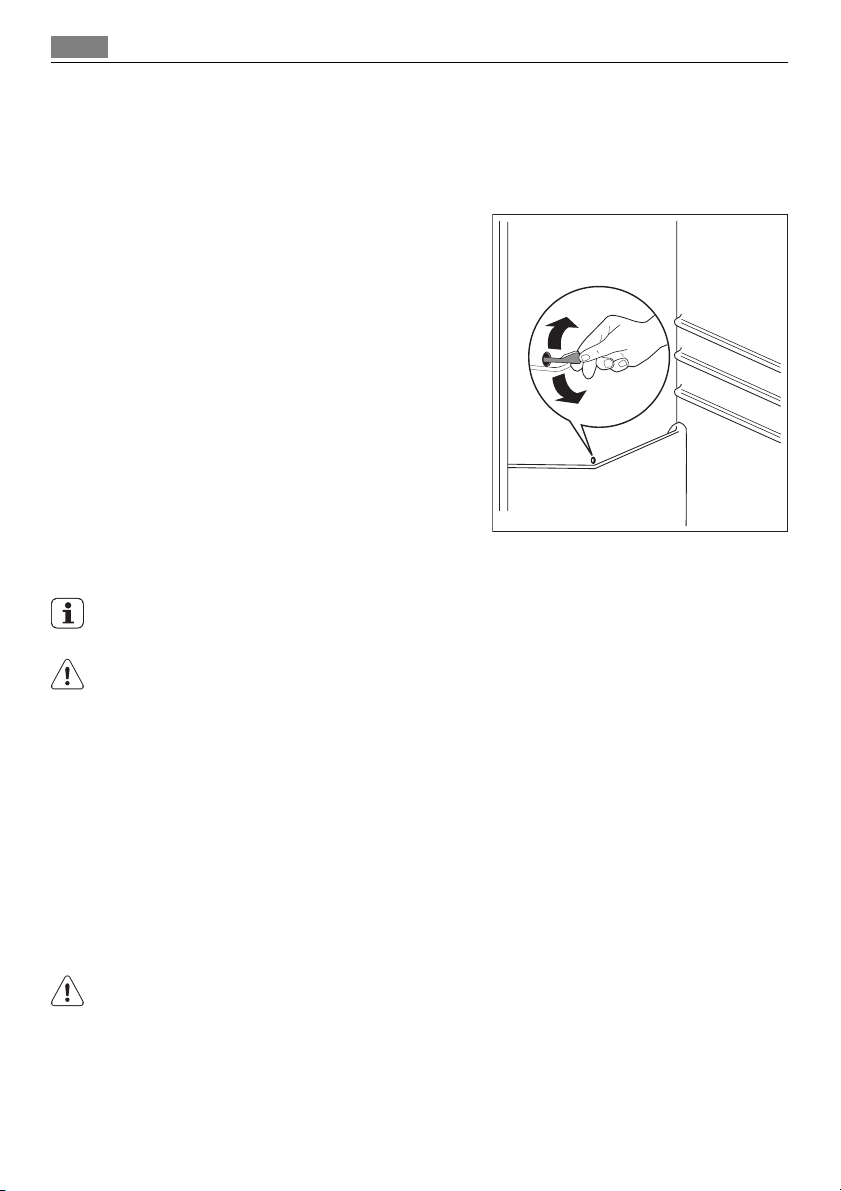
Reinigen Sie deshalb regelmäßig die Abflussöffnung des Tauwassers in der Mitte des Kühlschrankkanals, damit das Wasser nicht überfließt
und auf die gelagerten Lebensmittel tropft. Benutzen Sie dazu bitte das mitgelieferte Reinigungswerkzeug, das sich bereits in der Ablauföffnung befindet.
Abtauen des Gefrierschranks
Auf den Ablagen des Gefrierschranks und im Innern des oberen Fachs wird sich stets etwas
Reif bilden.
Tauen Sie den Gefrierschrank ab, wenn die Reifschicht eine Stärke von etwa 3 bis 5 mm
erreicht hat.
Entfernen Sie den Reif wie nachstehend erläutert:
1. Schalten Sie das Gerät aus.
2. Nehmen Sie das gesamte Gefriergut heraus, verpacken Sie es in mehrere Schichten
Zeitungspapier und lagern Sie es an einem kühlen Ort.
3. Lassen Sie die Tür offen.
Page 13
Was tun, wenn … 13
4. Ist das Geräteinnere vollständig abgetaut, trocken Sie die nassen Oberflächen gründ-
lich ab und setzen Sie den Stopfen wieder ein.
5. Schalten Sie das Gerät ein.
6. Drehen Sie den Temperaturregler auf eine höhere Einstellung, um die maximal mögli-
che Kühlung zu erreichen, und lassen Sie das Gerät zwei bis drei Stunden mit dieser
Einstellung laufen.
7. Legen Sie die ausgelagerten Lebensmittel wieder in das Fach hinein.
Verwenden Sie bitte niemals scharfe Gegenstände zum Entfernen von Reif und Eis vom Verdampfer, da dieser dadurch beschädigt werden könnte. Benutzen Sie keine mechanischen
oder sonstigen Hilfsmittel, um den Abtauprozess zu beschleunigen; halten Sie sich dazu
ausschließlich an die Angaben des Geräteherstellers. Ein Temperaturanstieg des Gefrierguts
während des Abtauens des Gerätes kann die Lagerzeit dieser Lebensmittel verkürzen.
Stillstandzeiten
Bei längerem Stillstand des Gerätes müssen Sie folgendermaßen vorgehen:
• trennen Sie das Gerät von der Netzversorgung
• entnehmen Sie alle Lebensmittel
•
tauen Sie das Gerät ab
• lassen Sie die Türen offen/angelehnt, um das Entstehen unangenehmer Gerüche zu vermeiden.
Möchten Sie bei einer längeren Abwesenheit den Gefrierschrank weiter laufen lassen, bitten
Sie jemanden, gelegentlich die Temperatur zu prüfen, damit das Gefriergut bei einem möglichen Stromausfall nicht im Innern des Gerätes verdirbt.
5)
, Reinigen Sie das Gerät und alle Zubehörteile
WAS TUN, WENN …
WARNUNG!
Ziehen Sie vor der Fehlersuche immer den Netzstecker aus der Steckdose.
Die Fehlersuche, die in der vorliegenden Gebrauchsanweisung nicht beschrieben ist, darf
nur von einem qualifizierten Elektriker oder einer kompetenten Person durchgeführt werden.
Während das Gerät in Betrieb ist, entstehen bestimmte Geräusche (Kompressor und Kühlkreislauf).
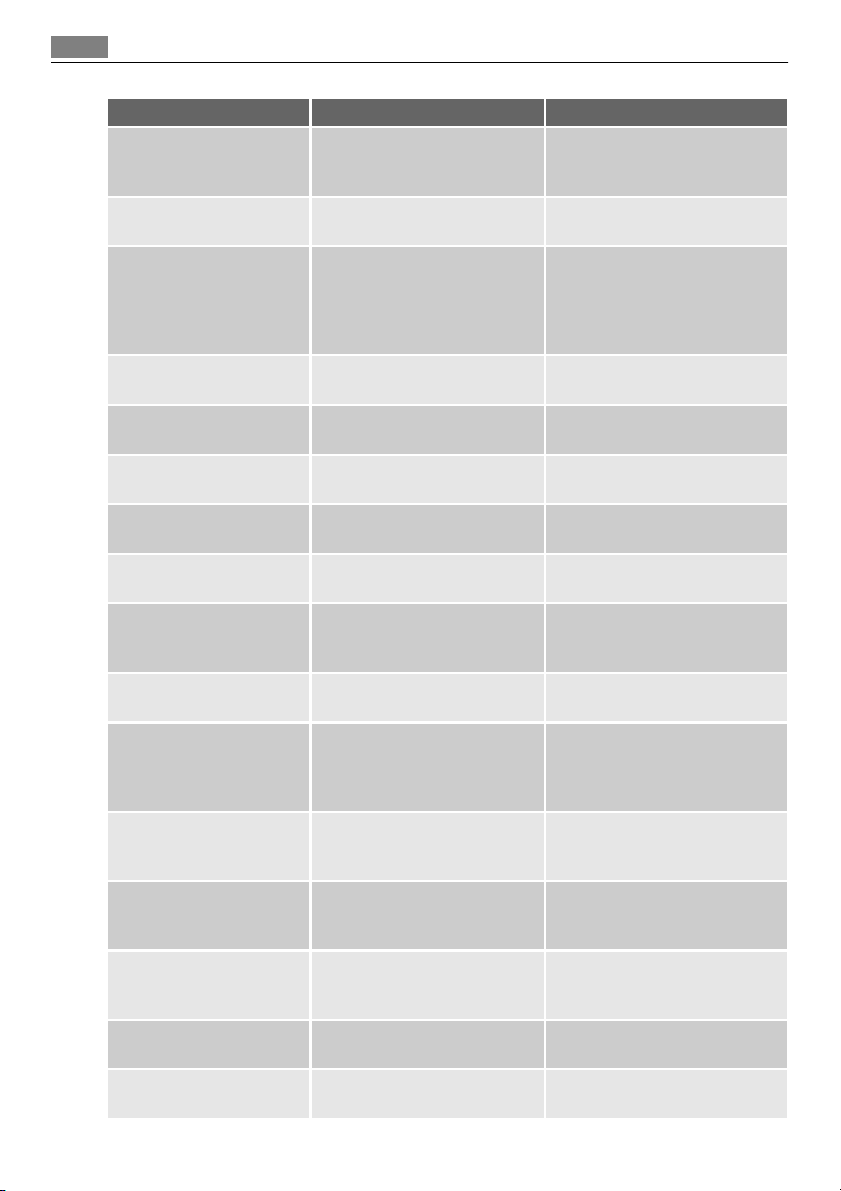
Störung Mögliche Ursache Abhilfe
Das Gerät ist zu laut Unebenheiten im Boden sind
durch Unterlegen nicht ausgeglichen worden
5) Falls dies vorgesehen ist.
Kontrollieren Sie, ob eventuelle
Unebenheiten der Standfläche
korrekt ausgeglichen wurden, so
dass alle vier Füße fest auf dem
Boden stehen
Page 14
14 Was tun, wenn …
Störung Mögliche Ursache Abhilfe
Das Gerät funktioniert
nicht. Die Lampe funktioniert nicht.
Der Netzstecker steckt nicht
Das Gerät bekommt keinen
Die Lampe funktioniert
nicht.
Die Lampe ist defekt. Siehe hierzu "Austauschen der
Der Kompressor arbeitet
ständig.
Die Tür ist nicht richtig ge-
Die Tür wurde zu häufig geöff-
Die Temperatur der zu kühlen-
Die Raumtemperatur ist zu
Wasser fließt an der Rückwand des Kühlschranks hinunter.
Wasser fließt in den Innenraum des Kühlschranks.
Die eingelagerten Lebensmittel
Wasser fließt auf den Boden.
Die Temperatur im Gerät
ist zu niedrig.
Die Temperatur im Gerät
ist zu hoch.
Das Gerät ist abgeschaltet. Schalten Sie das Gerät ein.
richtig in der Steckdose.
Strom. Es liegt keine Spannung
an der Netzsteckdose an.
Die Lampe ist im Standby-Modus.
Die Temperatur ist nicht richtig
eingestellt.
schlossen.
net.
den Lebensmittel ist zu hoch.
hoch.
Beim automatischen Abtauen
fließt das abgetaute Wasser an
der Rückwand des Kühlschranks
hinunter.
Der Wasserabflusskanal ist verstopft.
verhindern, dass das Wasser
zum Kollektor fließt.
Der Tauwasserablauf läuft nicht
in die Verdampferschale über
dem Kompressor.
Die Temperatur ist nicht richtig
eingestellt.
Die Temperatur ist nicht richtig
eingestellt.
Stecken Sie den Netzstecker richtig in die Steckdose.
Testen Sie bitte, ob ein anderes
Gerät an dieser Steckdose funktioniert.
Kontaktieren Sie gegebenenfalls
einen qualifizierten Elektriker.
Öffnen und schließen Sie die Tür.
Lampe".
Stellen Sie eine höhere Tempera-
tur ein.
Siehe hierzu "Schließen der Tür".
Lassen Sie die Tür nicht länger als
unbedingt erforderlich offen.
Lassen Sie die Lebensmittel auf
Raumtemperatur abkühlen, bevor
Sie sie in das Gerät legen.
Senken Sie die Raumtemperatur.
Das ist normal.
Reinigen Sie den Ablauf.
Stellen Sie sicher, dass die Lebensmittel nicht die Rückwand
berühren.
Befestigen Sie den Tauwasserablauf an der Verdampferschale.
Stellen Sie eine höhere Temperatur ein.
Stellen Sie eine niedrigere Temperatur ein.
Page 15
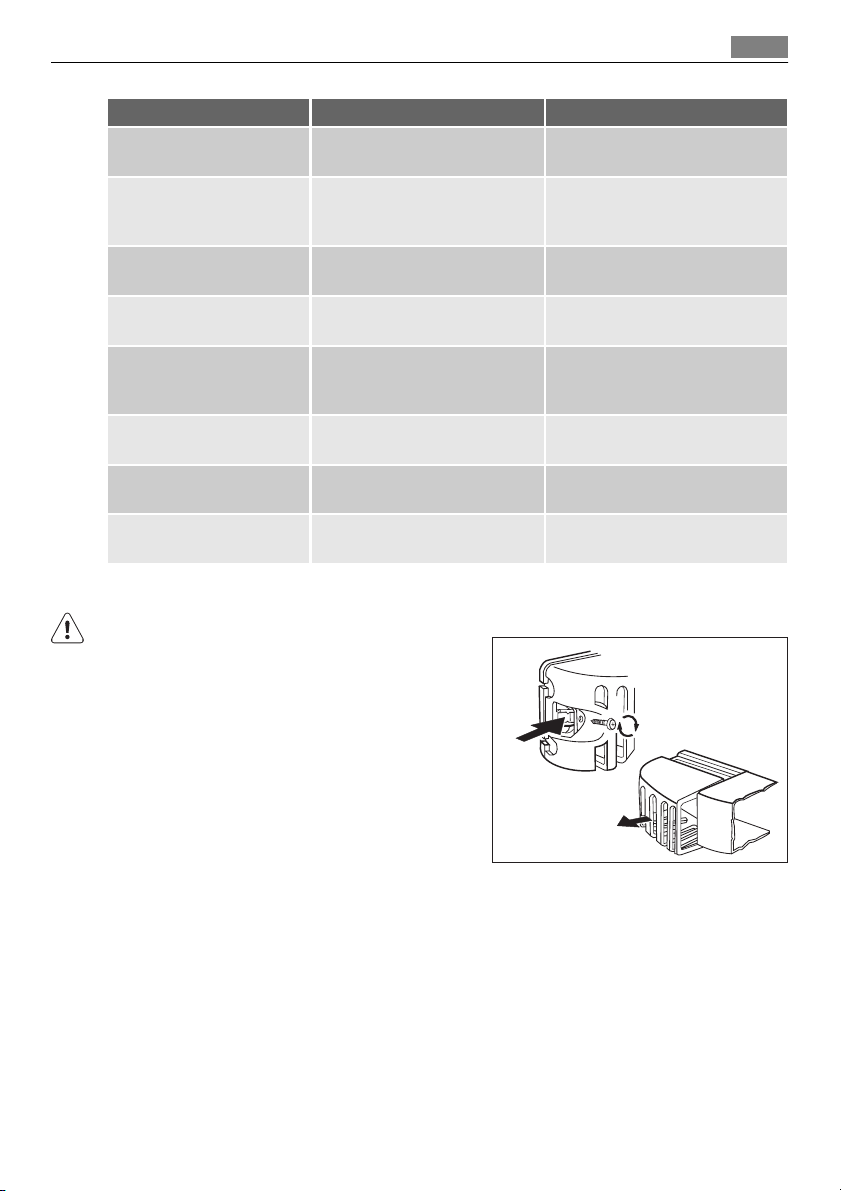
Störung Mögliche Ursache Abhilfe
Die Tür ist nicht richtig ge-
Die Temperatur der zu kühlen-
Es wurden zu viele Lebensmittel
Die Temperatur im Kühlschrank ist zu hoch.
Die Temperatur im Gefrierraum ist zu hoch.
Es bildet sich zu viel Reif
oder Eis.
Die Tür ist nicht richtig ge-
Die Temperatur ist nicht richtig
schlossen.
den Lebensmittel ist zu hoch.
auf einmal eingelegt.
Die Kaltluft kann nicht im Gerät
zirkulieren.
Die einzufrierenden Packungen
liegen zu dicht aneinander.
Die Lebensmittel sind nicht richtig verpackt.
schlossen.
eingestellt.
Austauschen der Lampe
VORSICHT!
Ziehen Sie den Netzstecker aus der Steckdose.
Was tun, wenn … 15
Siehe hierzu "Schließen der Tür".
Lassen Sie die Lebensmittel auf
Raumtemperatur abkühlen, bevor
Sie sie in das Gerät legen.
Legen Sie weniger Lebensmittel
auf einmal ein.
Stellen Sie sicher, dass die Kaltluft
im Gerät zirkulieren kann.
Stellen Sie sicher, dass die Kaltluft
im Gerät zirkuliert und die Lebensmittel dies nicht verhindern.
Verpacken Sie die Lebensmittel
richtig.
Siehe hierzu "Schließen der Tür".
Stellen Sie eine höhere Temperatur ein.
1. Lösen Sie die Schraube an der Lampenabde-
ckung.
2. Ziehen Sie den Haken an der Lampenabde-
2
ckung nach außen.
3. Nehmen Sie die Lampenabdeckung ab.
4. Ersetzen Sie die Lampe durch eine Lampe
3
der gleichen Leistung (die maximal erlaubte
Leistung steht auf der Abdeckung der Lampe).
5. Bringen Sie die Lampenabdeckung an.
6. Ziehen Sie die Schraube an der Lampenabdeckung fest.
7. Stecken Sie den Netzstecker in die Steckdose.
8. Tür öffnen. Prüfen Sie, ob die Lampe brennt.
Schließen der Tür
1. Reinigen Sie die Türdichtungen.
2. Stellen Sie die Tür nach Bedarf ein. Siehe hierzu "Montage".
3. Ersetzen Sie die defekten Türdichtungen, falls erforderlich. Kontaktieren Sie den Kun-
dendienst.
1
Page 16
16 Technische Daten
TECHNISCHE DATEN
Abmessungen der Einbaunische
Höhe 880 mm
Breite 560 mm
Tiefe 550 mm
Lagerzeit bei Störung 12 Std.
Spannung 230 V
Frequenz 50 Hz
Die technischen Informationen befinden sich auf dem Typenschild innen links im Gerät sowie auf der Energieplakette.
MONTAGE
WARNUNG!
Lesen Sie bitte die "Sicherheitshinweise" sorgfältig vor der Aufstellung des Geräts durch, um
Gefahren für Sie selbst zu vermeiden und einen korrekten Betrieb des Geräts zu gewährleisten.
Aufstellung
Dieses Gerät kann auch in einer trockenen, gut belüfteten Garage oder in einem Keller installiert werden, doch für eine optimale Leistung sollte dieses Gerät an einem Ort installiert
werden, an dem die Umgebungstemperatur mit der Klimaklasse übereinstimmt, die auf dem
Typschild des Geräts angegeben ist:
Klimaklasse Umgebungstemperatur
SN +10 °C bis 32 °C
N +16 °C bis 32 °C
ST +16 °C bis 38 °C
T +16 °C bis 43 °C
Elektrischer Anschluss
Kontrollieren Sie vor der ersten Benutzung des Gerätes, ob die Netzspannung und -frequenz Ihres Hausanschlusses mit den auf dem Typenschild angegebenen Anschlusswerten
übereinstimmen.
Das Gerät muss geerdet sein. Zu diesem Zweck ist die Netzkabelsteckdose mit einem
Schutzkontakt ausgestattet. Falls die Steckdose Ihres Hausanschlusses nicht geerdet sein
sollte, lassen Sie das Gerät bitte gemäß den geltenden Vorschriften erden und fragen Sie
dafür einen qualifizierten Elektriker.
Der Hersteller übernimmt keinerlei Haftung für Schäden oder Verletzungen, die durch Missachtung der oben genannten Sicherheitshinweise entstehen.
Page 17
Das Gerät entspricht den EU- Richtlinien.
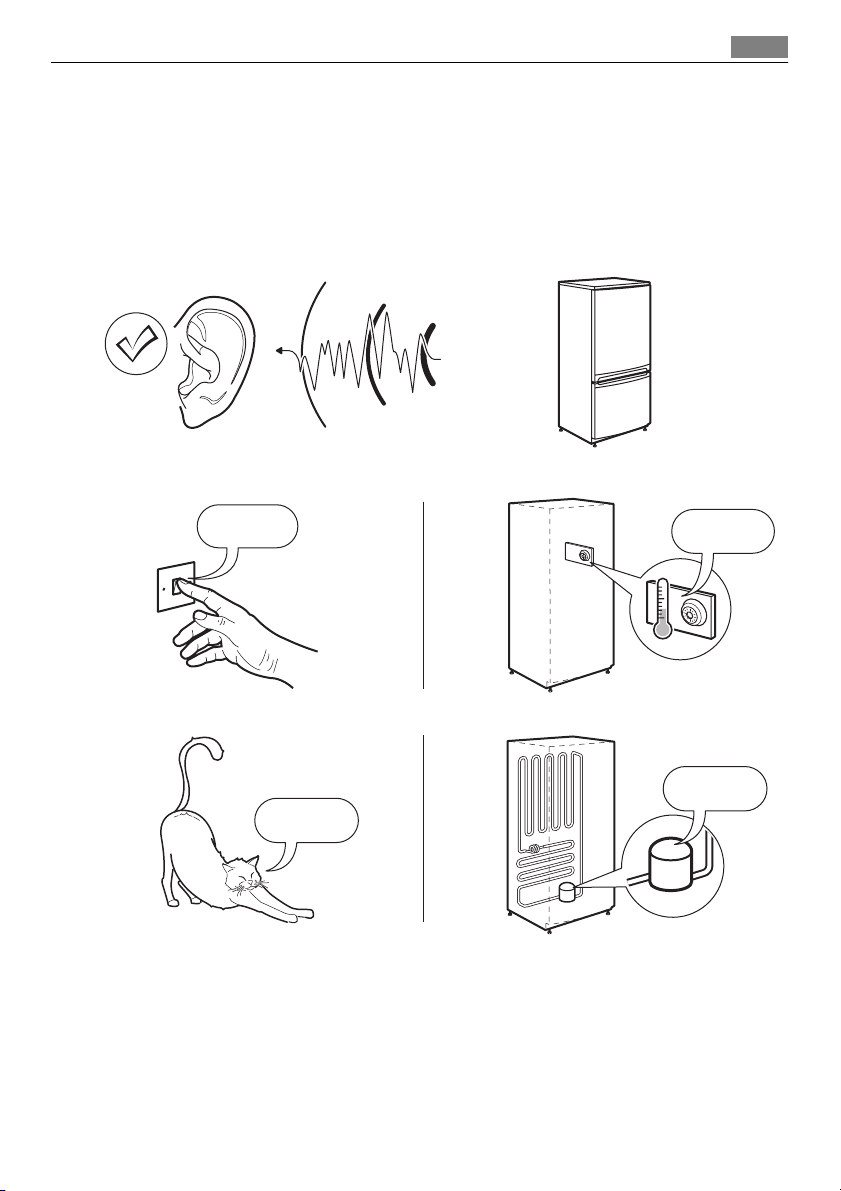
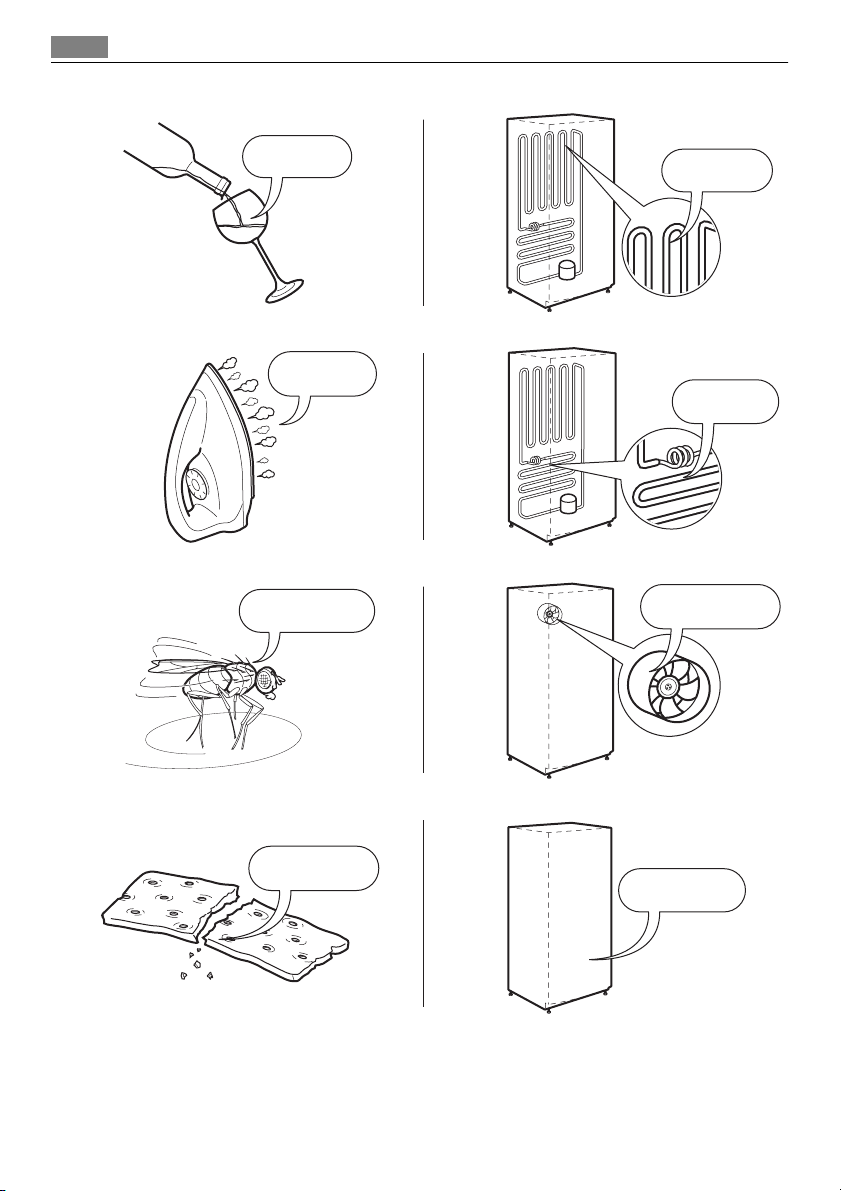
GERÄUSCHE
Während das Gerät in Betrieb ist, entstehen bestimmte Geräusche (Kompressor und Kühlkreislauf).
SSSRRR!
Geräusche 17
CLICK!
OK
CLICK!
BRRR!
HISSS!
BLUBB!
BRRR!
CRACK!
CLICK!
BRRR!
Page 18
18 Geräusche
BLUBB!
HISSS!
SSSRRR!
BLUBB!
HISSS!
SSSRRR!
CRACK!
CRACK!
Page 19
Hinweise zum Umweltschutz
HINWEISE ZUM UMWELTSCHUTZ
Das Symbol auf dem Produkt oder seiner Verpackung weist darauf hin, dass dieses
Produkt nicht als normaler Haushaltsabfall zu behandeln ist, sondern an einem
Sammelpunkt für das Recycling von elektrischen und elektronischen Geräten abgegeben
werden muss. Durch Ihren Beitrag zum korrekten Entsorgen dieses Produkts schützen Sie
die Umwelt und die Gesundheit Ihrer Mitmenschen. Umwelt und Gesundheit werden durch
falsches Entsorgen gefährdet. Weitere Informationen über das Recycling dieses Produkts
erhalten Sie von Ihrem Rathaus, Ihrer Müllabfuhr oder dem Geschäft, in dem Sie das
Produkt gekauft haben.
Wohin mit den Altgeräten?
Überall dort wo neue Geräte verkauft werden oder Abgabe bei den offiziellen SENSSammelstellen oder offiziellen SENS-Recyclern.
Die Liste der offiziellen SENS-Sammelstellen findet sich unter www.sens.ch.
19
Page 20
20
POUR DES RÉSULTATS PARFAITS
Merci d'avoir choisi ce produit AEG. Nous l'avons créé
pour vous offrir la meilleure performance pour une
longue durée, avec des technologies innovantes qui vous
simplifient la vie - autant de caractéristiques que vous ne
trouverez pas sûrement pas sur d'autres appareils.
Veuillez prendre quelques instants pour lire cette notice
afin d'utiliser au mieux votre appareil.
ACCESSOIRES ET CONSOMMABLES
Dans la boutique en ligne d'AEG, vous trouverez tout ce
qu'il vous faut pour que vos appareils AEG fonctionnent
parfaitement. Sans oublier une vaste gamme d'accessoires
conçus et fabriqués selon les critères de qualité les plus
élevés qui soient, des articles de cuisine spécialisés aux
range-couverts, des porte-bouteilles aux sacs à linge
délicats...
Visitez la boutique en ligne sur
www.aeg.com/shop
Page 21
SOMMAIRE
Sommaire
22 Consignes de sécurité
25 Bandeau de commande
26 Première utilisation
26 Utilisation quotidienne
27 Conseils utiles
29 Entretien et nettoyage
31 En cas d'anomalie de
fonctionnement
33 Caractéristiques techniques
34 Installation
34 Bruits
36 En matière de sauvegarde de
l'environnement
21
Les symboles suivants sont utilisés dans ce
manuel:
Informations importantes pour votre sécurité
et pour éviter d’abîmer l’appareil.
Informations générales et conseils
Informations écologiques
Sous réserve de modifications
Page 22
22 Consignes de sécurité
CONSIGNES DE SÉCURITÉ
Pour votre sécurité et garantir une utilisation correcte de l'appareil, lisez attentivement cette notice, y compris les conseils et avertissements, avant d'installer et d'utiliser l'appareil
pour la première fois. Pour éviter toute erreur ou accident, veillez à ce que toute personne
qui utilise l'appareil connaisse bien son fonctionnement et ses fonctions de sécurité. Conservez cette notice avec l'appareil. Si l'appareil doit être vendu ou cédé à une autre personne, veillez à remettre cette notice au nouveau propriétaire, afin qu'il puisse se familiariser
avec son fonctionnement et sa sécurité.
Pour la sécurité des personnes et des biens, conservez et respectez les consignes de sécurité
figurant dans cette notice. Le fabricant décline toute responsabilité en cas de dommages
dus au non-respect de ces instructions.
Sécurité des enfants et des personnes vulnérables
• Cet appareil n'est pas destiné à être utilisé par des enfants ou des personnes dont les
capacités physiques, sensorielles ou mentales, ou le manque d'expérience et de connaissance les empêchent d'utiliser l'appareil sans risque lorsqu'ils sont sans surveillance ou en
l'absence d'instruction d'une personne responsable qui puisse leur assurer une utilisation
de l'appareil sans danger.
Empêchez les enfants de jouer avec l'appareil.
• Ne laissez pas les différents emballages à portée des enfants. Ils pourraient s'asphyxier.
• Si l'appareil doit être mis au rebut, veillez à couper le câble d'alimentation électrique au
ras de l'appareil pour éviter les risques d'électrocution. Démontez la porte pour éviter que
des enfants ne restent enfermés à l'intérieur.
• Cet appareil est muni de fermetures magnétiques. S'il remplace un appareil équipé d'une
fermeture à ressort, nous vous conseillons de rendre celle-ci inutilisable avant de vous en
débarrasser. Ceci afin d'éviter aux enfants de s'enfermer dans l'appareil et de mettre ainsi
leur vie en danger.
Consignes générales de sécurité
AVERTISSEMENT
Veillez à ce que les orifices de ventilation, situés dans l'enceinte de l'appareil ou la structure
intégrée, ne soient pas obstrués.
• Les appareils sont destinés uniquement à la conservation des aliments et/ou des boissons
dans le cadre d’un usage domestique normal, tel que celui décrit dans la présente notice.
• N'utilisez pas d'appareils électriques, d'agents chimiques ou tout autre système artificiel
pour accélérer le processus de dégivrage.
• Ne faites pas fonctionner d'appareils électriques (comme des sorbetières électriques, ...) à
l'intérieur des appareils de réfrigération à moins que cette utilisation n'ait reçu l'agrément du fabricant.
• N'endommagez pas le circuit frigorifique.
Page 23
Consignes de sécurité 23
• Le circuit frigorifique de l’appareil contient de l’isobutane (R600a), un gaz naturel offrant
un haut niveau de compatibilité avec l’environnement mais qui est néanmoins inflammable.
Pendant le transport et l'installation de votre appareil, assurez-vous qu'aucune partie du
circuit frigorifique n'est endommagée.
Si le circuit frigorifique est endommagé :
– évitez les flammes vives et toute autre source d'allumage
– aérez soigneusement la pièce où se trouve l'appareil
• Ne modifiez pas les spécifications de l'appareil. Si le câble d'alimentation est endommagé, il peut causer un court circuit, un incendie et/ou une électrocution.
AVERTISSEMENT
Les éventuelles réparations ou interventions sur votre appareil, ainsi que le remplacement
du câble d'alimentation, ne doivent être effectuées que par un professionnel qualifié.
1. L'appareil ne doit pas être raccordé à l'aide d'un prolongateur, d'une prise multiple
ou d'un raccordement multiple (risque d'incendie).
2. Assurez-vous que la prise n'est pas écrasée ou endommagée par l'arrière de l'appa-
reil. Une prise de courant écrasée ou endommagée peut s'échauffer et causer un incendie.
3. Vérifiez que la prise murale de l'appareil est accessible.
4. Ne débranchez pas l'appareil en tirant sur le câble.
5. Si la prise murale n'est pas bien fixée, n'introduisez pas de prise dedans. Risque
d'électrocution ou d'incendie.
6.
Votre appareil ne doit pas être utilisé sans le diffuseur de l'ampoule d'éclairage.
6)
pour l'éclairage intérieur.
• Cet appareil est lourd. Faite attention lors de son déplacement.
• Ne touchez pas avec les mains humides les surfaces givrées et les produits congelés (risque de brûlure et d'arrachement de la peau).
• Évitez une exposition prolongée de l'appareil aux rayons solaires.
•
Les ampoules
7)
utilisées dans cet appareil sont des ampoules spécifiques destinées uniquement à un usage sur des appareils ménagers. Elles ne sont pas adaptées à l'éclairage
d'une habitation.
Utilisation quotidienne
• Ne posez pas d'éléments chauds sur les parties en plastique de l'appareil.
• Ne stockez pas de gaz ou de liquides inflammables dans l'appareil (risque d'explosion).
• Ne placez pas d'aliments directement contre la sortie d'air sur la paroi arrière de l'appa-
8)
reil.
• Un produit décongelé ne doit jamais être recongelé.
• Conservez les aliments emballés conformément aux instructions de leur fabricant.
6) Si l'appareil est équipé d'un diffuseur d'éclairage.
7) Si l'ampoule d'éclairage est prévue.
8) Si l'appareil est sans givre.
Page 24
24 Consignes de sécurité
• Respectez scrupuleusement les conseils de conservation donnés par le fabricant de l'appareil. Consultez les instructions respectives.
• Ne mettez pas de bouteilles ni de boîtes de boissons gazeuses dans le compartiment congélateur, car la pression se formant à l'intérieur du contenant pourrait le faire éclater et
endommager ainsi l'appareil.
• Ne consommez pas certains produits tels que les bâtonnets glacés dès leur sortie de l'appareil, car ils peuvent provoquer des brûlures.
Entretien et nettoyage
• Avant toute opération d'entretien, mettez l'appareil hors tension et débranchez-le de la
prise de courant.
• N'utilisez pas d'objets métalliques pour nettoyer l'appareil.
• N'utilisez pas d'objet tranchant pour gratter la couche de givre. Utilisez une spatule en
plastique.
• Contrôlez régulièrement l'orifice d'évacuation de l'eau de dégivrage dans le compartiment réfrigérateur. Nettoyez-le, si besoin. Si l'orifice est bouché, l'eau s'écoulera en bas
de l'appareil.
Installation
Avant de procéder au branchement électrique, respectez scrupuleusement les instructions
fournies dans cette notice.
• Déballez l'appareil et vérifiez qu'il n'est pas endommagé. Ne branchez pas l'appareil s'il
est endommagé. Signalez immédiatement au revendeur de l'appareil les dommages
constatés. Dans ce cas, gardez l'emballage.
• Il est conseillé d'attendre au moins quatre heures avant de brancher l'appareil pour que
le circuit frigorifique soit stabilisé.
• Veillez à ce que l'air circule librement autour de l'appareil pour éviter qu'il ne surchauffe.
Pour assurer une ventilation suffisante, respectez les instructions de la notice (chapitre
Installation).
• Placez l'appareil dos au mur pour éviter tout contact avec le compresseur et le condenseur (risque de brûlure).
• Placez de préférence votre appareil loin d'une source de chaleur (chauffage, cuisson ou
rayons solaires trop intenses).
• Assurez-vous que la prise murale reste accessible après l'installation de l'appareil.
•
Branchez à l'alimentation en eau potable uniquement.
9)
Maintenance
• Les branchements électriques nécessaires à l'entretien de l'appareil doivent être réalisés
par un électricien qualifié ou une personne compétente.
• Cet appareil ne doit être entretenu et réparé que par un Service après-vente autorisé,
exclusivement avec des pièces d'origine.
9) Si un branchement sur le réseau d'eau est prévu.
Page 25
Bandeau de commande
Protection de l'environnement
Le système frigorifique et l'isolation de votre appareil ne contiennent pas de C.F.C. contribuant ainsi à préserver l'environnement. L'appareil ne doit pas être mis au rebut avec les
ordures ménagères et les déchets urbains. La mousse d'isolation contient des gaz inflammables : l'appareil sera mis au rebut conformément aux règlements applicables disponibles auprès des autorités locales. Veillez à ne pas détériorer les circuits frigorifiques, notamment au
niveau du condenseur. Les matériaux utilisés dans cet appareil identifiés par le symbole
sont recyclables.
BANDEAU DE COMMANDE
1 2
1 Interrupteur d'éclairage
2 Thermostat
Mise en fonctionnement
Branchez l'appareil à une prise murale.
Tournez le thermostat dans le sens des aiguilles d'une montre sur une position moyenne.
25
Position Arrêt
Pour mettre à l'arrêt l'appareil, tournez le thermostat sur la position « 0 ».
Réglage de la température
La température est réglée automatiquement.
Pour faire fonctionner l'appareil, procédez comme suit :
• tournez le bouton du thermostat vers le bas pour obtenir un réglage de froid minimum.
• tournez le bouton du thermostat vers le haut pour obtenir un réglage de froid maximum.
Une position moyenne est la plus indiquée.
Toutefois, le réglage doit être choisi en tenant compte du fait que la température à l'intérieur de l'appareil dépend de plusieurs facteurs :
• la température ambiante
• la fréquence d'ouverture de la porte
• la quantité de denrées stockées
• l'emplacement de l'appareil.
Page 26
26 Première utilisation
Si le thermostat est réglé sur la position de froid maximum, lorsque la température ambiante est élevée et que l'appareil est plein, il est possible que le compresseur fonctionne en
régime continu. Dans ce cas, il y a un risque de formation excessive de givre sur la paroi
postérieure à l'intérieur de l'appareil. Pour éviter cet inconvénient, placez le thermostat sur
une température plus élevée de façon à permettre un dégivrage automatique et, par conséquent, des économies de courant.
PREMIÈRE UTILISATION
Nettoyage intérieur
Avant d'utiliser l'appareil pour la première fois, nettoyez l'intérieur et tous les accessoires
internes avec de l'eau tiède savonneuse pour supprimer l'odeur caractéristique du "neuf"
puis séchez soigneusement.
N'utilisez pas de produits abrasifs, poudre à récurer, éponge métallique pour ne pas abîmer
la finition.
UTILISATION QUOTIDIENNE
Congélation d'aliments frais
Le compartiment congélateur est idéal pour congeler des denrées fraîches et conserver les
aliments surgelés ou congelés pendant longtemps.
Pour congeler des aliments frais, il n'est pas nécessaire de modifier le réglage moyen.
Toutefois, pour une congélation plus rapide, tournez le thermostat vers le haut pour obtenir
plus de froid.
Dans ce cas, la température du compartiment réfrigérateur peut chuter au-dessous de 0°C.
Si cela se produit, repositionnez le thermostat sur un réglage plus chaud.
Conservation des aliments congelés
À la mise en service ou après un arrêt prolongé, placez le thermostat sur la position Max
pendant 2 heures environ, avant d'introduire les produits dans le compartiment.
En cas de dégivrage accidentel, dû par exemple à une panne de courant, si la panne doit se
prolonger plus longtemps qu'il n'est indiqué à la rubrique "temps d'augmentation" dans la
section Caractéristiques techniques, consommez les aliments décongelés le plus rapidement
possible ou recongelez-les après les avoir cuits (une fois refroidis).
La décongélation
Les aliments surgelés ou congelés peuvent être décongelés dans le compartiment réfrigérateur ou à température ambiante, avant d'être utilisés, en fonction du temps disponible pour
cette opération.
Les petites pièces peuvent même être cuites sans décongélation préalable : dans ce cas, la
cuisson est plus longue.
Page 27
Étagères amovibles
Les parois du réfrigérateur sont équipées d'une
série de glissières pour que les clayettes puissent
être placées en fonction des besoins.
Pour permettre une bonne circulation de l'air,
n'enlevez pas la clayette en verre au-dessus du
bac à légumes ni le balconnet porte-bouteilles.
Emplacement des balconnets de la porte
Selon la taille des emballages des aliments conservés, les balconnets de la porte peuvent être positionnés à différentes hauteurs.
Pour les ajuster, procédez comme suit :
tirez progressivement le balconnet dans le sens
des flèches pour le dégager, puis repositionnez-le
selon les besoins.
Le modèle est équipé d'un compartiment de rangement réglable, qui est fixé sous un balconnet de
porte et qui peut glisser latéralement.
Conseils utiles 27
CONSEILS UTILES
Bruits de fonctionnement normaux
• Le liquide de refroidissement qui passe dans le circuit d'évaporation peut produire un
bruit de gargouillis ou de bouillonnement. Ce phénomène est normal.
• Le compresseur peut produire un ronronnement aigu ou un bruit de pulsation. Ce phénomène est normal.
• La dilatation thermique peut provoquer un soudain, léger bruit de craquement. C'est un
phénomène normal et sans gravité. Ce phénomène est normal.
• Un léger claquement se produit lors de la mise en fonctionnement/à l'arrêt du compresseur. Ce phénomène est normal.
Page 28
28 Conseils utiles
Conseils pour l'économie d'énergie
• N'ouvrez pas la porte trop souvent ou plus longtemps que nécessaire.
• Si la température ambiante est élevée, le dispositif de réglage de température est sur la
position de froid maximum et l'appareil est plein : il est possible que le compresseur
fonctionne en régime continu, d'où un risque de formation excessive de givre sur l'évaporateur. Pour éviter ceci, modifiez la position du dispositif de réglage de température de
façon à obtenir des périodes d'arrêt du compresseur et ainsi permettre un dégivrage automatique, d'où des économies d'énergie.
Conseils pour la réfrigération de denrées fraîches
Pour obtenir les meilleures performances possibles :
• N'introduisez pas d'aliments encore chauds ou de liquides en évaporation dans le réfrigérateur.
• Couvrez ou enveloppez soigneusement les aliments, surtout s'ils sont aromatiques.
• Placez les aliments pour que l'air puisse circuler librement autour.
Conseils pour la réfrigération
Conseils utiles :
Viande (tous les types) : enveloppez-la dans des sachets en plastique et placez-la sur la tablette en verre au-dessus du bac à légumes.
La période de conservation est de 1 à 2 jours au maximum.
Aliments cuits, plats froids, etc. : placez-les bien couverts sur une clayette.
Fruits et légumes : placez-les une fois nettoyés dans le(s) bac(s) à légumes fourni(s).
Beurre et fromage : placez-les dans des récipients étanches spéciaux ou enveloppez-les soigneusement dans des feuilles d'aluminium ou de polyéthylène, pour emmagasiner le moins
d'air possible.
Lait en bouteille : bouchez-le et placez-le dans le balconnet de la contreporte réservé aux
bouteilles.
Bananes, pommes de terre, oignons et ail ne se conservent pas au réfrigérateur, s'ils ne sont
pas correctement emballés.
Conseils pour la congélation
Pour obtenir les meilleurs résultats, voici quelques conseils importants :
• la quantité maximale de denrées que vous pouvez congeler par 24 heures est indiquée
sur la plaque signalétique.
• le temps de congélation est de 24 heures. Aucune autre denrée à congeler ne doit être
ajoutée pendant cette période.
• congelez seulement les denrées alimentaires fraîches, de qualité supérieure (une fois nettoyées).
• préparez la nourriture en petits paquets pour une congélation rapide et uniforme, adaptés à l'importance de la consommation.
• enveloppez les aliments dans des feuilles d'aluminium ou de polyéthylène et assurezvous que les emballages sont étanches ;
• ne laissez pas des aliments frais, non congelés, toucher des aliments déjà congelés pour
éviter une remontée en température de ces derniers.
Page 29
Entretien et nettoyage
• les aliments maigres se conservent mieux et plus longtemps que les aliments gras ; le sel
réduit la durée de conservation des aliments
• la température très basse à laquelle se trouvent les bâtonnets glacés, s'ils sont consommés dès leur sortie du compartiment congélateur, peut provoquer des brûlures.
• L'identification des emballages est importante : indiquez la date de congélation du produit, et respectez la durée de conservation indiquée par le fabricant.
29
Conseils pour la conservation des produits surgelés et congelés du commerce
Pour une bonne conservation des produits surgelés et congelés, vous devez :
• vous assurer qu'ils ont bien été conservés au magasin ;
• prévoir un temps réduit au minimum pour leur transport du magasin d'alimentation à
votre domicile ;
• éviter d'ouvrir trop souvent la porte du congélateur et ne la laisser ouverte que le temps
nécessaire.
• une fois décongelés, les aliments se détériorent rapidement et ne peuvent pas être recongelés.
• respecter la durée de conservation indiquée par le fabricant.
ENTRETIEN ET NETTOYAGE
ATTENTION
débrancher l'appareil avant toute opération d'entretien.
Cet appareil contient des hydrocarbures dans son circuit réfrigérant : l'entretien et la recharge ne doivent donc être effectués que par du personnel autorisé.
Nettoyage périodique
Cet appareil doit être nettoyé régulièrement :
• nettoyez l'intérieur et tous les accessoires avec de l'eau tiède savonneuse.
• vérifiez régulièrement les joints de porte et nettoyez-les en les essuyant pour éviter toute
accumulation de déchets.
• rincez et séchez soigneusement.
Ne tirez pas, ne déplacez pas et n'endommagez pas les tuyaux et/ou câbles qui se trouvent
à l'intérieur de l'appareil.
N'utilisez JAMAIS de produits abrasifs ou caustiques ni d'éponge avec grattoir pour nettoyer
l'intérieur de façon à ne pas l'abîmer et laisser de fortes odeurs.
Attention à ne pas endommager le système de réfrigération.
De nombreux détergents pour la cuisine recommandés par les fabricants contiennent des
produits chimiques qui peuvent attaquer/endommager les pièces en plastique utilisées dans
cet appareil. Il est par conséquent recommandé d'utiliser seulement de l'eau chaude additionnée d'un peu de savon liquide pour nettoyer la carrosserie de l'appareil.
Après le nettoyage, rebranchez l'appareil.
Page 30
30 Entretien et nettoyage
Dégivrage du réfrigérateur
Le givre est automatiquement éliminé de l'évaporateur du compartiment réfrigérateur à
chaque arrêt du compresseur, en cours d'utilisation normale. L'eau de dégivrage est collectée dans un récipient spécial situé à l'arrière de l'appareil, au-dessus du compresseur, d'où
elle s'évapore.
Il est important de nettoyer régulièrement l'orifice
d'écoulement de la gouttière d'évacuation de l'eau
de dégivrage située au milieu du compartiment
réfrigérateur pour empêcher l'eau de déborder et
de couler sur les aliments qui se trouvent à l'intérieur. Nettoyez l'orifice d'écoulement de l'eau de
dégivrage avec le bâtonnet spécial se trouvant déjà dans l'orifice.
Dégivrage du congélateur
Une certaine quantité de givre se forme toujours sur les clayettes du congélateur et autour
du compartiment supérieur.
Dégivrez le congélateur lorsque l'épaisseur de la couche de givre est d'environ 3-5 mm.
Pour enlever le givre, suivez les instructions ci-dessous :
1. Mettez l'appareil à l'arrêt.
2. Sortez les denrées congelées, enveloppez celles-ci dans plusieurs feuilles de papier
journal et conservez-les dans un endroit frais.
3. Laissez la porte ouverte.
4. Le dégivrage terminé, épongez et séchez bien l'intérieur, et remettez le bouchon.
5. Mettez l'appareil en fonctionnement.
6. Réglez le thermostat pour obtenir plus de froid et faites fonctionner l'appareil pendant
deux ou trois heures en utilisant ce réglage.
7. Replacez les produits surgelés ou congelés dans le compartiment.
N'utilisez en aucun cas de couteau ou tout autre objet tranchant, d'objet métallique pour
gratter la couche de givre, vous risquez de détériorer irrémédiablement l'évaporateur. N'utilisez aucun autre dispositif mécanique ou moyen artificiel que ceux qui sont recommandés
par le fabricant pour accélérer le dégivrage de votre appareil. Une élévation de la température des denrées congelées, pendant la décongélation, peut réduire leur durée de conservation.
Page 31
En cas d'anomalie de fonctionnement 31
En cas d'absence prolongée ou de non-utilisation
Prenez les précautions suivantes :
• débranchez l'appareil
• retirez tous les aliments
•
dégivrez
10)
et nettoyez l'appareil et tous les accessoires
• laissez la porte/les portes entrouverte(s) pour prévenir la formation d'odeurs désagréables.
Si, toutefois, vous n'avez pas la possibilité de débrancher et vider l'appareiI, faites vérifier
régulièrement son bon fonctionnement pour éviter la détérioration des aliments en cas de
panne de courant.
EN CAS D'ANOMALIE DE FONCTIONNEMENT
AVERTISSEMENT
Avant d'intervenir sur l'appareil, débranchez-le.
Tout problème non mentionné dans le présent manuel, doit être exclusivement confié à un
électricien qualifié ou une personne compétente.
Certains bruits pendant le fonctionnement (compresseur, circuit de réfrigérant) sont normaux.
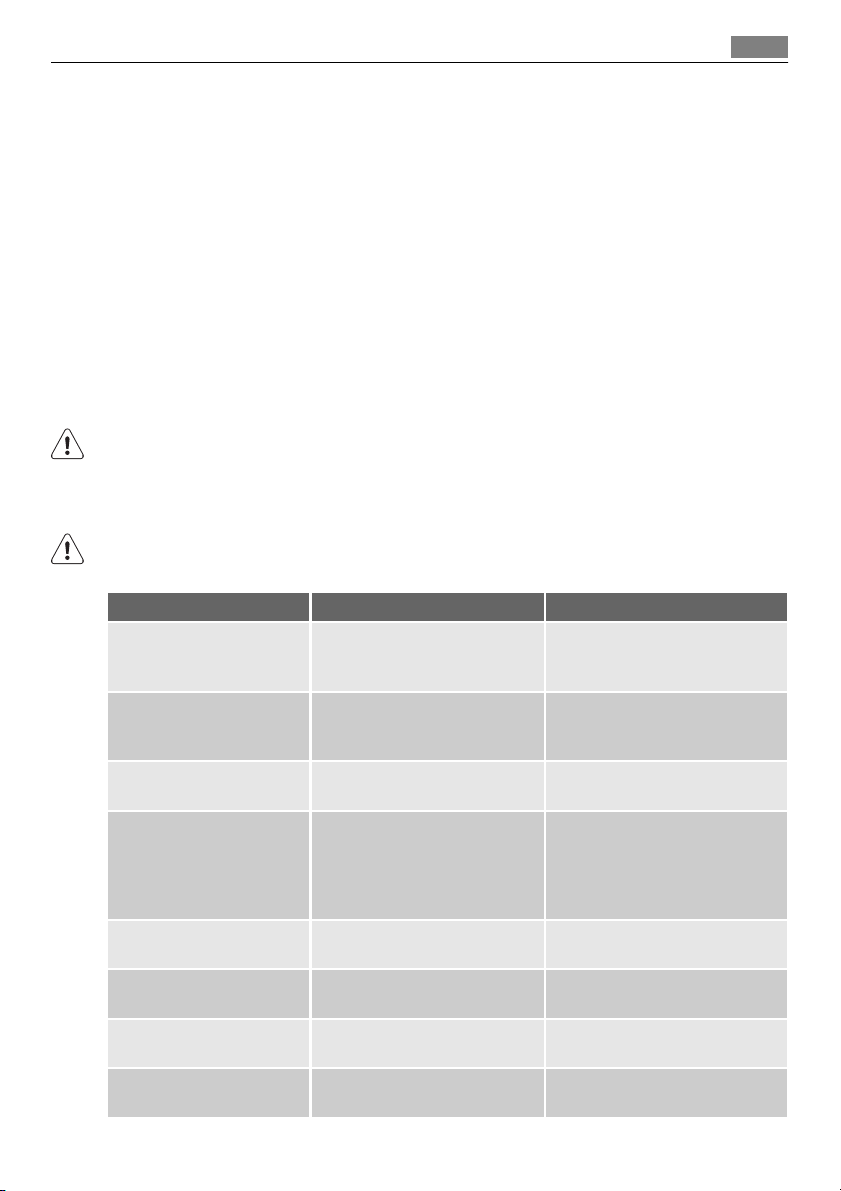
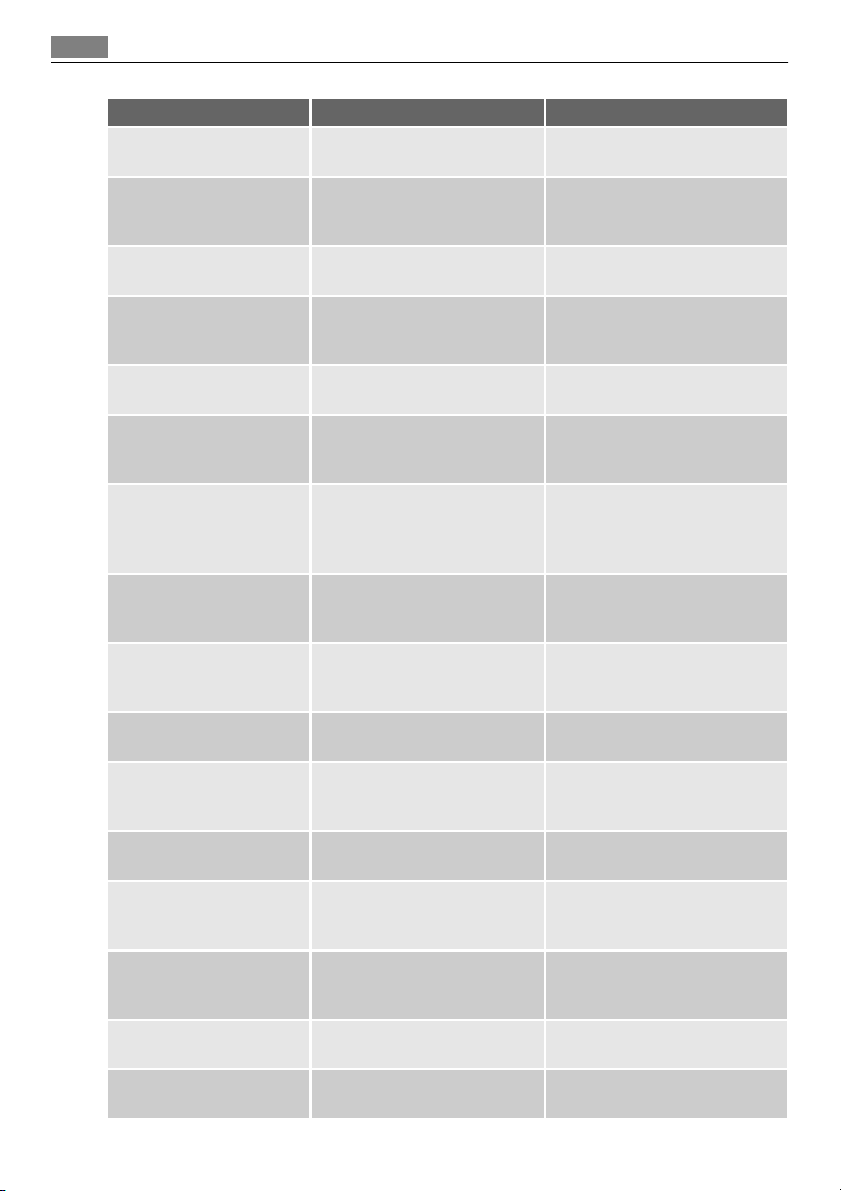
Anomalie Cause possible Remède
L'appareil est bruyant L'appareil n'est pas stable Vérifiez la stabilité (les quatre
L'appareil ne fonctionne
pas. L'ampoule ne fonctionne pas.
La fiche n'est pas correctement
Le courant n'arrive pas à l'appa-
L'ampoule ne fonctionne
pas.
L'ampoule est défectueuse. Consultez le paragraphe " Rem-
Le compresseur fonctionne
en permanence.
La porte n'est pas bien fermée. Consultez le paragraphe " Ferme-
L'appareil est éteint. Mettez l'appareil en fonctionne-
branchée à la prise de courant.
reil. La prise de courant n'est pas
alimentée.
L'éclairage est en mode veille Ouvrez et fermez la porte.
La température n'est pas bien
réglée.
pieds doivent être en contact
avec le sol)
ment.
Branchez correctement la fiche à
la prise de courant.
Branchez un autre appareil électrique à la prise de courant pour
voir s'il fonctionne.
Faites appel à un électricien qualifié.
placement de l'ampoule ".
Sélectionnez une température
plus élevée.
ture de la porte ".
10) Si cela est prévu.
Page 32
32 En cas d'anomalie de fonctionnement
Anomalie Cause possible Remède
La porte a été ouverte trop sou-
La température du produit est
La température ambiante est
De l'eau s'écoule sur la
plaque arrière du réfrigérateur.
De l'eau s'écoule dans le
réfrigérateur.
Des aliments empêchent l'eau
De l'eau coule sur le sol. L'eau de dégivrage ne s'écoule
La température à l'intérieur de l'appareil est trop
basse.
La température à l'intérieur de l'appareil est trop
élevée.
La porte n'est pas bien fermée. Consultez le paragraphe " Ferme-
La température du produit est
Trop de produits ont été intro-
La température du compartiment réfrigérateur est
trop élevée.
La température du congélateur est trop élevée.
Il y a trop de givre. Les aliments ne sont pas bien
La porte n'est pas bien fermée. Consultez le paragraphe " Ferme-
vent.
trop élevée.
trop élevée.
Pendant le dégivrage automati-
que, le givre fond sur la plaque
arrière.
L'orifice d'écoulement de l'eau
est obstrué.
de s'écouler dans le réservoir
d'eau.
pas dans le plateau d'évaporation situé au-dessus du compresseur.
Le thermostat n'est pas bien réglé.
Le thermostat n'est pas bien réglé.
trop élevée.
duits simultanément.
L'air froid ne circule pas dans
l'appareil.
Les produits sont trop près les
uns des autres.
emballés.
Ne laissez pas la porte ouverte
plus longtemps que nécessaire.
Laissez le produit revenir à température ambiante avant de le
ranger dans le congélateur.
Réduisez la température ambiante.
Ce phénomène est normal.
Nettoyez l'orifice.
Assurez-vous que les aliments ne
touchent pas la plaque arrière.
Fixez le tuyau de sortie de l'eau
au plateau d'évaporation.
Sélectionnez une température
plus élevée.
Sélectionnez une température
plus basse.
ture de la porte ".
Laissez le produit revenir à tem-
pérature ambiante avant de le
ranger dans le congélateur.
Introduisez moins de produits en
même temps.
Assurez-vous que l'air froid circule dans l'appareil.
Stockez les produits de façon à
permettre la circulation de l'air
froid.
Enveloppez les aliments correctement.
ture de la porte ".
Page 33
Caractéristiques techniques 33
Anomalie Cause possible Remède
Le thermostat n'est pas bien ré-
glé.
Sélectionnez une température
plus élevée.
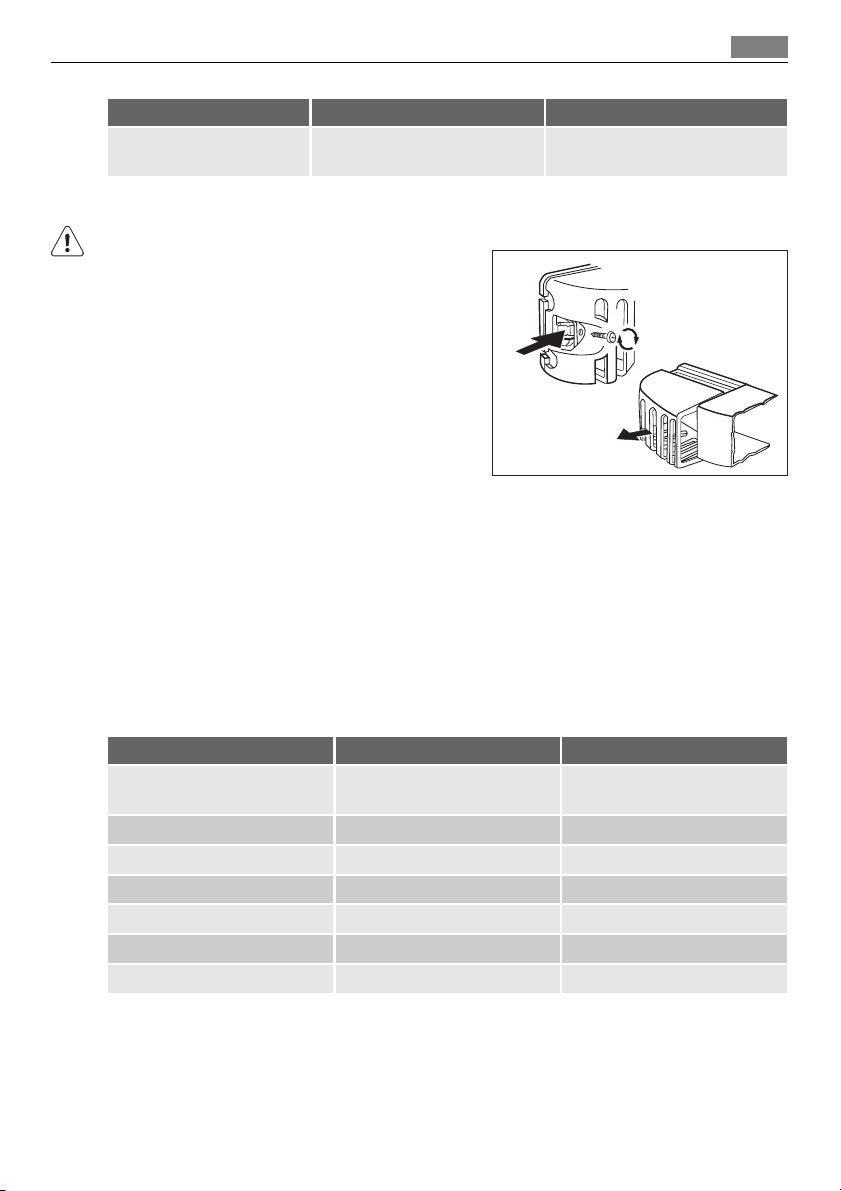
Remplacement de l'ampoule
ATTENTION
Débranchez l'appareil électriquement.
1. Retirez la vis du diffuseur.
2. Tirez le crochet du diffuseur vers l'extérieur.
2
3. Enlevez le diffuseur.
4. Remplacez l'ampoule par un modèle sem-
blable de même puissance (la puissance
maximale est indiquée sur le diffuseur).
5. Installez le diffuseur.
6. Serrez la vis du diffuseur.
7. Branchez l'appareil.
8. Ouvrez la porte. Vérifiez que l'ampoule s'allume.
Fermeture de la porte
1. Nettoyez les joints de la porte.
2. Si nécessaire, ajustez la porte. Consultez le paragraphe "Installation".
3. Si nécessaire, remplacez les joints défectueux. Contactez le Service Après-vente.
1
3
CARACTÉRISTIQUES TECHNIQUES
Dimensions de la niche d'encastrement
Hauteur 880 mm
Largeur 560 mm
Profondeur 550 mm
Autonomie de fonctionnement 12 h
Tension 230 V
Fréquence 50 Hz
Les caractéristiques techniques figurent sur la plaque signalétique située sur le côté gauche
à l'intérieur de l'appareil et sur l'étiquette énergétique.
Page 34

34 Installation
INSTALLATION
AVERTISSEMENT
Pour votre sécurité et le bon fonctionnement de l'appareil, veuillez lire attentivement les
"Consignes de sécurité" avant d'installer l'appareil.
Emplacement
Pour le bon fonctionnement de l'appareil, il est impératif de respecter les températures ambiantes du local où doit être placé l'appareil, suivant la classe climatique (indiquée sur la
plaque signalétique) pour lequel il est prévu. Au delà de ces températures, ses performances
peuvent s'en trouver diminuées : les différentes classes climatiques existantes et les températures ambiantes correspondantes en fonction du modèle de l'appareil sont les suivantes :
Classe climatique Température ambiante
SN +10 °C à +32 °C
N +16 °C à +32 °C
ST +16 °C à +38 °C
T +16 °C à +43 °C
Branchement électrique
Contrôlez, avant de brancher l'appareil, si la tension et la fréquence indiquées sur la plaque
signalétique correspondent à celles de votre réseau.
L'appareil doit être relié à la terre. La fiche du câble d'alimentation comporte un logement
pour mise à la terre. Si la prise de courant murale n'est pas mise à la terre, branchez l'appareil sur une prise de terre conformément aux normes en vigueur, en demandant conseil à
un électricien qualifié.
Le fabricant décline toute responsabilité en cas d'incident suite au non-respect des consignes de sécurité sus-mentionnées.
Cet appareil est conforme aux directives communautaires.
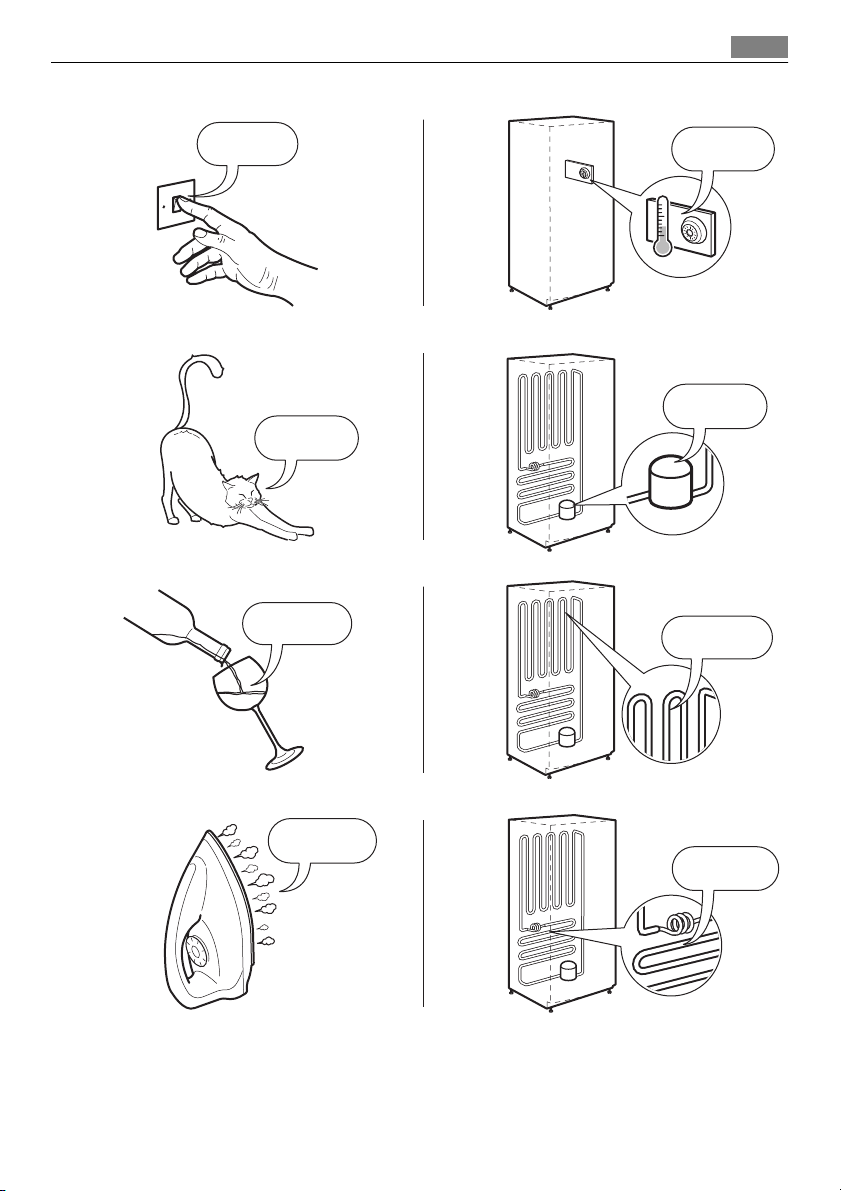
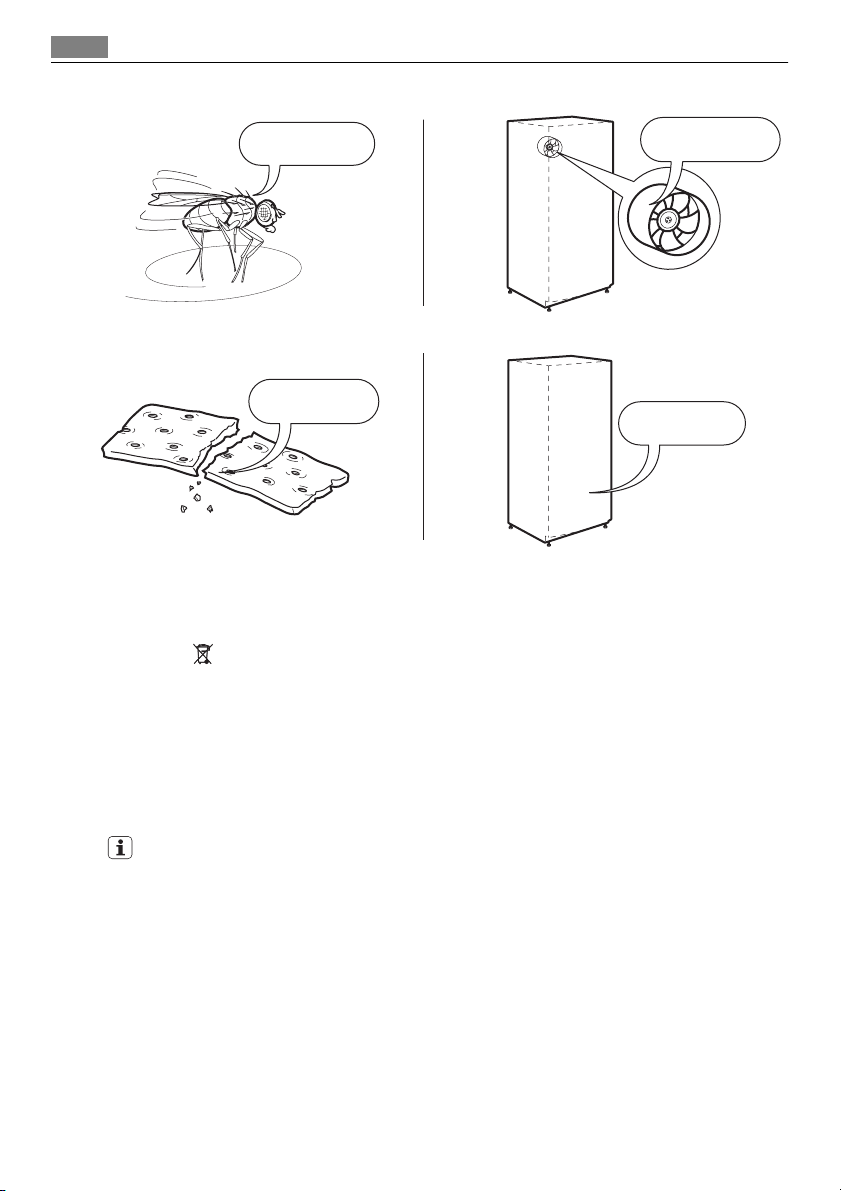
BRUITS
L'appareil émet certains bruits pendant son fonctionnement (compresseur, circuit de réfrigérant).
SSSRRR!
HISSS!
OK
BLUBB!
CLICK!
BRRR!
CRACK!
Page 35
Bruits 35
CLICK!
BRRR!
BLUBB!
CLICK!
BRRR!
BLUBB!
HISSS!
HISSS!
Page 36
36 En matière de sauvegarde de l'environnement
SSSRRR!
CRACK!
CRACK!
EN MATIÈRE DE SAUVEGARDE DE L'ENVIRONNEMENT
Le symbole sur le produit ou son emballage indique que ce produit ne peut être traité
comme déchet ménager. Il doit plutôt être remis au point de ramassage concerné, se
chargeant du recyclage du matériel électrique et électronique. En vous assurant que ce
produit est éliminé correctement, vous favorisez la prévention des conséquences négatives
pour l’environnement et la santé humaine qui, sinon, seraient le résultat d’un traitement
inapproprié des déchets de ce produit. Pour obtenir plus de détails sur le recyclage de ce
produit, veuillez prendre contact avec le bureau municipal de votre région, votre service
d’élimination des déchets ménagers ou le magasin où vous avez acheté le produit.
Où aller avec les appareils usagés?
Partout où des appareils neufs sont vendus, mais aussi dans un centre de collecte ou
une entreprise de récupération officiels SENS.
La liste des centres de collecte officiels SENS est disponible sous www.sens.ch.
SSSRRR!
Page 37
PER RISULTATI PERFETTI
Grazie per aver scelto di acquistare questo prodotto AEG.
Lo abbiamo creato per fornirvi prestazioni impeccabili per
molti anni, grazie a tecnologie innovative che vi
semplificheranno la vita - funzioni che non troverete sui
normali elettrodomestici. Vi invitiamo di dedicare qualche
minuto alla lettura per sapere come trarre il massimo dal
vostro elettrodomestico.
ACCESSORI E PRODOTTI DI CONSUMO
All'interno del webshop AEG troverete tutto ciò che vi
serve per fare in modo che i vostri elettrodomestici AEG
siano sempre perfettamente puliti e funzionanti. Non
mancano inoltre una vasta gamma di accessori studiati e
realizzati conformemente agli elevati standard qualitativi
che vi aspettate: pentole, scolaposate, portabottiglie e
sacchi biancheria delicati...
37
Visitate il webshop su
www.aeg.com/shop
Page 38
38 Indice
INDICE
39 Informazioni per la sicurezza
42 Pannello dei comandi
42 Primo utilizzo
43 Utilizzo quotidiano
44 Consigli e suggerimenti utili
46 Pulizia e cura
48 Cosa fare se…
50 Dati tecnici
50 Installazione
51 Rumori
53 Considerazioni ambientali
In questo manuale sono riportati i seguenti
simboli:
Informazioni importanti relative alla
prevenzione dei rischi per la salute personale
e dei danni alle apparecchiature.
Informazioni e consigli generali
Informazioni in materia di sicurezza
ambientale
Con riserva di modifiche
Page 39
Informazioni per la sicurezza
INFORMAZIONI PER LA SICUREZZA
Per garantire un impiego corretto e sicuro dell'apparecchio, prima dell'installazione e del
primo utilizzo leggere con attenzione il libretto istruzioni, inclusi i suggerimenti e le avvertenze. Per evitare errori e incidenti, è importante garantire che tutte le persone che utilizzano l'apparecchio ne conoscano il funzionamento e le caratteristiche di sicurezza. Conservare
queste istruzioni e accertarsi che rimangano unite all'apparecchio in caso di vendita o trasloco, in modo che chiunque lo utilizzi sia correttamente informato sull'uso e sulle norme di
sicurezza.
Per la sicurezza delle persone e delle cose osservare le precauzioni indicate nelle presenti
istruzioni per l'utente, il produttore non è responsabile dei danni provocati da eventuali
omissioni.
Sicurezza dei bambini e delle persone fragili
• Questo apparecchio non deve essere usato da persone, bambini inclusi, con ridotte capacità fisiche, sensoriali o psichiche, oppure prive di conoscenza e esperienza, a meno che
non siano state istruite all'uso dell'apparecchio da parte dei responsabili della loro sicurezza, oppure sotto vigilanza di questi.
I bambini devono essere sorvegliati per assicurarsi che non giochino con l'apparecchio.
• Tenere i materiali di imballaggio al di fuori della portata dei bambini. Alcuni materiali
possono creare rischi di soffocamento.
• Qualora l'apparecchio venga demolito, estrarre la spina dalla presa, tagliare il cavo di collegamento (il più vicino possibile all'apparecchio) e smontare lo sportello per evitare che i
bambini giocando possano subire scosse elettriche o chiudersi dentro l'apparecchio.
• Se questo nuovo apparecchio, che è dotato di guarnizioni magnetiche nello sportello, va
a sostituirne uno più vecchio avente sportello o coperchio con chiusure a molla, si deve
rendere inutilizzabili tali chiusure prima di eliminare l'apparecchio sostituito, per evitare
che diventi una trappola mortale per i bambini.
39
Norme di sicurezza generali
AVVERTENZA
Verificare che le aperture di ventilazione, sia sull'apparecchiatura che nella struttura da incasso, siano libere da ostruzioni.
• L'apparecchiatura è progettata per la conservazione domestica di alimenti e/o bevande
nelle modalità descritte nelle presenti istruzioni.
• Non utilizzare dispositivi meccanici o altri mezzi artificiali per accelerare lo sbrinamento.
• Non utilizzare altre apparecchiature elettriche (per esempio gelatiere) all'interno del frigorifero, salvo quelle approvate per tale scopo dal produttore.
• Non danneggiare il circuito refrigerante.
• Il circuito refrigerante dell'apparecchiatura contiene isobutano (R600a), un gas naturale
con un elevato livello di compatibilità ambientale che, tuttavia, è infiammabile.
Durante il trasporto e l'installazione dell'apparecchiatura, assicurarsi che nessuno dei
componenti del circuito refrigerante venga danneggiato.
Page 40
40 Informazioni per la sicurezza
In caso di danneggiamento del circuito refrigerante:
– Evitare fiamme libere e scintille
– Aerare bene il locale in cui si trova l'apparecchiatura
• È pericoloso cambiare le specifiche o modificare il prodotto in qualunque modo. Un danneggiamento del cavo potrebbe provocare cortocircuiti, incendi e/o scosse elettriche.
AVVERTENZA
Tutti i componenti elettrici (cavo di alimentazione, spina, compressore) devono essere sostituiti da un tecnico certificato o da personale d'assistenza qualificato al fine di evitare di
correre rischi.
1. Non collegare prolunghe al cavo di alimentazione.
2. Evitare che il lato posteriore dell'apparecchiatura possa schiacciare o danneggiare la
spina, causandone il surriscaldamento con un conseguente rischio di incendio.
3. La spina dell'apparecchiatura deve trovarsi in una posizione accessibile.
4. Non tirare il cavo di alimentazione.
5. Se la presa elettrica non è perfettamente stabile, non inserire la spina. Il collega-
mento potrebbe provocare scosse elettriche o creare un rischio di incendio.
6.
Non accendere l’apparecchiatura se non è installato il coprilampada
11)
della luce in-
terna.
• Quest'apparecchiatura è pesante. Prestare attenzione quando occorre spostarla.
• Evitare di estrarre o di toccare gli alimenti riposti nel vano congelatore con le mani bagnate o umide; il contatto potrebbe provocare abrasioni o ustioni da freddo.
• Evitare un'esposizione prolungata dell'apparecchiatura alla luce solare diretta.
•
Lampadine
12)
utilizzate in questa apparecchiatura solo lampadine speciali, selezionate
per essere usate unicamente negli elettrodomestici. Non sono adatte per l'illuminazione
degli ambienti.
Uso quotidiano
• Non collocare pentole calde sulle parti in plastica dell'apparecchio.
• Non collocare gas e liquidi infiammabili nell'apparecchio, perché potrebbero esplodere.
• Non collocare gli alimenti direttamente contro l'uscita dell'aria nella parete posteriore.
13)
• Gli alimenti congelati non devono essere ricongelati una volta scongelati.
• Riporre gli alimenti surgelati preconfezionati secondo le istruzioni del produttore dell'alimento surgelato.
• Osservare rigorosamente i consigli per la conservazione degli alimenti del produttore dell'apparecchio. Vedere le relative istruzioni.
• Non collocare bevande gassate o frizzanti nello scomparto congelatore perché creano
pressione sul recipiente che può esplodere danneggiando l'apparecchio.
• I ghiaccioli possono provocare bruciature da gelo se consumati immediatamente dopo
averli tolti dall'apparecchio.
11) Se previsto nel modello.
12) Se è prevista la luce.
13) Se l'apparecchio è di tipo No-Frost.
Page 41
Informazioni per la sicurezza 41
Pulizia e cura
• Prima della manutenzione, spegnere l'apparecchio e staccare la spina dalla presa.
• Non pulire l'apparecchio con oggetti metallici.
• Non usare oggetti appuntiti per rimuovere la brina dall'apparecchio. Usare un raschietto
di plastica.
• Esaminare regolarmente il foro di scarico dell'acqua di sbrinamento nel frigorifero. Se necessario, pulirlo. Se il foro è otturato, l'acqua si raccoglie sul fondo dell'apparecchio.
Installazione
Per il collegamento elettrico, seguire attentamente le istruzioni dei paragrafi corrispondenti.
• Disimballare l'apparecchio e assicurarsi che non presenti danni. Non collegare l'apparecchio se è danneggiato. Segnalare immediatamente gli eventuali danni al negozio in cui è
stato acquistato. In questo caso conservare l'imballaggio.
• Si consiglia di attendere almeno due ore prima di collegare l'apparecchio per consentire
all'olio di arrivare nel compressore.
• Attorno all'apparecchio vi deve essere un'adeguata circolazione dell'aria, altrimenti si può
surriscaldare. Per ottenere una ventilazione sufficiente seguire le istruzioni di installazione.
• Se possibile il retro dell'apparecchio dovrebbe essere posizionato contro una parete per
evitare di toccare le parti calde o di rimanervi impigliati (compressore, condensatore),
evitando così possibili scottature.
• L'apparecchio non deve essere posto vicino a radiatori o piani di cottura a gas.
• Installare l'apparecchio in modo che la presa rimanga accessibile.
•
Per il collegamento idrico, usare solo sorgenti d'acqua potabile.
14)
Assistenza tecnica
• Gli interventi elettrici sull'apparecchiatura devono essere eseguiti esclusivamente da elettricisti qualificati o da personale competente.
• Gli interventi di assistenza devono essere eseguiti esclusivamente da tecnici autorizzati e
utilizzando solo ricambi originali.
Tutela ambientale
Questo apparecchio non contiene gas che potrebbero danneggiare lo strato di ozono nel
circuito refrigerante o nei materiali isolanti. L'apparecchio non deve essere smaltito assieme
ai rifiuti urbani e alla spazzatura. La schiuma dell'isolamento contiene gas infiammabili: lo
smaltimento dell'apparecchio va eseguito secondo le prescrizioni vigenti da richiedere alle
autorità locali. Evitare di danneggiare il gruppo refrigerante, specialmente nella parte posteriore vicino allo scambiatore di calore. I materiali usati su questo apparecchio contrassegnati dal simbolo
14) Per gli apparecchi che prevedono un collegamento alla rete idrica.
sono riciclabili.
Page 42
42 Pannello dei comandi
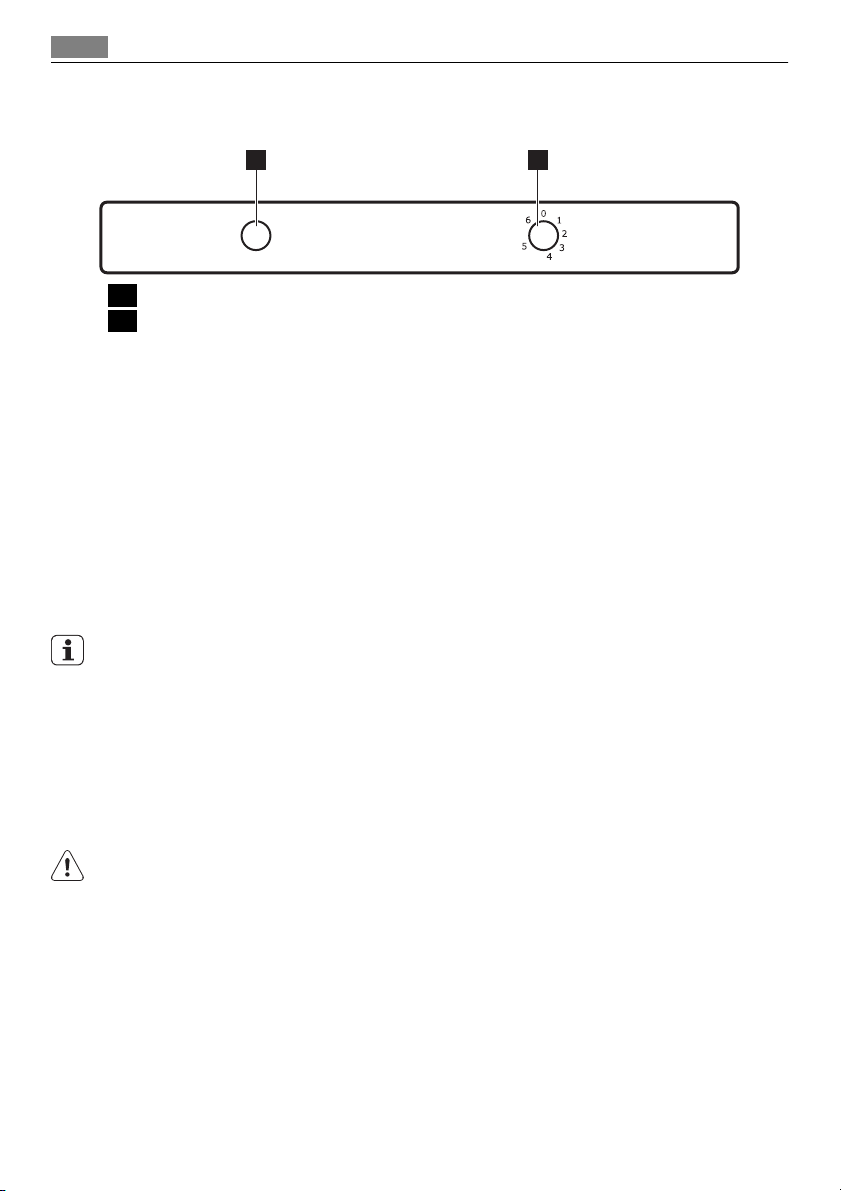
PANNELLO DEI COMANDI
1 2
1 Interruttore luce
2 Regolatore temperatura
Accensione
Inserire la spina nella presa a muro.
Impostare il regolatore di temperatura a un livello medio, ruotandolo in senso orario.
Spegnimento
Per spegnere l’apparecchiatura, ruotare il regolatore di temperatura in posizione "O".
Regolazione della temperatura
La temperatura è regolata automaticamente.
Per utilizzare l'apparecchio, procedere come segue:
• ruotare il termostato verso una regolazione bassa per un raffreddamento minimo.
• ruotare il termostato verso una regolazione alta per un raffreddamento massimo.
Una regolazione media è in genere la più adatta.
Tuttavia la regolazione esatta dovrebbe essere scelta tenendo a mente che la temperatura
all'interno dell'apparecchio dipende da:
• temperatura ambiente
• frequenza di apertura della porta
• quantità di cibo conservato
• posizione dell'apparecchio.
Se la temperatura ambiente è elevata o l'apparecchio è a pieno carico ed è regolato su temperature minime, può funzionare in continuo causando la formazione di brina sulla parete
posteriore. In questo caso la manopola deve essere regolata su una temperatura per consentire lo sbrinamento automatico riducendo così il consumo di energia.
PRIMO UTILIZZO
Pulizia dell'interno
Prima di utilizzare l'apparecchio per la prima volta, lavare l'interno e gli accessori interni
con acqua tiepida e un po' di sapone neutro in modo a togliere il tipico odore dei prodotti
nuovi, quindi asciugare accuratamente.
Page 43
Utilizzo quotidiano 43
Non usare detergenti corrosivi o polveri abrasive che danneggiano le finiture.
UTILIZZO QUOTIDIANO
Congelazione dei cibi freschi
Il vano congelatore è adatto alla congelazione di cibi freschi e alla conservazione a lungo
termine di cibi congelati e surgelati.
Per congelare cibi freschi non è necessario cambiare la regolazione media.
Tuttavia, per un'operazione di congelamento più rapida, ruotare il termostato verso una regolazione più alta per ottenere il massimo raffreddamento.
In questa condizione la temperatura del vano frigorifero può scendere sotto 0°C. In questo
caso riportare il termostato verso una regolazione più calda.
Conservazione dei surgelati
Al primo avvio o dopo un periodo di non utilizzo, lasciare in funzione l'apparecchiatura per
almeno 2 ore con una regolazione alta prima di introdurre gli alimenti.
Se si verifica un'interruzione della corrente elettrica di durata superiore al "tempo di salita"
indicato nella tabella dei dati tecnici, il cibo scongelato deve essere consumato rapidamente
o cucinato immediatamente e quindi ricongelato (dopo il raffreddamento).
Scongelamento
Prima dell'utilizzo, i cibi surgelati o congelati possono essere scongelati nel vano frigorifero
o a temperatura ambiente, in funzione del tempo disponibile per questa operazione.
I pezzi piccoli possono addirittura essere cucinati ancora congelati, direttamente dal congelatore: in questo caso la cottura durerà più a lungo.
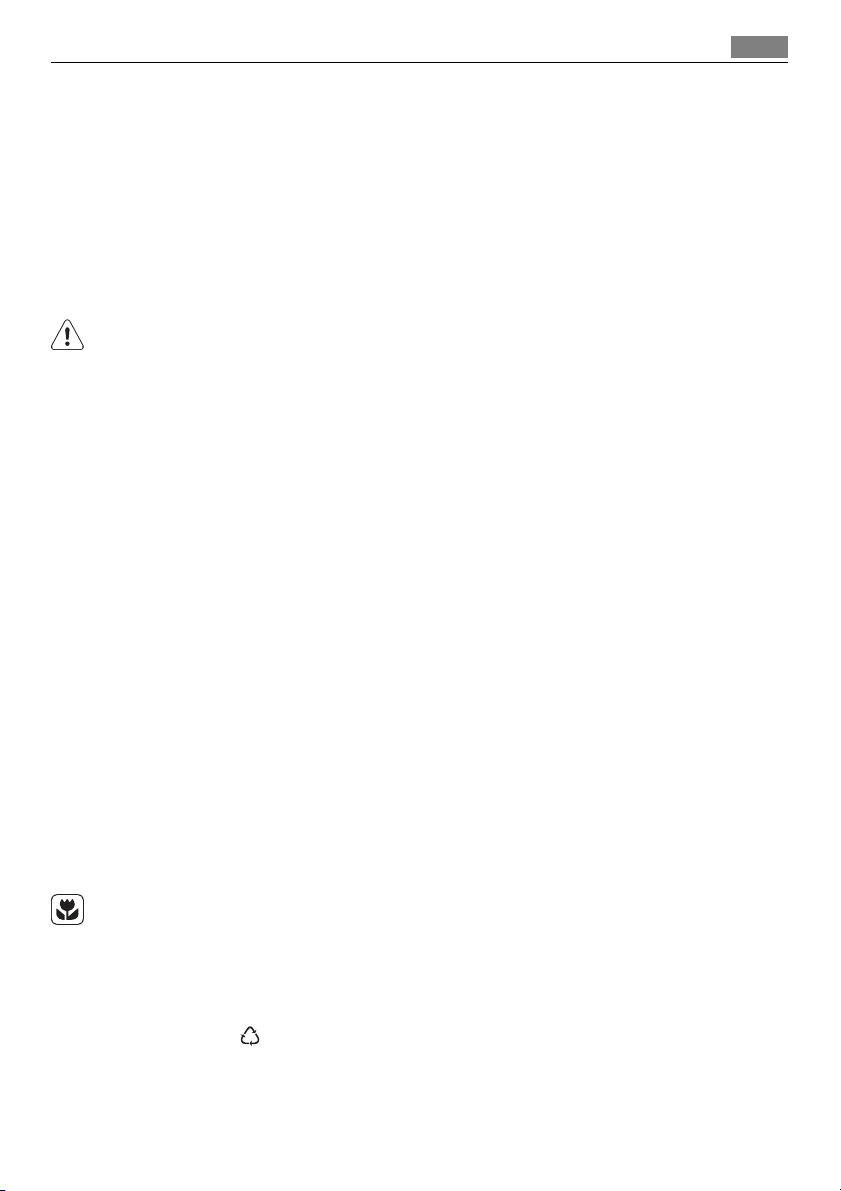
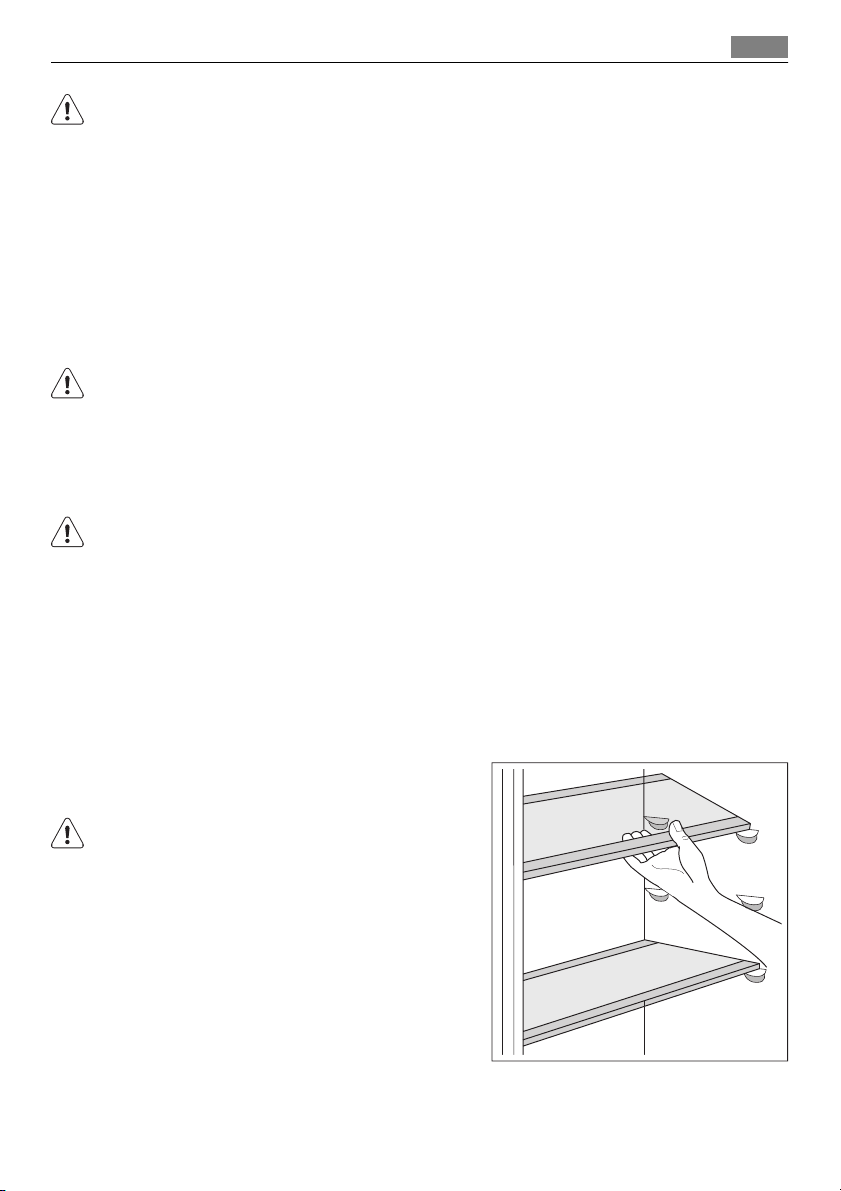
Ripiani mobili
Le guide presenti sulle pareti del frigorifero permettono di posizionare i ripiani a diverse altezze.
Non spostare il ripiano di vetro sopra il cassetto
delle verdure e il ripiano delle bottiglie per garantire la corretta circolazione dell'aria.
Page 44
44 Consigli e suggerimenti utili
Posizionamento dei ripiani della porta
Per facilitare l'introduzione di alimenti di diverse
dimensioni, i ripiani della porta possono essere
posizionati ad altezze differenti.
Per regolare l'altezza dei ripiani, procedere come
segue:
tirare delicatamente il ripiano nella direzione indicata dalle frecce fino a sganciarlo, quindi riposizionarlo dove necessario.
Il modello è dotato di un contenitore variabile per
la conservazione, applicato sotto un ripiano della
porta, che è possibile far scorrere lateralmente.
CONSIGLI E SUGGERIMENTI UTILI
Rumori normali durante il funzionamento
• Quando il refrigerante viene pompato attraverso le bobine o le tubazioni si può sentire
un fievole gorgoglio e un borbottio. Non si tratta di un'anomalia.
• Quando il compressore è in funzione, viene pompato il refrigerante e si può sentire un
ronzio e un rumore pulsante dal compressore. Non si tratta di un'anomalia.
• La dilatazione termica potrebbe provocare uno schiocco improvviso. È un fenomeno naturale, non pericoloso. Non si tratta di un'anomalia.
• Quando il compressore si accende o si spegne, si sente un lieve scatto del regolatore della
temperatura. Non si tratta di un'anomalia.
Consigli per il risparmio energetico
• Non aprire frequentemente la porta e non lasciarla aperta più di quanto assolutamente
necessario.
• Se la temperatura ambiente è elevata, il termostato è impostato su una regolazione alta
e l'apparecchio è a pieno carico, il compressore può funzionare in continuo causando la
formazione di brina o ghiaccio sull'evaporatore. In questo caso, ruotare il termostato su
una regolazione più bassa per consentire lo scongelamento automatico risparmiando così energia.
Consigli per la refrigerazione di cibi freschi
Per ottenere i migliori risultati:
• non riporre nel frigorifero cibi caldi o liquidi in fase di evaporazione
• coprire o avvolgere il cibo, in particolare se emana un odore forte
• posizionare il cibo in modo che l'aria possa circolare liberamente attorno ad esso
Page 45

Consigli e suggerimenti utili
Consigli per la refrigerazione
Consigli utili:
Carne (tutti i tipi): avvolgerla in sacchetti di politene e collocarla sul ripiano di vetro sopra il
cassetto delle verdure.
Per motivi di sicurezza, conservarla in queste condizioni solo per uno o due giorni al massimo.
Cibi cucinati, piatti freddi ecc..: dovrebbero essere coperti e possono essere collocati su
qualsiasi ripiano.
Frutta e verdura: dovrebbero essere pulite accuratamente e collocate nell'apposito/i cassetto/i speciale/i.
Burro e formaggio: dovrebbero essere posti in contenitori ermetici speciali o avvolti in pellicole di alluminio o sacchetti di politene per escludere per quanto possibile l'aria.
Bottiglie di latte: dovrebbero essere tappate e conservate nell'apposito ripiano sulla porta.
Non conservare nel frigorifero banane, patate, cipolle o aglio se non sono confezionati.
Consigli per il congelamento
Per un processo di congelamento ottimale, ecco alcuni consigli importanti:
• la quantità massima di cibo che può essere congelata in 24 h è riportata sulla targhetta;
• il processo di congelamento dura 24 ore. In questo periodo non aggiungere altro cibo da
congelare;
• congelare solo alimenti freschi, di ottima qualità e accuratamente puliti;
• preparare il cibo in piccole porzioni per consentire un congelamento rapido e completo e
per scongelare in seguito solo la quantità necessaria;
• avvolgere il cibo in pellicole di alluminio o in politene e verificare che i pacchetti siano
ermetici;
• non lasciare che cibo fresco non congelato entri in contatto con quello già congelato,
per evitare un aumento della temperatura in quest'ultimo;
• i cibi magri si conservano meglio e più a lungo di quelli grassi; il sale riduce il periodo di
conservazione del cibo;
• i ghiaccioli, se consumati immediatamente dopo la rimozione dal vano congelatore, possono causare ustioni da congelamento della pelle;
• si consiglia di riportare la data di congelamento su ogni singolo pacchetto per riuscire a
tenere traccia del tempo di conservazione;
45
Consigli per la conservazione dei surgelati
Per ottenere i migliori risultati con questo apparecchio:
• accertare che i cibi congelati commercialmente siano adeguatamente conservati dal rivenditore;
• fare in modo che i cibi congelati siano trasferiti dal negozio al congelatore nel più breve
tempo possibile;
• non aprire la porta frequentemente o lasciarla aperta più del tempo strettamente necessario.
• Una volta scongelato, il cibo si deteriora rapidamente e non può essere ricongelato.
• Non superare il periodo di conservazione indicato dal produttore.
Page 46
46 Pulizia e cura
PULIZIA E CURA
ATTENZIONE
Staccare la spina dell'apparecchio prima di eseguire lavori di manutenzione.
Questo apparecchio contiene idrocarburi nell'unità di raffreddamento; la manutenzione e la
ricarica devono pertanto essere effettuate esclusivamente da tecnici autorizzati.
Pulizia periodica
L'apparecchio deve essere pulito regolarmente:
• lavare l'interno e gli accessori con acqua tiepida e sapone neutro.
• ispezionare regolarmente le guarnizioni delo sportello ed eliminare con un panno umido
tracce di sporco e residui.
• risciacquare e asciugare accuratamente.
Evitare di tirare, spostare o danneggiare tubi e/o cavi all'interno dell'apparecchio.
Per la pulizia delle parti interne, non usare mai detergenti, polveri abrasive, prodotti con
forti profumazioni o cere lucidanti, che potrebbero danneggiare la superficie e lasciare un
odore intenso.
Prestare attenzione a non danneggiare il sistema refrigerante.
Molti detergenti per cucine di marca contengono sostanze chimiche in grado di attaccare/
danneggiare la plastica impiegata in questo apparecchio. Per questo motivo si raccomanda
di pulire l'involucro esterno dell'apparecchio solo con acqua calda con un po' di liquido detergente.
Dopo la pulizia, ricollegare l'apparecchio alla rete di alimentazione.
Sbrinamento del vano frigorifero
Durante l'uso normale, la brina viene eliminata automaticamente dall'evaporatore del vano
frigorifero ogni volta che il motocompressore si arresta. L'acqua di sbrinamento giunge attraverso un condotto in un apposito recipiente posto sul retro dell'apparecchio, sopra il motocompressore, dove evapora.
Page 47
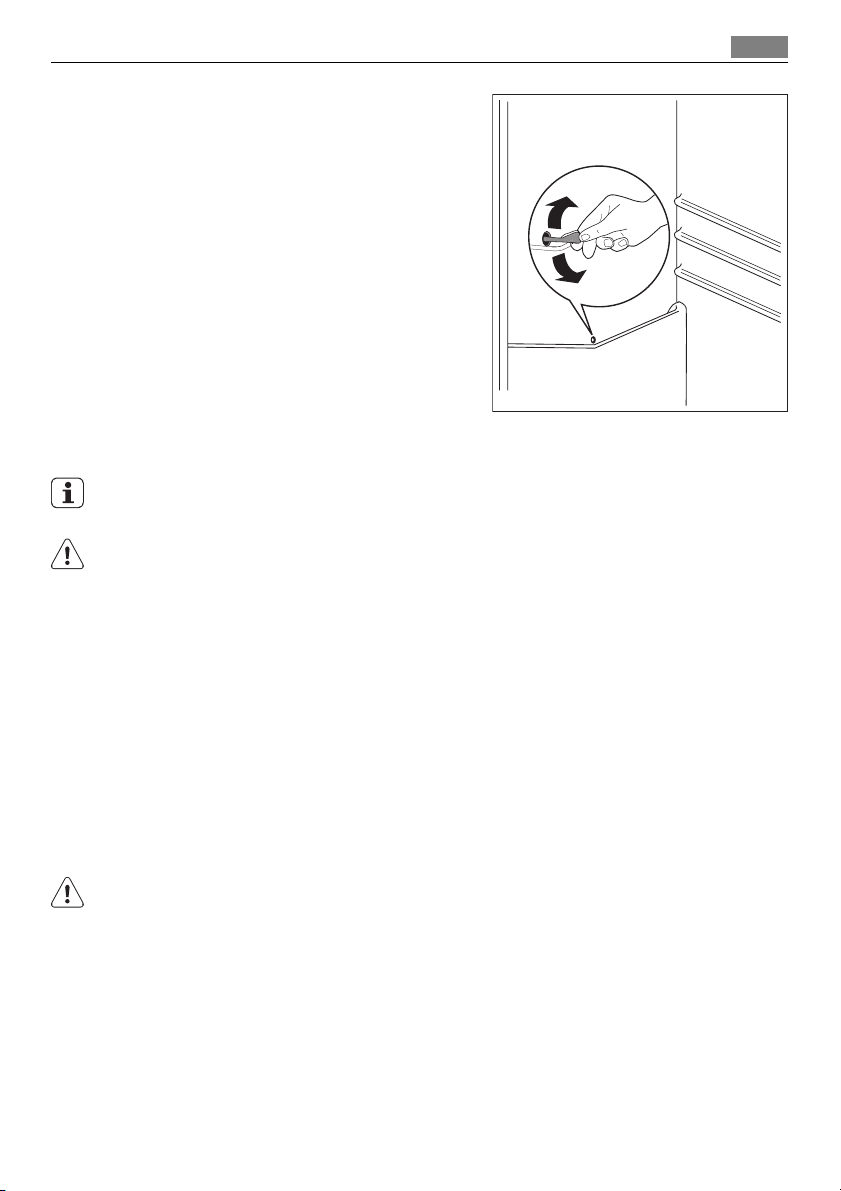
Pulizia e cura 47
È importante pulire periodicamente il foro di scarico dell'acqua di sbrinamento, situato al centro
del canale sulla parete posteriore, per evitare che
l'acqua fuoriesca sugli alimenti. Usare l'apposito
utensile già inserito nel foro di scarico.
Sbrinamento del congelatore
Una certa quantità di brina si formerà sempre sui ripiani del congelatore e attorno allo
scomparto superiore.
Sbrinare il congelatore quando lo strato di brina raggiunge uno spessore di ca. 3-5 mm.
Per rimuovere la brina, seguire le istruzioni sottostanti:
1. Spegnere l'apparecchio.
2. Rimuovere il cibo eventualmente conservato, avvolgendolo in diversi strati di carta di
giornale e collocandolo in un luogo fresco.
3. Lasciare la porta aperta.
4. Una volta completato lo sbrinamento, asciugare accuratamente l'interno e reinserire la
spina.
5. Accendere l'apparecchio.
6. Regolare il termostato sul raffreddamento massimo e fare funzionare l'apparecchio
con questa regolazione per due o tre ore.
7. Ricaricare nel vano il cibo precedentemente rimosso.
Non usare utensili metallici appuntiti per rimuovere la brina dall'evaporatore per non danneggiarlo. Non usare dispositivi elettrici o altri mezzi artificiali per accelerare il processo di
scongelamento diversi da quelli raccomandati dal fabbricante. Un aumento di temperatura
dei pacchetti di cibo congelato durante lo sbrinamento può ridurre la loro durata di conservazione.
Periodi di inutilizzo
Quando l'apparecchio non è utilizzato per lunghi periodi, adottare le seguenti precauzioni:
• scollegare l'apparecchio dalla rete elettrica
• rimuovere tutto il cibo
sbrinare
15)
e pulire l'apparecchio e tutti gli accessori
•
Page 48
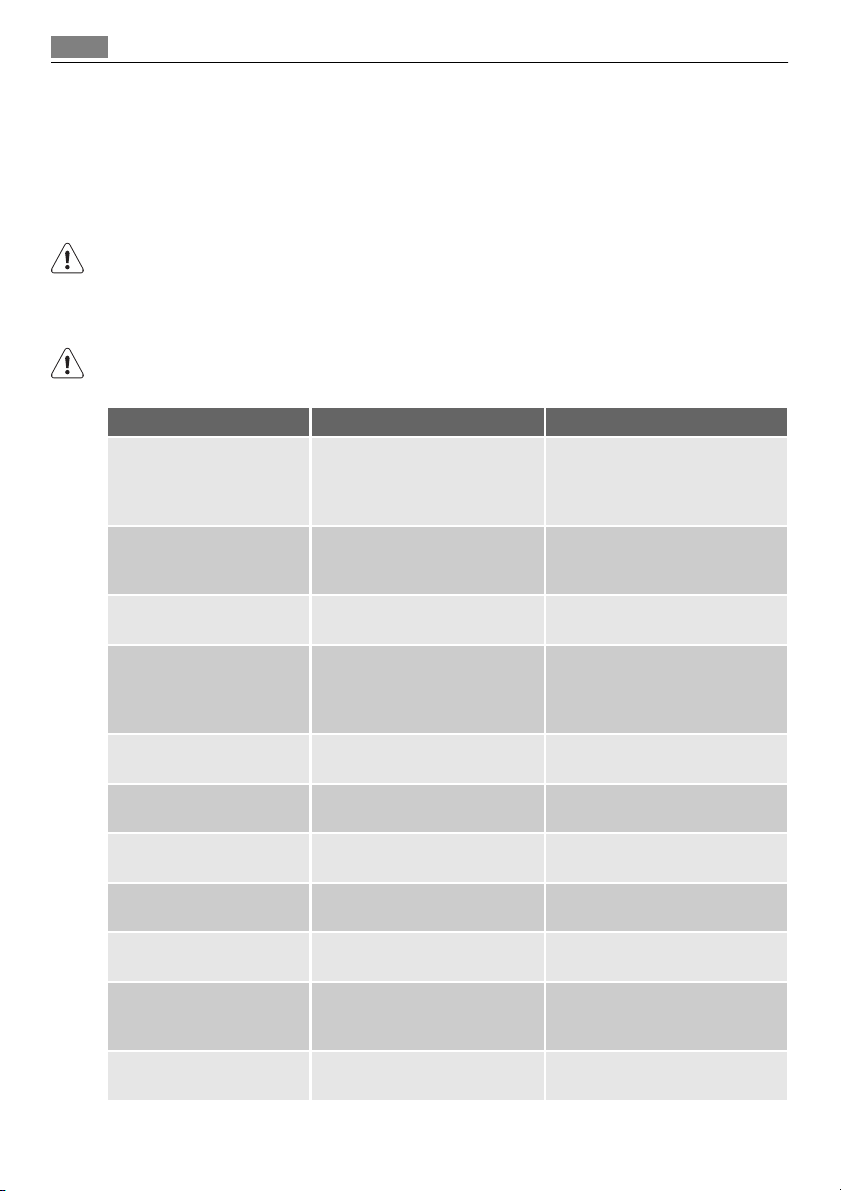
48 Cosa fare se…
• lasciare la/e porta/e socchiusa/e per evitare odori sgradevoli.
Se l'apparecchio rimane acceso, chiedere a qualcuno di controllare ogni tanto per evitare
che il cibo contenuto marcisca in caso di interruzione dell'alimentazione elettrica.
COSA FARE SE…
AVVERTENZA
Prima della ricerca guasti, estrarre la spina dalla presa.
Le operazioni di ricerca guasti non descritte nel presente manuale devono essere eseguite
esclusivamente da elettricisti qualificati o da personale competente.
Durante l'uso, alcuni rumori di funzionamento (come quelli del compressore o del circuito
refrigerante) sono da considerarsi normali.
Problema Possibile causa Soluzione
Funzionamento rumoroso L'apparecchiatura non è appog-
L'apparecchiatura non
funziona. La lampadina
non si accende.
La spina non è inserita corretta-
L'apparecchiatura non riceve
La lampadina non si accende.
La lampadina è difettosa. Vedere "Sostituzione della lampa-
Il compressore rimane
sempre in funzione.
La porta non è chiusa corretta-
La porta viene aperta troppo
La temperatura degli alimenti è
La temperatura ambiente è
giata in modo corretto
L'apparecchiatura è spenta. Accendere l'apparecchiatura.
mente nella presa.
corrente. Non arriva tensione alla presa elettrica.
La lampadina è in stand-by. Aprire e chiudere la porta.
La temperatura non è regolata
correttamente.
mente.
frequentemente.
troppo alta.
troppo alta.
Controllare che l'apparecchiatura
sia appoggiata in modo stabile
(tutti i piedini devono essere a
contatto con il pavimento)
Inserire correttamente la spina
nella presa.
Collegare alla presa un'altra apparecchiatura elettrica.
Rivolgersi a un elettricista qualificato.
dina".
Impostare una temperatura supe-
riore.
Vedere "Chiusura della porta".
Limitare il più possibile il tempo
di apertura della porta.
Prima di introdurre gli alimenti,
lasciarli raffreddare a temperatura ambiente.
Abbassare la temperatura ambiente.
15) Se previsto.
Page 49
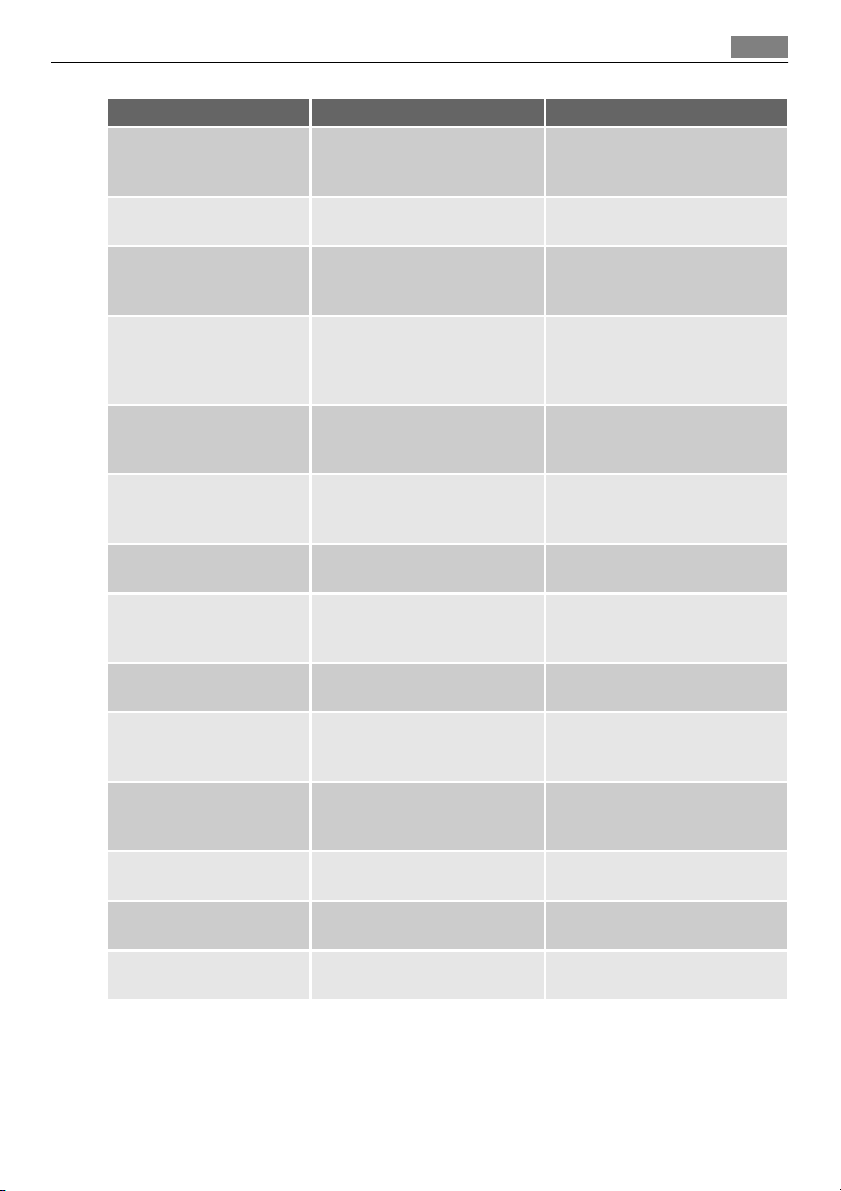
Problema Possibile causa Soluzione
Scorre acqua sul pannello
posteriore del frigorifero.
Scorre acqua all'interno
del frigorifero.
Gli alimenti impediscono all'ac-
Scorre acqua sul pavimento.
La temperatura all'interno
dell'apparecchiatura è
troppo bassa.
La temperatura all'interno
dell'apparecchiatura è
troppo alta.
La porta non è chiusa corretta-
La temperatura degli alimenti è
Sono stati introdotti molti ali-
La temperatura nel vano
frigorifero è troppo alta.
La temperatura nel vano
congelatore è troppo alta.
Si forma troppa brina. Gli alimenti non sono avvolti
La porta non è chiusa corretta-
La temperatura non è regolata
Durante lo sbrinamento automatico, la brina che si forma sul
pannello posteriore si scioglie.
Lo scarico dell'acqua è ostruito. Pulire lo scarico dell'acqua.
qua di scorrere nell'apposito collettore.
L'acqua di sbrinamento non viene scaricata nella bacinella di
evaporazione posta sopra il
compressore.
La temperatura non è regolata
correttamente.
La temperatura non è regolata
correttamente.
mente.
troppo alta.
menti insieme.
L'aria fredda non circola corret-
tamente all'interno dell'apparecchiatura.
I surgelati sono troppo vicini tra
loro.
correttamente.
mente.
correttamente.
Cosa fare se… 49
Non si tratta di un'anomalia.
Evitare di disporre gli alimenti direttamente contro la parete posteriore.
Collegare lo scarico dell'acqua di
sbrinamento alla bacinella di evaporazione.
Impostare una temperatura superiore.
Impostare una temperatura inferiore.
Vedere "Chiusura della porta".
Prima di introdurre gli alimenti,
lasciarli raffreddare a temperatura ambiente.
Introdurre gli alimenti poco alla
volta.
Adottare le misure necessarie per
garantire una corretta circolazione dell'aria fredda.
Disporre i surgelati in modo da
consentire una corretta circolazione dell'aria fredda.
Avvolgere correttamente gli alimenti.
Vedere "Chiusura della porta".
Impostare una temperatura superiore.
Page 50
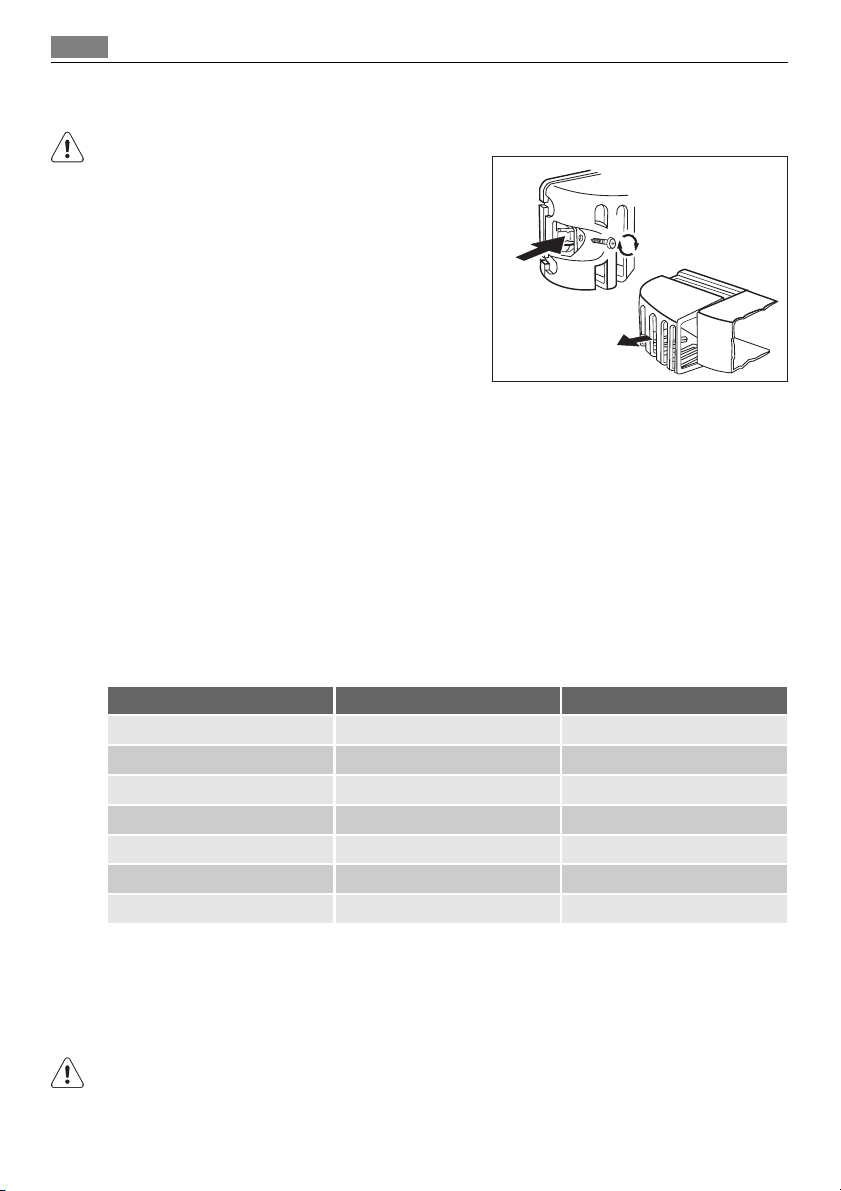
50 Dati tecnici
Sostituzione della lampadina
ATTENZIONE
Estrarre la spina dalla presa di corrente.
1. Rimuovere la vite dal coprilampada.
2. Tirare il gancio del coprilampada verso
l’esterno
3. Rimuovere il coprilampada.
4. Sostituire la lampadina con una di uguale
potenza (la potenza massima è indicata sul
coprilampada).
5. Installare il coprilampada.
6. Serrare la vite del coprilampada.
7. Inserire la spina nella presa.
8. Aprire la porta. Controllare che la lampadina si accenda.
2
1
3
Chiusura della porta
1. Pulire le guarnizioni della porta.
2. Se necessario, regolare la porta. Vedere "Installazione".
3. Se necessario, sostituire le guarnizioni della porta difettose. Contattare il Centro di as-
sistenza locale.
DATI TECNICI
Nicchia di incasso
Altezza 880 mm
Larghezza 560 mm
Profondità 550 mm
Tempo di risalita 12 h
Tensione 230 V
Frequenza 50 Hz
I dati tecnici sono riportati sulla targhetta del modello, applicata sul lato sinistro interno
dell'apparecchiatura, e sull'etichetta dei valori energetici.
INSTALLAZIONE
AVVERTENZA
Leggere con attenzione le "Informazioni per la sicurezza" per la vostra sicurezza e per il corretto funzionamento dell'apparecchio prima di procedere all'installazione.
Page 51

Luogo d'installazione
Questa apparecchiatura può essere installata in un luogo asciutto e ben ventilato (garage o
una cantina); tuttavia, per ottenere prestazioni ottimali è consigliabile installarlo in un luogo la cui temperatura ambiente corrisponda alla classe climatica indicata sulla targhetta del
modello:
Classe climatica Temperatura ambiente
SN da +10°C a 32°C
N da +16°C a 32°C
ST da +16°C a 38°C
T da +16°C a 43°C
Collegamento elettrico
Prima di inserire la spina, verificare che la tensione e la frequenza riportate sulla targhetta
corrispondano ai valori della rete elettrica domestica.
L'apparecchio deve essere collegato a massa. La spina del cavo di alimentazione è dotata di
un contatto a tale scopo. Se la presa della rete elettrica domestica non è collegata a massa,
collegare l'apparecchio ad una massa separata in conformità alle norme relative alla corrente, consultando un elettricista qualificato.
Il fabbricante declina qualsiasi responsabilità se le precauzioni suddette non sono rispettate.
Il presente apparecchio è conforme alle direttive CEE.
Rumori 51
RUMORI
Durante l'uso, alcuni rumori di funzionamento (come quelli del compressore o del circuito
refrigerante) sono da considerarsi normali.
SSSRRR!
HISSS!
OK
BLUBB!
CLICK!
BRRR!
CRACK!
Page 52
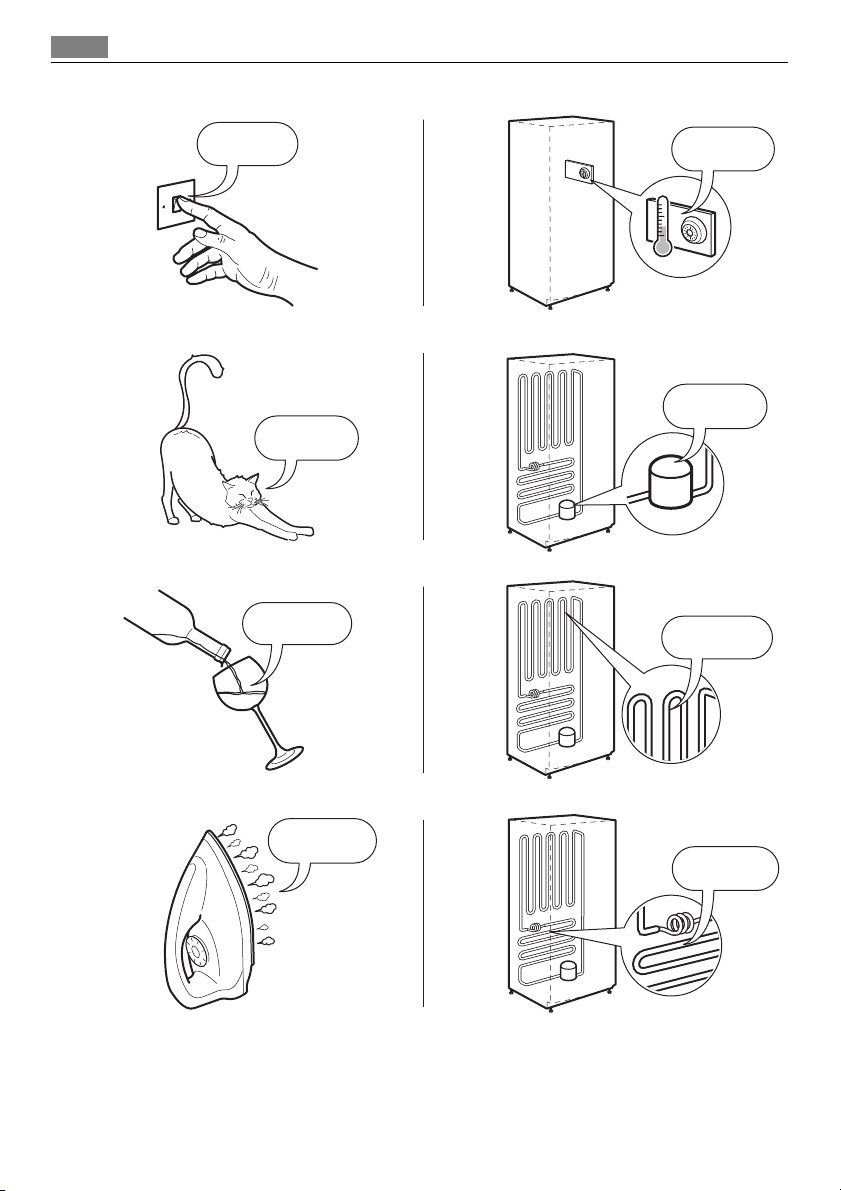
52 Rumori
CLICK!
BRRR!
BLUBB!
CLICK!
BRRR!
BLUBB!
HISSS!
HISSS!
Page 53
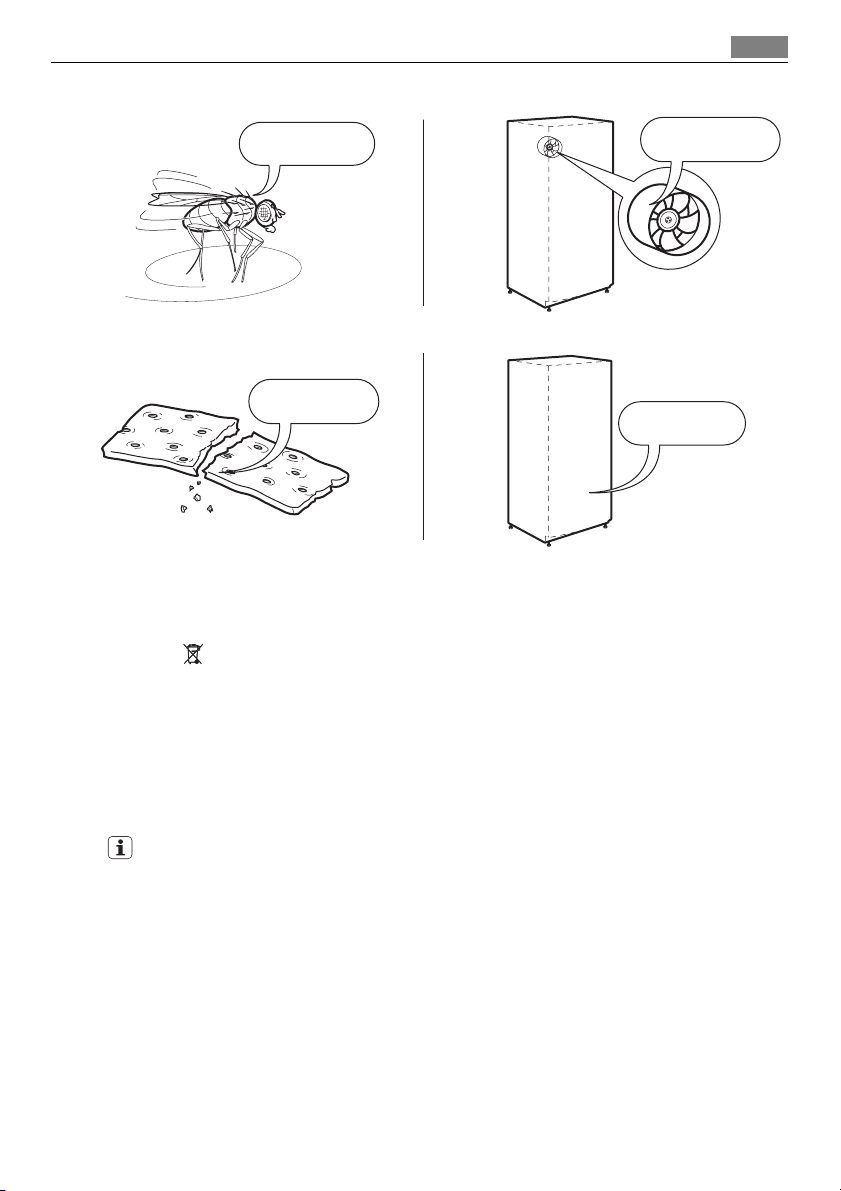
Considerazioni ambientali
53
SSSRRR!
SSSRRR!
CRACK!
CRACK!
CONSIDERAZIONI AMBIENTALI
Il simbolo sul prodotto o sulla confezione indica che il prodotto non deve essere
considerato come un normale rifiuto domestico, ma deve essere portato nel punto di
raccolta appropriato per il riciclaggio di apparecchiature elettriche ed elettroniche.
Provvedendo a smaltire questo prodotto in modo appropriato, si contribuisce a evitare
potenziali conseguenze negative, che potrebbero derivare da uno smaltimento inadeguato
del prodotto. Per informazioni più dettagliate sul riciclaggio di questo prodotto, contattare
l’ufficio comunale, il servizio locale di smaltimento rifiuti o il negozio in cui è stato
acquistato il prodotto.
Dove portare gli apparecchi fuori uso?
In qualsiasi negozio che vende apparecchi nuovi oppure si restituiscono ai centri di
raccolta ufficiali della SENS oppure ai riciclatori ufficiali della SENS.
La lista dei centri di raccolta ufficiali della SENS è visibile nel sito www.sens.ch.
Page 54
54
FOR PERFECT RESULTS
Thank you for choosing this AEG product. We have
created it to give you impeccable performance for many
years, with innovative technologies that help make life
simpler – features you might not find on ordinary
appliances. Please spend a few minutes reading to get the
very best from it.
ACCESSORIES AND CONSUMABLES
In the AEG webshop, you’ll find everything you need to
keep all your AEG appliances looking spotless and
working perfectly. Along with a wide range of accessories
designed and built to the high quality standards you
would expect, from specialist cookware to cutlery baskets,
from bottle holders to delicate laundry bags…
Visit the webshop at:
www.aeg.com/shop
Page 55
CONTENTS
56 Safety information
58 Control panel
59 First use
59 Daily use
61 Helpful hints and tips
63 Care and cleaning
64 What to do if…
67 Technical data
67 Installation
68 Noises
69 Environmental concerns
Contents
55
The following symbols are used in this user
manual:
Important information concerning your
personal safety and information on how to
avoid damaging the appliance.
General information and tips
Environmental information
Subject to change without notice
Page 56
56 Safety information
SAFETY INFORMATION
In the interest of your safety and to ensure the correct use, before installing and first using
the appliance, read this user manual carefully, including its hints and warnings. To avoid
unnecessary mistakes and accidents, it is important to ensure that all people using the appliance are thoroughly familiar with its operation and safety features. Save these instructions and make sure that they remain with the appliance if it is moved or sold, so that everyone using it through its life will be properly informed on appliance use and safety.
For the safety of life and property keep the precautions of these user's instructions as the
manufacturer is not responsible for damages caused by omission.
Children and vulnerable people safety
• This appliance is not intended for use by persons (including children) with reduced physical, sensory or mental capabilities, or lack of experience and knowledge, unless they have
been given supervision or instruction concerning use of the appliance by a person responsible for their safety.
Children should be supervised to ensure that they do not play with the appliance.
• Keep all packaging well away from children. There is risk of suffocation.
• If you are discarding the appliance pull the plug out of the socket, cut the connection
cable (as close to the appliance as you can) and remove the door to prevent playing children to suffer electric shock or to close themselves into it.
• If this appliance featuring magnetic door seals is to replace an older appliance having a
spring lock (latch) on the door or lid, be sure to make that spring lock unusable before
you discard the old appliance. This will prevent it from becoming a death trap for a child.
General safety
WARNING!
Keep ventilation openings, in the appliance enclosure or in the built-in structure, clear of
obstruction.
• The appliance is intended for keeping foodstuff and/or beverages in a normal household
as explained in this instruction booklet.
• Do not use a mechanical device or any artificial means to speed up the thawing process.
• Do not use other electrical appliances (such as ice cream makers) inside of refrigerating
appliances, unless they are approved for this purpose by the manufacturer.
• Do not damage the refrigerant circuit.
• The refrigerant isobutane (R600a) is contained within the refrigerant circuit of the appliance, a natural gas with a high level of environmental compatibility, which is nevertheless flammable.
During transportation and installation of the appliance, be certain that none of the components of the refrigerant circuit become damaged.
If the refrigerant circuit should become damaged:
– avoid open flames and sources of ignition
Page 57
Safety information 57
– thoroughly ventilate the room in which the appliance is situated
• It is dangerous to alter the specifications or modify this product in any way. Any damage
to the cord may cause a short-circuit, fire and/or electric shock.
WARNING!
Any electrical component (power cord, plug, compressor) must be replaced by a certified
service agent or qualified service personnel to avoid hazard.
1. Power cord must not be lengthened.
2. Make sure that the power plug is not squashed or damaged by the back of the ap-
pliance. A squashed or damaged power plug may overheat and cause a fire.
3. Make sure that you can come to the mains plug of the appliance.
4. Do not pull the mains cable.
5. If the power plug socket is loose, do not insert the power plug. There is a risk of
electric shock or fire.
6.
You must not operate the appliance without the lamp cover
16)
of interior lighting.
• This appliance is heavy. Care should be taken when moving it.
• Do not remove nor touch items from the freezer compartment if your hands are damp/
wet, as this could cause skin abrasions or frost/freezer burns.
• Avoid prolonged exposure of the appliance to direct sunlight.
•
Bulb lamps
17)
used in this appliance are special purpose lamps selected for household
appliances use only. They are not suitable for household room illumination.
Daily Use
• Do not put hot pot on the plastic parts in the appliance.
• Do not store flammable gas and liquid in the appliance, because they may explode.
•
Do not place food products directly against the air outlet on the rear wall.
• Frozen food must not be re-frozen once it has been thawed out.
• Store pre-packed frozen food in accordance with the frozen food manufacturer's instructions.
• Appliance's manufacturers storage recommendations should be strictly adhered to. Refer
to relevant instructions.
• Do not place carbonated or fizzy drinks in the freezer compartment as it creates pressure
on the container, which may cause it to explode, resulting in damage to the appliance.
• Ice lollies can cause frost burns if consumed straight from the appliance.
Care and cleaning
• Before maintenance, switch off the appliance and disconnect the mains plug from the
mains socket.
• Do not clean the appliance with metal objects.
• Do not use sharp objects to remove frost from the appliance. Use a plastic scraper.
16) If the lamp cover is foreseen.
17) If the lamp is foreseen.
18) If the appliance is Frost Free.
18)
Page 58
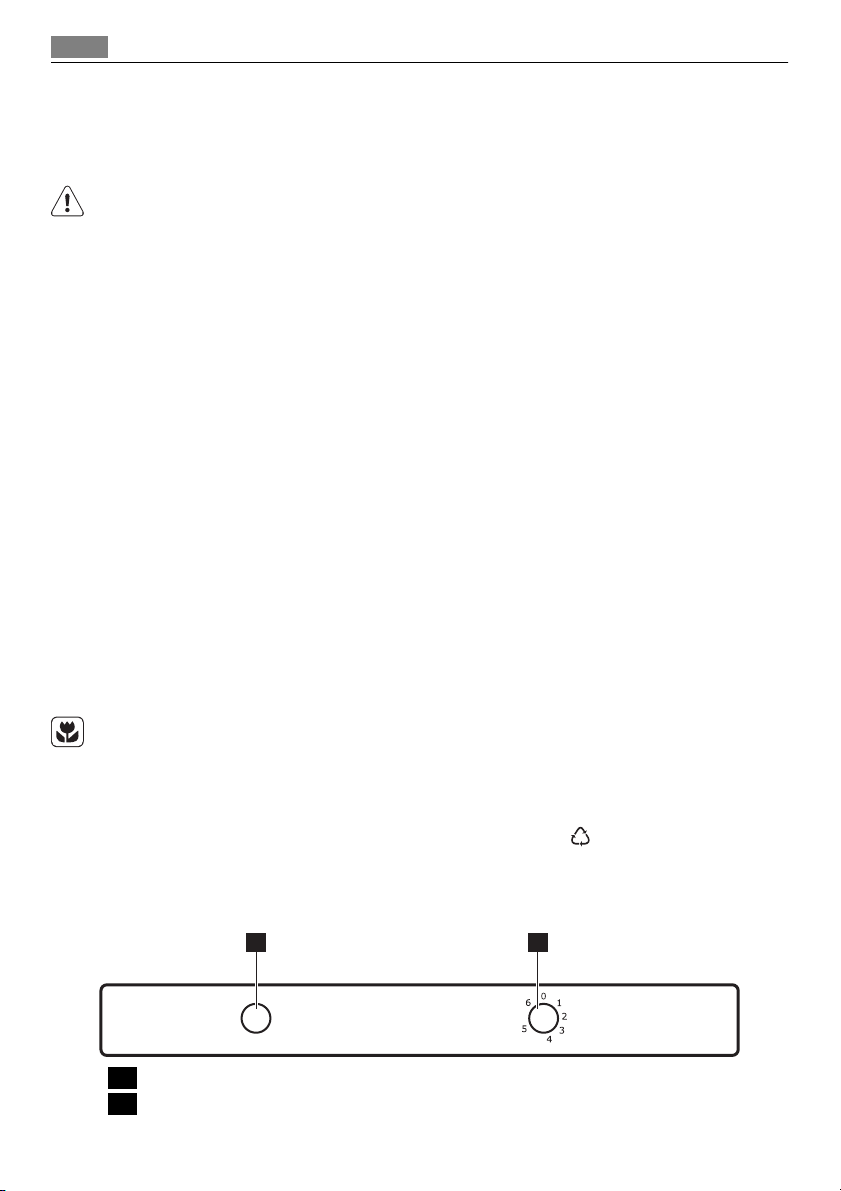
58 Control panel
• Regularly examine the drain in the refrigerator for defrosted water. If necessary, clean
the drain. If the drain is blocked, water will collect in the bottom of the appliance.
Installation
For electrical connection carefully follow the instructions given in specific paragraphs.
• Unpack the appliance and check if there are damages on it. Do not connect the appliance if it is damaged. Report possible damages immediately to the place you bought it.
In that case retain packing.
• It is advisable to wait at least four hours before connecting the appliance to allow the oil
to flow back in the compressor.
• Adequate air circulation should be around the appliance, lacking this leads to overheating. To achieve sufficient ventilation follow the instructions relevant to installation.
• Wherever possible the back of the product should be against a wall to avoid touching or
catching warm parts (compressor, condenser) to prevent possible burn.
• The appliance must not be located close to radiators or cookers.
• Make sure that the mains plug is accessible after the installation of the appliance.
•
Connect to potable water supply only.
19)
Service
• Any electrical work required to do the servicing of the appliance should be carried out by
a qualified electrician or competent person.
• This product must be serviced by an authorized Service Centre, and only genuine spare
parts must be used.
Environment Protection
This appliance does not contain gasses which could damage the ozone layer, in either its
refrigerant circuit or insulation materials. The appliance shall not be discarded together
with the urban refuse and rubbish. The insulation foam contains flammable gases: the appliance shall be disposed according to the applicable regulations to obtain from your local
authorities. Avoid damaging the cooling unit, especially at the rear near the heat exchanger. The materials used on this appliance marked by the symbol
are recyclable.
CONTROL PANEL
1 2
1 Light switch
2 Temperature regulator
19) If a water connection is foreseen.
Page 59
Switching on
Insert the plug into the wall socket.
Turn the Temperature setting regulator clockwise to a medium setting.
Switching off
To turn off the appliance, turn the Temperature regulator to the "O" position.
Temperature regulation
The temperature is automatically regulated.
To operate the appliance, proceed as follows:
• turn the Temperature regulator toward lower settings to obtain the minimum coldness.
• turn the Temperature regulator toward higher settings to obtain the maximum coldness.
A medium setting is generally the most suitable.
However, the exact setting should be chosen keeping in mind that the temperature inside
the appliance depends on:
• room temperature
• how often the door is opened
• the quantity of food stored
• the location of the appliance.
If the ambient temperature is high or the appliance is fully loaded, and the appliance is set
to the lowest temperatures, it may run continuously causing frost to form on the rear wall.
In this case the dial must be set to a higher temperature to allow automatic defrosting and
therefore reduced energy consumption.
First use
59
FIRST USE
Cleaning the interior
Before using the appliance for the first time, wash the interior and all internal accessories
with lukewarm water and some neutral soap so as to remove the typical smell of a brandnew product, then dry thoroughly.
Do not use detergents or abrasive powders, as these will damage the finish.
DAILY USE
Freezing fresh food
The freezer compartment is suitable for freezing fresh food and storing frozen and deepfrozen food for a long time.
To freeze fresh foods it is not necessary to change the medium setting.
However, for a faster freezing operation, turn the temperature regulator toward higher settings to obtain the maximum coldness.
Page 60
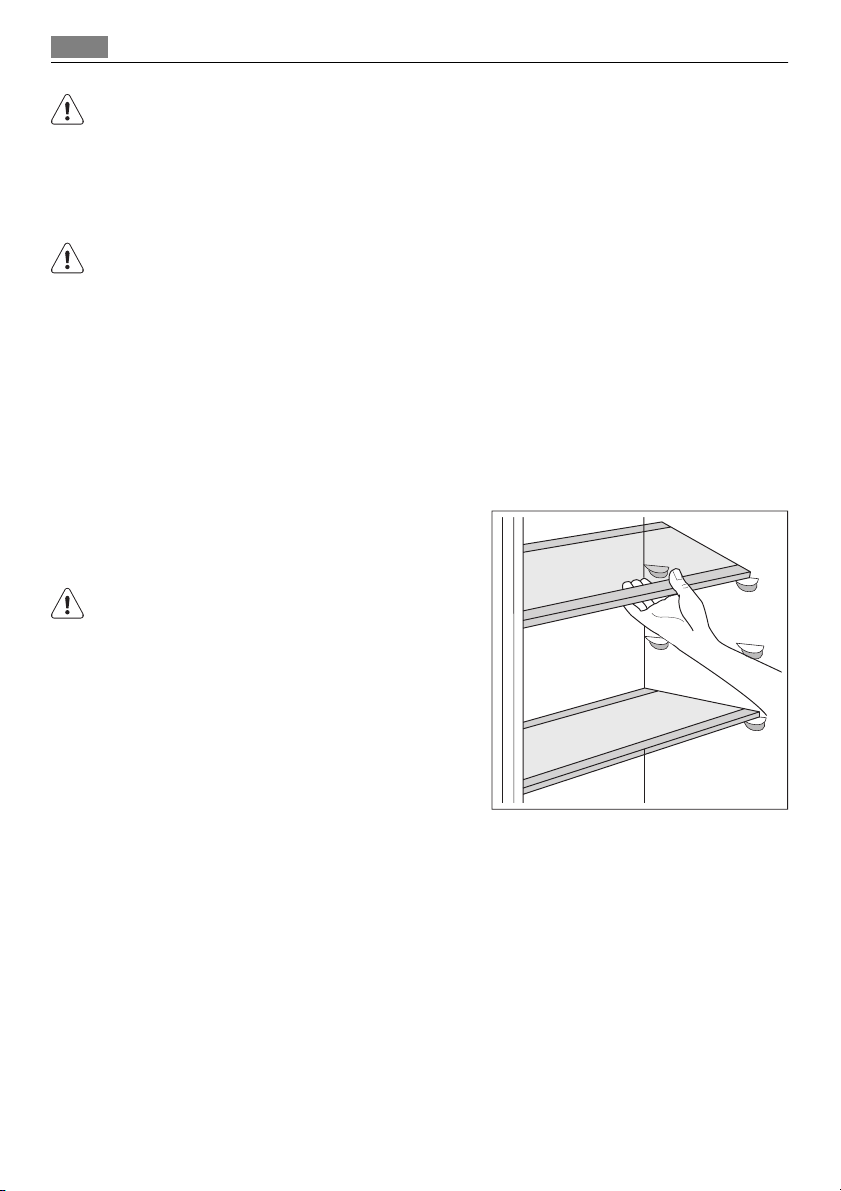
60 Daily use
In this condition, the refrigerator compartment temperature might drop below 0°C. If this
occurs reset the temperature regulator to a warmer setting.
Storage of frozen food
When first starting-up or after a period out of use, before putting the products in the compartment let the appliance run at least 2 hours on the higher settings.
In the event of accidental defrosting, for example due to a power failure, if the power has
been off for longer than the value shown in the technical characteristics chart under "rising
time", the defrosted food must be consumed quickly or cooked immediately and then refrozen (after cooling).
Thawing
Deep-frozen or frozen food, prior to being used, can be thawed in the refrigerator compartment or at room temperature, depending on the time available for this operation.
Small pieces may even be cooked still frozen, directly from the freezer: in this case, cooking
will take longer.
Movable shelves
The walls of the refrigerator are equipped with a
series of runners so that the shelves can be positioned as desired.
Do not move the glass shelf above the vegetable
drawer and the bottle shelf to ensure correct air
circulation.
Page 61
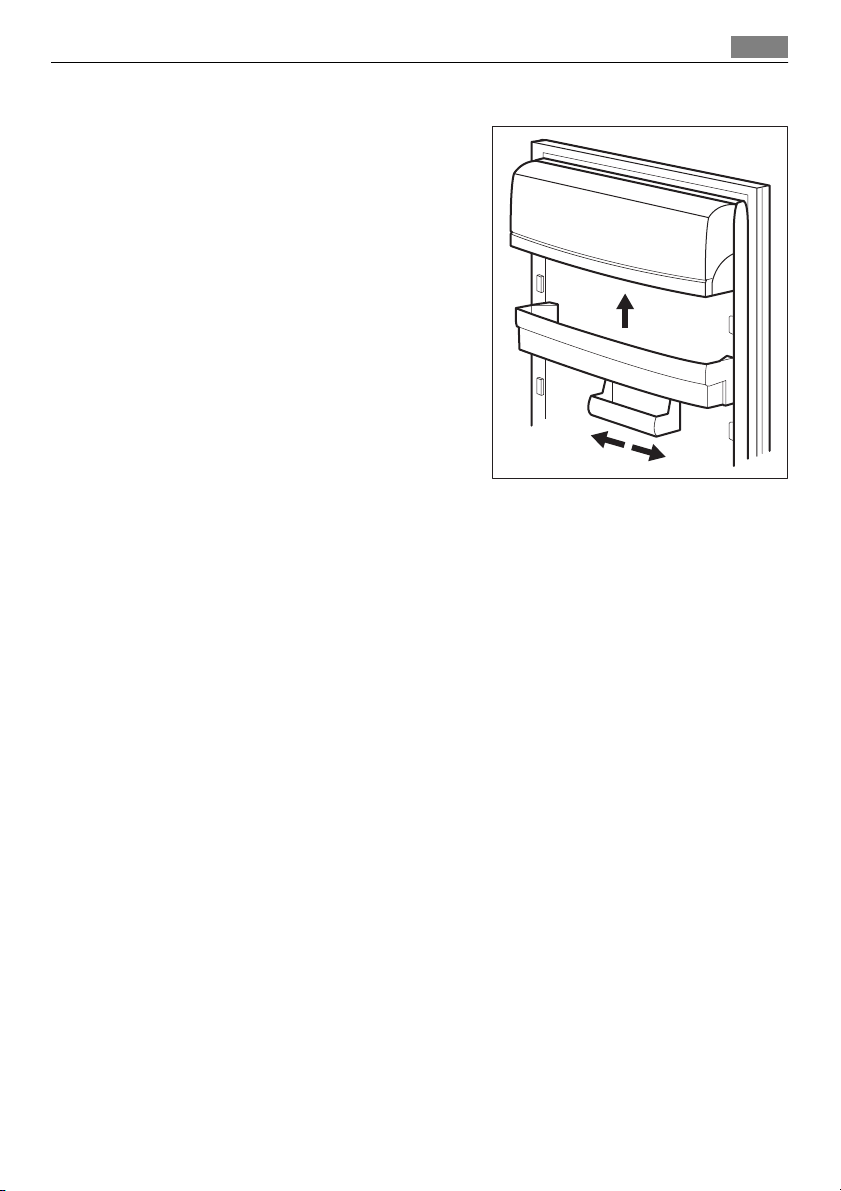
Helpful hints and tips 61
Positioning the door shelves
To permit storage of food packages of various
sizes, the door shelves can be placed at different
heights.
To make these adjustments proceed as follows:
gradually pull the shelf in the direction of the arrows until it comes free, then reposition as required.
The model is equipped with a variable storage box
which is fitted under a door shelf compartment
and can be slide sideways.
HELPFUL HINTS AND TIPS
Normal Operating Sounds
• You may hear a faint gurgling and a bubbling sound when the refrigerant is pumped
through the coils or tubing. This is correct.
• When the compressor is on, the refrigerant is being pumped around and you will hear a
whirring sound and a pulsating noise from the compressor. This is correct.
• The thermic dilatation might cause a sudden cracking noise. It is natural, not dangerous
physical phenomenon. This is correct.
• When the compressor switches on or switches off, you will hear a faint "click" of the
temperature regulator. This is correct.
Hints for energy saving
• Do not open the door frequently or leave it open longer than absolutely necessary.
• If the ambient temperature is high and the Temperature Regulator is set to low temperature and the appliance is fully loaded, the compressor may run continuously, causing
frost or ice on the evaporator. If this happens, set the Temperature Regulator toward
warmer settings to allow automatic defrosting and so a saving in electricity consumption.
Hints for fresh food refrigeration
To obtain the best performance:
• do not store warm food or evaporating liquids in the refrigerator
• do cover or wrap the food, particularly if it has a strong flavour
• position food so that air can circulate freely around it
Page 62
62 Helpful hints and tips
Hints for refrigeration
Useful hints:
Meat (all types) : wrap in polythene bags and place on the glass shelf above the vegetable
drawer.
For safety, store in this way only one or two days at the most.
Cooked foods, cold dishes, etc..: these should be covered and may be placed on any shelf.
Fruit and vegetables: these should be thoroughly cleaned and placed in the special drawer(s) provided.
Butter and cheese: these should be placed in special airtight containers or wrapped in aluminium foil or polythene bags to exclude as much air as possible.
Milk bottles: these should have a cap and should be stored in the bottle rack on the door.
Bananas, potatoes, onions and garlic, if not packed, must not be kept in the refrigerator.
Hints for freezing
To help you make the most of the freezing process, here are some important hints:
• the maximum quantity of food which can be frozen in 24 hrs. is shown on the rating
plate;
• the freezing process takes 24 hours. No further food to be frozen should be added during
this period;
• only freeze top quality, fresh and thoroughly cleaned, foodstuffs;
• prepare food in small portions to enable it to be rapidly and completely frozen and to
make it possible subsequently to thaw only the quantity required;
• wrap up the food in aluminium foil or polythene and make sure that the packages are
airtight;
• do not allow fresh, unfrozen food to touch food which is already frozen, thus avoiding a
rise in temperature of the latter;
• lean foods store better and longer than fatty ones; salt reduces the storage life of food;
• water ices, if consumed immediately after removal from the freezer compartment, can
possibly cause the skin to be freeze burnt;
• it is advisable to show the freezing in date on each individual pack to enable you to keep
tab of the storage time.
Hints for storage of frozen food
To obtain the best performance from this appliance, you should:
• make sure that the commercially frozen foodstuffs were adequately stored by the retailer;
• be sure that frozen foodstuffs are transferred from the foodstore to the freezer in the
shortest possible time;
• not open the door frequently or leave it open longer than absolutely necessary.
• Once defrosted, food deteriorates rapidly and cannot be refrozen.
• Do not exceed the storage period indicated by the food manufacturer.
Page 63
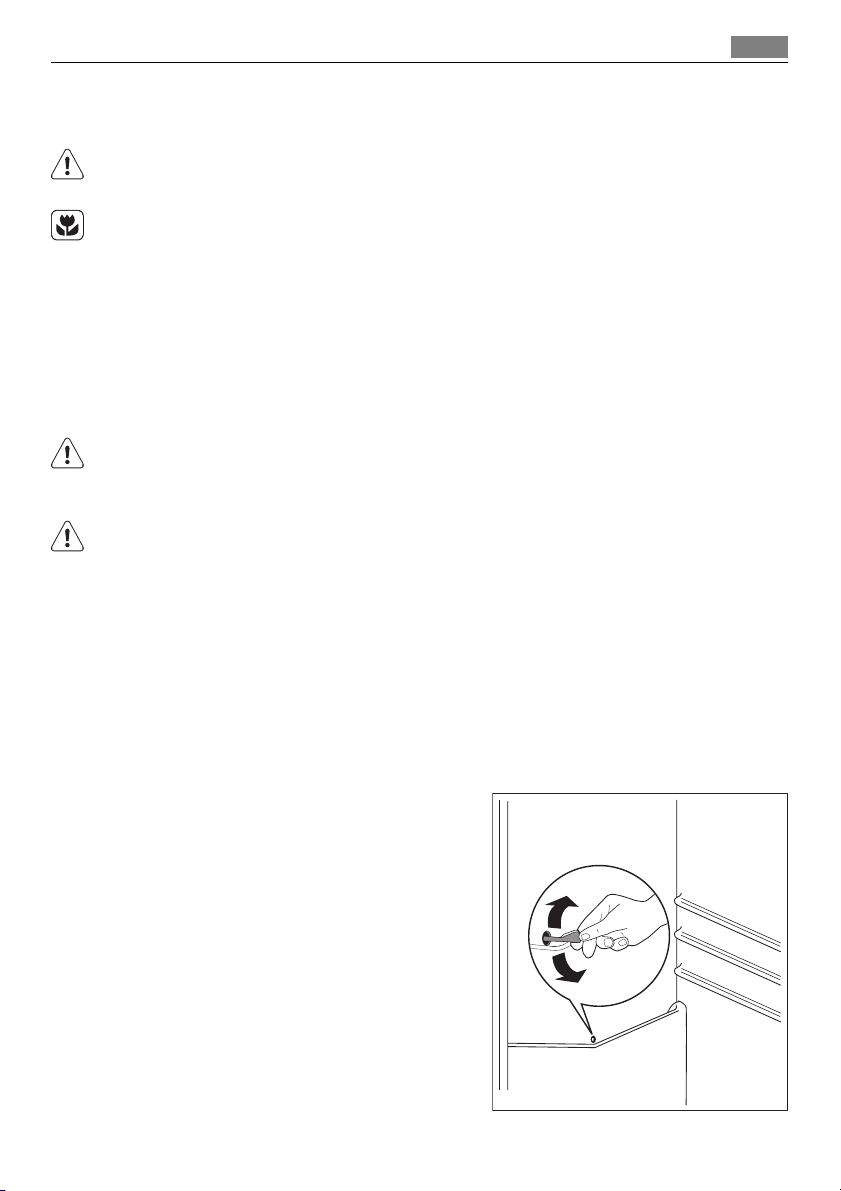
Care and cleaning 63
CARE AND CLEANING
CAUTION!
Unplug the appliance before carrying out any maintenance operation.
This appliance contains hydrocarbons in its cooling unit; maintenance and recharging must
therefore only be carried out by authorized technicians.
Periodic cleaning
The equipment has to be cleaned regularly:
• clean the inside and accessories with lukewarm water and some neutral soap.
• regularly check the door seals and wipe clean to ensure they are clean and free from
debris.
• rinse and dry thoroughly.
Do not pull, move or damage any pipes and/or cables inside the cabinet.
Never use detergents, abrasive powders, highly perfumed cleaning products or wax polishes
to clean the interior as this will damage the surface and leave a strong odour.
Take care of not to damage the cooling system.
Many proprietary kitchen surface cleaners contain chemicals that can attack/damage the
plastics used in this appliance. For this reason it is recommended that the outer casing of
this appliance is only cleaned with warm water with a little washing-up liquid added.
After cleaning, reconnect the equipment to the mains supply.
Defrosting of the refrigerator
Frost is automatically eliminated from the evaporator of the refrigerator compartment every time the motor compressor stops, during normal use. The defrost water drains out
through a trough into a special container at the back of the appliance, over the motor compressor, where it evaporates.
It is important to periodically clean the defrost
water drain hole in the middle of the refrigerator
compartment channel to prevent the water overflowing and dripping onto the food inside. Use
the special cleaner provided, which you will find
already inserted into the drain hole.
Page 64
64 What to do if…
Defrosting the freezer
A certain amount of frost will always form on the freezer shelves and around the top compartment.
Defrost the freezer when the frost layer reaches a thickness of about 3-5 mm.
To remove the frost, do these steps:
1. Switch off the appliance.
2. Remove any stored food, wrap it in several layers of newspaper and put it in a cool
place.
3. Leave the door open.
4. When defrosting is completed, dry the interior thoroughly and refit the plug.
5. Switch on the appliance.
6. Set the temperature regulator to obtain the maximum coldness and run the appliance
for two or three hours using this setting.
7. Reload the previously removed food into the compartment.
Never use sharp metal tools to scrape off frost from the evaporator as you could damage it.
Do not use a mechanical device or any artificial means to speed up the thawing process
other than those recommended by the manufacturer. A temperature rise of the frozen food
packs, during defrosting, may shorten their safe storage life.
Periods of non-operation
When the appliance is not in use for long periods, take the following precautions:
• disconnect the appliance from electricity supply
• remove all food
defrost
20)
and clean the appliance and all accessories
•
• leave the door/doors ajar to prevent unpleasant smells.
If the cabinet will be kept on, ask somebody to check it once in a while to prevent the food
inside from spoiling in case of a power failure.
WHAT TO DO IF…
WARNING!
Before troubleshooting, disconnect the mains plug from the mains socket.
Only a qualified electrician or competent person must do the troubleshooting that is not in
this manual.
There are some sounds during normal use (compressor, refrigerant circulation).
20) If foreseen.
Page 65
What to do if… 65
Problem Possible cause Solution
The appliance is noisy The appliance is not supported
The appliance does not
operate. The lamp does
not operate.
The mains plug is not connected
The appliance has no power.
The lamp does not work. The lamp is in stand-by. Close and open the door.
The lamp is defective. Refer to "Replacing the lamp".
The compressor operates
continually.
The door is not closed correctly. Refer to "Closing the door".
The door has been opened too
The product temperature is too
The room temperature is too
Water flows on the rear
plate of the refrigerator.
Water flows into the refrigerator.
Products prevent that water
Water flows on the
ground.
The temperature in the
appliance is too low.
The temperature in the
appliance is too high.
The door is not closed correctly. Refer to "Closing the door".
The product temperature is too
properly
The appliance is switched off. Switch on the appliance.
to the mains socket correctly.
There is no voltage in the mains
socket.
The temperature is not set correctly.
frequently.
high.
high.
During the automatic defrosting
process, frost defrosts on the
rear plate.
The water outlet is clogged. Clean the water outlet.
flows into the water collector.
The melting water outlet does
not flow in the evaporative tray
above the compressor.
The temperature regulator is not
set correctly.
The temperature regulator is not
set correctly.
high.
Check if the appliance stands stable (all the four feet should be on
the floor)
Connect the mains plug to the
mains socket correctly.
Connect a different electrical appliance to the mains socket.
Contact a qualified electrician.
Set a higher temperature.
Do not keep the door open longer
than necessary.
Let the product temperature decrease to room temperature before storage.
Decrease the room temperature.
This is correct.
Make sure that products do not
touch the rear plate.
Attach the melting water outlet
to the evaporative tray.
Set a higher temperature.
Set a lower temperature.
Let the product temperature decrease to room temperature before storage.
Page 66
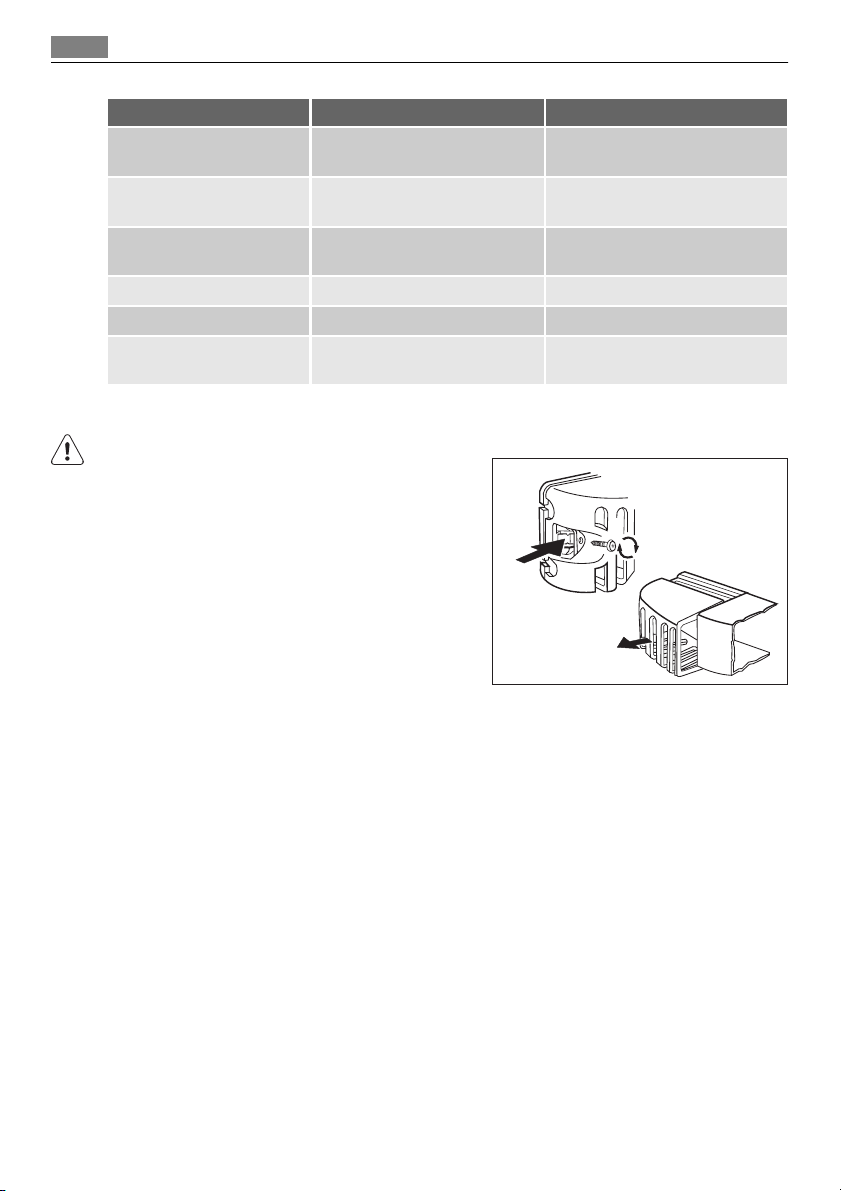
66 What to do if…
Problem Possible cause Solution
Many products are stored at the
The temperature in the refrigerator is too high.
The temperature in the
freezer is too high.
There is too much frost. Food is not wrapped correctly. Wrap the food correctly.
The door is not closed correctly. Refer to "Closing the door".
The temperature regulator is not
same time.
There is no cold air circulation in
the appliance.
Products are too near to each
other.
set correctly.
Replacing the lamp
CAUTION!
Disconnect the plug from the mains socket.
1. Remove the screw from the lamp cover.
2. Pull outwards the hook of the lamp cover.
3. Remove the lamp cover.
4. Replace the lamp with one of the same
power (the maximum power is shown on
the light bulb cover).
5. Install the lamp cover.
6. Tighten the screw to the lamp cover.
7. Connect the plug to the mains socket.
8. Open the door. Make sure that the light comes on.
Store less products at the same
time.
Make sure that there is cold air
circulation in the appliance.
Store products so that there is
cold air circulation.
Set a higher temperature.
2
1
3
Closing the door
1. Clean the door gaskets.
2. If necessary, adjust the door. Refer to "Installation".
3. If necessary, replace the defective door gaskets. Contact the Service Center.
Page 67
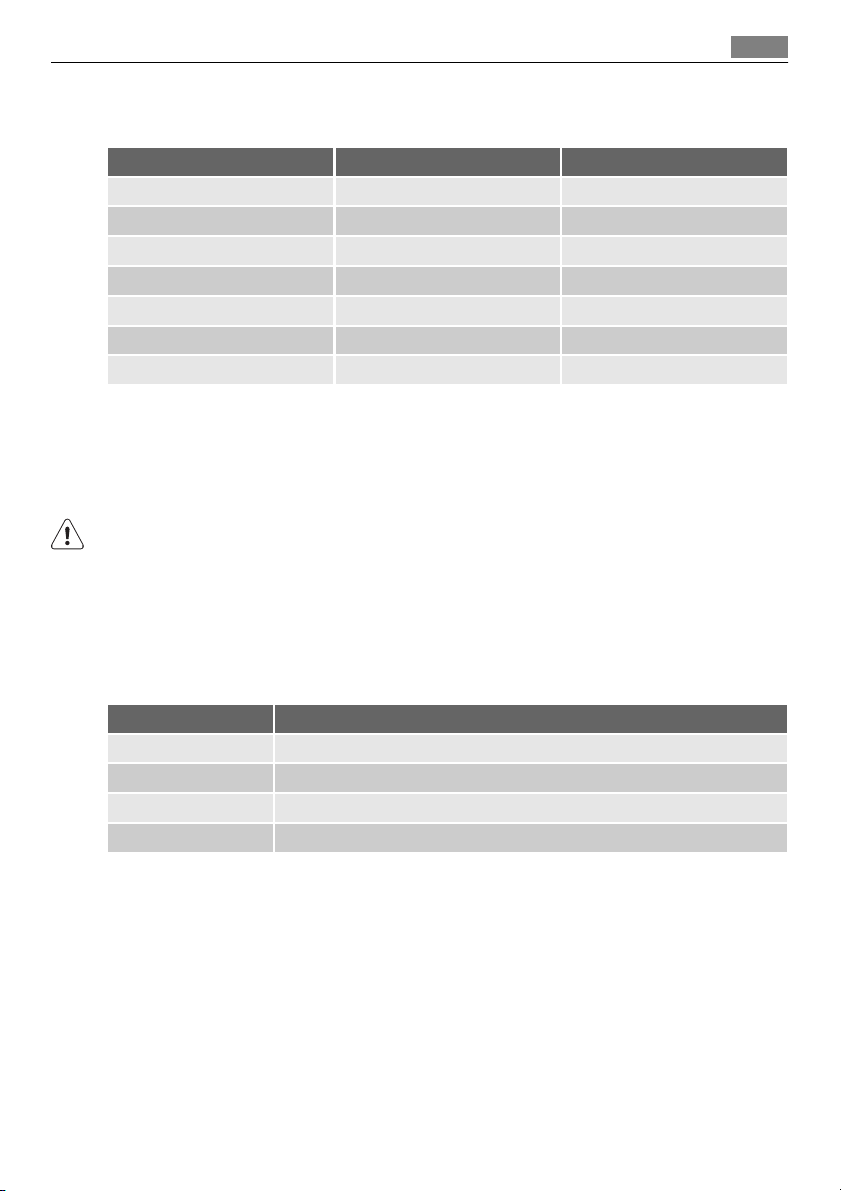
Technical data
TECHNICAL DATA
Dimension of the recess
Height 880 mm
Width 560 mm
Depth 550 mm
Rising Time 12 h
Voltage 230 V
Frequency 50 Hz
The technical information are situated in the rating plate on the internal left side of the
appliance and in the energy label.
INSTALLATION
WARNING!
Read the "Safety Information" carefully for your safety and correct operation of the appliance before installing the appliance.
Positioning
This appliance can be installed in a dry, well ventilated indoor (garage or cellar) also, but for
optimum performance install this appliance at a location where the ambient temperature
corresponds to the climate class indicated on the rating plate of the appliance:
Climate class Ambient temperature
SN +10°C to + 32°C
N +16°C to + 32°C
ST +16°C to + 38°C
T +16°C to + 43°C
67
Electrical connection
Before plugging in, ensure that the voltage and frequency shown on the rating plate correspond to your domestic power supply.
The appliance must be earthed. The power supply cable plug is provided with a contact for
this purpose. If the domestic power supply socket is not earthed, connect the appliance to a
separate earth in compliance with current regulations, consulting a qualified electrician.
The manufacturer declines all responsibility if the above safety precautions are not observed.
This appliance complies with the E.E.C. Directives.
Page 68
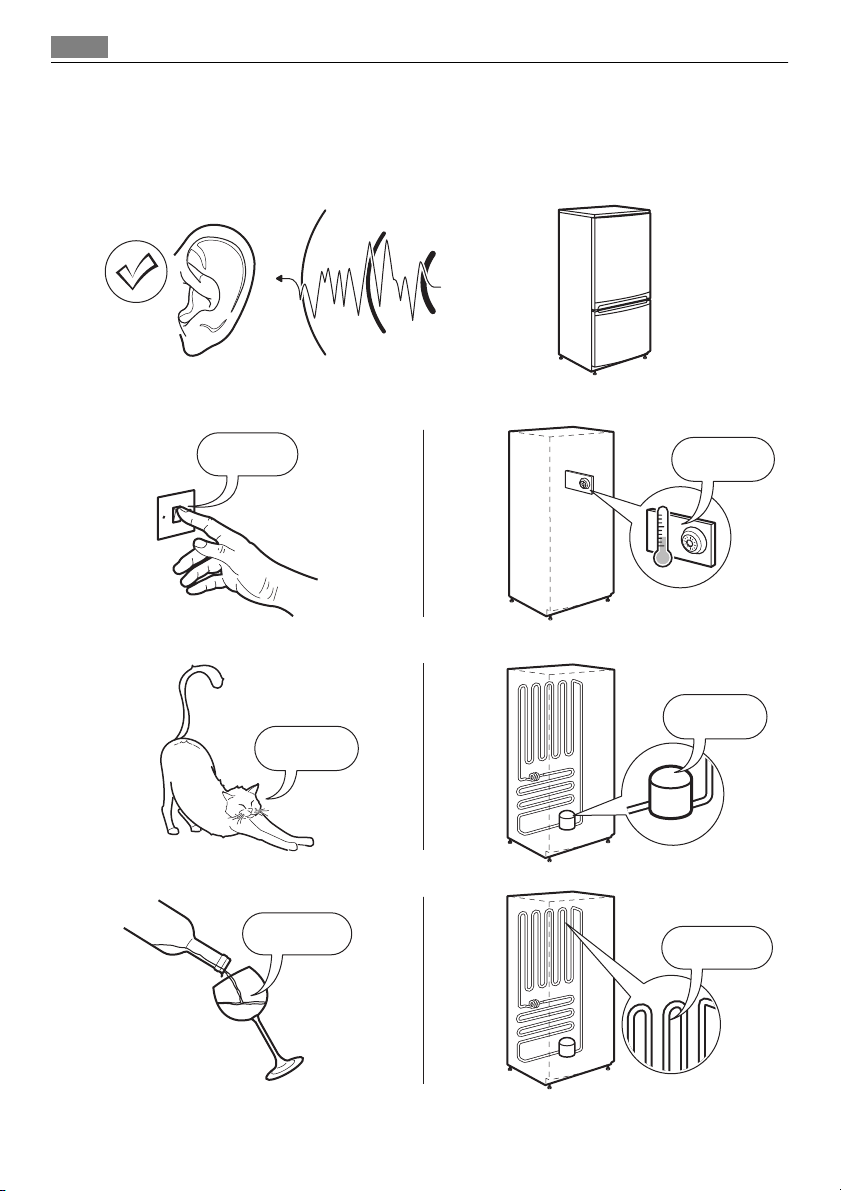
68 Noises
NOISES
There are some sounds during normal running (compressor, refrigerant circulation).
SSSRRR!
CLICK!
OK
CLICK!
BRRR!
HISSS!
BLUBB!
BRRR!
CRACK!
CLICK!
BRRR!
BLUBB!
BLUBB!
Page 69
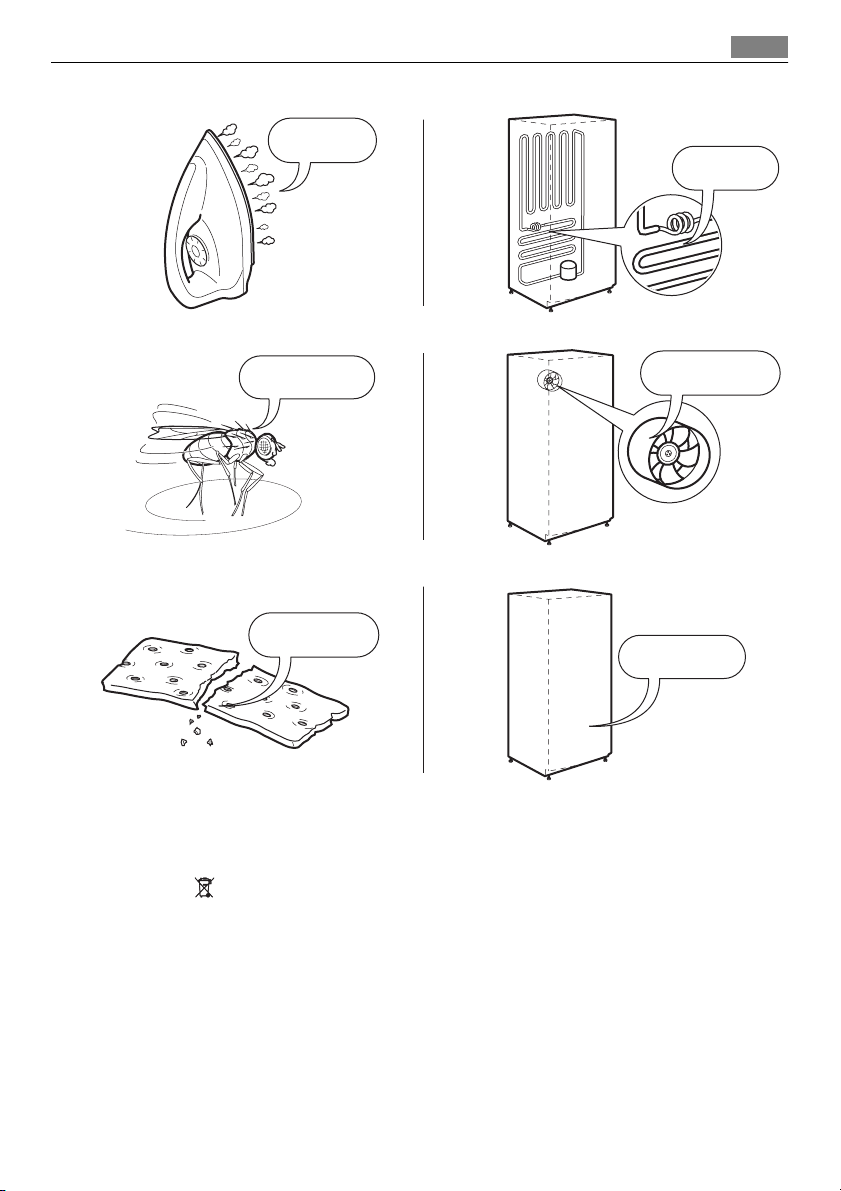
HISSS!
Environmental concerns
HISSS!
697071
SSSRRR!
SSSRRR!
CRACK!
CRACK!
ENVIRONMENTAL CONCERNS
The symbol on the product or on its packaging indicates that this product may not be
treated as household waste. Instead it should be taken to the appropriate collection point
for the recycling of electrical and electronic equipment. By ensuring this product is
disposed of correctly, you will help prevent potential negative consequences for the
environment and human health, which could otherwise be caused by inappropriate waste
handling of this product. For more detailed information about recycling of this product,
please contact your local council, your household waste disposal service or the shop where
you purchased the product.
Page 70
Page 71
Page 72
www.aeg.com/shop 211621373-A-082011
 Loading...