

Page 1
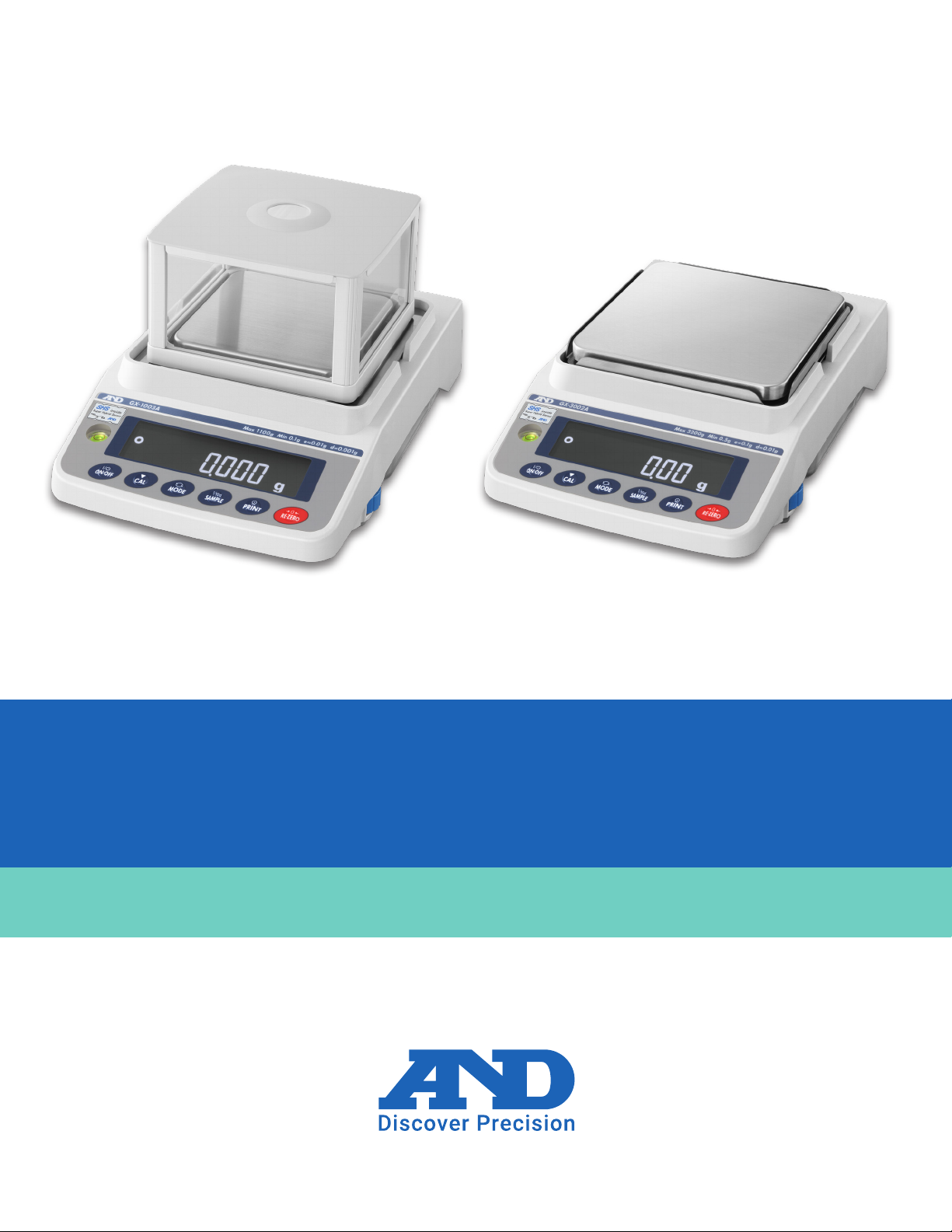
APOLLO SERIES GX-A | GF-A
Precision Balances
Taking Weighing Precision and Protection to New Heights
Page 2
DISCOVER PRECISION
Advanced Technologies Providing Innovative Solutions
Smart SHS Technology
A&D’s Smart-Super Hybrid Sensor (SHS) technology is the foundation
of the innovative solutions found in the Apollo Series. The Smart sensor
improvements stem from better design, construction, and materials,
resulting in better performance and turbo stabilization times of 1 second.
This increases productivity for all weighing work-flows in both labs and
production environments. Smart-SHS also gives higher maintainability with
a reduced number of parts while still offering maintenance accessibility,
unlike other Mono-type systems which only increase cost of ownership.
A&D’s easy eccentricity adjustment and hybrid design are two prime
examples of this high maintainability. We execute for the highest
performance, and keep our customer’s bottom-line in mind.
Remarkable cost and time savings
at the touch of a button.
Innovative
Technology
Smart
Reasoning
Beneficial
Outcomes
ECL
Auto Precision
Assessment
Dia-Check
Standard deviation
QuickMin-S
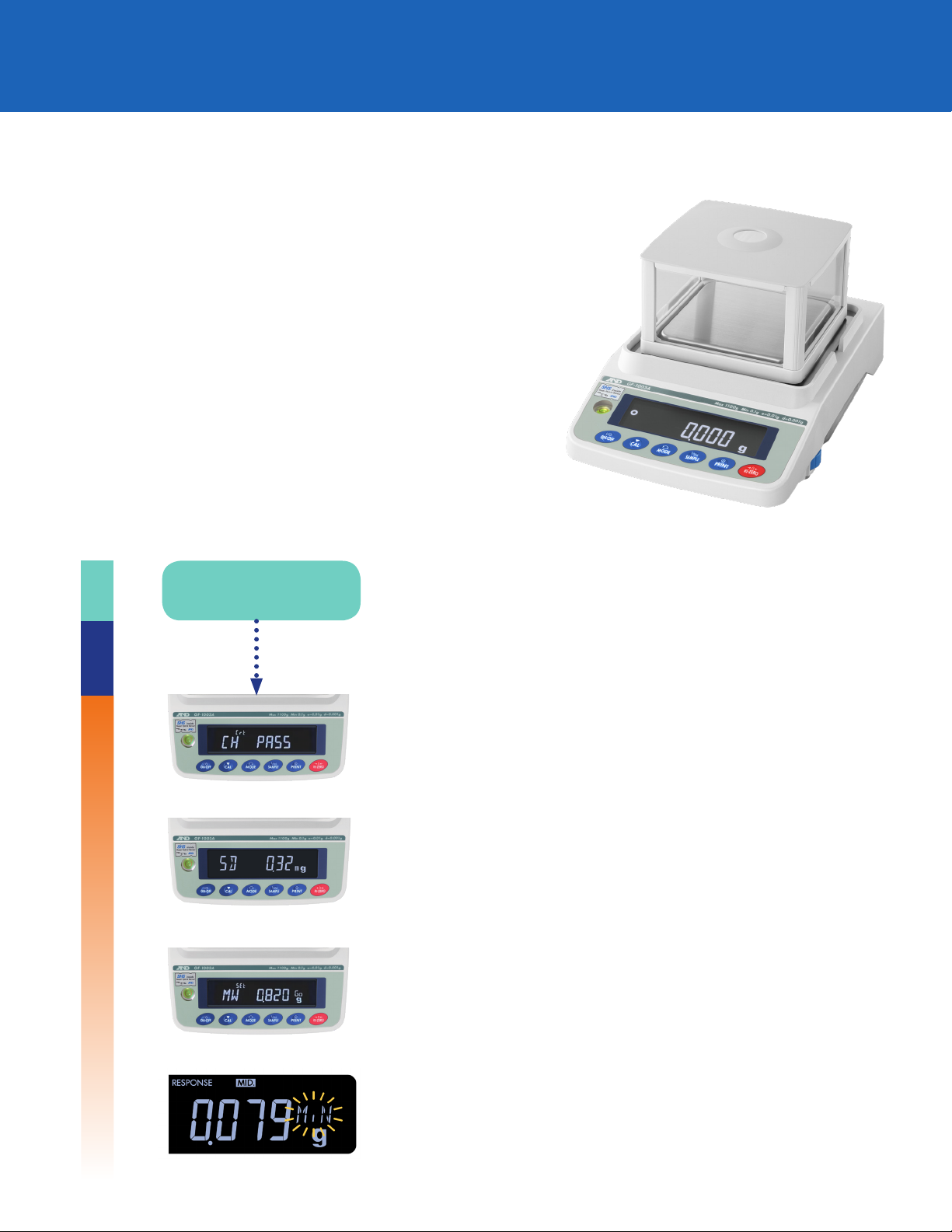
Electronically Controlled Load (ECL) Innovation
The operator simply holds the mode key to first perform a self diagnostic check and
proceed to ECL where internally a repeatability test is performed without use of an
external weight. This critically checks the stability of analog-to-digital conversion
before applying a controlled load inside the balance (between 0.3% to 3% of the
weighing capacity). It does this by altering the equilibrium state of the weigh sensor
and takes 10 repeated measurements. The entire process takes only 1.5 minutes
versus traditional repeatability procedures which can take up to 10 minutes,
ultimately giving greater convenience and time savings to customers.
The ECL technology provides valuable information which Auto Precision
Assessment (APA) smartly processes into meaningful, beneficial outcomes
such as Dia-Check, Standard Deviation, Quick Min-S, and Min-S-Alert.
Dia-Check quickly gives users peace of mind to proceed with daily weighing
routines, providing a critical pass or fail indication. A powerful, dynamic tool to
diagnose, and verify balance performance.
ECL steps it up a notch by producing the most valuable information, the
Standard Deviation (SD), allowing users to quickly assess the balance
performance under any given environment. This is helpful to include in daily
SOP checks.
SD also can determine the minimum sample weight with a feature called
QuickMin-S. QuickMin-S helps to overcome challenges with handling small weights,
accessibility to in-line systems, and in tough environmental conditions
Min-S Alert blinks
ECL goes one step further allowing users to set the minimum sample weight limit and
provides a real time alert with Min-S-Alert. Users always feel secure knowing they
are in compliance of USP 41 and does not limit how often a minimum sample weight
can be determined. This gives more flexibility to follow recommendations of USP
1251. What is so remarkable is this can be performed at the touch of a button, within
minutes, in challenging conditions, without the need of an external calibration weight.
Page 3
APOLLO SERIES
Factory Tough–Laboratory Precise
Impact Shock Detection (ISD) Innovation
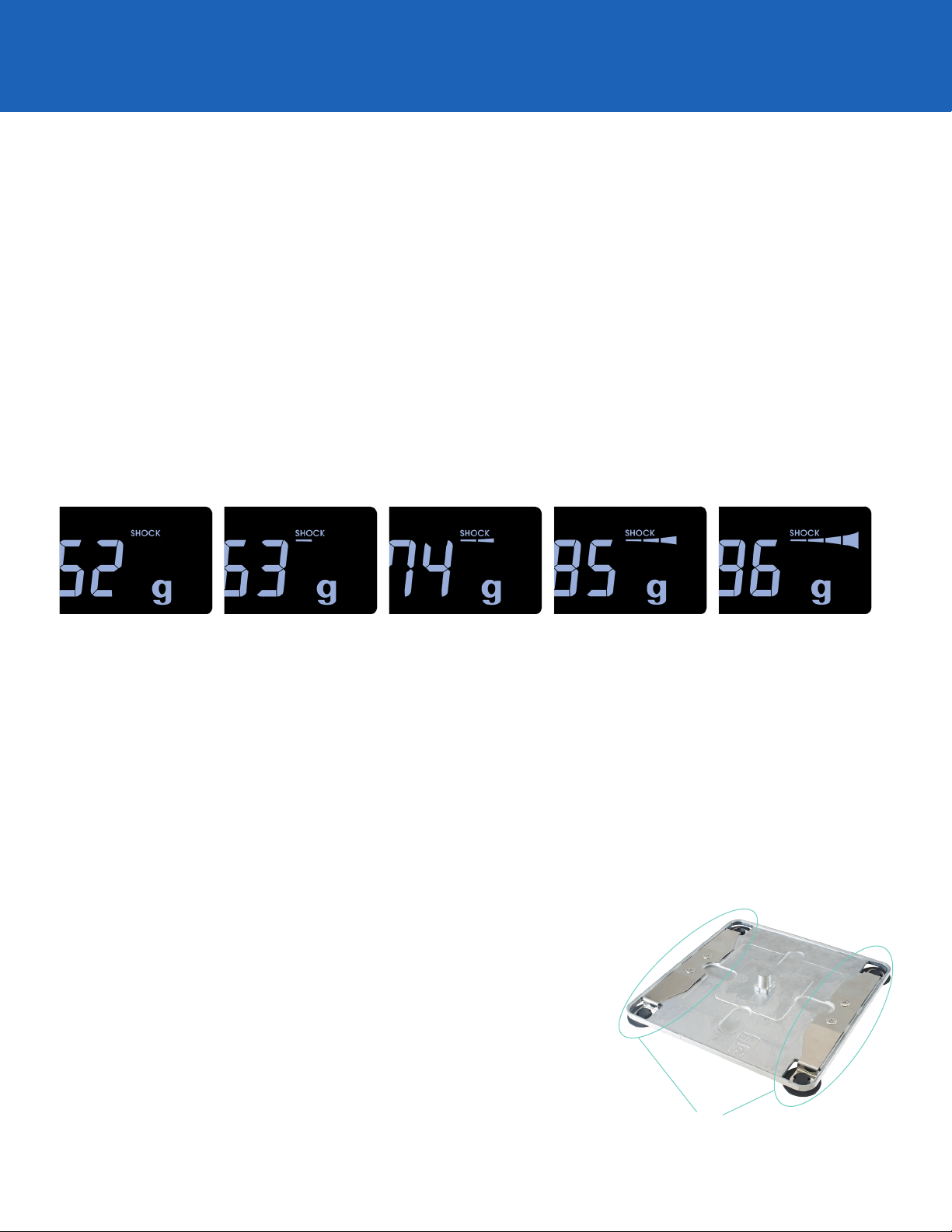
Often balances can be damaged or errors can occur due to sharp impacts
from automated machine loading or operators dropping material onto
the pan. The Apollo series educates, prevents and documents such
scenarios. ISD visually indicates the magnitudes of impact shocks that
a weigh sensor receives at four different levels. It audibly beeps once at
Level 3 and twice at Level 4 delivered through the feature of Impact-Alert.
This patented technology provides real-time feedback mechanisms
that prevent the sensor from being damaged and can ultimately train
and influence operator behaviors. ISD smartly strives for operators
to have better weighing techniques, while also helping to program
or modify loading in-line automated processes. Impact-Alert ensures
the investment of the balance is protected, helps to extend the life of
balance, reduce repair and replacement cost and ensure productivity can
be maintained by reducing downtime.
Real-time feedback
prevents the
sensor from being
damaged.
No Impact Shock Level 1 Level 2 Level 3 Level 4
ISD takes protection one step higher with Shock-log that documents the
date, time, and shock level. This enables managers and quality officers to
pinpoint the exact moment a critical shock occurred to quickly assess and
fix critical failure to get operations back online.
Shock-log
pinpoints the exact moment a critical shock
occurred to quickly assess and fix critical failure to get
operations back online
Overload Protection
The weight sensor is well protected against vertical and transverse static
overloading. It won’t break due to malfunction of the weighing system’s
actuator and the resulting excess “E” load. Additionally there are two leaf
springs that support the weighing pan of the Apollo series also mitigate
impact shocks significantly. A&D once again takes protection to heart
ensuring the Apollo series is the same A&D strong, A&D tough you’ve
come to know in labs and factories alike.
Leaf Springs
Page 4

DISCOVER PRECISION
Keeping Your Devices in Sync for
Better Accuracy & Precision
Flow Rate Display (FRD) Innovation
Many operators use a stopwatch or PC to determine a flow rate. FRD helps to streamline
and improve both by offering a synced solution that improves accuracy and precision in
filling or dosing applications. For example, the internal clocks of external devices are never
in complete sync with precision balances. Therefore there is a time-clock disparity that is
most noticeable when measuring and recording flow rates of pumps, feeders and other
devices at short intervals*1. Therefore command speed and refresh rate will cause the PC to
intermittently produce irregular values or spikes even if the actual flow rate is constant.
The Apollo series through an FR-Cal function calculates, displays, & outputs (WinCT-FRD)
the mass flow rate, or the volume flow rate by entering the density of the material. Up to
10 densities can be saved to the device. Both the display refresh rate and interval (set
between 1 second and 1 hour) are regulated by the same internal clock of the balance,
making measurements free from the irregularity that rise from time clock disparity problem.
Time disparity of two different internal clocks
Now what is smart about FRD technology is that we can use a comparator function of
FR-Compare to provide a feedback mechanism to the user if the flow rate is going too
fast or too slow or indicate if flow rate is kept within the designated limits.
Lastly, if the worst happened with a power outage during the “loss-in-weight”
measurement, the tare value is stored in our non-volatile memory. The remaining amount
in the container can be displayed again and the application can continue through our FR-
Secure.*2 This avoids loss of sensitive materials and lost time.
Flow rate measurement using FRD as opposed to the conventional method
*1 Flow rate is determined from the weight variation that occurs during a given interval.
*2 When function is activated, the power-on/rezero/tare is toggled off.
Page 5

APOLLO SERIES
Protecting and Adhering to Good Data Management,
Documentation and Compliance Practices
Quick Min-S
From the standard deviation obtained using ECL described
earlier, the Apollo series also calculates and indicates the
minimum weight at the installation location*3 in accordance
with the United States Pharmacopeia (USP) standard.
Min-S Alert
To ensure that the measured sample quantity meets the
minimum weight requirement, the Apollo series can display
an alert until the sample quantity reaches the value entered
as the minimum weight.
Password-Protect
Use of the balance can be password-protected
for authorized individuals (up to 11 including one
administrator)—the administrator can perform all
operations including calibration while other users can make
measurements only. Moreover, upon receiving a command
to disable its keys, the balance becomes operable only by
sending commands from an external device such as a PC.
GLP/GMP/GCP/ISO Compliant Output
For documentation requirements, the Apollo series can
output its manufacturer, model, serial number, ID number,
date + time, space for signature for calibration report,
calibration test report, and title & end blocks for a series of
weighing results.
Universal Flexi Coms (UFC)
UFC lets you edit serial data output/printout format.
With this function, label printing is also made possible
by connecting the balance to a commercially-available
printer*4, and enabling the arbitrary character strings output.
Statistical Calculation Function (SCF)
The Apollo series can display and output statistical
calculation data including number of data, sum, maximum,
minimum, range (maximum-minimum), average, standard
deviation, and coefficient of variation to facilitate the
analysis of measurements.
Automatic Self-Calibration (ASC)
The GX-A can be set to calibrate itself automatically
using its internal weight either (1) in response to
change in ambient temperature (approx. 10 °C) to
prevent error due to sensitivity drift, (2) at a set interval
time, or (3) at predetermined (up to three) times of the
day. Internal calibration can also be performed any time
with one key press.
*3 The effects of the ambient environmental conditions on repeatability is taken into account, unlike the values shown in catalogs as “ideal” or “typical”.
*4 Printers can be programmed to print from string sent via RS232C. Cross cables may be required based on the external device.
Gross/Net/Tare Output
On receiving a command or with key operation, the
Apollo series outputs the gross, net, and tare values to an
external device such as a printer, PC or PLC.
Page 6

DISCOVER PRECISION
Advanced and Practical Features
RS-232C and USB Interfaces Standard
For the USB interface, you can toggle between the
Quick USB mode (plug-and-play with weighing data
output to a PC only) and the Virtual COM mode (for
bi-directional communication) with internal settings.
A USB cable is provided as standard.
Bright Bubble
Large, easy-to-see spirit level
with LED Illumination
The illumination blinks for 5 seconds after the
display is turned on to indicate that the balance
level needs to be checked.
Security Slot
An off-the-shelf (such as
Kensington) anti-theft lock can
be used to prevent the balance
from being lost.
Stainless
Steel Pan &
Dustplate
Easy to clean
Large Reverse
Backlit LCD
Display
The contrast of black
and white provides
excellent visibility
even in poorly-lit
areas and also
prevents eye fatigue.
Easy 6 key
controls
Easy unit
toggle
One-touch Cal Easy resolution
toggle
Die cast
Aluminum
Housing
Top & Bottom
to increases
stabilization.
FlyThumbwheel
Anti-slip Feet
The leveling feet can be
adjusted up or down smoothly
using large thumbwheels.
Page 7

APOLLO SERIES
Options
GXA-03
GXA-04
GXA-06
GXA-09
GXA-10
GXA-12
GXA-13
GXA-17
GXA-23-PRINT
GXA-23-REZERO
GXA-23-PLUG
GXA-24
GXA-25
GXA-26
FXi-08
2nd RS-232C interface
Comparator relay output/buzzer/external key input interface
Enables signaling check weighing results (5 steps) by buzzer and/or external comparator
(traffic) lights. It also has two jacks for separately-sold foot switches.
*5
*5
Analog output interface*5 0-1 V, or 0.2-1 V for conversion to 4-20 mA.
Built-in rechargeable battery (factory-installed/dealer option)
10 hours of charging for 14 hours of operation (the remaining battery level will be
indicated on the display). The balance can be used while recharging the battery.
*5
Large glass breeze break
Animal weighing pan (for models of 320 g capacity or higher)
Use together with the animal weighing (average & hold) mode.
Density determination kit (for the 1 mg models only)
Makes weighing the sample in air and in water quicker, easier and more precise. The
GX-A/GF-A series can then perform a density calculation automatically.
Large glass breeze break with built-in fanless ionizer
(static eliminator) The fanless ionizer can neutralize even extremely fine powders
without disturbance.
External key input interface with the AX-SW137-PRINT foot switch
*5
External key input interface with the AX-SW137-REZERO foot switch
External key input interface with the AX-T-314A-S plug
USB host interface (factory-installed/dealer option)
Accepts an off-the-shelf USB flash drive to save weighing results in CSV format.
External fanless ionizer (static eliminator)
Power is supplied from the balance. Activated for a set duration with an IR sensor.
*5
*5
*5
External IR switch*5
For touchless operation of print or re-zero (tare).
Ethernet interface
*5
GXA-10 Large Glass
Breeze Break
*5
AX-SW137-PRINT
Accessories
AD-1641
AD-1682
AD-1683
AD-1684A
AD-1687
AD-1688
AD-1689
AD-1691
AD-8127
AD-8526
AD-8920A
AD-8922A
AX-GXA-31
AX-USB-9P
AD-8529PC-W
AD-8529PR-W
*5 Only one of GXA-03, GXA-04, GXA-06, FXi-08, GXA-09, GXA-23-PRINT/REZERO/PLUG,GXA-24, GXA-25 or GXA-26 can be installed.
*6 9V Power needs to be supplied from an AC adapter.
Air flow logger
Rechargeable battery unit
Static eliminator
*6
Electrostatic field meter
Weighing environment logger
Weighing data logger
Tweezers for calibration weight
Weighing environment analyzer
Compact printer
Serial/Ethernet converter
Remote display
Remote controller
Main unit cover (5 pcs)
USB to Serial converter w/9pin to 9pin cable
Bluetooth Converter for PC
Bluetooth Converter for Printer
AD-8127 with AD-8529PR-W
Page 8

Specifications
GF-123A
GF-203A GF-303A GF-403A GF-603A GF-1003A GF-1603A
Capacity 122 g 220 g 320 g 420 g 620 g 1100 g 1620 g
Readability 0.001 g
GX-203A GX-303A GX-403A GX-603A GX-1003A GX-1603A
Repeatability (std. deviation) 0.001 g
0.002 g (for 1600 g)
0.001 g (for 1000 g)
Linearity ±0.002 g ±0.003 g
Accuracy immediately after internal
calibration (for the GX-A series)
i
± 0.010 g
Stabilization Time Approx. 1 sec (approx 0.8 sec for 5 g)
± 0.010 g (for
1000 g)
Approx 1.5 sec
(approx 0.8 sec for 5 g)
Sensitivity drift ±2 ppm / ˚C (10 ˚C to 30 ˚C / 50 ˚F to 86 ˚F, when automatic self-calibration is OFF)
Type External GX Internal / GF External
Calibration
Wt. g.
50 g
100 g
50 g
100 g
200g
50 g
100 g
200 g
300 g
50 g
100 g
(100 g interval)
400 g
50 g
100 g
(100 g interval)
600 g
50 g
100 g
(100 g interval)
1000 g
50 g
100 g
(100 g interval)
1600 g
Display Reverse Backlit LCD (Character height: 17.8 mm)
Display Refresh Rate 5 times / second, 10 times / second or 20 times / second
Units of Measure
Counting
mode
Percent
mode
Min unit mass 0.001 g
Number of samples 5, 10, 25, 50 or 100 pieces
Min 100% ref mass 0.100 g
Min 100% display 0.01%, 0.1% or 1% (depends on the reference mass stored)
ii
g (gram), oz (ounces), lb (pound), lb-oz (pound-ounce), ozt (troy ounce), ct (metric carat), mom (momme), dwt (pennyweight), gr (grain),
pcs (counting mode), % (percent mode), SG (specific gravity), and a user-programmable unit.
Operating environment 5 ˚C to 40 ˚C / 41 ˚F to 104 ˚F, 85% R.H. or less (no condensation)
Power supply / consumption AC adapter / approx. 30 VA
Communication Interface RS-232C and USB
Weighing pan size 128 mm × 128 mm / 5 × 5 in
Dimensions (W × D × H) 212 (W) × 317 (D) × 93 (H) mm / 8.3 (W) × 12.5 (D) × 3.7 (H) in
Net weight Approx. 5 kg / 11 lb
Specifications
GF-1202A
GX-2002A GX-3002A GX-4002A GX-6002A GX-10002A GX-6001A GX-10001A
GF-2002A GF-3002A GF-4002A GF-6002A GF-10002A GF-6001A GF-10001A
Capacity 1220 g 2200 g 3200 g 4200 g 6200 g 10200 g 6200 g 10200 g
Readability 0.01 g 0.1 g
Repeatability (std. deviation) 0.01 g
0.02 g (for 10000 g)
0.01 g (for 5000 g)
0.1 g
Linearity ±0.02 g ±0.03 g ±0.1 g
Accuracy immediately after internal
calibration (for the GX-A series)
i
Stabilization Time Approx. 1 sec (approx 0.8 sec for 50 g)
± 0.10 g ± 0.15 g ± 0.15 g (for 5000 g) ± 0.5 g (for 5000 g)
Approx 1.5 sec
(approx 0.8 sec for 50 g)
Approx 1 sec
(approx 0.8 sec for 500 g)
Sensitivity drift ±2 ppm / ˚C (10 ˚C to 30 ˚C / 50 ˚F to 86 ˚F, when automatic self-calibration is OFF)
GX Internal / GF External
500 g
1000 g
(1000 g interval)
4000 g
500 g
1000 g
(1000 g interval)
6000 g
500 g
1000 g
(1000 g interval)
10000 g
500 g
1000 g
(1000 g interval)
6000 g
500 g
1000 g
(1000 g interval)
10000 g
Calibration
Display
Type External
Wt. g.
500 g
1000 g
500 g
1000 g
2000g
500 g
1000 g
2000 g
3000 g
Reverse Backlit LCD (Character height: 17.8 mm)
Display Refresh Rate 5 times / second, 10 times / second or 20 times / second
Units of Measure
Counting
mode
Percent
mode
Min unit mass 0.01 g 0.1 g
Number of samples 5, 10, 25, 50 or 100 pieces
Min 100% ref mass 1.00 g 10.0 g
Min 100% display 0.01%, 0.1% or 1% (depends on the reference mass stored)
ii
g (gram), oz (ounces), lb (pound), lb-oz (pound-ounce), ozt (troy ounce), ct (metric carat), mom (momme), dwt (pennyweight), gr (grain),
pcs (counting mode), % (percent mode), SG (specific gravity), and a user-programmable unit.
Operating environment 5 ˚C to 40 ˚C / 41 ˚F to 104 ˚F, 85% R.H. or less (no condensation)
Power supply / consumption AC adapter / approx. 30 VA
Communication Interface RS-232C and USB
Weighing pan size 165 mm × 165 mm / 6.5 × 6.5 in
Dimensions (W × D × H) 212 (W) × 317 (D) × 93 (H) mm / 8.3 (W) × 12.5 (D) × 3.7 (H) in
Net weight Approx. 5 kg / 11 lb
i Under stable environment (no rapid temperature/humidity change, vibration, draft, magnetism, static, etc). The mass of the internal weight may vary with age.
ii One additional unit from tael (Singapore/HK jewelry/Taiwan/China), tola or Newton can be added upon request.
SMART
Super
Hybrid
Sensor
GX-A
Internal
Calibration
GF-A
External
Calibration
ISD
FRD
Impact
Shock
Detection
Flow Rate
Display
ECL
Electronically
Controlled
Load
1756 Automation Parkway
San Jose, CA 95131
(800) 726-3364 or
(408) 263-5333
www.andweighing.com
Reverse
Black Lit
LCD
USB
Bidirectional
RS-232C Clock
Calendar
Counting
Percentage
Function
Function
Compliance Universal
Animal
Weighing
Flexi Coms
Statistical
Calculation
Data Memory Auto
Comparator
Function
Power
Underhook LAN-Ethernet
WinCT
Software
Password
Protect
Interface
Optional
Rechargable
USB Host
Battery
©2018 A&D Weighing
 Loading...