

Page 1
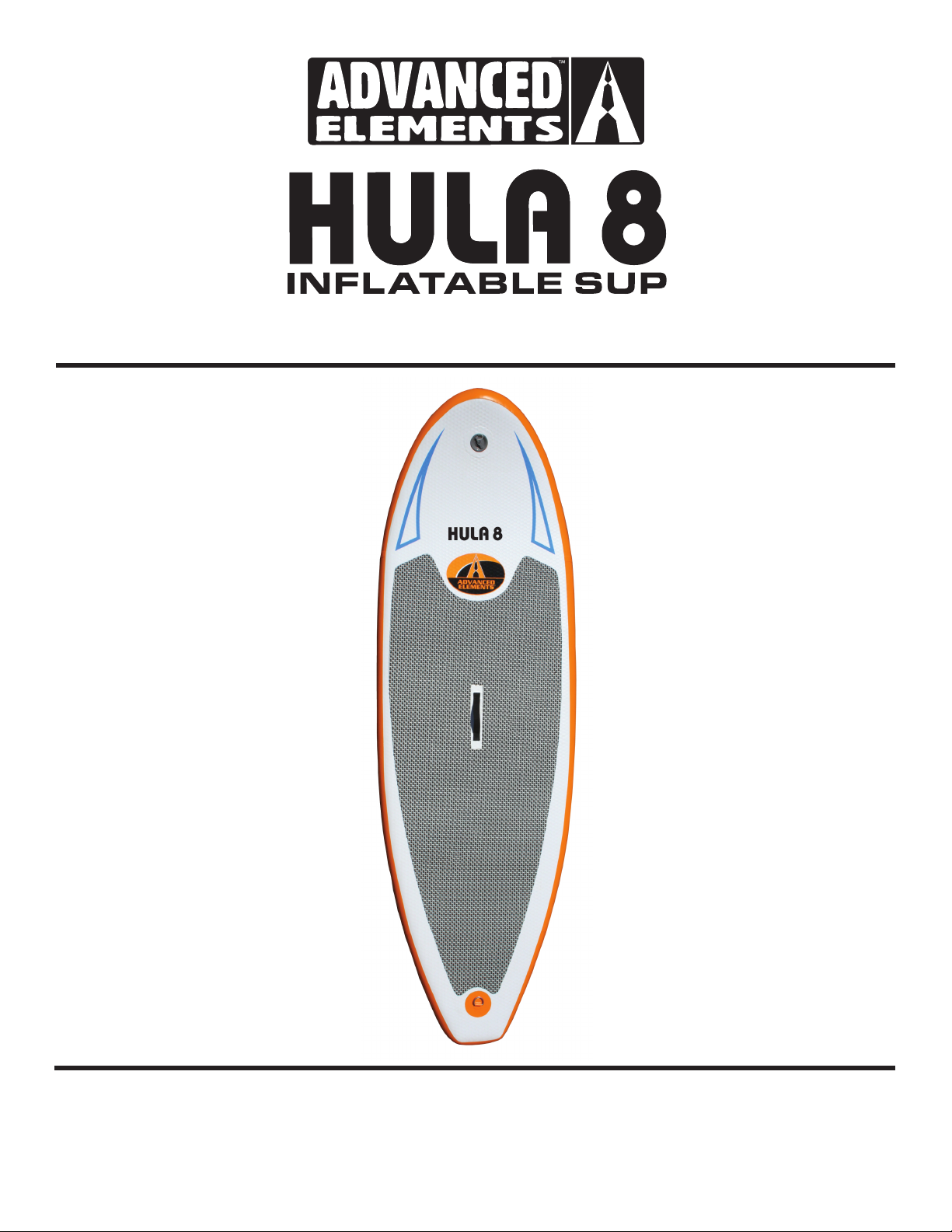
Owner’s Instruction Manual
IMPORTANT!
PLEASE READ THIS MANUAL CAREFULLY BEFORE PROCEEDING. AFTER READING THIS
MANUAL, SAVE THESE INSTRUCTIONS FOR FUTURE REFERENCE.
Page 2
Congratulations on your purchase of the Advanced Elements Hula™ 8 SUP. It is our goal at Advanced Elements to
develop new and unique paddle sports products that enhance our customer’s outdoor experience. This versatile
paddleboard has been designed for use in many water conditions from surf to flat waters and can be paddled standing
or sitting. Made of quality materials, this compact and highly durable SUP is easy to set up and will have you out on the
water in no time.
1 CAUTION – SAFETY WARNING
Users of this product agree by their use to accept the inherent risks involved in this paddle sports activity and agree to
follow all instructions, cautions, and warnings carefully before using this Paddleboard.
(PLEASE READ CAUTION STATEMENT CARFULLY)
Page 3
2 Set Up and Inflation
2.1 Set Up
1. Pull the Hula™ 8 out of its bag and un-fold it.
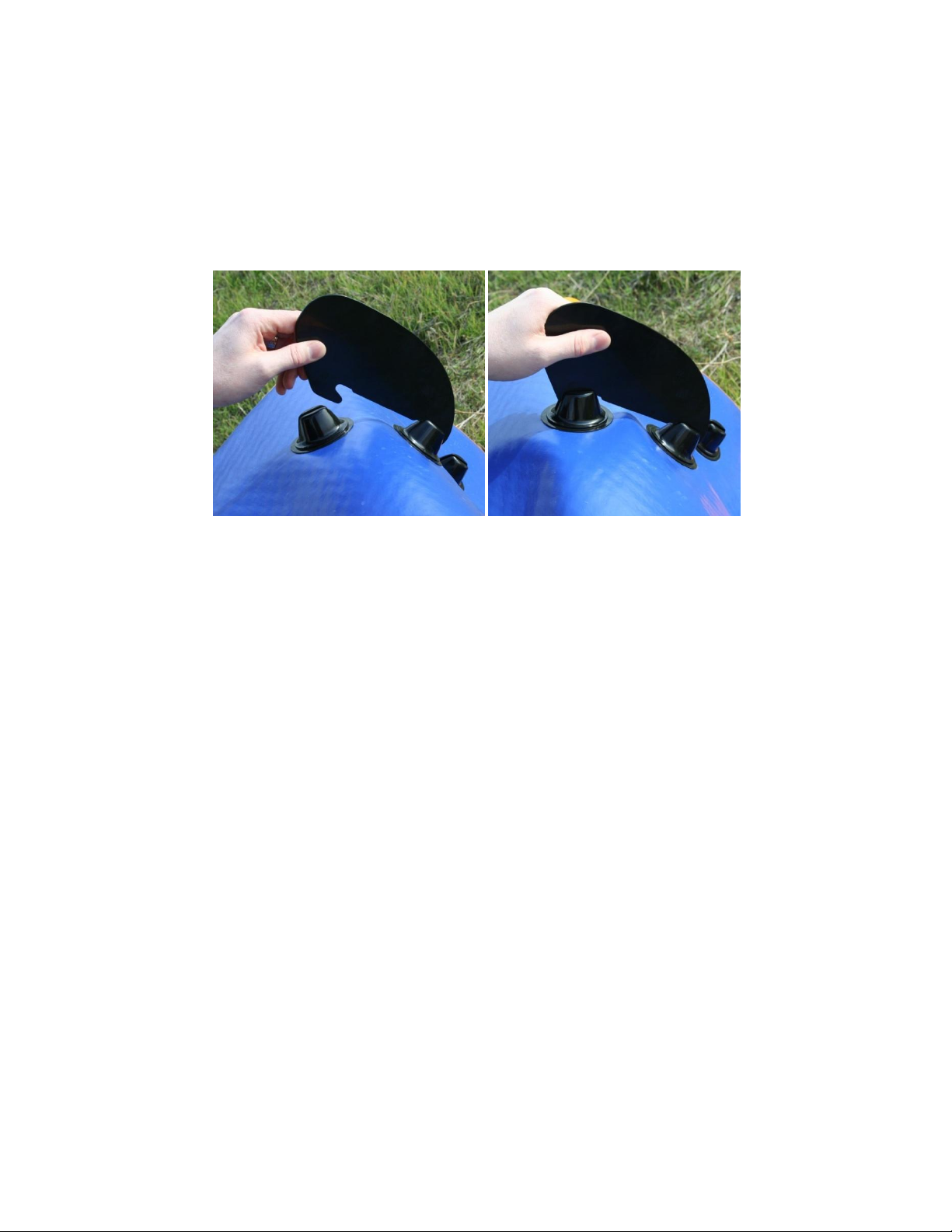
2. Locate the Fin holders on the bottom side of the board at the tail end. Take each Fin and hook them into place
making sure that the longer portion is going towards the end of the board. You will need to bring the two Fin
holders close together in order to get each Fin hooked into place. See images 1 and 2.
3. Once the Fins are in place, turn the board over so that the valve at the front of the board is facing up.
Image 1 Image 2
2.2 Inflation
Pump Set-up:
Your Single Action Hand Pump comes with a removable pressure gauge that needs to be attached to the pump before
use. Note: When the pump is stored, it is recommended that you detach the pump gauge and store it somewhere that
the gauge will be protected from being crushed or damaged.
1. Attach the gauge housing to the T-Handle of the pump.
2. Attach the pump hose to the gauge housing.
Inflation:
1. Remove the cap from the valve and check to see if the stem in the center of the valve is up (sticking up out of
the valve) or down (even with the inner rim of the valve). The stem of this valve must be in the up (inflate)
position to inflate the SUP. If the valve is not in the inflate position, use your finger to push in and turn the stem
counterclockwise a quarter turn and it will spring up into the inflate position. SEE IMAGES 3 AND 4.
2. Seat the valve adaptor included with the SUP Pump onto the valve turning clockwise to lock the adaptor into
place.
3. Inflate the SUP to 8.0 psi. Make sure that you do not exceed 9.0 psi or you will damage the SUP.
4. Once you are done inflating the SUP, disconnect the valve adaptor by turning counterclockwise and close the
valve using the attached valve cap. Make sure you lock the valve cap into place by turning clockwise.
Page 4
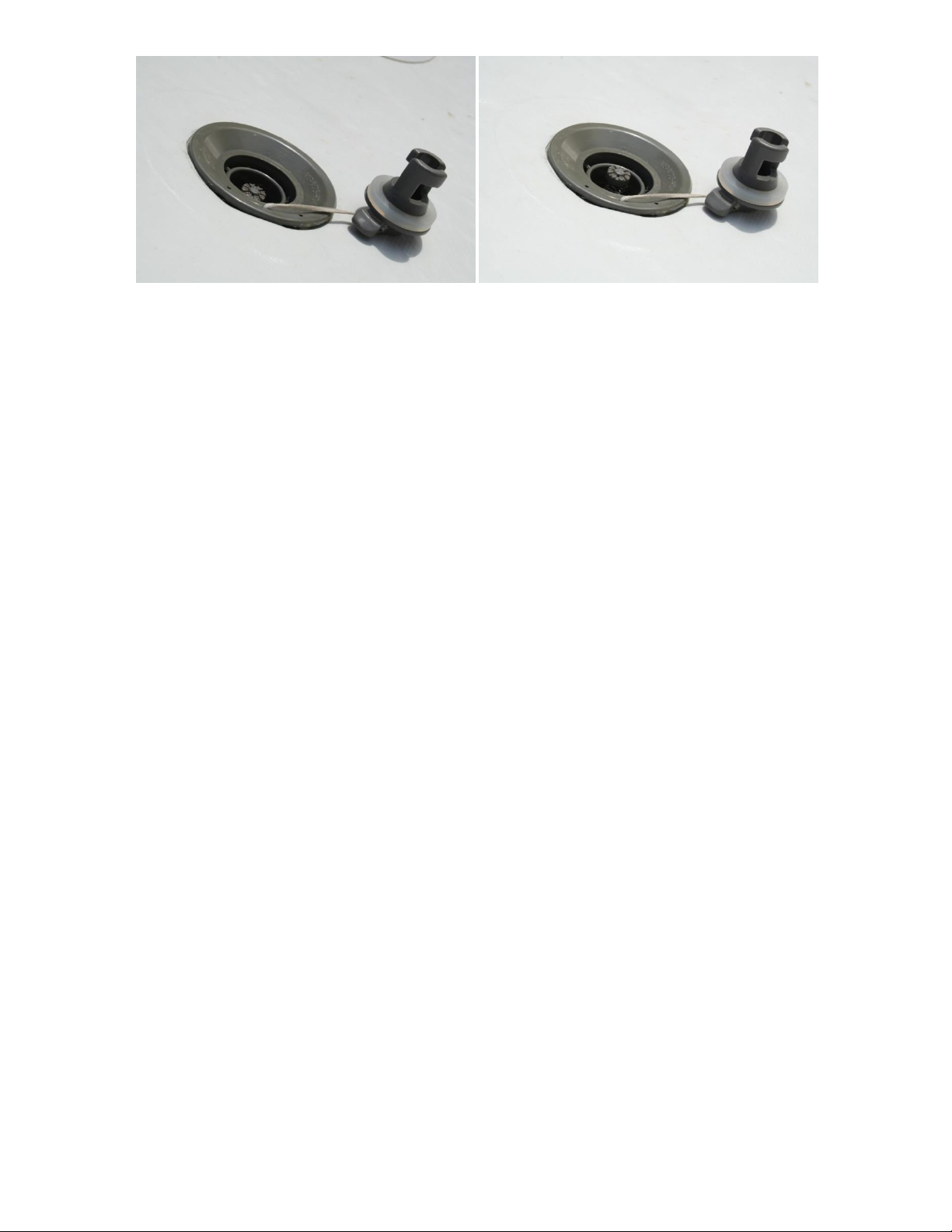
Image 3 (Deflate Position) Image 4 (Inflate Position)
Inflation/Pump Use Tips:
Because you will be inflating your SUP to such a high pressure, please follow these suggestions to help you with inflation.
1. Stand the pump on hard level ground when inflating the SUP.
2. Make sure to keep your hands towards the center of the pump handles when inflating and keep your feet firmly
on the foot rests. Make sure that you are standing directly over the pump so that you can utilize your body as
much as your arms while inflating (this will come in handy as you get the SUP up to higher pressure).
3. When the SUP begins to reach 7.0 psi or higher, you may experience resistance in the pump. The best way to
inflate your SUP to 8.0 psi or a little higher (Remember DO NOT exceed 9.0 psi) is to use your body weight on
the down stroke and use your leg strength for the up stroke.
3 D-Ring
The large d-ring at the tail of the SUP is for a surfboard ankle leash. Using an ankle leash is a great safety measure to
ensure that you will not become separated from your board if you fall off. It is highly recommended that you use an
ankle leash whenever using the SUP on flat water, but not when you are on a river!
4 Deflation and Break-down
1. To deflate and break-down your SUP, just remove the valve cap and push in the valve stem turning it clockwise a
quarter turn to lock it in the deflate position.
2. Un-hook the Fins by pressing the Fin holders close together and popping the Fins off.
3. Roll the SUP up with the top side facing out (this will push out all of the air), and put away in its bag.
Page 5

5 Care and Maintenance
Very little needs to be done to care for and maintain your SUP.
1. To clean your SUP, just use a mild detergent and warm water. You should rinse your SUP off with fresh water
after using it in salt water.
2. To ensure that your SUP lasts for years to come, do not store it in direct sunlight uncovered or in extremely hot
or cold temperatures for long periods of time, i.e. months. Exposing your SUP to these kinds of elements, such
as a freezing winter in an unheated shed, over such an extended amount of time can prematurely wear out the
materials that the SUP are made of.
3. Do not leave your SUP inflated in direct sunlight for long periods of time, unless it is in the water. Hot air
expands, so with this, if you leave your SUP on the beach or on the pavement in a parking lot fully inflated for a
long period of time, the air inside the SUP will expand and cause over inflation, damaging your paddleboard. If
you leave your SUP out in the sun for a long time, just let about half of the pressure out and then re-inflate when
you are ready to go back out.
6 Repairs
6.1 Repairing Small Punctures and Cuts
1. Cut a rounded patch at lease ¼” or ½” larger than the hole or cut.
2. Clean the area where the patch will be placed with water and/or mild soap.
3. Make sure all surfaces are dry.
4. In a well ventilated area, spread a thin layer of glue on both the patch and on the damaged area. Let it sit for
three to five minutes or until tacky.
5. Apply the patch and allow twelve hours for the glue to dry completely.
6.2 Repairing Pinholes
1. Inflate the SUP and locate the pinhole by sponging soapy water over the paddleboard until you see air bubbles.
Mark the location of the pinhole.
2. Deflate the SUP and dry the affected area. Apply a drop of glue to the pinhole.
3. Allow the glue to dry completely, approx. twelve hours.
4. Do not inflate the SUP for at least twelve hours.
7 Paddling Basics and Do’s and Don’ts
7.1 StandUp Paddling Basics
1. Make sure that your Hula™ 8 is fully inflated. It should be nearly rock hard and when standing on the SUP in the
water is should not bend. Your paddleboard will flex with your weight, but it should not bend to the point of
creating a crease.
2. If you are paddling in open water, such as a lake or the ocean, make sure that you use an ankle leash. If you fall
off, your board could be swept away from you, leaving you stranded. An ankle leash will keep this from
happening.
Page 6

3. If you are paddling a river, do not use an ankle leash. This could be very dangerous because if you fall off, your
board could pull you under the water as it continues down the river. Also, an ankle leash could get caught on
items under the water and pull you off of your board as you are riding down the river.
4. Be careful in windy conditions. Because you are completely above the water, strong winds can greatly affect you
and could push you around.
5. Never leave your board, even if you lose your paddle. You can still paddle your board with your hands, which is
easier than trying to swim back to shore. Also, if the wind was to pick up, your board will blow away from you
faster than you can swim to it. This is why an ankle leash is so important.
6. Foot Position: You should stand in the middle of the board when paddling. When on flat water, stand with your
feet about shoulder width apart and face forward. If you are surfing or in choppy water, you want to take more
of a surfer’s stance with your dominant foot facing forward. Your feet are not glued to the board, make sure to
get used to moving your feet around on the board because the sooner that you do this the more comfortable
you will feel about doing turns and riding waves.
7. The Best way to turn your board is to stand with your foot at the tail of the board with your weight over the fins.
This is where foot movement will come in handy.
8. For more in depth instructions or lessons on paddle boarding, we recommend utilizing the internet or a
paddleboard instructor.
7.2 Surfing Do’s and Don’ts
Be Aware: Be aware of other surfers and water users, of the surf conditions, and of where you are surfing.
Comfort Zone: You should paddle surf in waves that you are comfortable in, don't get in over your head.
Fitness: Make sure you are physically fit when surfing. You need to be able to swim back to shore if you lose your board
at the end of an exhausting session - no mean feat in a 9 foot swell.
Food: As with swimming, do not go surfing for at least 45 minutes after a meal.
Hold or Throw: Know when to hold onto your paddleboard and when to get rid of it. If you are paddling out then keep
hold of your board, you'll get out back to the line up more quickly and you will not put anyone paddling out behind you
at risk. If you are about to wipe-out then get rid of your board. You are far more likely to sustain an injury if you and your
board are getting washed around together.
Patrolled Beaches: If you are paddle surfing on a patrolled beach, make sure that you keep within the designated surfing
area. Take note of where you should be surfing before you go out, and make sure you stick to it when you are out.
Priority: Always make sure that you are not taking anyone else's wave. Remember, the surfer who is closest to the
breaking wave has priority. If you see someone already on a wave then the wave is taken and you'll have to wait for the
next one.
Practice: If you want to improve then you need to be in the water surfing as regularly as possible. No-one got any better
at anything by staying home and watching TV.
Respect: Respect the locals if you are visiting a beach. Remember that you are a guest and that waves should be shared.
Rips: If you are caught in a rip current remember that it's called R.I.P. for a reason and you will probably not make it back
to dry land ever again. Although hopefully you already know that a rip current is a strong current that (normally) goes
straight out to sea and if caught in one that you should not panic and paddle across the rip current (not against it) until
you have escaped.
Page 7

Surf Buddy: Always surf with at least one other person. Not only will you have more fun if you are sharing your waves
but you will always have someone to help you out if you need it.
Surf Conditions: Make sure that the surf is safe before you go in. If you are going paddle surfing at a spot you are
unfamiliar with it is a good idea to get some advice from a local. Check out the surf spot while warming up.
Warm-up: Always have a quick warm-up and stretch before entering the surf. This will reduce the risk of muscle injury
or cramp whilst you are paddle surfing. It also gives you time to check for any rip currents or where the best spot to
catch waves is.
Page 8

If you would like a catalog of our latest products please
visit our website at
www.advancedelements.com
or call Toll Free 866-262-9076
Email: [email protected]
IMPORTANT!
PLEASE READ THIS MANUAL CAREFULLY BEFORE PROCEEDING. AFTER READING THIS
MANUAL, SAVE THESE INSTRUCTIONS FOR FUTURE REFERENCE.
 Loading...