

Page 1
1
User Information |
Page 2

12
| Upgrading the Firmware
Table of Contents
1 User Information 3
1.1 Caution 3
2 Product Introduction 5
2.1 Product Overview 5
2.2 Package Contents 6
2.3 Connection 7
2.4 Front Panel 11
2.5 Side Panel 12
2.6 Back Panel 12
2.7 First Time Usage 13
2.8 Remote Control 16
3 Main Functions 18
3.1 Setup Menu 18
3.2 Movie Library 32
3.3 Photo Library 35
3.4 Music Library 38
3.5 File Manager 40
3.6 Playlist Management 45
3.7 Files Operation 46
3.8 Internet Media 48
3.9 Torrent Function 49
3.10 Jukebox 50
3.11 SAMBA Server and Client 53
3.12 FTP Server 54
4 Upgrading the Firmware 57
5 Appendixes 58
5.1 Specifications 58
5.2 Frequently Asked Questions 59
6 Copyrights and Trademarks 61
7 Warranty 62
8 GPL Statement 62
9 Disclaimer 62
.
2 | Table of Contents
Page 3

3
User Information |
1
User Information
1.1 Caution
1.1.1 Usage cautions
1.1.2 Power
1.1.3 Radio interference/compatibility
1.1.4 Repair
1.1.5 Disposing of the player
This player is designed and manufactured with safety in mind. In order to safely and
eectively use this player, please read the following before usage.
User should not modify this player. If commercial hard disk is being used, the environmental temperature should be within +5 ~ +35.
The player’s power voltage: DC 12V.
When using this player, please connect the supplied AC adapter or AC adapter cable
to the player’s power jack. When placing the adapter cable, make sure it will not get
damaged or be subject to pressure. To reduce the risk of electric shock, unplug the
adapter first before cleaning it. Never connect the adapter to the player in a humid or
dusty area. Do not replace the adapter or cable’s wire or connector.
- If not properly shielded, almost all electronic devices will get radio interference.
Under some conditions, your player might get interference.
- The design of this player complies with CE standards, and adheres to the following
rules:
(1) This player may not cause harmful interference
(2) This player may receive some interference, that may cause undesired operation.
If the player has a problem, you should take it to an appointed repair center and let
the specialists do the repair. Never repair the player yourself as you might damage
the player or endanger yourself or your data.
When you dispose of the player, be sure to dispose of it appropriately. Some
countries may regulate disposal of electrical devices, please consult with your local
authority.
Page 4

4
| User Information
1.1.6 Hard disk cautions
1.1.7 Others
The player uses an internal hard disk for data storage. Under normal circumstance,
format or repair is not required.
You should carefully read the < Frequently Asked Questions > chapter, and check our
website for latest information before formatting the hard disk.
- Physical impact may create bad sector in the hard disk, you can use CHKDSK to fix
the problem.
- All data stored in the player may be lost due to physical impact, electrical shock,
power lost, HDD format etc.
- It is recommended that you defragment after a long period of usage.
- Regularly backup the data in the hard disk so that it can be recovered in the event
of data corruption or loss. Our company takes no responsibility for loss of data stored
on the hard disk.
When using this player, please do not let the player come into contact with water
or other liquid, if water is accidentally spilled on the player, please use a dry cloth to
absorb the spillage.
Electronic products are vulnerable, when using please avoid the following:
• Do not let the player come into contact with water or other liquid.
• Do not disassemble the player, repair the player or change the design of the
player, any damage done will not be included in the repair policy.
• Do not press the buttons of the player too hard.
• Avoid hitting the player with hard object, avoid shaking the player, and stay
away from magnetic fields.
During electrostatic discharge or when exposed to a strong electromagnetic field,
the product will malfunction. If this happens, then unplug the power cable and
the product will return to normal performance next time it is powered on.
Page 5

Product Introduction |
5
2
Product Introduction
2.1 Product Overview
Thank you for purchasing an AC Ryan Playon!HD3 Media Player. Store, stream and
play your entire media collection in 3D Full HD. The ultimate in home entertainment,
this player has the following functionality:
Network Feature
• A/V streaming/transmission via Ethernet(10M/100M/1000M) & built-in Wi-Fi
(802.11b/g/n)
• A/V streaming via UPnP Media Server
• Files sharing via Samba server
• FTP Server
• Internet Radio (SHOUTcast)
• BT download (Transmission)
• Video podcast
Media Library
• Quick-Search, search files by keywords.
• A powerful search engine, allows you to browse multimedia files with ease.
• Movie Jukebox
• A great feature that allows you to view your Movie files by using Movie Photo
thumbnails.
Movie Playback
• Fast forward/rewind
• View subtitle
• Supports major audio formats (1080p HD video decoding)
• Subtitle control: color/oset/size
• Movie format: ASF/AVI/BD-ISO/DAT/DVD-ISO/FLV/IFO/MPG/MP4/M2TS/MKV/
MOV/ M4V/TP/TS/TRP/WMV/VOB/RM/RMVB
Music Playback
• Fast forward/rewind
• Shue
• Repeat
• Music format: AAC/LC-AAC/HE-AAC/MP2/MP3/FLAC/WAV/MS-ADPCM/WMA
(DRM and Advance Profile or lossless not supported)/OGG Vorbis/PCM/LPCM/
COOK/RA-Lossless
Page 6
| Product Introduction
6
Photo Viewing
• You can view photos in slide show mode with background music and/or transition eects.
• Zoom in/out, Rotate
• Photo format: JPEG/HD JPEG/BMP/GIF/TIF/PNG
USB 3.0 & 2.0 Support
• USB 3.0 DEVICE port (for computer connection, compatible to USB 2.0)
• 2x USB 2.0 HOST port (for USB storage devices)
Card reader
• SD/SDHC/MMC/MS/MSPro
File Copy
• Supports copying & moving files from external USB drive, Internal Hard drive and
Network.
Note: All the information contained in this manual was correct at the time of publication. However, as our engineers are always updating and improving the product, your
device’s software may have a slightly dierent appearance or modified functionality
than presented in this manual
Note: The actual contents in the package might be dierent from the packing list in
this manual.
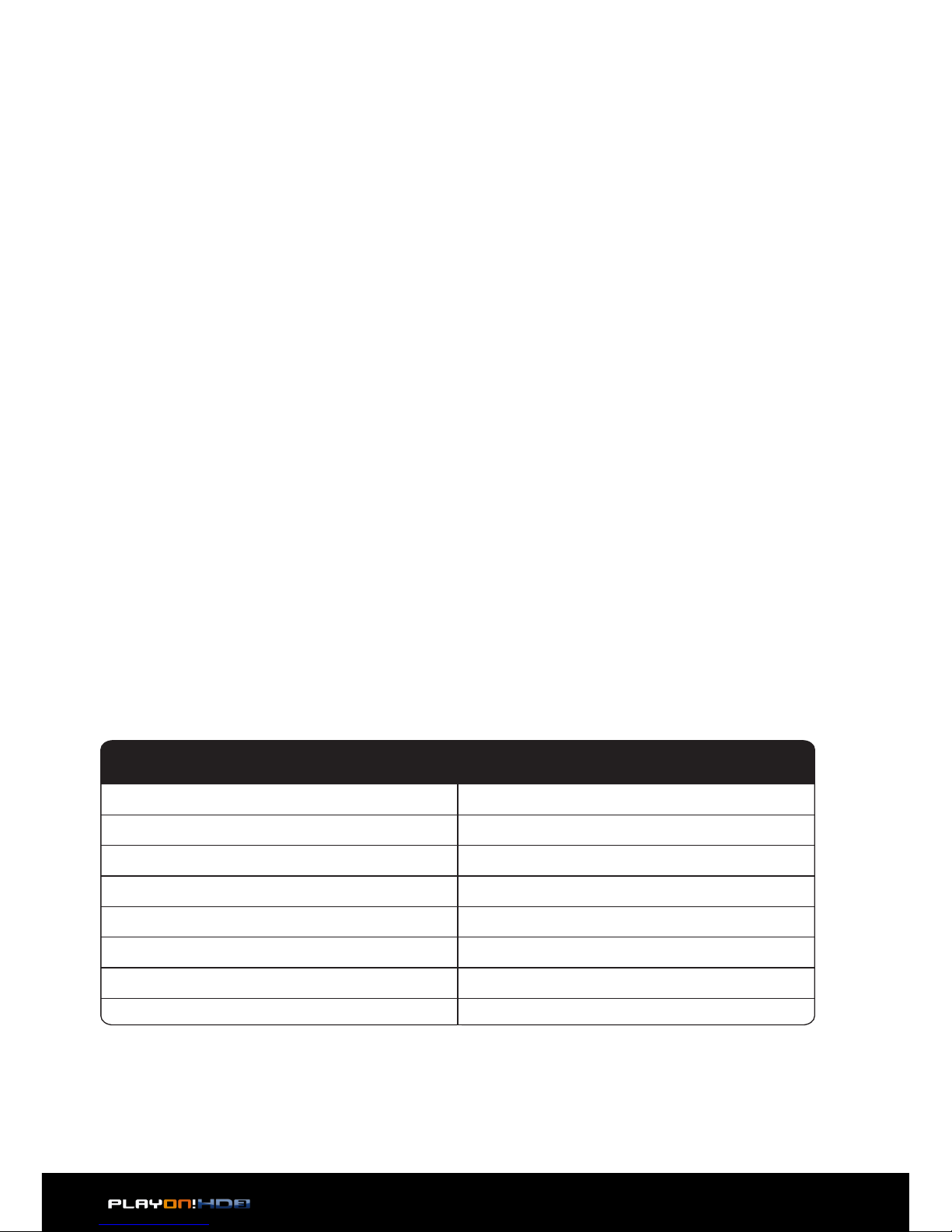
2.2 Package Contents
Part Quantity
Player 1
USB 3.0 cable 1
Remote Control 1
Remote Control Battery 2
AC/DC adaptor 1
Quick Installation Guide 1
Composite cable 1
HDMI Cable 1
Page 7
Product Introduction |
7
2.3 Connection
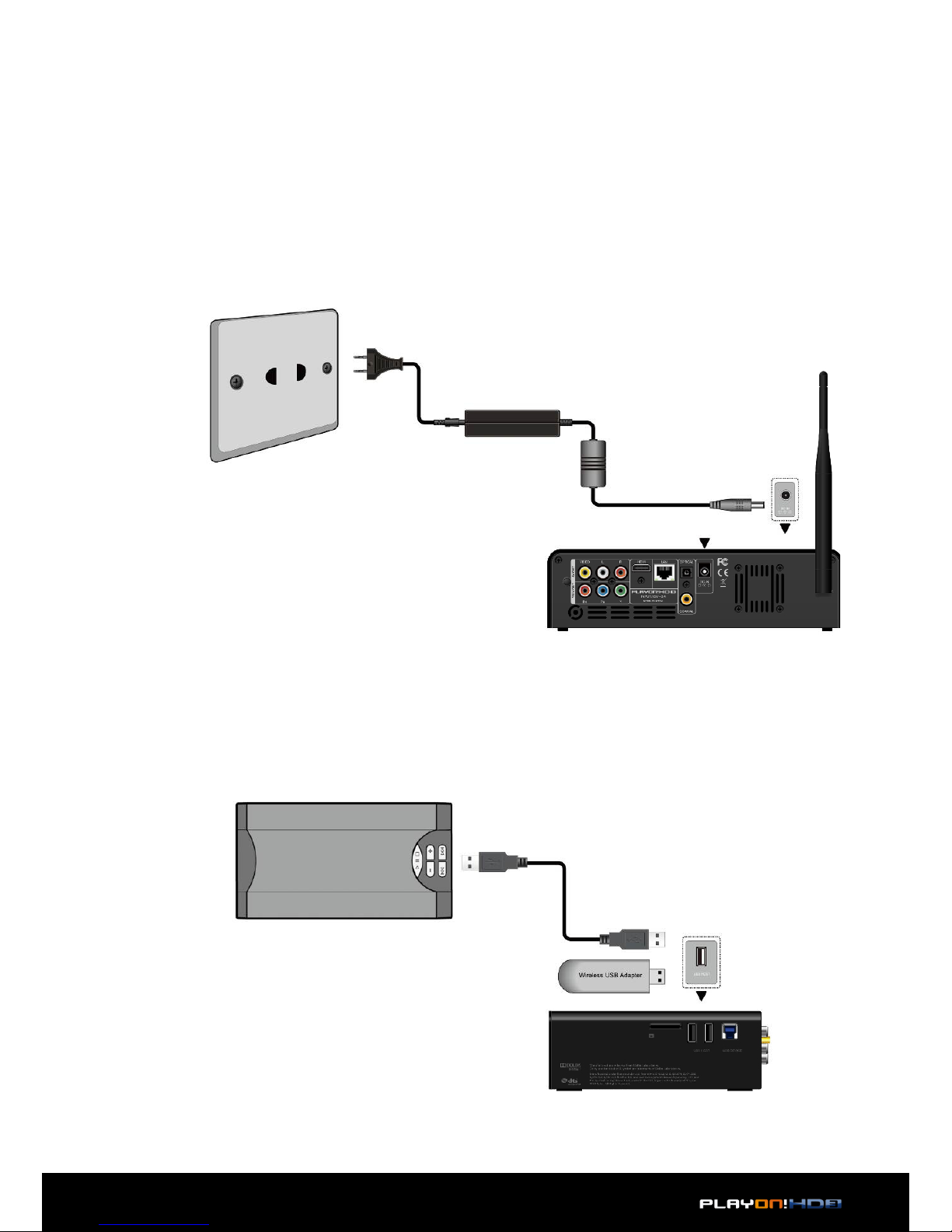
2.3.1 Power connection
1. Follow the picture and connect the AC adaptor to the player’s DC IN jack;
2. Follow the picture and plug in the AC adaptor to the power outlet
2.3.2 USB Mass Storage Device (USB stick, USB HDD etc.) Connection
1. Make sure the player is powered on;
2. Plug in the USB stick or USB HDD etc. to one of the USB host ports of this player.
3. To safely remove the USB device use the EJECT button on the remote control.
Page 8

| Product Introduction
8
2.3.3 Connecting a Memory Card
Memory card can be used by inserting into the card slot
1. Follow the picture to insert the memory card into the card slot properly;
2. Insert the card by following the arrow pointer in the picture.
2.3.4 TV connection
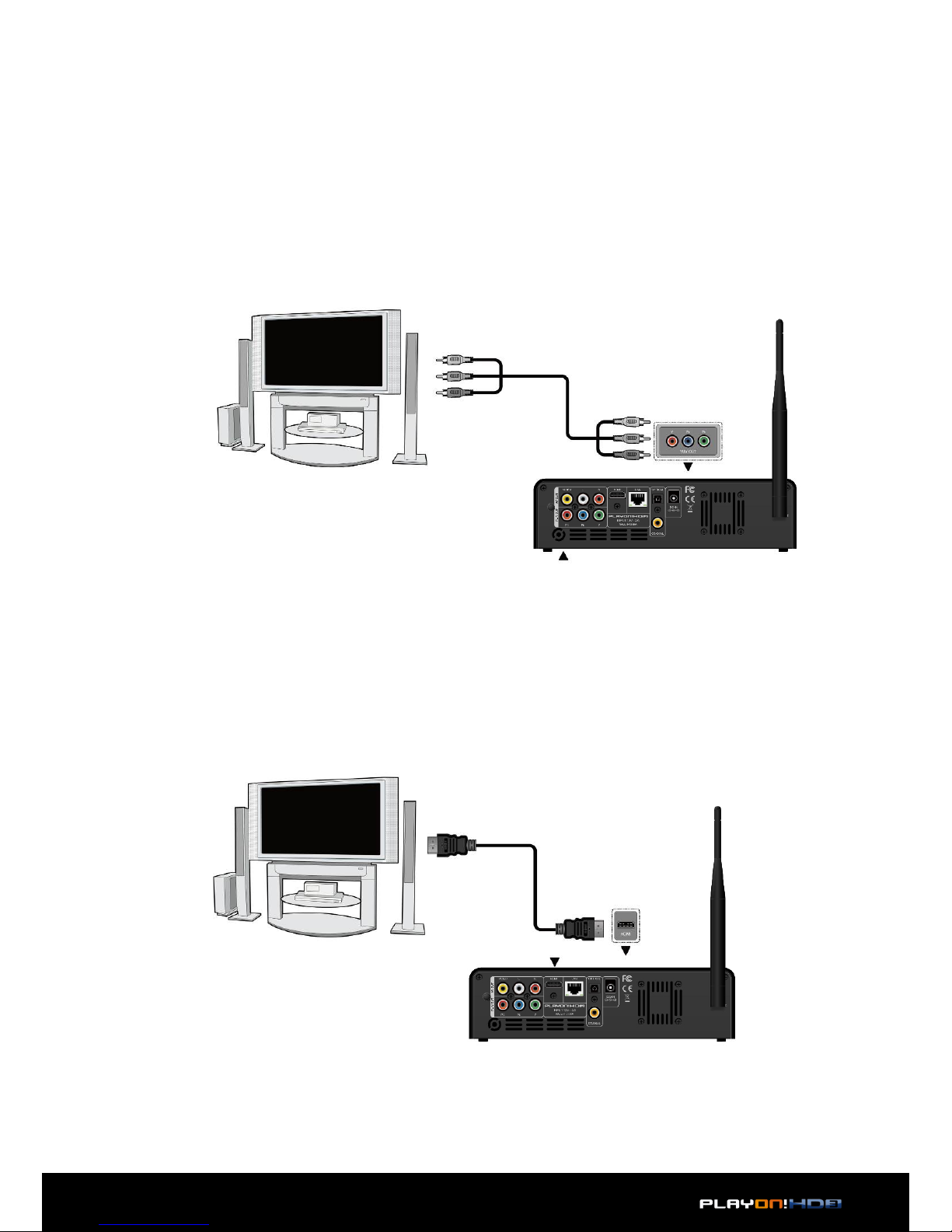
2.3.4.1 A/V OUT
1. Follow the picture and plug in the 3 color connector to the player’s A/V OUT
jack;
2. Follow the picture and plug in the 3 color connector to the TV’s A/V IN jack.
This allows you to connect the content in the player to your TV or other display
devices.
Page 9
Product Introduction |
9
2.3.4.2 Y/Pb/Pr Component OUT
1. Follow the picture and plug in the connector of the YUV cable to the player’s Y/
Pb/Pr jack;
2. Follow the picture and plug in the 3 color connector to the TV’s Y/Pb/Pr jack.
Audio Connection while using Y/Pb/Pr Video out:
First method: use the audio output from the A/V OUT jack;
Second method: use the audio output from the S/PDIF Coaxial or Optical jack.
2.3.4.3 HDMI OUT
1. Follow the picture and plug one connector on your HDMI cable to the player’s
HDMI jack;
2. Follow the picture and plug the other connector on your HDMI cable to the TV’s
HDMI jack.
This allows you to enjoy your media content in the player, on your TV.
This allows you to enjoy your media content in the player, on your TV.
Page 10
| Product Introduction
10
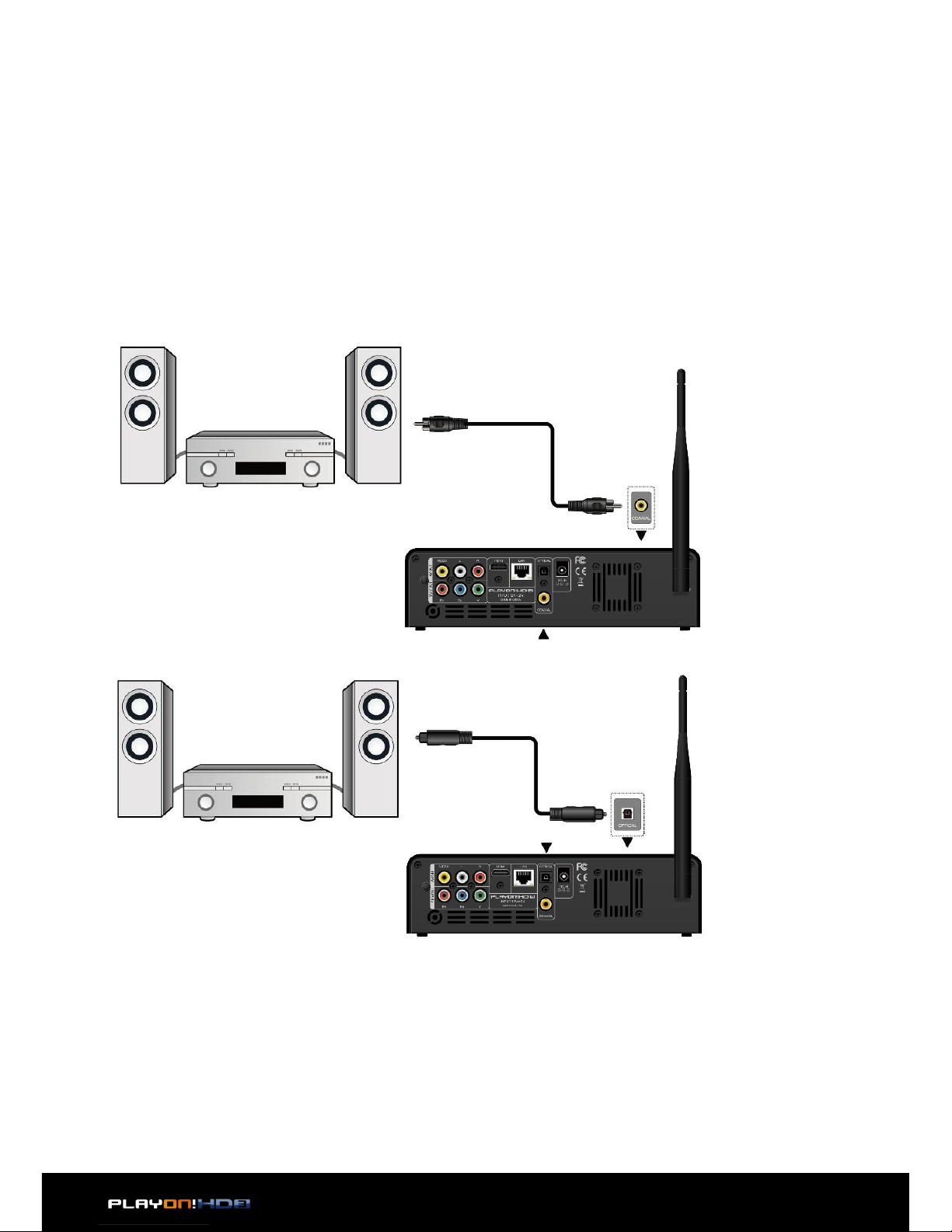
2.3.5 Digital Audio Device connection
1. Follow the picture and plug in the RCA connector on your coaxial cable to the
player’s S/PDIF Coaxial jack. Or if you use optical fiber, please plug in the Toslink
connector on your optical fiber to the player’s S/PDIF Optical jack; (not supplied)
2. Follow the picture and plug in the other connector on your coaxial cable or optical fiber to the digital audio device. (not supplied)
Page 11
Product Introduction |
11
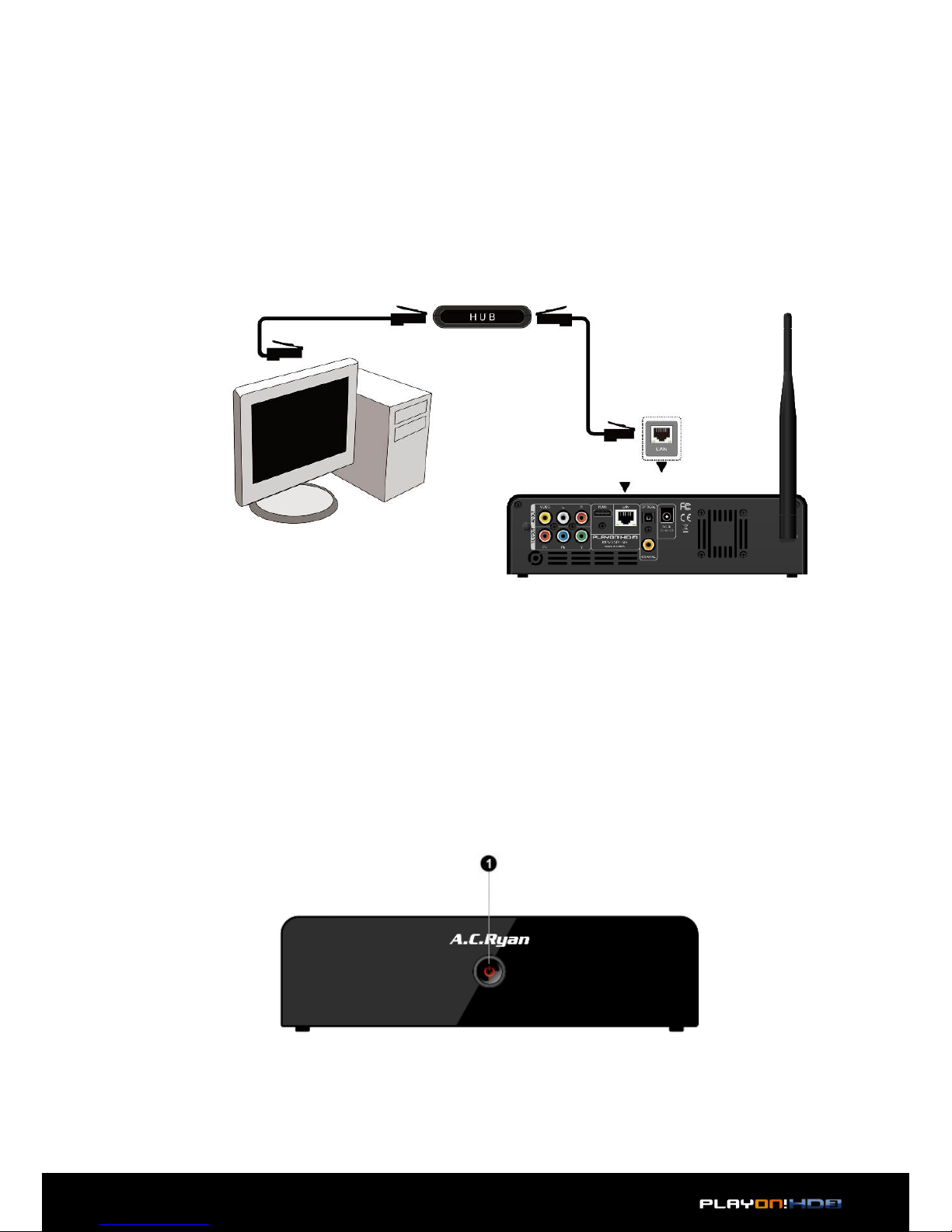
2.3.6 Connecting to a LAN
To connect to a LAN (Local Area Network) you require a cat5, cat5e or cat6 network
cable (not supplied).
1. Connect one of the crystal plugs on the cable to the player’s RJ45 LAN socket;
2. Connect the other crystal plug on the cable to a RJ45 LAN port on your router,
switch, or hub devices.
2.3.7 Connecting to a WLAN
1. Make sure the player is powered on;
2. Search for your router’s SSID and then key in the correct security key if necessary.
Note: Please refer to ‘3.1.4 Changing Network Settings’ for more details about wireless setup
1. POWER button & indicator
2.4 Front Panel
Page 12
| Product Introduction
12
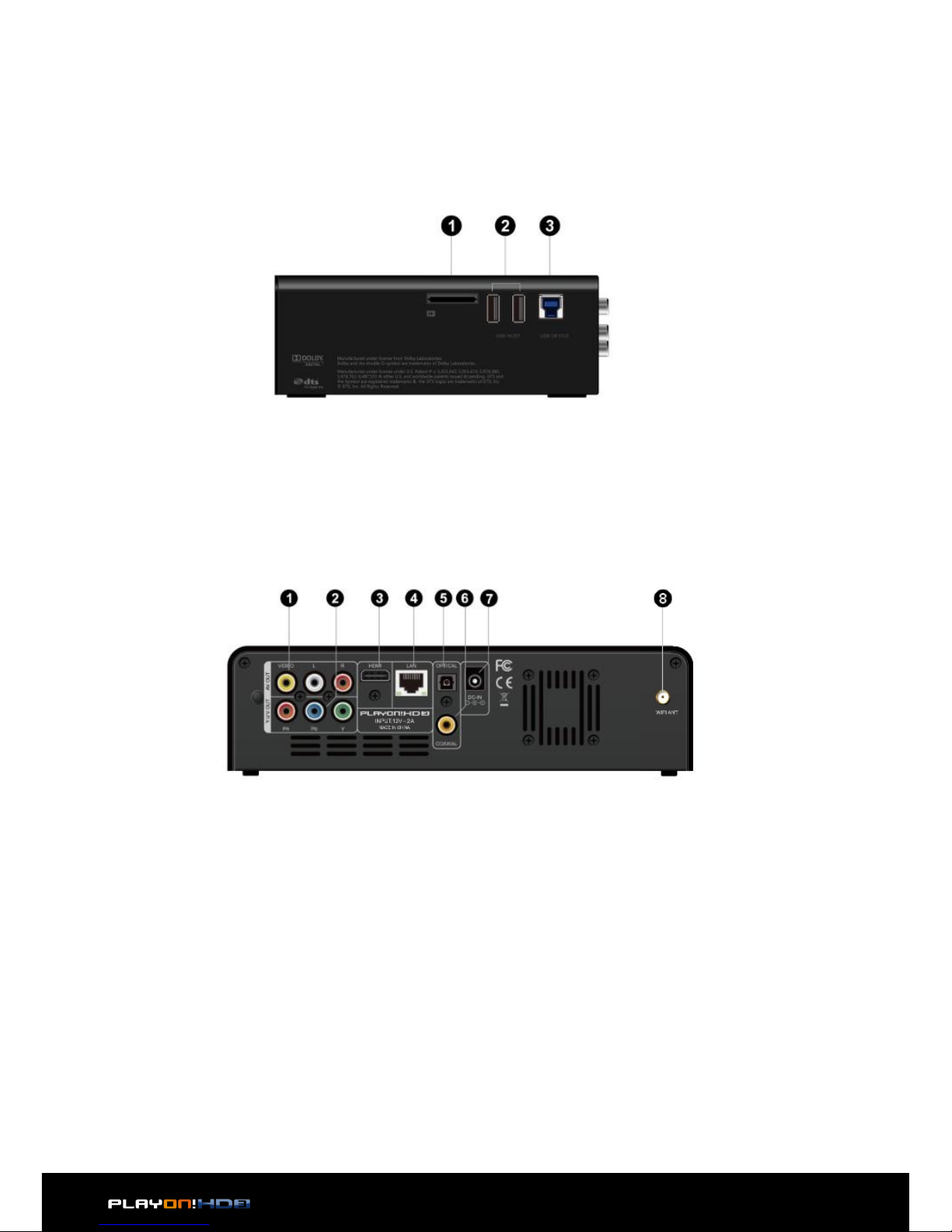
1. Memory Card slot
2. 2x USB 2.0 HOST port
3. USB 3.0 Device port
1. A/V OUT jack
2. Y/Pb/Pr OUT jack
3. HDMI jack
4. RJ45 LAN socket
5. S/PDIF Optical jack
6. S/PDIF Coaxial jack
7. DC-IN jack
8. Wi-Fi Antenna
2.5 Side Panel
2.6 Back Panel
Page 13
Product Introduction |
13
2.7 First Time Usage
2.7.1 Power On / O
Power On
After connecting the DC IN jack, press the power button on the front panel. The indicator will gradually turn to white. And the player will enter the home screen soon.
Power O
Press the power button on the front panel, the player will soon enter standby mode.
The power indicator will turn to red. Then unplug the power cord to cut o the
power supply.
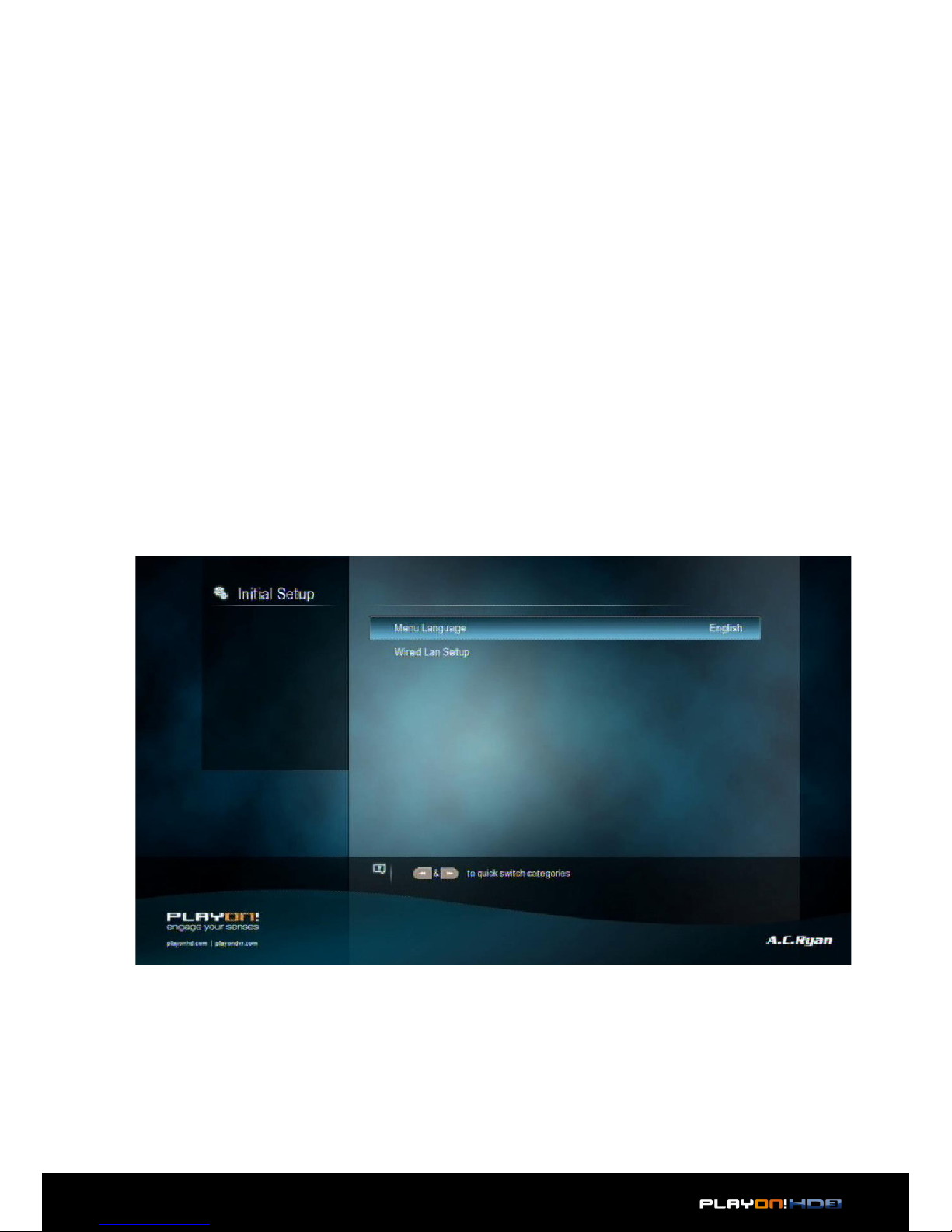
2.7.2 Menu language
The system language of this player can be set to English or other languages. Change
the language you wish in the setup menu, the selected language will take eect immediately.
Page 14
| Product Introduction
14
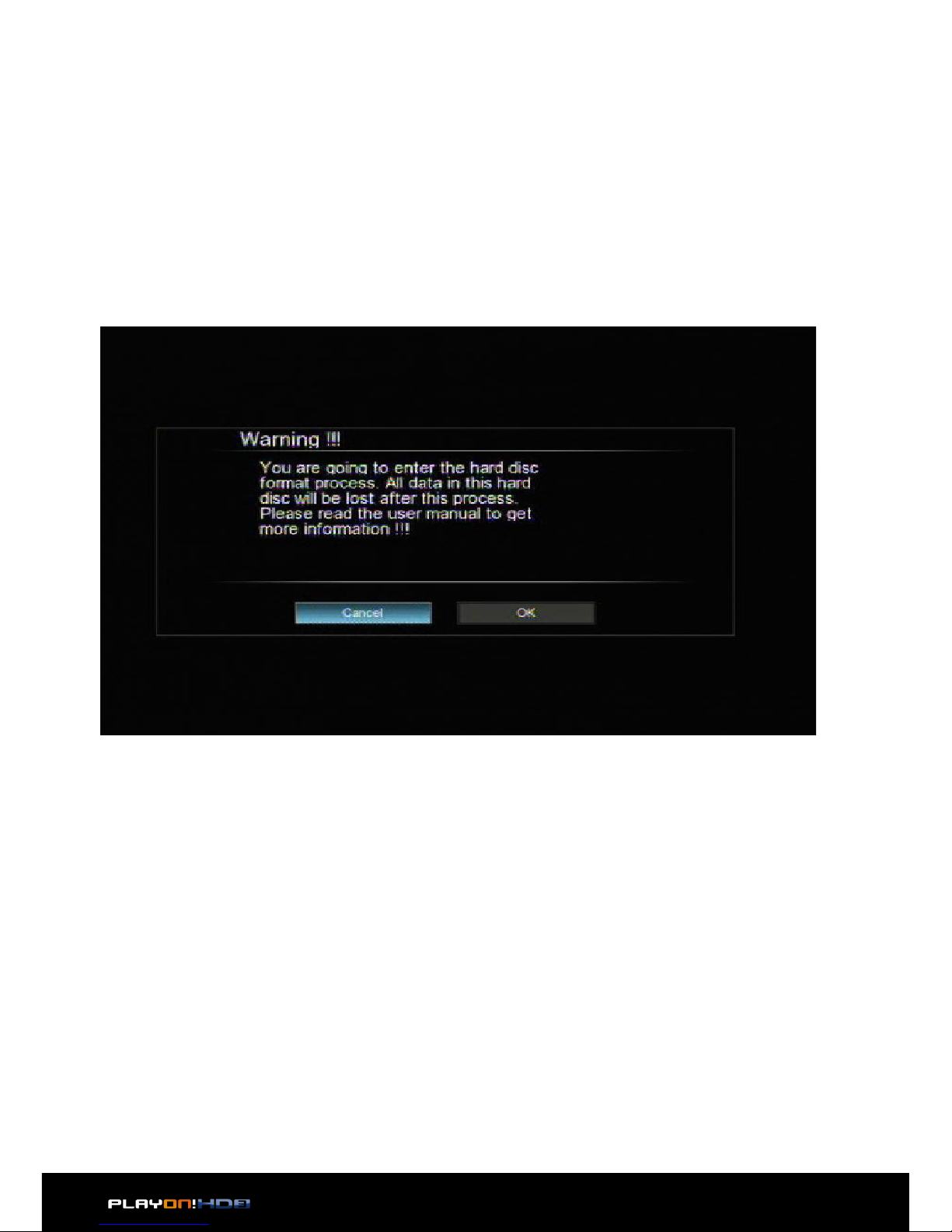
2.7.3 HDD Format
For users who wish to install a new SATA HDD into the player, first you need to format the hard disk using the player built in formatting system before usage. Otherwise
certain functions may not function correctly, such as torrent downloading. Please
refer to the following procedures to format the hard disk.
• Step 1: Select OK on the Warning page, press OK to confirm.
Note: This page can also be accessed via Setup->System-> Format menu.
Page 15
Product Introduction |
15
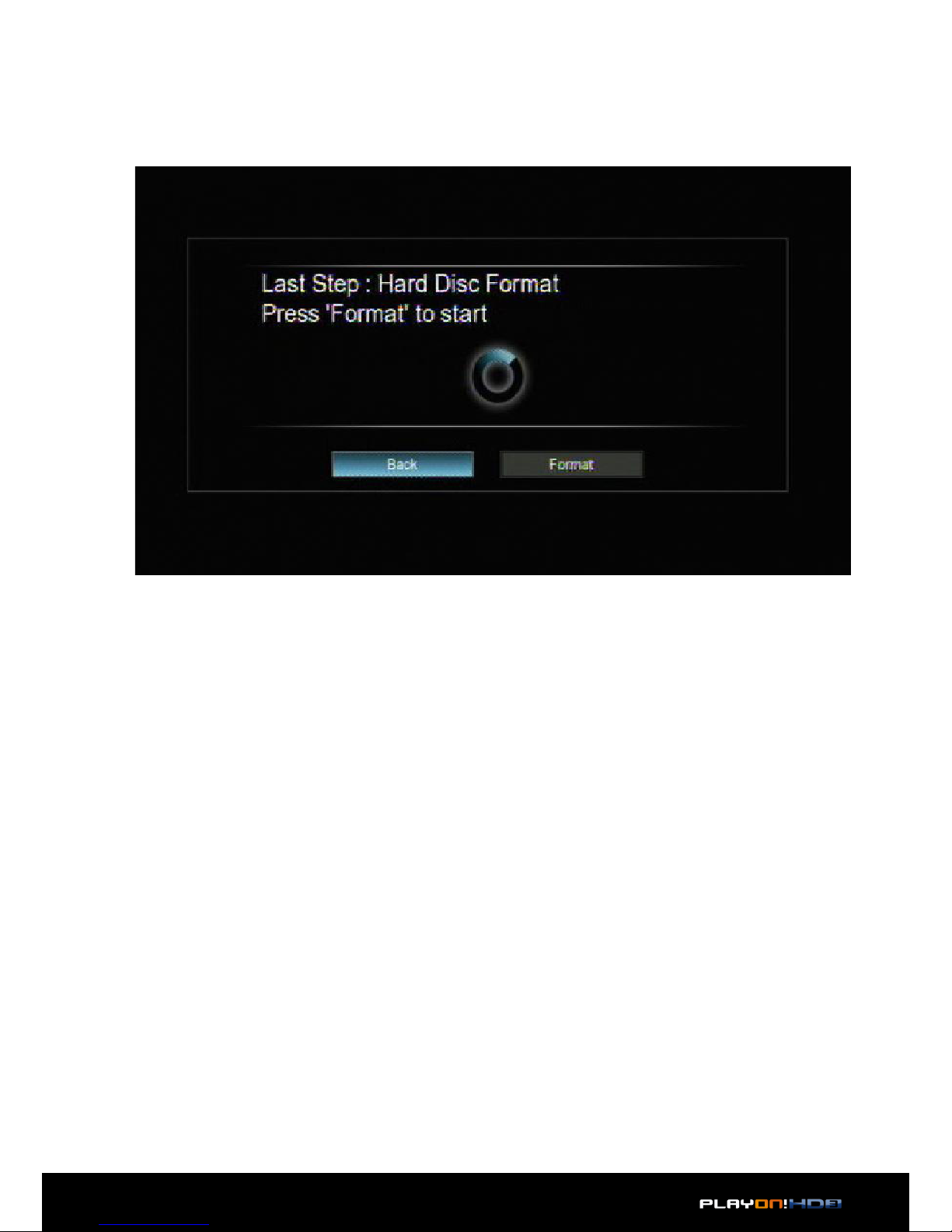
• Step 2: Select Format, press OK, and then hard disk format will start.
When prompted for to choose a filesystem, it is recommended to choose NTFS for
better use with a Windows based machine. Otherwise choose EXT3 if you are using a
Linux-based machine.
The formatting procedure will be completed within a few minutes and the player will
power o after you press OK. You can then use the hard disk properly on the player
on the next power on.
Note: HDD format will remove all data stored on the hard disk drive. Please be sure
to backup your important data in advance!
Page 16
| Product Introduction
16
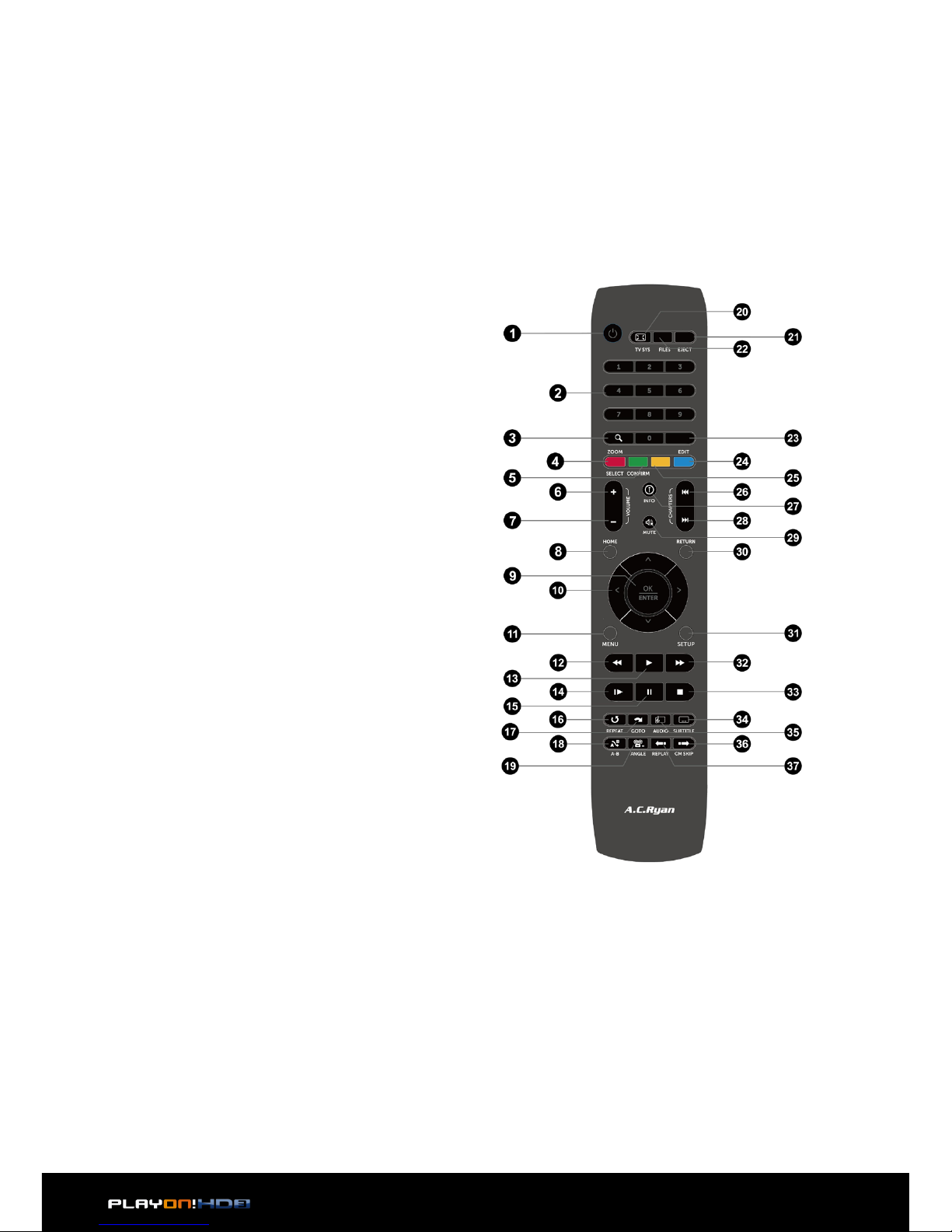
2.8 Remote Control
1. Power 2. Numeric buttons
3. Zoom 4. Red/Select
5. Green/
Confirm
6. VOL+
7. VOL- 8. Home
9. OK /Enter 10. Navigational
buttons
11. Menu 12. FRWD
13. Play 14. Slow
15. Pause 16. Repeat
17. Goto 18. A-B
19. Angle 20. TV Sys.
21. Eject 22. Files
23. Edit 24. Blue
25. Yellow 26. Prev
27. Info 28. Next
29. Mute 30. Return
31. Setup 32. FFWD
33. Stop 34. Subtitle
35. Audio 36. CM skip
37. Replay
Page 17

Product Introduction |
17
1 Power Press to enter standby mode or wake up.
2 Numeric buttons Press to enter numeric input when changing settings.
3 Zoom Press to zoom the image (photo or video).
4 Red/Select Press to select files in file selecting menu.
5 Green/Confirm Function is available in virtual keyboard and in various environment.
6 VOL+ Press to increase the volume.
7 VOL- Press to decrease the volume.
8 Home Press to enter the home screen.
9 OK/Enter Press OK button to confirm.
10 Navigational buttons Press the arrow buttons to select menu options, and the OK button to confirm.
11 Menu Press to show the option menu, for example you can change the layout mode of file manager;
Press to display or hide the option menu during playback.
12 FRWD Press to fast rewind the current playback. Press repeatedly to select speeds
13 Play Press to begin playback or slideshow
14 Slow Press to play back in slow motion. Press the PLAY button to resume regular playback.
15 Pause Press to pause playback or slideshow
16 Repeat Press to set repeat option.
17 Goto Press to jump to a specific point on a title. Specify the point using Title, Chapter and Time.
18 A-B Press to set the beginning and end points of a section to repeat.
19 Angle Press to change the view angle during DVD (with multi-angle) playback.
20 TV SYS. Press to switch between NTSC, PAL, 480P, 576P, 720P, 1080I, and 1080P.
21 Eject Press to safely remove the USB device or internal HDD
22 Files Press to enter file manager.
23 Edit Press to enter file editing menu in file manager. Press to enter file selecting menu in media library.
24 Blue Press to open/close USB DVD-ROM.
25 Yellow Display / close text console in the browser/internet media
26 Prev Press to view the previous file / page up.
27 Info Press to display current status. Press during playback, an on-screen display appears showing track
number and time elapsed/remaining.
28 Next Press to view the next file / page down.
29 Mute Press to mute audio output, and press again to resume.
30 Return Press to return to the previous screen while navigating menus.
31 Setup Press to enter the setup menu.
32 FFWD Press to fast forward the current playback. Press repeatedly to select speeds.
33 Stop Press to stop playback.
34 Audio Press to select an audio track.
35 Subtitle Press to set subtitle options. You can change the color/size/oset/text encoding of subtitle.
36 CM Skip Press to advance 30 seconds of the current playback.
37 Replay Press to rewind 10 seconds of the current playback.
ButtonNo.
Function
Page 18
| Main Functions
18
Main Functions
3
3.1 Setup Menu
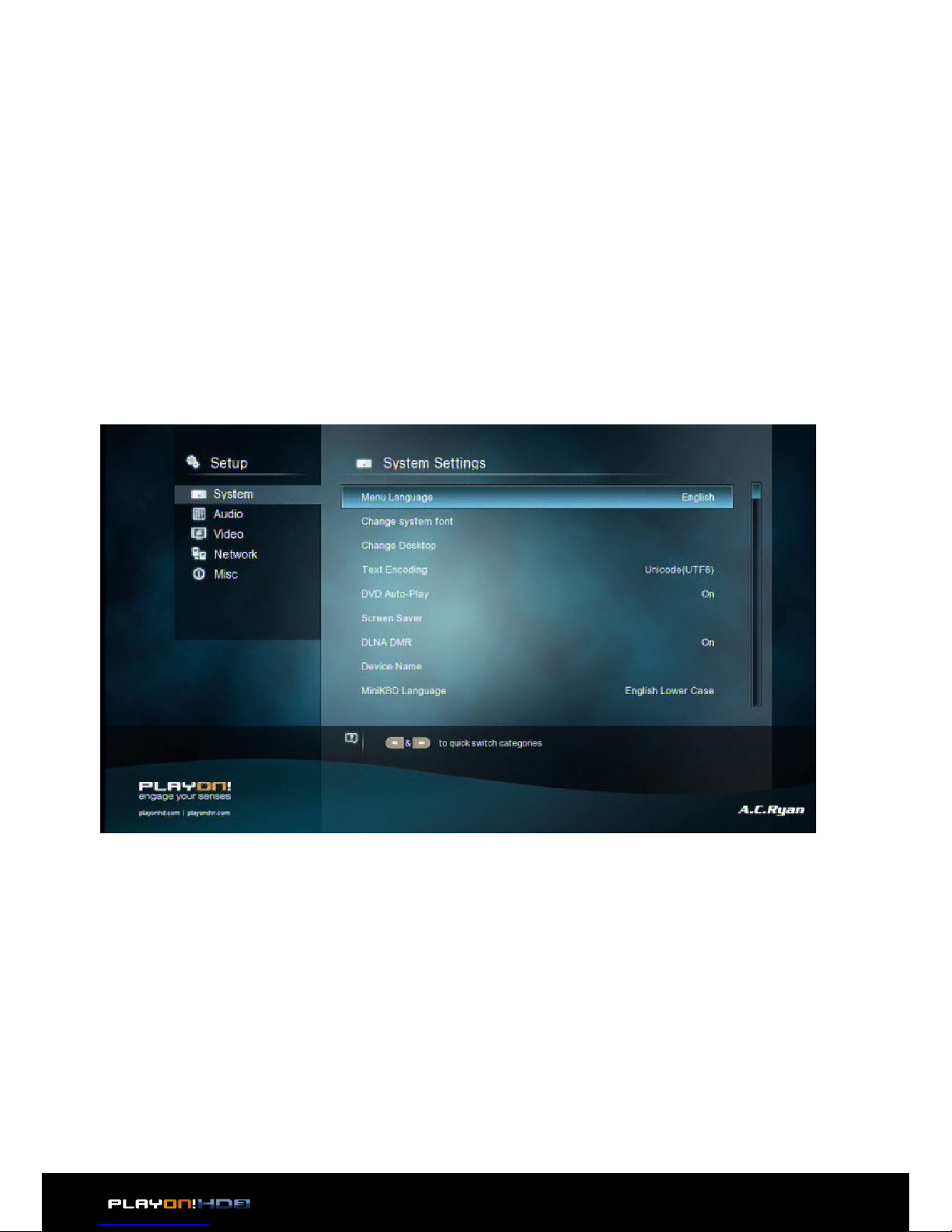
The Setup menu allows you to personalize and configure the preferences for your
player. Select the Setup icon on the home screen or press Setup button on the remote control. There are five setup options, including System, Audio, Video, Network
and Misc. Use the Prev/Next (Chapter) buttons to switch categories.
3.1.1 Changing System Settings
Use this menu to configure system settings.
Menu Language
• Select to choose the OSD (On-Screen Display) language.
Text Encoding
• Select to set the text encoding option (subtitle display during playback)
Change system font
• Select to change system font.
• Create a folder named “Resource” in the root directory of your USB or HDD,
rename your font as ‘font.ttf ‘and then copy it to the folder.
Change Desktop
• Select to change the image of the home menu.
Page 19

Main Functions |
19
• Create a folder named “Resource” in the root directory of your USB or HDD,
rename your photo as ‘desktop.png ‘and then copy it to the folder.
DVD Auto-Play
• Select to turn on/o DVD auto-play.
Show all files
• Select to display all hidden files (non-media files).
Screen Saver
• Timing
Select to change timing of screen saver.
• Options
Select to change screen saver.
DLNA DMR
• Digital Media Renderer, can play content received from a digital media controller
(DMC), which will find content from a digital media server (DMS)
Host Name
• Select to name DLNA DMR (default is PLAYONHD3).
Keyboard input method
• Select to change the desired virtual keyboard input language.
Clear History
• Select to clear the database of indexed movies/music/photos
Keyboard Language
• Select to change the language of the virtual keyboard.
Scan storage
• Select to set the scan mode of media library.
Resume Play
• Select to turn on / o resume playback (auto-bookmarking) feature for movies.
Format
• Select to format your HDD if installed.
BD-Lite Menu
• Select to display Bluray Lite Menu’s.
Restore Default
• Select to restore factory defaults.
Page 20

| Main Functions
20
3.1.2 Changing Audio Settings
Use this menu to configure audio settings.
Night Mode
• Choose among O / On / Auto. If the option is turned on, the audio output volume will be decreased or choose auto to auto-adjust dialogues and background
audio at a normalised level.
HDMI Output
• Choose among RAW, LPCM and Auto.
SPDIF Output
• Choose among LPCM, RAW.
Note: In RAW mode, the audio package will not be decoded by the player and will be
bypassed to the HDMI TV or Digital amplifier.
Due to bandwidth requirement, High-Definition audio formats can only be bypassed
through HDMI cable, also the TV system must be 720p or above.
Page 21

Main Functions |
21
3.1.3 Changing Video Settings
Use this menu to configure video settings.
Aspect Ratio
• Pan Scan 4:3: Displays a wide picture on the entire screen and cuts o the re-
dundant portions. Select when a standard 4:3 TV is connected.
• Letter Box 4:3: Displays a wide picture with two black borders on the top and
bottom of 4:3 screen. Select when a standard 4:3 TV is connected.
• 16:9: Widescreen aspect ratio. Select when a 16:9 TV is connected.
• 16:10: Select when a 16:10 computer display is connected.
TV SYSTEM
• Select to adjust video output resolution. This setting depends on your display
type and its compatible modes.
480P/576P – Choose this if your player is connected via composite A/V cables
to a conventional (CRT) TV.
720P/1080i – Choose this if your player is connected via component cables or
HDMI cable to a display that does not support Full HD resolution.
1080P/HDMI Auto - Choose this if your player is connected via HDMI cable to
your display that supports Full HD resolution.
Page 22

| Main Functions
22
Plasma Mode
• Help to protect your plasma TV by reducing the level of brightness. Choose
between Dark / Dim / Light for the best results.
1080p 24Hz
• Choose this option to enable or disable 1080P 24Hz support. A TV display that
supports 1080P 24Hz (24P) mode is required for this to function correctly.
Page 23

Main Functions |
23
Deep Color
• Provides more detailed level of color depth, and makes continuous color change
smoother. You can get more vivid color eects with this setting. A TV display with
deep color support is required for the best results.
Screen Size
• Adjust the video output size according to the size of your display screen. And
press Zoom button to Fit the screen size you have set during video playback.
Page 24

| Main Functions
24
3.1.4 Network
Use this menu to configure your local network settings.
Wired Lan Setup
• DHCP IP (AUTO)
Select to obtain IP address automatically (DHCP must be enabled on your
Router).
• FIX IP (MANUAL)
Select to manually input the IP Address, Subnet Mask, Default Gateway, and DNS
Server IP Address.
Wireless Setup
There are 3 modes for you to select, Infrastructure (AP) and Peer to Peer (Ad Hoc)
and WPS (AP) mode. Follow the prompting message on the screen and press Play
button to choose Peer to Peer (Ad Hoc) or WPS (AP) mode.
Page 25

Main Functions |
25
This player can store up to three wireless network connections. Press OK to connect, press Return to cancel, press Zoom to rescan the AP’s and press Play button to
choose Peer to Peer (Ad Hoc) or WPS (AP).
Infrastructure (AP)
• Infrastructure mode is used to connect computers with wireless network adapters. Also known as wireless clients to an existing wired network with the help of a
wireless router or access point. Please take the following steps to configure your
wireless network.
Step 1, Scanning AP (Access Point) in your network
Follow the prompting message on the screen and press the Zoom button
to select Infrastructure (AP) mode and update the access points list, and all
SSID will be displayed on the screen.
Page 26

| Main Functions
26
Step 2, Input WEP / WPA key
Press OK to input encryption keys via the virtual keyboard. Press the navigational buttons to select, OK to input, FFWD to move cursor left, FRWD
to move cursor right, Zoom to switch between uppercase and lowercase,
Stop to delete a character, Play to make more symbols available, Green to
change the language of the virtual keyboard, OK to confirm and to start testing the connection.
The testing process will take a while, please be patient. If the test is ok, the
network information (Profile Name, IP address, Subnet Mask, Gateway, etc.)
will be displayed on the screen.
Peer to Peer (Ad Hoc)
• Peer to Peer mode, which is also called Ad Hoc mode or computer-to-computer
mode, is used to connect wireless clients directly together, without the need for
a wireless router or access point.
Page 27

Main Functions |
27
Step 1, Specify your SSID name
Step 2, Specify your host IP
WPS (AP)
• WPS, Wi-Fi Protected Setup, is used to connect a wireless router directly, without
searching SSID and inputting password. In this mode, you just need to configure the parameters of your router which support WPS function. There are two
modes for you to select, PBC mode and PIN mode.
Page 28

| Main Functions
28
PBC
First press the WPS button on the router or select the button mode in the
configuration menu of the router, then select the PBC mode, the connection process will take a while, please be patient.
PIN
Input the pin code when you configure your router, then select the PIN
mode, the connection process will take a while, please be patient.
PPPOE Setup
• Input the ADSL account and password in this menu, system will obtain IP address
automatically from the server based on PPPOE protocol.
Step 1, Select the connection interface, wired or wireless
Page 29

Main Functions |
29
Step 2, press Right button to input your ADSL account
Step 3, press Right button to input your password and start to test
the connection.
Page 30

| Main Functions
30
Transmission
• Select to turn Transmission Torrent Client On/O. Please refer to ‘Transmission
Download’ for more details on this feature.
Samba Process
• Select to turn NAS function to On/O. Please refer to ’SAMBA Server’ for more
details on NAS function of this product.
FTP
• Select to turn on / o FTP services and to configure your desired login User
Name and Password. Please refer to ’FTP Server’ for more details on this feature.
UPnP Server
• Select to turn On/O the built-in UPnP Server
NOTE: the UPnP Server will be default O after reboot!
3.1.5 Miscellaneous
Use this menu to adjust miscellaneous settings.
Version Info
• This tab shows you the system firmware version installed and other system information of your player.
Page 31

Main Functions |
31
USB Upgrade
• Select to update the firmware via a USB stick.
1. Copy ‘install.img’ or extension files to the root directory of a FAT32 formatted USB stick, and connect it to the USB HOST port of the player.
2. Press OK to confirm.
Edit Protection
To prevent deleting of files and formatting HDD by asking for a password.
The default password is ‘0000’. Press the numerical buttons to input, and the
OK button to confirm.
Password
• Change the password.
1. The default password is ‘0000’. Press the numerical buttons to input, and
the OK button to confirm.
Network Info
• This tab shows you information about your network, MAC Address, IP address
Gateway, Subnet.
HDD spin down
• Select the time-out duration to spin down your HDD after the desired idle time is
up. Please be patient when you access the HDD again due to its spin up.
Folder Access Protection
• Lock folders to prevent access to children.
1. To prevent deleting files and formatting HDD by asking for a password. The
default password is ‘0000’. Press the numerical buttons to input, and the OK
button to confirm.
2. In file manager, press Edit button to lock/unlock folder.
Page 32

| Main Functions
32
Quick-Search
• Choose the Search option in the option menu, you can search for a media file
by entering keywords to locate the specific media file.
3.2.1 Movie Library Options
In movie library, press the Menu button to display the option menu, the following
functions are available through the option menu.
3.2 Movie Library
Enter into movie interface, only supported files will be displayed. Please refer to Appendixes in chapter ‘5.1 Specifications’ for more details about the supported files.
Layout Mode
• Choose a layout mode by Thumbnails, List and Preview from option menu.
Page 33

Main Functions |
33
Show BD/DVD
• Choose to display DVD IFO, BD MV and ISO files directly in media library.
Flash Animation
• Choose to display .swf file format in media library.
Go to Folder
• Choose to locate the file in file manager.
3.2.2 Movie Playback Control
You can access the following functions during playback.
Play Start or resume the playback.
Pause Pause the current playback.
Prev/Next View the previous or next file/chapter.
FRWD/FFWD Fast rewind or fast forward. Press repeatedly to select the speed.
Slow Play back in slow motion.
Goto Jump to a specific point on a title. Specify the point using Title, Chapter and
Time.
Menu Display or hide the option menu during playback.
Stop Stop playback.
VOL+/- Increase/decrease the volume.
Audio Select an audio track.
Subtitle Select a subtitle, browse or search for one via the internet (results varies).
Repeat Set the repeat option.
Zoom Zoom in the image.
Info View the media information.
CM Skip Press to advance 30 seconds of the current playback.
Replay Press to rewind 10 seconds of the current playback
Button Function
Sorting Mode
• Choose to sort by Name, Size, Most Viewed or Recently Added from option menu.
Page 34

| Main Functions
34
3.2.3 Movie Playback Options
During movie playback, press Menu button to display or hide the option menu at the
side of the screen.
You can also access functions such as audio track, subtitle and repeat mode through
the Option Menu during video playback.
DVD Menu
• Select to return to the navigation menu during DVD IFO or ISO playback.
• Title Menu / Root Menu return to the main menu of entire disc during DVD
playback.
2D/3D (3D display required)
• Select 3D simulation to convert your 2D video into 3D.
• Select 3D if you are playing a 3D file, such as a bluray 3D title.
• Select 3D Side by Side or 3D Top Bottom if your video file is already encoded in
one of these formats.
BD Menu
• Top Menu / Menu - Select to return to the Title Menu or Main Menu
Page 35

Main Functions |
35
3.3 Photo Library
Enter the photo interface, only supported image files will be displayed.
This player supports JPEG/HD JPEG/BMP/GIF/TIF/PNG files.
3.3.1 Photo Library Options
In photo library, press Menu button to display the option menu, you can access the
following functions trought the option menu.
Quick-Search
• Choose the Search option in the option menu, you can search for a photo by
entering keywords to locate the specific photo.
Layout Mode
• Choose a layout mode by Thumbnails, List and Preview from option menu.
Page 36

| Main Functions
36
3.3.2 Photo Playback Control
You can access the following functions during photo playback.
Sorting Mode
• Choose to sort by Name, Recently Added or Recently Played from option menu.
Folder Directory
• Choose to show all folders.
Leaf Folder View
• Choose to show all folders that includes images.
Date View
• Choose to view photo by date.
Prev / Next View the previous or next photo.
Up / Down Rotate a photo in any angle.
Menu Display or hide the option menu during playback.
Stop Stop playback.
Zoom Zoom in on the image.
Info Display picture information
Play Play / pause a slideshow
Pause Play / pause a slideshow
Button Function
Page 37

Main Functions |
37
3.3.3 Photo Playback Options
During photo playback, press Menu button to display or hide the option menu at the
side of the screen. The following functions are available through the Option menu
during photo playback.
Slide Timing
• Select to choose the Interval and start a slideshow.
Slide Transition
• Select to choose the Transition eects
Repeat Mode
• Choose a repeat mode among Repeat o, Repeat all and Shue Loop from
option menu.
Select Music
• Select to turn on/o background music during slideshow playback.
• Select a special music as the background music during photo playback.
Video Setting
• Select to adjust the value of Brightness, Contrast, Saturation and Hue.
2D/3D (3D display required)
• Select 3D Auto to convert your 2D image into 3D.
• Select 3D Side by Side or 3D Top Bottom if your image file is already encoded in
one of these formats.
Page 38

| Main Functions
38
Quick-Search
• Choose the Search option in the option menu, you can search by entering key-
words to locate the specific music.
Layout Mode
• Choose a layout mode by Thumbnails, List and Preview from option menu.
3.4 Music Library
Enter music interface, only supported audio files will be displayed.
This player supports AAC/LC-AAC/HE-AAC/MP2/MP3/FLAC/WAV/MS-ADPCM/OGG/
Vorbis/PCM/LPCM/ COOK/RA-Lossless/WMA (DRM and advance Profile or lossless
not supported) Standard audio files.
3.4.1 Music Library Options
In music library, press Menu button to display the option menu, the following functions are available throught the option menu.
Page 39

Main Functions |
39
Filter options
• Choose Albums to search for music files by album.
• Choose Artists to search for music files by artist.
• Choose Genres to search for music files by genre.
• Choose Years to search for music files by year.
• Choose Playlists to search for playlists.
Sorting Mode
• Sort your music by Name, Recently Added or Recently Played from option
menu.
Go to Folder
• Choose to locate the file in file manager.
3.4.2 Music Playback Control
You can access the following functions during music playback.
Play/Pause Begin/Pause playback.
FRWD / FFWD Fast rewind or fast forward. Press repeatedly to select the speed.
Prev / Next Plays the previous or next music.
Menu Display or hide the option menu during playback.
VOL+/- Increase/Decrease the volume.
Repeat Set the repeat option.
CM Skip Press to advance 30 seconds of the current playback.
Button Function
Page 40

| Main Functions
40
Repeat Mode
• Choose a repeat mode among Repeat o, Repeat one, Repeat all and Shue
Loop from option menu.
3.5 File Manager
The file manager allows you to browse and play music, photo and movie files stored
in the internal HDD, external USB device, memory card and network.
3.4.3 Music Playback Options
During music playback, press Menu button to display or hide the option menu at the
side of the screen. Access the following functions through the Option menu during
music playback.
Page 41

Main Functions |
41
Layout Mode
• Choose a layout mode by Thumbnails, List and Preview from option menu.
3.5.1 File Manager Options
In file manager, press Menu button to display the option menu and access the following functions trought the option menu.
Filter options
• Choose All Media to display all the supported media files in current directory.
• Choose Movies to display all the the supported video files in current directory.
• Choose Photos to display all the supported image files in the current directory.
• Choose Music to display all the supported audio files in the current directory.
Page 42

| Main Functions
42
3.5.2 A/V Streaming via Network
In file manager, go to the Network selection to start searching for available network
host names in your local network setup.
3.5.2.1 Browsing through workgroup
You can choose the workgroup which your PC belongs to from the workgroup list,
find your PC name, and press the OK button to confirm. Then you can select and
play the shared media files that you want to browse.
Note:
• Due to dierent network conditions, sometimes the workgroup might not be
accessed or shown in the list. In this case you need to use ‘My Shortcuts’ to
browse shared files.
You can stream your media files shared on the home network. Please refer to ’3.1.4
Changing Network Settings’ for more details on network settings.
There are two ways to locate media files shared on your local network in the
Network menu. One is to browse through Workgroup; the other way is to browse
through ‘My Shortcuts’.
3.5.2.2 Browsing through ‘My Shortcuts’
You can set ‘Specific File Server IP’ and access it from ‘My Shortcuts’ in the menu.
• Press the Menu button and a pop-up menu appears.
Page 43

Main Functions |
43
• Select Add to open a popup menu where you can input Label, Net User ID,
Net Password, Domain, Host Name, and Specific File Server IP. Select OK to
confirm, Cancel to cancel, and Simple / Detail to switch between simple and
advanced options.
• Select the shortcut you have added and press the OK button to confirm. You can
then select and play the shared media files hosted on the destination computer.
3.5.3 A/V Streaming via UPnP-server
A built-in UPnP (Universal Plug and Play) client has been integrated in the system,
which enables the player to auto-detect UPnP Media Servers on the network to
browse and stream media files from them.
3.5.3.1 Installing UPnP Media Server on your PC
There are a lot of free and commercial UPnP Media Server software, such as Windows Media Connect, Windows Media Player 11, XBMC Media Center (Linux/Mac/
Windows), MediaTomb (Linux), etc. Please install one of them on your computer. In
the following chapters, we will take Windows Media Player on Microsoft Windows 7
as an example.
Page 44

| Main Functions
44
3.5.3.2 Sharing Media on your PC
The Media Sharing feature of Windows Media Player lets you enjoy the contents of
your Windows Media Player library from anywhere in your home.
• Open Windows Media Player, click Organize -> Manage libraries to add or remove media files from the library.as an example.
3.5.3.3 Streaming Media on your Player
• Connect your player to the home network (LAN or WLAN).
• Visit File Manager - > UPnP menu on the player, select the UPnP-server, and
press OK.
• Click Stream -> More streaming options, then you can allow or deny devices to
access the media library. Click Allow to authorize your player.
• Then you can browse the media library shared by Windows Media Player.
Page 45

Main Functions |
45
Note:
• Make sure your player and your computer are on the same local area network
and subnet.
• Firewalls may prevent your player communicating with your computer. Please
open the ports manually and add your player to the ‘trusted’ list, or disable the
firewall temporarily.
3.6 Playlist management
The file manager allows you to browse and play music, photo and movie files stored
in the internal HDD, external USB device, memory card and network.
3.6.1 Music playlist
To create a playlist you can browse to your music files via the ‘Music’ shortcut in
main menu or via the file manager. Press the Edit Button on one of your music files
and select ‘Multiple Select’. Add the files you wish, press the Edit Button and choose
‘Save Playlist’.
Enter music library, press Menu button and choose Playlists to show your music playlists available on your external USB devices and internal HDD.
3.6.2 Photo Album
To create a photo album you can browse to your photo files via the ‘Photo’ shortcut
in main menu or via the file manager. Press the Edit Button on one of your photo
files and select ‘Multiple Select’. Add the files you wish, press the Edit Button and
choose ‘Save Photo Album’.
Page 46

| Main Functions
46
3.7 Files operation
• On a file or folder, press the Edit button and select Multiple Select.
• Press Red button to select file or folder which you want to copy to the list.
Enter photo library, press Menu button and choose Albums to show your photo
albums available on your external USB devices and internal HDD.
Page 47

Main Functions |
47
• When you are done selecting, press Green button to confirm.
• Select mode of operation, and then follow the prompt on screen to finish the
process.
3.7.1 Single file operation
On a file or folder, press the Edit button to display the file editing menu, choose Copy
for example and follow the prompt on screen to finish the process. If you want to
select more files and folders, please choose Multiple Select to enter the file selecting
menu as explained earlier.
Page 48

| Main Functions
48
3.8 Internet Media
This feature is an additional function. All content and services provided through this
feature are from third-party service providers, our company does not oer any content and services of this feature and therefore is not responsible for any content and
services provided under this feature. Our company is not responsible for any operational stability of the content and services, for example, if you cannot access a certain
website for video streaming or news broadcast, or the content of a website has been
changed etc, the third party service provider controls and is responsible for this. If you
find that these features cannot operate properly, please contact our customer service
or visit our company website to obtain the relevant information.
Please find following the instructions for SHOUTcast radio.
3.8.1 SHOUTcast Radio
Select SHOUTcast Radio icon to get all free internet radio stations, press OK to select
and play radio station, press Return to go back to the previous level.
Note:
• When you enter the Digital Radio menu for the first time, it will take several
seconds to download data from the Internet, please be patient;
• For more about SHOUTcast, please refer to the website: www.shoutcast.com.
Station
• All downloaded stations will be listed under this menu.
Genre
• You can search for stations by genre (pop, rock, jazz, etc.) under this menu.
Favorite
• Your favorite stations can be kept under this menu..
Search
• You can search for stations with the on-screen virtual keyboard under this menu.
Page 49

Main Functions |
49
3.9 Torrent function (using Transmission client)
Once Transmission is enabled in SETUP -> NETWORK -> Transmission ‘On’ you are
able to access the Transmission web control via your favorite browser on port 9091.
For example: 192.168.1.20:9091 (where 192.168.1.20 is the IP address of your player
connected to your router) Here you can add / remove / pause / start your torrent
downloads. You are also able to edit your settings for the current session by clicking
on the smaller symbol on the bottom left corner o the screen.
Page 50

| Main Functions
50
3.10 Jukebox
Getting Started
1. Launch YAMJ for AC Ryan
(Please download the latest version from our support page at http://www.
acryan.com/sg/acr/support/) and install it on your PC or notebook.
Launch the program by double clicking on the icon on your desktop or from
the Start Menu, AC Ryan MovieJukebox
The program will prompt you to install Java runtime if it does not detect any
previous Java installation in your system.
(YetAnother) MovieJukebox is a command line tool, written in Java, which recursively
scans your video library for video files (AVI, MKV, VIDEO_TS, BluRay, etc.) and analyzes these files in order to extract information like: year, language, subtitles, container,
part, fps, audio and video codecs. Other movie and television information like, director, rating, etc. are collected using various plugins for online databases such as IMDb,
TheMovieDB, TheTVDB, Allocine, FilmAnity, FilmWeb, etc.
MovieJukebox then generates the indexes that are compatible for displaying in the
AC Ryan Playon! series media players.
Please select Yes to proceed with the
installation of Java.
Page 51

Main Functions |
51
2.1 Select the directory of your
stored movies in your product internal
HDD, or on any external USB storage
device or network attached storage
(NAS) which you will use to run the
Movie Jukebox on the player.
Note: Generating the necessary information to a network device may take
a longer time than doing the same via
USB.
2.2 Press the Save button to save the
directory information. Press OK to close
the dialog box.
2.3 Press Run/Update to start generating the Jukebox. An active internet
connection is required to obtain the
movie information.
2.4 Press any key to close the com-
mand window after the generation is
completed.
2. Running YAMJ for AC Ryan
Page 52

| Main Functions
52
3 Updating existing Jukebox
You can update the existing Jukebox if you have add/remove
movies to the previously saved directory.
Launch Run or Update YAMJ by double clicking on the icon on
your desktop or from the Start Menu, AC Ryan Movie Jukebox
From the Home menu screen, select Jukebox icon to enter the Movie Jukebox
menu.
Go to the location of your Jukebox where it was generated with YAMJ for AC Ryan.
Upon entering the location, the system will search and display all generated Jukebox
information for loading (if you have more than one)
A message box will ask if you want to update the selected Jukebox
- Choose OK if you are loading it for the first time or made any changes.
- Choose Cancel to continue loading for the second time or if you did not do any
changes.
*: Updating the Jukebox for the first time may take a while depending on the location of your stored Jukebox
and the amount of movies this Jukebox has. You can speed load the same Jukebox again the next time by
selecting Cancel.
Running Movie Jukebox
Page 53

Main Functions |
53
If you have added/removed any new contents to your current Jukebox, please generate again with Run or Update YAMJ and then select Yes to update and load with the
new Jukebox information. Choosing Yes is also required for loading Jukebox for the
first time.
Selecting Other – All from the category page will display all cover arts in the Jukebox
in a thumbnail layout. You can also use the category page to sort and display your
movies according to Genres, Title, Rating, Year, etc.
Selecting any movie from the thumbnail will display the movie details as well as the
movie synopsis, star rating, etc as generated by YAMJ for AC Ryan
Press the OK button on your remote control to start playing the movie. Enjoy.
3.11 SAMBA Server and Client
This player can be used either as a SAMBA Server or as a client.
3.11.1 SAMBA Client
You can stream media files shared on the home network. Please refer to ’3.5.2 A/V
Streaming via Network’ for more details.
3.11.2 SAMBA Server
This product functions as a NAS (Network Attached Storage) device when it is attached to the home network via WLAN. This feature allows users to store and retrieve
large amounts of data from their own local network.
• When the network connection is done correctly and ready for use, please turn
on SAMBA function in the setup menu in advance (refer to 3.1.4 Changing Net-
work Settings for more details), and then type in: \\IP Address or \\Host name
in the Run window (click Run in the start menu) or in the address bar of a web
browser, for example Internet Explorer on your PC (if the IP address of the product is 192.168.0.9, please type in: \\192.168.0.9), and click OK or press the Enter
button on the keyboard.
Page 54

| Main Functions
54
Under Windows Vista and Windows 7, please type in at the
search bar:
\\192.168.0.9
Then press the Enter button on
the keyboard.
You can then manage the files stored on the internal hard disk of the product. In
this way, you can also playback and copy files via network between your PC and the
internal hard disk of this product.
Note:
• Make sure the player is connected properly to your network, please refer to ‘3.1.4
Changing Network Settings’ for more details;
3.12 FTP Server
This product can also function as a FTP Server when it is attached to your home
network via wired or wireless connection.
3.12.1 FTP Server Configuration
• You can configure the username and password of the FTP Server. Please refer to
’3.1.4 Network setup’ on doing so.
On your product
• Assign a manual Fixed IP address for the product, for example 192.168.0.9 when
you connect to your router either via wired or wireless connection.
• Assign the same subnet mask as your router, usually 255.255.255.0 and the gateway of your router (router’s local IP address, usually 192.168.xxx.xxx). Please refer
to your router documentation on getting this information from your router.
• Key in your router DNS IP address (primary or secondary)
Page 55

Main Functions |
55
FTP Address: Your router’s WAN IP address
User ID: Key in the same user name as entered on the player.
Password: Key in the same password as entered on the player.
On your router,
• Configure FTP Server within your router’s Virtual Server setting and key in the
above IP address in example, 192.168.0.9 and change the public port to 21 and
private port to 21 which is by default.
• For your convenience, you can also choose to enable Dynamic DNS and sign
up for a free DDNS domain at any of the website providing such free services. An
example would be www.dyndns.com
• At your router’s DDNS page, key in your host name and enter the same user
name and password when you create a DDNS account. Please refer to your
router documentation on getting this information from your router.
3.12.2 Accessing from a FTP program
Using your favorite FTP application on your PC, an example would be ALFTP, which
can be downloaded from http://www.altools.com/ALTools/ALFTP.aspx
At the FTP program connection page, you can either connect using your router’s
WAN IP address or via your DDNS host name.
Be sure to start the FTP service with your User Name and Password as discussed at
FTP, ’3.1.4 Network’
Page 56

| Main Functions
56
FTP Address: Your DDNS host name
User ID: The User Name which was set under FTP, ’3.1.4 Network’
Password: The Password which was set under FTP, ’ 3.1.4 Network’
After login is successful, you will be able to upload/download files via FTP Server.
Page 57

The firmware is the operating system (OS) installed on the device. Firmware upgrades
can bring new features, improvements and bug fixes.
• Step 1, download the firmware from our website www.acryan.com and extract it.
• Step 2, Copy ‘install.img’ to the root directory of a FAT32 formatted USB stick,
and connect it to one of the USB HOST ports of the player (the player must be
turned o!)
• Step 3, Press and hold the power / standby button on the front panel, and do not
loosen.
• Step 4, wait for about 15 seconds, and then loosen your finger on the power /
standby button; Firmware installation will start.
• Step 5, DO NOT remove the power cord during the firmware process. This might
damage your player and result in an incorrect firmware flash!
Firmware installation will start. There is another way for upgrading. Please refer to
USB Update in chapter ‘3.1.5 Miscellaneous’ for more details.
Upgrading the Firmware
4
Upgrading the Firmware |
57
Page 58

12
| Upgrading the Firmware
5.1 SPECIFICATIONS
• I/O INTERFACES SUPPORTED:
• Gigabit Network Adapter
• 3.5’’ SATA HDD (optional)
• USB 3.0 Device port (compatible to USB 2.0 )
• 2x USB 2.0 HOST port
• Memory Card slot (supports SD/SDHC/MMC/MS/MSPro)
• Composite (CVBS) A/V jack
• Component Y/Pb/Pr jack
• HDMI V1.4 interface
• S/PDIF Optical & Coaxial jack
• DC-IN 12V/2A
NETWORK FEATURE
• 10/100/1000Mbps Auto-Negotiation Ethernet
(for high performance Full HD streaming, 10/100Mbps for data transfer)
• Built-in 802.11b/g/n Wireless Adapter
FILE SYSTEM SUPPORTED:
• FAT/FAT32/NTFS/HFS+/EXT3
CONTENT FORMATS SUPPORTED:
• ASF/AVI/BD-ISO/DAT/DVD-ISO/FLV/IFO/MPG/MP4/M2TS/MKV/MOV/ M4V/TP/TS/TRP/
WMV/VOB/RM/RMVB, resolution up to 720p/1080i/1080p
• AAC/APE/LC-AAC/HE-AAC/MP2/MP3/FLAC/WAV/MS-ADPCM/OGG Vorbis/PCM/
LPCM/ COOK/RA-Lossless/WMA Standard (DRM, and Advanced Profile not supported)
• JPEG/HD JPEG/BMP/GIF/TIF/PNG
VIDEO CODECS SUPPORTED:
• MPEG-1/MPEG-2/MPEG-4 SP/ASP/AVC/H.264/x264/XviD/WMV9 (VC-1)/ RealNetworks
(RM/RMVB) 8/9/10, up to 720p
AUDIO OUTPUT SUPPORTED:
• Pass-through & down-mix to stereo:
• Dolby Digital AC3 5.1,
• Dolby Digital Plus 5.1/7.1
• Dolby TrueHD 5.1/7.1
• DTS Digital Surround 5.1
• Core DTS 5.1 pass-through & down-mix to stereo:
• DTS-HD High Resolution 5.1/7.1
• DTS-HD Master Audio 5.1/7.1
• Multi-channel pass-through & down-mix to stereo:
• AAC 5.1/7.1
• FLAC 5.1/7.1
SUBTITLE FORMATS SUPPORTED:
• SRT, SMI, SSA, SUB, IDX+SUB, PGS
Note: The specifications and design of this product are subject to change without notice.
Appendixes
5
| Appendixes
58
Page 59

5.2 Frequently Asked Questions
Question 1. When I try to disconnect the USB device, I keep on getting “The device
‘Generic volume’ cannot be stopped right now. Try stopping the device again later.”
message, what should I do?
Answer:
Close any program that might be accessing data on the player, including Windows
Explorer. If it does not work, close all programs and wait for another 20 seconds,
then try the green arrow icon again. If it still does not work, you should shut down
the player and disconnect the USB cable.
Question 2. I find new file names and folder names that I never created before or
they have strange gibberish names.
Answer:
Most likely, the player’s file allocation table (FAT) has been corrupted. This might be
due to the player shutting down (due to low battery power) while reading or writing
to your computer by the USB connection. Windows and Macintosh often write extra
files to the hard disk such as finder.def or System volume info. These are normal and
will not do any harm to the player.
Question 3. I used my player to transfer files back and forth between dierent
computers. Will defragmenting the player hard disk do any harm to it?
Answer:
Defragmenting the player hard disk may be useful after having transferred many files
to and from the player. It is never harmful to use the defragment on the player. Make
sure no other programs are running while using the Windows defragment utility.
Make sure you have connected the player with the external power adapter during
this procedure.
Question 4. My files have disappeared from the player.
Answer:
Make sure that you browse your files via the correct browser mode which means
correct filtered views such as Photos, Music, or Movies.
Question 5. During power on, why does the TV have a short flashing, blue screen
or screensaver?
Answer:
This is normal, when the system initializes, it will setup the corresponding parameters
so it can output the correct video signal to the TV, during the initializing time, the TV
will receive incorrect signals or the signals will not be stable and will cause the TV
Appendixes |
59
Page 60

12
| Upgrading the Firmware
screen to flash, some TV’s will treat this as no signal, and will display a blue screen or
screensaver.
Question6. Why couldn’t the player find the hard disc?
Answer:
Make sure the firmware is installed correctly, and no system partitions on the HDD
were deleted. If hard disc failure occurs, please backup your data and reinstall the
firmware.
Question7. Why the transmission speed of my HDD can’t up to 3Gbps or higher
when connected to PC?
Answer:
Make sure there is a USB 3.0 host controller installed on your PC, the transmission
speed is related with HDD itself and also the configuration of PC.
Question8. Why can’t I find my USB drive in file manager?
Answer:
Try to replace a short USB cable or plug in the power cable to your USB drive. You
are suggested to plug in one USB drive at the same time.
Question 9. Where can I register the product I purchased?
Answer:
You can register your product online, please go to
http://www.acryan.com/sg/acr/support/registration
| Appendixes
60
Page 61

Copyrights
All rights reserved. No part of this manual may be reproduced, or transmitted in
any form or by any means, whether by electronically or mechanically, without the
express written permission from the copyright holder.
Copyrighted materials, such as software, music files, or movies, are protected by local law, and may not be illegally copied or used without permission from the copyright owner.
Trademarks
Microsoft and Windows are registered trademarks of Microsoft Corporation.
All other trademarks are property of their respective holders.
Manufactured under license under U.S. Patent #’s:5,451,942; 5,956,674; 5,974,380;
5,978,762; 6,487,535 & other U.S. and worldwide patents issued & pending. DTS
and DTS 2.0 + Digital Out are registered trademarks and the DTS logos and Symbol are trademarks of DTS, Inc. © 1996-2008 DTS, Inc. All Rights Reserved.
Manufactured under license from Dolby Laboratories.
Dolby and the double-D symbol are trademarks of Dolby Laboratories.
Copyrights and Trademarks
6
Copyrights and Trademarks |
61
Page 62

12
| Upgrading the Firmware
Warranty
GPL Statement
Disclaimer
7
8
9
What your warranty does not cover:
-Acts of nature, such as fire, static discharge.
-Damage from unauthorized repair, alteration or accident.
-Damage from misuse or neglect.
-A unit that has been modified or incorporated into other products or is used for
institutional or other commercial purposes.
-Loss of customer’s software, firmware, information, or memory data.
-Improper handling or installation.
This product contains free software which is licensed under the GNU General Public
License. After you purchase this product, you may procure, modify or distribute the
source code of the GPL/LGPL software that is used in this product.
To obtain a copy of our open source software, please contact our support center
and we will provide you with a CD-ROM of the source code that is used, charging
only the actual expense involved. However, please be noted that we cannot provide
guarantee with the source code, and there is also no technical support for the source
code from us.
All images and text included in this manual are for guidance purposes only. AC Ryan
releases updated firmware for our media players on a regular basis, so cannot be held
responsible for inaccuracies in the manual. If you require additional support, please
visit www.acryan.com/support.
| Warranty | GPL Statement
62
Page 63

Main Functions |
63
www.acryan.com
Rev. Jan 2013
 Loading...