

Page 1
The
Acoustat
Slimline
A UNIQUE FULFILLMENT
Series
OF
MUSICAL
ACCURACY
From the time the first generation of full-range
electrostatic loudspeakers was introduced, about two
decades ago, it was apparent that someday this
technology could yield speakers of truly superb
performance. That day has arrived.
-
The Acoustat full
loudspeaker systems represent the culmination of over
20
years of design and development - beginning with
the bold assumption that it was possible
trostatic speaker system of no compromise, one that
would be of full range design, capable of high sound
pressure levels, have no crossovers, and be more
reliable than any speaker of any type.
The new Acoustat Slimline
systems have achieved all these goals
more. Finally, the ideal music transducer (the electro
static) is available in a full-range-element, crossoverless
design, in a manageable size and price range
not only reliable, but virtually indestructible.
WHAT MAKES THE ACOUSTAT
LOUDSPEAKERS UNIQUE?
The Electrostatic Element:
speakers utilize full-range-element electrostatic panels
to
reproduce all frequencies in the audible spectrum
without splitting the frequency spectrum with separate
woofer, mid
crossovers and the phase distortion penalty they exact.
The ideal method of reproducing musical waveforms
would be
microphone, and for that matter the full
function of the human ear. Only with the electrostatic
transducer can this ideal method be realized.
-
range and tweeter drivers, and without
to
exactly reverse the process of the recording
range-element electrostatic
to
build an elec-
Series loudspeaker
-
and much
All
Acoustat loud
-
range-element
-
-
and is
-
-
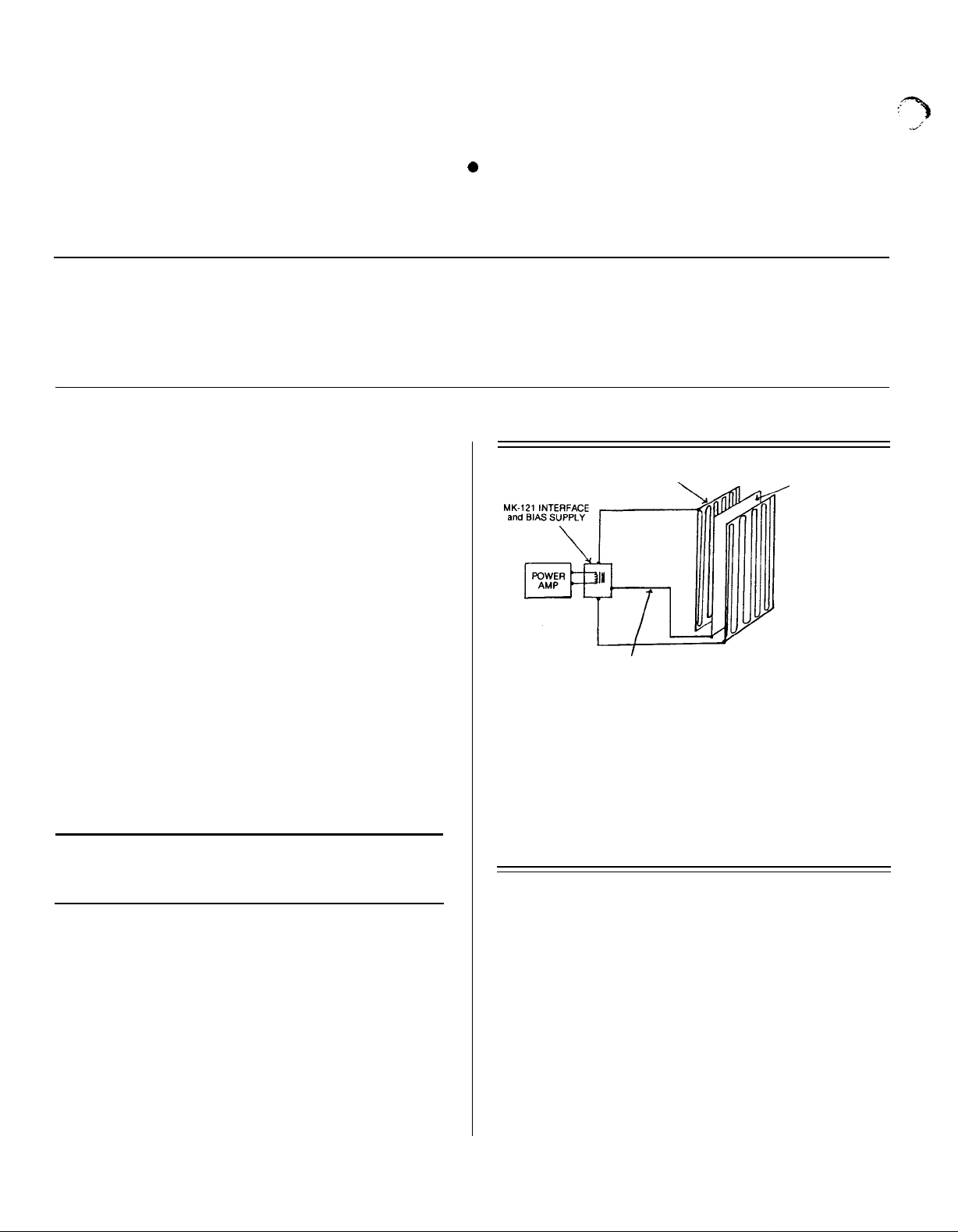
Figure
1
-
The
electrostatic transducer is composed of a thin membrane (diaphragm)
made of Mylar that is stretched and contained between two acoustically open
wire grids. The two grids are connected
MK-121
interface, which provides the high-voltage audio signal. The diaphragm
is connected
trostatic charge that becomes trapped in the diaphragm. The
provide an electric field that is the voltage equivalent
presence of an audio signal, the electric field exerts forces on the electrostatic
charge that is trapped in the diaphragm. These forces are transfered
diaphragm, causing the diaphragm
forces.
to
Full-Range Elements:
phone, and the Acoustat loudspeakers all employ a
single diaphragm
deepest bass
original waveform is not broken into pieces, pieces that
would be very disimilar in terms of colorations, time of
arrival, and phase.
quite small changes in phase are readibly audible, and
can degrade the clarity and definition of musical tran
sients and upset the homogeneity and coherence of the
stereo image.)
Each speaker contains two, three or four panels
which are angled for horizontal dispersion, but
electrically they are one, and all are driven full range.
WIRE GRID CARRYING
AUDIO SIGNAL,
DIAPHRAGM
Electrostatic Operating Principle
a high voltage,
BIAS
FOR STATIC CHARGE
to
the highest treble notes. This means the
VOLTAGE
to
low
current bias supply, which provides an elec
to
move in synchronization with these
The human ear, the micro
to
cover all frequencies, from the
(It
has been well documented that
LIGHT MEMBRANE
CONDUCTIVE COATING
TRUE PUSH-PULL
the plus/minus outputs of the
of
the-audio signal. In the
with
c---
_
__
-
+
PISTON ACTION
OF
DIAPHRAGM
two
wire grids
to
the
-
-
-
Page 2
I]
\,
‘.
ACOUSTAT
c
I
NO TIME LAG
r(
NO
BREAKUP
Uniformity of
Applied Force
Mass of Over Radiating
Radiator Area
Dynamic High Poor
e
Planar Lower Better
Magnetic
Electrostatic Lowest Best
MICROPHONE
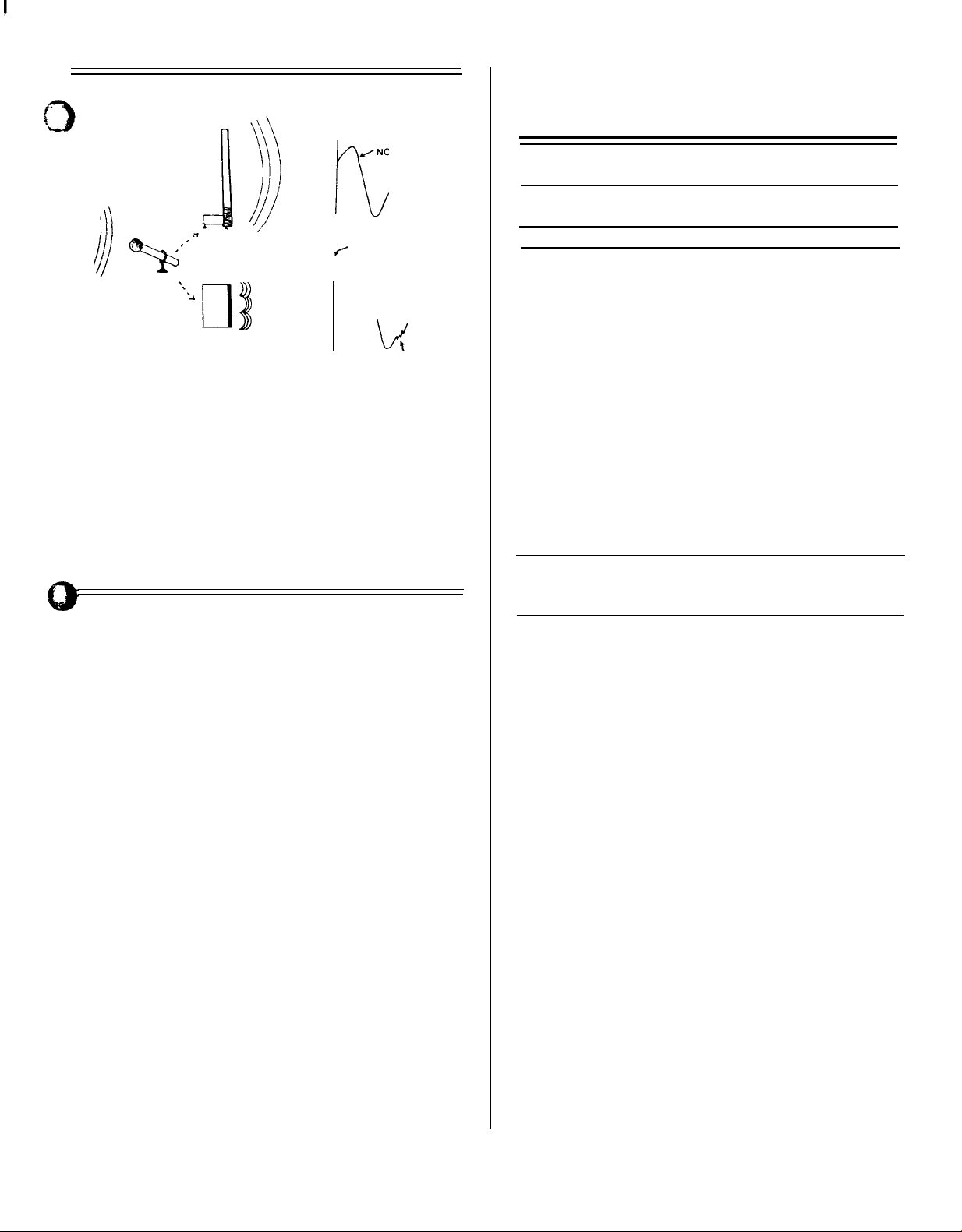
Figure
2
-
The
lorces acting
ferent results than the electrostatic transducer. The application of the driving
force only
vent buckling and deformation of the cone structure. Such a stiff cone (even
it
which degrades its transient response capability significantly. In addition, the
forces applied to the apex do not act uniformly over the cone surface and
cause
representative of the original signal.
to
is made of an exotic ”low-mass” material) must have considerable mass
it
to “break-up” into numerous vibrational modes, only one of which
Figure 2 illustrates the problems of the typical loud
speaker which are due
’L
‘
0)
CONVENTIONAL
The
Musical
lo
move the dynamic transducer’s cone produce very
the apex of the cone necessitates a sufficiently stiff cone to pre
SPEAKER
Wavefront
CONE
BREAKUP
dif-
-
to
the limitations
of
dynamic
-
if
is
(magnetic) type drivers. The uniform wavefront of the
Acoustat speakers contains all the spatial and harmonic
information as it was originally recorded,
to
give the
breathtaking imaging and accurate depth perspective
that approaches that of a live concert. A multi
-
element
system with crossovers simply cannot reproduce all this
music information correctly
-
and the truly accurate
recreation of the original musical performance
is impossible.
Low-Mass Radiator with Intimate Drive:
Again, the human ear, the microphone and the Acoustat
loudspeaker all utilize a very low mass diaphragm, in
timately driven over its entire surface. The diaphragm of
the Acoustat loudspeaker is only
.00065
inches thick,
and weighs only as much as an equivalent size volume
of air only
7
mm thick! In addition, just like the con
denser microphone, the diaphragm is driven over its en
tire surface by the audio signal. This gives the audio
signal several million times more control over air motion
than a cone, and several hundred thousand times more
control than a planar magnetic or ribbon type speaker,
where the audio signal force is only present at the voice
-
A coil
not on the actual diaphragm that moves the air.
diaphragm
of
such extreme lightness, combina-
tion with an actuating force that is uniformly distributed
over the entire surface of the diaphragm, results in a
transducer whose transient response closely duplicates
-
-
-
the electrical input. The net result is a diaphragm motion
that is a good replica of the electrical forces acting upon
it, with all sections of the diaphragm surface moving
with highly accurate phase and amplitude linearity
throughout its excursion, at all frequencies. This
characteristic of the Acoustat speakers results in an
amazingly open, well defined sound with preservation of
detail at all listening levels.
Because the radiating area of dynamic (cone) drivers
to
tends
be small, their impedance match to the air is
quite poor. The Acoustat electrostatic, with its large
radiating area is a much better acoustic impedance
match
to
air, particularly in the difficult
low
frequency
range. This is the reason for the excellent low bass
response of which Acoustat speakers are capable.
OTHER ADVANTAGES
OF
THE ACOUSTAT APPROACH
Exceedingly Flat Frequency Response:
the Acoustat speakers don’t rely on multiple drivers and
crossovers
to
reproduce the audible range
of
cies, they are capable of both extremely uniform
amplitude throughout that range, as well as
from local peaks and valleys in their response. This
locally flat nature of the electrostatic transducer cannot
be duplicated with any dynamic driver, and results in a
of
total absence
tions, which enables the speaker
ing the music
Vanishingly Low Distortion:
the typical loudspeaker tonal colora
to
“disappear”, allow
to
pass through unaltered.
With 5
to
lower distortion across the frequency spectrum than a
dynamic (magnetic) type speaker, the listener can enjoy
extended listening sessions without the typical “listener
fatigue” associated with most audio systems.
lndestructability and Consistency:
unique panel construction methods pioneered by
Acoustat, the loudspeaker system cannot be damaged
by over or under powering. The Acoustat speaker
systems stand alone in this ability
applications without damage or failure. In addition, the
panels maintain extraordinary unit
with no measureable variations between panels.
Whereas no two woofers or two tweeters are exactly the
same, every Acoustat electrostatic panel is exactly like
every other Acoustat panel.
to
withstand all audio
to
unit consistency,
Since
frequen
a freedom
10
times
Due
to
-
-
the
-
Page 3

Superb Construction:
mance that the electrostatic panel is capable of, the
panels must be mounted in an extremely rigid,
monolithic frame. The Acoustat speaker’s frames are
made of the strongest, most durable materials available,
and are all hand made and assembled at our Florida fac
tory. The Acoustat loudspeaker system is both rigid and
remarkably attractive.
In order
to
get the perfor
-
a Model Two in a large room would be a poor choice,
to
too
play
small a
since a great deal of power would be required
the system at reasonable volume levels. On the other
hand, the Model Four would tend to overload
room, resulting in a less well defined image than a
-
smaller Model would provide. In general, however, the
three Models are virtually identical in the quality of
sound they reproduce, the only difference being the total
amount of radiating area employed.
THE REVOLUTIONARY MK-121 DRIVE*
It
is hard
tionary this method for driving full-range-element
electrostatic speakers really
year old problem originally defined by the introduction of
the first somewhat full
in the mid nineteen
The introduction
face* culminates one of the most intensive studies ever
made
static transducer characteristics, transformer theory,
network theory and complex vector impedance. Special
in
-
house instrumentation was used
design.
The MK
transformers cooperatively overlap to handle the critical
midrange band. Each has special properties
uncompromised performance in its own exclusive do
main (bass and high frequencies respectively).
said without contradiction that never before has such a
near perfect power
The result is a quantum leap in efficiency, allowing most
-
100 watt per channel amplifiers
50
nearly all listening situations. In addition, the load
presented
ohm load, more linear than many conventional speaker
systems.
The MK
much higher powered amplifiers if more incremental
headroom is desired. The MK-121
utilizing military grade, conservatively rated parts. Com
bined with Acoustat’s proven near “bullet-proof” panel
technology, the result is a system you can listen
concert levels without apprehension.
WHICH
IS
RIGHT
In general, your primary consideration, other than
cost, are room size and volume levels required. The
return for the larger size speakers is higher efficiency
(less power required for a given volume level in the
same size room), greater maximum sound pressure
level, and slightly extended bass response. For example,
to
describe in simple terms just how revolu
is.
It solves a twenty-five
-
range electrostatic loudspeakers
-
fifties.
of
the MK-121 Magne-Kinetic Inter
of
the overall interactive nature of the electro
to
help perfect the
-
121 is of “biformer” design. Two optimized
-
impedance match been possible.
to
work very well in
to
the amplifier is an extremely peaceful 4
-
121 is not, however, shy about dealing with
is extremely well built,
OF
THE MODELS
FOR
YOU?
‘PATENT PENDING
to
extend
lt
-
-
-
can be
to
at
-
-
SP
ECI
FI
CAT10
Model
Frequency Response: 35-20K Hz & 2 dB
Sound Pressure Level: 105 dB @ 15’ in a 12’x 18’ room
Minimum Power Requirement:
Nominal Impedance: 4 ohms
Power Consumption:
Control: High Frequency Balance
Dimensions:
Weight: 64 Ibs.
Model
Frequency Response: 30-20K Hz
Sound Pressure Level: 110 dB
Minimum Power Required:
Nominal Impedance:
Power Consumption: 5 watts (120v,
Control: High Frequency Balance
Dimensions: 59”~28”~3’/z”
Weight:
Model
Frequency Response: 28-20K Hz f 2dB
Sound Pressure Level: 115 dB
Minimum Power Required: 50 watts
Nominal Impedance:
Power Consumption:
Control: High Frequency Balance
Dimensions: 59' x 36' x4"
Weight:
Two
(Program Material Peaks)
(Controls Frequencies Above 10K
(Net Weight for one Speaker with Interface)
Three
(Program Material Peaks)
(Controls Frequencies Above 10K
75
Ibs.
(Net Weight for one Speaker with Interface)
Four
(Program Material Peaks)
(Controls Frequencies Above 10k
86
Ibs.
(Net Weight for one Speaker with Interface)
NS
5
watts (120v, 50160 Hz)
58”x20”~31/2”
70
4
ohms
4
ohms
5
watts (1 20v,50160 Hz)
100
watts
Hz)
rf:
2 dB
@I
18’ in a 14' x22' room
watts
50160 Hz)
Hz)
@
22’
in a 16’x26’ room
Hz)
WARRANTY
Lifetime, See warranty statement for details.
 Loading...