

Page 1
Read and Save These Instructions
INSTALLATION & MAINTENANCE INSTRUCTIONS
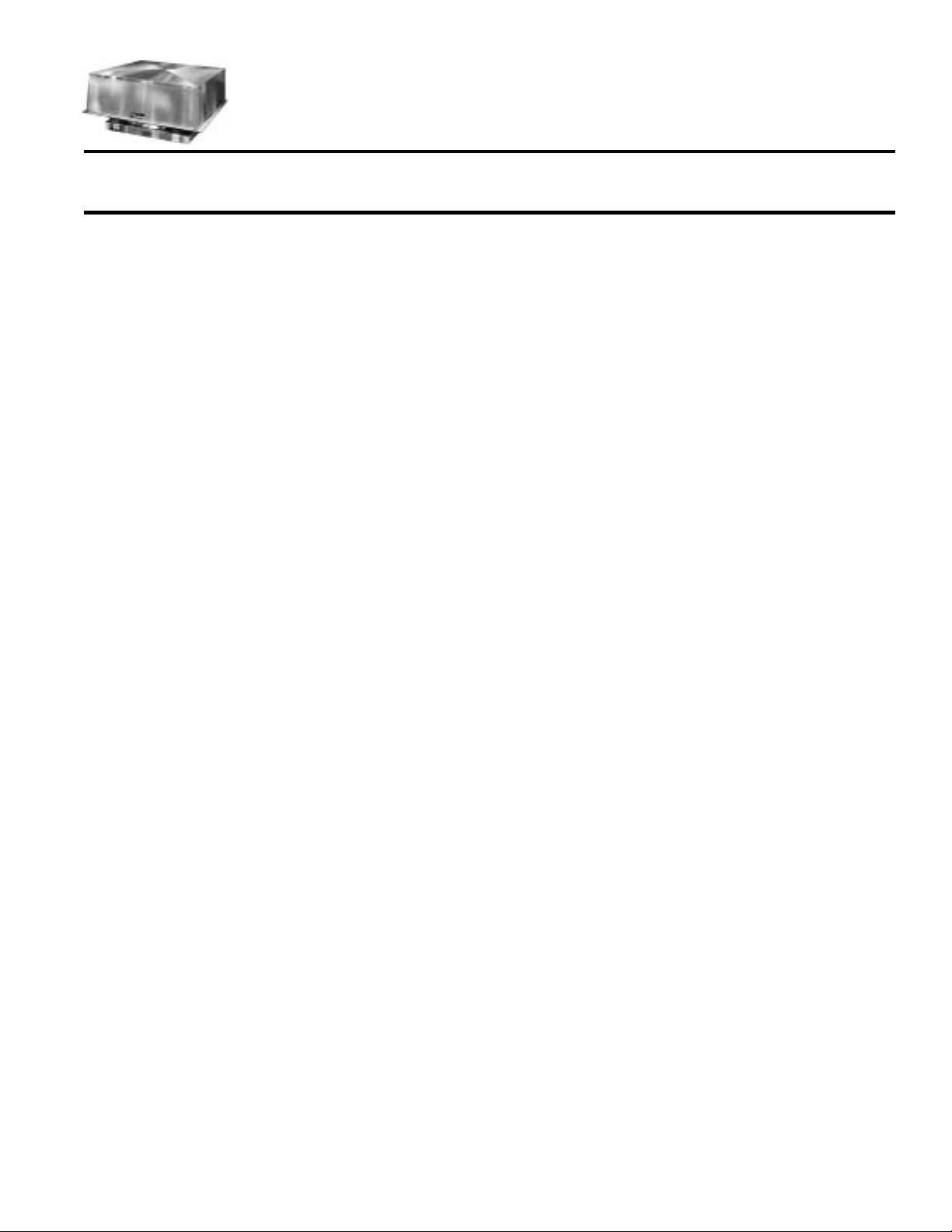
Models PL & USPL
RECEIVING AND INSPECTION
Immediately upon receipt of a shipment, carefully inspect for
damage and shortage. Turn the impeller by hand to see that it
turns freely and does not bind. If any damage and/or shortage
is detected or suspected, the carrier must be asked to conduct
an inspection. The consignee's representative should not
accept a shipment without a notation on the delivery receipt
indicating items not delivered or the apparent extent of
damage.
When a shipment is opened and damage is found which was
not evident externally (concealed damage), it is mandatory that
the consignee request an immediate inspection by the carrier.
Report any damage to the carrier within 15 days. Failure to
report damage within the above time limit will result in rejection
of a claim.
HANDLING
When handling fans and their accessories, always use
equipment and methods that will not cause damage. Fans
should be lifted using slings and padding or spreaders to avoid
damage.
CAUTION! Always make sure that all lifting and handling
equipment and techniques conform to current safety
standards.
Avoid lifting fans in a way that will bend or distort fan parts.
Never pass slings or timbers through the orifices of fan.
CAUTION! Do not lift by the fan hood. Fans with special
coatings or paints must be protected in handling to prevent
damage.
STORAGE
Fans are protected against damage during shipment. If they
cannot be installed and put into operation immediately upon
receipt certain precautions are necessary to prevent
deterioration during storage. Responsibility for integrity of fans
and accessories during storage must be assumed by the user.
The manufacturer will not be responsible for damage during
storage. These suggestions are provided solely as a
convenience to the user, who shall make the decision whether
to use any or all of them.
INDOOR: The ideal storage environment for fans and
accessories is indoors, above grade, in a low humidity
atmosphere which is sealed to prevent the entry of blowing
dust, rain, or snow. Temperatures should be evenly
maintained between 70°F and 105°F (wide temperature swings
may cause condensation and "sweating" of metal parts).
Windows should be covered to prevent temperature variations
caused by sunlight. Provide thermometers and humidity
indicators at several points and maintain the atmosphere at
40% relative humidity, or lower.
It may be necessary to use trays of renewable desiccant or
portable dehumidifier to remove moisture from the air in the
storage enclosure.
Thermostatically controlled portable heaters (vented to
outdoors) may be required to maintain even temperatures
inside the enclosure.
FORM 613102
CAUTION! Provide fire extinguishers, fire alarms, or
emergency response communication to protect building and
equipment against fire damage. Be sure that building and
storage practices meet all local, state and federal fire and
safety codes.
The following fans or accessories must be stored indoors, in a
clean dry atmosphere:
a. Propeller wall fans not in wall housings.
b. Any fan that is protected by a cardboard carton.
c. Motors dismounted from fans.
d. Spare wheels or propellers.
e. Belts, sheaves, bushings and other parts when not
mounted on fan.
f. Boxes, bags or cartons of hardware.
g. Curbs
h. Dampers
Remove any accumulations of dirt, water, ice or snow and wipe
dry before moving indoors. Allow cold parts to reach room
temperature to avoid “sweating” of metal parts. Open boxes or
cartons. Remove any accumulated moisture; if necessary use
portable electric heaters to dry parts and packages. Leave
coverings loose to permit air circulation and to permit periodic
inspection.
Rotate impeller by hand to distribute bearing grease over the
entire bearing surfaces.
Store at least 3 ½” off the floor on wooden blocks covered with
moisture proof paper or polyethylene sheathing. Provide aisles
between parts and along all walls to permit air circulation and
space for inspection.
OUTDOOR: Fans designed for outdoor use may be stored
outdoors, if absolutely necessary. The storage area should be
reasonably level and drained or ditched to prevent
accumulation of water. Fencing and lighting for security are
desirable. Roads or aisles for portable cranes and hauling
equipment are needed. Consider the use of drift fencing to
minimize accumulation of blowing snow or dirt.
The following fans may be stored outdoors, if dry indoor
storage space is not available:
a. Fans intended for outdoor use that are crated in wood.
b. Wall fans installed in wall housings.
All fans must be supported on wooden blocks or timbers above
water or normal snow levels. Provide enough blocking to
prevent settling into soft ground. Fans should be set in place
using the directional arrow markings on the crate as a guide.
Locate pieces far enough apart to permit air circulation,
sunlight, and space for periodic inspection. Place all parts on
their supports so that rain water will run off, or to minimize
water accumulation. Do not cover parts with plastic film or
tarps — these cause condensation of moisture from the air
passing through heating and cooling cycles.
Fan impellers should be blocked to prevent spinning caused by
strong winds.
Page 2

INSPECTION AND MAINTENANCE DURING
STORAGE
Inspect fans and accessories at least once per month, while in
storage. Log results of inspection and maintenance
performed. A typical log entry should include the following:
a. Date
b. Inspector’s Name
c. Name of Fan
d. Location
e. Condition of Paint or Coating
f. Is moisture present?
g. Is dirt accumulated?
h. Corrective steps taken?
If moisture or dirt accumulations are found on parts, the source
should be located and eliminated. Fan impellers should be
rotated at each inspection by hand ten to fifteen revolutions to
redistribute the motor and bearing lubricant.
If paint deterioration begins, consideration should be given to
touch-up or repainting. Fans with special coatings may require
special techniques for touch-up or repair.
Machined parts coated with rust preventive should be restored
to good condition promptly if signs of rust occur. The most
critical items are pulleys, shafts and bearing locking collars. At
the first sign of rusting on any of the above parts, remove the
original rust preventive coating with petroleum solvent and
clean lint-free cloths. Polish any remaining rust from surfaces
with crocus cloth or fine emery paper and oil. Do not destroy
the continuity of the surfaces. Wipe clean with lint-free cloths
and recoat surfaces evenly and thoroughly with Tectly 506
(Ashland Oil Company) or equal. For hard to reach internal
surfaces or for occasional use, consider using Tectly 511M
Rust Preventive or WD40 or equal.
REMOVING FROM STORAGE
As fans are removed from storage to be installed in their final
location, they should be protected and maintained in similar
fashion, until the fan equipment goes into operation.
INSTALLATION
1. CAUTION! This unit has rotating parts and safety
precautions should be exercised during installation,
operation and maintenance.
2. WARNING! Do not use fans in hazardous environments
where fan's electrical system could provide ignition to
combustible or flammable materials, unless the unit is
specifically built for hazardous environment.
3. If prefab curb is used, damper will mount on the damper
flange provided as part of the curb. Damper should be
installed before setting Exhauster.
4. If damper box is being used, assemble box and mount in
curb before setting Exhauster. Damper may be installed
at this time if desired. Damper should be fastened to the
bottom of the damper box, curb flanges or nailing strips
in curb.
6. Remove shipping blocks from under adjusting rails.
7. Turn impeller by hand to make sure it rotates freely. If
impeller hits orifice, adjust as follows:
Loosen nuts on both sides of vibration isolators and
move adjusting rails to realign the impeller. If impeller
continues to strike, move impeller and shaft up. The
bearing support structure for models 135 through 300 is
slotted for up and down adjustment. Models 330
through 543 require sliding the shaft through the
bearings. (See Maintenance Section, No. 7 for bearing
replacement.)
8. CAUTION! Guards must be installed when fan is within
reach of personnel or within seven (7) feet (2.134 m) of
working level or when deemed advisable for safety.
9. CAUTION! Before proceeding, make sure electrical
service to fan is locked in “OFF” position. Run wires
through the internal wiring post to the motor to
disconnect switch if used. WARNING! The wiring post
is sealed to the curbcap with a large washer and sealing
gasket. If the wiring post is loosened, the seal may be
broken, thereby creating a possible water leak. Leave
enough slack in wiring to allow for motor movement
when adjusting belt tension. Some fractional motors will
have to be removed to make connection at terminal box
on end of motor; remove bolts securing motor base to
adjusting rails — do not take out motor bolts. Re-adjust
belt tension.
10. All wiring should be in accordance with local ordinances
and the National Electric Code.
11. WARNING! Check voltage at the fan to see if it
corresponds with the motor nameplate; high or low
voltage can seriously damage the motor. Extra care
should be taken when wiring two or three speed motors
since improper connections will damage motor and void
motor warranty.
12. Operate under power and compare rotation with
directional arrow. WARNING! Operation in the wrong
direction will deliver air but will overload the motor to the
extent of blowing fuses, overload protection and could
seriously damage the motor. In the case of three phase
motors, the direction can be changed by interchanging
any two of the three motor leads. In the case of single
phase motors, the reversing instructions will appear on
the wiring diagram located either in the motor wiring
compartment or on the outside of the motor housing.
13. Using a minimum of eight (8) lag bolts — two on each
side near corners, securely fasten exhauster to curb.
The fan should rest on the curb as level as possible.
MAINTENANCE
1. Under normal usage, no spare parts are recommended
for one year of operation.
2. CAUTION! Before proceeding, make sure electrical
service to fan is locked in the “OFF” position.
5. Remove motor compartment cover and mount motor if
required. Remove motor base bolts and lift motor base
from adjusting rails, secure motor to base with bolts
provided and replace on rails. Install belt and check
pulley alignment and belt tension. Belt should depress
its width when pressed firmly inward at midway point
between the pulleys.
WINDMILLING: Even when the power supply is locked
out, fans may cause injury or damage if the impeller is
subject to “windmilling” which is the turning of the
impeller and drive components due to a draft in the
system. To guard against this hazard, the impeller
should be secured to physically restrict rotational
movement.
Page 2
Page 3

3. Duplex split pillow block bearings are prelubricated,
sealed and require no service.
Optional unitary pillow block bearings with external
lubrication fittings under normal operating conditions will
need no relubrication for 3 to 5 years. For normal
operating condition, use a grease conforming to NLGI
No. 2. Caution! Lubricating bearings with a high
pressure gun which can blow bearing seals and overfill
the bearing with grease. This condition can result in
excessive churning and overheating. For normal
operating conditions it is standard practice to fill only
30% of the bearing void with grease. Do not over
lubricate.
4. Motor bearings are prelubricated. Consult information
printed on motor for lubrication instructions.
5. Check belt tension after first 48 hours of operation and
thereafter annually. Belt should depress its width when
pressed firmly inward at midway point between the
pulleys. Too much tension will damage bearings. The
belt should be tight enough to prevent slippage. When
replacing worn belt, replace motor pulley if “shoulder” is
worn in groove. WARNING! Do not replace the motor
pulley with a larger diameter pulley. Do not replace fan
pulley with one smaller in diameter. The pulley ratios are
set so that the motor will not be overloaded. Do not
operate at higher speeds than rated in catalog.
6. If motor requires replacement, one comparable to the
original with the same service factor and enclosure must
be used.
7. If impeller shaft bearings need replacement, replace with
bearings that are comparable to the original equipment.
For die-formed type support housing (duplex split pillow
block bearings), install new bearings into the neoprene
rings, check correct position of impeller with the fan
housing, position the bearings in die-formed recess and
tighten the set screws. Replace the die-formed bearing
cap and tighten the four bolts.
NOTE: If unitary pillow block type bearings are used,
slide bearings on to the shaft to desired location and bolt
the bearing block securely to the support base. Slide the
shaft back and forth in secured bearing (do not drive with
a hammer) and rotate to make certain that it turns freely.
Check the correct position of the impeller in tube or
orifice. Impeller should not strike any part of the fan
housing and tip clearance between the impeller and the
tube should be the same at each blade tip.
PROCEDURE FOR TIGHTENING SET SCREWS IN
BEARINGS AND HUBS
One Set Screw Application
Using a torque wrench, tighten the set screw to the torque
recommended in Table 1.
Two Set Screw Application
1. Using a torque wrench, tighten one set screw to half of
the torque recommended in Table 1.
2. Tighten the second set screw to the full recommended
torque.
3. Tighten the first set screw to the full recommended
torque.
Table 1. Recommended Tightening Torque
for Set Screws
Set Screw Diameter Torque (in-lbs)
#10 35
1/4 80
5/16 126
3/8 240
7/16 384
1/2 744
9/16 1080
5/8 1500
3/4 2580
7/8 3600
1 5400
VARIABLE FREQUENCY
DRIVES AND MOTORS
There are occasions when a Variable Frequency Drive (VFD)
will cause poor motor performance and possible damage. To
avoid these problems, the Company recommends the
following:
1. Select compatible motor and VFD converter; if possible,
the motor and the converter should be from the same
manufacturer or at least the converter selected should
be recommended by the motor manufacturer.
Page 3
2. A motor shaft grounding system should be used to
prevent motor bearing damage from eddy currents.
NOTE: The Company will not honor motor warranty
claims if the customer fails to follow these
recommendations.
Page 4

Exploded View
Ref. No. Description Qty. Ref. No.
1 Hood Corner Piece 4 9 Motor 1
2 Hood Top & Sides 1 10 Hood Support 2
3 Hood End 2 11 Lower Channel 2
4 Shaft and Bearing Assembly 1 12 Wiring Post 1
5 Bearing Cap 2 13 S Brackets *
6 Disconnect Switch 1 14 Impeller 1
7 Motor Base 1 15 Birdscreen 1
8 Upper Channels 2 16 Curb & Orifice Assembly 1
*Quantity varies per fan size.
WHEN ORDERING REPLACEMENT PARTS, LIST MODEL, DESCRIPTION AND QUANTITY.
Page 4
Description Qty.
Parts List
Page 5

TERMS AND CONDITIONS
DESIGN CHANGES The Company reserves
the right to make changes in design, improve
ments and additions in and to its products any
time without imposing any liability or obligations
to itself to apply or install the same in any prod
uct manufactured by it.
TITLE The title and right of possession of the
equipment sold herein shall remain with the
Company and such equipment shall remain
personal property until all payments herein (in
These instructions cover the usual installation, operation and maintenance methods for which the product(s) was designed. They do not purport to
cover all details or variations in the product(s) nor to provide for every possible contingency that might be met in connection with the installation, oper
ation and maintenance. For any departures from these instructions, or should particular problems arise which are not covered sufficiently for the pur
chaser’s purpose, the matter should be referred to the Company.
cluding deferred payments whether evidenced
by notes or otherwise) shall have been made in
full in cash and the Purchaser agrees to do all
acts necessary to perfect and maintain such
right and title in the Company.
-
SAFETY ACCESSORIES The Company manu
factures equipment designed to serve multiple
applications and offers a wide range of safety
equipment, including guards and other devices,
as may be required to meet customer specifica
-
tions. Without exception, the Company recom
mends that all orders include applicable safety
devices. Equipment ordered without applicable
safety devices is clearly the responsibility of the
Purchaser. Further, the Purchaser warrants
that he has determined and acquired any and
all safety devices required for equipment sold
by the Company. Weather covers and guards
for motor and V-belt drives, couplings, shafts
and bearings, along with inlet and outlet
screens, are optional accessories noted in the
price list.
-
-
-
-
WARNING The Company products are designed and manufactured to provide reliable performance but they are not guaranteed to be 100% free of de
fects. Even reliable products will experience occasional failures and this possibility should be recognized by the User. If these products are used ina
life support ventilation system where failure could result in loss or injury, the User should provide adequate back-up ventilation, supplementary natural
ventilation or failure alarm system, or acknowledge willingness to accept the risk of such loss or injury.
WARNING DO NOT use in HAZARDOUS ENVIRONMENTS where fan’s electrical system could provide ignition to combustible or flammable materials
unless unit is specifically built for hazardous environments.
CAUTION Guards must be installed when fan is within reach of personnel or within seven (7) feet (2.134 m) of working level or when deemed advisable
for safety.
DISCLAIMER The Company has made a diligent effort to illustrate and describe the products in this literature accurately; however, such illustrations and
descriptions are for the sole purpose of identification, and do not express or imply a warranty that the products are merchantable, or fit for a particular
purpose, or that the products will necessarily conform to the illustrations or descriptions or dimensions.
LIMITED WARRANTY
WARRANTY AND DISCLAIMER: The Com-
pany extends this limited warranty to the original buyer and warrants that products manufactured by the Company shall be free from original defects in workmanship and materials for
two years from date of shipment, unless otherwise noted (see specific product literature), provided same have been properly stored, installed, serviced, maintained and operated.
This warranty shall not apply to products which
have been altered or repaired without the Com
pany’s express authorization, or altered or re
paired in any way so as, in the Company’s
judgment, to affect its performance or reliability,
nor which have been improperly installed or
subjected to misuse, negligence, or accident, or
incorrectly used in combination with other sub
stances. The Buyer assumes all risks and liabil
ity for results of use of the products. Warranties
on purchased parts, such as but not limited to
bearings, sheaves, belts, couplings, electric
motors, pumps and controls are limited to the
terms of warranty extended by our supplier.
Polyethylene tubing and cooling pads are war
ranted to be free of defects in material and
workmanship for a period of 90 days from date
of shipment and a like warranty applies to the
cross fluted cellular type cooling cells for a pe
riod of two years from date of shipment pro
vided same have been properly handled,
stored, installed, serviced, maintained and op
erated. And further, not subjected to excessive
heat, corrosive agents or chemicals, or me
chanical abuse that may cause tearing, crush
ing or undue deterioration nor used on a sys
tem or in a manner other than that for which it
was designed as explained in the product litera
ture.
LIMITATION OF REMEDY AND DAMAGES:
All claims under this warranty must be made in
writing and delivered to P. O. Box 978, Musko
gee, Oklahoma, 74402, within 15 days after dis
covery of the defect and prior to the expiration
of the warranty period from the date of ship
ment by the Company of the product claimed
defective, and Buyer shall be barred from any
remedy if Buyer fails to make such claim within
such period.
Within 30 days after receipt of a timely claim,
the Company shall have the option either to inspect the product while in Buyer’s possession
or to request Buyer to return the product to the
Company at Buyer’s expense for inspection by
-
the Company. The Company shall replace, or
-
at its option repair, free of charge, any product
it determines to be defective, and it shall ship
the repaired or replacement product to Buyer
F.O.B. point of shipment; provided, however, if
circumstances are such as in the Company’s
-
judgment to prohibit repair or replacement to
-
remedy the warranted defects, the Buyer’s sole
and exclusive remedy shall be a refund to the
Buyer of any part of the invoice price, paid to
the Company, for the defective product or part.
The Company is not responsible for the cost of
removal of the defective product or part, dam
-
ages due to removal, or any expenses incurred
in shipping the product or part to or from the
Company’s plant, or the installation of the re
paired or replaced product or part.
-
-
Implied warranties, when applicable, shall com
mence upon the same date as the express war
-
ranty provided above, and shall, except for war
ranties of title, extend only for the duration of
-
the express warranty. Some states do not allow
-
limitations on how long an implied warranty
-
lasts, so the above limitation may not apply to
you. The only remedy provided to you under an
-
applicable implied warranty and the express
warranty shall be the remedy provided under
the express warranty, subject to the terms and
conditions contained therein. The Company
shall not be liable for incidental and consequen
-
tial losses and damages under the express
-
warranty, any applicable implied warranty, or
claims for negligence, except to the extent that
-
this limitation is found to be unenforceable un
der applicable state law. Some states do not allow the exclusion or limitation of incidental or
consequential damages, so the above limitation
or exclusion may not apply to you. This warranty gives you specific legal rights, and you
may also have other rights which vary from
state to state.
No employee, agent, dealer, or other person is
authorized to give any warranties on behalf of
the Company or to assume for the Company
any other liability in connection with any of its
products except in writing and signed by an offi
cer of the Company.
REPLACEMENT PARTS If replacement parts
are ordered, buyer warrants that the original
components in which these replacement parts
will be placed are in satisfactory working condi
tion, and when said replacement parts are in
stalled, the resultant installation will operate in
a safe manner, at speeds and temperatures for
which the original equipment was purchased.
-
TECHNICAL ADVICE AND RECOMMENDA
TIONS, DISCLAIMER: Notwithstanding any
-
past practice or dealings or any custom of the
trade, sales shall not include the furnishing of
technical advice or assistance or system de
sign. Any such assistance shall be at the Com
pany’s sole option and may be subject to addi
tional charge.
-
The Company assumes no obligation or liability
on account of any recommendations, opinions
or advice as to the choice, installation or use of
products. Any such recommendations, opinions
or advice are given and shall be accepted at
your own risk and shall not constitute any war
ranty or guarantee of such products or their
performance.
GENERAL In no event shall any claim for con
sequential damages be made by either party.
The Company will comply with all applicable
-
Federal, State, and local laws.
-
-
-
-
-
-
-
-
-
-
November 2001 Form 613102
 Loading...