

Page 1
DE
Gebrauchsanweisung
EN
Operating Instructions
FR
Mode d’emploi
IT
Manuale per l’utente
PL
Instrukcja obsługi
Ref : AB-CPEXPERT
Page 2

ALLGEMEINE
SICHERHEITSHINWEISE
WARNHINWEISE! Lesen Sie alle Anleitungen. Nichtbeachtung kann
zu Stromschlag, Feuer und/oder ernsthaften Verletzungen führen.
Werkzeuge, welche mit Netzspannung (über Netzkabel) betrieben
werden sowie auf batteriebetriebene Elektrowerkzeuge (ohne
Netzkabel).
BITTE BEWAHREN SIE DIE
BEDIENUNGSANLEITUNG AUF
ARBEITSPLATZ
a) Halten Sie Ihren Arbeitsbereich sauber und aufgeräumt.
Unordnung und unbeleuchtete Arbeitsbereiche können zu
Unfällen führen.
b) Arbeiten Sie mit diesem Gerät nicht in
explosionsgefährdeter Umgebung, in der sich
Elektrowerkzeuge erzeugen Funken, die den Staub oder die
Dämpfe entzünden können.
c) Halten Sie Kinder und andere Personen während der
Benutzung des Elektrowerkzeuges fern. Bei Ablenkung
können Sie die Kontrolle über das Gerät verlieren.
ELEKTRISCHE SICHERHEIT
a) Der Anschlussstecker des Gerätes muss in die Steckdose
passen. Der Stecker darf in keiner Weise verändert
werden. Verwenden Sie keine Adapterstecker
gemeinsam mit schutzgeerdeten Geräten. Unveränderte
Stecker und passende Steckdosen verringern das Risiko eines
elektrischen Schlages.
b) Vermeiden Sie Körperkontakt mit geerdeten
und Kühlschränken. Es besteht ein erhöhtes Risiko durch
elektrischen Schlag, wenn Ihr Körper geerdet ist.
c) Halten Sie das Gerät von Regen oder Nässe fern. Das
Eindringen von Wasser in ein Elektrogerät erhöht das Risiko
eines elektrischen Schlages.
d) Zweckentfremden Sie das Kabel nicht, um das Gerät
zu tragen, aufzuhängen oder um den Stecker aus der
Steckdose zu ziehen. Halten Sie das Kabel fern von
Hitze, Öl, scharfen Kanten oder sich bewegenden
Geräteteilen. Beschädigte oder verwickelte Kabel erhöhen
das Risiko eines elektrischen Schlages.
e) Wenn Sie mit einem Elektrowerkzeug im Freien arbeiten,
verwenden Sie nur Verlängerungskabel, die auch für
den Außenbereich zugelassen sind. Die Anwendung eines
für den Außenbereich zugelassenen Verlängerungskabels
verringert das Risiko eines elektrischen Schlages.
SICHERHEIT VON PERSONEN
a) Seien Sie aufmerksam, achten Sie darauf, was Sie tun
und gehen Sie mit Vernunft an die Arbeit mit einem
Elektrowerkzeug. Benutzen Sie das Gerät nicht, wenn
Alkohol oder Medikamenten stehen. Ein Moment der
Unachtsamkeit beim Gebrauch des Elektrogerätes kann zu
ernsthaften Verletzungen führen.
b) Tragen Sie persönliche Schutzausrüstung und immer eine
Schutzbrille. Das Tragen persönlicher Schutzausrüstung, wie
Staubmaske, rutschfeste Sicherheitsschuhe, Schutzhelm oder
Gehörschutz, je nach Art und Einsatz des Elektrowerkzeuges,
verringert das Risiko von Verletzungen.
c) Vermeiden Sie eine unbeabsichtigte Inbetriebnahme.
Vergewissern Sie sich, dass der Schalter in der Position
„OFF” ist, bevor Sie den Stecker in die Steckdose stecken.
Wenn Sie beim Tragen des Geräts den Finger am Schalter
haben oder das Gerät eingeschaltet an die Stromversorgung
anschließen, kann dies zu Unfällen führen.
d) Entfernen Sie Einstellwerkzeuge oder -schlüssel, bevor
Sie das Elektrowerkzeug einschalten. In beweglichen
Teilen des Elektrowerkzeugs verbliebene Einstellwerkzeuge
oder -schlüssel können zu Verletzungen führen.
e) Beugen S
ie sich nicht über das Gerät. Sorgen Sie für
einen sicheren Stand, und halten Sie jederzeit das
Gleichgewicht. Dadurch können Sie das Gerät in unerwarteten
Situationen besser kontrollieren.
f) Tragen Sie geeignete Kleidung. Tragen Sie keine weite
Kleidung oder Schmuck. Halten Sie Haare, Kleidung
und Handschuhe fern von sich bewegenden Teilen.
Lockere Kleidung, Schmuck oder lange Haare können von sich
bewegenden Teilen erfasst werden.
SORGFÄLTIGER UMGANG UND
GEBRAUCH VON ELEKTROWERKZEUGEN
a) Überlasten Sie das Gerät nicht. Verwenden Sie für Ihre
Arbeit das dafür bestimmte Elektrowerkzeug. Mit dem
passenden Elektrowerkzeug arbeiten Sie besser und sicherer im
angegebenen Leistungsbereich.
b) Benutzen Sie kein Elektrowerkzeug, dessen Schalter
defekt ist. Ein Elektrowerkzeug, das sich nicht mehr ein- oder
ausschalten lässt, ist gefährlich und muss repariert werden.
c) Wenn ein Ersatz des Netzkabels erforderlich ist, dann ist
dies vom Hersteller oder seinem Vertreter auszuführen,
um Sicherheitsgefährdungen zu vermeiden.
d)
Ziehen Sie den Stecker aus der Steckdose, bevor
Sie Geräteeinstellungen vornehmen, Zubehörteile
wechseln oder das Gerät weglegen.
Diese
Vorsichtsmaßnahme verhindert den unbeabsichtigten Start
des Gerätes.
AB-CPEXPERT
DE 03
EN 08
FR 13
IT 18
PL 23
The symbol on the product or its packaging indicates that the product should
not be disposed of in the household waste but recycled appropriately. With
your support and by recycling the product correctly, you contribute to the
protection of the environment and people. The environment and people
Gebrauchsanweisung
Operating Instructions
Mode d’emploi
Manuale per l’utente
Instrukcję obsługi
are endangered by poor recycling. Recycling materials helps to reduce the
consumption of raw materials. Further information about recycling can be
obtained from your municipality, recycling and waste disposal sites.
Page 3
DE
GEBRAUCHSAN WEISUNG
AB-CPEXPERT
ALLGEMEINE
SICHERHEITSHINWEISE
WARNHINWEISE! Lesen Sie alle Anleitungen. Nichtbeachtung kann
zu Stromschlag, Feuer und/oder ernsthaften Verletzungen führen.
Werkzeuge, welche mit Netzspannung (über Netzkabel) betrieben
werden sowie auf batteriebetriebene Elektrowerkzeuge (ohne
Netzkabel).
BITTE BEWAHREN SIE DIE
BEDIENUNGSANLEITUNG AUF
ARBEITSPLATZ
a) Halten Sie Ihren Arbeitsbereich sauber und aufgeräumt.
Unordnung und unbeleuchtete Arbeitsbereiche können zu
Unfällen führen.
b) Arbeiten Sie mit diesem Gerät nicht in
explosionsgefährdeter Umgebung, in der sich
Elektrowerkzeuge erzeugen Funken, die den Staub oder die
Dämpfe entzünden können.
c) Halten Sie Kinder und andere Personen während der
Benutzung des Elektrowerkzeuges fern. Bei Ablenkung
können Sie die Kontrolle über das Gerät verlieren.
ELEKTRISCHE SICHERHEIT
a) Der Anschlussstecker des Gerätes muss in die Steckdose
passen. Der Stecker darf in keiner Weise verändert
werden. Verwenden Sie keine Adapterstecker
gemeinsam mit schutzgeerdeten Geräten. Unveränderte
Stecker und passende Steckdosen verringern das Risiko eines
elektrischen Schlages.
b) Vermeiden Sie Körperkontakt mit geerdeten
und Kühlschränken. Es besteht ein erhöhtes Risiko durch
elektrischen Schlag, wenn Ihr Körper geerdet ist.
c) Halten Sie das Gerät von Regen oder Nässe fern. Das
Eindringen von Wasser in ein Elektrogerät erhöht das Risiko
eines elektrischen Schlages.
d) Zweckentfremden Sie das Kabel nicht, um das Gerät
zu tragen, aufzuhängen oder um den Stecker aus der
Steckdose zu ziehen. Halten Sie das Kabel fern von
Hitze, Öl, scharfen Kanten oder sich bewegenden
Geräteteilen. Beschädigte oder verwickelte Kabel erhöhen
das Risiko eines elektrischen Schlages.
e) Wenn Sie mit einem Elektrowerkzeug im Freien arbeiten,
verwenden Sie nur Verlängerungskabel, die auch für
den Außenbereich zugelassen sind. Die Anwendung eines
für den Außenbereich zugelassenen Verlängerungskabels
verringert das Risiko eines elektrischen Schlages.
SICHERHEIT VON PERSONEN
a) Seien Sie aufmerksam, achten Sie darauf, was Sie tun
und gehen Sie mit Vernunft an die Arbeit mit einem
Elektrowerkzeug. Benutzen Sie das Gerät nicht, wenn
Alkohol oder Medikamenten stehen. Ein Moment der
Unachtsamkeit beim Gebrauch des Elektrogerätes kann zu
ernsthaften Verletzungen führen.
b) Tragen Sie persönliche Schutzausrüstung und immer eine
Schutzbrille. Das Tragen persönlicher Schutzausrüstung, wie
Staubmaske, rutschfeste Sicherheitsschuhe, Schutzhelm oder
Gehörschutz, je nach Art und Einsatz des Elektrowerkzeuges,
verringert das Risiko von Verletzungen.
c) Vermeiden Sie eine unbeabsichtigte Inbetriebnahme.
Vergewissern Sie sich, dass der Schalter in der Position
„OFF” ist, bevor Sie den Stecker in die Steckdose stecken.
Wenn Sie beim Tragen des Geräts den Finger am Schalter
haben oder das Gerät eingeschaltet an die Stromversorgung
anschließen, kann dies zu Unfällen führen.
d) Entfernen Sie Einstellwerkzeuge oder -schlüssel, bevor
Sie das Elektrowerkzeug einschalten. In beweglichen
Teilen des Elektrowerkzeugs verbliebene Einstellwerkzeuge
oder -schlüssel können zu Verletzungen führen.
e) Beugen S
einen sicheren Stand, und halten Sie jederzeit das
Gleichgewicht. Dadurch können Sie das Gerät in unerwarteten
Situationen besser kontrollieren.
f) Tragen Sie geeignete Kleidung. Tragen Sie keine weite
Kleidung oder Schmuck. Halten Sie Haare, Kleidung
und Handschuhe fern von sich bewegenden Teilen.
Lockere Kleidung, Schmuck oder lange Haare können von sich
bewegenden Teilen erfasst werden.
SORGFÄLTIGER UMGANG UND
ie sich nicht über das Gerät. Sorgen Sie für
GEBRAUCH VON ELEKTROWERKZEUGEN
a) Überlasten Sie das Gerät nicht. Verwenden Sie für Ihre
Arbeit das dafür bestimmte Elektrowerkzeug. Mit dem
passenden Elektrowerkzeug arbeiten Sie besser und sicherer im
angegebenen Leistungsbereich.
b) Benutzen Sie kein Elektrowerkzeug, dessen Schalter
defekt ist. Ein Elektrowerkzeug, das sich nicht mehr ein- oder
ausschalten lässt, ist gefährlich und muss repariert werden.
c) Wenn ein Ersatz des Netzkabels erforderlich ist, dann ist
dies vom Hersteller oder seinem Vertreter auszuführen,
um Sicherheitsgefährdungen zu vermeiden.
d)
Ziehen Sie den Stecker aus der Steckdose, bevor
Sie Geräteeinstellungen vornehmen, Zubehörteile
wechseln oder das Gerät weglegen.
Vorsichtsmaßnahme verhindert den unbeabsichtigten Start
des Gerätes.
3
Diese
Page 4
DE
1 2 3
6
5
9
8
7
4
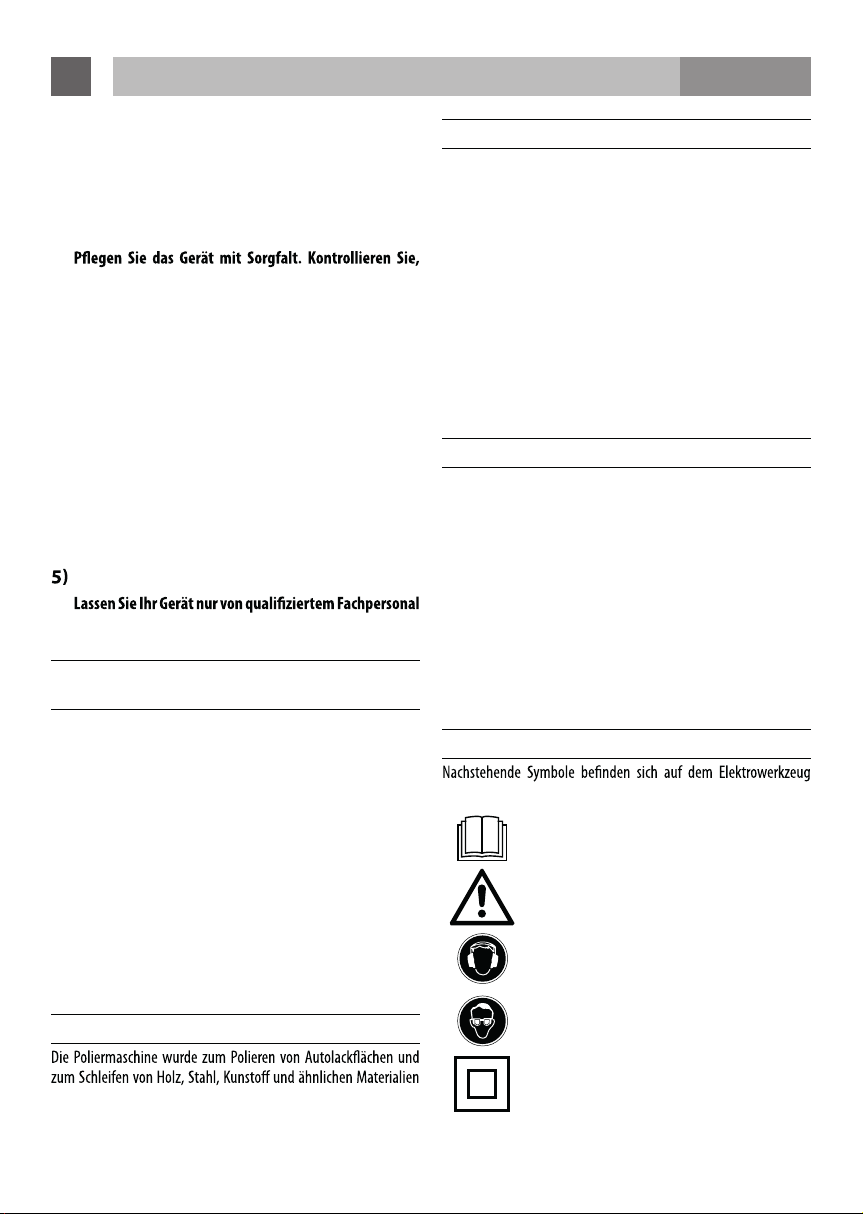
TEILE
1
2 Geschwindigkeitsregler
3
4 Netzkabel
5 Feststelltaste
6 Ein/Aus-Schalter
7 Woll-Polierscheibe
8 Polier-/Schleifscheibe
9 Sperrtaste Polierscheibe
MONTAGE
Gefahr!
Schalten Sie das Gerät vor der Montage aus und ziehen Sie den Netzstecker.
•
• Schrauben Sie die Polierscheibe mit einem Schraubenschlüssel an.
• Zum Abnehmen der Polierscheibe drücken Sie die Sperrtaste (siehe Abb. 2).
Abbildung 1 Abbildung 2
ANBRINGEN VON POLIERHAUBE UND SCHLEIFPAPIER
•
• Setzen Sie den mitgelieferten Schwamm oder das Schleifpapier auf die Polierscheibe auf.
• Einfaches Auswechseln von Polier- und Schleifmaterial mit dem Klettverschluss.
• Ziehen Sie das Polier- oder Schleifmaterial einfach von der Polierscheibe ab.
GEBRAUCHSAN WEISUNG
AB-CPEXPERT
e) Bewahren Sie unbenutzte Elektrowerkzeuge außerhalb
der Reichweite von Kindern auf. Lassen Sie Personen
das Gerät nicht benutzen, die mit diesem Gerät nicht
vertraut sind oder diese Anweisungen nicht gelesen
haben. Elektrowerkzeuge sind gefährlich, wenn sie von
unerfahrenen Personen benutzt werden.
f)
ob bewegliche Teile einwandfrei funktionieren und
nicht klemmen, ob Teile gebrochen oder so beschädigt
sind, dass die Funktion des Gerätes beeinträchtigt ist.
Lassen Sie beschädigte Teile vor dem Einsatz des Gerätes
reparieren. Viele Unfälle haben ihre Ursache in schlecht
gewarteten Elektrowerkzeugen.
g) Verwenden Sie Elektrowerkzeug, Zubehör,
Einsatzwerkzeuge usw. entsprechend diesen
Anweisungen und so, wie es für diesen speziellen
Gerätetyp vorgeschrieben ist. Berücksichtigen Sie
dabei die Arbeitsbedingungen und die auszuführende
Tätigkeit. Der Gebrauch von Elektrowerkzeugen für andere
als die vorgesehenen Anwendungen kann zu gefährlichen
Situationen führen.
SERVICE
a)
und nur mit Original-Ersatzteilen reparieren. Damit wird
sichergestellt, dass die Sicherheit des Gerätes erhalten bleibt.
BESONDERE
SICHERHEITSHINWEISE
• Schalten Sie die Maschine nur ein und aus, wenn der Polierteller
auf der zu polierenden Oberäche auiegt.
• Tragen Sie beim Trockenpolieren immer eine Schutzmaske.
• Verwenden Sie keine zu großen Mengen Poliermittel. Eine zu
große Menge kann dazu führen, dass die Polierhaube vom
Polierteller gleitet.
• Befolgen Sie immer die Vorschriften des Herstellers des
verwendeten Poliermittels.
• Benutzen Sie keine beschädigten oder verschlissenen Polieroder Schleifscheiben.
• Benutzen Sie nur vom Hersteller empfohlenes Zubehör, Polierund Schleifscheiben mit 180 mm Durchmesser.
• Legen Sie das Netzkabel über die Schulter.
VERWENDUNGSZWECK
LIEFERUMFANG
• 1 Polier-/Schleifmaschine
• 1 Handgri
• 2 Bolzen
• 1 Innensechskantschlüssel
• 1 Polier-/Schleifscheibe
Vor Inbetriebnahme überprüfen Sie bitte alles auf
Transportschäden.
an Ihren Fachhändler. Überprüfen Sie bitte alles auf Vollständigkeit.
Wenden Sie sich bei fehlenden Teilen unverzüglich an Ihren
Fachhändler.
Bei Schäden wenden Sie sich bitte unverzüglich
TECHNISCHE SPEZIFIKATIONEN
Netzspannung: 230V-50Hz
Nennleistung: 900W
Geschwindigkeit: 1500-4500min
Anschlussgewinde: M14
Polier-/Schleifscheibe Durchmesser: 125mm
L
Schallleistungspegel: 98dB (A)
wA
L
Schalldruckpegel: 87dB (A)
wA
Vibration aw: 6.76m/s
Schutzklasse: II
Gewicht: 2,37kg
ERKLÄRUNG DER SYMBOLE
oder auf dem Typenschild:
Lesen Sie vor Gebrauch alle Anleitungen.
Achtung!
Gehörschutz tragen
Schutzbrille tragen
-1
-2
mit Sandpapier konzipiert.
Doppelt isoliert
4
Page 5
DE
GEBRAUCHSAN WEISUNG
TEILE
1
2 Geschwindigkeitsregler
3
4 Netzkabel
5 Feststelltaste
6 Ein/Aus-Schalter
7 Woll-Polierscheibe
8 Polier-/Schleifscheibe
9 Sperrtaste Polierscheibe
9
8
1 2 3
7
MONTAGE
Gefahr!
Schalten Sie das Gerät vor der Montage aus und ziehen Sie den Netzstecker.
•
• Schrauben Sie die Polierscheibe mit einem Schraubenschlüssel an.
• Zum Abnehmen der Polierscheibe drücken Sie die Sperrtaste (siehe Abb. 2).
AB-CPEXPERT
4
5
6
Abbildung 1 Abbildung 2
ANBRINGEN VON POLIERHAUBE UND SCHLEIFPAPIER
•
• Setzen Sie den mitgelieferten Schwamm oder das Schleifpapier auf die Polierscheibe auf.
• Einfaches Auswechseln von Polier- und Schleifmaterial mit dem Klettverschluss.
• Ziehen Sie das Polier- oder Schleifmaterial einfach von der Polierscheibe ab.
5
Page 6
DE
ENTSORGUNG
Ausgediente Elektrogeräte sind wiederverwertbar.
Entsorgen Sie Geräte nicht mit dem Hausmüll. Geben Sie diese bei den örtlichen Sammelstellen ab.
Entsorgen Sie Verpackungsmaterialien umweltgerecht.
Papier und Pappe entsorgen Sie bitte als Altpapier, Folien und andere Materialien über die entsprechenden
Sammelcontainer.
BEDIENUNGSHINWEISE
Ein/Aus-Schalter
Achtung!
•
• Mit dem Ein/Aus-Schalter (6) schalten Sie das Gerät ein und aus.
• Mit der Feststelltaste (5) arretieren Sie den Ein/Aus-Schalter für Dauerbetrieb.
• Mit dem Geschwindigkeitsregler (2) stellen Sie die Geschwindigkeit ein.
GEBRAUCHSAN WEISUNG
3).
Polieren
• Tragen Sie das Poliermittel mit dem Schwamm auf.
• Bitte vergewissern Sie sich, dass sich keine Fremdkörper im Schwamm benden.
• Verteilen Sie das Poliermittel gleichmäßig auf dem Schwamm. Tragen Sie die Polierpaste nicht auf dem Lack auf.
• Drücken Sie die Poliermaschine nicht auf.
• Lassen Sie die Poliermaschine leicht über die Arbeitsäche gleiten.
• Mit der Woll-Polierscheibe schließen Sie die Politur ab.
• Vergewissern Sie sich, dass sich keine Fremdkörper in der Woll-Polierscheibe benden.
Hinweise für das optimale Polierergebnis
• Waschen Sie das Auto mindestens alle zwei Wochen.
• Waschen Sie das Auto immer von oben nach unten.
• Polieren Sie das Auto zwei- oder dreimal im Jahr.
• Polieren Sie zuerst die großen Flächen (wie Dach und Motorhaube) und dann die kleineren (wie Türen).
• Polieren Sie schwer zu erreichende Stellen von Hand.
AB-CPEXPERT
REINIGUNG UND PFLEGE
Achtung!
•
• Das Elektrowerkzeug erfordert keine besondere Wartung.
• Halten Sie alle Sicherheitsmechanismen, Lüftungsschlitze und das Motorgehäuse schmutz- und staubfrei.
• Wischen Sie die Schleifmaschine mit einem feuchten Tuch ab.
• Waschen Sie Schwamm und Woll-Polierscheibe regelmäßig von Hand. Lassen Sie Schwamm und Woll-Polierscheibe an der Luft
trocknen.
• Bewahren Sie das Gerät im Originalkarton auf.
6
Page 7

DE
GEBRAUCHSAN WEISUNG
ENTSORGUNG
Ausgediente Elektrogeräte sind wiederverwertbar.
Entsorgen Sie Geräte nicht mit dem Hausmüll. Geben Sie diese bei den örtlichen Sammelstellen ab.
Entsorgen Sie Verpackungsmaterialien umweltgerecht.
Papier und Pappe entsorgen Sie bitte als Altpapier, Folien und andere Materialien über die entsprechenden
Sammelcontainer.
AB-CPEXPERT
7
Page 8
EN
SPECIAL SAFETY REFERENCES
•
resting on the surface.
• Always wear a dust mask during dry-polishing and sanding.
• Do not use large quantities of polishing agents. This might lead
to sliding of the polishing disk.
• Always refer to the regulations of the manufacturer of the used
polishing agent.
• Do not use damaged or worn out polishing pads or sanding
papers.
• The manufacturer recommends to use the following accessories
only: polishing pads and sanding paper, suitably for 180 mm
diameter.
• Place the power cord over your shoulder. Keep your movements
steady; do not move abruptly while working.
INTENDED USE
The polishing / sanding-machine is intended for polishing coated
surfaces and sanding wood, iron, plastic and similar materials using
abrasive paper.
PACKAGING CONTENT
• 1 polishing / sanding machine
• 1 grip
• 2 screws
• 1 allen key
• 1 polishing / sanding disk
Before using check all parts for transport damage. In case of damage
contact your dealer immediatel
y. Check the package for complete-
ness. Inform your dealer about missing parts immediately.
TECHNICAL DATA
Voltage: 230V-50Hz
Power rating: 900W
Speed: 1500-4500min
-1
Connection thread: M14
Polishing / Sanding disk diameter: 125 mm
L
wA
sound power level: 98dB (A)
L
wA
sound pressure level: 87dB (A)
Vibration aw: 6.76 m/s
-2
Protection Class: II
Weight: 2.37 kg
EXPLANATION OF SYMBOLS
The following symbols can be found on the machine and/or on the
rating plate:
Read the instruction before using your
product.
Attention!
Wear ear protection
Wear safety glasses
Double insulation
OPERATING INSTRUCTIONS
AB-CPEXPERT
GENERAL SAFETY RULES
WARNING! Read all instruc tions. Failure to follow all instructions
The term “power tool” in all the warnings listed below refers to your
mains operated (corded) power tool or battery operated (cordless)
power tool.
SAVE THESE INSTRUCTIONS
WORK AREA
a) Keep work area clean and well lit. Cluttered and dark areas
incite accidents.
b) Do not operate power tools in explosive atmospheres,
dust. Power tools create sparks which may ignite the dust or
fumes.
c) Keep children and bystanders away while operating a
power tool. Distractions can cause you to lose control.
ELECTRICAL SAFETY
a) Power tool plugs must match the outlet. Never modify
the plug in any way. Do not use any adapter plugs with
earthed (grounded) power tools.
matching outlets will reduce risk of electric shock.
b) Avoid body contact with earthed or grounded surfaces
such as pipes, radiators, ranges and refrigerators. There
is an increased risk of electric shock if your body is earthed or
grounded.
c) Do not expose power tools to rain or wet conditions.
Water entering a power tool will increase the risk of electric
shock.
d) Do not abuse the cord. Never use the cord for carrying,
pulling or unplugging the power tool. Keep cord away
from heat, oil, sharp edges or moving parts. Damaged or
entangled cords increase the risk of electric shock.
e) When operating a power tool outdoors, use an extension
cord suitable for outdoor use. Use of a cord suitable for
outdoor use reduces the risk of electric shock.
PERSONAL SAFETY
a) Stay alert, watch what you are doing and use common
sense when operating a power tool. Do not use a power
alcohol or medication. A moment of inattention while
operating power tools may result in serious personal injury.
b) Use safety equipment. Always wear eye protection.
Safety equipment such as dust mask, non-skid safety shoes,
hard hat, or hearing protection used for appropriate conditions
will reduce personal injuries.
c)
position before plugging in. Carrying power tools with your
switch on invites accidents.
d) Remove any adjusting key or wrench before turning the
power tool on. A wrench or a key left attached to a rotating
part of the power tool may result in personal injury.
e) Do not overreach. Keep proper footing and balance at
all times. This enables better control of the power tool in
unexpected situations.
f) Dress properly. Do not wear loose clothing or jewellery.
Keep your hair, clothing and gloves away from moving
parts. Loose clothes, jeweller y or long hair can be caught in
moving parts.
POWER TOOL USE AND CARE
a) Do not force the power tool. Use the correct power tool
for your application. The correct power tool will do the job
better and safer at the rate for which it was designed.
b) Do not use the power tool if the switch does not turn it
c) If the replacement of the supply cord is necessary, this
d) Disconnect the plug from the power source before
e) Store idle power tools out of the reach of children and
f) Maintain power tools. Check for misalignment or binding
g) Use the power tool, accessories and tool bits etc., in
Any power tool that cannot be controlled with the
switch is dangerous and must be repaired.
has to be done by the manufaturer or his agent in order
to avoid a safety hazard.
making any adjustments, changing accessories, or
storing power tools. Such preventive safety measures reduce
the risk of starting the power tool accidentally.
do not allow persons unfamiliar with the power tool or
these instructions to operate the power tool. Power tools
are dangerous in the hands of untrained users.
of moving parts, breakage of parts and any other
If damaged, have the power tool repaired before use.
Many accidents are caused by poorly maintained power tools.
accordance with these instructions and in the manner
intended for the particular type of power tool, taking
into account the working conditions and the work to be
performed.
intended could result in a hazardous situation.
SERVICE
a)
person using only identical replacement parts. This will
ensure that the safety of the power tool is maintained.
8
Page 9
EN
OPERATING INSTRUCTIONS
AB-CPEXPERT
SPECIAL SAFETY REFERENCES
•
resting on the surface.
• Always wear a dust mask during dry-polishing and sanding.
• Do not use large quantities of polishing agents. This might lead
to sliding of the polishing disk.
• Always refer to the regulations of the manufacturer of the used
polishing agent.
• Do not use damaged or worn out polishing pads or sanding
papers.
• The manufacturer recommends to use the following accessories
only: polishing pads and sanding paper, suitably for 180 mm
diameter.
• Place the power cord over your shoulder. Keep your movements
steady; do not move abruptly while working.
INTENDED USE
The polishing / sanding-machine is intended for polishing coated
surfaces and sanding wood, iron, plastic and similar materials using
abrasive paper.
PACKAGING CONTENT
• 1 polishing / sanding machine
• 1 grip
• 2 screws
• 1 allen key
• 1 polishing / sanding disk
TECHNICAL DATA
Voltage: 230V-50Hz
Power rating: 900W
Speed: 1500-4500min
Connection thread: M14
Polishing / Sanding disk diameter: 125 mm
L
sound power level: 98dB (A)
wA
L
sound pressure level: 87dB (A)
wA
Vibration aw: 6.76 m/s
Protection Class: II
Weight: 2.37 kg
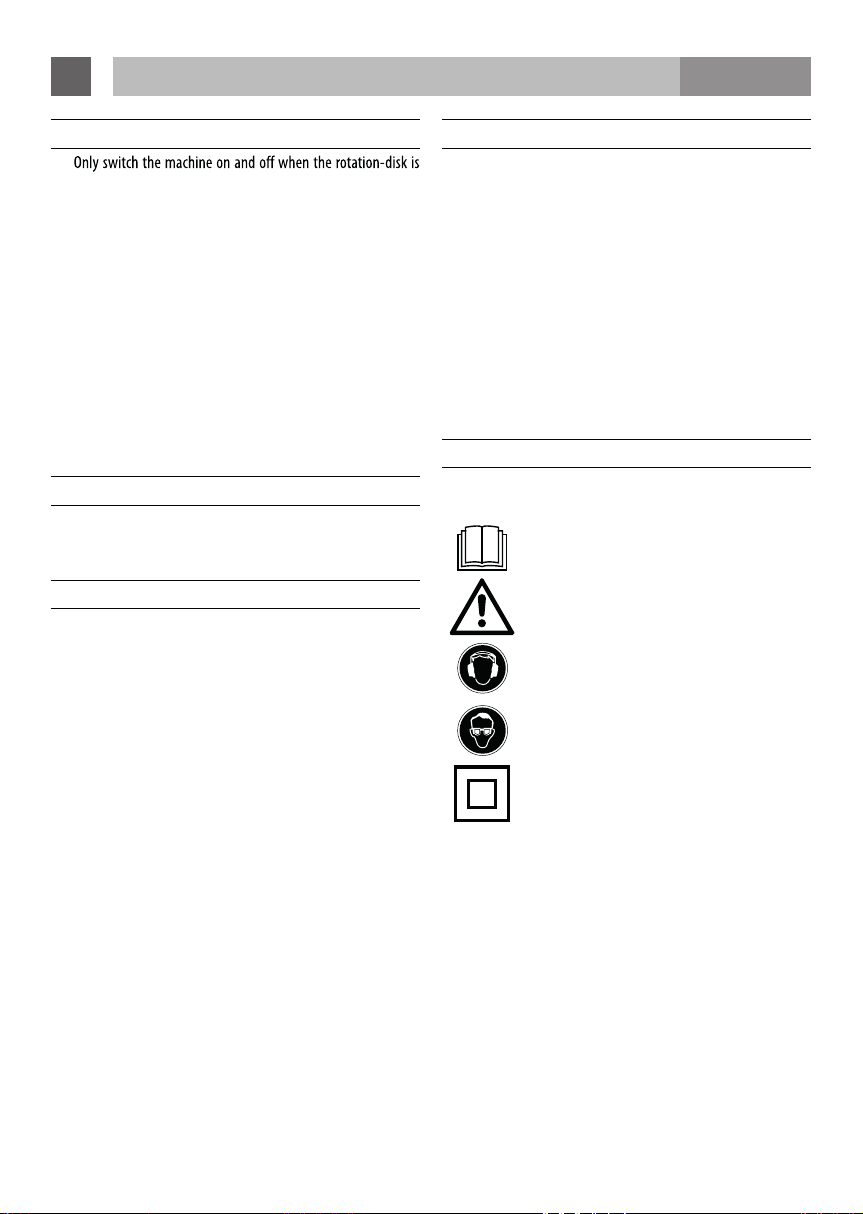
-1
-2
EXPLANATION OF SYMBOLS
The following symbols can be found on the machine and/or on the
rating plate:
Read the instruction before using your
product.
Attention!
Wear ear protection
Wear safety glasses
Before using check all parts for transport damage. In case of damage
contact your dealer immediatel
ness. Inform your dealer about missing parts immediately.
y. Check the package for complete-
Double insulation
9
Page 10
EN
OPERATION
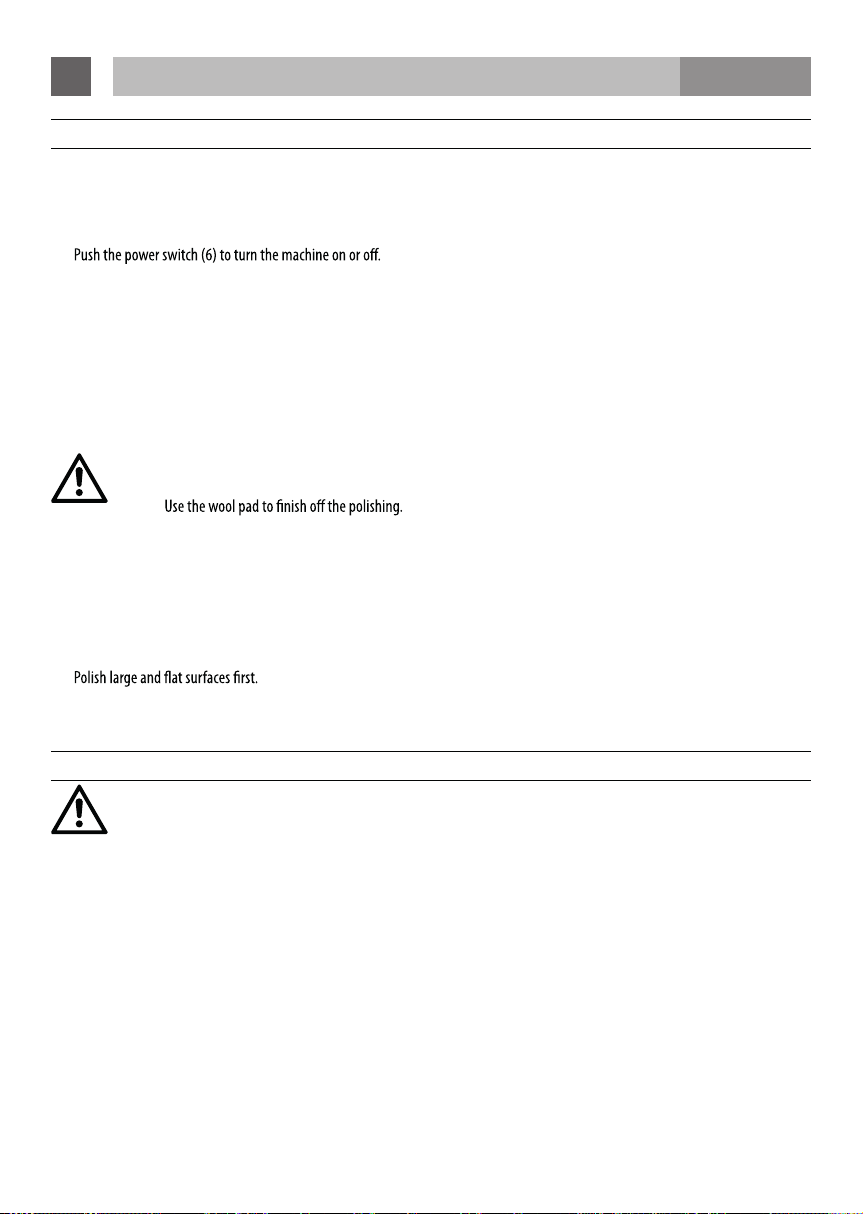
ON/OFF Switch
Attention!
• Hold the machine before switching on with both hands, the right on the front grip (1) and the left hand on the rear grip (3).
•
• Use the lock button (5) for setting the power switch for continuous use.
• Turn the speed-controller (2) up or down to increase or to reduce the speed .
Polishing
• Use the sponge pad to apply the polishing agent.
• Make sure that the sponge pad is free of any debris.
• Spread the polishing paste evenly over the sponge pad. Do not apply the polishing paste to the surface.
• Do not exert pressure on the polishing machine.
• Allow the polishing machine to slide over the surface.
•
• Make sure that the wool pad is free of any debris.
Tips for an optimal polishing result
• Wash the car at least every two weeks.
• Wash the car from above always downward.
• Polish the car twice or three times a year.
•
• Dicult-to-reach sections of the car should be polished by hand, without the use of the polisher.
CLEANING AND MAINTENANCE
Attention!
• Always disconnect power adaptor from the mains before starting any cleaning or maintenance.
• The polishing and sanding machine does not require special maintenance.
• Keep all safety devices, air vents and the motor housing free of dirt and dust.
• The housing of the equipment can easily be cleaned with a moistened cloth.
• Wash the sponge and wool pads regularly and only by hand. Air- dry the pads.
• Store the machine in its original packaging.
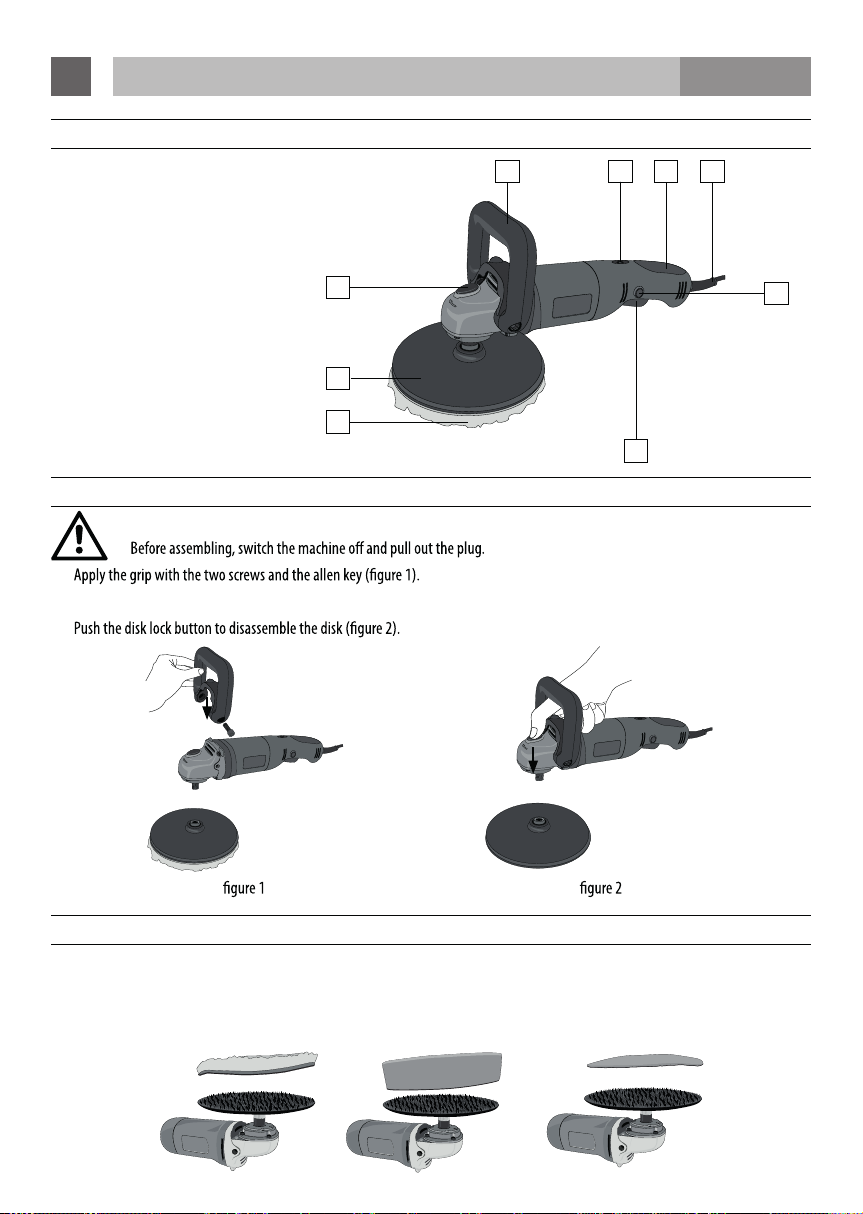
PARTS
1 Front grip
2 Speed controller
3 Rear grip
4 Power cord
5 Lock button
6 Power switch
7 Wool pad
8 Polishing / sanding disk
9 Disk lock
ASSEMBLY
Danger!
•
• Screw the polishing / sanding disk on the stud (use a wrench).
•
OPERATING INSTRUCTIONS
9
8
7
1 2 3
6
AB-CPEXPERT
4
5
ATTACH POLISHING PAD AND SANDING PAPER
• Put the equipment with the polishing disk upward on the table.
• Attach the supplied sponge pad or sanding paper on the disk.
• The hook-and-loop fastener enables easy changing of the polishing and sanding attachments.
• To remove, pull the sanding paper or the pad from the disk.
10
Page 11
EN
OPERATING INSTRUCTIONS
AB-CPEXPERT
OPERATION
ON/OFF Switch
Attention!
• Hold the machine before switching on with both hands, the right on the front grip (1) and the left hand on the rear grip (3).
•
• Use the lock button (5) for setting the power switch for continuous use.
• Turn the speed-controller (2) up or down to increase or to reduce the speed .
Polishing
• Use the sponge pad to apply the polishing agent.
• Make sure that the sponge pad is free of any debris.
• Spread the polishing paste evenly over the sponge pad. Do not apply the polishing paste to the surface.
• Do not exert pressure on the polishing machine.
• Allow the polishing machine to slide over the surface.
•
• Make sure that the wool pad is free of any debris.
Tips for an optimal polishing result
• Wash the car at least every two weeks.
• Wash the car from above always downward.
• Polish the car twice or three times a year.
•
• Dicult-to-reach sections of the car should be polished by hand, without the use of the polisher.
CLEANING AND MAINTENANCE
Attention!
• Always disconnect power adaptor from the mains before starting any cleaning or maintenance.
• The polishing and sanding machine does not require special maintenance.
• Keep all safety devices, air vents and the motor housing free of dirt and dust.
• The housing of the equipment can easily be cleaned with a moistened cloth.
• Wash the sponge and wool pads regularly and only by hand. Air- dry the pads.
• Store the machine in its original packaging.
11
Page 12

EN
RÈGLES GÉNÉRALES DE SÉCURITÉ
ATTENTION ! Lire toutes les instructions. Le non-respect des instruc-
tions ci-dessous est susceptible d’entraîner une électrocution, un
incendie et/ou de graves blessures. Le terme « outil électrique »
dans les avertissements ci-dessous fait référence à votre outil
électrique branché sur le secteur (cordon d’alimentation) ou à votre
CONSERVEZ CES INSTRUCTIONS
ZONE DE TRAVAIL
a) Maintenir sa zone de travail propre et bien éclairée.
Les zones de travail encombrées et sombres sont propices aux
accidents.
b) Ne pas utiliser les outils élec triques à proximité dans
une ambiance de poussière, de gaz et à proximité de
Les outils électriques génèrent
vapeurs.
c) Lors de l’utilisation d’un outil électrique, ne jamais
laisser qui que ce soit s’approcher. Toute distraction est
susceptible de vous faire perdre le contrôle de l’outil.
SÉCURITÉ ÉLECTRIQUE
a) Les prises de l’outil électrique doivent correspondre à
manière que ce soit. Ne pas utiliser d’adaptateur avec
les outils électriques (avec branchement à la terre). Les
prises d’origine et une parfaite compatibilité avec les prises
murales réduiront les risques d’électrocution.
b) Éviter tout contact corporel avec les surfaces en
contact avec le sol ou la terre, telles que les tuyaux,
les radiateurs, les cuisinières et les réfrigérateurs. Les
risques d’électrocution sont augmentés lorsque le corps est en
contact avec la terre ou le sol.
c) Conserver et utiliser les outils électriques à l’abri des
intempéries (pluie, humidité). Tout liquide pénétrant dans
l’outil électrique augmente le danger d’électrocution.
d) Ne pas tirer sur le cordon. Ne jamais utiliser le cordon
pour porter, tirer ou débrancher l’outil électrique.
Conserver le cordon à distance de la chaleur, de l’huile,
des rebords pointus et
de tout élément en mouvement.
Les cordons endommagés ou emmêlés augmentent les risques
d’électrocution.
e) Lors de l’utilisation d’un outil élec trique en extérieur,
utiliser une rallonge prévue pour les travaux en
extérieur. L’utilisation d’une rallonge prévue pour les travaux
en extérieur diminue le risque d’électrocution.
SÉCURITÉ PERSONNELLE
a) Rester vigilant et concentré sur ce que vous faites ;
faites preuve de bon sens quand vous utilisez un outil
électrique. Ne pas utiliser d’outils électriques quand
d’alcool ou de médicament. Un moment d’inattention
pendant l’utilisation d’outils électriques peut entraîner de
graves blessures.
b) Utiliser un équipement de sécurité. Toujours porter
des lunettes de protection. Un équipement de sécurité
comme un masque anti-poussière, des chaussures de sécurité
antiglisse, un casque ou un casque antibruit réduira le risque de
blessures.
c)
le bouton d’alimentation est sur la position ARRÊT (ou
OFF). Transporter des outils électriques en conservant un doigt
sur le bouton d’alimentation ou brancher des outils électriques
dont le bouton d’alimentation est sur MARCHE (ou ON) est
dangereux.
d) Retirer tout outil (clé, clé à molette, etc.) avant de
mettre l’outil électrique sous tension. Une clé à molette
électrique est susceptible d’entraîner des blessures.
e) Ne pas tendre le bras trop loin. Toujours conserver
un bon équilibre à tout moment. De cette façon vous
de situations inattendues.
f) S’habiller correctement. Ne pas porter de vêtements
lâches et de bijoux. Toujours conserver les cheveux,
les vêtements et les gants à distance des éléments en
mouvement. Les vêtements lâches, les bijoux et les cheveux
longs peuvent être pris dans les éléments en mouvement.
UTILISATION ET ENTRETIEN DES
OUTILS ÉLECTRIQUES
a) Ne pas exercer une trop forte pression sur l’outil
électrique. Utiliser l’outil électrique adapté à vos
besoins. Vous obtiendrez de bien meilleurs résultats avec un
outil électrique adapté aux travaux entrepris.
b) Ne pas utiliser un outil électrique si le bouton
d’alimentation ne le met pas sous/hors tension. Tout
outil électrique équipé d’un bouton d’alimentation qui ne
fonctionne pas est dangereux et doit être réparé.
c) S’il est nécessaire de changer le cordon d’alimentation,
toujours s’adresser au fabricant ou à son représentant
ainsi tout danger.
d) Débrancher la prise (de l’outil élec trique) de sa source
d’alimentation avant tout réglage, tout changement
d’accessoires ou tout entreposage dudit outil électrique.
Ces mesures préventives permettent de réduire le risque de
mise sous tension accidentelle de l’outil électrique.
OPERATING INSTRUCTIONS
AB-CPEXPERT
DISPOSAL
Old electrical appliances are recyclable.
Do not dispose them in the domestic waste! Separately deliver these in a valuable material collection point.
Dispose the packing material environmentally friendly.
Please give cardboard and paper to the waste paper, foils to a valuable material collection point.
12
Page 13
FR
MODE D’EMPLOI
AB-CPEXPERT
RÈGLES GÉNÉRALES DE SÉCURITÉ
ATTENTION ! Lire toutes les instructions. Le non-respect des instructions ci-dessous est susceptible d’entraîner une électrocution, un
incendie et/ou de graves blessures. Le terme « outil électrique »
dans les avertissements ci-dessous fait référence à votre outil
électrique branché sur le secteur (cordon d’alimentation) ou à votre
CONSERVEZ CES INSTRUCTIONS
ZONE DE TRAVAIL
a) Maintenir sa zone de travail propre et bien éclairée.
Les zones de travail encombrées et sombres sont propices aux
accidents.
b) Ne pas utiliser les outils élec triques à proximité dans
une ambiance de poussière, de gaz et à proximité de
vapeurs.
c) Lors de l’utilisation d’un outil électrique, ne jamais
laisser qui que ce soit s’approcher. Toute distraction est
susceptible de vous faire perdre le contrôle de l’outil.
SÉCURITÉ ÉLECTRIQUE
a) Les prises de l’outil électrique doivent correspondre à
manière que ce soit. Ne pas utiliser d’adaptateur avec
les outils électriques (avec branchement à la terre). Les
prises d’origine et une parfaite compatibilité avec les prises
murales réduiront les risques d’électrocution.
b) Éviter tout contact corporel avec les surfaces en
contact avec le sol ou la terre, telles que les tuyaux,
les radiateurs, les cuisinières et les réfrigérateurs. Les
risques d’électrocution sont augmentés lorsque le corps est en
contact avec la terre ou le sol.
c) Conserver et utiliser les outils électriques à l’abri des
intempéries (pluie, humidité). Tout liquide pénétrant dans
l’outil électrique augmente le danger d’électrocution.
d) Ne pas tirer sur le cordon. Ne jamais utiliser le cordon
pour porter, tirer ou débrancher l’outil électrique.
Conserver le cordon à distance de la chaleur, de l’huile,
des rebords pointus et
Les cordons endommagés ou emmêlés augmentent les risques
d’électrocution.
e) Lors de l’utilisation d’un outil élec trique en extérieur,
utiliser une rallonge prévue pour les travaux en
extérieur. L’utilisation d’une rallonge prévue pour les travaux
en extérieur diminue le risque d’électrocution.
Les outils électriques génèrent
de tout élément en mouvement.
SÉCURITÉ PERSONNELLE
a) Rester vigilant et concentré sur ce que vous faites ;
faites preuve de bon sens quand vous utilisez un outil
électrique. Ne pas utiliser d’outils électriques quand
d’alcool ou de médicament. Un moment d’inattention
pendant l’utilisation d’outils électriques peut entraîner de
graves blessures.
b) Utiliser un équipement de sécurité. Toujours porter
des lunettes de protection. Un équipement de sécurité
comme un masque anti-poussière, des chaussures de sécurité
antiglisse, un casque ou un casque antibruit réduira le risque de
blessures.
c)
le bouton d’alimentation est sur la position ARRÊT (ou
OFF). Transporter des outils électriques en conservant un doigt
sur le bouton d’alimentation ou brancher des outils électriques
dont le bouton d’alimentation est sur MARCHE (ou ON) est
dangereux.
d) Retirer tout outil (clé, clé à molette, etc.) avant de
mettre l’outil électrique sous tension. Une clé à molette
électrique est susceptible d’entraîner des blessures.
e) Ne pas tendre le bras trop loin. Toujours conserver
un bon équilibre à tout moment. De cette façon vous
de situations inattendues.
f) S’habiller correctement. Ne pas porter de vêtements
lâches et de bijoux. Toujours conserver les cheveux,
les vêtements et les gants à distance des éléments en
mouvement. Les vêtements lâches, les bijoux et les cheveux
longs peuvent être pris dans les éléments en mouvement.
UTILISATION ET ENTRETIEN DES
OUTILS ÉLECTRIQUES
a) Ne pas exercer une trop forte pression sur l’outil
électrique. Utiliser l’outil électrique adapté à vos
besoins. Vous obtiendrez de bien meilleurs résultats avec un
outil électrique adapté aux travaux entrepris.
b) Ne pas utiliser un outil électrique si le bouton
d’alimentation ne le met pas sous/hors tension. Tout
outil électrique équipé d’un bouton d’alimentation qui ne
fonctionne pas est dangereux et doit être réparé.
c) S’il est nécessaire de changer le cordon d’alimentation,
toujours s’adresser au fabricant ou à son représentant
ainsi tout danger.
d) Débrancher la prise (de l’outil élec trique) de sa source
d’alimentation avant tout réglage, tout changement
d’accessoires ou tout entreposage dudit outil électrique.
Ces mesures préventives permettent de réduire le risque de
mise sous tension accidentelle de l’outil électrique.
13
Page 14
FR
1 2 3
6
5
9
8
7
4
PIÈCES
1 Poignée avant
2 Contrôleur de vitesse
3 Poignée arrière
4 Cordons d’alimentation
5 Bouton de verrouillage
6 Bouton d’alimentation
7 Tampon en laine
8 Disque à lustrer / à poncer
9 Verrou sécurité du disque
MONTAGE
Danger !
Avant le montage, mettez l’appareil hors tension et débranchez-le.
• Fixez la poignée à l’aide des deux vis et de la clé à six pans (illustration 1).
• Vissez le disque à lustrer / à poncer sur le goujon (utilisez une clé à molette).
• Appuyez sur le bouton de verrouillage du disque pour démonter le disque (illustration 2).
Illustration 1 Illustration 2
FIXATION DU TAMPON LUSTRANT ET DU PAPIER DE VERRE
• Déposez l’outil sur une surface plane, disque vers le haut.
• Fixez le tampon éponge ou le papier de verre fournis sur le disque.
• L’attache rapide permet de changer facilement de matériels de lustrage ou de ponçage.
• Pour retirer le papier de verre ou le tampon, tirez simplement dessus.
MODE D’EMPLOI
AB-CPEXPERT
e) Toujours entreposer les outils électriques hors de la
portée des enfants et ne jamais laisser quelqu’un
disposant d’une connaissance limitée des outils
électriques ou de ces instructions utiliser l’outil
électrique. Les outils électriques sont dangereux lorsqu’ils sont
dans les mains de personnes peu habitués à leur utilisation
f)
le bon alignement des éléments en mouvement ;
de gêner le bon fonctionnement de l’outil électrique.
Si l’outil élec trique présente un problème quelconque,
faire réparer l’outil électrique avant utilisation. De
nombreux accidents sont causés par des outils électriques mal
entretenus.
g) Utiliser l’outil électrique, les accessoire et les pièces
fournies (etc.) conformément à ces instructions et de la
manière dont il a été prévu d’utiliser l’outil électrique
(en prenant compte des conditions et du travail à
de ceux pour lequel l’outil électrique a été conçu peut s’avérer
dangereux.
RÉPARATION
a) Toujours faire réparer son outil électrique par un
remplacement identiques. De cette manière, une bonne
sécurité est garantie.
RECOMMANDATIONS DE
SÉCURITÉ
• Mettre la machine sous tension ou hors tension uniquement
lorsque le disque pivotant est posé sur la surface à traiter.
• Toujours porter un masque antipoussière au cours des
opérations de lustrage et de ponçage.
• Ne pas utiliser de grandes quantités d’agent lustrant. En pareil
cas, le disque lustrant risque de glisser.
• Toujours respecter les règles du fabricant de l’agent lustrant
utilisé.
• Ne pas utiliser de papier de verre ou de tampons lustrants
endommagés ou usés.
• Le fabricant recommande l’utilisation des accessoires suivants :
papier de verre ou tampons lustrant, 180 mm de diamètre.
• Mettre le cordon d’alimentation sur votre épaule. Rester stable
et ne pas faire de mouvements brusques en cours d’utilisation.
UTILISATION PRÉVUE
La machine à lustrer / à poncer a été conçue pour lustrer les surfaces
disposant d’un re
et tout autre élément identique à l’aide de papier abrasif.
vêtement et pour lustrer le bois, le métal, le plastic
CONTENU DE L’EMBALLAGE
• 1 machine à lustrer
• 1 poignée
• 2 vis
• 1 clé à six pans
• 1 Disque à lustrer / à poncer
Si l’un ou plusieurs des éléments présentent une défaillance,
l’emballage. Contactez immédiatement votre revendeur s’il manque
des pièces.
CARACTÉRISTIQUES TECHNIQUES
Tension : 230V-50Hz
Alimentation électrique : 1100W
Vitesse : 1000-3000min
Fil de connexion : M14
Diamètre du disque à lustrer / à poncer : 180 mm
Niveau puissance sonore L
Niveau pression sonore L
Vibration a
Isolation totale : II
Poids : 2,2 kg
: 6.76 m/s
w
: 98dB (A)
wA
: 87dB (A)
wA
EXPLICATION DES SYMBOLES
Les symboles suivants peuvent être présents sur la machine et/ou
sur la plaque signalétique:
Lisez ce mode d’emploi avant d’utiliser
cette machine.
Attention !
Portez des protections pour les oreilles
Porter des lunettes de sécurité
Double isolation
-1
-2
14
Page 15
FR
MODE D’EMPLOI
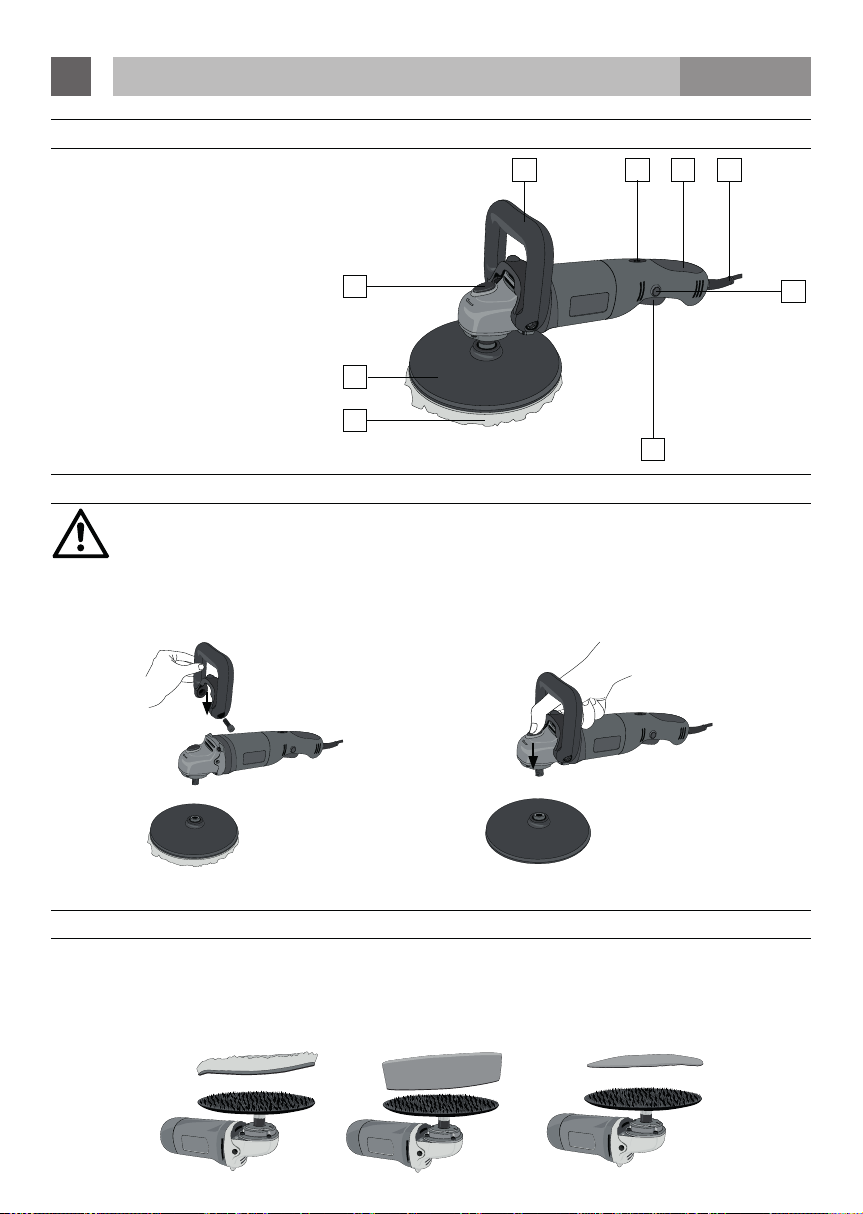
PIÈCES
1 Poignée avant
2 Contrôleur de vitesse
3 Poignée arrière
4 Cordons d’alimentation
5 Bouton de verrouillage
6 Bouton d’alimentation
7 Tampon en laine
8 Disque à lustrer / à poncer
9 Verrou sécurité du disque
9
8
1 2 3
7
MONTAGE
Danger !
Avant le montage, mettez l’appareil hors tension et débranchez-le.
• Fixez la poignée à l’aide des deux vis et de la clé à six pans (illustration 1).
• Vissez le disque à lustrer / à poncer sur le goujon (utilisez une clé à molette).
• Appuyez sur le bouton de verrouillage du disque pour démonter le disque (illustration 2).
AB-CPEXPERT
4
5
6
Illustration 1 Illustration 2
FIXATION DU TAMPON LUSTRANT ET DU PAPIER DE VERRE
• Déposez l’outil sur une surface plane, disque vers le haut.
• Fixez le tampon éponge ou le papier de verre fournis sur le disque.
• L’attache rapide permet de changer facilement de matériels de lustrage ou de ponçage.
• Pour retirer le papier de verre ou le tampon, tirez simplement dessus.
15
Page 16
FR
ÉLIMINATION DU PRODUIT
Les vieux appareils électriques sont recyclables.
Ne les mélangez pas aux ordures ménagères ! Envoyez-les dans un centre de recyclage.
Éliminez l’emballage d’une manière qui respecte l’environnement.
Déposez le car ton et le papier dans des centres de recyclage des papiers et le papier aluminium dans un centre de recyclage
FONCTIONNEMENT
Bouton ON/OFF
Attention !
• Tenez l’appareil à deux mains avant de le mettre sous tension, main droite sur la poignée avant (1) et main gauche sur la poignée arrière
• Appuyez sur le bouton d’alimentation (6) pour mettre l’appareil sous tension ou hors tension.
• Utilisez le bouton de verrouillage (5) pour régler l’alimentation sur le mode Continu.
• Tournez le contrôleur de vitesse (2) vers le haut ou vers le bas pour augmenter ou réduire la vitesse.
MODE D’EMPLOI
(3).
AB-CPEXPERT
Lustrage
• Utilisez le tampon en éponge pour appliquer l’agent lustrant.
• Vériez qu’il n’y aucune saleté sur le tampon en éponge.
• Étalez la pâte lustrante de façon égale sur toute la surface du tampon en éponge. Ne pas appliquer la pâte lustrante sur la surface.
• Ne pas exercer une trop forte pression sur la machine à lustrer.
• Laissez la machine à lustrer glisser sur toute la surface.
• Utilisez le tampon en laine pour terminer le lustrage.
•
Conseils pour un meilleur lustrage
• Nettoyez la voiture au moins toutes les deux semaines.
• Nettoyez votre voiture du haut vers le bas.
• Lustrez la voiture au moins deux ou trois fois par an.
• Commencez par lustrer de grandes surfaces.
• Il est conseillé de lustrer à la main, sans la machine à lustrer, les par ties de la voiture diciles à atteindre.
NETTOYAGE ET ENTRETIEN
Attention !
• Toujours débrancher l’adaptateur secteur du courant avant tout travail de nettoyage ou d’entretien.
• La machine à lustrer et à poncer n’a pas besoin d’être entretenue d’une manière particulière.
• Tous les éléments de sécurité, les conduits d’aération et le logement du moteur ne doivent pas être encombrés ni par de la saleté, ni par
de la poussière.
•
• Nettoyez régulièrement les tampons en éponge et en laine (à la main uniquement). Séchez les tampons à l’air.
• Entreposez l’appareil dans son emballage d’origine.
16
Page 17

FR
MODE D’EMPLOI
ÉLIMINATION DU PRODUIT
Les vieux appareils électriques sont recyclables.
Ne les mélangez pas aux ordures ménagères ! Envoyez-les dans un centre de recyclage.
Éliminez l’emballage d’une manière qui respecte l’environnement.
Déposez le car ton et le papier dans des centres de recyclage des papiers et le papier aluminium dans un centre de recyclage
AB-CPEXPERT
17
Page 18
IT
familiari con l’utensile, o che non abbiano letto queste
istruzioni, di far funzionare l’utensile elettrico. Gli utensili
elettrici sono pericolosi, nelle mani di utenti non addestrati.
f)
il disallineamento o la piegatura di parti in movimento,
la rottura di pezzi, o qualsiasi altra condizione che possa
fosse danneggiato, far riparare l’utensile elettrico
prima dell’impiego. Molti incidenti vengono causati da
utensili elettrici oggetto di scarsa manutenzione.
g) Utilizzare l’utensile elettrico, i suoi accessori e vari pezzi,
etc., conformemente a queste istruzioni, e nel modo
previsto per quel tipo particolare di accessorio o pezzo,
tenendo conto delle condizioni di lavoro e del lavoro
da eseguire. L’impiego dell’utensile elettrico per operazioni
diverse da quelle previste può determinare una situazione di
pericolo.
ASSISTENZA
a) Assicurarsi di far riparare l’utensile elettrico da personale
originali necessari. Questo assicurerà il mantenimento del
livello di sicurezza dell’utensile elettrico.
RIFERIMENTI SPECIFICI DI
SICUREZZA
• Accendere e spegnere la macchina soltanto allorquando il disco
• Indossare sempre una maschera anti-polvere durante
l’operazione di lucidatura a secco, o di smerigliatura.
• Non impiegare elevate quantità di agenti di lucidatura. Ciò
potrebbe provocare lo slittamento del disco di lucidatura.
• Osservare sempre le direttive indicate dal produttore dell’agente
di lucidatura utilizzato.
• Non utilizzare cuscinetti di lucidatura o car te smerigliatrici
danneggiate o fortemente usurate.
• Il produttore consiglia di utilizzare soltanto i seguenti accessori:
cuscinetti di lucidatura o carte smerigliatrici adatte per una
macchina con un disco da 180 mm di diametro.
• Sistemare il cavo d’alimentazione sopra la spalla. Eseguire
movimenti equlibrati; non muoversi a scatti durante il lavoro.
IMPIEGO PREVISTO
ricoperte o verniciate e per la smerigliatura di legno, ferro, plastica
ed altri materiali simili mediante carte abrasive.
CONTENUTO DELLA CONFEZIONE
• 1 lucidatrice
• 1 maniglia di presa
• 2 viti
• 1 chiave Allen
• 1 disco lucidante / smerigliante
trasporto. In caso di danni accertati, mettersi immediatamente in
confezione. Informare immediatamente il venditore dell’eventuale
mancanza di pezzi.
DATI TECNICI
Tensione: 230 V – 50 Hz
Potenza nominale: 900 W
Velocità: da 1500 a 4500 giri/min
-1
Filettatura di connessione: M14
Diametro del disco lucidante /
smerigliante: 125mm
Livello di potenza sonora L
wA
: 98 dB (A)
Livello di potenza sonora L
wA
: 87 dB (A)
Vibrazione aw: 6,76 m/s
-2
Isolazione, completa: II
Peso: 2,37 kg
SPIEGAZIONE DEI SIMBOLI
I seguenti simposi si possono trovare sulla macchina e/o sulla
piastra:
Leggere le istruzioni prima di usare il
prodotto.
Attenzione!
Indossare protezione per gli occhi
Indossare occhiali di sicurezza
Doppio isolamento
MANUALE PER L’UTENTE
AB-CPEXPERT
REGOLE GENERALI DI SICUREZZA
AVVERTENZA! Leggere tutte le istruzioni. La mancata osservanza
di tutte le istruzioni elencate di seguito può provocare scosse elettriche, incendi e/o gravi ferite. Il termine “utensile elettrico” in tutte
le avvertenze citate di seguito si riferisce agli utensili alimentati
dalla rete (mediante un cavo), nonché a quelli che operano tramite
batteria (senza cavo).
CONSERVARE QUESTE ISTRUZIONI
SPAZIO DI LAVORO
a) Mantenere pulito e ben illuminato il proprio spazio di
lavoro. Spazi ingombrati e oscuri sono forieri di incidenti.
b) Non far funzionare utensili elettrici in ambienti ove
siano presenti sostanze esplosive, quali liquidi, gas o
scintille in grado di appiccare un incendio a polveri o fumi.
c) Mantenere lontani bambini ed altre persone mentre si
fa funzionare un utensile elettrico. Le distrazioni possono
provocare una perdita di controllo dell’utensile.
SICUREZZA ELETTRICA
a) Le spine degli utensili elettrici dovono corrispondere alle
Non impiegare spine adattatrici per utensili provvisti di
polarità di messa a terra.
corrispondenti riduranno il rischio di scosse elettriche.
b)
che sono messi a terra, quali tubazioni, radiatori di
riscaldamento, elettrodomestici e frogoriferi. Il rischio di
scossa elettrica aumenta se il proprio corpo è messo a terra.
c) Non esporre gli utensili elettrici alla pioggia o a
condizioni di umidità. Se dell’acqua fosse penetrata in un
utensile elettrico, il rischio di scossa elettrica aumenta.
d) Non maltrattare il cavo d’alimentazione. Non utilizzare
mai il cavo di alimentazione per trasportare, tirare o
staccare dalla presa l’utensile elettrico. Mantenere tale
cavo lontano da fonti di calore, olio, spigoli appuntiti
o par ti in movimento. Cavi di alimentazione danneggiati o
attorcigliati aumentano il rischio di scossa elettrica.
e) Se si fa funzionare un utensile elettrico all’esterno,
utilizzare una prolunga adatta all’impiego esterno.
L’impiego di un cavo adatto ad un utilizzo esterno riduce il
rischio di scossa elettrica.
SICUREZZA PERSONALE
a) Prestare attenzione, osservare quello che si sta facendo
e far prova di buon sensoallorquando si fa funzionare
un utensile elettrico. Non utilizzare un utensile
Gli utensili elettrici possono provocare
alcol o medicinali. Un attimo di disattenzione mentre si
utilizzano utensili elettrici può provocare una grave ferita alla
propria, o ad altre persone.
b) Impiegare attrezzature di sicurezza. Indossare sempre
una protezione per gli occhi. Mezzi di sicurezza quali una
maschera anti-polvere, scarpe di sicurezza anti-scivolo, un
casco o protezioni per l’udito, utilizzati nelle condizioni adatte,
ridurranno il rischio di ferite alle persone.
c) Evitare un avvio accidentale. Assicurarsi che
l’interruttore si trovi in posizione “spento” prima di
connettere l’utensile all’alimentazione elettrica. Il
trasporto di utensili elettrici con il dito sull’interruttore, o la
connessione all’alimentazione di utensili con l’interruttore in
posizione “acceso” sono forieri di incidenti.
d) Rimuovere tutte le chiavi di regolazione o manovra,
prima
e) Non estendere troppo la propria portata. Mantenere i
f) Vestirsi in maniera adatta. Non indossare abiti allentati,
a) Non forzare gli utensili elettrici. Utilizzare l’utensile
b) Non utilizzare l’utensile elettrico se il suo interruttore
c) Se dovesse rendersi necessaria la sostituzione del
d) Sconnettere la spina dalla presa di rete prima di
e) Riporre gli utensili elettrici fuori della portata dei
18
di accendere l’utensile elettrico. Una chiave
di manovra o regolazione, lasciata attaccata ad un par te
in rotazione, potrebbe arrecare danni all’incolumità delle
persone.
piedi saldi e il proprio equilibrio in tutte le condizioni.
Questo garantirà un miglior controllo dell’utensile elettrico in
situazioni inattese.
o gioielli. Mantenere la propria capigiatura, abiti e
guanti a distanza da parti in movimento. Abiti allentati,
gioielli o lunghe capigliature possono essere attratti in parti in
movimento.
UTILIZZO E CURA DI UTENSILI
ELETTRICI
elettrico adatto all’applicazione desiderata. L’utensile
elettrico adatto eseguirà un lavoro migliore e più sicuro, al ritmo
per cui è stato concepito.
“acceso/spento” non funziona. Un qualsiasi utensile elettrico
che non può essere comandato tramite il suo interruttore è
pericoloso, e deve essere sottoposto a riparazione.
cavo di alimentazione, questo intervento dovrà essere
compiuto dal costruttore, o un suo rappresentante, al
apportare una qualche regolazione, cambiare gli
accessori o riporre l’utensile elettrico. Tali misure
di sicurezza preventive riducono il rischio di av viare
accidentalmente l’utensile elettrico
bambini, e non consentire a persone che non siano
Page 19
IT
MANUALE PER L’UTENTE
AB-CPEXPERT
familiari con l’utensile, o che non abbiano letto queste
istruzioni, di far funzionare l’utensile elettrico. Gli utensili
elettrici sono pericolosi, nelle mani di utenti non addestrati.
f)
il disallineamento o la piegatura di parti in movimento,
la rottura di pezzi, o qualsiasi altra condizione che possa
fosse danneggiato, far riparare l’utensile elettrico
prima dell’impiego. Molti incidenti vengono causati da
utensili elettrici oggetto di scarsa manutenzione.
g) Utilizzare l’utensile elettrico, i suoi accessori e vari pezzi,
etc., conformemente a queste istruzioni, e nel modo
previsto per quel tipo particolare di accessorio o pezzo,
tenendo conto delle condizioni di lavoro e del lavoro
da eseguire. L’impiego dell’utensile elettrico per operazioni
diverse da quelle previste può determinare una situazione di
pericolo.
ASSISTENZA
a) Assicurarsi di far riparare l’utensile elettrico da personale
originali necessari. Questo assicurerà il mantenimento del
livello di sicurezza dell’utensile elettrico.
RIFERIMENTI SPECIFICI DI
SICUREZZA
• Accendere e spegnere la macchina soltanto allorquando il disco
• Indossare sempre una maschera anti-polvere durante
l’operazione di lucidatura a secco, o di smerigliatura.
• Non impiegare elevate quantità di agenti di lucidatura. Ciò
potrebbe provocare lo slittamento del disco di lucidatura.
• Osser vare sempre le direttive indicate dal produttore dell’agente
di lucidatura utilizzato.
• Non utilizzare cuscinetti di lucidatura o carte smerigliatrici
danneggiate o fortemente usurate.
• Il produttore consiglia di utilizzare soltanto i seguenti accessori:
cuscinetti di lucidatura o carte smerigliatrici adatte per una
macchina con un disco da 180 mm di diametro.
• Sistemare il cavo d’alimentazione sopra la spalla. Eseguire
movimenti equlibrati; non muoversi a scatti durante il lavoro.
IMPIEGO PREVISTO
CONTENUTO DELLA CONFEZIONE
• 1 lucidatrice
• 1 maniglia di presa
• 2 viti
• 1 chiave Allen
• 1 disco lucidante / smerigliante
trasporto. In caso di danni accertati, mettersi immediatamente in
confezione. Informare immediatamente il venditore dell’eventuale
mancanza di pezzi.
DATI TECNICI
Tensione: 230 V – 50 Hz
Potenza nominale: 900 W
Velocità: da 1500 a 4500 giri/min
Filettatura di connessione: M14
Diametro del disco lucidante /
smerigliante: 125mm
Livello di potenza sonora L
Livello di potenza sonora L
Vibrazione aw: 6,76 m/s
Isolazione, completa: II
Peso: 2,37 kg
: 98 dB (A)
wA
: 87 dB (A)
wA
-2
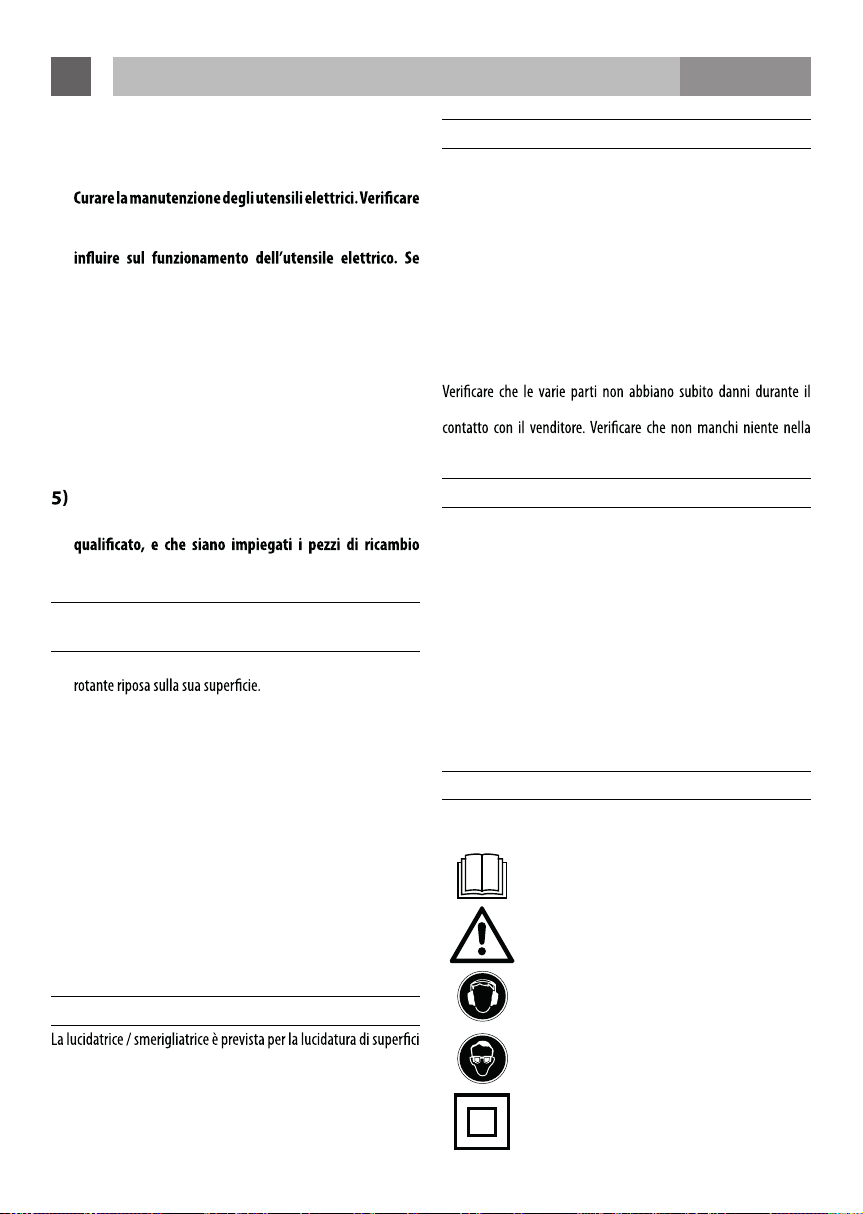
SPIEGAZIONE DEI SIMBOLI
I seguenti simposi si possono trovare sulla macchina e/o sulla
piastra:
Leggere le istruzioni prima di usare il
prodotto.
Attenzione!
Indossare protezione per gli occhi
-1
ricoperte o verniciate e per la smerigliatura di legno, ferro, plastica
ed altri materiali simili mediante carte abrasive.
Indossare occhiali di sicurezza
Doppio isolamento
19
Page 20
IT
FUNZIONAMENTO
Interruttore “acceso / spento” (ON/OFF)
Attenzione!
• Mantenere la macchina, prima di accenderla, con entrambe le mani, la destra sulla maniglia di presa anteriore (1), la sinistra sulla
maniglia di presa posteriore (3).
• Premere l’interruttore di alimentazione (6) per accendere o spegnere la macchina.
• Utilizzare il pulsante di blocco (5) per mantenere attivato in continuazione l’interruttore di alimentazione .
• Ruotare il variatore di velocità (2) su o giù per incrementare o ridurre la velocità.
Lucidatura
• Impiegare il cuscinetto di spugna per applicare l’agente lucidante.
• Assicurarsi che sul cuscinetto non siano presenti corpi estranei.
• Stendere la pasta lucidante in modo uniforme sul cuscinetto di spugna. Non applicare la pasta lucidante sulla supercie da trattare.
• Non esercitare alcuna pressione sulla macchina lucidante.
• Consentire alla lucidatrice di scivolare sulla supercie da trattare.
• Impiegare il cuscinetto di lana per la nitura della lucidatura.
• Assicurarsi che il cuscinetto di lana non presenti alcun corpo estraneo.
Suggerimenti per un risultato ottimale della lucidatura
• Lavare la macchina almeno ogni due settimane.
• Lavare la macchina sempre dall’alto verso il basso.
• Lucidare la macchina due o tre volte all’anno.
• Praticare per prima una lucidatura ampia su grandi superci.
• Parti della macchina di dicile accesso dovrebbero essere lucidate a mano, senza impiegare la lucidatrice.
PULIZIA E MANUTENZIONE
Attenzione!
• Sconnettere sempre l’adattatore/alimentatore dalla presa di rete, prima di ogni operazione di pulitura o manutenzione.
•
• Mantenere tutti i dipositivi di sicurezza, le ventilazioni d’aria e l’alloggiamento del motore liberi da sporcizia e polvere.
• Il contenitore della macchina potrà essere pulito facilmente mediante un panno inumidito.
• Lavare con frequenza i cuscinetti di spugna e di lana, e soltanto a mano. Lasciarli poi asciugarsi all’aria.
• R iporre la macchina nella sua confezione originale.
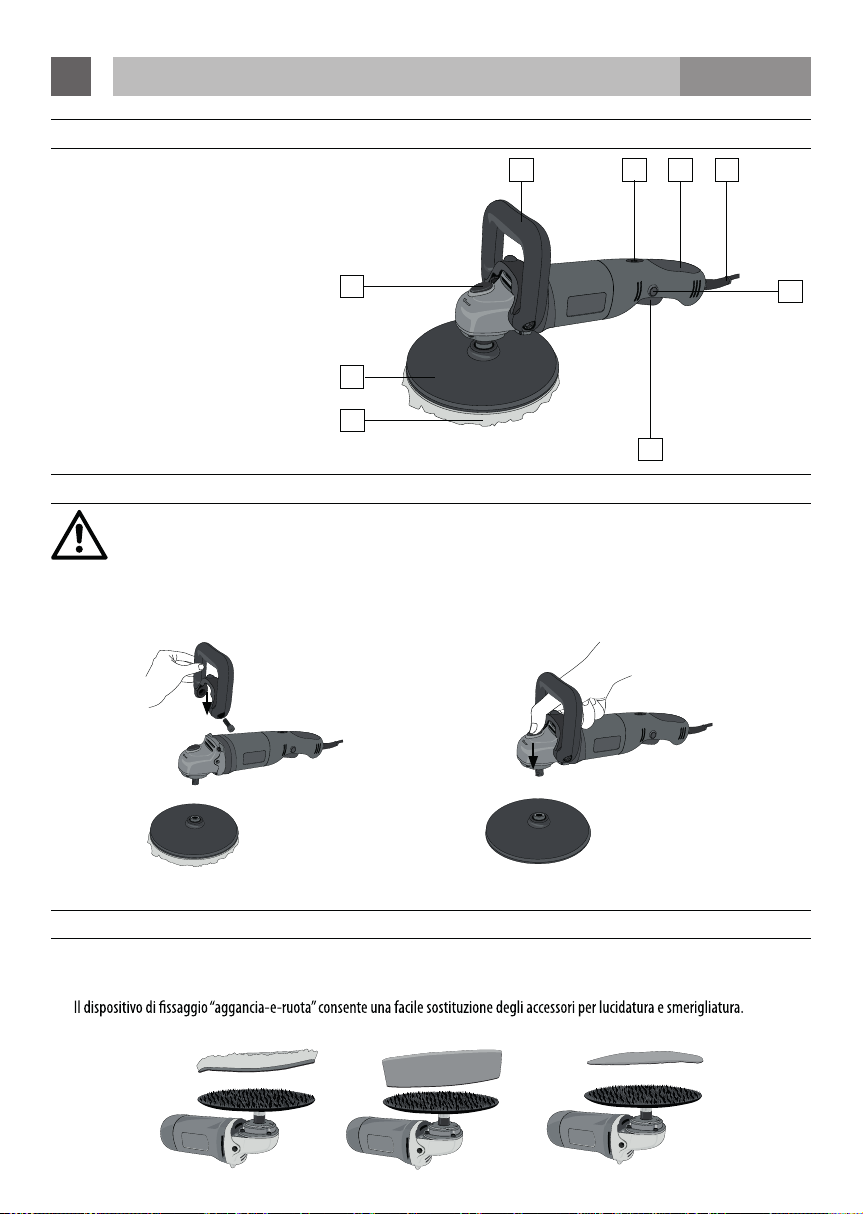
PARTI
1 Maniglia di presa anteriore
2 Variatore della velocità
3 Maniglia di presa posteriore
4 Cavo di alimentazione
5 Pulsante di blocco
6 Interruttore “acceso/spento”
7 Cuscinetto di lana
8 Disco lucidante / smerigliante
9 Blocco del disco
MONTAGGIO
Pericolo!
Prima di procedere al suo montaggio, spegnere la macchina e staccarne la spina.
• Applicare la maniglia di presa mediante le due viti e la chiave Allen (Figura 1).
• Avvitare il disco lucidante / smerigliante sul prigioniero (per mezzo di una chiave di manovra).
• Premere il pulsante di blocco del disco per smontarlo (Figura 2).
MANUALE PER L’UTENTE
1 2 3
9
8
7
AB-CPEXPERT
4
5
6
ATTACCO DEL CUSCINETTO LUCIDANTE E DELLA CARTA SMERIGLIANTE
• Disporre la macchina su un ripiano, con il disco lucidante verso l’alto.
• Attaccare sul disco il cuscinetto di spugna o la carta smerigliante forniti a corredo.
•
• Per rimuoverli, tirare la carta smerigliante o il cuscinetto dal disco.
Figura 1 Figura 2
20
Page 21
IT
MANUALE PER L’UTENTE
AB-CPEXPERT
FUNZIONAMENTO
Interruttore “acceso / spento” (ON/OFF)
Attenzione!
• Mantenere la macchina, prima di accenderla, con entrambe le mani, la destra sulla maniglia di presa anteriore (1), la sinistra sulla
maniglia di presa posteriore (3).
• Premere l’interruttore di alimentazione (6) per accendere o spegnere la macchina.
• Utilizzare il pulsante di blocco (5) per mantenere attivato in continuazione l’interruttore di alimentazione .
• Ruotare il variatore di velocità (2) su o giù per incrementare o ridurre la velocità.
Lucidatura
• Impiegare il cuscinetto di spugna per applicare l’agente lucidante.
• Assicurarsi che sul cuscinetto non siano presenti corpi estranei.
• Stendere la pasta lucidante in modo uniforme sul cuscinetto di spugna. Non applicare la pasta lucidante sulla supercie da trattare.
• Non esercitare alcuna pressione sulla macchina lucidante.
• Consentire alla lucidatrice di scivolare sulla supercie da trattare.
• Impiegare il cuscinetto di lana per la nitura della lucidatura.
• Assicurarsi che il cuscinetto di lana non presenti alcun corpo estraneo.
Suggerimenti per un risultato ottimale della lucidatura
• Lavare la macchina almeno ogni due settimane.
• Lavare la macchina sempre dall’alto verso il basso.
• Lucidare la macchina due o tre volte all’anno.
• Praticare per prima una lucidatura ampia su grandi superci.
• Parti della macchina di dicile accesso dovrebbero essere lucidate a mano, senza impiegare la lucidatrice.
PULIZIA E MANUTENZIONE
Attenzione!
• Sconnettere sempre l’adattatore/alimentatore dalla presa di rete, prima di ogni operazione di pulitura o manutenzione.
•
• Mantenere tutti i dipositivi di sicurezza, le ventilazioni d’aria e l’alloggiamento del motore liberi da sporcizia e polvere.
• Il contenitore della macchina potrà essere pulito facilmente mediante un panno inumidito.
• Lavare con frequenza i cuscinetti di spugna e di lana, e soltanto a mano. Lasciarli poi asciugarsi all’aria.
• R iporre la macchina nella sua confezione originale.
21
Page 22

IT
OGÓLNE ZASADY
BEZPIECZEŃSTWA
OSTRZEŻENIE! Przeczytaj wszystkie wskazówki. Nieprzestrzeganie
wszystkich wymienionych niżej wskazówek może powodować
porażenie elektryczne, pożar i/lub poważne obrażenia. Pojęcie
“narzędzie mechaniczne o napędzie elektrycznym” we wszystkich
ostrzeżeniach odnosi się do narzędzi zasilanych z sieci (przewo-
dowych) oraz z akumulatora (bezprzewodowych).
ZACHOWAJ TĘ INSTRUKCJĘ
MIEJSCE PRACY
a) Dbaj o czystość w miejscu pracy i o dobre oświetlenie.
Nieporządek i niedostateczne oświetlenie sprzyjają
nieszczęśliwym wypadkom.
b) Nie używaj narzędzi zasilanych elektrycznie w
atmosferze wybuchowej, takiej jak w obecności
łatwopalnych cieczy, gazów lub pyłu. Narzędzia
mechaniczne i napędzie elektrycznym wytwarzają iskry, które
mogą spowodować zapalenie się pyłu lub dymu.
c) Nie dopuszczaj dzieci ani osób postronnych w pobliże
miejsca, gdzie jest używane narzędzie mechaniczne
o napędzie elektrycznym. Nieuwaga może spowodować
utratę kontroli.
BEZPIECZEŃSTWO ELEKTRYCZNE
a) Wtyczka narzędzia musi pasować do gniazdka. Nigdy, w
pośredniej z narzędziem elektrycznym posiadającym
zerowanie.
zmniejszą ryzyko porażenia elektrycznego.
b) Unikaj kontaktu ciała z uziemionymi lub zerowanymi
powierzchniami takimi jak rury, grzejniki, trzony
kuchenne i chłodziarki. W takim przypadku istnieje
zwiększone ryzyko porażenia elektrycznego, jeśli ciało jest
uziemione lub zerowane.
c) Nie wystawiaj narzędzia mechanicznego o napędzie
elektrycznym na deszcz ani wilgoć. Woda wnikająca do
narzędzia zwiększa ryzyko porażenia elektrycznego.
d) Chroń przewód przed uszkodzeniami. Nigdy nie używaj
przewodu do noszenia, ciągnięcia narzędzia lub jego
odłączania od gniazdka. Chroń przewód przed ciepłem,
olejem, ostrymi krawędziami i ruchomymi częściami.
Uszkodzone lub splątane przewody zwiększają ryzyko porażenia
elektrycznego.
e) Podczas pracy z narzędziem na wolnym powietrzu
używaj przewodu przedłużającego odpowiedniego
do
tego celu. Użycie przewodu odpowiedniego na warunków na
wolnym powietrzu zmniejsza ryzyko porażenia elektrycznego.
BEZPIECZEŃSTWO OSOBISTE
a) Bądź czujny, uważaj na to, co robisz i zachowaj rozsądek
podczas prac y z narzędziem mechanicznym o napędzie
elektrycznym. Nie używaj narzędzia będąc pod wpływem
narkotyków, alkoholu lub leków. Chwila nieuwagi podczas
pracy z narzędziem może powodować poważne obrażenia.
b) Używaj sprzętu ochronnego. Zawsze zakładaj okulary
ochronne. Sprzęt ochronny taki, jak maska przeciwpyłowa,
buty ochronne chroniące przed poślizgiem, twarde nakr ycie
głowy lub ochrona narządu słuchu używane w odpowiednich
warunkach zmniejszają zagrożeniem obrażeniami.
c) Unikaj przypadkowego uruchomienia. Zanim włożysz
wtyczkę do gniazdka upewnij się, czy włącznik jest w
pozycji wyłączonej. Noszenie narzędzia z palcem na włączniku
lub łączenie z gniazdkiem na
rzędzia, które ma włącznik, sprzyja
nieszczęśliwym wypadkom.
d) Zdjąć klucz regulacyjny lub klucz płaski przed włączeniem
narzędzia. Klucz płaski lub klucz pozostawiony na obracającej
się części narzędzia może powodować obrażenia.
e) Nie wychylaj się. Zawsze utrzymuj właściwą pozycję i
równowagę. Umożliwia to lepszą kontrolę nad narzędziem w
nieoczekiwanych sytuacjach.
f) Właściwie ubieraj się. Nie noś luźnej odzieży ani
biżuterii. Włosy, odzież i rękawice trzymaj z daleka od
ruchomych części. Luźna odzież, biżuteria lub długie włosy
mogą zostać uchwycone przez ruchome części.
UŻYTKOWANIE I KONSERWACJA
NARZĘDZIA MECHANICZNEGO O
NAPĘDZIE ELEKTRYCZNYM
a) Nie przeciążaj narzędzia. Używaj narzędzia właściwego
do zadania. Prawidłowe narzędzie wykona zadanie lepiej
i bezpieczniej przy wartościach znamionowych, do których
zostało zaprojektowane.
b) Nie używaj narzędzia, jeśli nie włącza się ono i
nie wyłącza. Narzędzie, którego nie da się kontrolować
włącznikiem, jest niebezpieczne i należy je naprawić.
c) Jeżeli konieczna jest wymiana przewodu zasilającego,
powinien to wykonywać producent lub jego
przedstawiciel – ze względów bezpieczeństwa.
d) Przed dokonywaniem jakichkolwiek regulacji, zmianą
akcesoriów lub przechowywaniem odłącz przewód
od gniazdka. Takie środki prewencyjne zmniejszają ryzyko
przypadkowego uruchomienia urządzenia.
MANUALE PER L’UTENTE
AB-CPEXPERT
ELIMINAZIONE
I vecchi apparecchi elettrici sono riciclabili.
Eliminare il materiale d’imballaggio senza pericolo per l’ambiente.
22
Page 23
PL
INSTRUKCJA OBSŁUGI
AB-CPEXPERT
OGÓLNE ZASADY
BEZPIECZEŃSTWA
OSTRZEŻENIE! Przeczytaj wszystkie wskazówki. Nieprzestrzeganie
wszystkich wymienionych niżej wskazówek może powodować
porażenie elektryczne, pożar i/lub poważne obrażenia. Pojęcie
“narzędzie mechaniczne o napędzie elektrycznym” we wszystkich
ostrzeżeniach odnosi się do narzędzi zasilanych z sieci (przewodowych) oraz z akumulatora (bezprzewodowych).
ZACHOWAJ TĘ INSTRUKCJĘ
MIEJSCE PRACY
a) Dbaj o czystość w miejscu pracy i o dobre oświetlenie.
Nieporządek i niedostateczne oświetlenie sprzyjają
nieszczęśliwym wypadkom.
b) Nie używaj narzędzi zasilanych elektrycznie w
atmosferze wybuchowej, takiej jak w obecności
łatwopalnych cieczy, gazów lub pyłu. Narzędzia
mechaniczne i napędzie elektrycznym wytwarzają iskry, które
mogą spowodować zapalenie się pyłu lub dymu.
c) Nie dopuszczaj dzieci ani osób postronnych w pobliże
miejsca, gdzie jest używane narzędzie mechaniczne
o napędzie elektrycznym. Nieuwaga może spowodować
utratę kontroli.
BEZPIECZEŃSTWO ELEKTRYCZNE
a) Wtyczka narzędzia musi pasować do gniazdka. Nigdy, w
pośredniej z narzędziem elektrycznym posiadającym
zerowanie.
zmniejszą ryzyko porażenia elektrycznego.
b) Unikaj kontaktu ciała z uziemionymi lub zerowanymi
powierzchniami takimi jak rury, grzejniki, trzony
kuchenne i chłodziarki. W takim przypadku istnieje
zwiększone ryzyko porażenia elektrycznego, jeśli ciało jest
uziemione lub zerowane.
c) Nie wystawiaj narzędzia mechanicznego o napędzie
elektrycznym na deszcz ani wilgoć. Woda wnikająca do
narzędzia zwiększa ryzyko porażenia elektrycznego.
d) Chroń przewód przed uszkodzeniami. Nigdy nie używaj
przewodu do noszenia, ciągnięcia narzędzia lub jego
odłączania od gniazdka. Chroń przewód przed ciepłem,
olejem, ostrymi krawędziami i ruchomymi częściami.
Uszkodzone lub splątane przewody zwiększają ryzyko porażenia
elektrycznego.
e) Podczas pracy z narzędziem na wolnym powietrzu
używaj przewodu przedłużającego odpowiedniego
tego celu. Użycie przewodu odpowiedniego na warunków na
wolnym powietrzu zmniejsza ryzyko porażenia elektrycznego.
do
BEZPIECZEŃSTWO OSOBISTE
a) Bądź czujny, uważaj na to, co robisz i zachowaj rozsądek
podczas prac y z narzędziem mechanicznym o napędzie
elektrycznym. Nie używaj narzędzia będąc pod wpływem
narkotyków, alkoholu lub leków. Chwila nieuwagi podczas
pracy z narzędziem może powodować poważne obrażenia.
b) Używaj sprzętu ochronnego. Zawsze zakładaj okulary
ochronne. Sprzęt ochronny taki, jak maska przeciwpyłowa,
buty ochronne chroniące przed poślizgiem, twarde nakr ycie
głowy lub ochrona narządu słuchu używane w odpowiednich
warunkach zmniejszają zagrożeniem obrażeniami.
c) Unikaj przypadkowego uruchomienia. Zanim włożysz
wtyczkę do gniazdka upewnij się, czy włącznik jest w
pozycji wyłączonej. Noszenie narzędzia z palcem na włączniku
lub łączenie z gniazdkiem na
nieszczęśliwym wypadkom.
d) Zdjąć klucz regulacyjny lub klucz płaski przed włączeniem
narzędzia. Klucz płaski lub klucz pozostawiony na obracającej
się części narzędzia może powodować obrażenia.
e) Nie wychylaj się. Zawsze utrzymuj właściwą pozycję i
równowagę. Umożliwia to lepszą kontrolę nad narzędziem w
nieoczekiwanych sytuacjach.
f) Właściwie ubieraj się. Nie noś luźnej odzieży ani
biżuterii. Włosy, odzież i rękawice trzymaj z daleka od
ruchomych części. Luźna odzież, biżuteria lub długie włosy
mogą zostać uchwycone przez ruchome części.
rzędzia, które ma włącznik, sprzyja
UŻYTKOWANIE I KONSERWACJA
NARZĘDZIA MECHANICZNEGO O
NAPĘDZIE ELEKTRYCZNYM
a) Nie przeciążaj narzędzia. Używaj narzędzia właściwego
do zadania. Prawidłowe narzędzie wykona zadanie lepiej
i bezpieczniej przy wartościach znamionowych, do których
zostało zaprojektowane.
b) Nie używaj narzędzia, jeśli nie włącza się ono i
nie wyłącza. Narzędzie, którego nie da się kontrolować
włącznikiem, jest niebezpieczne i należy je naprawić.
c) Jeżeli konieczna jest wymiana przewodu zasilającego,
powinien to wykonywać producent lub jego
przedstawiciel – ze względów bezpieczeństwa.
d) Przed dokonywaniem jakichkolwiek regulacji, zmianą
akcesoriów lub przechowywaniem odłącz przewód
od gniazdka. Takie środki prewencyjne zmniejszają ryzyko
przypadkowego uruchomienia urządzenia.
23
Page 24
PL
1 2 3
6
5
9
8
7
4
CZĘŚCI
1 Uchwyt czołowy
2 Regulator szybkości
3 Uchwyt tylny
4 Przewód zasilający
5 Przycisk blokady
6 Włącznik zasilania
7 Nakładka wełniana
8
9 Blokada tarczy
MONTAŻ
Uwaga!
Przed montażem wyłącz maszynę i wyjmij wtyczkę z gniazdka.
• Zamocuj uchw yt dwiema śrubami i kluczem do wkrętów z sześciokątnym gniazdkiem (Rys. 1).
•
• Aby tarczę odmontować, wciśnij przycisk jej blokady (Rys. 2).
Rys. 1 Rys. 2
ZAMOCUJ TARCZĘ POLERSKĄ I PAPIER SZLIFIERSKI
• Ułóż sprzęt na stole tarczą polerską do góry.
•
•
•
INSTRUKCJA OBSŁUGI
AB-CPEXPERT
e) Przechowuj unieruchomione narzędzie poza zasięgiem
dzieci i nie pozwalaj na jego obsługę osobom nie
obeznanym z narzędziem lub instrukcją obsługi. Narzędzia
mechaniczne o napędzie elektrycznym są niebezpieczne w
rękach nieprzeszkolonych użytkowników
f) Narzędzie poddawaj konserwacji. Sprawdzaj narzędzie
pod względem ustawienia lub łączenia części ruchomych,
uszkodzenia części i wszelkich innych warunków,
które mogłyby wpływać na pracę narzędzia. Oddawaj
narzędzie do naprawy w razie uszkodzenia przed
ponownym użyciem. Wiele nieszczęśliwych wypadków
powstaje wskutek nienależytej konserwacji narzędzi.
g) Używaj narzędzia, akcesoriów, końcówek itd. zgodnie
z niniejszą instrukcją oraz w sposób wyznaczony dla
konkretnego typu narzędzia, uwzględniając warunki
pracy oraz zadanie, jakie ma być wykonane. Użycie
mechanicznego o napędzie elektrycznym do zadań
narzędzia
odmiennych od wyznaczonych może powodować niebezpieczne
sytuacje.
SERWIS
a)
przy użyciu identycznych części zamiennych. Zapewni to
bezpieczeństwo eksploatacyjne narzędzia.
SPECJALNE ZALECENIA
DOTYCZĄCE BEZPIECZEŃSTWA
• Masz ynę włączać i w yłączać tylko wtedy, gdy tarcza obrotowa
spoczywa na powierzchni.
• Podczas polerowania na sucho i szlifowania zawsze nosić maskę
przeciwpyłową.
• Nie używać dużych ilości środków polerskich. Może to prowadzić
do ślizgania się tarczy polerskiej.
• Zawsze stosować się do przepisów producenta używanego
środka polerskiego.
• Nie używaj uszkodzonych lub mocno zużytych nakładek
polerskich lub papierów ściernych.
• Producent zaleca używanie tylko następujących akcesoriów:
nakładek polerskich i papierów ściernych odpowiednio do
średnicy 180 mm.
• Przewód zasilający umieszczaj nad ramionami. Wykonuj
łagodne ruchy; nie poruszaj się gwałtownie podczas pr
UŻYTKOWANIE ZGODNE Z
acy.
PRZEZNACZENIEM
ZAWARTOŚĆ OPAKOWANIE
•
• 1 uchw yt
• 2 śruby
• 1 klucz do wkrętów z sześciokątnym gniazdkiem
•
Sprawdź wszystkie części pod względem ewentualnych uszkodzeń
w transporcie. W razie uszkodzenia niezwłocznie skontaktuj się
ze sprzedawcą. Sprawdź kompletność opakowania. Niezwłocznie
poinformuj sprzedawcę, w razie stwierdzenia braku jakichś części.
DANE TECHNICZNE
Napięcie: 230V-50Hz
Moc nominalna: 900W
Szybkość: 1500-4500min
Gwint łączący: M14
Poziom mocy akustycznej L
Poziom ciśnienia akustycznego L
Wibracje a
Izolacja: II
Ciężar: 2.37 kg
: 6.76 m/s
w
OBJAŚNIENIE SYMBOLI
Poniższe symbole znajdują się na urządzeniu i/lub na tabliczce
znamionowej:
Proszę przeczytać instrukcję przed
rozpoczęciem eksploatacji produktu.
Uwaga!
Proszę zakładać ochraniacze na uszy
Proszę zakładać okulary ochronne
125mm
: 98dB (A)
wA
: 87dB (A)
wA
-1
-2
powierzchni oraz do szlifowania drewna, stali, tworzyw sztucznych
i podobnych materiałów, za pomocą papieru ściernego.
Podwójna izolacja
24
Page 25
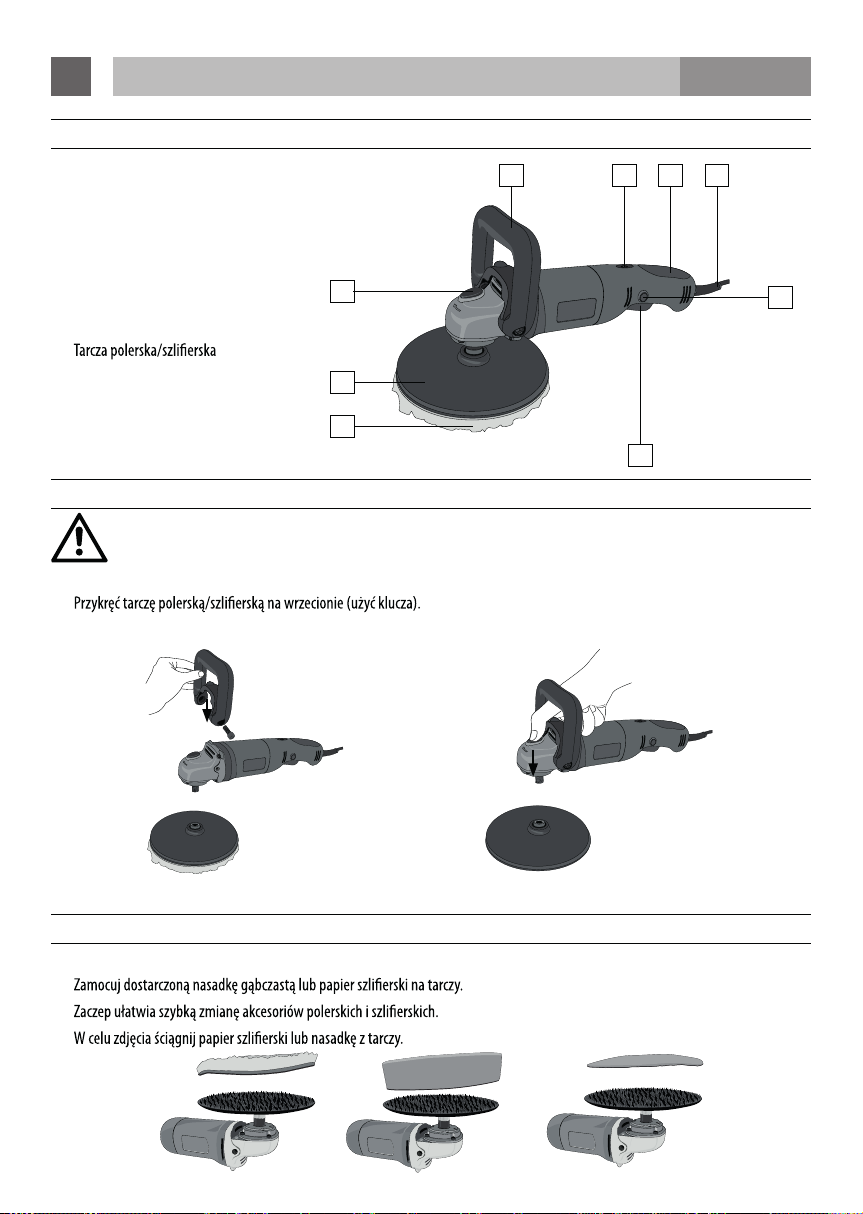
PL
INSTRUKCJA OBSŁUGI
CZĘŚCI
1 Uchwyt czołowy
2 Regulator szybkości
3 Uchwyt tylny
4 Przewód zasilający
5 Przycisk blokady
6 Włącznik zasilania
7 Nakładka wełniana
8
9 Blokada tarczy
9
8
1 2 3
7
MONTAŻ
Uwaga!
Przed montażem wyłącz maszynę i wyjmij wtyczkę z gniazdka.
• Zamocuj uchw yt dwiema śrubami i kluczem do wkrętów z sześciokątnym gniazdkiem (Rys. 1).
•
• Aby tarczę odmontować, wciśnij przycisk jej blokady (Rys. 2).
AB-CPEXPERT
4
5
6
Rys. 1 Rys. 2
ZAMOCUJ TARCZĘ POLERSKĄ I PAPIER SZLIFIERSKI
• Ułóż sprzęt na stole tarczą polerską do góry.
•
•
•
25
Page 26
PL
UTYLIZACJA
Zużyte urządzenia elektryczne podlegają recyklingowi.
Nie wyrzucaj ich ze śmieciami domowymi! Dostarczaj je oddzielnie do punktów zbiórki surowców wtórnych.
Materiał opakowaniowy utylizuj w sposób przyjazny dla środowiska.
Kartony i papier oddawaj do punktu zbiórki makulatury, folię – do punktu zbiórki tworzyw sztucznych.
OBSŁUGA
Włącznik/wyłącznik
Uwaga!
• Przed włączeniem trzymaj maszynę oburącz, prawą ręką na uchwycie czołowym (1), lewą - na tylnym (3).
• Wciśnij włącznik zasilania (6), aby maszynę włączyć lub wyłączyć.
• Użyj przycisku blokady (5) do ustawiania włącznika na tryb ciągły pracy.
• Obracaj regulatorem szybkości (2) w górę lub w dół, aby zwiększać lub zmniejszać szybkość.
INSTRUKCJA OBSŁUGI
Polerowanie
• Użyj nasadki gąbczastej, aby zastosować środek polerski.
• Upewnij się, czy nasadka jest wolna od pozostałości.
• Równo rozmieść środek polerski na nasadce gąbczastej. Nie nakładaj pasty na powierzchnię.
• Nie wywieraj nacisku na maszynę polerską.
• Pozwól maszynie na ślizganie się po powierzchni.
• Do wykończenia polerowania użyj nasadki wełnianej.
• Upewnij się, czy nasadka wełniana jest wolna od pozostałości.
Wskazówki dotyczące optymalnych wyników polerowania
• Myj samochód przynajmniej co dwa tygodnie.
• Myj samochód zawsze od góry do dołu.
• Poleruj samochód dwa lub trzy razy w roku.
• Najpier w poleruj duże i płaskie powierzchnie.
• C zęści trudno dostępne samochodu powinny być polerowane ręcznie, bez użycia polerki.
AB-CPEXPERT
CZYSZCZENIE I KONSERWACJA
Uwaga!
• Przed p
•
• Utrzymywać w czystości wszystkie urządzenia związane z bezpieczeństwem, otwory wentylacyjne silnika i obudowę.
• Obudowę sprzętu można łatwo czyścić nawilżoną ściereczką.
• Nakładkę gąbczastą i wełnianą myć regularnie, tylko ręcznie. Pozostawiać do wyschnięcia na powietrzu.
• Masz ynę przechowywać w oryginalnym opakowaniu.
rzystąpieniem do czyszczenia lub prac konserwacyjnych zawsze odłączać najpierw wtyczkę sieciową od gniazdka.
26
Page 27

PL
INSTRUKCJA OBSŁUGI
UTYLIZACJA
Zużyte urządzenia elektryczne podlegają recyklingowi.
Nie wyrzucaj ich ze śmieciami domowymi! Dostarczaj je oddzielnie do punktów zbiórki surowców wtórnych.
Materiał opakowaniowy utylizuj w sposób przyjazny dla środowiska.
Kartony i papier oddawaj do punktu zbiórki makulatury, folię – do punktu zbiórki tworzyw sztucznych.
AB-CPEXPERT
27
Page 28

MSA INTERNATIONAL SA
Avenue de L’Europe
Pôle Européen de Développement (PED)
L-4802 LAM ADELAINE • LUXEMBOURG
www.absaar.com
 Loading...