

Page 1

PICO-ITX Board
P I C O - HD01
PICO-HD01
AMD G-series Dual Core T40E/
Single Core T40R Processor
Gigabit Ethernet
5 USB 2.0, 2 COM
4-bit Digital I/O
1 Mini Card/ mSATA(Half-size)
1 SATA 3.0Gb/s
PICO-HD01 Manual Rev.A 2nd Ed.
November 2013
Page 2

PICO-ITX Board
P I C O - HD01
Copyright Notice
This document is copyrighted, 2013. All rights are reserved. The
original manufacturer reserves the right to make improvements to
the products described in this manual at any time without notice.
No part of this manual may be reproduced, copied, translated, or
transmitted in any form or by any means without the prior written
permission of the original manufacturer. Information provided in this
manual is intended to be accurate and reliable. However, the
original manufacturer assumes no responsibility for its use, or for
any infringements upon the rights of third parties that may result
from its use.
The material in this document is for product information only and is
subject to change without notice. While reasonable efforts have
been made in the preparation of this document to assure its
accuracy, AAEON assumes no liabilities resulting from errors or
omissions in this document, or from the use of the information
contained herein.
AAEON reserves the right to make changes in the product design
without notice to its users.
i
Page 3

PICO-ITX Board
P I C O - HD01
Acknowledgments
All other products’ name or trademarks are properties of their
respective owners.
AMI is a trademark of American Megatrends Inc.
AMD® is trademark of Advanced Micro Devices.
Microsoft Windows® is a registered trademark of Microsoft
Corp.
ITE is a trademark of Integrated Technology Express, Inc.
IBM, PC/AT, PS/2, and VGA are trademarks of International
Business Machines Corporation.
SoundBlaster is a trademark of Creative Labs, Inc.
Please be notified that all other products’ name or trademarks
not be mentioned above are properties of their respective
owners.
ii
Page 4

PICO-ITX Board
P I C O - HD01
Packing List
Before you begin installing your card, please make sure that
the following materials have been shipped:
1 Heatsink
1 SATA Power Cable
1 Power Cable
1 SATA Cable
1 DVD-ROM for Manual (in PDF Format) and
Drivers
1 PICO-HD01
If any of these items should be missing or damaged, please
contact your distributor or sales representative immediately.
iii
Page 5

PICO-ITX Board
P I C O - HD01
Contents
Chapter 1 General Information
1.1 Introduction ................................................................ 1-2
1.2 Features .................................................................... 1-3
1.3 Specifications ............................................................ 1-4
Chapter 2 Quick Installation Guide
2.1 Safety Precautions .................................................. 2-2
2.2 Location of Connectors and Jumpers ...................... 2-3
2.3 Mechanical Drawing ................................................ 2-5
2.4 List of Jumpers ........................................................ 2-7
2.5 List of Connectors ..................................................... 2-8
2.6 Setting Jumpers ....................................................... 2-9
2.7 COM2 RI/+5/+12V Selection (JP1) ......................... 2-10
2.8 Clear CMOS Selection (JP2) .................................. 2-10
2.9 LVDS Backlight Inverter VCC Selection (JP3) ........ 2-10
2.10 LVDS Operating Voltage Selection (JP4) ............. 2-11
2.11 LVDS Backlight Lightness Control Mode Selection
(JP5) .............................................................................. 2-11
2.12 AT/ATX Power Supply Mode Selection (JP6) ....... 2-11
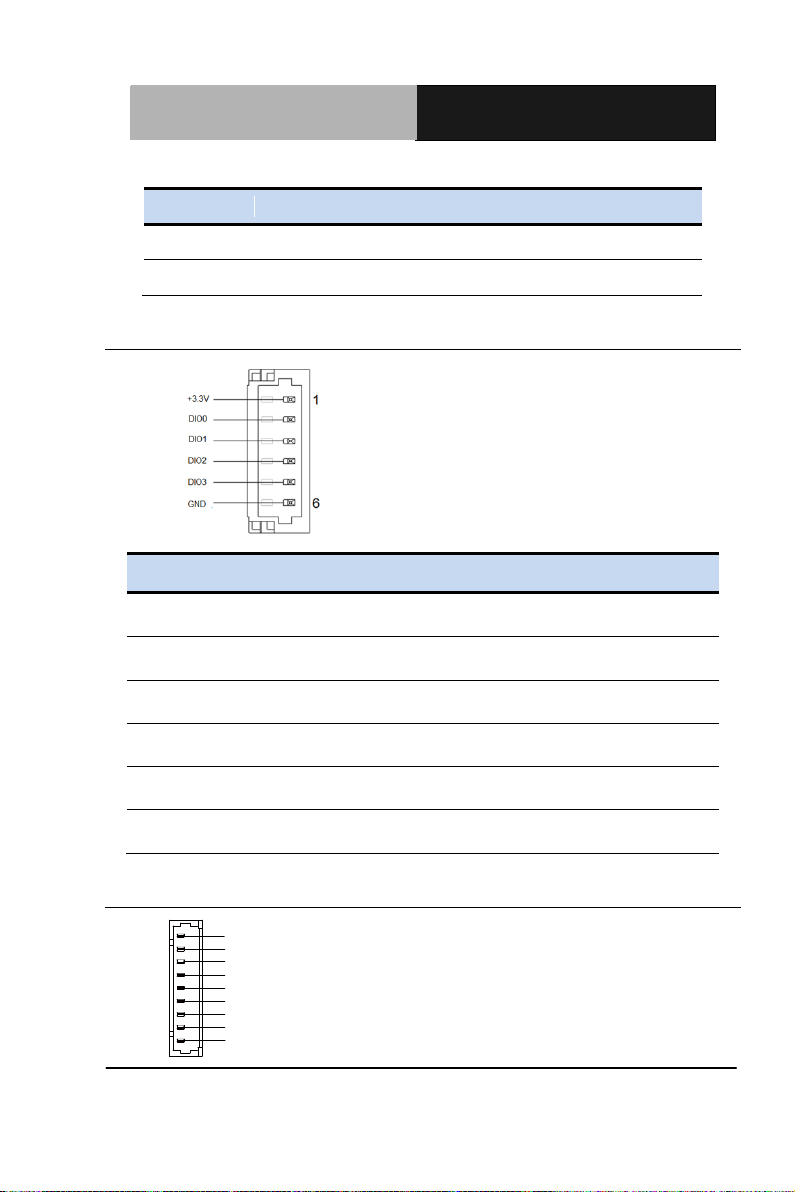
2.13 Digital IO Port Connector (CN1) ............................ 2-12
2.14 COM Port 1 Connector (CN2) ............................... 2-12
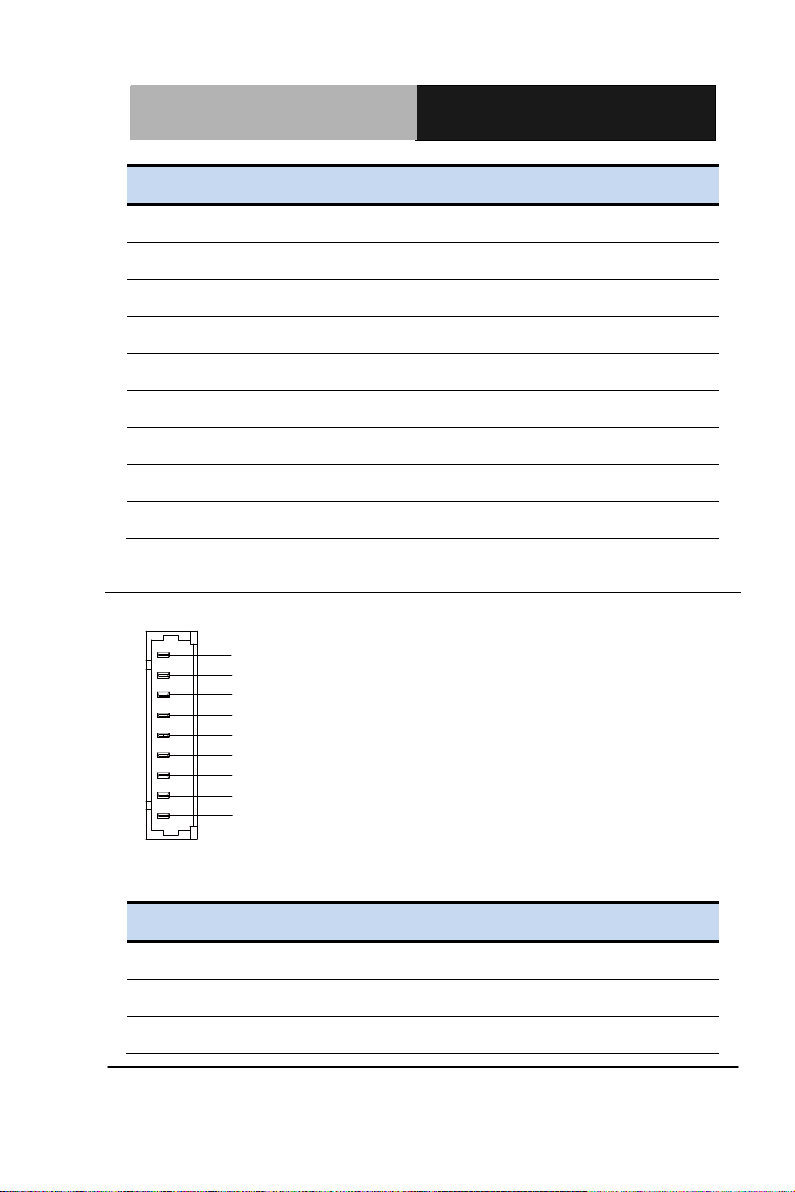
2.15 COM Port 2 Connector (CN3) ............................... 2-13
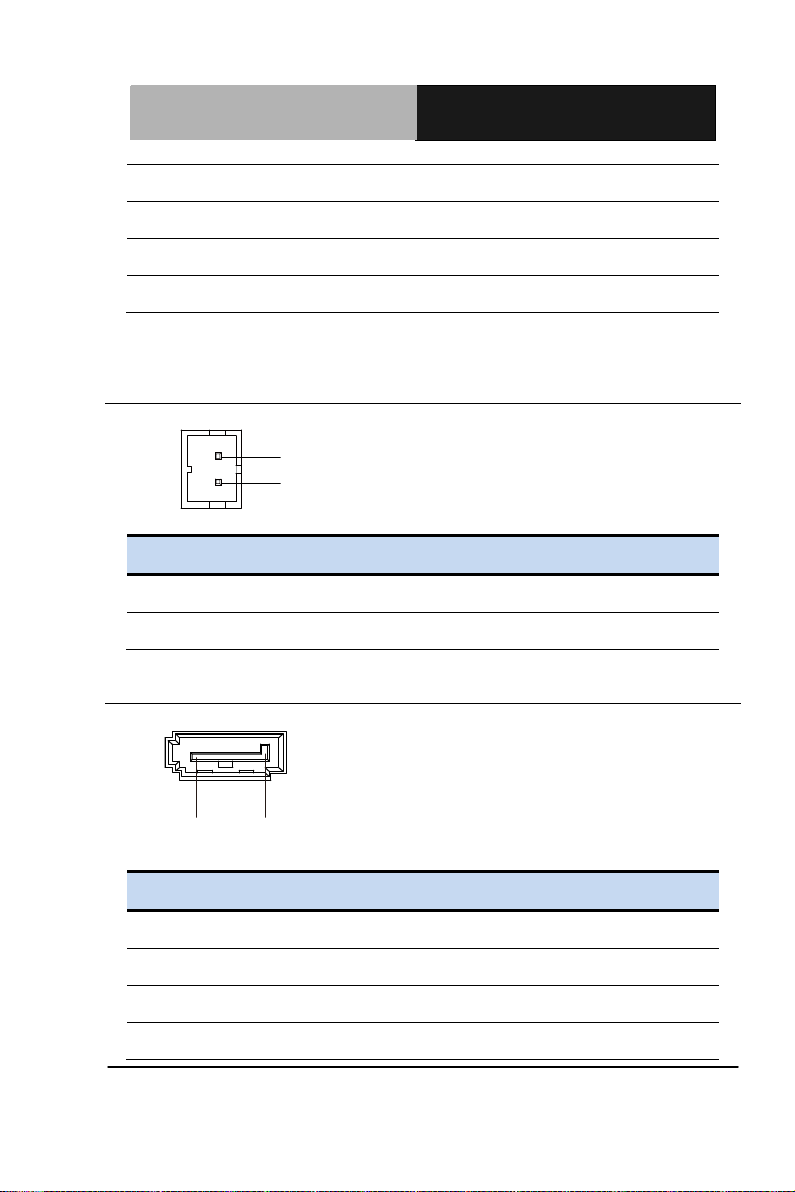
2.16 +5V Output For SATA HDD Connector (CN4) ...... 2-15
2.17 SATA Port Connector (CN5) ................................. 2-15
iv
Page 6

PICO-ITX Board
P I C O - HD01
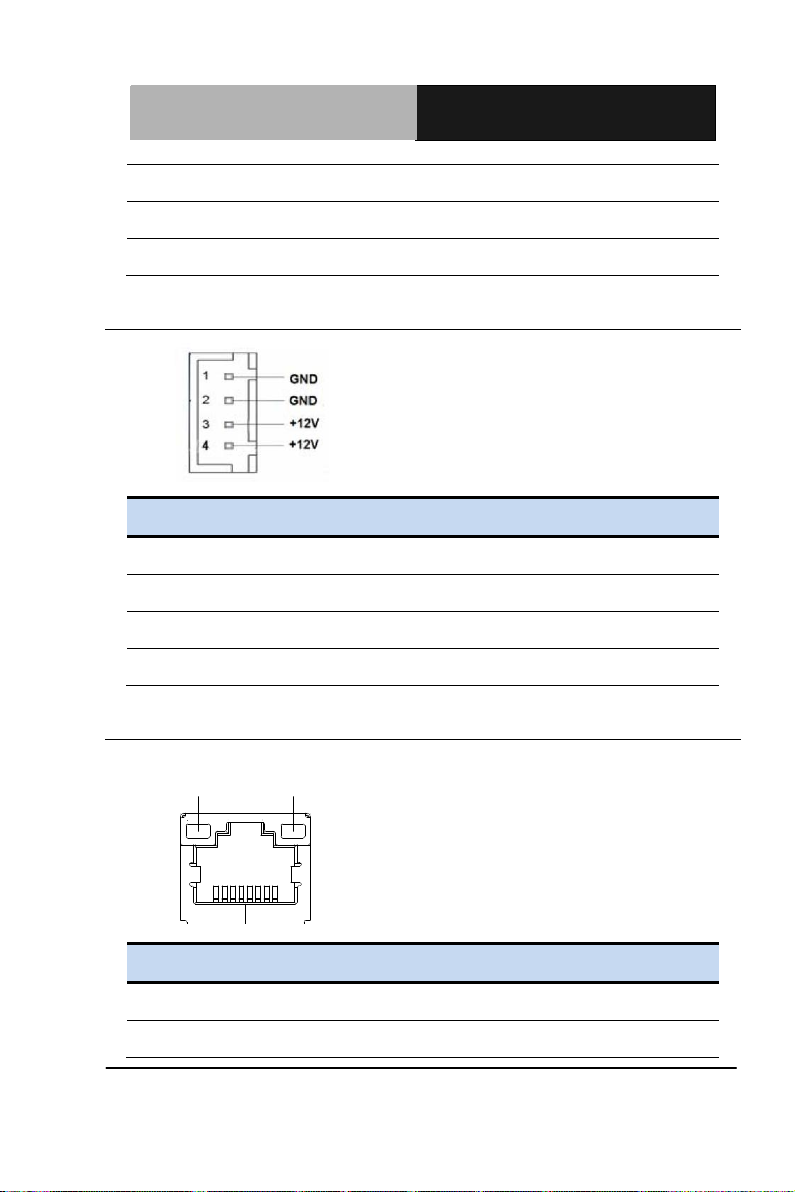
2.18 External +12V Input Connector (CN6) .................. 2-16
2.19 Realtek LAN (RJ-45) Port Connector (CN7) ......... 2-16
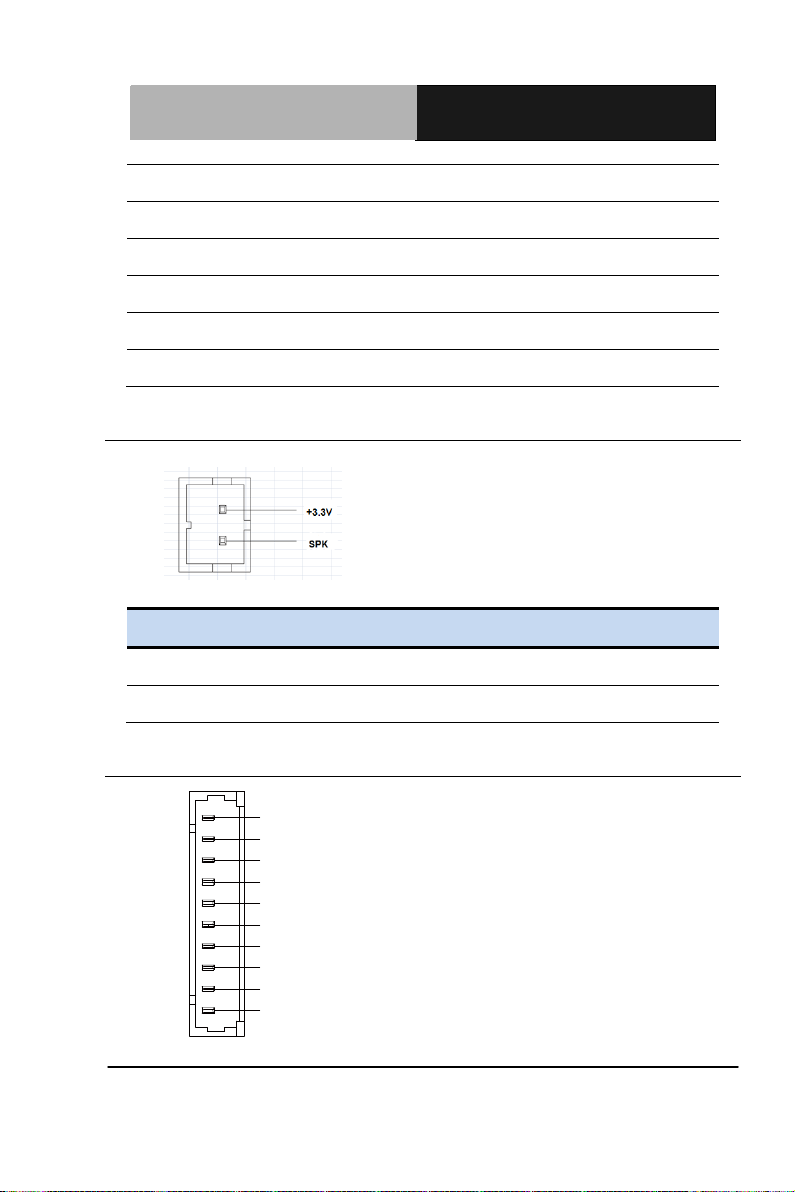
2.20 Buzzer Connector (CN8) ....................................... 2-17
2.21 Audio Line In/Out and MIC Connector (CN9)........ 2-17
2.22 LPC Port Connector (CN10) .................................. 2-18
2.23 USB 2.0 Ports 5 Connector (CN11) ...................... 2-19
2.24 VGA Port Connector (CN12) ................................. 2-20
2.25 USB 2.0 Port 3 Connector (CN13) ........................ 2-21
2.26 USB 2.0 Port 4 Connector (CN14) ........................ 2-21
2.27 18-bits LVDS Output Connector (CN15) ............... 2-22
2.28 USB Port 1 and Port 2 Connector (CN16) ............ 2-23
2.29 HDMI Type C Connector (CN17) .......................... 2-24
2.30 LVDS Port Inverter / Backlight Connector (CN18) 2-25
2.31 Front Panel Connector (CN19) ............................. 2-25
2.32 DDR3 SODIMM Slot (DIMM1) .............................. 2-26
2.33 Mini Card Slot (PCIE1) .......................................... 2-26
Chapter 3 AMI BIOS Setup
3.1 System Test and Initialization. .................................. 3-2
3.2 AMI BIOS Setup ........................................................ 3-3
Chapter 4 Driver Installation
4.1 Installation……………………………………………..4-3
Appendix A Programming The Watchdog Timer
A.1 Watchdog Timer Registers .................................... A-2
A.2 Watchdog Sample Program ................................... A-3
v
Page 7

PICO-ITX Board
P I C O - HD01
Appendix B I/O Information
B.1 I/O Address Map .................................................... B-2
B.2 Memory Address Map ............................................ B-4
B.3 IRQ Mapping Chart ................................................ B-5
B.4 DMA Channel Assignments.……………………… . B-5
Appendix C Mating Connector
C.1 List of Mating Connectors and Cables.................. C-2
Appendix D AHCI Setting
D.1 Setting AHCI ......................................................... D-2
Appendix E Electrical Specifications for I/O Ports
E.1 Electrical Specifications for I/O Ports ..................... E-2
E.2 DIO Programming .................................................. E-3
E.3 Digital I/O Register ................................................. E-4
E.4 Digital I/O Sample Program ................................... E-5
vi
Page 8

PICO-ITX Board PICO-HD01
Chapter
1
General
Information
Chapter 1 General Information 1- 1
Page 9

PICO-ITX Board PICO-HD01
1.1 Introduction
The PICO-HD01 is the embedded board with PICO-ITX form
factor AAEON developed. It supports AMD G-series T40R/
T40E processor up to 1.0 GHz. Moreover, it equips AMD
A50M chipset offers a high performance computing platform
with low power consumption. This new product supports
DDR3 SODIMM at speeds of 1066 MHz, up to 4 GB.
One SATA 3.0Gb/s and one mSATA interfaces provide ample
storages. With one Gigabit Ethernet, two COM ports, and five
USB2.0, the PICO-HD01 meets the requirements of today’s
demanding applications.
Display requirements are met with an abundance of interfaces
such as VGA, HDMI, and LVDS. In addition, the PICO-HD01
supports 18-bit Single Channel LVDS with PWM function.
With all of its integrated features, the PICO-HD01 strikes a
balance of performance and price. This versatile product t arget s
Industrial Automation, Entertainment, Networking, KIOSK/POS,
Transportatio n, Banking, Healthcare a nd Digital Signage
applications that require high performance and high reliability.
Chapter 1 General Information 1-2
Page 10

PICO-ITX Board PICO-HD01
1.2 Features
Onboard AMD G-Series T40R/T40E Single/Dua
Processor
AMD G-Series APU +A50M
204-pin SODIMM DDR3 1066MHz up to 4GB
One Reatek RTL-8111E for 10/1000/1000Base-TX
CRT, 18-bit Single Channel LVDS, HDMI
HD Audio for Line-in/out & MIC
SATA 3.0Gb/s x 1, mSATA (Half-Size) Slot x 1 Co-lay with
Mini Card
USB 2.0 x 5, COM x 2, 4-bit Digital I/O
Expansion : Mini Card x 1
DC 12V Operating
Supports Mini HDMI Connector on Rear I/O
Chapter 1 General Information
1-3
Page 11

PICO-ITX Board PICO-HD01
1.3 Specifications
System
From Factor
PICO-ITX
Processor
System Memory
Chipset
I/O Chipset
Ethernet
BIOS
Wake On LAN
Watchdog Timer
H/W Status
Monitoring
Expansion Interface
Battery
Power Requirement
Board Size
AMD G-series T40E/ T40R
processor up to 1.0 GHz
204-pin SODIMM DDR3 1066
MHz, up to 4 GB
AMD G-series + A50M
Fintek F81801U-I
Realtek RTL-8111E,
10/100/1000Base-TX, RJ-45 x 1
AMI BIOS-32 Mb ROM
Yes
Programmable 255 levels system
reset
Vcore, +1.5V_DDR
mSATA/ Mini Card (Half-size) x 1
Lithium Battery
DC 12V, AT/ATX (Default)
3.94" x 2.76" (100mm x 72mm)
Gross Weight
Operating
Temperature
Storage Temperature
Operating Humidity
Chapter 1 General Information 1-4
1.7 lb (0.77 Kg)
32°F~140°F (0°C~60°C)
-40°F~176°F (-40°C~80°C)
0% ~ 90% relative humidity,
non-condensing
Page 12

PICO-ITX Board PICO-HD01
Display: Supports CRT/LCD, HDMI/DVI/LCD simultaneous /
iew displays
dual v
Chipset
AMD G-series Processor
integrated
Resolution
LCD Interface
I/O: Fintek F81801U-I
Storage
Serial Port
USB
Digital I/O
Audio
Up to 1366 x 768 (18-bit) @ 60 Hz
for LVDS;
Up to 1920 x 1200 @ 60 Hz for
CRT and HDMI
18-bit single channel LVDS with
PWM function
SATA 3.0Gb/s x 1 , mSATA x 1
co-lay with Mini Card
RS-232 x 1
RS-232/422/485 x 1
USB2.0 x 5
4-bit Programmable (2-in/ 2-out)
Buzzer x 1, HD Audio Codec
(Realtek ALC662) fo r Line-in/out &
MIC x 1
Chapter 1 General Information
1-5
Page 13

PICO-ITX Board
P I C O - H D 0 1
Chapter
2
Quick
Installation
Guide
Chapter 2 Quick Installation Guide 2-1
Page 14
PICO-ITX Board
P I C O - H D 0 1
Always completely disconnect the power cord
from your board whenever you are working on
it. Do not make connections while the power is
on, because a sudden rush of power can
damage sensitive electronic components.
Always ground yourself to remove any static
charge before touching the board. Modern
electronic devices are very sensitive to static
electric charges. Use a grounding wrist strap at
all times. Place all electronic components on a
static-dissipative surface or in a static-shielded
bag when they are not in the chassis
2.1 Safety Precautions
Chapter 2 Quick Installation Guide 2-2
Page 15
PICO-ITX Board
P I C O - H D 0 1
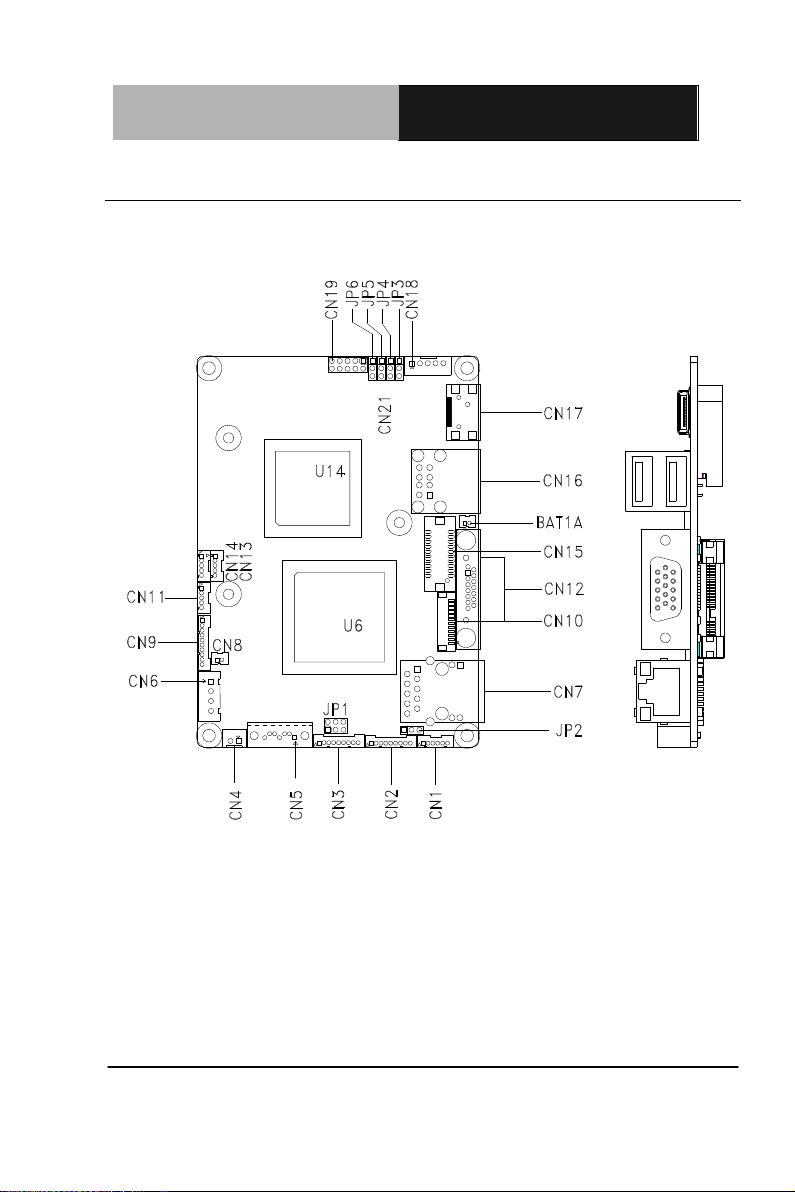
2.2 Location of Connectors and Jumpers
Component Side
Chapter 2 Quick Installation Guide 2-3
Page 16
PICO-ITX Board
P I C O - H D 0 1
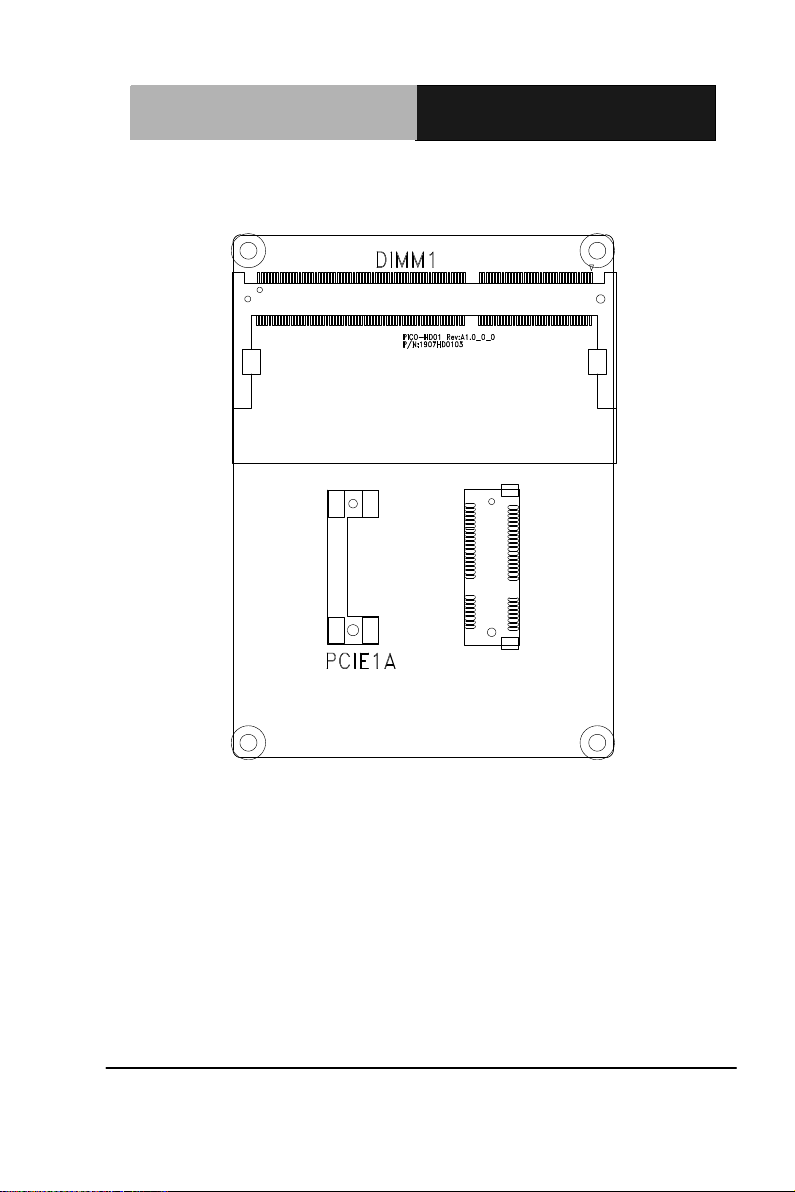
Solder Side
Chapter 2 Quick Installation Guide 2-4
Page 17
PICO-ITX Board
P I C O - H D 0 1
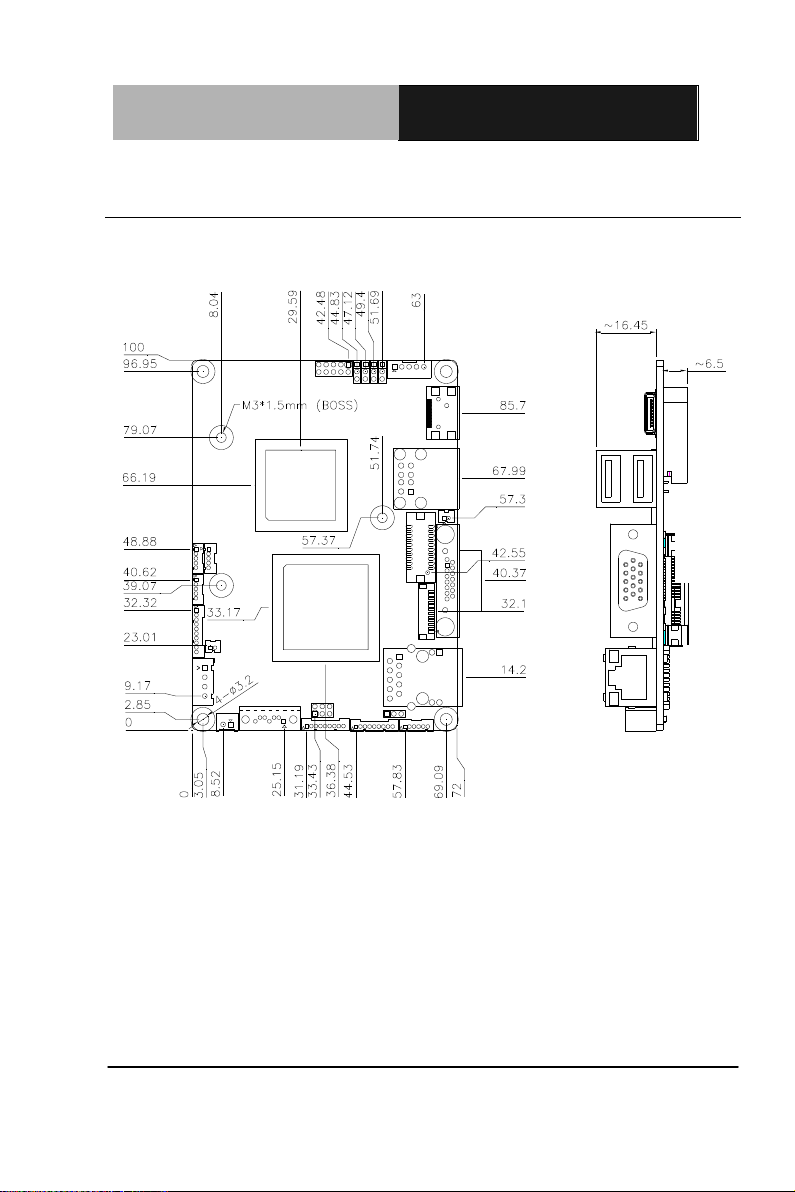
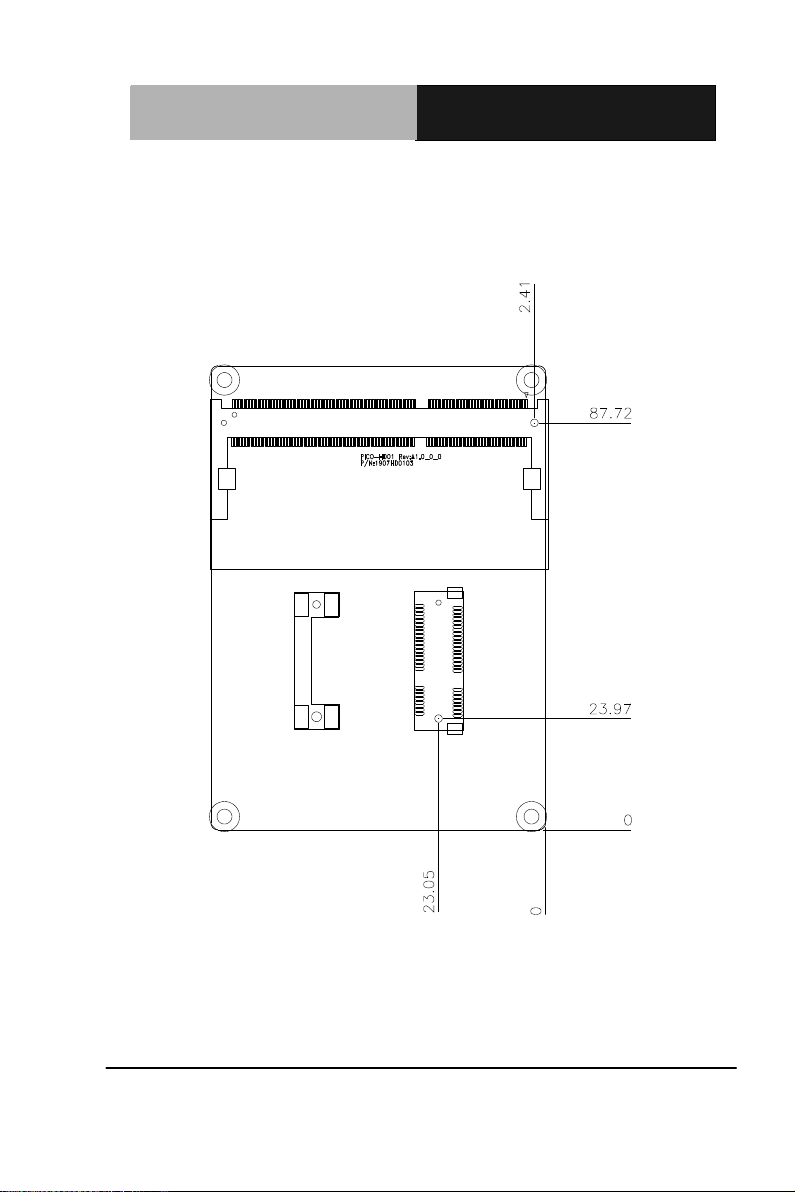
2.3 Mechanical Drawing
Component Side
Chapter 2 Quick Installation Guide 2-5
Page 18
PICO-ITX Board
P I C O - H D 0 1
Solder Side
Chapter 2 Quick Installation Guide 2-6
Page 19

PICO-ITX Board
P I C O - H D 0 1
Label
Function
JP1
COM2 RI/+5/+12V Selection
JP2
Clear CMOS
JP3
LVDS Inverter/ Backlight Voltage Selection
JP4
LVDS Operating Voltage Selection
JP5
LVDS Backlight Lightness Control Mode Selection
JP6
AT/ATX Power Supply Mode Selection
2.4 List of Jumpers
The board has a number of jumpers that allow you to configure your
system to suit your application.
The table below shows the function of each of the board's jumpers:
Chapter 2 Quick Installation Guide 2-7
Page 20

PICO-ITX Board
P I C O - H D 0 1
Label
0B0BFunction
CN1
Digital I/O Connector
CN2
COM Port #1
CN3
COM Port #2
CN4
+5V Output For SATA HDD
CN5
SATA Port
CN6
External 12V Input
CN7
RJ-45 Ethernet
CN8
Buzzer
CN9
Audio Line In/Out and MIC Connector
CN10
LPC Expansion I/F
CN11
USB Port #5
CN12
Analog CRT Display Connector
CN13
USB Port #3
CN14
USB Port #4
CN15
18-bit LVDS Output
CN16
USB Port 1 & 2
CN17
HDMI TYPE C
CN18
LVDS Inverter/ Backlight Connector
CN19
Front Panel
2.5 List of Connectors
The board has a number of connectors that allow you to configure your
system to suit your application. The table below shows the function of
each board's connectors:
Chapter 2 Quick Installation Guide 2-8
Page 21
PICO-ITX Board
P I C O - H D 0 1
1
2
3
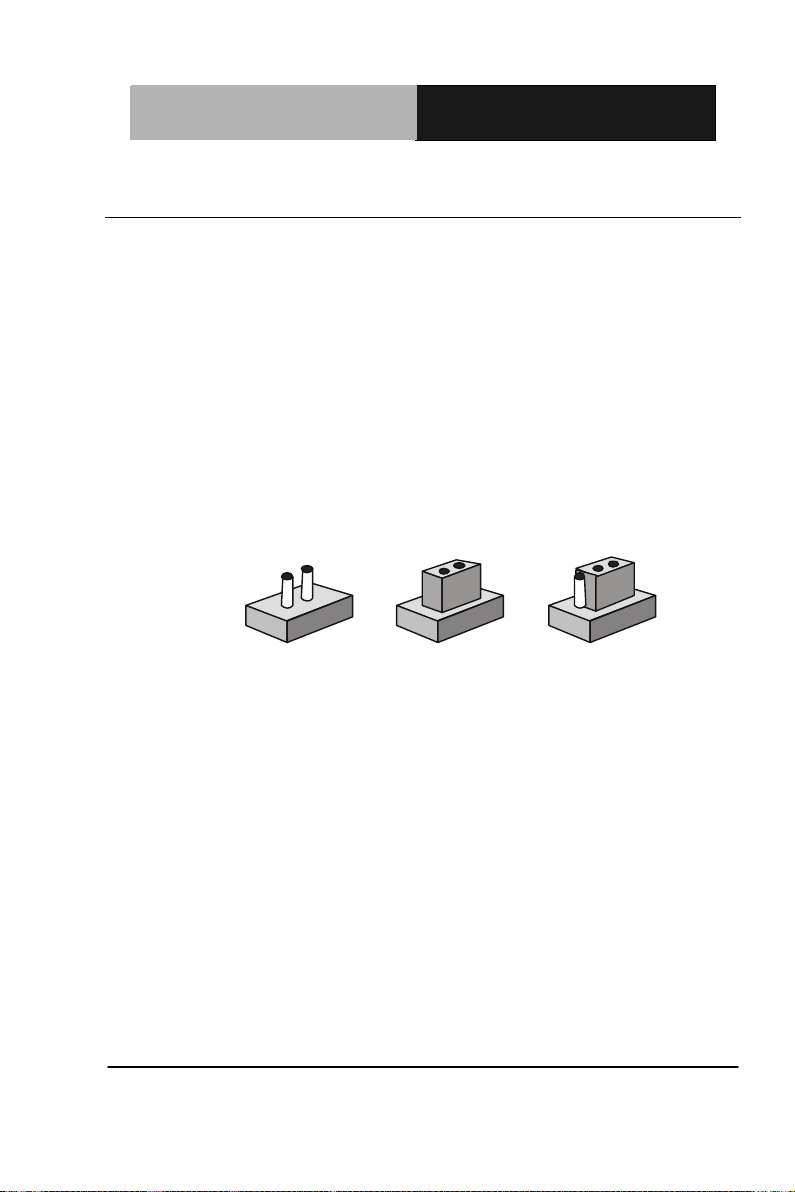
Open Closed Closed 2-3
2.6 Setting Jumpers
You configure your card to match the needs of your application by
setting jumpers. A jumper is the simplest kind of electric switch. It
consists of two metal pins and a small metal clip (often protected by a
plastic cover) that slides over the pins to connect them. To “close” a
jumper you connect the pins with the clip.
To “open” a jumper you remove the clip. Sometimes a jumper will have
three pins, labeled 1, 2 and 3. In this case you would connect either
pins 1 and 2 or 2 and 3.
A pair of needle-nose pliers may be helpful when working with jumpers.
If you have any doubts about the best hardware configuration for your
application, contact your local distributor or sales representative before
you make any change.
Generally, you simply need a standard cable to make most
connections.
Chapter 2 Quick Installation Guide 2-9
Page 22
PICO-ITX Board
P I C O - H D 0 1
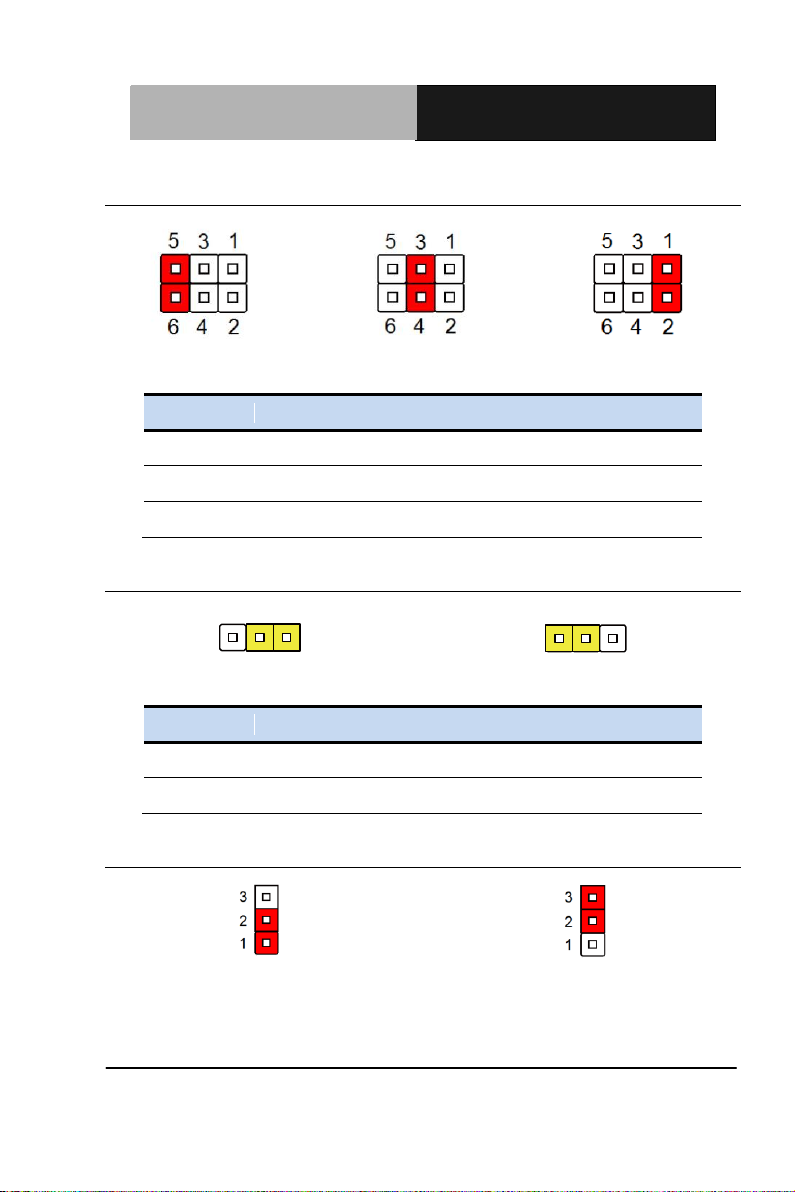
+5V
Ring (Default)
+12V
JP1
1B1BFunction
1-2
+12V
3-4
Ring (Default)
5-6
+5V
3 2 1
1 2 3
Normal (Default)
3 2 1
1 2 3
Clear CMOS
JP2
2B2BFunction
1-2
Normal (Default)
2-3
Clear CMOS
+12V
+5V (Default)
2.7 COM2 RI/+5/+12V Selection (JP1)
2.8 Clear CMOS Selection (JP2)
2.9 LVDS Backlight Inverter VCC Selection (JP3)
Chapter 2 Quick Installation Guide 2-10
Page 23
PICO-ITX Board
P I C O - H D 0 1
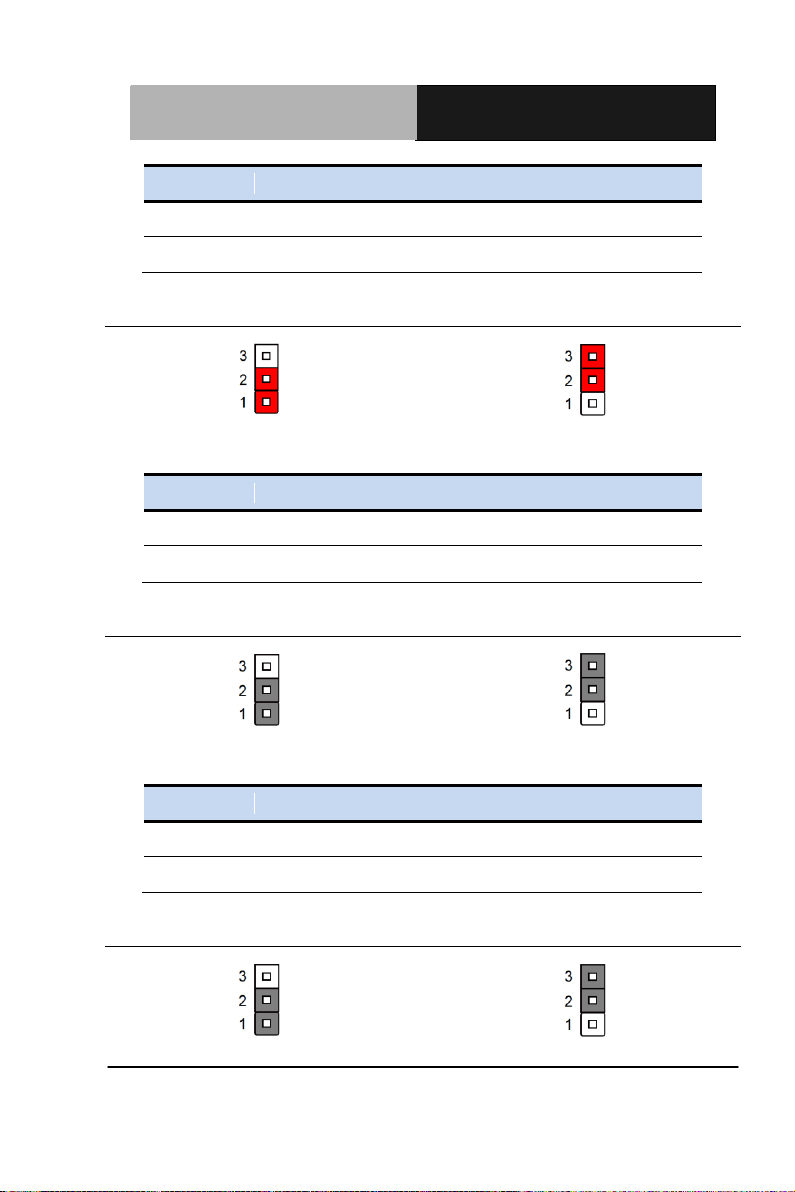
JP3
3B3BFunction
1-2
+12V
2-3
+5V (Default)
+5V
+3.3V (Default)
JP4
4B4BFunction
1-2
+5V
2-3
+3.3V (Default)
VR Mode
PWM Mode (Default)
JP5
5B5BFunction
1-2
VR Mode
2-3
PWM Mode (Default)
AT Mode
ATX Mode (Default)
2.10 LVDS Operating Voltage Selection (JP4)
2.11 LVDS Backlight Lightness Control Mode Selection (JP5)
2.12 AT/ATX Power Supply Mode Selection (JP6)
Chapter 2 Quick Installation Guide 2-11
Page 24
PICO-ITX Board
P I C O - H D 0 1
JP6
6B6BFunction
1-2
AT Mode
2-3
ATX Mod (Default)
Pin
Pin Name
Signal Type
Signal Level
1
+3.3V
PWR
+3.3V
2
DIO0
I/O
+3.3V
3
DIO1
I/O
+3.3V
4
DIO2
I/O
+3.3V 5 DIO3
I/O
+3.3V 6 GND
GND
GND
DCD
DSR
RX
RTS
TX
CTS
DTR
RI
GND
2.13 Digital IO Port Connector (CN1)
2.14 COM Port 1 Connector (CN2)
Chapter 2 Quick Installation Guide 2-12
Page 25
PICO-ITX Board
P I C O - H D 0 1
1
2
3
4
5
6
7
8
9
Pin
Pin Name
Signal Type
Signal Level
1
DCDA
IN
2 DSRA
IN
3 RXA
IN
4 RTSA
OUT
±9V 5 TXA
OUT
±9V 6 CTSA
IN
7 DTRA
OUT
±9V 8 RIA
IN
9 GND
GND
Pin
Pin Name
Signal Type
Signal Level
1
DCDB
IN
2 DSRB
IN
3 RXB
IN
2.15 COM Port 2 Connector (CN3)
RS-232
Chapter 2 Quick Installation Guide 2-13
Page 26

PICO-ITX Board
P I C O - H D 0 1
4
RTSB
OUT
±9V 5 TXB
OUT
±9V 6 CTSB
IN
7 DTRB
OUT
±9V
8
RI/+5V/+12V
IN/ PWR
+5V/+12V 9 GND
GND
Pin
Pin Name
Signal Type
Signal Level
1
RS422_TX-
OUT
±5V 2 NC
3 RS422_TX+
OUT
±5V 4 NC
5 RS422_RX+
IN
6 NC
7 RS422_RX-
IN
8 NC/+5V/+12V
PWR
+5V/+12V 9 GND
GND
Pin
Pin Name
Signal Type
Signal Level
1
RS485_D-
I/O
±5V
2
NC
3
RS485_D+
I/O
±5V 4 NC
5 NC
RS-422
RS-485
Chapter 2 Quick Installation Guide 2-14
Page 27
PICO-ITX Board
P I C O - H D 0 1
6
NC
7 NC
8 NC/+5V/+12V
PWR
+5V/+12V 9 GND
GND
+5V
GND
Pin
Pin Name
Signal Type
Signal Level
1
+5V
PWR
+5V 2 GND
GND
GND
Pin 1 Pin 7
Pin
Pin Name
Signal Type
Signal Level
1
GND
GND
2
SATA_TX+
DIFF
3 SATA_TX-
DIFF
4 GND
GND
Note 1: COM2 RS-232/422/485 can be set by BIOS setting. Default is RS-232.
Note 2: Pin 8 function can be set by JP1.
2.16 +5V Output For SATA HDD Connector (CN4)
2.17 SATA Port Connector (CN5)
Chapter 2 Quick Installation Guide 2-15
Page 28
PICO-ITX Board
P I C O - H D 0 1
5
SATA_RX-
DIFF
6 SATA_RX+
DIFF
7 GND
GND
Pin
Pin Name
Signal Type
Signal Level
1
GND
GND
GND 2 GND
GND
GND
3
+12V
PWR
+12V
4
+12V
PWR
+12V
1
ACT/LINK
LED
SPEED
LED
8
Pin
Pin Name
Signal Type
Signal Level
1
MDI0+
DIFF
2 MDI0-
DIFF
2.18 External +12V Input Connector (CN6)
2.19 Realtek LAN (RJ-45) Port Connector (CN7)
Chapter 2 Quick Installation Guide 2-16
Page 29
PICO-ITX Board
P I C O - H D 0 1
3
MDI1+
DIFF
4 MDI2+
DIFF
5 MDI2-
DIFF
6 MDI1-
DIFF
7 MDI3+
DIFF
8 MDI3-
DIFF
Pin
Pin Name
Signal Type
Signal Level
1
+3.3V
PWR
+3.3V 2 SPK
OUT
MIC_L1
10
MIC_R
LINE_L_IN
LINE_R_IN
LEFT_OUT
RIGHT_OUT
+5V_AUDIO
GND_AUDIO
GND_AUDIO
GND_AUDIO
2.20 Buzzer Connector (CN8)
2.21 Audio Line In/Out and MIC Connector (CN9)
Chapter 2 Quick Installation Guide 2-17
Page 30

PICO-ITX Board
P I C O - H D 0 1
LAD0 1
12
LAD1
LAD2
LAD3
LFRAME#
LRESET#
LDRQ0
LDRQ1
SERIRQ
GND
LCLK
+3.3V
Pin
Pin Name
Signal Type
Signal Level
1
MIC_L
IN
2 MIC_R
IN
3 GND_AUDIO
GND
4 LINE_L_IN
IN
5 LINE_R_IN
IN
6 GND_AUDIO
GND
7 LEFT_OUT
OUT
8 GND_AUDIO
GND
9 RIGHT_OUT
OUT
10
+5V_AUDIO
PWR
+5V
Pin
Pin Name
Signal Type
Signal Level
1
LAD0
I/O
+3.3V
2
LAD1
I/O
+3.3V
3
LAD2
I/O
+3.3V
2.22 LPC Port Connector (CN10)
Chapter 2 Quick Installation Guide 2-18
Page 31

PICO-ITX Board
P I C O - H D 0 1
4
LAD3
I/O
+3.3V 5 +3.3V
PWR
+3.3V
6
LFRAME#
IN
7 LRESET#
OUT
+3.3V 8 GND
GND
9 LCLK
OUT
10
LDRQ0
IN
11
LDRQ1
IN
12
SERIRQ
I/O
+3.3V
Pin
Pin Name
Signal Type
Signal Level
1
+5VSB
PWR
+5V 2 USB4_D-
DIFF
3
USB4_D+
DIFF
4
GND
GND
5
GND
GND
2.23 USB 2.0 Ports 5 Connector (CN11)
Chapter 2 Quick Installation Guide 2-19
Page 32

PICO-ITX Board
P I C O - H D 0 1
Pin
Pin Name
Signal Type
Signal Level
1
RED
OUT
2
GREEN
OUT
3 BLUE
OUT
4 NC
5 GND
GND
6
RED_GND_RTN
GND
7
GREEN_GND_RTN
GND
8
BLUE_GND_RTN
GND
9 +5V
PWR
+5V
10
CRT_PLUG#
GND
+5V
11
NC
12
DDC_DATA
I/O
+5V
13
HSYNC
OUT
14
VSYNC
OUT
15
DDC_CLK
I/O
+5V
2.24 VGA Port Connector (CN12)
Chapter 2 Quick Installation Guide 2-20
Page 33

PICO-ITX Board
P I C O - H D 0 1
Pin
Pin Name
Signal Type
Signal Level
1
+5V
PWR
+5V
2
USB3_D-
DIFF
3 USB3_D+
DIFF
4 GND
GND
5 GND
GND
Pin
Pin Name
Signal Type
Signal Level
1
+5V
PWR
+5V 2 USB4_D-
DIFF
3 USB4_D+
DIFF
2.25 USB 2.0 Port 3 Connector (CN13)
2.26 USB 2.0 Port 4 Connector (CN14)
Chapter 2 Quick Installation Guide 2-21
Page 34

PICO-ITX Board
P I C O - H D 0 1
4
GND
GND
5 GND
GND
Pin
Pin Name
Signal Type
Signal Level
1
BKL_ENABLE
OUT
2
BKL_CONTROL
OUT
3
LCD_PWR
+3.3V/+5V
4
LCD_PWR
PWR
+3.3V/+5V
5
LVDS_A_CLK-
DIFF
6 LVDS_DA2+
DIFF
7
LVDS_A_CLK+
DIFF
8 LVDS_DA2-
DIFF
9 LCD_PWR
DIFF
+3.3V/+5V
10
GND
GND
11
LVDS_DA0+
DIFF
12
LVDS_DA3+
DIFF
13
LVDS_DA0-
DIFF
2.27 18-bits LVDS Output Connector (CN15)
Chapter 2 Quick Installation Guide 2-22
Page 35

PICO-ITX Board
P I C O - H D 0 1
14
LVDS_DA3-
DIFF
15
GND
GND
16
GND
GND
17
LVDS_DA1+
DIFF
18
DDC_DATA
I/O
+3.3V
19
LVDS_DA1-
DIFF
20
DDC_CLK
I/O
+3.3V
Pin
Pin Name
Signal Type
Signal Level
1
+5VSB
PWR
+5V 2 USB1_D-
DIFF
3 USB1_D+
DIFF
4
GND
GND
5
+5VSB
PWR
+5V
6
USB2_D-
DIFF
7 USB2_D+
DIFF
2.28 USB Port 1 and Port 2 Connector (CN16)
Chapter 2 Quick Installation Guide 2-23
Page 36

PICO-ITX Board
P I C O - H D 0 1
8
GND
GND
Pin
Pin Name
Signal Type
Signal Level
1
GND
GND
2 HDMI_TX2+
DIFF
3 HDMI_TX2-
DIFF
4 GND
GND
5
HDMI_TX1+
DIFF
6
HDMI_TX1-
DIFF
7 GND
GND
8 HDMI_TX0+
DIFF
9 HDMI_TX0-
DIFF
10
GND
GND
11
HDMI_CLK+
DIFF
12
HDMI_CLK-
DIFF
13
GND
GND
14
NC
NC
15
HDMI_DDC_CLK
I/O
+5V
16
HDMI_DDC_DATA
I/O
+5V
2.29 HDMI Type C Connector (CN17)
Chapter 2 Quick Installation Guide 2-24
Page 37

PICO-ITX Board
P I C O - H D 0 1
17
NC
NC
18
DPD_HPD
IN
19
DPD_PWR
PWR
+5V
BLK_PWR
2
3
4
5
1
BKL_CONTROL
GND
GND
BKL_ENABLE
Pin
Pin Name
Signal Type
Signal Level
1
BKL_PWR
PWR
+5V / +12V
2
BKL_CONTROL
OUT
3
GND
GND
4
GND
GND
5 BKL_ENABLE
OUT
+5V
Pin
Pin Name
Signal Type
Signal Level
1
PWR_BTN-
2 PWR_BTN+
2.30 LVDS Port Inverter / Backlight Connector (CN18)
2.31 Front Panel Connector (CN19)
Chapter 2 Quick Installation Guide 2-25
Page 38

PICO-ITX Board
P I C O - H D 0 1
3
HDD_LED-
4 HDD_LED+
5 SPEAKER-
6 SPEAKER+
7 PWR_LED-
8 PWR_LED+
9 H/W RESET-
10
H/W RESET+
Pin
Pin Name
Signal Type
Signal Level
1
PCIE_WAKE#
IN
2 +3.3VSB
PWR
+3.3V 3 NC
4 GND
GND
5 NC
6 +1.5V
PWR
+1.5V
7
PCIE_CLK_REQ#
IN
8 UIM_PWR
PWR
9
GND
GND
10
UIM_DATA
I/O
2.32 DDR3 SODIMM Slot (DIMM1)
Standard Specification
2.33 Mini Card Slot (PCIE1)
Chapter 2 Quick Installation Guide 2-26
Page 39

PICO-ITX Board
P I C O - H D 0 1
11
PCIE_REF_CLK-
DIFF
12
UIM_CLK
IN
13
PCIE_REF_CLK+
DIFF
14
UIM_RST
IN
15
GND
GND
16
UIM_VPP
PWR
17
NC
18
GND
GND
19
NC
20
W_DISABLE#
OUT
+3.3V
21
GND
GND
22
PCIE_RST#
OUT
+3.3V
23
PCIE_RX-
DIFF
24
+3.3VSB
PWR
+3.3V
25
PCIE_RX+
DIFF
26
GND
GND
27
GND
GND
28
+1.5V
PWR
+1.5V
29
GND
GND
30
SMB_CLK
I/O
+3.3V
31
PCIE_TX-
DIFF
32
SMB_DATA
I/O
+3.3V
33
PCIE_TX+
DIFF
34
GND
GND
Chapter 2 Quick Installation Guide 2-27
Page 40

PICO-ITX Board
P I C O - H D 0 1
35
GND
GND
36
USB_D-
DIFF
37
GND
GND
38
USB_D+
DIFF
39
+3.3VSB
PWR
+3.3V
40
GND
GND
41
+3.3VSB
PWR
+3.3V
42
NC
43
GND
GND
44
NC
45
NC
46
NC
47
NC
48
+1.5V
PWR
+1.5V
49
NC
50
GND
GND
51
NC
52
+3.3VSB
PWR
+3.3V
Chapter 2 Quick Installation Guide 2-28
Page 41

PICO-ITX Board
P I C O - H D 0 1
部件名称
有毒有害物质或元素
铅
(Pb)
汞
(Hg) 镉 (Cd)
六价铬
(Cr(VI))
多溴联苯
(PBB)
多溴二苯醚
(PBDE)
印刷电路板
及其电子组件
× ○ ○ ○ ○
○
外部信号
连接器及线材
× ○ ○ ○ ○
○
O:表示该有毒有害物质在该部件所有均质材料中的含量均在
SJ/T 11363-2006 标准规定的限量要求以下。
X:表示该有毒有害物质至少在该部件的某一均质材料中的含量超出
SJ/T 11363-2006 标准规定的限量要求。
备注:此产品所标示之环保使用期限,系指在一般正常使用状况下。
Below Table for China RoHS Requirements
产品中有毒有害物质或元素名称及含量
AAEON Main Board/ Daughter Board/ Backplane
Chapter 2 Quick Installation Guide 2-29
Page 42

PICO-ITX Board PICO-HD01
Chapter
3
AMI
BIOS Setup
Chapter 3 AMI BIOS Setup 3-1
Page 43

PICO-ITX Board PICO-HD01
3.1 System Test and Initialization
These routines test and initialize board hardware. If the routines
encounter an error during the tests, you will either hear a few short
beeps or see an error message on the screen. There are two kinds
of errors: fatal and non-fatal. The system can usually continue the
boot up sequence with non-fatal errors.
System configuration verification
These routines check the current system configuration stored in the
CMOS memory and BIOS NVRAM. If system configuration is not
found or system configuration data error is detected, system will
load optimized default and re-boot with this default system
configuration automatically.
There are four situations in which you will need to setup system
configuration:
1. You are starting your system for the first time
2. You have changed the hardware attached to your system
3. The system configuration is reset by Clear-CMOS jumper
4. The CMOS memory has lost power and the configuration
information has been erased.
The PICO-HD01 CMOS memory has an integral lithium battery
backup for data retention. However, you will need to replace the
complete unit when it finally runs down.
Chapter 3 AMI BIOS Setup 3-2
Page 44

PICO-ITX Board PICO-HD01
3.2 AMI BIOS Setup
AMI BIOS ROM has a built-in Setup program that allows users to
modify the basic system configuration. This type of information is
stored in battery-backed CMOS RAM and BIOS NVRAM so that it
retains the Setup information when the power is turned off.
Entering Setup
Power on the computer and press <Del>or <F2> immediately. This
will allow you to enter Setup.
Main
Set the date, use tab to switch between date elements.
Advanced
Enable disable boot option for legacy network devices.
Chipset
Host bridge parameters.
Boot
Enables/disable quiet boot option.
Security
Set setup administrator password.
Save & Exit
Exit system setup after saving the changes.
Chapter 3 AMI BIOS Setup 3-3
Page 45

PICO-ITX Board PICO-HD01
Setup Menu
Setup submenu: Main
Options summary: (default setting)
System Date Day MM:DD:YYYY
Change the month, year and century. The ‘Day’ is changed automatically.
System Time HH : MM : SS
Change the clock of the system.
Chapter 3 AMI BIOS Setup 3-4
Page 46

PICO-ITX Board PICO-HD01
Setup submenu: Advanced
Options summary: (default setting)
ACPI Settings
System ACPI Parameters
S5 RTC Wake Settings
Support S5 RTC Wake Function
CPU Configuration
CPU Configuration Parameters
SATA Configuration
SATA Device Options Settings
USB Configuration
Chapter 3 AMI BIOS Setup 3-5
Page 47

PICO-ITX Board PICO-HD01
USB Configuration Parameters
F81801 Super IO
Configuration
F81801 Super IO Configuration Parameters
Digital IO Port
Configuration
DIO configuration
H/W Monitor
Monitor hardware status
Chapter 3 AMI BIOS Setup 3-6
Page 48

PICO-ITX Board PICO-HD01
ACPI Settings
Options summary: (default setting)
Enable Hibernation
Enabled
Disabled
Enabled or disabled hibernate (OS/S4 Sleep State).
Suspend Disabled
S1 only(CPU Stop Clock)
ACPI Sleep State
S3 only(Suspend to RAM)
AUTO
Select the ACPI state used for System Suspend
Chapter 3 AMI BIOS Setup 3-7
Page 49

PICO-ITX Board PICO-HD01
S5 RTC Wake Settings
Options summary: (default setting)
Wake system with
Fixed Time
Enable or disable System wake on alarm event. Wake up time is setting by
following settings.
Wake up day 0-31
Select 0 for daily system wake up 1-31 for which day of the month that you
would like the system to wake up
Wake up hour 0-23
Chapter 3 AMI BIOS Setup 3-8
Disabled
Enabled
Page 50

PICO-ITX Board PICO-HD01
Wake up minute 0-59
Wake up second 0-59
Wake system with
Dynamic Time
Enable or disable System wake on alarm event. Wake up time is current
time + Increase minutes.
Wake up minute
increase
Disabled
Enabled
1-5
Chapter 3 AMI BIOS Setup 3-9
Page 51

PICO-ITX Board PICO-HD01
CPU Configuration
Options summary: (default setting)
Disabled
Enabled
Disabled for Windows XP
Chapter 3 AMI BIOS Setup 3-10
Limit CPUID Maximum
Page 52

PICO-ITX Board PICO-HD01
SATA Configuration
Options summary: (default setting)
IDE OnChip SATA Type
AHCI
Configure SATA controller operating as IDE/AHCI mode.
SATA Power on PORT0
Enable / Disable SATA port
mSATA Power on
Enable / Disable mSATA port
Enabled
Disabled
Enabled
Disabled
Chapter 3 AMI BIOS Setup 3-11
Page 53

PICO-ITX Board PICO-HD01
USB Configuration
Options summary: (default setting)
Legacy USB Support
Enables BIOS Support for Legacy USB Support. When enabled, USB can
be functional in legacy environment like DOS. AUTO option disables
legacy support if no USB devices are connected. DISABLE option will
keep USB devices available only for EFI application
Device Name
(Emulation Type)
Chapter 3 AMI BIOS Setup 3-12
Enabled
Disabled
Auto
Auto
Floppy
Page 54

PICO-ITX Board PICO-HD01
Forced FDD
Hard Disk
CD-ROM
If Auto. USB devices less than 530MB will be emulated as Floppy and
remaining as Floppy and remaining as hard drive. Forced FDD option can
be used to force a HDD formatted drive to boot as FDD(Ex. ZIP drive)
F81801 Super IO Configuration
Options summary: (default setting)
Serial Port 1/2
Configuration
Set Parameters of Serial Port 1/2
Chapter 3 AMI BIOS Setup 3-13
Page 55

PICO-ITX Board PICO-HD01
Serial Port 1 Configuration
Options summary: (default setting)
Disabled Serial Port
Enabled
En/Disable specified serial port.
Change Settings
Chapter 3 AMI BIOS Setup 3-14
Auto
IO=3F8h; IRQ=4;
IO=3F8h;
IRQ=3,4,5,7,10,11,12;
IO=2F8h;
IRQ=3,4,5,7,10,11,12;
Page 56

PICO-ITX Board PICO-HD01
IO=3E8h;
IRQ=3,4,5,7,10,11,12;
IO=2E8h;
IRQ=3,4,5,7,10,11,12;
Select a resource setting for Super IO device.
Serial Port 2 Configuration
Options summary: (default setting)
Disabled Serial Port
Enabled
En/Disable specified serial port.
Chapter 3 AMI BIOS Setup 3-15
Page 57

PICO-ITX Board PICO-HD01
Change Settings
Auto
Select a resource setting for Super IO device.
Device Type
Configure COM2 operated as RS232, RS422 or RS485.
IO=2F8h; IRQ=3;
IO=3F8h;
IRQ=3,4,5,7,10,11,12;
IO=2F8h;
IRQ=3,4,5,7,10,11,12;
IO=3E8h;
IRQ=3,4,5,7,10,11,12;
IO=2E8h;
IRQ=3,4,5,7,10,11,12;
RS232
RS422
RS485
Chapter 3 AMI BIOS Setup 3-16
Page 58

PICO-ITX Board PICO-HD01
Digital IO Port Configuration
Options summary: (default setting)
GPIO1/GPIO2
Direction
Set GPIO1/GPIO2 as Input or Output
Direction
Set GPIO3/GPIO4 as Input or Output
Set GPIO Level when used as Output
Input
Output
Input GPIO3/GPIO4
Output
Hi Output Level
Low
Chapter 3 AMI BIOS Setup 3-17
Page 59

PICO-ITX Board PICO-HD01
H/W Monitor
Chapter 3 AMI BIOS Setup 3-18
Page 60

PICO-ITX Board PICO-HD01
Setup submenu: Chipset
Options summary: (default setting)
Host Bridge
Host Bridge Parameters
South Bridge
South Bridge Parameters
Chapter 3 AMI BIOS Setup 3-19
Page 61

PICO-ITX Board PICO-HD01
Host Bridge
Options summary: (default setting)
GFX Configuration
Enter to set GFX Configuration
Memory Information
Show current memory information
Chapter 3 AMI BIOS Setup 3-20
Page 62

PICO-ITX Board PICO-HD01
GFX Configuration
Options summary: (default setting)
DP0 Output Mode
LVDS Enable/Disable
DP1 Output Mode
HDMI Enable/Disable
LVDS Panel Type
LVDS
Disabled
HDMI
Disabled
640x480
800x600
1024x768
Chapter 3 AMI BIOS Setup 3-21
Page 63

PICO-ITX Board PICO-HD01
1280x768
1366x768
Select panel native resolution. Note: Only support 18-bit panels
LVDS Backlight Level
Select Backlight Level
Select Backlight control type.
Inverted: Brightest for low PWM duty cycle and voltage.
100%
90%
80%
70%
60%
50%
40%
30%
20%
10%
0%
Normal LVDS Backlight Type
Inverted
Normal: Brightest for high PWM duty cycle and voltage.
Chapter 3 AMI BIOS Setup 3-22
Page 64

PICO-ITX Board PICO-HD01
South Bridge
Options summary: (default setting)
HD Audio Azalia
Device
HD Audio device Enable/Disable
PCIe
miniCard as PCIe Enable/Disable
RTL8111E
RTL8111E LAN Enable/Disable
Enabled
Disabled
Enable
Disabled
Enabled
Disabled
Chapter 3 AMI BIOS Setup 3-23
Page 65

PICO-ITX Board PICO-HD01
Power Mode
Select the power type used on the system
ATX Type
AT T y pe
Power Failure
Select AC power state when power is re-applied after a power failure.
Power On
Power Off
Last State
Boot Configuration
Options summary: (default setting)
Bootup NumLock State
Chapter 3 AMI BIOS Setup 3-24
On
Page 66

PICO-ITX Board PICO-HD01
Number Lock On/Off
Off
Disabled Quiet Boot
Enabled
En/Disable showing boot logo.
Disabled
OpROM
En/Disable PXE boot for RTL8111E LAN
Boot Option #X/
XXXX Drive BBS
Priorities
The order of boot priorities.
Enabled
Launch LAN PXE
Chapter 3 AMI BIOS Setup 3-25
Page 67

PICO-ITX Board PICO-HD01
BBS Priorities
Options summary: (default setting)
Sets the system boot order
Chapter 3 AMI BIOS Setup 3-26
Disabled Boot Option #x
Device name
Page 68

PICO-ITX Board PICO-HD01
Setup submenu: Security
Options summary: (default setting)
Not set
Password/
User Password
You can install a Supervisor password, and if you install a supervisor
password, you can then install a user password. A user password does not
provide access to many of the features in the Setup utility.
Install the Password:
Press Enter on this item, a dialog box appears which lets you enter a
password. You can enter no more than six letters or numbers. Press Enter
after you have typed in the password. A second dialog box asks you to
Administrator
Chapter 3 AMI BIOS Setup 3-27
Page 69

PICO-ITX Board PICO-HD01
retype the password for confirmation. Press Enter after you have retyped it
correctly. The password is required at boot time, or when the user enters
the Setup utility.
Removing the Password:
Highlight this item and type in the current password. At the next dialog
box press Enter to disable password protection.
HDD Security
Options summary: (default setting)
Not set
Set Master Password
Chapter 3 AMI BIOS Setup 3-28
Set User Password/
Page 70

PICO-ITX Board PICO-HD01
You can install a Master and User password. Before booting to OS, HDD
will be set to frozen state. On S3 resume HDD will be unlocked using the
HDD Password we entered while system booting.
Install the Password:
Press Enter on this item, a dialog box appears which lets you enter a
password. You can enter no more than six letters or numbers. Press Enter
after you have typed in the password. A second dialog box asks you to
retype the password for confirmation. Press Enter after you have retyped it
correctly. The password is required at boot time, or when the user enters
the Setup utility.
Removing the Password:
Highlight this item and type in the current password. At the next dialog
box press Enter to disable password protection.
Chapter 3 AMI BIOS Setup 3-29
Page 71

PICO-ITX Board PICO-HD01
Setup submenu: Exit
Options summary: (default setting)
Save Changes and Reset
Reset the system after saving the changes
Discard Changes and
Reset
Reset system setup without saving any changes
Restore Defaults
Restore/Load Default values for all the setup options.
Save as User Defaults
Save the changes done so far as User Defaults
Chapter 3 AMI BIOS Setup 3-30
Page 72

PICO-ITX Board PICO-HD01
Restore User Defaults
Restore the User Defaults to all the setup options
Chapter 3 AMI BIOS Setup 3-31
Page 73

PICO-ITX Board PICO-HD01
Chapter
4
Driver
Inst
.
Chapter 4 Driver Installation 4 -1
allation
Page 74

PICO-ITX Board PICO-HD01
The PICO-HD01 comes with an AutoRun DV
D-ROM that contains
all drivers and utilities that can help you to install the driver
automatically.
Insert the driver DVD, the driver DVD-title will auto start and show
the installation guide. If not, please follow the sequence below to
install the drivers.
Follow the sequence below to install the drivers:
Step 1 – Install Chipset Driver
Step 2 – Install AHCI Driver
Step 3 – Install LAN Driver
Step 4 – Install Audio Driver
Step 5 – Bluetooth 3.0 & WiFi (Optional)
Step 6 – Serial Port Driver (Optional)
Please read instructions below for further detailed installations.
Chapter 4 Driver Installation 4 -2
Page 75

PICO-ITX Board PICO-HD01
4.1 Installation:
Insert the PICO-HD01 DVD-ROM into the DVD-ROM drive. And
install the drivers from Step 1 to Step 6 in order.
Step 1 – Install Chipset Driver
1. Click on the STEP1-CHIPSET folder and select the OS
folder your system is
2. Double click on the Setup.exe file located in each OS
folder
3. Follow the instructions that the window shows
4. The system will help you install the driver automatically
Step 2 – Install AHCI Driver
Please refer to the Appendix D AHCI Setting
Step 3 – Install LAN Driver
1. Click on the STEP3-LAN folder and select the OS folder
your system is
2. Double click on the setup.exe file located in each OS
folder
3. Follow the instructions that the window shows
4. The system will help you install the driver automatically
Step 4 – Install Audio Driver
1. Click on the STEP4-AUDIO folder and select the OS
Chapter 4 Driver Installation 4 -3
Page 76

PICO-ITX Board PICO-HD01
folder your system is
2.
Double click on the Setup.exe file located in each OS
folder
3. Follow the instructions that the window shows
4. The system will help you install the driver automatically
Step 5 – Bluetooth 3.0 & WiFi (optional)
For Window
®
7:
1. Click on the STEP5-Bluetooth 3.0 & WiFi(Optional)
folder and then click the WIN7_32 folder
2. Click on the BT_7.4.0.98 folder and double click on the
Bluetooth_Suite_win7.exe file in the folder to install
Bluetooth driver
3. Follow the instructions that the window shows
4. The system will help you install the driver automatically
5. Back to the previous level and click on the folder of
WLAN/Install_CD, double click on the setup.exe file in
the folder to install WiFi driver
6. Follow the instructions that the window shows
7. The system will help you install the driver automatically
For Window
®
XP:
1. Click on the STEP5-Bluetooth 3.0 & WiFi(Optional)
folder and then click the WINXP_32 or WINXP_64 folder
2. Click on the BT_7.3.0.130 folder and double click on the
Bluetooth_Suite_XP.exe file in the folder
Chapter 4 Driver Installation 4 -4
Page 77

PICO-ITX Board PICO-HD01
3. Follow the instructions that the
window shows
4. The system will help you install the driver automatically
5. Back to the previous level and click on the folder of
XP_9.2.0.458\Install_CD, double click on the setup.exe
file in the folder to install WiFi driver
6. Follow the instructions that the window shows
7. The system will help you install the driver automatically
Step 6 – Serial Port Driver (Optional)
For Windows
®
XP:
1. Click on the STEP6-Serial Port Driver (Optional) and
select the folder of WINXP_32
2. Double click on patch.bat file
3. Follow the instructions that the window shows
4. The system will help you install the driver automatically
Chapter 4 Driver Installation 4 -5
Page 78

PICO-ITX Board PICO-HD01
For Windows
®
7:
1. Create a password for Administrator account.
2. Change User Account Control Settings to [Never notify]
Chapter 4 Driver Installation 4 -6
Page 79

PICO-ITX Board PICO-HD01
3. Reboot and Administrator login.
4. To run patch.bat with [Run as administrator].
Chapter 4 Driver Installation 4 -7
Page 80

PICO-ITX Board PICO-HD01
A
Appendix
Programming the
atchdog Timer
W
Appendix A Programming the Watchdog Timer A-1
Page 81

PICO-ITX Board PICO-HD01
A.1 Watchdog Timer Registers
Tab le1:WatchdogrelativeIOaddress
DefaultValue Note
I/OBase
Address
0xA00
Register Offset BitNum Value Note
Watchdog
WDTRST#Enable
PulseWidth 0x05 0:1 01
SignalPolarity 0x05 2 0
CountingUnit 0x05 3 0
OutputSignal
Type
WatchdogTimer
Enable
TimeoutStatus 0x05 6 1
TimerCounter 0x06
Appendix A Programming the Watchdog Timer A-2
I/OBaseaddressforWatchdogoperation.
ThisaddressisassignedbySIOLDN7,register0x60‐0x61.
Tab le2:Watchdogrelativeregistertable
Enable/Disable
0x00 7 1
0x05 4 1
0x05 5 1
timeoutoutputviaWDTRST#
0:Disable
1:Enable
WidthofPulsesignal
00:1ms(donotuse)
01:25ms
10:125ms
11:5s
Pulsewidthismustlongerthen
16ms.
0:lowactive
1:highactive
Mustsetthisbitto0
Selecttimeunit.
0:second
1:minute
0:Level
1:Pulse
Mustsetthisbitto1
0:Disable
1:Enable
1: timeout occurred. Write a 1
tocleartimeoutstatus
Timeofwatchdogtimer
(0~255)
Page 82

PICO-ITX Board PICO-HD01
A.2 WatchDog Sample Program
******************************************************************************
// WDT I/O operation relative definition (Please reference to Table 1)
#define WDTAddr 0xA00 // WDT I/O base address
Void WDTWriteByte(byte Register, byte Value);
byte WDTReadByte(byte Register);
Void WDTSetReg(byte Register, byte Bit, byte Val);
// Watch Dog relative definition (Please reference to Table 2)
#define DevReg 0x00 // Device configuration register
#define WDTRstBit 0x80 // Watchdog WDTRST# (Bit7)
#define WDTRstVal 0x80 // Enabled WDTRST#
#define TimerReg 0x05 // Timer register
#define PSWidthBit 0x00 // WDTRST# Pulse width (Bit0:1)
#define PSWidthVal 0x01 // 25ms for WDTRST# pulse
#define PolarityBit 0x02 // WDTRST# Signal polarity (Bit2)
#define PolarityVal 0x00 // Low active for WDTRST#
#define UnitBit 0x03 // Unit for timer (Bit3)
#define ModeBit 0x04 // WDTRST# mode (Bit4)
#define ModeVal 0x01 // 0:level 1: pulse
#define EnableBit 0x05 // WDT timer enable (Bit5)
#define EnableVal 0x01 // 1: enable
#define StatusBit 0x06 // WDT timer status (Bit6)
#define CounterReg 0x06 // Timer counter register
*******************************************************************************
*******************************************************************************
VOID Main(){
// Procedure : AaeonWDTConfig
// (byte)Timer : Counter of WDT timer.(0x00~0xFF)
// (boolean)Unit : Select time unit(0: second, 1: minute).
AaeonWDTConfig(Counter, Unit);
// Procedure : AaeonWDTEnable
// This procudure will enable the WDT counting.
Appendix A Programming the Watchdog Timer A-3
Page 83

PICO-ITX Board PICO-HD01
AaeonWDTEnable();
}
*******************************************************************************
*******************************************************************************
// Procedure : AaeonWDTEnable
VOID AaeonWDTEnable (){
WDTEnableDisable(1);
}
// Procedure : AaeonWDTConfig
VOID AaeonWDTConfig (byte Counter, BOOLEAN Unit){
// Disable WDT counting
WDTEnableDisable(0);
// Clear Watchdog Timeout Status
WDTClearTimeoutStatus();
// WDT relative parameter setting
WDTParameterSetting(Timer, Unit);
}
VOID WDTEnableDisable(byte Value){
If (Value == 1)
WDTSetBit(TimerReg, EnableBit, 1);
else
WDTSetBit(TimerReg, EnableBit, 0);
}
VOID WDTParameterSetting(byte Counter, BOOLEAN Unit){
// Watchdog Timer counter setting
WDTWriteByte(CounterReg, Counter);
// WDT counting unit setting
WDTSetBit(TimerReg, UnitBit, Unit);
// WDT output mode set to pulse
WDTSetBit(TimerReg, ModeBit, ModeVal);
// WDT output mode set to active low
WDTSetBit(TimerReg, PolarityBit, PolarityVal);
// WDT output pulse width is 25ms
Appendix A Programming the Watchdog Timer A-4
Page 84

PICO-ITX Board PICO-HD01
WDTSetBit(TimerReg, PSWidthBit, PSWidthVal);
// Watchdog WDTRST# Enable
WDTSetBit(DevReg, WDTRstBit, WDTRstVal);
}
VOID WDTClearTimeoutStatus(){
WDTSetBit(TimerReg, StatusBit, 1);
}
*******************************************************************************
*******************************************************************************
VOID WDTWriteByte(byte Register, byte Value){
IOWriteByte(WDTAddr+Register, Value);
}
byte WDTReadByte(byte Register){
return IOReadByte(WDTAddr+Register);
}
VOID WDTSetBit(byte Register, byte Bit, byte Val){
byte TmpValue;
TmpValue = WDTReadByte(Register);
TmpValue &= ~(1 << Bit);
TmpValue |= Val << Bit;
WDTWriteByte(Register, TmpValue);
}
*******************************************************************************
Appendix A Programming the Watchdog Timer A-5
Page 85

PICO-ITX Board PICO-HD01
Appendix
B
I/O Information
Appendix B I/O Information B-1
Page 86

PICO-ITX Board PICO-HD01
B.1 I/O Address Map
Appendix B I/O Information B-2
Page 87

PICO-ITX Board PICO-HD01
Appendix B I/O Information B-3
Page 88

PICO-ITX Board PICO-HD01
B.2 Memory Address Map
Appendix B I/O Information B-4
Page 89

PICO-ITX Board PICO-HD01
B.3 IRQ Mapping Chart
B.4 DMA Channel Assignments
Appendix B I/O Information B-5
Page 90

PICO-ITX Board PICO-HD01
Appendix
C
Mating Connector
Appendix C Mating Connector C - 1
Page 91

PICO-ITX Board PICO-HD01
C.1 List of Mating Connectors and Cables
The table notes mating connectors and available cables.
Connector
Label
CN1 Digital I/O CATCH 1201-700-06S
CN2 COM1 Port CATCH 1201-700-09S
CN3 COM2 Port CATCH 1201-700-09S
CN4
CN5 SATA Port ASTRON 97-0912HA-7-R
CN6
CN7
CN8 Buzzer CATCH 1201-700-02S
CN9
CN10
Function
+5V Output
for SATA HDD
External 12V
Input
RJ-45
Ethernet
Audio Line
In/Out and
MIC
Connector
LPC
Expansion I/F
Mating Connector
Vendor Model number
CATCH 1192-700-02S
CATCH 1191-700-04S
UDE
CATCH 1201-700-10S
CATCH 1204-700-12S
RT7-17FAAM1
A
Available
Cable
AAEON
DIO
Extension
Cable
Serial
Port
Cable
Serial
Port
Cable
2 Pins for
SATA
PWR
Cable
7 Pin
50cm
SATA
Cable
PWR
Cable
N/A N/A
Buzzer
Cable
Audio
Cable
AAEON
LPC
Cable
Cable P/N
1701060150
1701090150
1701090150
1702150155
1709070500
170204010S
170302010C
1709100254
1703120130
Appendix C Mating Connector C - 2
Page 92

PICO-ITX Board PICO-HD01
CN11 USB Port 5 CATCH 1201-700-05S
CN12
CN13 USB Port 3 CATCH 1201-700-05S
CN14 USB Port 4 CATCH 1201-700-05S
CN15
CN16
CN17 HDMI Type C ASTRON
CN18
CN19 Front Panel JVE
BAT1
Analog CRT
Display
18-bit LVDS
Output
USB Port 1
and 2
LVDS
Inverter/
Backlight
Connector
External RTC
Battery
Connector
ASTRON
E-Call
TechBest
CATCH 1192-700-05S N/A N/A
CATCH
HDLH-B15-CF
HN1T-1-R
0110-01-553-20
0
KS-002D-ANB(
2.0)-L
360FC19-0N00
2T-R
21B22050-XXS
10B-01G-4/2
1201-700-02S
USB Port
Cable
N/A N/A
USB Port
Cable
USB Port
Cable
N/A N/A
N/A N/A
N/A N/A
AAEON
Front
Panel
Cable
Battery
Cable
1700050207
1700050207
1700050207
1701100156
175011901
M
Appendix C Mating Connector C - 3
Page 93

PICO-ITX Board PICO-HD01
A ppendix
D
AHCI Setting
Appendix D AHCI Setting D-1
Page 94

PICO-ITX Board PICO-HD01
D.1 Setting AHCI
OS installation to setup AHCI Mode.
Step 1: Copy the files below from “Driver DVD -> STEP4AHCI\WinXP\SB8xx_RAID_XP_3.2.1540.92” to Disk
Step 2: Connect the USB Floppy to the board
Step 3: Setup OS
Appendix D AHCI Setting D-2
Page 95

PICO-ITX Board PICO-HD01
Step 4: Press “F6”
Step 5: Choose “S”
Appendix D AHCI Setting D-3
Page 96

PICO-ITX Board PICO-HD01
Step 6: Choose “AMD AHCI Compatible RAID Controller-x86 platform”
Step 7: It will show the model number you select and then press “ENTER
Step 8: Setup is loading files
Appendix D AHCI Setting D-4
Page 97

PICO-ITX Board PICO-HD01
Appendix
E
Electrical Specifications
for I/O Port
Appendix E Electrical Specificat ions for I/O Ports E-1
s
Page 98

PICO-ITX Board PICO-HD01
E.1 Electrical Specifications for Digital I/O Ports
Tab le1:DigitalInput/OutputPinElectricalSpecification
InputThreshold
Pin Type
DIO1 I/O 0.8 2.0 0 3.3
DIO2 I/O 0.8 2.0 0 3.3
DIO3 I/O 0.8 2.0 0 3.3
DIO4 I/O 0.8 2.0 0 3.3
Voltage
Low High Low High
Note: All DIO pins are 5V tolerance in input mode.
OutputVoltage
Note
Appendix E Electrical Specifications for I/O Ports E-2
Page 99

PICO-ITX Board PICO-HD01
E.2 DIO Programming
PICO-HD01 utilizes FINTEK F81801U chipset as its Digital I/O
controller. Below are the procedures to complete its configuration
and the AAEON initial DIO program is also attached based on
which you can develop customized program to fit your application.
There are three steps to complete the configuration setup: (1) Enter
the MB PnP Mode; (2) Modify the data of configuration re gisters; (3)
Exit the MB PnP Mode. Undesired result may occur if the MB PnP
Mode is not exited normally.
Appendix E Electrical Specifications for I/O Ports E-3
Page 100

PICO-ITX Board PICO-HD01
E.3 Digital I/O Register
Tab le2:SuperIOrelativeregistertable
DefaultValue Note
Index 0x2E
Data 0x2F)
SIOMBPnPModeIndexRegister
0x2Eor0x4E
SIOMBPnPModeDataRegister
0x2For0x4F
Tab le3:DigitalInput/Outputrelativeregistertable
LDN Register BitNum Note
GPIO1Direction 0x06 0xD0 0 0:input,1:output
GPIO2Direction 0x06 0xD0 1
GPIO3Direction 0x06 0xD0 2
GPIO4Direction 0x06 0xD0 3
GPIO1OutputLevel 0x06 0xD1 0 0:low,1:high
GPIO2OutputLevel 0x06 0xD1 1
GPIO3OutputLevel 0x06 0xD1 2
GPIO4OutputLevel 0x06 0xD1 3
GPIO1Status 0x06 0xD2 0 0:low,1:high
GPIO2Status 0x06 0xD2 1
GPIO3Status 0x06 0xD2 2
GPIO4Status 0x06 0xD2 3
Appendix E Electrical Specifications for I/O Ports E-4
 Loading...