

Page 1
ADVANCED
LINEAR
DEVICES, INC.
MICROPOWER RAIL-TO-RAIL CMOS OPERATIONAL AMPLIFIER
ALD1701A/ALD1701B
ALD1701/ALD1701G
GENERAL DESCRIPTION
The ALD1701 is a monolithic CMOS micropower high slew rate operational
amplifier intended for a broad range of analog applications using ±1V to
±6V dual power supply systems, as well as +2V to +12V battery operated
systems. All device characteristics are specified for +5V single supply or
±2.5V dual supply systems. Supply current is 250µA maximum at 5V
supply voltage. It is manufactured with Advanced Linear Devices' enhanced ACMOS silicon gate CMOS process.
The ALD1701 is designed to offer a trade-off of performance parameters
providing a wide range of desired specifications. It offers the popular
industry standard pin configuration of µA741 and ICL7611 types.
The ALD1701 has been developed specifically for the +5V single supply or
±1V to ±6V dual supply user. Several important characteristics of the
device make application easier to implement at those voltages.
First, the operational amplifier can operate with rail to rail input and output
voltages. This means the signal input voltage and output voltage can be
equal to the positive and negative supply voltages. This feature allows
numerous analog serial stages and flexibility in input signal bias levels.
Secondly, the device was designed to accommodate mixed applications
where digital and analog circuits may operate off the same power supply
or battery. Thirdly, the output stage can typically drive up to 50pF capacitive
and 10KΩ resistive loads.
These features, combined with extremely low input currents, high open
loop voltage gain of 100V/mV, useful bandwidth of 700KHz, a slew rate of
0.7V/µs, low power dissipation of 0.5mW, low offset voltage and temperature drift, make the ALD1701 a versatile, micropower operational amplifier.
The ALD1701, designed and fabricated with silicon gate CMOS technology, offers 1pA typical input bias current. On chip offset voltage trimming
allows the device to be used without nulling in most applications.
FEATURES
• All parameters specified for +5V single
supply or ±2.5V dual supply systems
• Rail to rail input and output voltage ranges
• No frequency compensation required -unity gain stable
• Extremely low input bias currents --
1.0pA typical (30pA max.)
• Ideal for high source impedance
applications
• Dual power supply ±1.0V to ±6.0V operation
• Single power supply +2V to +12V operation
• High voltage gain -- typically 100V/mV
@ ±2.5V(100dB)
• Drive as low as 10KΩ load
• Output short circuit protected
• Unity gain bandwidth of 0.7MHz
• Slew rate of 0.7V/µs
• Low power dissipation
APPLICATIONS
• Voltage amplifier
• Voltage follower/buffer
• Charge integrator
• Photodiode amplifier
• Data acquisition systems
• High performance portable instruments
• Signal conditioning circuits
• Sensor and transducer amplifiers
• Low leakage amplifiers
• Active filters
• Sample/Hold amplifier
• Picoammeter
• Current to voltage converter
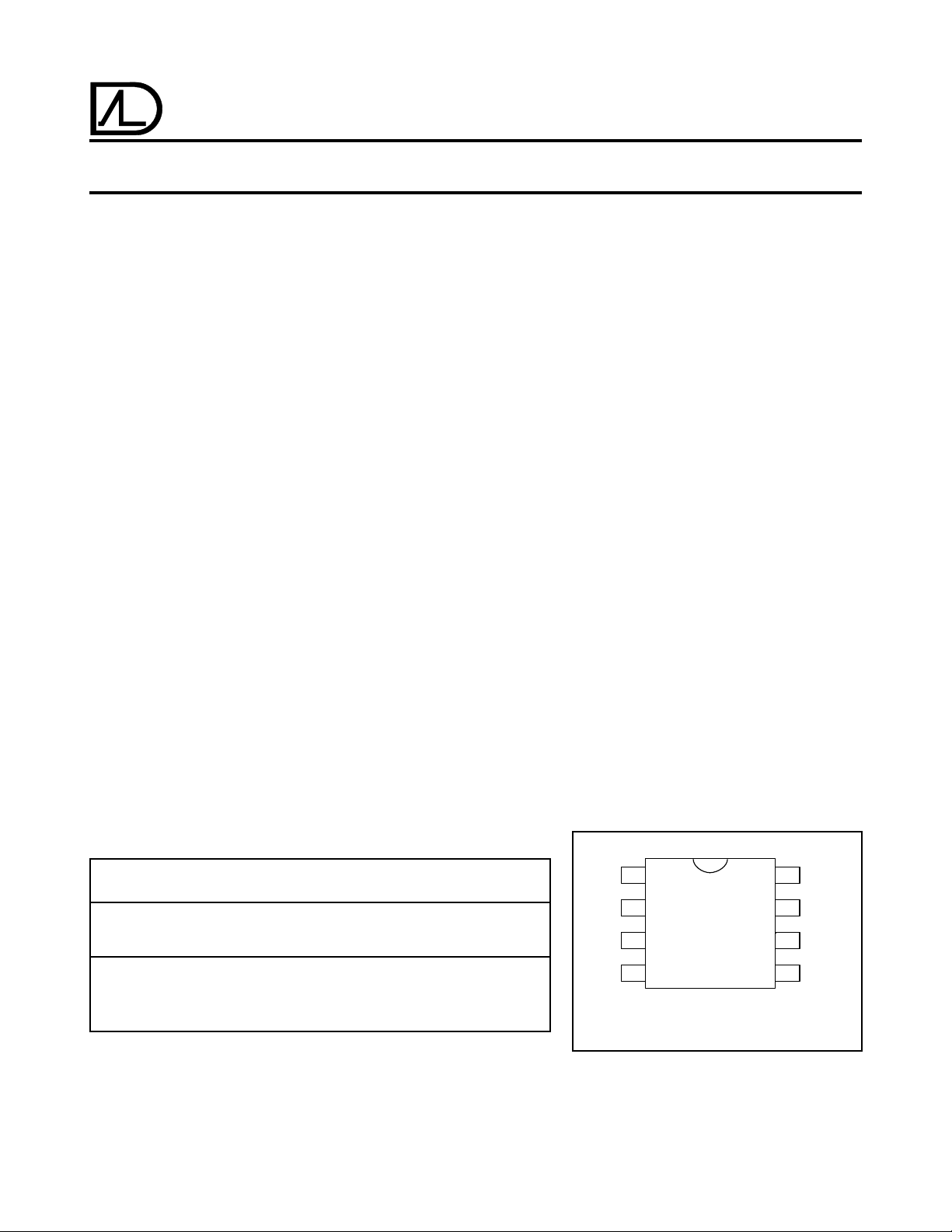
PIN CONFIGURATION
ORDERING INFORMATION
Operating Temperature Range
-55°C to +125°C0°C to +70°C0°C to +70°C
8-Pin 8-Pin 8-Pin
CERDIP Small Outline Plastic Dip
Package Package (SOIC) Package
ALD1701A DA ALD1701A SA ALD1701A PA
ALD1701B DA ALD1701B SA ALD1701B PA
ALD1701 DA ALD1701 SA ALD1701 PA
ALD1701G DA ALD1701G SA ALD1701G PA
* Contact factory for industrial temperature range
© 1998 Advanced Linear Devices, Inc. 415 T asman Drive, Sunnyvale, California 94089 -1706 Tel: (408) 747-1155 Fax: (408) 747-1286 http://www .aldinc.com
1
N/C
-IN
+IN
-
V
* N/C Pin is internally connected. Do not connect externally.
2
2
3
4
TOP VIEW
DA, PA, SA PACKAGE
8
N/C
+
7
V
6
OUT
5
N/C
Page 2
ABSOLUTE MAXIMUM RATINGS
Supply voltage, V
Differential input voltage range -0.3V to V
Power dissipation 600 mW
Operating temperature range PA, SA package 0°C to +70°C
Storage temperature range -65°C to +150°C
Lead temperature, 10 seconds +260°C
+
13.2V
+
+0.3V
DA package -55°C to +125°C
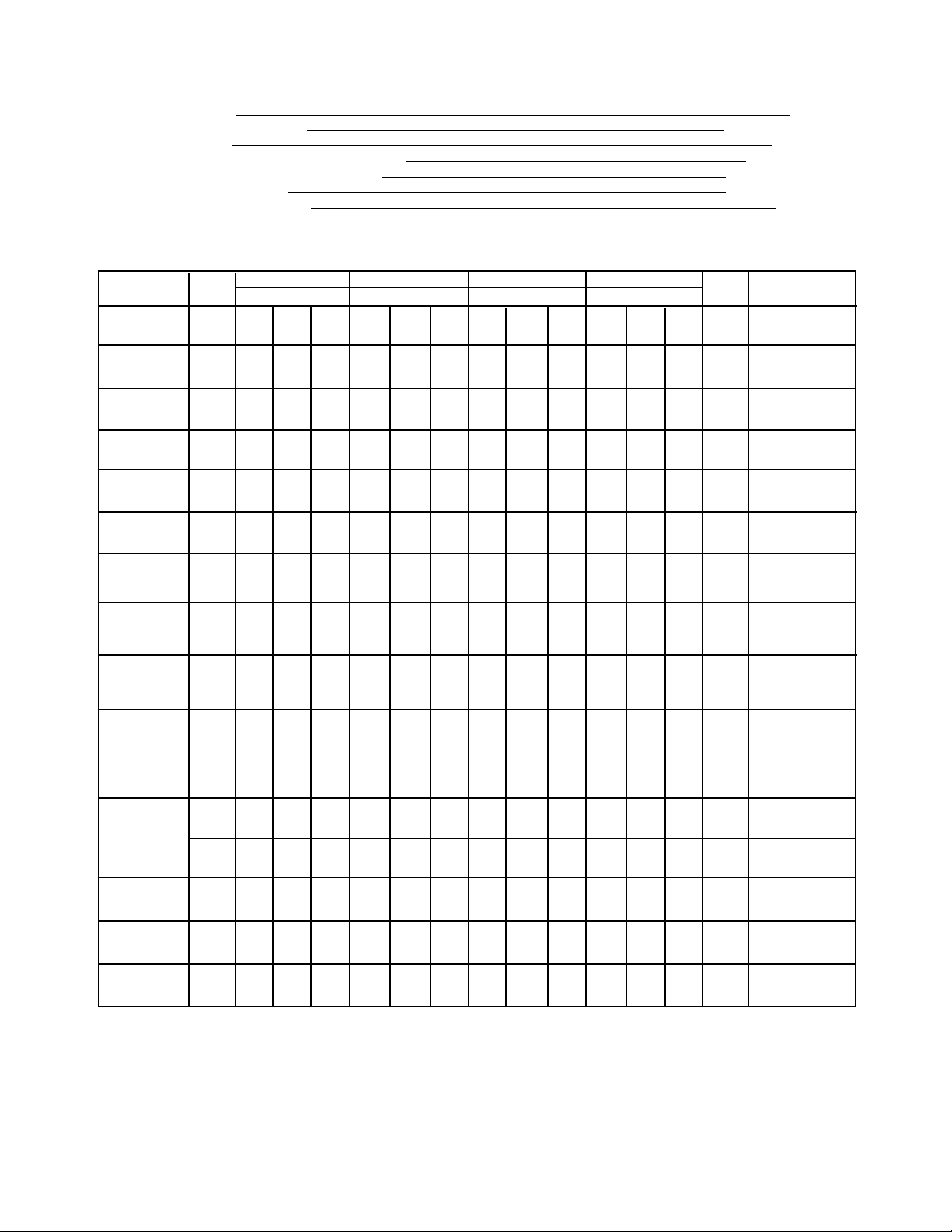
OPERATING ELECTRICAL CHARACTERISTICS
T
= 25°C V
A
Parameter Symbol Min Typ Max Min Typ Max Min Typ Max Min Typ Max Unit Conditions
Supply V
Voltage V
Input Offset V
Voltage 1.7 2.8 5.3 11.0 mV 0°C ≤ T
Input Offset I
Current 240 240 240 450 pA 0°C ≤ T
Input Bias I
Current 300 300 300 600 pA 0°C ≤ T
Input Voltage V
Range -2.8 2.8 -2.8 2.8 -2.8 2.8 -2.8 2.8 V V
Input R
Resistance
= ±2.5V unless otherwise specified
S
1701A 1701B 1701 1701G Test
±1.0 ±6.0 ±1.0 ±6.0 ±1.0 ±6.0 ±1.0 ±6.0 Dual Supply
S
+
2.0 12.0 2.0 12.0 2.0 12.0 2.0 12.0 V Single Supply
OS
OS
B
-0.3 5.3 -0.3 5.3 -0.3 5.3 -0.3 5.3 V V
IR
IN
10
0.9 2.0 4.5 10.0 mV R
1.0 25 1.0 25 1.0 25 1.0 30 pA T
1.0 30 1.0 30 1.0 30 1.0 50 pA T
12
10
≤ 100KΩ
S
≤ +70°C
A
= 25°C
A
≤ +70°C
A
= 25°C
A
≤ +70°C
A
+
= +5V
= ±2.5V
S
12
10
12
10
12
Ω
Input Offset TCV
OS
7777µV/°CR
S
≤ 100KΩ
Voltage Drift
Power Supply PSRR 70 80 65 80 65 80 60 80 dB R
Rejection Ratio 70 80 65 80 65 80 60 80 dB 0°C ≤ T
Common Mode CMRR 70 83 65 83 65 83 60 83 dB R
Rejection Ratio 70 83 65 83 65 83 60 83 dB 0°C ≤ T
Large Signal A
40 100 32 100 32 100 20 80 V/ mV R
V
Voltage Gain 1000 1000 1000 1000 V/ mV R
20 20 20 10 V/ mV R
Output VO low 0.001 0.01 0.001 0.01 0.001 0.01 0.001 0.01 V
≤ 100KΩ
S
≤ +70°C
A
≤ 100KΩ
S
≤ +70°C
A
= 100KΩ
L
≥ 1MΩ
L
= 100KΩ
L
≤ +70°C
0°C ≤ T
A
RL =1MΩ V+ = +5V
Voltage VO high 4.99 4.999 4.99 4.999 4.99 4.999 4.99 4.999 V 0°C ≤ TA ≤ +70°C
Range VO low -2.48 -2.40 -2.48 -2.40 -2.48 -2.40 -2.48 -2.40 V RL =100KΩ
VO high 2.40 2.48 2.40 2.48 2.40 2.48 2.40 2.48 V 0°C ≤ TA ≤ +70°C
Output Short I
SC
1 1 1 1 mA
Circuit Current
Supply Current I
S
120 250 120 250 120 250 120 300 µAV
IN
= 0V
No Load
Power P
D
1.25 1.25 1.25 1.50 mW V
= ±2.5V
S
Dissipation
ALD1701A/ALD1701B Advanced Linear Devices 2
ALD1701/ALD1701G
Page 3

OPERATING ELECTRICAL CHARACTERISTICS (cont'd)
= 25°C VS = ±2.5V unless otherwise specified
T
A
1701A 1701B 1701 1701G Test
Parameter Symbol Min Typ Max Min Typ Max Min Typ Max Min Typ Max Unit Conditions
Input C
Capacitance
IN
11 11pF
Bandwidth B
Slew Rate S
Rise time t
Overshoot 20 20 20 20 % R
Factor C
Settling Time t
TA = 25°C V
= ±5.0V unless otherwise specified
S
400 700 400 700 400 700 700 KHz
W
0.33 0.7 0.33 0.7 0.33 0.7 0.7 V/µsA
R
r
s
0.2 0.2 0.2 0.2
10.0 10.0 10.0 10.0 µs 0.1%
= +1
V
= 100KΩ
R
L
µsR
= 100KΩ
L
=100KΩ
L
= 50pF
L
AV = -1RL=100KΩ
C
= 50pF
L
1701A 1701B 1701 1701G Test
Parameter Symbol Min Typ Max Min Typ Max Min Typ Max Min Typ Max Unit Conditions
Power Supply PSRR 83 83 83 83 dB R
Rejection Ratio
Common Mode CMRR 83 83 83 83 dB R
Rejection Ratio
Large Signal A
V
250 250 250 250 V/mV R
≤ 100KΩ
S
≤ 100KΩ
S
=100KΩ
L
Voltage Gain
Output Voltage V
Range V
low -4.98 -4.90 -4.98 -4.90 -4.98 -4.90 -4.98 -4.90 V R
O
high 4.90 4.98 4.90 4.98 4.90 4.98 4.90 4.98 V
O
=100KΩ
L
Bandwidth B
Slew Rate S
V
= ±2.5V -55°C ≤ T
S
W
R
A
1.0 1.0 1.0 1.0 MHz
1.0 1.0 1.0 1.0 V/µsA
≤ +125°C unless otherwise specified
V
C
L
= +1
= 50pF
1701B DA 1701 DA Test
Parameter Symbol Min Typ Max Min Typ Max Unit Conditions
Input Offset V
OS
3.0 6.5 mV R
≤ 100KΩ
S
Voltage
Input Offset I
OS
8.0 8.0 nA
Current
Input Bias I
B
10.0 10.0 nA
Current
Power Supply PSRR 60 75 60 75 dB R
≤ 100KΩ
S
Rejection Ratio
Common Mode CMRR 60 83 60 83 dB R
≤ 100KΩ
S
Rejection Ratio
Large Signal A
V
15 50 15 50 V/ mV R
= 100KΩ
L
Voltage Gain
Output Voltage V
Range V
low -2.47 -2.40 -2.47 -2.40 V
O
high 2.35 2.45 2.35 2.45 V R
O
= 100KΩ
L
ALD1701A/ALD1701B Advanced Linear Devices 3
ALD1701/ALD1701G
Page 4

Design & Operating Notes:
1. The ALD1701 CMOS operational amplifier uses a 3 gain stage
architecture and an improved frequency compensation scheme to
achieve large voltage gain, high output driving capability, and better
frequency stability. In a conventional CMOS operational amplifier
design, compensation is achieved with a pole splitting capacitor
together with a nulling resistor. This method is, however, very bias
dependent and thus cannot accommodate the large range of supply
voltage operation as is required from a stand alone CMOS operational amplifier. The ALD1701 is internally compensated for unity
gain stability using a novel scheme that does not use a nulling
resistor. This scheme produces a clean single pole roll off in the gain
characteristics while providing for more than 70 degrees of phase
margin at the unity gain frequency.
2. The ALD1701 has complementary p-channel and n-channel input
differential stages connected in parallel to accomplish rail to rail input
common mode voltage range. This means that with the ranges of
common mode input voltage close to the power supplies, one of the
two differential stages is switched off internally. To maintain compatibility with other operational amplifiers, this switching point has been
selected to be about 1.5V below the positive supply voltage. Since
offset voltage trimming on the ALD1701 is made when the input
voltage is symmetrical to the supply voltages, this internal switching
does not affect a large variety of applications such as an inverting
amplifier or non-inverting amplifier with a gain larger than 2.5 (5V
operation), where the common mode voltage does not make excursions above this switching point. The user should however, be
aware that this switching does take place if the operational amplifier
is connected as a unity gain buffer, and should make provision in his
design to allow for input offset voltage variations.
3. The input bias and offset currents are essentially input protection
diode reverse bias leakage currents, and are typically less than 1pA
at room temperature. This low input bias current assures that the
analog signal from the source will not be distorted by input bias
currents. Normally, this extremely high input impedance of greater
12
Ω would not be a problem as the source impedance would
than 10
limit the node impedance. However, for applications where source
impedance is very high, it may be necessary to limit noise and hum
pickup through proper shielding.
4. The output stage consists of class AB complementary output drivers,
capable of driving a low resistance load. The output voltage swing
is limited by the drain to source on-resistance of the output transistors as determined by the bias circuitry, and the value of the load
resistor. When connected in the voltage follower configuration, the
oscillation resistant feature, combined with the rail to rail input and
output feature, makes an effective analog signal buffer for medium
to high source impedance sensors, transducers, and other circuit
networks.
5. The ALD1701 operational amplifier has been designed to provide full
static discharge protection. Internally, the design has been carefully
implemented to minimize latch up. However, care must be exercised
when handling the device to avoid strong static fields that may
degrade a diode junction, causing increased input leakage currents.
In using the operational amplifier, the user is advised to power up the
circuit before, or simultaneously with any input voltages applied, and
to limit input voltages not to exceed 0.3V of the power supply voltage
levels.
6. The ALD1701, with its micropower operation, offers numerous
benefits in reduced power supply requirements, less noise coupling
and current spikes, less thermally induced drift, better overall reliability due to lower self heating, and lower input bias current. It
requires practically no warm up time as the chip junction heats up to
only 0.1°C above ambient temperature under most operating conditions.
TYPICAL PERFORMANCE CHARACTERISTICS
SUPPLY CURRENT AS A FUNCTION
OF SUPPLY VOLTAGE
±500
INPUTS GROUNDED
OUTPUT UNLOADED
±400
±300
±200
±100
SUPPLY CURRENT (µA)
0
0 ±1 ±2 ±3 ±4 ±5 ±6
OPEN LOOP VOLTAGE GAIN AS A
FUNCTION OF LOAD RESISTANCE
1000
100
10
GAIN (V/mV)
OPEN LOOP VOLTAGE
1
10K
TA = -55°C
SUPPLY VOLTAGE (V)
100K 1M
LOAD RESISTANCE (Ω)
-25°C
+70°C
+125°C
VS = ±2.5V
T
= 25°C
A
+25°C
10M
COMMON MODE INPUT VOLTAGE RANGE
AS A FUNCTION OF SUPPLY VOLTAGE
±7
±6
TA = 25°C
±5
±4
±3
±2
VOLTAGE RANGE (V)
COMMON MODE INPUT
±1
0
0 ±1 ±2 ±3 ±4 ±5 ±6 ±7
SUPPLY VOLTAGE (V)
INPUT BIAS CURRENT AS A FUNCTION
OF AMBIENT TEMPERATURE
10000
= ±2.5V
1.0
0.1
V
S
10
AMBIENT TEMPERATURE (°C)
1000
100
INPUT BIAS CURRENT (pA)
100-25 0 75 1255025-50
ALD1701A/ALD1701B Advanced Linear Devices 4
ALD1701/ALD1701G
Page 5

TYPICAL PERFORMANCE CHARACTERISTICS
OPEN LOOP VOLTAGE GAIN AS A FUNCTION
OF SUPPLY VOLTAGE AND TEMPERATURE
1000
100
10
GAIN (V/mV)
±55°C ≤ T
OPEN LOOP VOLTAGE
1
0 ±2 ±4 ±6 ±8
SUPPLY VOLTAGE (V)
RL = 100KΩ
A
INPUT OFFSET VOLTAGE AS A FUNCTION
OF AMBIENT TEMPERATURE
REPRESENTATIVE UNITS
+5
+4
+3
+2
+1
0
-1
-2
-3
-4
INPUT OFFSET VOLTAGE (mV)
-5
-50 -25 0 +25 +50 +75 +100 +125
AMBIENT TEMPERATURE (°C)
VS = ±2.5V
INPUT OFFSET VOLTAGE AS A FUNCTION
OF COMMON MODE INPUT VOLTAGE
15
10
5
0
VS = ±2.5V
T
≤ +125°C
= 25°C
A
OUTPUT VOLTAGE SWING AS A FUNCTION
OF SUPPLY VOLTAGE
±6
±25°C ≤ TA ≤ +125°C
±5
RL = 100KΩ
±4
±3
±2
OUTPUT VOLTAGE SWING (V)
±1
0
±1 ±2 ±3 ±4 ±7±6±5
SUPPLY VOLTAGE (V)
OPEN LOOP VOLTAGE GAIN AS A FUNCTION
OF FREQUENCY
120
100
80
60
40
GAIN (dB)
20
OPEN LOOP VOLTAGE
0
-20
1 10 100 1K 10K 1M 10M100K
FREQUENCY (Hz)
VS = ±2.5V
T
A
LARGE - SIGNAL TRANSIENT
RESPONSE
2V/div
VS = ±1.0V
T
R
C
= 25°C
= 25°C
A
= 100KΩ
L
= 50pF
L
PHASE SHIFT IN DEGREES
0
45
90
135
180
-5
-10
INPUT OFFSET VOLTAGE (mV)
-15
-2 -1 0 +1 +3+2
COMMON MODE INPUT VOLTAGE (V)
LARGE - SIGNAL TRANSIENT
RESPONSE
5V/div
2V/div 5µs/div
VS = ±2.5V
= 25°C
T
A
R
= 100KΩ
L
= 50pF
C
L
500mV/div 5µs/div
SMALL - SIGNAL TRANSIENT
RESPONSE
100mV/div
20mV/div 2µs/div
V
= ±2.5V
S
= 25°C
T
A
= 100KΩ
R
L
= 50pF
C
L
ALD1701A/ALD1701B Advanced Linear Devices 5
ALD1701/ALD1701G
Page 6

TYPICAL APPLICATIONS
RAIL-TO-RAIL VOLTAGE FOLLOWER/BUFFER
~
ZIN = 1012Ω
V
IN
0≤ V
≤ 5V
IN
* See Rail to Rail Waveform
5V
0.1µF
-
OUTPUT
+
HIGH INPUT IMPEDANCE RAIL-TO-RAIL
PRECISION DC SUMMING AMPLIFIER
10M
+2.5V
+
-
- 2.5V
4
0.1µF
0.1µF
10M
V- ≤ V
V- ≤ V
IN
OUT
V
≤ V+
OUT
≤ V+
10M
V
1
V
2
10M
10M
V
3
V4
10M
V
= V1 + V2 - V3 - V
RIN = 10MΩ Accuracy limited by resistor tolerances and input offset voltage
OUT
OUTPUT
PHOTODIODE
RAIL-TO-RAIL WAVEFORM
+5V
INPUT
0V
+5V
0V
Performance waveforms.
Upper trace is the output of a
Wien Bridge Oscillator. Lower
trace is the output of Rail-to-rail
voltage follower.
PHOTO DETECTOR CURRENT TO
VOLTAGE CONVERTER
R
= 5M
F
I
-
+
+2.5V
-2.5V
RL = 100K
1 X R
V
=
OUT
F
SINE WAVE GENERATOR
C = .01µF
* See Rail to Rail Waveform
R = 10K
-
+
+2.5V
-2.5V
10K
.01µF
1
~
f = ~ 1.6KHz
2πR
C
RAIL-TO-RAIL VOLTAGE COMPARATORWIEN BRIDGE OSCILLATOR (RAIL-TO-RAIL)
V
OUTPUT
10K
10K
IN
+5V
50K
LOW VOLTAGE INSTRUMENTATION AMPLIFIER
V+
1M
f max = 20KHz
-40mV ≤ V
IN
1M
≤ 40mV
+
-
V+
-
+
V-
0.1µF
100K
V-
100K
0.1µF
500K
V+
0.1µF
-
0.1µF
0.1µF
50K
V+ 1M
100K
100K
GAIN = 25 V- ≤ V
V+ = +1.0V, V- = -1.0V. Short circuit input current 1µA.
+
0.1µF
V-
1M
OUT
V-
≤ V+. All resistors are 1%.
+5V
-
+
10M
V
OUT
0.1µF
OUTPUT
ALD1701A/ALD1701B Advanced Linear Devices 6
ALD1701/ALD1701G
 Loading...