

Page 1
50B-5KG/2050B-5KG
Page 2

Page 3
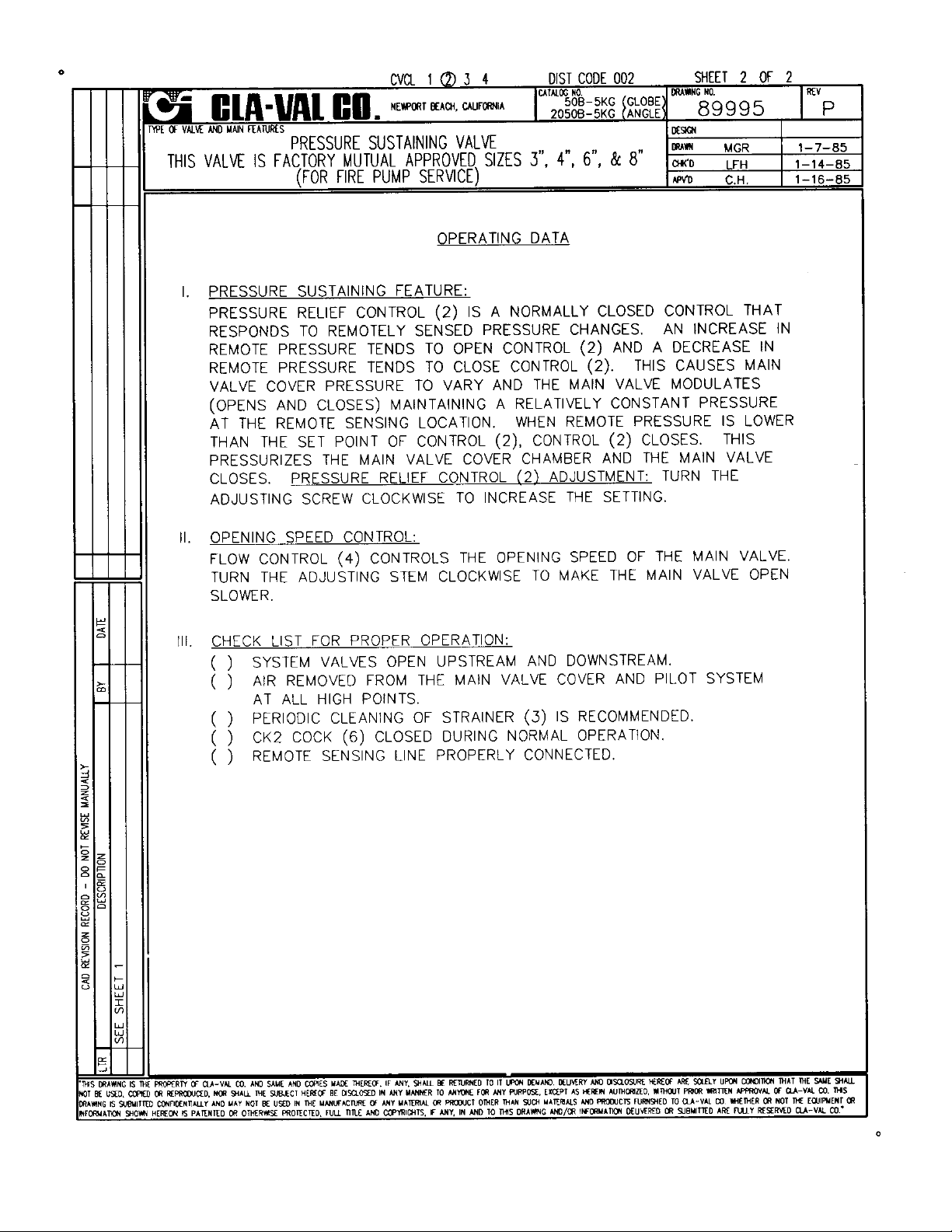
Page 4
50B-5KG
• Adjustable Opening Speed For Pump Suction
Protection
• Pilot Control Provides Wide Flow Range With
Minimal Pressure Variations
• Controlled Closing For System Protection
• Modulates Within 5% of Setting for Accurate
Pressure Control
• Pressure Setting Adjustable
• Pressure Setting Not Affected by Pressure at Valve
Discharge
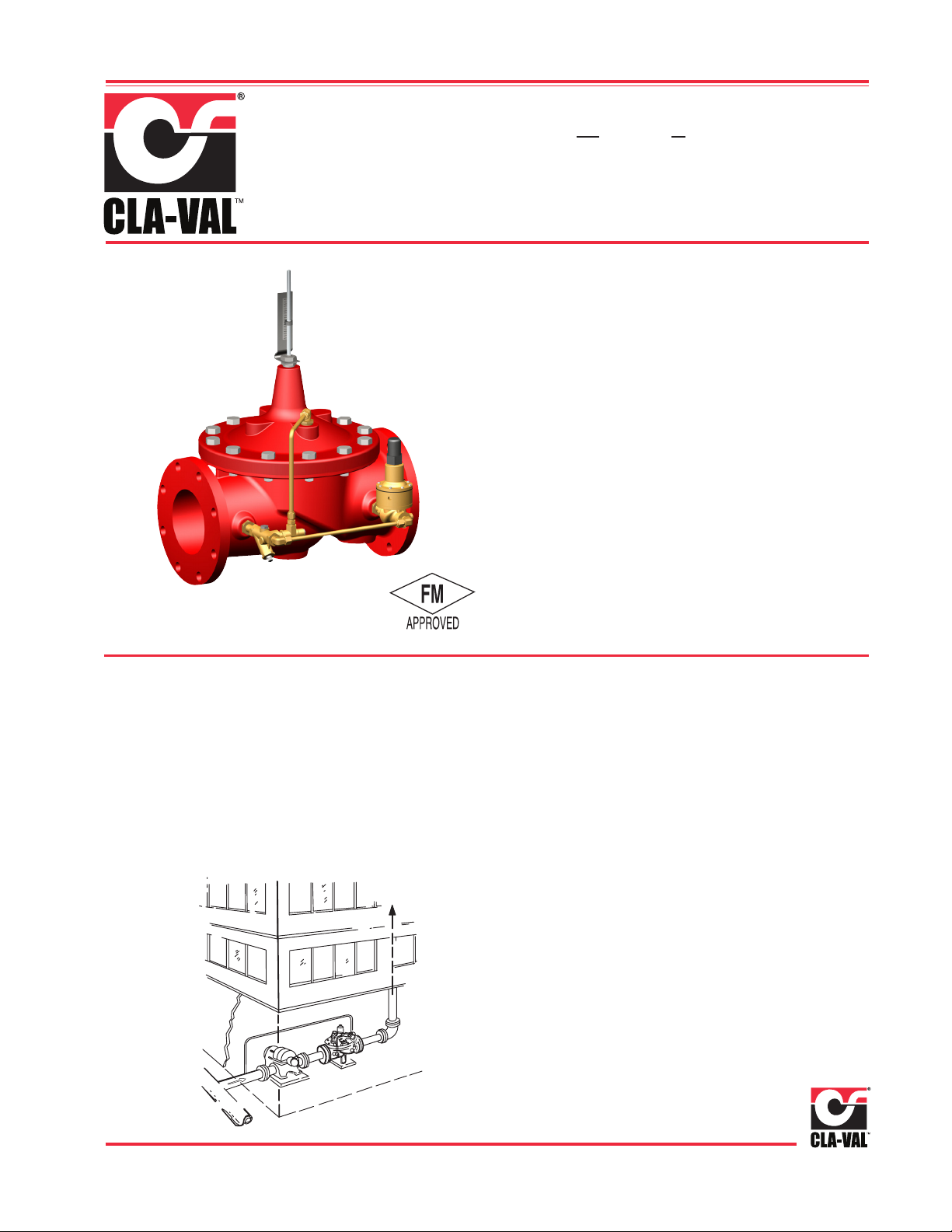
The Model 50B-5KG Pump Suction Control Valve is
designed specifically for Fire Pump Suction Control Service.
It modulates to maintain the pump discharge in relation to
the suction head available, thus assuring that the suction
head pressure does not fall below the pre-set minimum.
Pump Suction Control Valve
Typical Installation
When there is a demand in the Fire System, the pump is started,
delivering water from the supply source to the area of demand. To
assure that the fire pump draw does not exceed the available water
supply, the Model 50B-5KG, sensing the pump suction, modulates
to prevent suction pressure from dropping below a pre-set minimum.
By maintaining minimum pressure requirements in the supply main,
the main is protected from possible damage or backflow conditions.
Also, a minimum supply pressure is provided for local fire apparatus.
Specifications
Globe:
3" - 8" flanged
Angle:
3" - 8" flanged
150 and 300 ANSI B16.42
150 class - 250 psi Max.
300 class - 400 psi Max
Water, to +180°F Max.
Main valve body & cover
Ductile Iron ASTM A-536
Main valve trim:
Brass QQ-B-626
Bronze Seat ASTM B61
Stainless Steel Stem 303
Delrin Sleeved
Pilot control system:
Cast Bronze ASTM B62 with
303 Stainless Steel trim
Available in the following
pressure range only:
5 to 25 psi
Set at 10 psi
Sizes
End Details
Pressure Ratings
Temperature Range
Materials
Adjustment Range
TO
FIRE SERVICE
SYSTEM
REMOTE SENSING LINE
CLA-VAL 50B-5KG
FIRE PUMP
SUPPLY SYSTEM
50B-5KG
MODEL
Page 5
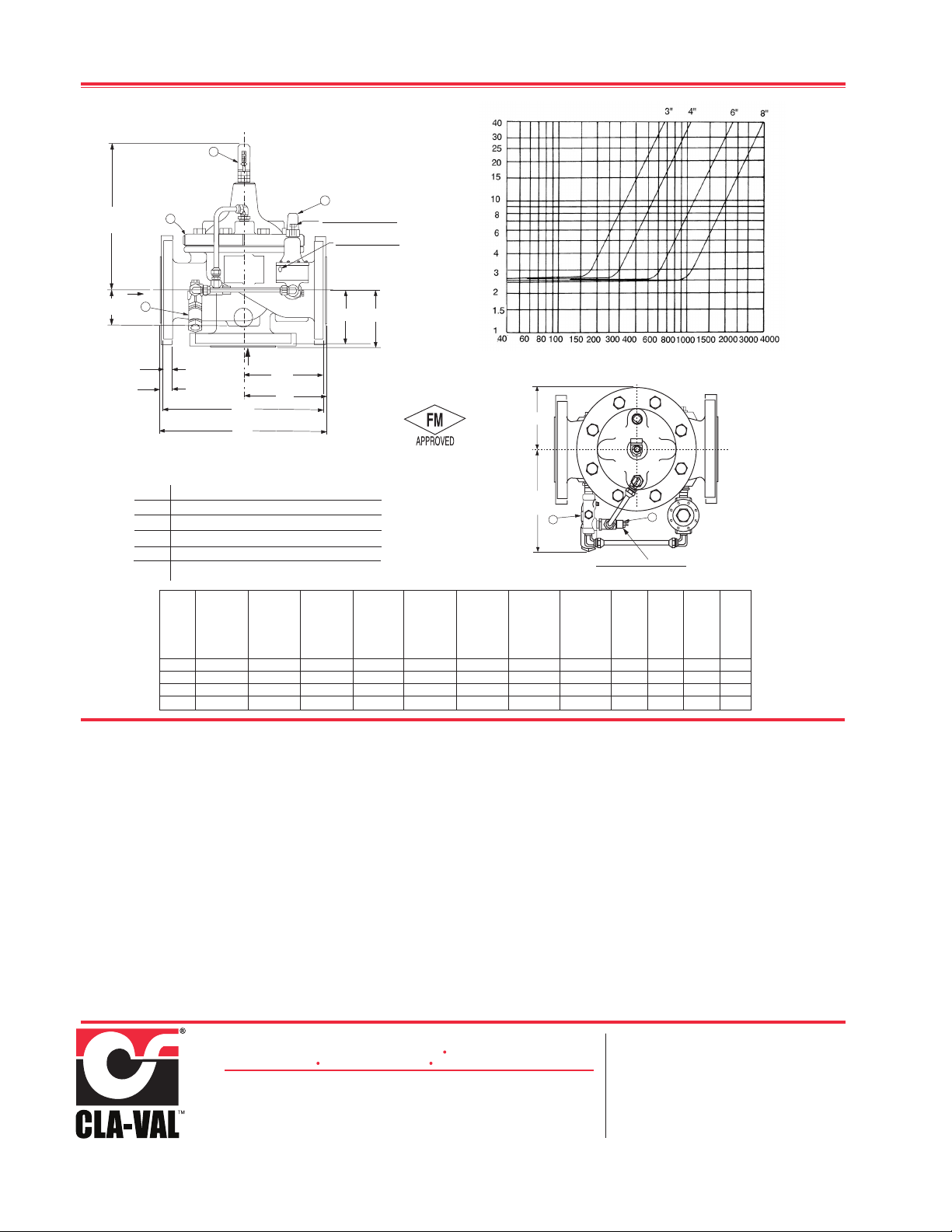
Dimensions (in Inches)
Flow Chart
VALVE
SIZE
AA
300 LB.
FLANGES
A
150 LB.
FLANGES
B
150 LB.
FLANGES
CC
300 LB.
FLANGES
C
150 LB.
FLANGES
DD
(TYP.)
300 LB.
FLANGES
(MIN.)
D
(TYP.)
150 LB.
FLANGES
(MIN.)
E
(MAX.)F(MAX.)G(MAX.)
KBB
300 LB.
FLANGES
3”
4”
6”
8”
13.25
15.62
21.00
26.38
12.00
15.00
20.00
25.38
6.00
7.50
10.00
12.75
4.38
5.31
6.50
8.50
4.00
5.00
6.00
8.00
1.12
1.25
1.44
1.62
.75
.94
1.00
1.12
15.75
17.75
20.25
23.00
13.50
15.00
16.50
20.00
4.62
5.75
7.88
10.00
2.56
3.19
4.31
5.31
6.38
7.88
10.50
13.25
PO Box 1325 Newport Beach CA 92659-0325 Phone: 949-722-4800
Fax: 949-548-5441
Web Site: cla-val.com E-mail: claval@cla-val.com
CLA-VAL
CLA-VAL CANADA CLA-VAL EUROPE
4687 Christie Drive
Beamsville, Ontario
Canada LOR 1B4
Phone: 905-563-4963
Fax: 905-563-4040
E-Mail: sales@cla-val.ca
Chemin des M
;
sanges 1
CH-1032 Romanel/
Lausanne, Switzerland
Phone: 41-21-643-15-55
Fax: 41-21-643-15-50
E-Mail: cla-val@cla-val.ch
'COPYRIGHT
CLA-VAL 2002 Printed in USA Specifications subject to change without notice.
CLA-VAL UK
Dainton House, Goods Station Road
GB - Tunbridge Wells
Kent TN1 2 DH England
Phone: 44-1892-514-400
Fax: 44-1892-543-423
E-Mail: info@cla-val.co.uk
Represented By:
50B-5KG (R-11/06)
Item
No.
Description
(MAX.)
E
1
5
2
PRESSURE RELIEF CONTROL ADJUSTMENT:
TURN THE ADJUSTING STEM CLOCKWISE TO
INCREASE THE SETTING.
REMOTE SENSING LINE CONNECTION:
1/8" - 27 N.P.T.
Pressure Drop - psi
INLET
6
K
A
AA
INLET (ANGLE PATTERN)
D
DD
(4" SIZE VALVE SHOWN)
1
Purchase Specifications
100KCGVX Hytrol (Main Valve)
2
CRL5A Pressure Relief Control
3
4
5
6
X44A Strainer and Orifice Assembly
CV Flow Control (Opening)
X101C Valve Position Indicator
CK2 (Blow-Off Valve)
B
BB
OUTLET
C
CC
The Fire Pump Suction Control Valve shall modulate to maintain a minimum pressure at the pump suction regardless of
system demand. It shall control the pump discharge in relation to the suction head available, and shall not allow suction
head pressure to fall below a pre-set minimum.
It shall be actuated by line pressure through a pilot control system which allows rapid response to changing pressure conditions without line surges. The pilot control shall be remote
sensed to the pump suction head pressure.
The main valve shall be of the hydraulically-operated, pilotcontrolled, diaphragm-type, globe or angle valve. It shall have
a single removable seat, a delrin-sleeved guided stem and a
renewable resilient synthetic rubber disc with a rectangular
cross section, contained on three and one-half sides by a disc
Flow - Gallons Per Minute
G
F
(MAX.)
3
OPENING SPEED CONTROL ADJUSTMENT:
TURN THE ADJUSTING SCREW CLOCKWISE TO
MAKE THE MAIN VALVE OPEN SLOWER.
retainer and disc guide. No external packing glands shall be
permitted and the diaphragm shall not be used as a seating
4
surface. The pilot control shall be a direct-acting, adjustable,
spring-loaded, diaphragm-type valve designed for modulating
service to permit flow when controlling pressure exceeds
spring setting.
A device indicating the percent at which the valve is open or
closed shall be supplied on the assembly, together with a sediment evacuator and dampening device.
The valve shall be designed to allow for repair and servicing
without removing the valve body from the line.
The valve shall be Factory Mutual Approved. It shall be the
MODEL 50B-5KG FIRE PUMP SUCTION CONTROL VALVE
as manufactured by Cla-Val, Newport Beach, California.
Page 6
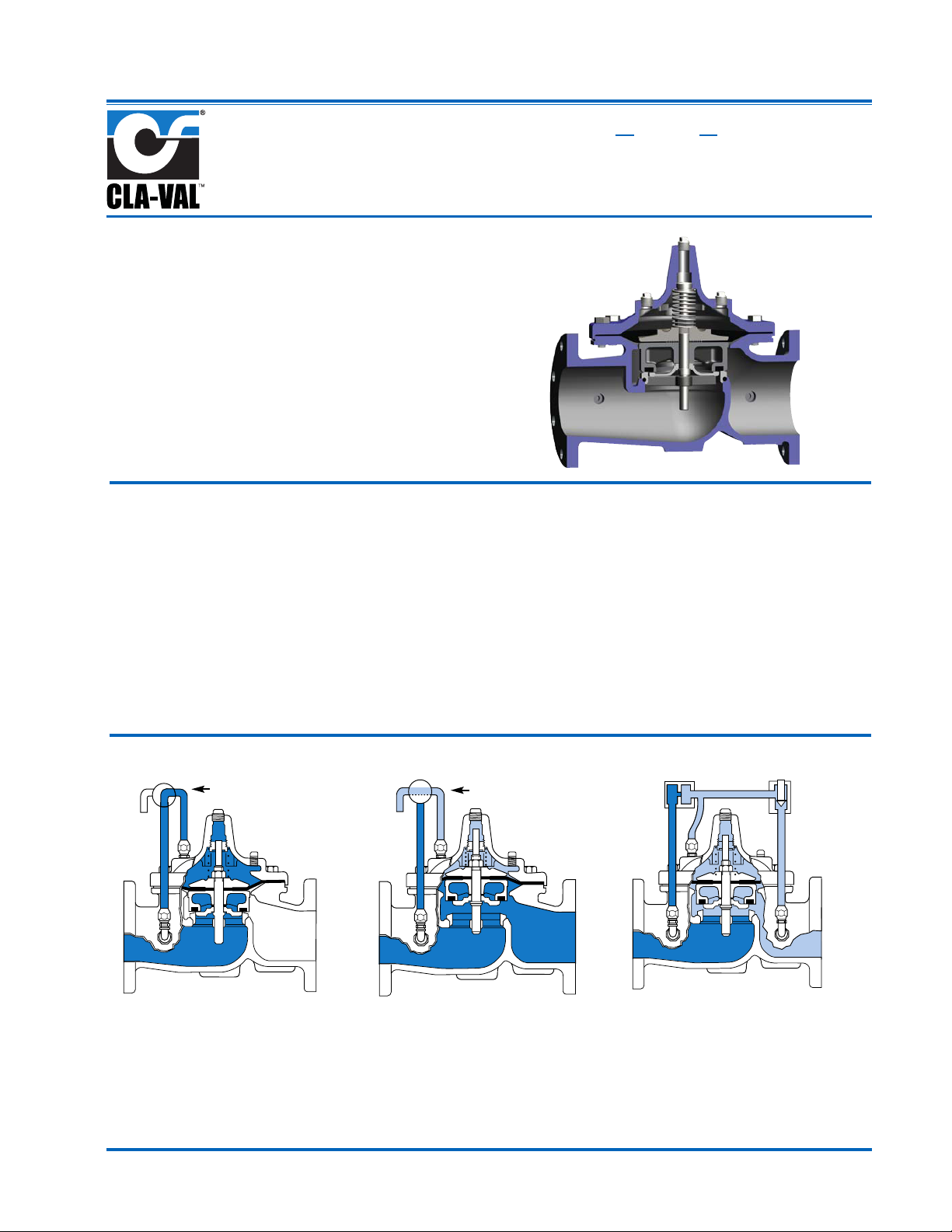
Description
The CIa-VaI Model 100-01 Hytrol Valve is a main valve for
CIa-VaI Automatic Control Valves. It is a hydraulically operated,
diaphragm-actuated, globe or angle pattern valve.
This valve consists of three major components; body, diaphragm
assembly, and cover. The diaphragm assembly is the only
moving part. The diaphragm assembly uses a diaphragm of nylon
fabric bonded with synthetic rubber. A synthetic rubber disc,
contained on three and one half sides by a disc retainer and disc
guide, forms a seal with the valve seat when pressure is applied
above the diaphragm. The diaphragm assembly forms a sealed
chamber in the upper portion of the valve, separating operating
pressure from line pressure.
Installation
1. Before valve is installed, pipe lines should be flushed of all
chips, scale and foreign matter.
2. It is recommended that either gate or block valves be
installed on both ends of the 100-01 Hytrol Valve to facilitate
isoIating the valve for preventive maintenance and repairs.
3. Place the valve in the line with flow through the valve in the
direction indicated on the inlet nameplate. (See “Flow Direction”
Section)
4. Allow sufficient room around valve to make adjustments and
for disassembly.
5. CIa-VaI 100-01 Hytrol Valves operate with maximum efficiency
when mounted in horizontal piping with the cover UP, however,
other positions are acceptable. Due to size and weight of the
cover and internal components of 8 inch and larger valves,
installation with the cover UP is advisable. This makes internal
parts readily accessible for periodic inspection.
6. Caution must be taken in the installation of this valve to insure
that galvanic and/or electrolytic action does not take place. The
proper use of dielectric fittings and gaskets are required in all
systems using dissimilar metals.
7. If a pilot control system is installed on the 100-01 Hytrol Valve,
use care to prevent damage. If it is necessary to remove fittings
or components, be sure they are kept clean and replaced
exactly as they were.
8. After the valve is installed and the system is first pressurized,
vent air from the cover chamber and pilot system tubing by
loosening fittings at all high points.
Tight Closing Operation
When pressure from the valve inlet (or
an equivalent independent operating
pressure) is applied to the diaphragm
chamber the valve closes drip-tight.
Full Open Operation
When pressure in diaphragm chamber
is relieved to a zone of lower pressure
(usually atmosphere) the line pressure
(5 psi Min.) at the valve inlet opens the
valve.
Modulating Action
Valve modulates when diaphragm pressure is held at an intermediate point
between inlet and discharge pressure.
With the use of a Cla-Val. "modulating
control," which reacts to line pressure
changes, the pressure above the
diaphragm is varied, allowing the valve
to throttle and compensate for the
change.
Principles of Operation
Three Way
Pilot Control
Three Way
Pilot Control
Restriction
Modulating
Control
100-01
Hytrol Valve
MODEL
INSTALLATION / OPERATION / MAINTENANCE
Page 7
2
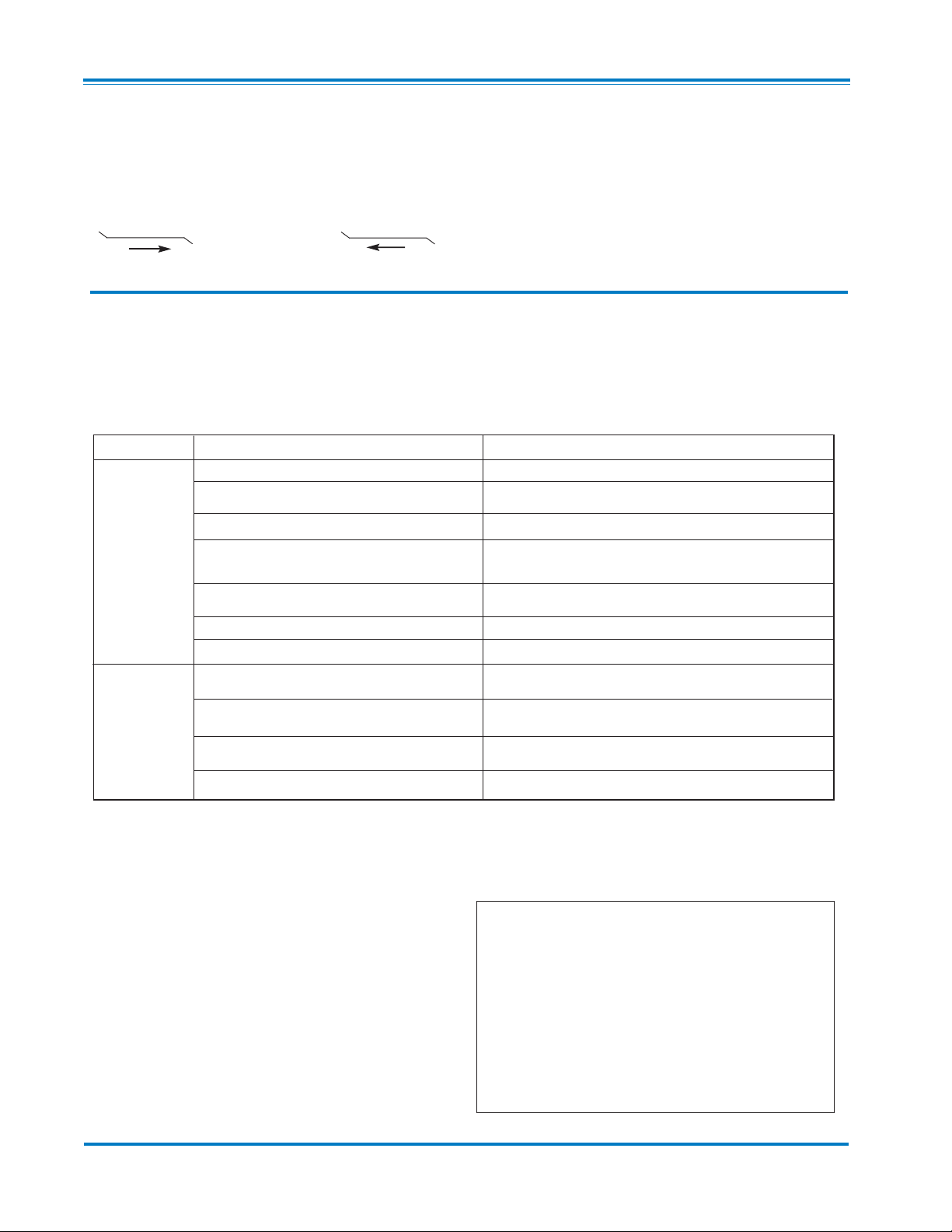
Flow Direction
The flow through the 100-01 Hytrol Valve can be in one of two
directions. When flow is “up-and-over the seat,” it is in “normal”
flow and the valve will fail in the open position. When flow is “overthe seat-and down,” it is in “reverse” flow and the valve will fail in
the closed position. There are no permanent flow arrow markings.
The valve must be installed according to nameplate data.
BRIDGEWALL INDlCATOR
Normal Flow Reverse Flow
Troubleshooting
The following troubleshooting information deals strictly with the
Model 100-01 Hytrol Valve. This assumes that all other components of the pilot control system have been checked out and are
in proper working condition. (See appropriate sections in
Technical Manual for complete valve).
Three Checks
The 100-01 Hytrol Valve has only one moving part (the diaphragm
and disc assembly). So, there are only three major types of problems to be considered.
First: Valve is stuck - that is, the diaphragm assembly is not free
to move through a full stroke either from open to close or vice
versa.
Second: Valve is free to move and can’t close because of a worn
out diaphragm.
Third: Valve leaks even though it is free to move and the
diaphragm isn’t leaking.
Closed isolation valves in control system, or in main line.
Lack of cover chamber pressure.
Diaphragm damaged. (See Diaphragm Check.)
Diaphragm assembly inoperative.
Corrosion or excessive scale build up on valve stem.
(See Freedom of Movement Check)
Mechanical obstruction. Object lodged in valve.
(See Freedom of Movement Check)
Worn disc. (See Tight Sealing Check)
Badly scored seat. (See Tight Sealing Check)
Closed upstream and/or downstream isolation
valves in main line.
Insufficient line pressure.
Diaphragm assembly inoperative. Corrosion or excessive
buildup on valve stem. (See Freedom of Movement Check)
Diaphragm damaged. (For valves in "reverse flow" only)
After checking out probable causes and remedies, the following three checks can be used to diagnose the nature of the
problem before maintenance is started. They must be done in the order shown.
Open Isolation valves.
Check upstream pressure, pilot system, strainer, tubing, valves, or needle
valves for obstruction.
Replace diaphragm.
Clean and polish stem. Inspect and replace any damaged or badly eroded
part.
Remove obstruction.
Replace disc.
Replace seat.
Open isolation valves.
Check upstream pressure. (Minimum 5 psi flowing line pressure differential.)
Clean and polish stem. Inspect and replace any
damaged or badly eroded part.
Replace diaphragm.
Fails to Close
Fails to Open
CAUTION:
Care should be taken when doing the troubleshooting checks on
the 100-01 Hytrol Valve. These checks do require the valve to
open fully. This will either allow a high flow rate through the
valve, or the downstream pressure will quickly increase to the
inlet pressure. In some cases, this can be very harmful. Where
this is the case, and there are no block valves in the system to
protect the downstream piping, it should be realized that the
valve cannot be serviced under pressure. Steps should be
taken to remedy this situation before proceeding any further.
(cast into side of valve body)
SYMPTOM PROBABLE CAUSE REMEDY
Recommended Tools
1. Three pressure gauges with ranges suitable to the installation to be put at Hytrol inlet, outlet and cover connections.
2. Cla-Val Model X101 Valve Position Indicator. This provides visual indication of valve position without disassembly
of valve.
3. Other items are: suitable hand tools such as screwdrivers, wrenches, etc. soft jawed (brass or aluminum) vise,
400 grit wet or dry sandpaper and water for cleaning.
All trouble shooting is possible without removing the valve from the
line or removing the cover. It is highly recommended to permanently
install a Model X101 Valve Position Indicator and three gauges in
unused Hytrol inlet, outlet and cover connections.
Page 8

Diaphragm Check (#1 )
1. Shut off pressure to the Hytrol Valve by slowly closing upstream
and downstream isolation valves. SEE CAUTION.
2. Disconnect or close all pilot control lines to the valve cover and
leave only one fitting in highest point of cover open to atmosphere.
3.With the cover vented to atmosphere, slowly open upstream
isolation valve to allow some pressure into the Hytrol Valve body.
Observe the open cover tapping for signs of continuous flow. It is
not necessary to fully open isolating valve. Volume in cover chamber capacity chart will be displaced as valve moves to open position. Allow sufficient time for diaphragm assembly to shift positions. If there is no continuous flow, you can be quite certain the
diaphragm is sound and the diaphragm assembly is tight. If the
fluid appears to flow continuously this is a good reason to believe
the diaphragm is either damaged or it is loose on the stem. In
either case, this is sufficient cause to remove the valve cover and
investigate the leakage. (See “Maintenance” Section for procedure.)
COVER CHAMBER CAPACITY
(Liquid Volume displaced when valve opens)
Valve size (inches) Displacement
Gallons Liters
1 1/4 .020 .07
1 1/2 .020 .07
2 .032 .12
2 1/2 .043 .16
3 .080 .30
4 .169 .64
6 .531 2.0
8 1.26 4.8
10 2.51 9.5
12 4.00 15.1
14 6.50 24.6
16 9.57 36.2
24 29.00 109.8
30 42.00 197.0
36 90.00 340.0
Freedom of Movement Check (#2)
4. Determining the Hytrol Valve’s freedom of movement can be
done by one of two methods.
5. For most valves it can be done after completing Diaphragm
Check (Steps 1, 2, and 3). SEE CAUTION. At the end of step 3
the valve should be fully open.
6. If the valve has a Cla-Val X101 Position Indicator, observe the
indicator to see that the valve opens wide. Mark the point of maximum opening.
7. Re-connect enough of the control system to permit the application of inlet pressure to the cover. Open pilot system cock so
pressure flows from the inlet into the cover.
8. While pressure is building up in the cover, the valve should
close smoothly. There is a hesitation in every Hytrol Valve closure,
which can be mistaken for a mechanical bind. The stem will
appear to stop moving very briefly before going to the closed position. This slight pause is caused by the diaphragm flexing at a
particular point in the valve’s travel and is not caused by a
mechanical bind.
9. When closed, a mark should be made on the X101 Valve position indicator corresponding to the “closed” position. The distance
between the two marks should be approximately the stem travel
shown in chart.
STEM TRAVEL
(Fully Open to Fully Closed)
Valve Size (inches) Travel (inches)
Inches MM Inches MM
1 1/4 32 0.4 10
1 1/2 40 0.4 10
2 50 0.6 15
2 1/2 65 0.7 18
3 80 0.8 20
4 100 1.1 28
6 150 1.7 43
8 200 2.3 58
10 250 2.8 71
12 300 3.4 86
14 350 4.0 100
16 400 4.5 114
24 600 6.5 165
30 800 7.5 190
36 900 8.5 216
10. If the stroke is different than that shown in stem travel chart
this is a good reason to believe something is mechanically restricting the stroke of the valve at one end of its travel. If the flow does
not stop through the valve when in the indicated “closed” position,
the obstruction probably is between the disc and the seat. If the
flow does stop, then the obstruction is more likely in the cover. In
either case, the cover must be removed, and the obstruction located and removed. The stem should also be checked for scale buildup. (See “Maintenance, section for procedure.)
11. For valves 6” and smaller, the Hytrol Valve’s freedom of movement check can also be done after all pressure is removed from
the valve. SEE CAUTION. After closing inlet and outlet isolation
valves and bleeding pressure from the valve, check that the cover
chamber and the body are temporarily vented to atmosphere.
Insert fabricated tool into threaded hole in top of valve stem, and
lift the diaphragm assembly manually. Note any roughness. The
diaphragm assembly should move smoothly throughout entire
valve stroke. The tool is fabricated from rod that is threaded on
one end to fit valve stem and has a “T” bar handle of some kind
on the other end for easy gripping. (See chart in Step 4 of
“Disassembly” Section.)
12. Place marks on this diaphragm assembly lifting tool when the
valve is closed and when manually positioned open. The distance
between the two marks should be approximately the stem travel
shown in stem travel chart. If the stroke is different than that
shown, there is a good reason to believe something is mechanically restricting the stroke of the valve. The cover must be
removed, and the obstruction located and removed. The stem
should also be checked for scale build-up. (See “Maintenance”
Section for procedure.)
Tight Sealing Check (#3)
13. Test for seat leakage after completing checks #1 & #2 (Steps
1 to 12). SEE CAUTION. Close the isolation valve downstream of
the Hytrol Valve. Apply inlet pressure to the cover of the valve, wait
until it closes. Install a pressure gauge between the two closed
valves using one of the two ports in the outlet side of the Hytrol.
Watch the pressure gauge. If the pressure begins to climb, then
either the downstream isolation valve is permitting pressure to
creep back, or the Hytrol is allowing pressure to go through it.
Usually the pressure at the Hytrol inlet will be higher than on the
isolation valve discharge, so if the pressure goes up to the inlet
pressure, you can be sure the Hytrol is leaking. Install another
gauge downstream of isolating valve. If the pressure between the
valves only goes up to the pressure on the isolation valve
discharge, the Hytrol Valve is holding tight, and it was just the isolation valve leaking.
3
Page 9
Maintenance
NUT
ANGLE OR CHANNEL IRON
LONG STUD OR BOLT
NUT OR BOLT HEAD
DO NOT
LIFT
VALVE SEAT
VALVE BODY
4
Preventative Maintenance
The Cla-Val Co. Model 100-01 Hytrol Valve requires no lubrication or
packing and a minimum of maintenance. However, a periodic inspection schedule should be established to determine how the operating
conditions of the system are affecting the valve. The effect of these
actions must be determined by inspection.
Disassembly
Inspection or maintenance can be accomplished without removing
the valve from the line. Repair kits with new diaphragm and disc are
recommended to be on hand before work begins.
WARNING: Maintenance personnel can be injured and equipment
damaged if disassembly is attempted with pressure in the valve. SEE
CAUTION.
1. Close upstream and downstream isolation valves and independent operating pressure when used to shut off all pressure to the
valve.
2. Loosen tube fittings in the pilot system to remove pressure from
valve body and cover chamber. After pressure has been released
from the valve, use care to remove the controls and tubing. Note and
sketch position of tubing and controls for re-assembly. The schematic in front of the Technical Manual can be used as a guide when
reassembling pilot system.
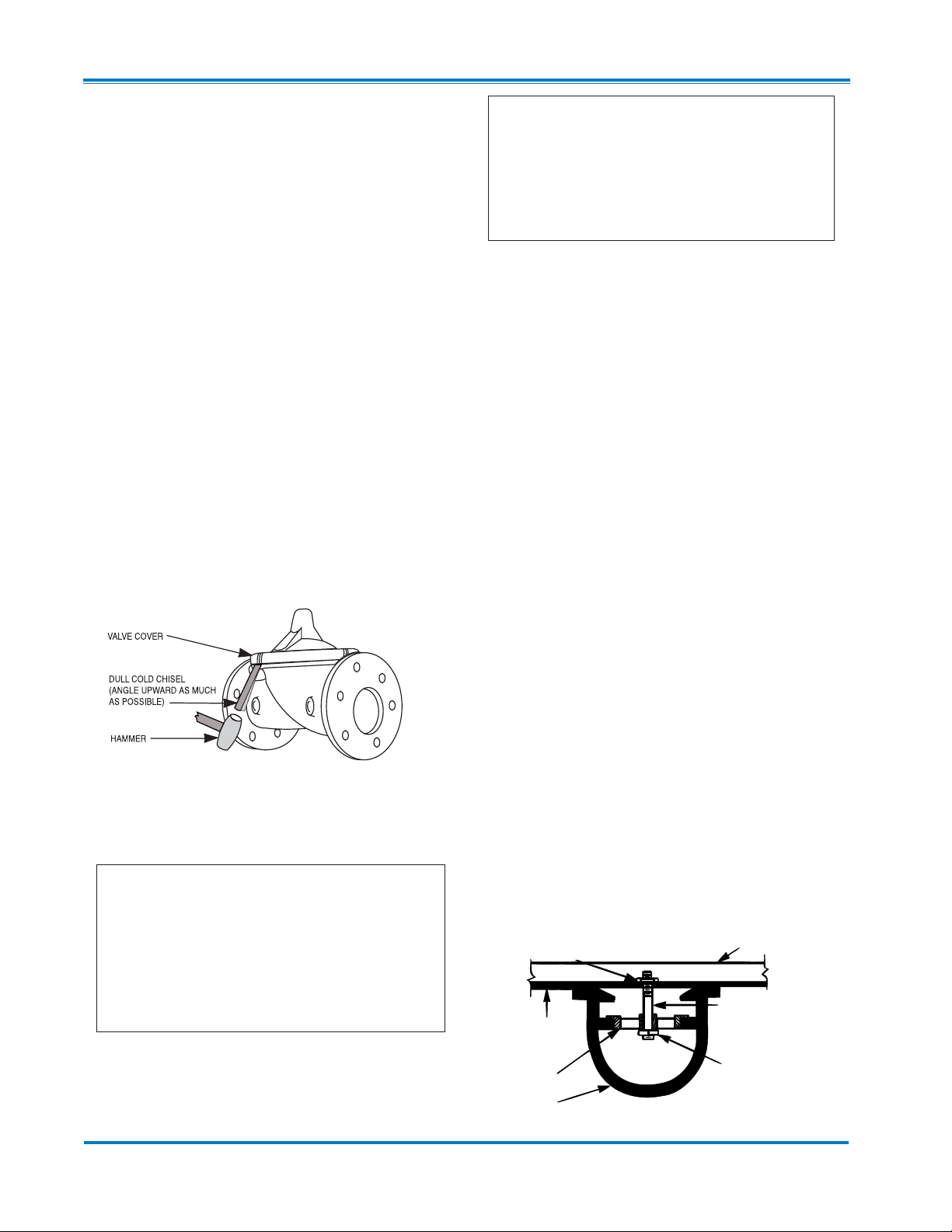
3. Remove cover nuts and remove cover. If the valve has been in
service for any length of time, chances are the cover will have to be
loosened by driving upward along the edge of the cover with a dull
cold chisel.
VALVE STEM THREAD SIZE
Valve Size Thread Size (UNF Internal)
1 1/4"
—2 1/2" 10—32
3"—4" 1/4—28
6"—14" 3/8—24
16" 1/2—20
24" 3/4-16
30” 3/4-16
36” 3/4-16
5. The next item to remove is the stem nut. Examine the stem
threads above the nut for signs of mineral deposits or corrosion.
If the threads are not clean, use a wire brush to remove as much
of the residue as possible. Attach a good fitting wrench to the nut
and give it a sharp “rap” rather than a steady pull. Usually
several blows are sufficient to loosen the nut for further removal.
On the smaller valves, the entire diaphragm assembly can be held
by the stem in a vise equipped with soft brass jaws before
removing the stem nut.
The use of a pipe wrench or a vise without soft brass jaws scars
the fine finish on the stem. No amount of careful dressing can
restore the stem to its original condition. Damage to the finish of
the stem can cause the stem to bind in the bearings and the valve
will not open or close.
6. After the stem nut has been removed, the diaphragm assembly
breaks down into its component parts. Removal of the disc from
the disc retainer can be a problem if the valve has been in service for a long time. Using two screwdrivers inserted along the outside edge of the disc usually will accomplish its removal. Care
should be taken to preserve the spacer washers in water, particularly if no new ones are available for re-assembly.
7. The only part left in the valve body is the seat which ordinarily
does not require removal. Careful cleaning and polishing of inside
and outside surfaces with 400 wet/dry sandpaper will usually
restore the seat’s sharp edge. If, however, it is badly worn and
replacement is necessary, it can be easily removed.
Seats in valve sizes 1 1/4” through 6” are threaded into the valve
body. They can be removed with accessory X109 Seat Removing
Tool available from the factory. On 8” and larger valves, the seat
On 6” and smaller valves block and tackle or a power hoist can be
used to lift valve cover by inserting proper size eye bolt in place of
the center cover plug. on 8” and larger valves there are 4 holes (5/8”
— 11 size) where jacking screws and/or eye bolts may be inserted
for lifting purposes. Pull cover straight up to keep from damaging
the integral seat bearing and stem.
COVER CENTER PLUG SIZE
Valve Size Thread Size (NPT)
1 1/4"
—1 1/2" 1/4"
2"—3" 1/2"
4"—6" 3/4"
8"—10" 1"
12" 1 1/4"
14" 1 1/2"
16" 2"
24" 2"
30” & 36” 2”
4. Remove the diaphragm and disc assembly from the valve body.
With smaller valves this can be accomplished by hand by pulling
straight up on the stem so as not to damage the seat bearing.
On large valves, an eye bolt of proper size can be installed in the
stem and the diaphragm assembly can be then lifted with a block and
tackle or power hoist. Take care not to damage the stem or bearings.
The valve won't work if these are damaged.
is held in place by flat head machine screws. Use a tight-fitting,
long shank screwdriver to prevent damage to seat screws. If upon
removal of the screws the seat cannot be lifted out, it will be necessary to use a piece of angle or channel iron with a hole drilled
in the center. Place it across the body so a long stud can be inserted through the center hole in the seat and the hole in the angle
iron. By tightening the nut a uniform upward force is exerted on
the seat for removal.
NOTE: Do not lift up on the end of the angle iron as this may force
the integral bearing out of alignment, causing the stem to bind.
Page 10

Lime Deposits
Inspection of Parts
One of the easiest ways to remove lime deposits from the valve
stem or other metal parts is to dip them in a 5-percent muriatic
acid solution just long enough for the deposit to dissolve. This
will remove most of the common types of deposits. CAUTlON:
USE EXTREME CARE WHEN HANDLING ACID. Rinse parts in
water before handling. If the deposit is not removed by acid, then
a fine grit (400) wet or dry sandpaper can be used with water.
Reassembly
1. Reassembly is the reverse of the disassembly procedure. If a
new disc has been installed, it may require a different number of
spacer washers to obtain the right amount of “grip” on the disc.
When the diaphragm assembly has been tightened to a point
where the diaphragm cannot be twisted, the disc should be compressed very slightly by the disc guide. Excessive compression
should be avoided. Use just enough spacer washers to hold the
disc firmly without noticeable compression.
2. MAKE SURE THE STEM NUT IS VERY TIGHT. Attach a good
fitting wrench to the nut and give it a sharp “rap” rather than a
steady pull. Usually several blows are sufficient to tighten the
stem nut for final tightening. Failure to do so could allow the
diaphragm to pull loose and tear when subjected to pressure.
After the valve has been disassembled, each part should be
examined carefully for signs of wear, corrosion, or any other
abnormal condition. Usually, it is a good idea to replace the rubber parts (diaphragm and disc) unless they are free of signs of
wear. These are available in a repair kit. Any other parts which
appear doubtful should be replaced. WHEN ORDERlNG
PARTS, BE SURE TO GIVE COMPLETE NAMEPLATE DATA,
ITEM NUMBER AND DESCRlPTlON.
NOTE: If a new disc isn’t available, the existing disc can be
turned over, exposing the unused surface for contact with the
seat. The disc should be replaced as soon as practical.
3. Carefully install the diaphragm assembly by lowering the stem
through the seat bearing. Take care not to damage the stem or
bearing. Line up the diaphragm holes with the stud or bolt holes
on the body. on larger valves with studs, it may be necessary to
hold the diaphragm assembly up part way while putting the
diaphragm over the studs.
4. Put spring in place and replace cover. Make sure diaphragm
is Iying smooth under the cover.
5. Tighten cover nuts firmly using a cross-over pattern until all
nuts are tight.
6. Test Hytrol Valve before re-installing pilot valve system.
Test Procedure After Valve Assembly
There are a few simple tests which can be made in the field to
make sure the Hytrol Valve has been assembled properly. Do
these before installing pilot system and returning valve to
service. These are similar to the three troubleshooting tests.
1. Check the diaphragm assembly for freedom of movement
after all pressure is removed from the valve. SEE CAUTlON.
Insert fabricated tool into threaded hole in top of valve stem, and
lift the diaphragm assembly manually. Note any roughness,
sticking or grabbing. The diaphragm assembly should move
smoothly throughout entire valve stroke. The tool is fabricated
from rod that is threaded on one end to fit valve stem (See chart
in Step 4 of “Disassembly” section.) and has a “T” Bar handle of
some kind on the other end for easy gripping.
Place marks on this diaphragm assembly lifting tool when the
valve is closed and when manually positioned open. The distance between the two marks should be approximately the stem
travel shown in stem travel chart. (See “Freedom of Movement
Check” section.) If the stroke is different than that shown, there
is a good reason to believe something is mechanically restricting
the stroke of the valve. The cover must be removed, the obstruction located and removed. (See “Maintenance” Section for
procedure.)
Due to the weight of the diaphragm assembly this procedure is
not possible on valves 8” and larger. on these valves, the same
determination can be made by carefully introducing a low
pressure-less than five psi) into the valve body with the cover
vented. SEE CAUTION. Looking in cover center hole see the
diaphragm assembly lift easily without hesitation, and then
settle back easily when the pressure is removed.
2. To check the valve for drip-tight closure, a line should be
connected from the inlet to the cover, and pressure applied at the
inlet of the valve. If properly assembled, the valve should hold
tight with as low as ten PSI at the inlet. See “Tight Sealing
Check” section.)
3. With the line connected from the inlet to the cover, apply full
working pressure to the inlet. Check all around the cover for any
leaks. Re-tighten cover nuts if necessary to stop leaks past the
diaphragm.
4. Remove pressure, then re-install the pilot system and tubing
exactly as it was prior to removal. Bleed air from all high
points.
5. Follow steps under “Start-Up and Adjustment” Section in
Technical Manual for returning complete valve back to service
.
5
Page 11
1
5
8
10
14
16
6
17
7
9
OUTLETINLET
GLOBE PATTERN
9
26
27
12
15
14
16
INLET
OUTLET
ANGLE PATTERN
22
23
13
12
14
10
11
15
23
TOP VIEW
8" - 24" SEAT DETAIL
1 1/4" - 6" SEAT DETAIL
16" COVER DETAIL
4
24
2
25
13
31
28
30
29
5
14
3
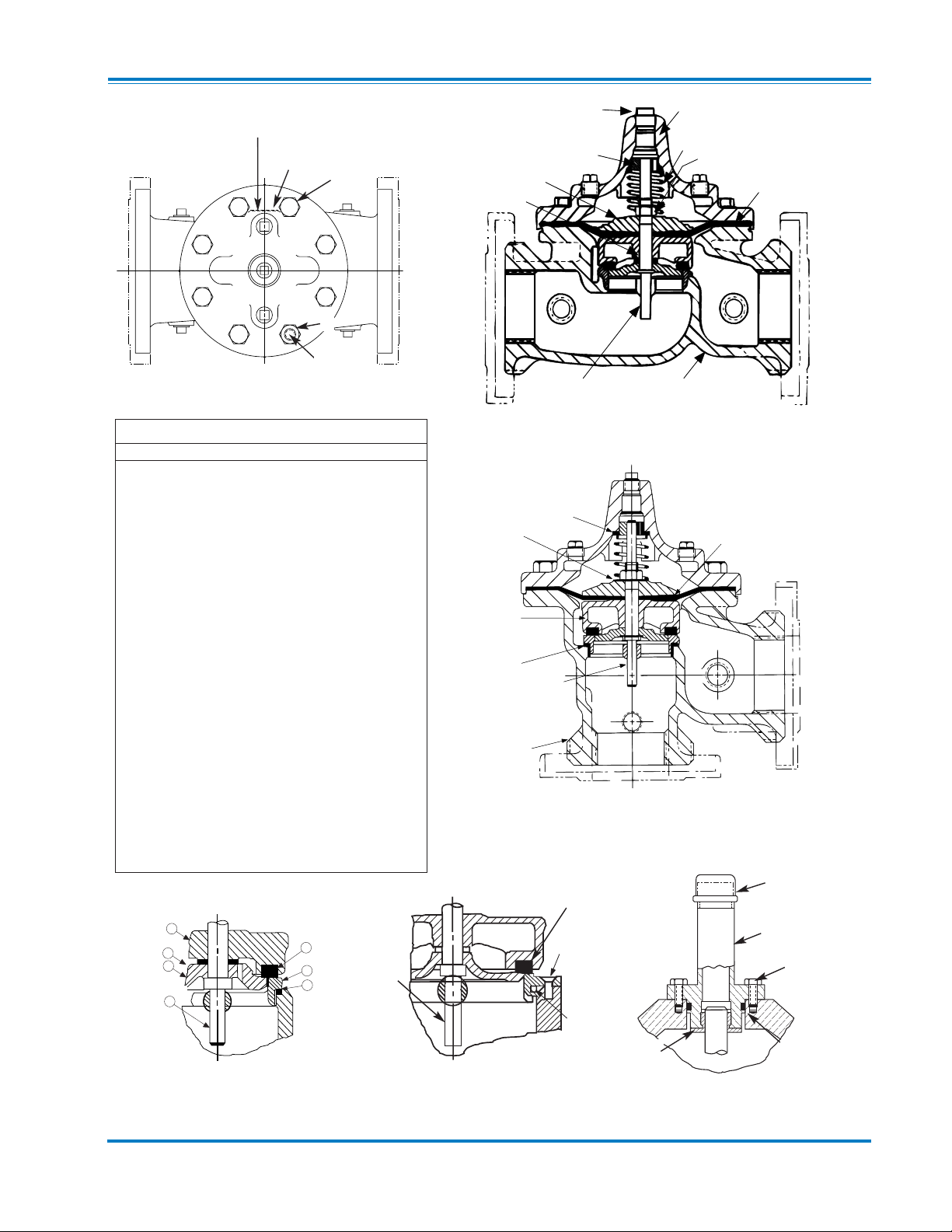
Item Description
1. Pipe Plug
2. Drive Screws (for nameplate)
3. Hex Nut (8” and larger)
4. Stud (8” and larger)
5. Cover Bearing
6. Cover
7. Stem Nut
8. Diaphragm Washer
9. Diaphragm
10. Spacer Washers
11. Disc Guide
12. Disc Retainer
13. Disc
14. Stem
15. Seat
16. Body
17. Spring
22. Flat Head Screws (8” and larger)
23. Seat O-Ring
24. Hex head Bolt (1 1/4” thru 4”)
25. Nameplate
26. Upper Spring Washer (Epoxy coated valves only)
27. Lower Spring Washer (Epoxy coated valves only)
28. Cover Bearing Housing (16” only)
29. Cover O-Ring (16’” only)
30. Hex Bolt (16” only)
31. Pipe Cap (16” only)
PARTS LIST
6
Page 12

100-01
Hytrol Valve Service Data
MODEL
INSTALLATION / OPERATION / MAINTENANCE
Description 100-01 Hytrol Valve
The CIa-VaI Model 100-01 Hytrol Valve is a main valve for
CIa-VaI Automatic Control Valves. It is a hydraulically operated,
diaphragm-actuated, globe or angle pattern valve.
This valve consists of three major components; body, diaphragm
assembly, and cover. The diaphragm assembly is the only
moving part. The diaphragm assembly uses a diaphragm of nylon
fabric bonded with synthetic rubber. A synthetic rubber disc,
contained on three and one half sides by a disc retainer and disc
guide, forms a seal with the valve seat when pressure is applied
above the diaphragm. The diaphragm assembly forms a sealed
chamber in the upper portion of the valve, separating operating
pressure from line pressure.
Description 100-20 600 Series Hytrol Valve
The CIa-VaI Model 100-20 Hytrol Valve (600 Series main valve)
have only one part -the body- that is different from standard 100
Series Cla-Val main valve parts. The remaining parts of the 600
series main valve are standard Cla-Val main valve parts.
All service and maintenance information for the standard 100
Series main valves also apply to the 600 series main valves.
The most important thing to remember when ordering main
valve repair kits and replacement parts, except for the body, all
other parts are going to be for a smaller size main valve. ClaVal identifies main valve parts with the flange size of the standard 100 Series main valve. Refer to the "Main Valve Sizes”
chart below.
1”
1 1/4”
1 1/2”
2”
2 1/2”
3”
4”
6”
8”
10”
12”
14”
16”
24”
25
32
40
50
65
80
100
150
200
250
300
350
400
600
100-01
HYTROL SIZE Stem
Travel
Cover Capacity
Displacement
Valve Stem
Thread
UNF-Internal
Cover
Center
Plug NPT
4”
6”
8”
10”
12”
16”
20”,24”
100
150
200
250
300
400
600
0.3
0.4
0.4
0.6
0.7
0.8
1.1
1.7
2.3
2.8
3.4
3.9
4.5
6.5
8
10
10
15
18
20
23
43
58
71
86
99
114
165
0.020
0.020
0.032
0.043
0.080
0.169
0.531
1.26
2.51
4.0
6.5
9.5
29.0
0.07
0.07
0.12
0.16
0.30
0.64
2.00
4.80
9.50
15.10
24.60
36.20
108.80
1/4”
1/4”
1/4”
1/2”
1/2”
1/2”
3/4”
3/4”
1”
1”
1 1/4”
1 1/2”
2”
3/4”
1/4” - 20 (B)
5/16” - 18 (B)
5/16” - 18 (B)
3/8” - 16 (B)
7/16” - 14 (B)
1/2” - 13 (B)
3/4” - 10 (B)
3/4” - 10 (B)
3/4” - 10
7/8” - 9
1-1/8” -7
1-1/4” -7
1-1/4” -7
1-1/2” -12
10-32
10-32
10-32
10-32
1/4 - 28
1/4 - 28
3/8 - 24
3/8 - 24
3/8 - 24
3/8 - 24
3/8 - 24
1/2 - 20
3/4 - 16 *
100-20
Thread
(Bolt)
7/16”
1/2”
1/2”
9/16”
5/8”
3/4”
1 1/8”
1 1/8”
1 1/4”
1 7/16
1 13/16
2”
2”
2 3/8”
Socket
5/8” - 11
3/4” - 10
3/4” - 10
1” - 8
1” - 8
1-1/8” 7
Cover
Lifting
Holes UNC
Liters
8
8
8
8
8
8
8
12
16
20
20
20
20
24
Qty
3/8”
1/2”
1/2”
3/4”
3/4”
1”
1”
1”
1”
1”
1”
Thread
3/8” - 24
7/16” 20
7/16” 20
1/2” - 20
5/8” - 18
5/8” - 18
3/4” - 16
7/8” - 14
1 1/8” - 12
1 1/2” - 12
1 1/2” - 12
1 1/2” - 12
2” - 16
3” - 12
Thread
3/4”
15/16”
15/16”
1 1/16”
1 5/16”
1 13/16”
1 7/8”
2 1/2”
2 1/2”
3”
Special
Socket
(Long)
7/16”
9/16”
9/16”
5/8”
5/8”
13/16”
13/16”
13/16”
13/16”
13/16”
13/16”
Socket
4
8
8
12
20
30
110
110
110
160
390
545
545
800
ft. Lbs.
48
96
96
in. Lbs.
4
6
6
10
21
21
40
85
125
250
270
280
500
1350
Lubed
6
10
10
15
30
30
60
125
185
375
400
420
750
N/R
DRY
Gallonsmmmm mm inchesinches inches
Cover Nut or Bolt Cover Plug Cover Torque Stem Nut ** Stem Nut Torque
(ft Lbs)
Grade 5 Bolts
“Heavy” Grade Nuts
Tighten cover nuts in a “star” cross-over pattern
* Adapter p/n 2594101E
inside 1/4” - 28
**Must Use ONLY
Cla-Val Supplied part
HYTROL Service Data
Page 13

CLA-VAL
Copyright Cla-Val 2008 Printed in USA Specifications subject to change without notice.
P.O. Box 1325 • Newport Beach, CA 92659-0325 • Phone: 949-722-4800 • Fax: 949-548-5441 • E-mail: claval@cla-val.com • Website cla-val.com
©
N-100-01 (R-12/07)
BOLT/NUT TORQUING PROCEDURES ON VALVE COVERS
4
BOLTS
6
BOLTS
8
BOLTS
12
BOLTS
16
BOLTS
20
BOLTS
4
3
2
1
65
4
3
2
1
8
7
6
5
4
3
2
1
0
9
8
7
6
5
3
2
1
12
11
10
9
8
7
6
5
4
3
2
1
16
15
14
13
12
11
10
9
8
7
6
5
4
3
2
1
20
19
18
17
16
15
14
13
12
11
Follow this procedure when reassembling MAIN Valve:
1. Tightens bolts/nuts in a “Star” or “Cross-Over” Pattern following the
numbers shown above to insure that cover seats evenly on the diaphragm
material and body.
2. Torque the bolt/nuts in three stages:
A. To approximately 10% of final torque valve.
B. To approximately 75% of final torque valve.
C. To final required torque valve.
3. Valves that are to be tested to 375 PSI or higher should be retorqued
after 24 hours.
COVER
PIPE PLUG
COVER BEARING
SPRING
STEM NUT
DIAPHRAGM WASHER
DISC RETAINER
BODY
*
SPACER WASHERS
DISC GUIDE
SEAT
PIPE PLUG
STEM
SEAT O-RING
STUD
8" and Larger
*
DIAPHRAGM
*
DISC
*
Repair Parts
Seat Screw
8" and Larger
(Globe
or
Angle)
PIPE PLUG
HEX NUT
8" and Larger
Cover Bolt
6" and Smaller
KO
DISC GUIDE
KO
SEAT
KO Anti-Cavitation
Trim Option
100-01 Hytrol Main Valve Assembly
Page 14

UNDERSTANDING THE 600 SERIES VALVES
In 1987, Cla-Val introduced the Model 100-20 Hytrol as the basic
main valve for the 600 Series of automatic control valves. To
identify all new valves using the 100-20 Hytrol, an existing catalog number is modified. Making a 600 Series catalog number is
simply done by using a "6" in front of the two digit catalog numbers or replacing the "2" with a "6" in three digit catalog numbers. Current schematics reflect both catalog numbers together
separated by a slash ( i.e. - 90-01/690-01, 58-02/658-02, 21001/610-01, etc). Since these two valves 'share' the same catalog
number and schematic, they provide the same function in a system. The only difference between the two valves is the relative
capacity of the two main valve series.
The 100-01 Hytrol is the basic main valve for Cla-Val automatic
control valves. This valve is the current version of the Clayton
Hytrol valve design originated in 1936. The 100-01 Hytrol is
designed as a full flow area valve. This means that the inlet,
seat and outlet openings are the same size. Thus, the pressure
drop is kept to a minimum for this globe style design.
The 100-20 Hytrol valve has all of the basic features and advantages of the original 100-01 Hytrol. Only one part has been
changed - the body. It is designed with different size inlet, seat
and outlet openings. The 100-20 Hytrol has inlet and outlet
flanges one valve size larger than the seat opening size. This
results in what is sometimes called a ''reduced port' main valve.
For example, a 4" 100-20 valve has a 3" seat. Note: valve size
is always determined by the flange size. The following chart
compares the 100-01 and the 100-20 main valves.
600 Series Hytrol Valve
100-20
MODEL
INSTALLATION / OPERATION / MAINTENANCE
SERVICE AND MAINTENANCE OF 600 SERIES
VALVES
The 600 series main valves have only one part -the body- that is
different from standard 100 Series Cla-Val main valve parts. The
remaining parts of the 600 series main valve are standard ClaVal main valve parts. All service and maintenance information
for the standard 100 Series main valves in this manual also
apply to the 600 series main valves.
The most important thing to remember when ordering main valve
repair kits and replacement parts, except for the body, all other
parts are going to be for a smaller size main valve. Cla-Val identifies main valve parts with the flange size of the standard 100
Series main valve. Refer to the "Main Valve Sizes Comparison"
chart. For example, if you are servicing a 6" 100-20 Hytrol and
needed a repair kit, you would order a repair kit for a 4" 100-01
Hytrol. This kit is also suitable for a 6" 100-20 Hytrol. Complete
Technical Manuals include a repair kit data sheet N-RK that
shows this relationship.
When you order repair parts, it is a good idea to include valve
nameplate data (size, catalog number, and part number) and
description of the parts desired. Do this to be sure parts will fit
the valve you are working on and not be too big for it. Pilot controls and repair kits maintenance information remain the same
for 100 or 600 Series valves.
Cla-Val Main Valves
Catalog Number
The 100-20 Hytrol is available only in ductile iron, 150 and 300
pressure class, and Bronze trim standard. Available extra cost
main valve options include stainless steel trim, epoxy coating,
Dura-Kleen stem, Delrin sleeved stem, and high temperature rubber parts. All four basic main valves have a 600 Series version
available with all of the same benefits and size relationships.
The following chart shows the relationship of Cla-Val main valve
catalog numbers.
Catalog Name
Hytrol
Powertrol
Powercheck
Hycheck
Circa 1936
100 (Angle =2100)
100P & 100PA
100PC & 100PCA
181
100-Series
100-01
100-02
100-03
100-04
600 Series
100-20
100-21
100-22
100-23
(Reduced Internal Port)
Basic Main Valve Size Comparison
Globe Pattern Valves
Flange Size (inch)
Seat Size
100-01 (100 Series) 100-20 (600 Series)
3 3 2
4 4 3
6 6 4
8 8 6
10 10 8
12 12 10
14 14 ---16 16 12
20 ---- 16
24 24 16
30 30 24
36 36 30
42 ---- 36
48 ---- 36
Angle Pattern Valves
Flange Size (inch)
Seat Size
100-01 (100 Series) 100-20 (600 Series)
4 4 3
6 6 4
8 8 6
Page 15

CLA-VAL
Copyright Cla-Val 2008 Printed in USA Specifications subject to change without notice.
P.O. Box 1325 • Newport Beach, CA 92659-0325 • Phone: 949-722-4800 • Fax: 949-548-5441 • E-mail: claval@cla-val.com • Website cla-val.com
©
N-100-20 (R-1/08)
100-20
PARTS LIST
NO. DESCRIPTION
1 Pipe Plug
2 Drive Screws (for nameplate)
3 Hex Nut (8" and larger)
4 Stud (8" and larger)
5 Cover Bearing
6 Cover
7 Stem Nut
8 Diaphragm Washer
9 Diaphragm
10 Spacer Washers
11 Disc Guide
12 Disc Retainer
13 Disc
14 Stem
15 Seat
16 Body
17 Spring
22 Flat Head Screws (10" and larger)
23 Seat O-Ring
24 Hex Bolt (3 " Thru 6")
25 Nameplate (Mounted on inlet flange)
26 Upper Spring Washer (Epoxy coated valves only)
27 Lower Spring Washer (Epoxy coated valves only)
28 Cover Bearing Housing (20" & 24" & 30")
29 Cover Bearing Housing O-Ring (20"& 24" & 30")
30 Hex Bolt (20" & 24")
31 Pipe Cap (20" & 24 & 30"")
11
14
1 24 3 4
5
17
16
26
14
7
8
9
27
14
13
22
12
15
31
28
5
30
29
10" — 24" SEAT DETAIL
20" — 24" COVER DETAIL
TOP VIEW
12
13
15
OUTLET
GLOBE
INLET
ANGLE
INLET
6
8
9
2
25
3" — 6" COVER DETAIL
23
11
WHEN ORDERING PARTS, BE SURE TO GIVE COMPLETE
NAMEPLATE DATA, ITEM NUMBER AND DESCRIPTION.
10
Page 16
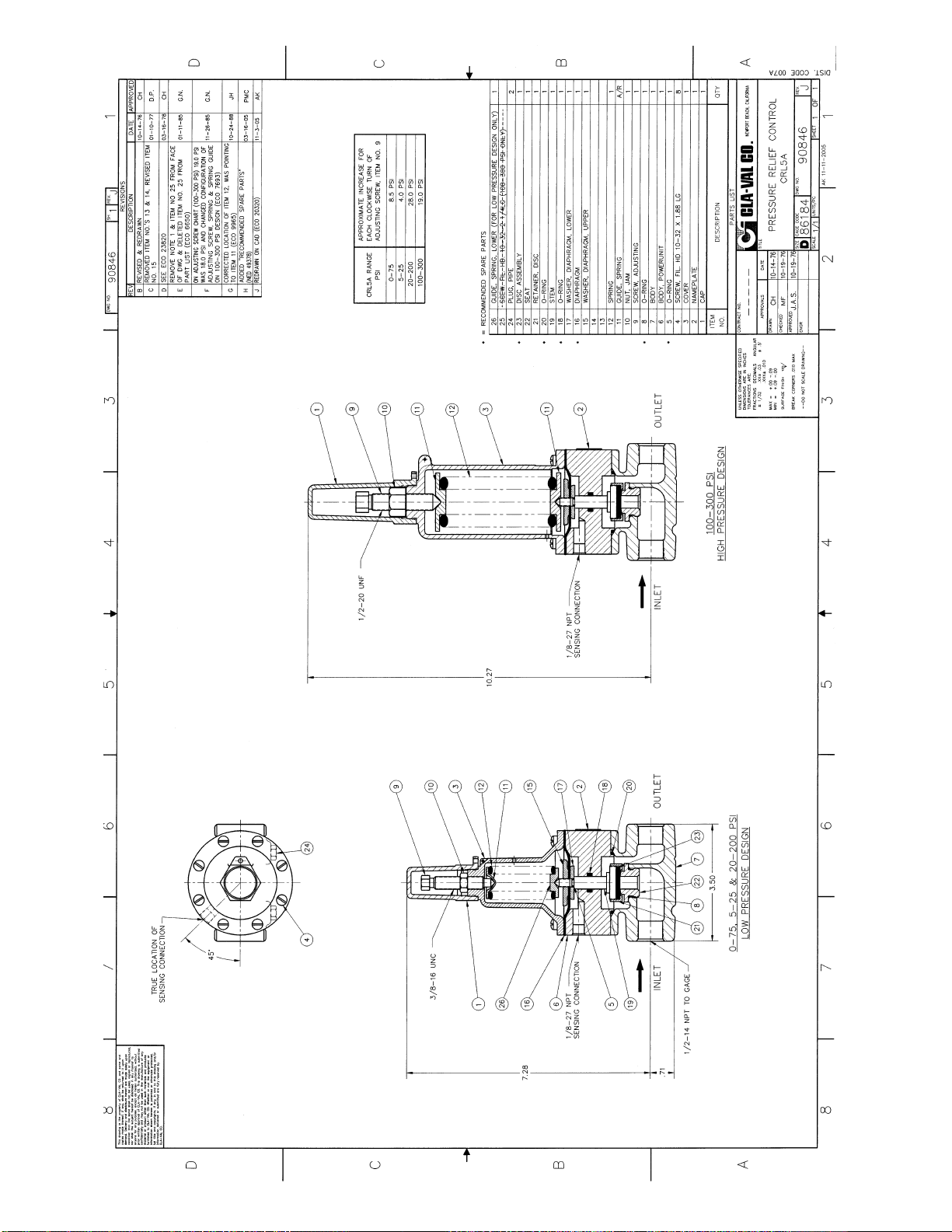
Page 17
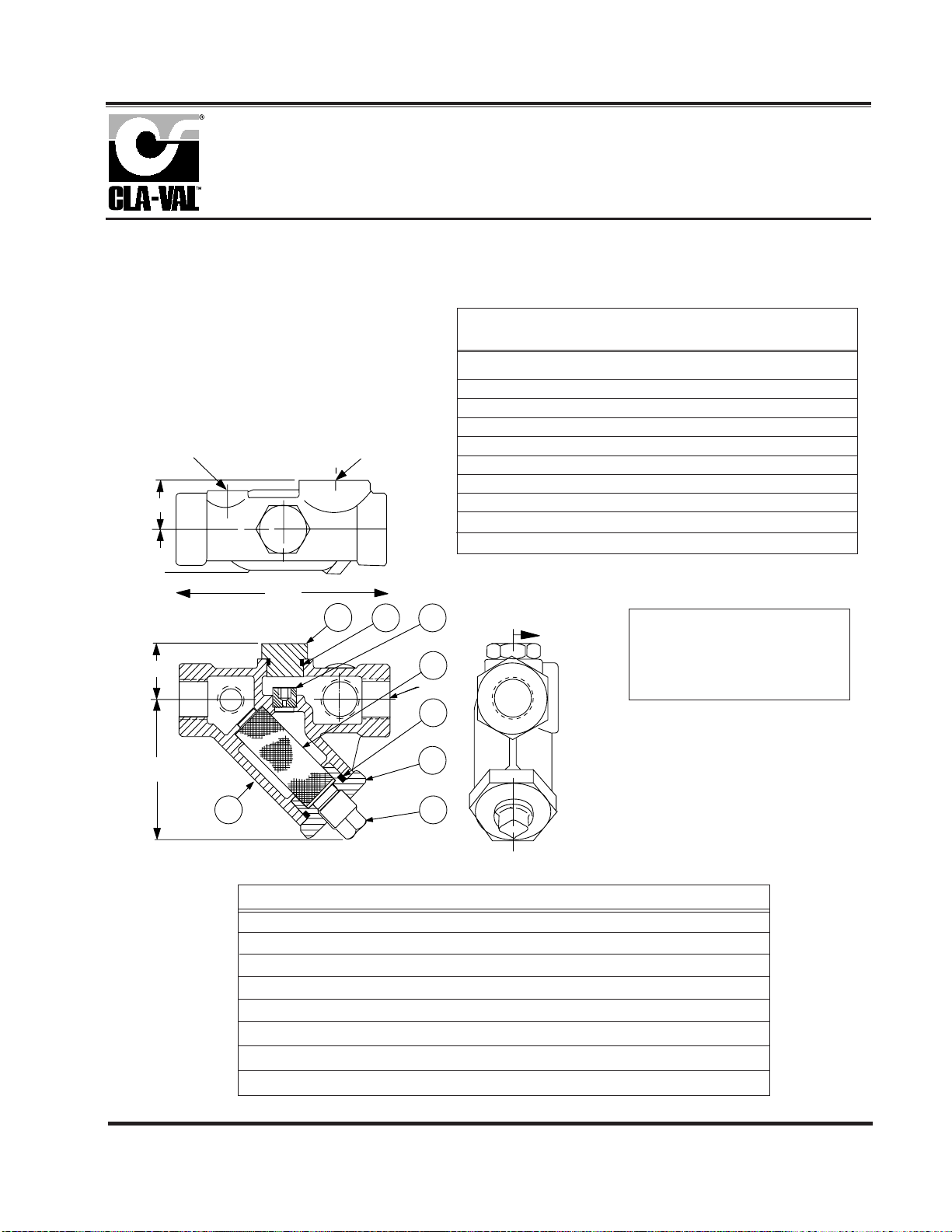
When ordering parts, please specify:
• All Nameplate Data
• Item Number
• Description
• Recommended Spare Parts
Strainer and Orifice Assembly
X44A
BRONZE BODY — S.S. ORIFICE
1/8 NPT
3/8 NPT
3/4
3/4
3 3/8
2
3
5
4
3/8 NPT
8
7
6
1
2 1/4 MAX.
7/8
Inlet
Outlet
X44A
STOCK NO.
71310-01
-02
-03
-04
-05
-06
* -07
-08
-09
-10
ORIFICE DIA.
.031
.046
.062
.078
.093
.109
.125
.140
.156
.187
ORIFICE PLUG
PART # (ITEM 5)
94132-01
-02
-03
-04
-05
-06
-07
-08
-09
-10
*Standard
3/8" x 3/8"
ITEM
1
2
3
4
5
6
7
8
DESCRIPTION
Body
Plug, Top
"O" Ring, Plug Top
Screen
Orifice Plug
Plug, Pipe
Strainer Plug
"O" Ring, Strainer Plug
MATERIAL
Red Brs.
Brass
Syn. Rub.
Monel
Delrin
Brass
S.S.
Syn. Rub.
QTY.
1
1
1
1
1
1
1
1
CLA-VAL
Copyright Cla-Val 2008 Printed in USA Specifications subject to change without notice.
P.O. Box 1325 • Newport Beach, CA 92659-0325 • Phone: 949-722-4800 • Fax: 949-548-5441 • E-mail: claval@cla-val.com • Website cla-val.com
©
P-X44A (R-1/08)
PARTS LIST
Page 18
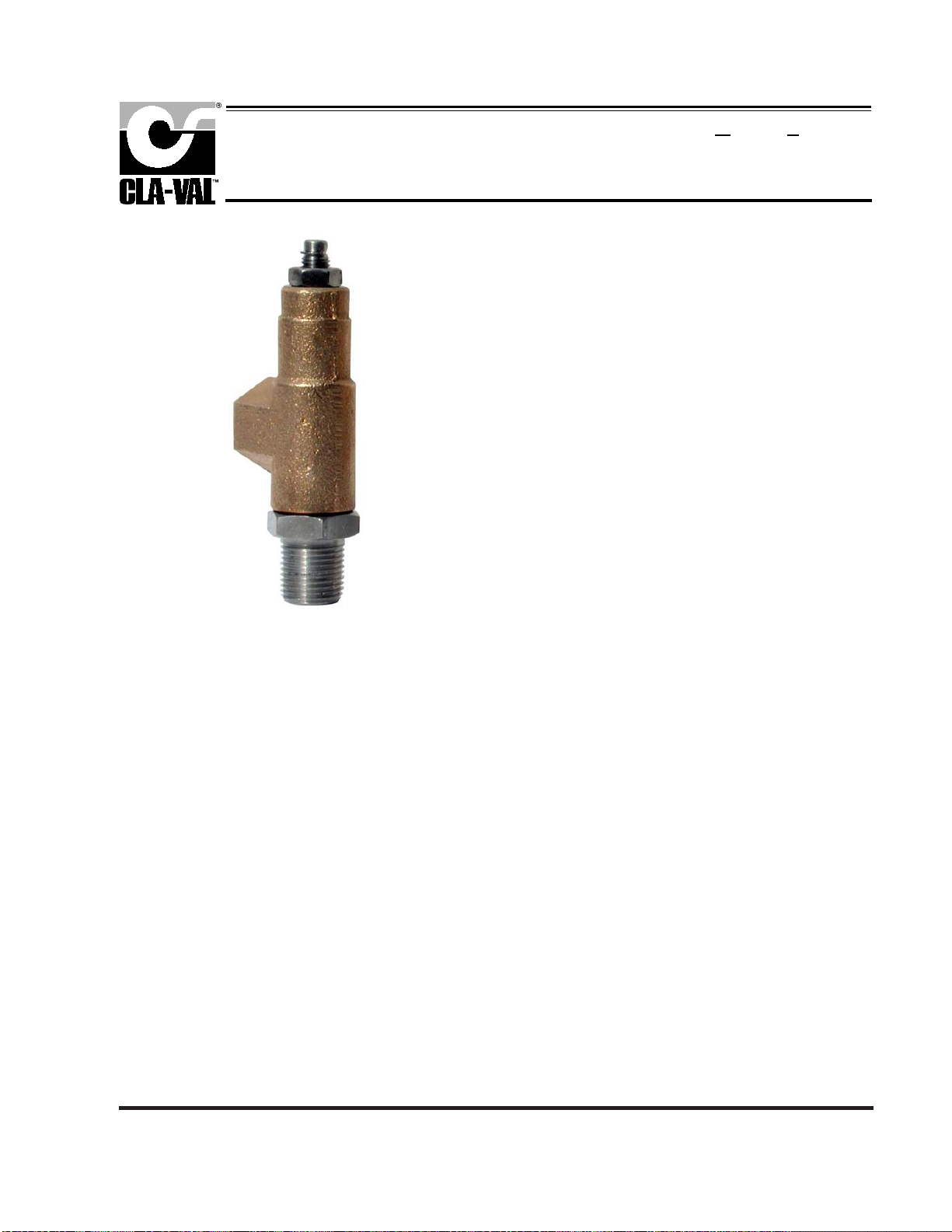
CLA-VAL
Copyright Cla-Val 2008 Printed in USA Specifications subject to change without notice.
P.O. Box 1325 • Newport Beach, CA 92659-0325 • Phone: 949-722-4800 • Fax: 949-548-5441 • E-mail: claval@cla-val.com • Website cla-val.com
©
INSTALLATION / OPERATION / MAINTENANCE
Flow Control
CV
MODEL
N-CV (R-1/08)
DESCRIPTION
The Cla-Val Model CV Flow Control is a simply-designed,
spring-loaded check valve. Rate of flow is full flow in one direction and restricted in other direction. Flow is adjustable in the
restricted direction. It is intended for use in conjunction with a
pilot control system on a Cla-Val Automatic Control Valve.
OPERATION
The CV Flow Control permits full flow from port A to B, and
restricted flow in the reverse direction. Flow from port A to B
lifts the disc from seat, permitting full flow. Flow in the reverse
direction seats the disc, causing fluid to pass through the clearance between the stem and the disc. This clearance can be
increased, thereby increasing the restricted flow, by screwing
the stem out, or counter-clockwise. Turning the stem in, or
clockwise reduces the clearance between the stem and the
disc, thereby reducing the restricted flow.’
INSTALLATION
Install the CV Flow Control as shown in the valve schematic
All connections must be tight to prevent leakage.
DISASSEMBLY
Follow the sequence of the item numbers assigned to the
parts in the cross sectional illustration for recommended
order of disassembly.
Use a scriber, or similar sharp-pointed tool to remove O-ring
from the stem.
INSPECTION
Inspect all threads for damage or evidence of crossthreading. Check mating surface of seat and valve disc for
excessive scoring or embedded foreign particles. Check
spring for visible distortion, cracks and breaks. Inspect all
parts for damage, corrosion and cleanliness.
CLEANING
After disassembly and inspection, cleaning of the parts can
begin. Water service usually will produce mineral or lime
deposits on metal parts in contact with water. These
deposits can be cleaned by dipping the parts in a 5-percent
muriatic acid solution just long enough for deposits to dissolve. This will remove most of the common types of
deposits. Caution: use extreme care when handling
acid. If the deposit is not removed by acid, then a fine grit
(400) wet or dry sandpaper can be used with water. Rinse
parts in water before handling. An appropriate solvent can
clean parts used in fueling service. Dry with compressed air
or a clean, lint-free cloth. Protect from damage and dust
until reassembled.
REPAIR AND REPLACEMENT
Minor nicks and scratches may be polished out using a fine
grade of emery or crocus cloth; replace parts if scratches
cannot be removed.
Replace O-ring packing and gasket each time CV Flow
Control is overhauled.
Replace all parts which are defective. Replace any parts
which create the slightest doubt that they will not afford completely satisfactory operation. Use Inspection steps as a
guide.
REASSEMBLY
Reassembly is the reverse of disassembly; no special tools
are required.
TEST PROCEDURE
No testing of the flow Control is required prior to reassembly
to the pilot control system on Cla-Val Main Valve.
Page 19
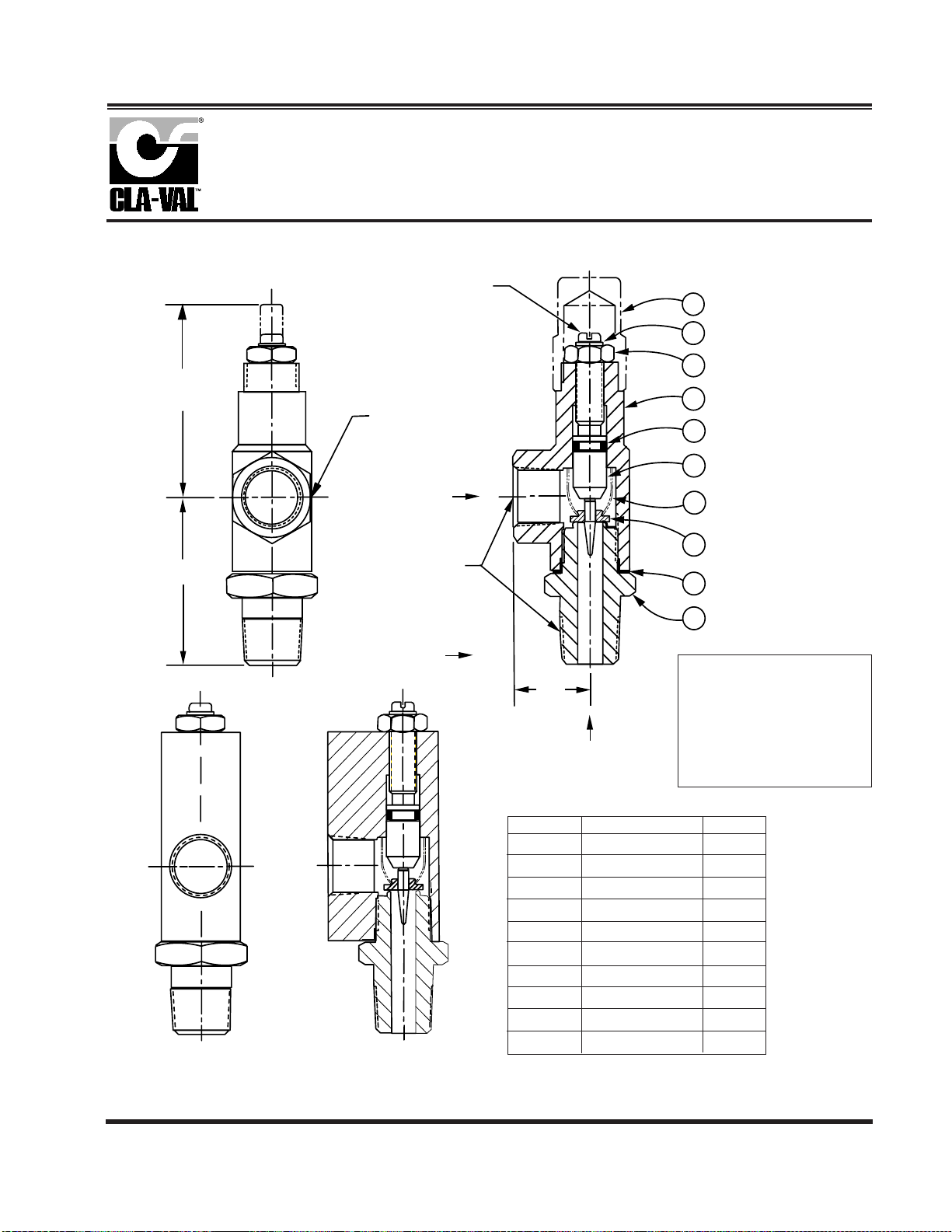
2.12
CLA-VAL
Copyright Cla-Val 2008 Printed in USA Specifications subject to change without notice.
P.O. Box 1325 • Newport Beach, CA 92659-0325 • Phone: 949-722-4800 • Fax: 949-548-5441 • E-mail: claval@cla-val.com • Website cla-val.com
©
PL-CV (R-1/08)
PARTS LIST
MAX
1.84
ADJUSTING STEM
(TURN CLOCKWISE TO
INCREASE RESTRICTION)
STAMP PART NO. ON
SMOOTH SURFACE
RESTRICTED
FLOW
3/8 - 18 NPT
CV
3/8" Flow Control
1
7
2
10
9
8
6
5
4
BAR STOCK
CONFIGURATION
3
When ordering parts,
.85
FREE FLOW
ITEM DESCRIPTION QTY
1 Cap (SS only) 1
2 Nut, Jam 1
3 Seat 1
4 Gasket 1
5 Disc 1
6 Spring 1
7 Ring, Retaining 1
8 Stem 1
9 O-Ring 1
10 Housing 1
please specify:
• Number Stamped on Side
• Description (CV Flow Control)
• Part Description
• Material
Page 20
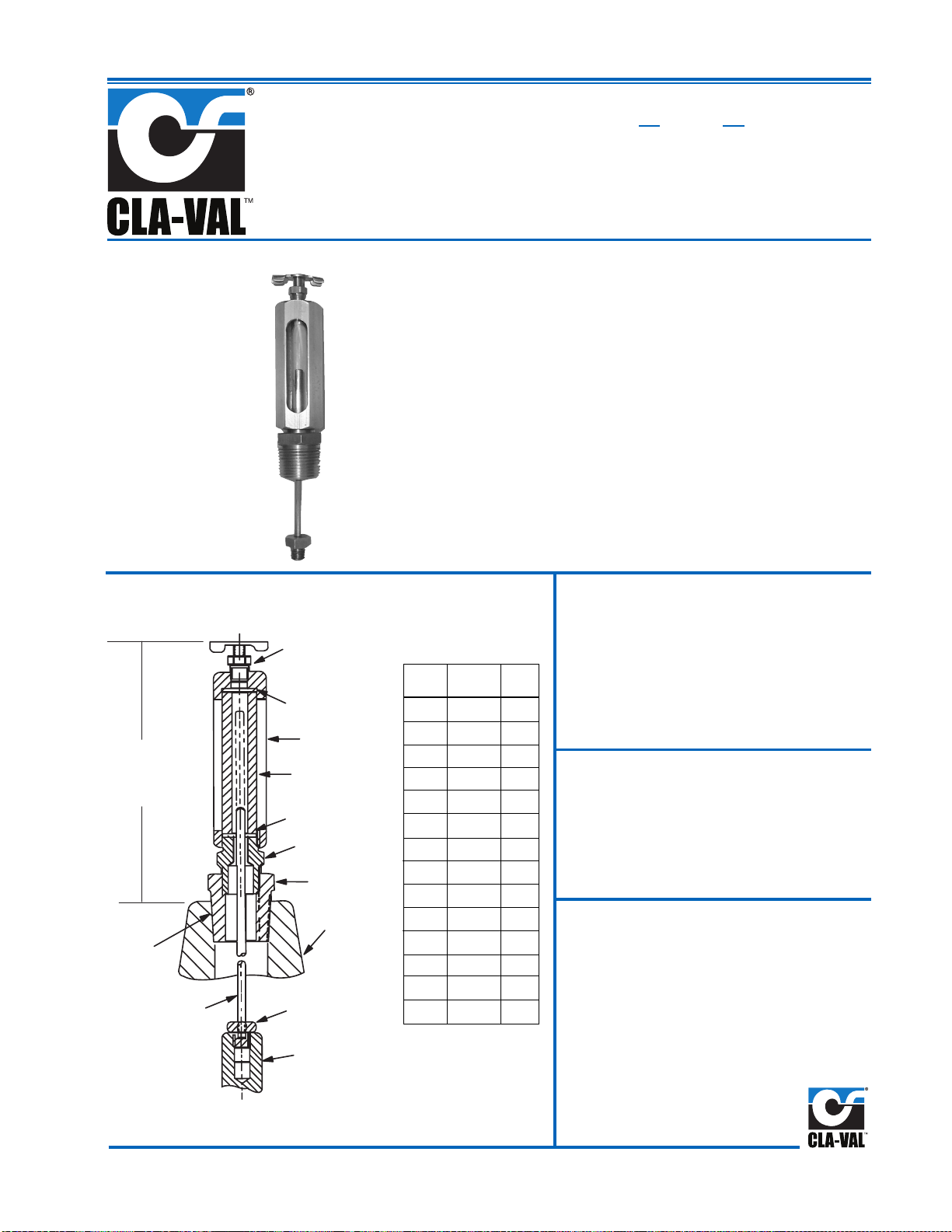
Valve Position Indicator
& Pilot System Components
When Ordering, Please Specify
1. Valve Size
2. Catalog No. X101
3. Valve Series No. (Appears on Valve Nameplate)
4. Optional Material
Stainless Steel
A
Vent Valve
Closed
B
NPT
Sight Tube
Stem
Gasket
Adapter
Bushing
Valve Cover
Stem Adapter
Valve Stem
Housing
Gasket
Vent Valve
X101
MODEL
Dimensions
Specifications
Installation
Dimension "A" is height added to valve by indicator assembly
Can be installed on any Cla-Val basic main
valve in a few minutes. Simply replace the
fitt in g on top of the val ve c over with the
indicator assembly.
Sizes: 1" thru 24"
Materials: Brass, Pyrex Tube
Pressure Rating: 400 psi
Optional Material: Stainless Steel
• Positive Visual Indicator
• Frictionless
• Leak Proof
• Easy Maintenance and Cleaning
• Protected Indicator Rod
The Cla-Val Model X101 Visual Position Indicator is designed to
display Cla-Val valve position quickly and easily. A solid brass
indicator rod fastened directly to the valve stem moves up and down
inside a pyrex tube. The tube is contained within a brass housing
which is open on two opposite sides to permit clear vision of the
indicator rod.
To purge air that may be trapped in the valve cover, a vent valve in the
top of the housing is provided. Model X101 valve position indicator is
furnished complete for installation on specified size Cla-Val Automatic
Control Valve.
VALVE A B
SIZE INCHES NPT
1" 5.88
1/4"
1
1/4
" 3.21
1/4"
1
1/2
" 3.21
1/4"
2" 3.33
1/2"
2
1/2
" 3.33
1/2"
3" 3.33
1/2"
4" 4.52
3⁄4"
6" 4.52
3⁄4"
8" 5.83 1
"
10" 7.70 1
"
12" 8.20 1
1/4"
14" 8.20 1
1/2"
16" 10.81 2
"
24" 12.04 1"
Page 21
PO Box 1325 Newport Beach CA 92659-0325
Phone: 949-722-4800
Fax: 949-548-5441
C
LA-VAL
CLA-VAL CANADA CLA-VAL EUROPE
4687 Christie Drive
Beamsville, Ontario
Canada LOR 1B4
Phone: 905-563-4963
Fax: 905-563-4040
Chemin dés Mesanges 1
CH-1032 Romanel/
Lausanne, Switzerland
Phone: 41-21-643-15-55
Fax: 41-21-643-15-50
©COPYRIGHT CLA-VAL 2007 Printed in USA
Specifications subject to change without notice.
www.cla-val.com
E-X101 (R-12/07)
Represented By:
CSM-11 Solenoid Control
CDS6 Altitude Control
CDC-1 Check Valve CSC Swing Check Valve
CN Series - Needle Valves CK Series - Isolation Valve
Size Body Material Trim Material
3/8"-1" Standard: Bronze Stainless Steel/Teflon
Option: Stainless Steel Stainless Steel/Teflon
Size Body Material Trim Material
1/4"-1" Standard: Bronze Brass
Option: Stainless Steel Stainless Steel
Size Body Material Trim Material
3/8"-1/2" Brass Delrin
Size Body Material Trim Material
3/8"-1" Brass Brass/Buna N
Wetted Body Material
Standard: Bronze with
Stainless Steel
Trim
Body Material
Standard: Bronze with
Monel Trim
Option: Bronze with
Stainless Steel
Trim
No. of Springs Altitude Ranges
1 5 - 40 ft
2 30 - 80 ft
3 70 - 120 ft
4 110 - 160 ft
5 150 - 200 ft
Page 22
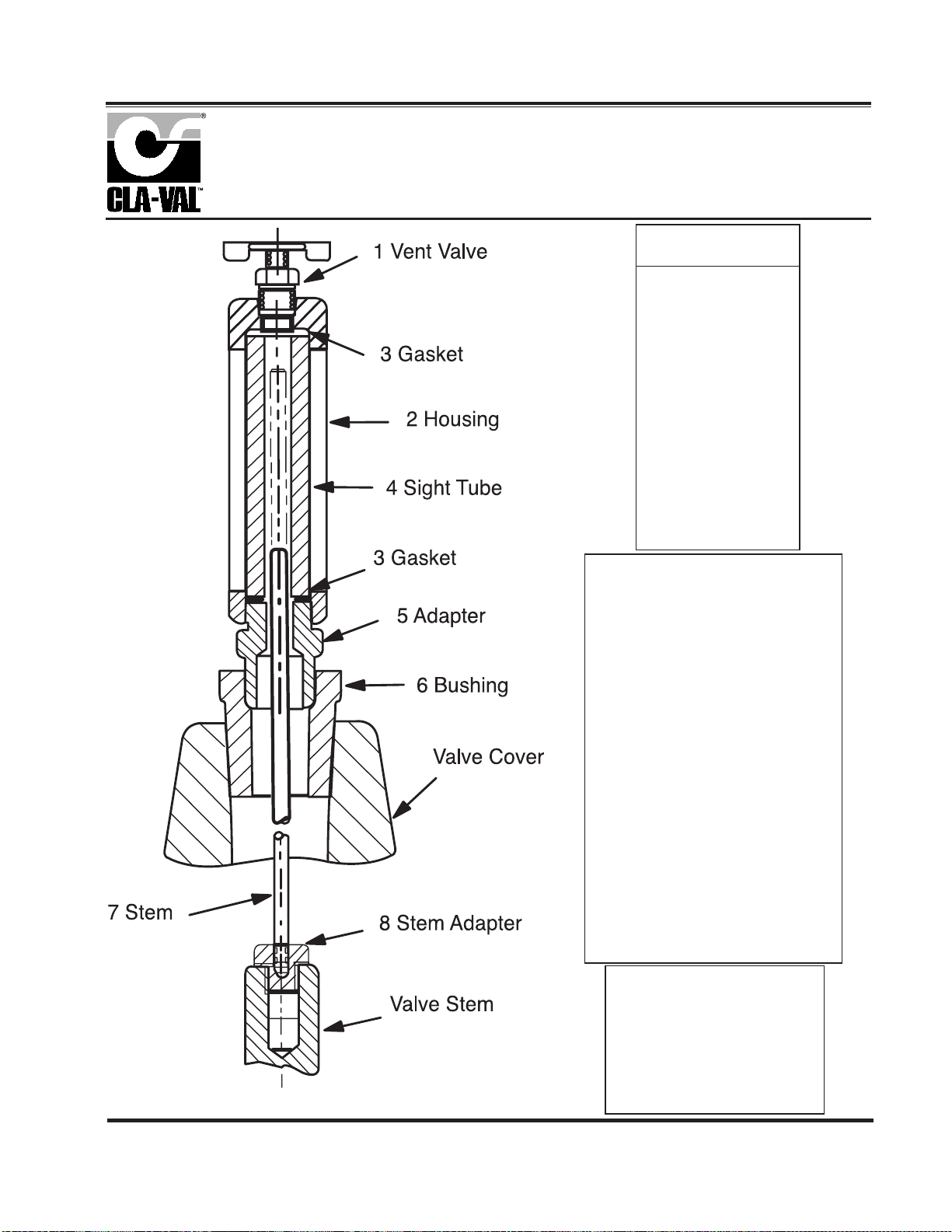
Valve Position Indicator
X101
When ordering parts,
please specify:
• All Nameplate data
• Item Number
• Description
• Material
• Part Number
ITEM DESCRIPTION MATERIAL
1 Vent Valve Brass
2 Housing Brass
3 *Gasket
(2 Required) Buna-N
4 *Sight Tube Pyrex
5 Adapter Brass
6 Busing Brass
7 Stem Brass
8 Stem Adapter Brass
COMPLETE X101
1 1/4 - 1 1/2 C2812A
2 C8972G
2 1/2 C2607E
3 C2609A
4 9710001A
6 9710002J
8 C8581F
10 C9187A
12 31420D
14 30256C
16 30251D
SIZE STOCK NO.
CLA-VAL
Copyright Cla-Val 2008 Printed in USA Specifications subject to change without notice.
P.O. Box 1325 • Newport Beach, CA 92659-0325 • Phone: 949-722-4800 • Fax: 949-548-5441 • E-mail: claval@cla-val.com • Website cla-val.com
©
PL- X101 (R-1/08)
PARTS LIST
Page 23
CLA-VAL
Copyright Cla-Val 2008 Printed in USA Specifications subject to change without notice.
P.O. Box 1325 • Newport Beach, CA 92659-0325 • Phone: 949-722-4800 • Fax: 949-548-5441 • E-mail: claval@cla-val.com • Website cla-val.com
©
PL-CK2 (R-1/08)
Page 24
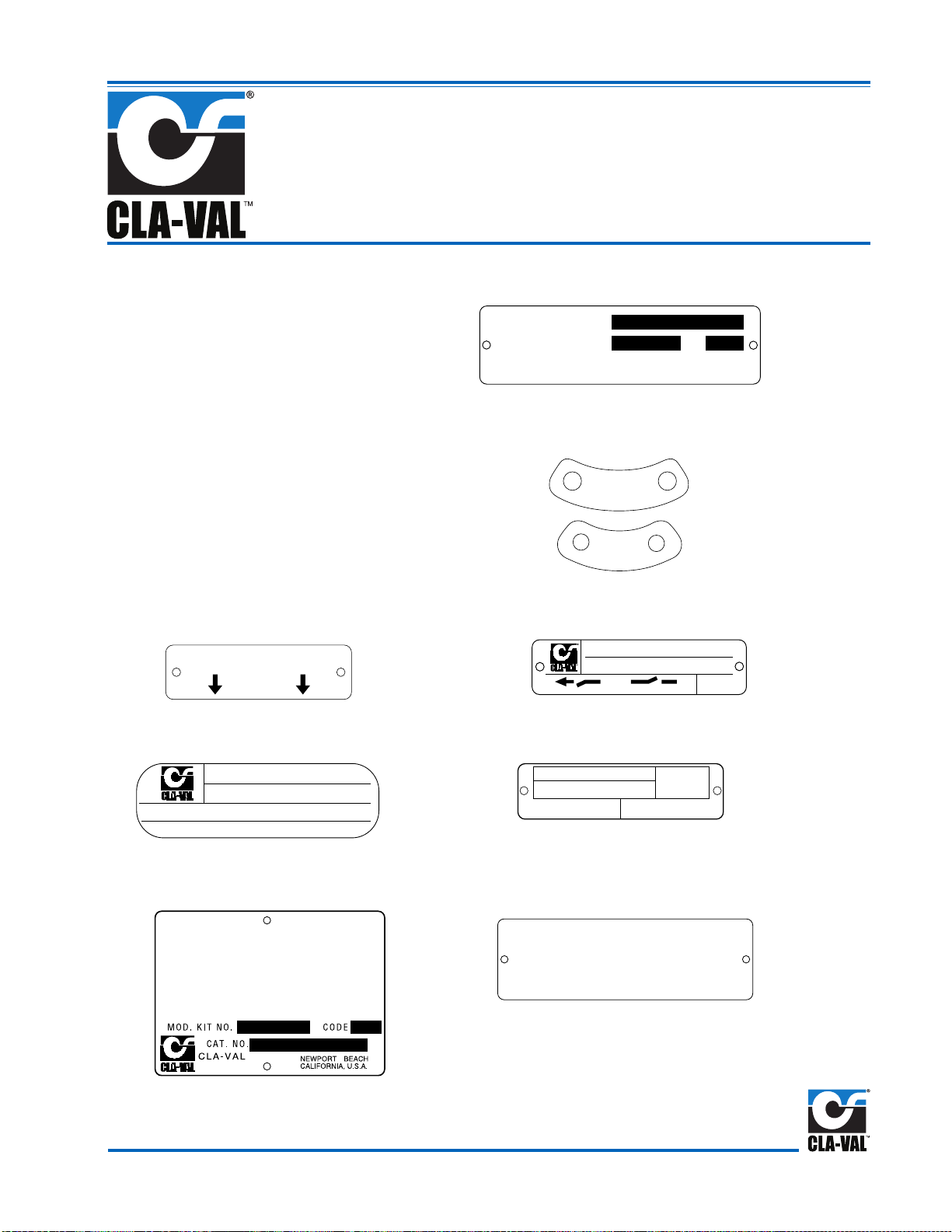
Proper Identification
For ordering repair kits, replacement parts, or for
inquiries concerning valve operation, it is important to
properly identify Cla-Val products already in service
by including all nameplate data with your inquiry.
Pertinent product data includes valve function, size,
material, pressure rating, end details, type of pilot
controls used and control adjustment ranges.
Identification Plates
For product identification, cast-in body markings are
supplemented by identification plates as illustrated on
this page. The plates, depending on type and size of
product, are mounted in the most practical position. It
is extremely important that these identification
plates are not painted over, removed, or in any
other way rendered illegible.
Cla-Val Product
Identification
How to Order
INLET
EINTRITT
ENTREE
ENTRADA
This brass plate appears on valves sized 21/2" and larger
and is located on the top of the inlet flange.
SIZE &
CAT NO.
STOCK
NO.
MFD. BY CLA-VAL
NEWPORT BEACH, CALIF, U.S.A.
I
N
T
L
E
I
N
T
L
E
CODE
RESERVOIR
END
This brass plate appears on altitude valves only and is
SPRING
RANGE
This tag is affixed to the cover of the pilot control valve.
The adjustment range appears in the spring range section.
found on top of the outlet flange.
®
SIZE &
CAT NO.
C
STOCK
™
NO.
MFD. BY CLA-VAL NEWPORT BEACH, CALIF. U.S.A.
DO NOT REMOVE
THI S VA LV E H A S BEE N M O DIFIE D
SI N CE ORI G IN A L SHI P MEN T F ROM
FACTO RY. WHEN OR DER ING PART S
AND/ OR SERVICE SUPPLY DATA FROM
THIS PLATE & ALL OTHER PLATES ON
ORIGINAL VALVE.
®
C
™
This aluminum plate is included in pilot system
modification kits and is to be wired to the new pilot
control system after installation.
These two brass plates appear on 3/8", 1/2", and 3/4" size
valves and are located on the valve cover.
SIZE &
CAT NO.
STOCK
NO.
MFD. BY CLA -VAL NEWPORT BEACH, C ALIF. U.S.A.
FLOW
CODE
These two brass plates appear on threaded valves
1" through 3" size or flanged valves 1" through 2".
It is located on only one side of the valve body.
SIZE &
CAT NO.
STOCK
NO.
CODE
MFD. BY CLA-VAL
NEWPORT BEACH, CALIF.
U.S.A.
This brass plate is used to identify pilot control valves.
The adjustment range is stamped into the plate.
REDUCED PRESSURE BACKFLOW PREVENTION DEVICE
CAT.
NO.
RP
CLA-VAL
STK.
-4
NO.
SER.
NO.
NEWPORT BEACH, CA.
This brass plate is used on our backflow prevention
assemblies. It is located on the side of the Number Two
check (2" through 10"). The serial number of the
assembly is also stamped on the top of the inlet flange of
the Number One check.
Page 25
HOW TO ORDER
C
LA-VAL
CLA-VAL CANADA CLA-VAL EUROPE
4687 Christie Drive
Beamsville, Ontario
Canada LOR 1B4
Phone: 905-563-4963
Fax: 905-563-4040
Chemin dés Mesanges 1
CH-1032 Romanel/
Lausanne, Switzerland
Phone: 41-21-643-15-55
Fax: 41-21-643-15-50
©COPYRIGHT CLA-VAL 2007 Printed in USA
Specifications subject to change without notice.
www.cla-val.com
E-Product I.D. (R-12//07)
Represented By:
Because of the vast number of possible configurations and
combinations available, many valves and controls are not
shown in p ublished pr oduct and pri ce lists. F or o rdering
information, price and availability on product that are not listed,
please contact your local Cla-Val office or our factory office
located at:
P. O. Box 1325
Newport Beach, California 92659-0325
(949) 722-4800
FAX (949) 548-5441
SPECIFY WHEN ORDERING
• Model Number • Valve Size
• Globe or Angle Pattern • Threaded or Flanged
• Adjustment Range • Body and Trim Materials
(As Applicable) • Optional Features
• Pressure Class
UNLESS OTHERWISE SPECIFIED
• Globe or angle pattern are the same price
• Ductile iron body and bronze trim are standard
• X46 Flow Clean Strainer or X43 “Y” Strainer are included
• CK2 Isolation Valves are included in price on 4" and larger
valve sizes (6" and larger on 600 Series)
LIMITED WARRANTY
Automatic valves and controls as manufactured by Cla-Val are warranted
for three years from date of shipment against manufacturing defects in
material and workmanship that develop in the service for which they are
designed, provided the products are installed and used in accordance
with a ll a pp licable ins tr uctions and l im itations iss ued by Cla-Val .
Electronic components manufactured by Cla-Val are warranted for one
year from the date of shipment.
We will repair or replace defective material, free of charge, that is returned
to our factory, transportation charges prepaid, if upon inspection, the
material is found to have been defective at time of original shipment. This
warranty is expressly conditioned on the purchaser’s providing written
notification to Cla-Val immediate upon discovery of the defect.
Components used by Cla-Val but manufactured by others, are warranted
only to the extent of that manufacturer’s guarantee.
This warranty shall not apply if the product has been altered or repaired by
others, Cla-Val shall make no allowance or credit for such repairs or
alterations unless authorized in writing by Cla-Val.
TERMS OF SALE
ACCEPTANCE OF ORDERS
All orders are subject to acceptance by our main office at Newport Beach, California.
CREDIT TERMS
Credit terms are net thirty (30) days from date of invoice.
PURCHASE ORDER FORMS
Orders submitted on customer’s own purchase order forms will be accepted only
with the express understanding that no statements, clauses, or conditions contained
in said order form will be binding on the Seller if they in any way modify the Seller’s
own terms and conditions of sales.
PRODUCT CHANGES
The right is reserved to make changes in pattern, design or materials when deemed
necessary, without prior notice.
PRICES
All prices are F.O.B. Newport Beach, California unless expressly stated otherwise on
our acknowledgement of the order. Prices are subject to change without notice. The
prices at which any order is accepted are subject to adjustment to the Seller’s price
in effect at the time of shipment. Prices do not include sales, excise, municipal, state
or any other Government taxes. Minimum order charge $75.00.
RESPONSIBILITY
We will not be responsible for delays resulting from strikes, accidents, negligence of
carriers, or other causes beyond our control. Also, we will not be liable for any
unauthorized product alterations or charges accruing there from.
DISCLAIMER OF WARRANTIES AND
LIMITATIONS OF LIABILITY
The foreg oi ng w ar ranty is e xc lusive and in l ie u of all other
warranties and representations, whether expressed, implied, oral or
written, including but not limited to any implied warra nties or
merchantability or fitness for a particular purpose. All such other
warranties and representations are hereby cancelled.
Cla-Val shall not be liable for any incidental or consequential loss,
damage or expense arising directly or indirectly from the use of the
product. Cla-Val shall not be liable for any damages or charges for
labor or expense in making repairs or adjustments to the product.
Cla-Val shall not be liable for any damages or charges sustained in
the adaptation or use of its engineering data and services. No
representative of Cla-Val may change any of the foregoing or
assume any additional liability or responsibility in connection with
th e p rodu ct. The liab i lit y o f C la- V al is l imi ted to mate ria l
replacements F.O.B. Newport Beach, California.
RISK
All goods are shipped at the risk of the purchaser after they have been delivered by
us to the carrier. Claims for error, shortages, etc., must be made upon receipt of
goods.
EXPORT SHIPMENTS
Export shipments are subject to an additional charge for export packing.
RETURNED GOODS
1. Customers must obtain written approval from Cla-Val prior to returning any
material.
2. Cla-Val reserves the right to refuse the return of any products.
3. Products more than six (6) months old cannot be returned for credit.
4. Specially produced, non-standard models cannot be returned for credit.
5. Rubber goods such as diaphragms, discs, o-rings, etc., cannot be returned for
credit, unless as part of an unopened vacuum sealed repair kit which is less
than six months old.
6. Goods authorized for return are subject to a 35% ($75 minimum) restocking
charge and a service charge for inspection, reconditioning, replacement of
rubber parts, retesting, repainting and repackaging as required.
7. Authorized returned goods must be packaged and shipped prepaid to Cla-Val,
1701 Placentia Avenue, Costa Mesa, California 92627.
PO Box 1325 Newport Beach CA 92659-0325
Phone: 949-722-4800
Fax: 949-548-5441
Page 26

Complete Replacement Diaphragm Assemblies for 100-01 and 100-20 Hytrol Main Valves
For: Hytrol Main Valves with Ductile Iron, Bronze Trim Materials—125/150 Pressure Class Only.
FACTORY ASSEMBLED
Includes: Stem, Disc Guide, Disc, Disc Retainer, Spacer Washers, Diaphragm, Diaphragm Washer
and Stem Nut.
3/8"
1/2" - 3/4"
1"
1 1/4"-1 1/2"
2"
2 1/2"
3"
4"
(Also 81-01 )
(Also 81-01 )
N/A
N/A
N/A
N/A
N/A
N/A
C2524B
C2525J
6"
8"
10"
12"
14"
16"
20"
24"
40456G
45276D
81752J
85533J
89067D
89068B
N/A
N/A
33273E
40456G
45276D
81752J
N/A
85533J
89068B
89068B
Valve
Size
Valve
Size
49097K
C2518D
C2520K
C2522 F
C2524B
C2523D
C2525J
33273E
100-01 100-20
Diaphragm Assembly
Stock Number
100-01 100-20
Diaphragm Assembly
Stock Number
3/8"
1/2" - 3/4"
1"
1 1/4" - 1 1/2"
2"
2 1/2"
3"
4"
6"
8"
10"
12"
14"
16"
20"
24"
(Also 81-01 )
(Also 81-01 )
N/A
N/A
N/A
N/A
N/A
N/A
9169805A
9169812G
9169813E
9169815K
9817901D
9817902B
N/A
9817903K
9817905E
9817905E
3/8"
1/2" - 3/4"
1"
1 1/4” - 1 1/2"
2"
2 1/2"
3"
4"
6"
8"
9169806J
9169807G
9169808E
9169809C
9169810A
9169817F
9169818D
9169819B
9169820K
9169834A
N/A
N/A
N/A
N/A
N/A
N/A
9169810A
9169818D
9169819B
9169820K
Valve
Size
Valve
Size
9169801K
9169802H
9169803F
9169804D
9169805A
9169811J
9169812G
9169813E
9169815K
9817901D
9817902B
9817903K
9817904H
9817905E
N/A
9817906C
100-01 100-20
Repair Kit
Stock Number
100-01 100-20
Repair Kit
Stock Number
Repair Kits for 100-01/100-20 Hytrol Valves
For: Hytrol Main Valves—125/150 Pressure Class Only.
Includes: Diaphragm, Disc (or Disc Assembly) and spare Spacer Washers.
(Also 81-01 )
(Also 81-01 )
REPAIR KITS
When ordering, please give complete nameplate data of the valve and/or control being repaired.
MINIMUM ORDER CHARGE APPLIES.
Buna-N®Standard Material
Viton (For KB Valves)
MODEL
INSTALLATION / OPERATION / MAINTENANCE
Page 27
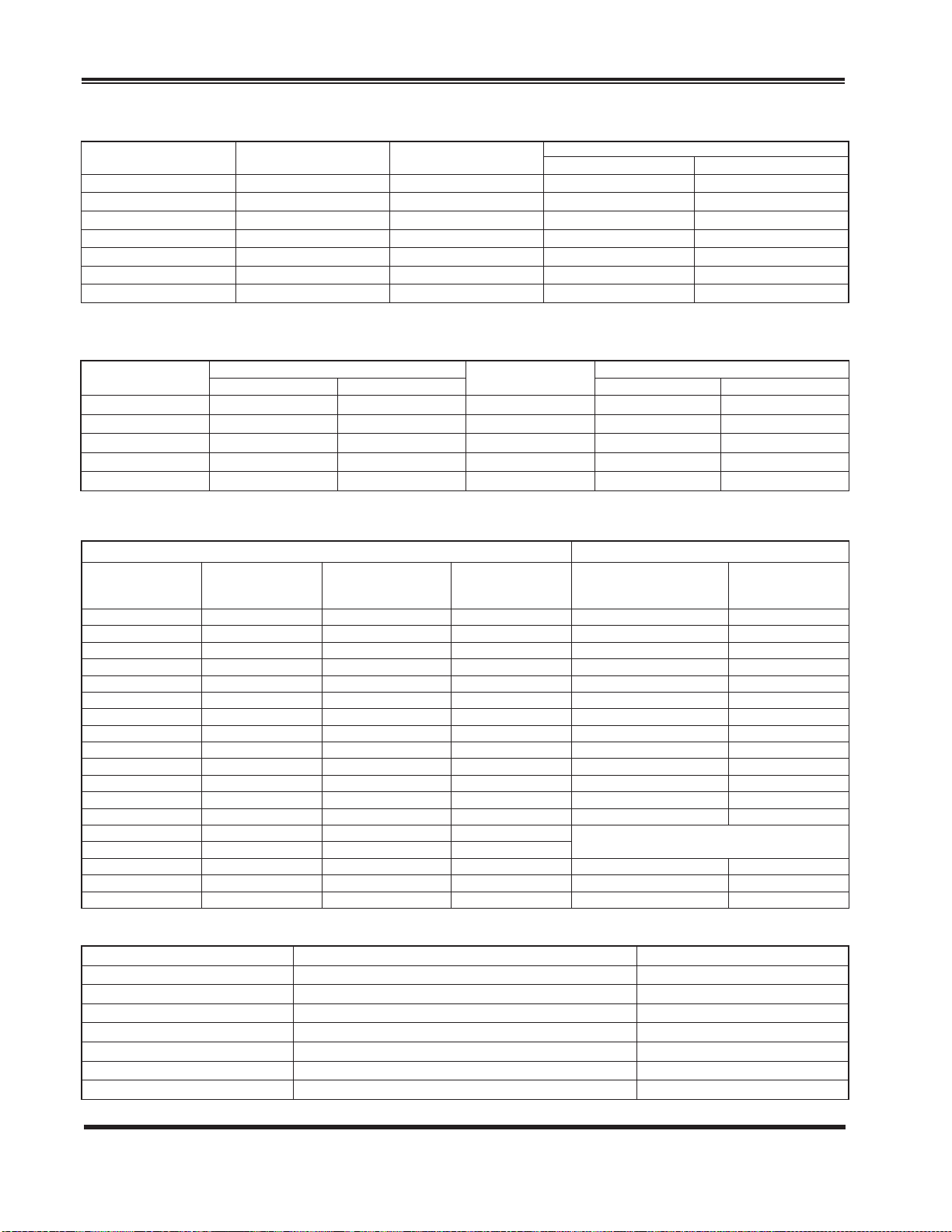
Repair Kits for 100-04/100-23 Hy-Check Main Valves
For: Hy-Check Main Valves—125/150 Pressure Class Only
Includes: Diaphragm, Disc and O-Rings and full set of spare Spacer Washers.
Larger Sizes: Consult Factory.
Repair Kits for 100-02/100-21 Powertrol and 100-03/100-22 Powercheck Main Valves
For: Powertrol and Powercheck Main Valves—125/150 Pressure Class Only
Includes: Diaphragm, Disc (or Disc Assembly) and O-rings and full set of spare Spacer Washers.
Repair Kits for Pilot Control Valves
Includes: Diaphragm, Disc (or Disc Assembly), O-Rings, Gaskets or spare Screws as appropriate.
Repair Assemblies (In Standard Materials Only)
CLA-VAL
Copyright Cla-Val 2008 Printed in USA Specifications subject to change without notice.
P.O. Box 1325 • Newport Beach, CA 92659-0325 • Phone: 949-722-4800 • Fax: 949-548-5441 • E-mail: claval@cla-val.com • Website cla-val.com
©
N-RK (R-1/08)
Valve
Size
Kit Stock Number
100-02
Valve
Size
Kit Stock Number
100-02 & 100-03 100-21 & 100-22
3
⁄8”
9169901H
2
1
⁄2”
9169910J N/A
1
⁄2” &3⁄4”
9169902F
3”
9169911G 9169905J
1” 9169903D
4”
9169912E 9169911G
1
1
⁄4” & 11⁄2”
9169904B
6”
9169913C 9169912E
2” 9169905J
8”
99116G 9169913C
10”
9169939H 99116G
12"
9169937B 9169939H
Valve
Size
Kit Stock Number
Valve
Size
Kit Stock Number
100-04 100-23 100-04 100-23
4” 20210901B N/A 12” 20210905H 20210904J
6” 20210902A 20210901B 14” 20210906G N/A
8” 20210903K 20210902A 16” 20210907F 20210905H
10” 20210904J 20210903K 20” N/A 20210907F
24” N/A 20210907F
BUNA-N
®
(Standard Material)
VITON (For KB Control)
Pilot
Control
Kit
Stock
Number
Pilot
Control
Kit
Stock
Number
Pilot
Control
Kit
Stock
Number
CDB 9170006C CRM-7 1263901K CDB-KB 9170012A
CDB-3D 9170023H CFM-7A 1263901K CRA-KB N/A
CDB-3I 9170024F CFM-9 12223E
CRD-KB (w/bucking spring)
9170008J
CDB-7 9170017K
CRA (w/bucking spring)
9170001D CRL-KB 9170013J
CDH-2 18225D
CRD (w/bucking spring)
9170002B CDHS-2BKB 9170010E
CDHS-2 44607A
CRD (no bucking spring)
9170003K CDHS-2FKB 9170011C
CDHS-2B 9170004H CRD-18 20275401K CDHS-18KB (no bucking spring) 9170009G
CDHS-2F 9170005E CRD-22 98923G
102C-KB
1726202D
CDHS-3C-A2 24657K CRL (55F, 55L) 9170007A
CDHS-8A 2666901A CRL-4A 43413E
CDHS-18 9170003K CRL-5 (55B) 65755B
CDS-4 9170014G CRL-5A (55G) 20666E
CDS-5 14200A CRL-18 20309801C
CDS-6 20119301A CV 9170019F
Buna-N
®
CDS-6A 20349401C X105L (O-ring) 00951E
CFCM-M1 1222301C 102B-1 1502201F CRD Disc Ret. (Solid) C5256H
CFM-2 12223E 102C-2 172601F CRD Disc Ret. (Spring) C5255K
102C-3 172601F
Control Description Stock Number
CF1-C1 Pilot Assembly Only 89541H
CF1-Cl Complete Float Control less Ball and Rod 89016A
CFC2-C1 Disc, Distributor and Seals 2674701E
CSM 11-A2-2 Mechanical Parts Assembly 97544B
CSM 11-A2-2 Pilot Assembly Only 18053K
33A 1" Complete Internal Assembly and Seal 2036030B
33A 2" Complete Internal Assembly and Seal 2040830J
When ordering, please give complete nameplate data of the valve and/or control being repaired. MINIMUM ORDER CHARGE APPLIES
Larger Sizes: Consult Factory.
 Loading...