

Page 1

340-07/3640-07
Page 2
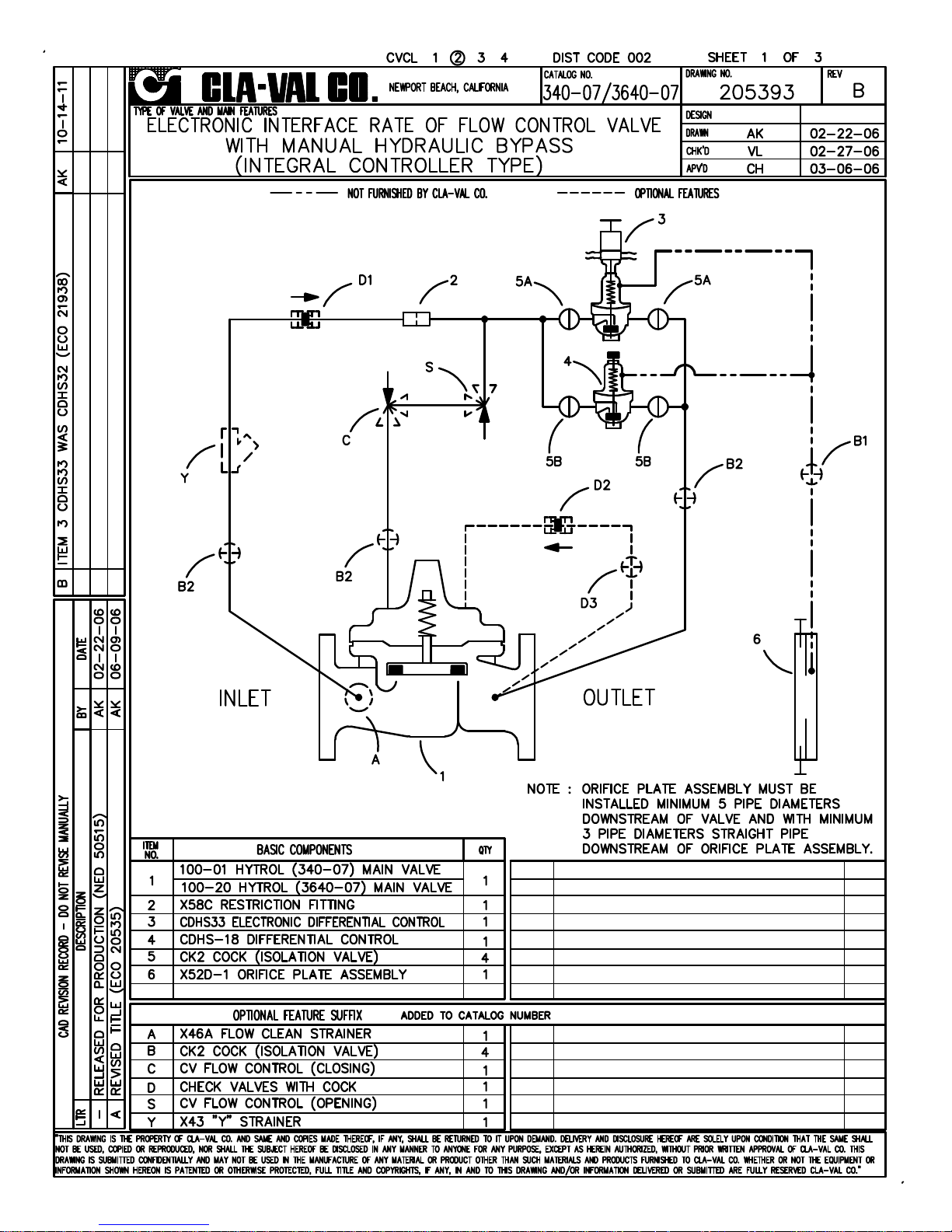
Page 3
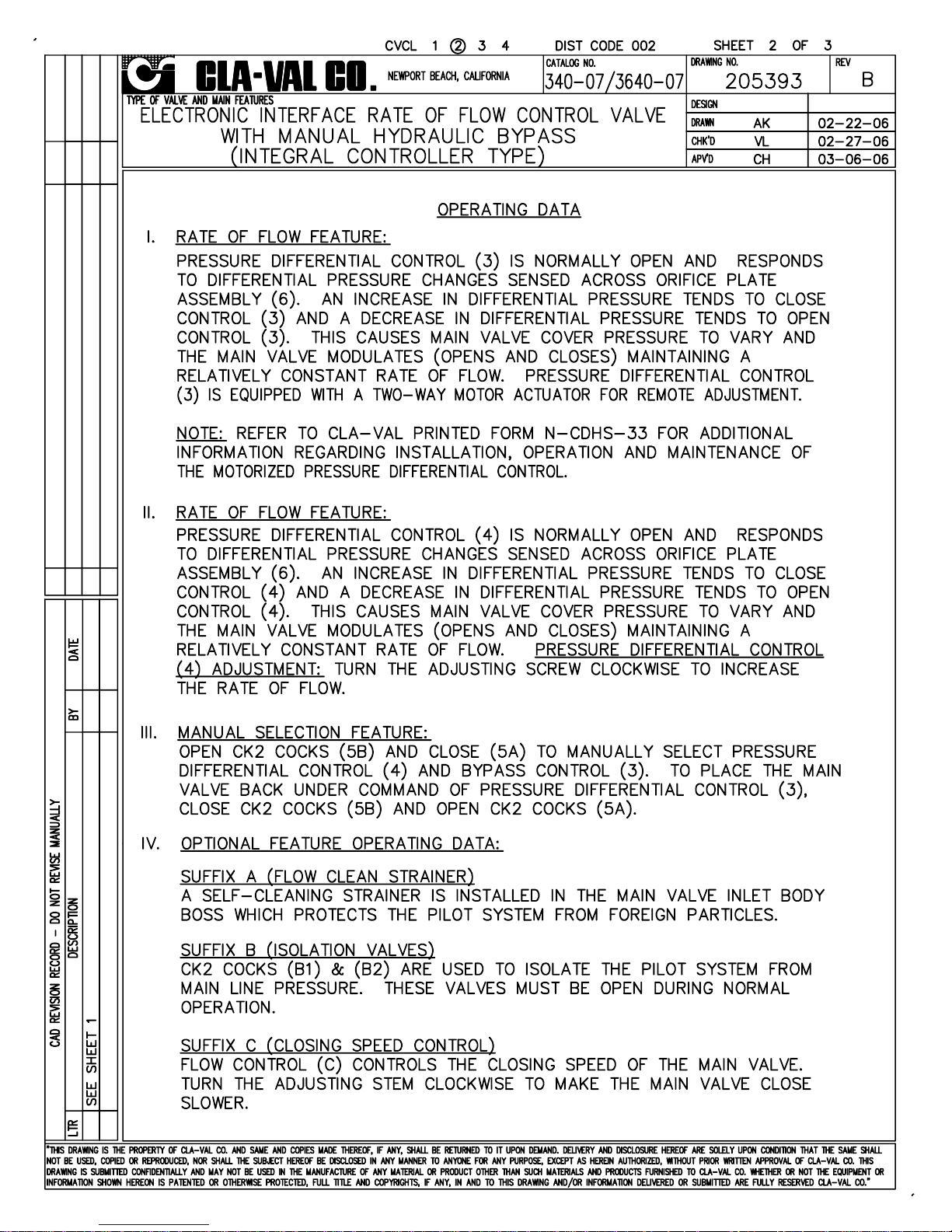
Page 4

Page 5

Description
The CIa-VaI Model 100-01 Hytrol Valve is a main valve for CIa-VaI
Automatic Control Valves. It is a hydraulically operated, diaphragm-actuated, globe or angle pattern valve.
This valve consists of three major components; body, diaphragm assembly, and cover. The diaphragm assembly is the only moving part. The
diaphragm assembly uses a diaphragm of nylon fabric bonded with synthetic rubber. A synthetic rubber disc, contained on three and one half
sides by a disc retainer and disc guide, forms a seal with the valve seat
when pressure is applied above the diaphragm. The diaphragm assembly forms a sealed chamber in the upper portion of the valve, separating
operating pressure from line pressure.
Installation
1. Before valve is installed, pipe lines should be flushed of all chips,
scale and foreign matter.
2. It is recommended that either gate or block valves be installed on
both ends of the 100-01 Hytrol Valve to facilitate isoIating the valve for
preventive maintenance and repairs.
3. Place the valve in the line with flow through the valve in the direction indicated on the inlet nameplate. (See “Flow Direction” Section)
Note: Valve can be installed in the vertical or horizontal position.
4. Allow sufficient room around valve to make adjustments and for disassembly.
5. CIa-VaI 100-01 Hytrol Valves operate with maximum effic iency when
mounted in horizontal piping with the cover UP, however, other positions are acceptable. Due to size and weight of the cover and internal
components of 8 inch and larger valves, installation with the cover UP
is advisable. This makes internal parts readily accessible for periodic
inspection.
6. Caution must be taken in the installation of this valve to
insure that galvanic and/or electrolytic action does not take
place. The proper use of dielectric fittings and gaskets are
required in all systems using dissimilar metals.
7. If a pilot control system is installed on the 100-01 Hytrol
Valve, use care to prevent damage. If it is necessary to
remove fittings or components, be sure they are kept clean
and replaced exactly as they were.
8. After the valve is installed and the system is first pressurized, vent air from the cover chamber and pilot system tubing by loosening fittings at all high points.
Tight Closing Operation
When pressure from the valve inlet (or
an equivalent independent operating
pressure) is applied to the diaphragm
chamber the valve closes drip-tight.
Full Open Operation
When pressure in diaphragm chamber
is relieved to a zone of lower pressure
(usually atmosphere) the line pressure
(5 psi Min.) at the valve inlet opens the
valve.
Modulating Action
Valve modulates when diaphragm pressure is held at an intermediate point
between inlet and discharge pressure.
With the use of a Cla-Val. "modulating
control," which reacts to line pressure
changes, the pressure above the
diaphragm is varied, allowing the valve
to throttle and compensate for the
change.
Principles of Operation
Three Way
Pilot Control
Three Way
Pilot Control
Restriction
Modulating
Control
100-01
Hytrol Valve
MODEL
INSTALLATION / OPERATION / MAINTENANCE
Page 6

2
Flow Direction
The flow through the 100-01 Hytrol Valve can be in one of two
directions. When flow is “up-and-over the seat,” it is in “normal”
flow and the valve will fail in the open position. When flow is “overthe seat-and down,” it is in “reverse” flow and the valve will fail in
the closed position. There are no permanent flow arrow markings.
The valve must be installed according to nameplate data.
BRIDGEWALL INDlCATOR
Normal Flow Reverse Flow
Troubleshooting
The following troubleshooting information deals strictly with the
Model 100-01 Hytrol Valve. This assumes that all other components of the pilot control system have been checked out and are
in proper working condition. (See appropriate sections in
Technical Manual for complete valve).
Three Checks
The 100-01 Hytrol Valve has only one moving part (the diaphragm
and disc assembly). So, there are only three major types of problems to be considered.
First: Valve is stuck - that is, the diaphragm assembly is not free
to move through a full stroke either from open to close or vice
versa.
Second: Valve is free to move and can’t close because of a worn
out diaphragm.
Third: Valve leaks even though it is free to move and the
diaphragm isn’t leaking.
Closed isolation valves in control system, or in main line.
Lack of cover chamber pressure.
Diaphragm damaged. (See Diaphragm Check.)
Diaphragm assembly inoperative.
Corrosion or excessive scale build up on valve stem.
(See Freedom of Movement Check)
Mechanical obstruction. Object lodged in valve.
(See Freedom of Movement Check)
Worn disc. (See Tight Sealing Check)
Badly scored seat. (See Tight Sealing Check)
Closed upstream and/or downstream isolation
valves in main line.
Insufficient line pressure.
Diaphragm assembly inoperative. Corrosion or excessive
buildup on valve stem. (See Freedom of Movement Check)
Diaphragm damaged. (For valves in "reverse flow" only)
After checking out probable causes and remedies, the following three checks can be used to diagnose the nature of the
problem before maintenance is started. They must be done in the order shown.
Open Isolation valves.
Check upstream pressure, pilot system, strainer, tubing, valves, or needle
valves for obstruction.
Replace diaphragm.
Clean and polish stem. Inspect and replace any damaged or badly eroded
part.
Remove obstruction.
Replace disc.
Replace seat.
Open isolation valves.
Check upstream pressure. (Minimum 5 psi flowing line pressure differential.)
Clean and polish stem. Inspect and replace any
damaged or badly eroded part.
Replace diaphragm.
Fails to Close
Fails to Open
CAUTION:
Care should be taken when doing the troubleshooting checks on
the 100-01 Hytrol Valve. These checks do require the valve to
open fully. This will either allow a high flow rate through the
valve, or the downstream pressure will quickly increase to the
inlet pressure. In some cases, this can be very harmful. Where
this is the case, and there are no block valves in the system to
protect the downstream piping, it should be realized that the
valve cannot be serviced under pressure. Steps should be
taken to remedy this situation before proceeding any further.
(cast into side of valve body)
SYMPTOM PROBABLE CAUSE REMEDY
Recommended Tools
1. Three pressure gauges with ranges suitable to the installation to be put at Hytrol inlet, outlet and cover connections.
2. Cla-Val Model X101 Valve Position Indicator. This provides visual indication of valve position without disassembly
of valve.
3. Other items are: suitable hand tools such as screwdrivers, wrenches, etc. soft jawed (brass or aluminum) vise,
400 grit wet or dry sandpaper and water for cleaning.
All trouble shooting is possible without removing the valve from the
line or removing the cover. It is highly recommended to permanently
install a Model X101 Valve Position Indicator and three gauges in
unused Hytrol inlet, outlet and cover connections.
Page 7

Diaphragm Check (#1 )
1. Shut off pressure to the Hytrol Valve by slowly closing upstream
and downstream isolation valves. SEE CAUTION.
2. Disconnect or close all pilot control lines to the valve cover and
leave only one fitting in highest point of cover open to atmosphere.
3.With the cover vented to atmosphere, slowly open upstream
isolation valve to allow some pressure into the Hytrol Valve body.
Observe the open cover tapping for signs of continuous flow. It is
not necessary to fully open isolating valve. Volume in cover chamber capacity chart will be displaced as valve moves to open position. Allow sufficient time for diaphragm assembly to shift positions. If there is no continuous flow, you can be quite certain the
diaphragm is sound and the diaphragm assembly is tight. If the
fluid appears to flow continuously this is a good reason to believe
the diaphragm is either damaged or it is loose on the stem. In
either case, this is sufficient cause to remove the valve cover and
investigate the leakage. (See “Maintenance” Section for procedure.)
Freedom of Movement Check (#2)
4. Determining the Hytrol Valve’s freedom of movement can be
done by one of two methods.
5. For most valves it can be done after completing Diaphragm
Check (Steps 1, 2, and 3). SEE CAUTION. At the end of step 3
the valve should be fully open.
6. If the valve has a Cla-Val X101 Position Indicator, observe the
indicator to see that the valve opens wide. Mark the point of maximum opening.
7. Re-connect enough of the control system to permit the application of inlet pressure to the cover. Open pilot system cock so
pressure flows from the inlet into the cover.
8. While pressure is building up in the cover, the valve should
close smoothly. There is a hesitation in every Hytrol Valve closure,
which can be mistaken for a mechanical bind. The stem will
appear to stop moving very briefly before going to the closed position. This slight pause is caused by the diaphragm flexing at a
particular point in the valve’s travel and is not caused by a
mechanical bind.
9. When closed, a mark should be made on the X101 Valve position indicator corresponding to the “closed” position. The distance
between the two marks should be approximately the stem travel
shown in chart.
10. If the stroke is different than that shown in stem travel chart
this is a good reason to believe something is mechanically restricting the stroke of the valve at one end of its travel. If the flow does
not stop through the valve when in the indicated “closed” position,
the obstruction probably is between the disc and the seat. If the
flow does stop, then the obstruction is more likely in the cover. In
either case, the cover must be removed, and the obstruction located and removed. The stem should also be checked for scale buildup. (See “Maintenance, section for procedure.)
11. For valves 6” and smaller, the Hytrol Valve’s freedom of movement check can also be done after all pressure is removed from
the valve. SEE CAUTION. After closing inlet and outlet isolation
valves and bleeding pressure from the valve, check that the cover
chamber and the body are temporarily vented to atmosphere.
Insert fabricated tool into threaded hole in top of valve stem, and
lift the diaphragm assembly manually. Note any roughness. The
diaphragm assembly should move smoothly throughout entire
valve stroke. The tool is fabricated from rod that is threaded on
one end to fit valve stem and has a “T” bar handle of some kind
on the other end for easy gripping. (See chart in Step 4 of
“Disassembly” Section.)
12. Place marks on this diaphragm assembly lifting tool when the
valve is closed and when manually positioned open. The distance
between the two marks should be approximately the stem travel
shown in stem travel chart. If the stroke is different than that
shown, there is a good reason to believe something is mechanically restricting the stroke of the valve. The cover must be
removed, and the obstruction located and removed. The stem
should also be checked for scale build-up. (See “Maintenance”
Section for procedure.)
Tight Sealing Check (#3)
13. Test for seat leakage after completing checks #1 & #2 (Steps
1 to 12). SEE CAUTION. Close the isolation valve downstream of
the Hytrol Valve. Apply inlet pressure to the cover of the valve, wait
until it closes. Install a pressure gauge between the two closed
valves using one of the two ports in the outlet side of the Hytrol.
Watch the pressure gauge. If the pressure begins to climb, then
either the downstream isolation valve is permitting pressure to
creep back, or the Hytrol is allowing pressure to go through it.
Usually the pressure at the Hytrol inlet will be higher than on the
isolation valve discharge, so if the pressure goes up to the inlet
pressure, you can be sure the Hytrol is leaking. Install another
gauge downstream of isolating valve. If the pressure between the
valves only goes up to the pressure on the isolation valve
discharge, the Hytrol Valve is holding tight, and it was just the isolation valve leaking.
STEM TRAVEL
(Fully Open to Fully Closed)
Valve Size (inches) Travel (inches)
Inches MM Inches MM
1 1/4 32 0.4 10
1 1/2 40 0.4 10
250 0.615
2 1/2 65 0.7 18
380 0.820
4 100 1.1 28
6 150 1.7 43
8 200 2.3 58
10 250 2.8 71
12 300 3.4 86
14 350 4.0 100
16 400 4.5 114
20 500 5.6 143
24 600 6.7 165
30 800 7.5 190
36 900 8.5 216
COVER CHAMBER CAPACITY
(Liquid Volume displaced when valve opens)
Valve size (inches) Displacement
Gallons Liters
1 1/4 .020 .07
1 1/2 .020 .07
2 .032 .12
2 1/2 .043 .16
3 .080 .30
4 .169 .64
6 .531 2.0
8 1.26 4.8
10 2.51 9.5
12 4.00 15.1
14 6.50 24.6
16 9.57 36.2
20 12.00 45.4
24 29.00 109.8
30 42.00 197.0
36 90.00 340.0
3
Page 8

Maintenance
Preventative Maintenance
The Cla-Val Co. Model 100-01 Hytrol Valve requires no lubrication or
packing and a minimum of maintenance. However, a periodic inspection schedule should be established to determine how the operating
conditions of the system are affecting the valve. The effect of these
actions must be determined by inspection.
Disassembly
Inspection or maintenance can be accomplished without removing
the valve from the line. Repair kits with new diaphragm and disc are
recommended to be on hand before work begins.
WARNING: Maintenance personnel can be injured and equipment
damaged if disassembly is attempted with pressure in the valve. SEE
CAUTION.
1. Close upstream and downstream isolation valves and independ-
ent operating pressure when used to shut off all pressure to the
valve.
2. Loosen tube fittings in the pilot system to remove pressure from
valve body and cover chamber. After pressure has been released
from the valve, use care to remove the controls and tubing. Note and
sketch position of tubing and controls for re-assembly. The schematic in front of the Technical Manual can be used as a guide when
reassembling pilot system.
3. Remove cover nuts and remove cover. If the valve has been in
service for any length of time, chances are the cover will have to be
loosened by driving upward along the edge of the cover with a dull
cold chisel.
On 6” and smaller valves block and tackle or a power hoist can be
used to lift valve cover by inserting proper size eye bolt in place of
the center cover plug. on 8” and larger valves there are 4 holes (5/8”
— 11 size) where jacking screws and/or eye bolts may be inserted
for lifting purposes. Pull cover straight up to keep from damaging
the integral seat bearing and stem.
4. Remove the diaphragm and disc assembly from the valve body.
With smaller valves this can be accomplished by hand by pulling
straight up on the stem so as not to damage the seat bearing.
On large valves, an eye bolt of proper size can be installed in the
stem and the diaphragm assembly can be then lifted with a block and
tackle or power hoist. Take care not to damage the stem or bearings.
The valve won't work if these are damaged.
5. The next item to remove is the stem nut. Examine the stem
threads above the nut for signs of mineral deposits or corrosion.
If the threads are not clean, use a wire brush to remove as much
of the residue as possible. Attach a good fitting wrench to the nut
and give it a sharp “rap” rather than a steady pull. Usually
several blows are sufficient to loosen the nut for further removal.
On the smaller valves, the entire diaphragm assembly can be held
by the stem in a vise equipped with soft brass jaws before
removing the stem nut.
The use of a pipe wrench or a vise without soft brass jaws scars
the fine finish on the stem. No amount of careful dressing can
restore the stem to its original condition. Damage to the finish of
the stem can cause the stem to bind in the bearings and the valve
will not open or close.
6. After the stem nut has been removed, the diaphragm assembly
breaks down into its component parts. Removal of the disc from
the disc retainer can be a problem if the valve has been in service for a long time. Using two screwdrivers inserted along the outside edge of the disc usually will accomplish its removal. Care
should be taken to preserve the spacer washers in water, particularly if no new ones are available for re-assembly.
7. The only part left in the valve body is the seat which ordinarily
does not require removal. Careful cleaning and polishing of inside
and outside surfaces with 400 wet/dry sandpaper will usually
restore the seat’s sharp edge. If, however, it is badly worn and
replacement is necessary, it can be easily removed.
Seats in valve sizes 1 1/4” through 6” are threaded into the valve
body. They can be removed with accessory X109 Seat Removing
Tool available from the factory. On 8” and larger valves, the seat
is held in place by flat head machine screws. Use a tight-fitting,
long shank screwdriver to prevent damage to seat screws. If upon
removal of the screws the seat cannot be lifted out, it will be necessary to use a piece of angle or channel iron with a hole drilled
in the center. Place it across the body so a long stud can be inserted through the center hole in the seat and the hole in the angle
iron. By tightening the nut a uniform upward force is exerted on
the seat for removal.
NOTE: Do not lift up on the end of the angle iron as this may force
the integral bearing out of alignment, causing the stem to bind.
VALVE STEM THREAD SIZE
Valve Size Thread Size (UNF Internal)
1 1/4"
—2 1/2" 10—32
3"—4" 1/4—28
6"—14" 3/8—24
16" 1/2—20
20 3/4-16
24" 3/4-16
30” 3/4-16
36” 3/4-16
COVER CENTER PLUG SIZE
Valve Size Thread Size (NPT)
1 1/4"
—1 1/2" 1/4"
2"—3" 1/2"
4"—6" 3/4"
8"—10" 1"
12" 1 1/4"
14" 1 1/2"
16" 2"
20” & 24" 2"
30” & 36” 2”
NUT
ANGLE OR CHANNEL IRON
LONG STUD OR BOLT
NUT OR BOLT HEAD
DO NOT
LIFT
VALVE SEAT
VALVE BODY
4
Page 9

Lime Deposits
One of the easiest ways to remove lime deposits from the valve
stem or other metal parts is to dip them in a 5-percent muriatic
acid solution just long enough for the deposit to dissolve. This
will remove most of the common types of deposits. CAUTlON:
USE EXTREME CARE WHEN HANDLING ACID. Rinse parts in
water before handling. If the deposit is not removed by acid, then
a fine grit (400) wet or dry sandpaper can be used with water.
Reassembly
1. Reassembly is the reverse of the disassembly procedure. If a
new disc has been installed, it may require a different number of
spacer washers to obtain the right amount of “grip” on the disc.
When the diaphragm assembly has been tightened to a point
where the diaphragm cannot be twisted, the disc should be compressed very slightly by the disc guide. Excessive compression
should be avoided. Use just enough spacer washers to hold the
disc firmly without noticeable compression.
2. MAKE SURE THE STEM NUT IS VERY TIGHT. Attach a good
fitting wrench to the nut and give it a sharp “rap” rather than a
steady pull. Usually several blows are sufficient to tighten the
stem nut for final tightening. Failure to do so could allow the
diaphragm to pull loose and tear when subjected to pressure.
Test Procedure After Valve Assembly
There are a few simple tests which can be made in the field to
make sure the Hytrol Valve has been assembled properly. Do
these before installing pilot system and returning valve to
service. These are similar to the three troubleshooting tests.
1. Check the diaphragm assembly for freedom of movement
after all pressure is removed from the valve. SEE CAUTlON.
Insert fabricated tool into threaded hole in top of valve stem, and
lift the diaphragm assembly manually. Note any roughness,
sticking or grabbing. The diaphragm assembly should move
smoothly throughout entire valve stroke. The tool is fabricated
from rod that is threaded on one end to fit valve stem (See chart
in Step 4 of “Disassembly” section.) and has a “T” Bar handle of
some kind on the other end for easy gripping.
Place marks on this diaphragm assembly lifting tool when the
valve is closed and when manually positioned open. The distance between the two marks should be approximately the stem
travel shown in stem travel chart. (See “Freedom of Movement
Check” section.) If the stroke is different than that shown, there
is a good reason to believe something is mechanically restricting
the stroke of the valve. The cover must be removed, the obstruction located and removed. (See “Maintenance” Section for
procedure.)
Inspection of Parts
After the valve has been disassembled, each part should be
examined carefully for signs of wear, corrosion, or any other
abnormal condition. Usually, it is a good idea to replace the rubber parts (diaphragm and disc) unless they are free of signs of
wear. These are available in a repair kit. Any other parts which
appear doubtful should be replaced. WHEN ORDERlNG
PARTS, BE SURE TO GIVE COMPLETE NAMEPLATE DATA,
ITEM NUMBER AND DESCRlPTlON.
NOTE: If a new disc isn’t available, the existing disc can be
turned over, exposing the unused surface for contact with the
seat. The disc should be replaced as soon as practical.
3. Carefully install the diaphragm assembly by lowering the stem
through the seat bearing. Take care not to damage the stem or
bearing. Line up the diaphragm holes with the stud or bolt holes
on the body. on larger valves with studs, it may be necessary to
hold the diaphragm assembly up part way while putting the
diaphragm over the studs.
4. Put spring in place and replace cover. Make sure diaphragm
is Iying smooth under the cover.
5. Tighten cover nuts firmly using a cross-over pattern until all
nuts are tight.
6. Test Hytrol Valve before re-installing pilot valve system.
Due to the weight of the diaphragm assembly this procedure is
not possible on valves 8” and larger. on these valves, the same
determination can be made by carefully introducing a low
pressure-less than five psi) into the valve body with the cover
vented. SEE CAUTION. Looking in cover center hole see the
diaphragm assembly lift easily without hesitation, and then
settle back easily when the pressure is removed.
2. To check the valve for drip-tight closure, a line should be
connected from the inlet to the cover, and pressure applied at the
inlet of the valve. If properly assembled, the valve should hold
tight with as low as ten PSI at the inlet. See “Tight Sealing
Check” section.)
3. With the line connected from the inlet to the cover, apply full
working pressure to the inlet. Check all around the cover for any
leaks. Re-tighten cover nuts if necessary to stop leaks past the
diaphragm.
4. Remove pressure, then re-install the pilot system and tubing
exactly as it was prior to removal. Bleed air from all high
points.
5. Follow steps under “Start-Up and Adjustment” Section in
Technical Manual for returning complete valve back to service
.
5
Page 10

1
5
8
10
14
16
6
17
7
9
OUTLE
T
INLET
GLOBE PATTERN
9
26
27
12
15
14
16
INLET
OUTLET
ANGLE PATTERN
22
23
13
12
14
10
11
15
23
TOP VIEW
8" - 24" SEAT DETAIL
1 1/4" - 6" SEAT DETAIL
16" COVER DETAIL
4
24
2
25
13
31
28
30
29
5
14
3
Item Description
1. Pipe Plug
2. Drive Screws (for nameplate)
3. Hex Nut (8” and larger)
4. Stud (8” and larger)
5. Cover Bearing
6. Cover
7. Stem Nut
8. Diaphragm Washer
9. Diaphragm
10. Spacer Washers
11. Disc Guide
12. Disc Retainer
13. Disc
14. Stem
15. Seat
16. Body
17. Spring
22. Flat Head Screws (8” and larger)
23. Seat O-Ring
24. Hex head Bolt (1 1/4” thru 4”)
25. Nameplate
26. Upper Spring Washer (Epoxy coated valves only)
27. Lower Spring Washer (Epoxy coated valves only)
28. Cover Bearing Housing (16” only)
29. Cover O-Ring (16’” only)
30. Hex Bolt (16” only)
31. Pipe Cap (16” only)
PARTS LIST
6
Page 11

100-01
Hytrol Valve Service Data
MODEL
INSTALLATION / OPERATION / MAINTENANCE
Description 100-01 Hytrol Valve
The CIa-VaI Model 100-01 Hytrol Valve is a main valve for
CIa-VaI Automatic Control Valves. It is a hydraulically operated,
diaphragm-actuated, globe or angle pattern valve.
This valve consists of three major components; body, diaphragm
assembly, and cover. The diaphragm assembly is the only
moving part. The diaphragm assembly uses a diaphragm of nylon
fabric bonded with synthetic rubber. A synthetic rubber disc,
contained on three and one half sides by a disc retainer and disc
guide, forms a seal with the valve seat when pressure is applied
above the diaphragm. The diaphragm assembly forms a sealed
chamber in the upper portion of the valve, separating operating
pressure from line pressure.
Description 100-20 600 Series Hytrol Valve
The CIa-VaI Model 100-20 Hytrol Valve (600 Series main valve)
have only one part -the body- that is different from standard 100
Series Cla-Val main valve parts. The remaining parts of the 600
series main valve are standard Cla-Val main valve parts. All serv-
ice and maintenance information for the standard 100 Series
main valves also apply to the 600 series main valves.
The most important thing to remember when ordering main
valve repair kits and replacement parts, except for the body, all
other parts are going to be for a smaller size main valve. Cla-
Val identifies main valve parts with the flange size of the stan-
dard 100 Series main valve. Refer to the "Main Valve Sizes”
chart below.
HYTROL Service Data
HYTROL SIZE
Stem
Travel
Cover Capacity
Displacement
Valve Stem
Thread
UNF-Internal
Cover
Center
Plug
NPT
Cover Nut or Bolt
Cover
Lifting
Holes
UNC
Cover Plug Cover Torque Stem Nut**
Stem Nut Torque
(ft. Lbs.)
100-01 100-20
Thread
(Bolt)
Socket
Qty Thread
Socket ft. Lbs.
in. Lbs.
Thread
Socket
(Long)
inches mm inches mm inches mm
Gallons
Liters Lubed DRY
1"
25 0.3 8 1/4" 1/4" - 20 (B) 7/16" 8 4 48 3/8" - 24
4
6
1 1/4"
32
0.4
10
0.020
0.07 10 - 32
1/4"
5/16" - 18 (B)
1/2"
8
8
96 7/16" -20 6 10
1 1/2"
40 0.4 10
0.020 0.07 10 - 32
1/4" 5/16" - 18 (B) 1/2"
8
8
96 7/16" -20 6 10
2"
50 0.6 15
0.032
0.12
10 - 32
1/2"
3/8" - 16 (B)
9/16" 8 3/8"
7/16" 12 1/2" - 20
3/4"
10
15
2 1/2"
65 0.7 18
0.043 0.16
10 - 32 1/2"
7/16" - 14 (B)
5/8" 8 1/2"
9/16" 20 5/8" - 18 15/16" 21
30
3"
80 4" 100 0.8
20
0.080 0.30
1/4 - 28 1/2"
1/2" - 13 (B)
3/4" 8 1/2"
9/16" 30
5/8" - 18
15/16"
21 30
4"
100
6"
150
1.1 23
0.169 0.64
1/4 - 28
3/4"
3/4" - 10 (B)
1 1/8" 8 3/4" 5/8" 110
3/4" - 16
1 1/16"
40
60
6"
150 8" 200 1.7 43
0.531 2.00
3/8 - 24 3/4"
3/4" - 10 (B) 1 1/8"
12 3/4"
5/8"
110 7/8" - 14
1 5/16"
85 125
8"
200 10" 250 2.3 58
1.26 4.80
3/8 - 24 1" 3/4" - 10 1 1/4" 16
5/8" - 11
1"
13/16" 110 1 1/8" -12 1 13/16"
125
185
10"
250 12" 300 2.8 71
2.51 9.50 3/8 - 24
1"
7/8" - 9
1 7/16"
20
3/4" - 10
1"
13/16" 160
1 1/2" -12 1 7/8" 252 375
12"
300 16" 400
3.4 86 4.0 15.10 3/8 - 24 1 1/4" 1 1/8" - 7 1 13/16"
20
3/4" - 10 1" 13/16" 390
1 1/2" -12 2 1/2"
270 400
14"
350 3.9
99
6.5
24.60
3/8 - 24
1 1/2" 1 1/4" - 7 2" 20
1" - 8
1" 13/16" 545 1 1/2" -12
2 1/2"
280 420
16"
400
20", 24"
600 4.5
114
9.6 36.20
1/2 - 20 2"
1 1/4" - 7
2" 20 1" - 8 1"
13/16"
545
2" - 16 3" 500
750
20"
500 5.63
143
12 45.40
3/4 - 16 1 1/2"
1 3/8" - 6
2 1/8" 24 1" - 8 1"
13/16" 670
2 1/4" - 16
3 1/2"
930 N/R
24" 600 30"
800
6.75 165
29.0
108.80
3/4 - 16*
3/4"
1 1/2" - 12 2 3/8" 24 1 1/8"- 7 1" 13/16"
800 3" - 12
Special
1350
N/R
* Adapter
p/n 2594101E
inside 1/4" - 28"
Grade 5 Bolts
"Heavy" Grade Nuts
Tighten cover nuts in a "star" cross-over pattern
** Must Use ONLY
Cla-Val Supplied part
Page 12

CLA-VAL
Copyright Cla-Val 2014 Printed in USA Specifications subject to change without notice.
P.O. Box 1325 • Newport Beach, CA 92659-0325 • Phone: 949-722-4800 • Fax: 949-548-5441 • E-mail: claval@cla-val.com • Website cla-val.com
©
COVER
PIPE PLUG
COVER BEARING
SPRING
STEM NUT
DIAPHRAGM WASHER
DISC RETAINER
BODY
*
SPACER WASHERS
DISC GUIDE
SEAT
PIPE PLUG
STEM
SEAT O-RING
STUD
8" and Larger
*
DIAPHRAGM
*
DISC
*
Repair Parts
Seat Screw
8" and Larger
(Globe
or
Angle)
PIPE PLUG
HEX NUT
8" and Larger
Cover Bolt
6" and Smaller
KO
DISC GUIDE
KO
SEAT
KO Anti-Cavitation
Trim Option
N-100-01 (R-08/2014)
BOLT/NUT TORQUING PROCEDURES ON VALVE COVERS
4
BOLTS
6
BOLTS
8
BOLTS
12
BOLTS
16
BOLTS
20
BOLTS
4
3
2
1
65
4
3
2
1
8
7
6
5
4
3
2
1
0
9
8
7
6
5
3
2
1
12
11
10
9
8
7
6
5
4
3
2
1
16
15
14
13
12
11
10
9
8
7
6
5
4
3
2
1
20
19
18
17
16
15
14
13
12
11
Follow this procedure when reassembling MAIN Valve:
1. Tightens bolts/nuts in a “Star” or “Cross-Over” pattern following the
numbers shown above to insure that cover seats evenly on the diaphragm
material and body.
2. Torque the bolt/nuts in three stages with a "Star" or "Cross-Over" pattern
for each stage:
A. To approximately 10% of final torque.
B. To approximately 75% of final torque.
C. To final required torque.
3. Valves that are to be tested to 375 PSI or higher should be retorqued
after 24 hours.
100-01 Hytrol Main Valve Assembly
Page 13

UNDERSTANDING THE 600 SERIES VALVES
In 1987, Cla-Val introduced the Model 100-20 Hytrol as the basic
main valve for the 600 Series of automatic control valves. To
identify all new valves using the 100-20 Hytrol, an existing catalog number is modified. Making a 600 Series catalog number is
simply done by using a "6" in front of the two digit catalog numbers or replacing the "2" with a "6" in three digit catalog numbers. Current schematics reflect both catalog numbers together
separated by a slash ( i.e. - 90-01/690-01, 58-02/658-02, 21001/610-01, etc). Since these two valves 'share' the same catalog
number and schematic, they provide the same function in a system. The only difference between the two valves is the relative
capacity of the two main valve series.
The 100-01 Hytrol is the basic main valve for Cla-Val automatic
control valves. This valve is the current version of the Clayton
Hytrol valve design originated in 1936. The 100-01 Hytrol is
designed as a full flow area valve. This means that the inlet,
seat and outlet openings are the same size. Thus, the pressure
drop is kept to a minimum for this globe style design.
The 100-20 Hytrol valve has all of the basic features and advantages of the original 100-01 Hytrol. Only one part has been
changed - the body. It is designed with different size inlet, seat
and outlet openings. The 100-20 Hytrol has inlet and outlet
flanges one valve size larger than the seat opening size. This
results in what is sometimes called a ''reduced port' main valve.
For example, a 4" 100-20 valve has a 3" seat. Note: valve size
is always determined by the flange size. The following chart
compares the 100-01 and the 100-20 main valves.
600 Series Hytrol Valve
100-20
MODEL
INSTALLATION / OPERATION / MAINTENANCE
SERVICE AND MAINTENANCE OF 600 SERIES
VALVES
The 600 series main valves have only one part -the body- that is
different from standard 100 Series Cla-Val main valve parts. The
remaining parts of the 600 series main valve are standard ClaVal main valve parts. All service and maintenance information
for the standard 100 Series main valves in this manual also
apply to the 600 series main valves.
The most important thing to remember when ordering main valve
repair kits and replacement parts, except for the body, all other
parts are going to be for a smaller size main valve. Cla-Val identifies main valve parts with the flange size of the standard 100
Series main valve. Refer to the "Main Valve Sizes Comparison"
chart. For example, if you are servicing a 6" 100-20 Hytrol and
needed a repair kit, you would order a repair kit for a 4" 100-01
Hytrol. This kit is also suitable for a 6" 100-20 Hytrol. Complete
Technical Manuals include a repair kit data sheet N-RK that
shows this relationship.
When you order repair parts, it is a good idea to include valve
nameplate data (size, catalog number, and part number) and
description of the parts desired. Do this to be sure parts will fit
the valve you are working on and not be too big for it. Pilot controls and repair kits maintenance information remain the same
for 100 or 600 Series valves.
Cla-Val Main Valves
Catalog Number
The 100-20 Hytrol is available only in ductile iron, 150 and 300
pressure class, and Bronze trim standard. Available extra cost
main valve options include stainless steel trim, epoxy coating,
Dura-Kleen stem, Delrin sleeved stem, and high temperature rubber parts. All four basic main valves have a 600 Series version
available with all of the same benefits and size relationships.
The following chart shows the relationship of Cla-Val main valve
catalog numbers.
Catalog Name
Hytrol
Powertrol
Powercheck
Hycheck
Circa 1936
100 (Angle =2100)
100P & 100PA
100PC & 100PCA
181
100-Series
100-01
100-02
100-03
100-04
600 Series
100-20
100-21
100-22
100-23
(Reduced Internal Port)
Basic Main Valve Size Comparison
Globe Pattern Valves
Flange Size (inch)
Seat Size
100-01 (100 Series) 100-20 (600 Series)
3 3 2
4 4 3
6 6 4
8 8 6
10 10 8
12 12 10
14 14 ---16 16 12
18 ---- 16
20 20 16
24 24 16
30 30 24
36 36 30
42 ---- 36
48 ---- 36
Angle Pattern Valves
Flange Size (inch)
Seat Size
100-01 (100 Series) 100-20 (600 Series)
4 4 3
6 6 4
8 8 6
Page 14

CLA-VAL
Copyright Cla-Val 2011 Printed in USA Specifications subject to change without notice.
P.O. Box 1325 • Newport Beach, CA 92659-0325 • Phone: 949-722-4800 • Fax: 949-548-5441 • E-mail: claval@cla-val.com • Website cla-val.com
©
N-100-20 (R-3/2011)
100-20
PARTS LIST
NO. DESCRIPTION
1 Pipe Plug
2 Drive Screws (for nameplate)
3 Hex Nut (8" and larger)
4 Stud (8" and larger)
5 Cover Bearing
6 Cover
7 Stem Nut
8 Diaphragm Washer
9 Diaphragm
10 Spacer Washers
11 Disc Guide
12 Disc Retainer
13 Disc
14 Stem
15 Seat
16 Body
17 Spring
22 Flat Head Screws (10" and larger)
23 Seat O-Ring
24 Hex Bolt (3 " Thru 6")
25 Nameplate (Mounted on inlet flange)
26 Upper Spring Washer (Epoxy coated valves only)
27 Lower Spring Washer (Epoxy coated valves only)
28 Cover Bearing Housing (20" & 24" & 30")
29 Cover Bearing Housing O-Ring (20"& 24" & 30")
30 Hex Bolt (20" & 24")
31 Pipe Cap (20" & 24 & 30"")
11
14
12434
5
17
16
26
14
7
8
9
27
14
13
22
12
15
31
28
5
30
29
10" — 24" SEAT DETAIL
20" — 24" COVER DETAIL
TOP VIEW
12
13
15
OUTLET
GLOBE
INLET
ANGLE
INLET
6
8
9
2
25
3" — 6" COVER DETAIL
23
11
WHEN ORDERING PARTS, BE SURE TO GIVE COMPLETE
NAMEPLATE DATA, ITEM NUMBER AND DESCRIPTION.
10
Page 15
RDH051228,TB_300-SingleModeControls32.doc,6/16/2006
Technical Bulletin
300 Series (Single-Mode) Electronic Actuated Pilot Controls
Introduction
CDB-32, CDHS-32, CRA-32, CRD-32, and CRL-32 are pilot controls for Cla-Val 300 Series Electronic Actuated
Control Valves. These controls offer the same hydraulic control of the valve as existing manually-set controls, along
with additional remote electronic setpoint adjustment capabilities. The new pilot controls consist of a modified pilot
control sub-assembly, and the 130VC-2 Electronic Actuator with mounting components. Complete controls are valve
mounted with an accessory X56 Mounting Assembly.
I. O. M. Information
A. The 130VC-2 wiring diagram is included with this technical bulletin. The 5-wire cable is permanently attached to
actuator and should be terminated in suitable junction box. Care should be used when attaching to wires to avoid
damage. There are no user serviceable parts inside the actuator and tampering or opening it will void the warranty.
B. For Installation, Operation and Maintenance information only on the pilot sub-assembly use instructions in the
appropriate N-sheet for the manually adjusted pilot control. Since the 130VC-2 Electronic Actuator changes the
setpoint adjustment of the control, all other service and maintenance information remains the same for both. See
table below.
C. Additional service notes:
1. Before disassembly of pilot subassembly from 130VC-2 actuator, adjust pilot control to full minimum range setting
with laptop computer and 130VC-2 software to ensure full adjustment range when reassembled.
2. Note orientation of sub-assembly ports and bracket. Coupler and blue Aluminum bracket will remain attached to
actuator. Loosen and remove jam nut and washer from sub-assembly cover as sub-assembly is removed from
130VC-2 bracket. Count number of turns counterclockwise of pilot adjustment shaft from minimum range set position
to full out stop position. See pilot drawing.
3. After servicing the pilot sub-assembly, re-establish minimum spring setting by manually turning adjusting screw
counterclockwise until it stops (full out stop position). Then, turn in same number of turns found in step 2 to minimum
range set position.
4. Do not lubricate coupler slots. A small amount of waterproof anti-seize grease is used only on sub-assembly
adjusting screw threads and contact point with spring guide inside cover.
5. Reinstall sub-assembly to bracket with jam nut and washer. Check coupler slots and adjusting screw pin are lined
up while installing actuator to bracket. Be sure to retain original alignment of sub-assembly with bracket when
tightening jam nut and washer. A slight manual adjustment of adjusting screw may help align the coupler to adjusting
screw. See pilot assembly drawing.
6. After reinstalling onto valve, use laptop computer and 130VC-2 software to reset range values.
Pilot Control Pilot Assembly
Drawing
Sub-Assembly
IOM (ref. only)
Sub-Assembly
Drawing
Sub-Assembly
Repair Kit
CDB-32 205580 N-CDB-7 201935 9170023H
CDHS-32 205137 N-CDHS-11A 76832 20287401E
CDHS-32A 205333 N-CDHS-11B 205332 9170028G
CRA-32 N-CRA 82528 9170001D
CRD-32 205129 N-CRD 70899 9170002B
CRL-32 205130 N-CRL-5A 90846 20666E
Page 16

•
Simplified Remote Valve Set-Point Control
•
12-24VDC Input Power
•
Easy Interfacing to SCADA Systems
•
Accurate Flow Rate Control
•
Reliable Hydraulic Operation
•
Submersible (IP-68)
The Cla-Val Model CDHS-32 Electronic Actuated Differential Pressure Pilot
Control provides remote set-point adjustment and accurate differential pressure control for rate of flow control on Cla-Val 340 Series Control Valves.
Remote set-point command signals can be from any SCADA-type control
system that uses analog 4-20 mA signals. A precision orifice plate installed
with the valve creates differential pressure used for rate of flow control by
the CDHS-32. Operating on 12 to 24 VDC and consuming very little power,
it is an ideal control system for remote valve sites that may even be solar
powered. Existing manually-set Cla-Val 40 Series Rate-of-Flow control
valves can be retrofitted with CDHS-32 to add remote set-point control.
Verification of differential pressure and corresponding flow rate may be sent
to SCADA system from customer supplied differential pressure sensor
attached to orifice plate.
The CDHS-32 consists of a hydraulic pilot and integral controller that
accepts a 4-20 mA remote set-point and positions the pilot to maintain a
maximum pressure differential at orifice plate and corresponding flow rate
within preset limits. Pressure differential settings are linear between these
settings. Special USB connector cable and free downloadable software is
required to change built-in electronic range limits for differential pressure
and corresponding flow rate. Continuous internal monitoring of actuator
position results in smooth transitions between pilot set-points with no backlash or dithering. When power or control input fail, the CDHS-32 pilot
remains in automatic hydraulic control assuring system stability under all
conditions.
Electronic Actuated
Rate of Flow Pilot Control
Remote
Set-Point
SCADA
Computer
Remote Telemetry Unit
(Customer Supplied)
Standard Flow Sensing
Orifice Plate Assembly
and Optional
Customer Supplied
Transmitter
CLA-VAL
340 Series
Electronic Actuated
Rate of Flow Valve
with CDHS-32 Pilot Control
Flow
CLA-VAL
CDHS-32
Control
Typical Applications
The CDHS-32 Is installed on Cla-Val 340 Series valves that maintain
flow rate and require this flow to be changed from a remote location. It
is also an effective solution for lowering costs associated with "confined
space" requirements by eliminating the need for entry in valve structure
for set-point adjustment. Additional pilot controls, hydraulic and/or electronic, are also available to perform multiple functions to fit exact system
requirements.
CDHS-32
MODELS
CLA-VAL
Page 17

When Ordering, Please Specify
1. Catalog No. CDHS-32 (Orifice Downstream)
CDHS-32A (Orifice Upstream)
2. Adjustment Range
3. Materials - Pilot Control
4. X56 Mounting Kit (Specify Valve Size)
Adjustment Range
30 to 480 inches H2O Differential
End Connection
3/8" NPT
Temperature Range
Water: to 180°F
Materials
Pilot Control: Bronze ASTM B62
Trim:Stainless Steel Type 303
Rubber:Buna-N
®
Synthetic Rubber
Available with optional Stainless Steel or Monel
materials at additional cost. Consult factory for details
Note: Available with Remote Sensing for orifice upstream,
specify CDHS-32A
Note: Shipping Weight: 8 Lbs.
Pilot Control Subassembly Specifications
130VC-2 Electronic Actuator Specifications
PO Box 1325 Newport Beach CA 92659-0325
Phone: 949-722-4800 Fax: 949-548-5441
C
LA-VAL
CLA-VAL CANADA CLA-VAL EUROPE
4687 Christie Drive
Beamsville, Ontario
Canada LOR 1B4
Phone: 905-563-4963
Fax: 905-563-4040
Chemin dés Mesanges 1
CH-1032 Romanel/
Lausanne, Switzerland
Phone: 41-21-643-15-55
Fax: 41-21-643-15-50
©COPYRIGHT CLA-VAL 2007 Printed in USA
Specifications subject to change without notice.
www.cla-val.com
E-CDHS-32 (R-12-07)
Represented By:
CDHS-32 Purchase Specifications
The Electronic Actuated Rate of Flow Control Pilot shall have an integral hydraulic pilot and electronic controller contained in a IP-68 rated
submersible enclosure to provide interface between remote telemetry and valve set-point control. It will compare a remote analog command
signal with an internal position sensor signal and adjust the hydraulic pilot control spring mechanism to a new set-point position. 4-20 mA
actuator position feedback output shall be supplied standard.
If power fails the valve shall continue to control to the last set-point command. If the Remote Set-Point signal is lost the actuator is
programmable to go to either the 4mA, Last, or 20mA command set-point. No mechanical adjustments shall be necessary to the
actuator. The low and high position range adjustment shall be accomplished only with valve manufacturer's components and
instructions to be supplied in a separate kit.
The Electronic Actuated Rate of Flow Pilot Control shall be Cla-Val Model CDHS-32 as manufactured by Cla-Val, Newport Beach, CA.
Ranging software makes it easy to set low (4mA) and
high (20mA) set-point limits.
Supply Power Input: 12V to 24V DC
No Load draw: 50 mA
Max. Load draw: 250 mA
Remote Command Input: 4-20 mA analog signal
Position Feedback Signal: 4-20 mA
Speed of Rotation: Adjustable On/Off time, max 6 rpm
Diagnostic: LED Indicator
Loss of Power: Actuator will remain in last commanded
position.
Loss of Signal Programmable - 4mA, Last, or 20mA
Electrical Connections: Single, permanently attached cable with
color-coded power supply and signal wires
Mechanical Specifications:
Environmental
Protection Class: IP-68 (Temporary submersible)
Ambient Temperature: 15
° to 150° F (-10° to 65° C)
Materials
Enclosure and Bracket: Anodized Aluminum
Coupling Assembly: Stainless Steel
Gear Train: Stainless Steel, permanently lubricated
Options:
Re-ranging software - free download from www.cla-val.com.
USB connection cable required when changing range
parameters or restoring range parameters after servicing
pilot control subassembly.
Page 18

Page 19

Page 20

DESCRIPTION
The Cla-Val CDHS-18 Differential Control Valve is a normally open,
spring loaded, diaphragm type valve that operates hydraulically and is
designed to close on a rising differential pressure. When used as a pilot
control with Cla-Val Valves, it acts as a flow limiting control.
INSTALLATION
The Differential Control may be installed in any position. There is one
inlet port and two outlet ports in the body for either straight or angle
installation. The outlet port senses the high pressure or inlet to the differential
producing device. One of the outlet ports can be used for a gauge
connection. The port above the diaphragm (located in the control cover)
is used to sense the low pressure or outlet side of the differential producing
device. A flow arrow is marked on the body casting.
OPERATION
The Differential Control is normally held open by the compression spring
and the sensing pressure above the diaphragm. When the rate of flow
through the main valve increases, the sensing pressure above the
diaphragm of the control decreases and the higher pressure at the outlet
port closes the control; which, in turn, closes the main valve. When the
rate of flow through the main valve decreases, the sensing pressure
above the diaphragm increases. This opens the control and in turn
opens the main valve. This action causes the main valve to modulate,
limiting the flow rate to the setting of the control.
ADJUSTMENT
The Differential Control Valve can be adjusted to limit the rate of flow as
specified on the data plate. Rate of flow adjustment is made by turning
the adjustment screw to vary the spring pressure on the diaphragm. The
greater the compression on the spring the higher the flow rate.
1. Turn the adjustment screw in (clockwise) to increase flow rate.
2. Turn the adjustment screw out (counterclockwise) to decrease flow
rate.
DISASSEMBLY
The Differential Control Valve should be removed from the Hytrol Valve
assembly. Make sure that pressure shutdown is accomplished prior to
disconnecting assembly. During disassembly inspect all threads for damage or evidence of cross-threading.
NOTE: A bench vice equipped with soft brass jaws should be used to
hold the valve body during disassembly and reassembly. DO NOT tighten
vice jaws more than enough to hold unit firmly. Excessive pressure may
spring or crack casting
1. Remove adjusting screw cap (16).
2. Loosen lock nut on adjusting stem assembly (9) and turn
adjusting screw counterclockwise to relieve tension on spring.
3. Remove bottom plug (8) and gasket (6).
4. Remove disc retainer assembly (5) and inspect sealing surface for
damage or wear. Replace if necessary.
5 Remove 8 screws (12) and carefully Iift off cover (2) spring guide
(10) and spring (13) can now be removed.
6. Remove diaphragm assembly.
7. Remove diaphragm nut (7) and diaphragm washer (4).
8. Remove diaphragm (3), inspect for damage and replace if neces-
sary.
9. Inspect all parts for damage, corrosion, wear, foreign particles, and
cleanliness.
10. Repair minor nicks and scratches, these may be polished out
using a fine grade of emery or crocus cloth.
REASSEMBLY
Prior to reassembly replace all parts which are damaged or worn. When
ordering replacement parts be sure to specify item, part number, and all
nameplate data.
1. Place diaphragm (3) on top of yoke (11) place diaphragm
washer (4) over diaphragm with rounded edges down or next
to diaphragm. Screw on diaphragm nut (7) with the spring
guide shoulder in up position. The nut is not tightened at this time.
2. Align diaphragm flange holes with and folding diaphragm as
shown. Tighten diaphragm nut, retaining alignment shown.
3. Place yoke assembly in body (1) and screw the disc retainer
assembly (5) in until it bottoms.
4. Screw in plug (8).
NOTE: The yoke arms can be viewed through the 3/8" NPT
high pressure sensing outlet. There should be even spacing
between the yoke arms and the 3/8' NPT inlet boss seat
assembly. There must be no drag or friction between these
parts. If there is drag, repeat step 2.
5. Align diaphragm flange holes with the body holes and position
spring and spring guide (13) (10).
6. Replace cover (2) and secure with 8 screws (12).
7. Remove plug (8) and turn adjusting screw clockwise until the
disc retainer assembly moves down.
8. Replace gasket (6) and plug (8).
9. Replace cap (16).
3/8" Differential Control
CDHS-18
DIAPHRAGM
HOLES
DIAPHRAGM
YOKE
DIAPHRAGM HOLE ALIGNMENT
FAILS TO OPEN
CONTROLLING DIFFERENTIAL
NOT CHANGING
CHECK WITH GAUGE OR
MANOMETERS
DIAPHRAGM ASSEMBLY STUCK
CLOSED
DISASSEMBLE AND FREE
FOREIGN OBJECT UNDER
DISC RETAINER
DISASSEMBLE AND REMOVE
FAILS TO CLOSE
INSUFFICIENT CONTROLLING
DIFFERENTIAL
INCREASE DIFFERENTIAL
FOREIGN OBJECT UNDER
DISC
DISASSEMBLE AND REMOVE
DIAPHRAGM ASSEMBLY STUCK
OPEN
DISASSEMBLE AND FREE
DAMAGED DIAPHRAGM DISASSEMBLE AND REPLACE
SPRING COMPRESSED SOLID BACK OFF ADJUSTING STEM
SYMPTOM PROBABLE CAUSE REMEDY
NO SPRING COMPRESSION SCREW IN ADJUSTING STEM
SERVICE SUGGESTIONS
MODEL
INSTALLATION / OPERATION / MAINTENANCE
CLA-VAL
Copyright Cla-Val 2012 Printed in USA Specifications subject to change without notice.
P.O. Box 1325 • Newport Beach, CA 92659-0325 • Phone: 949-722-4800 • Fax: 949-548-5441 • E-mail: claval@cla-val.com • Website cla-val.com
©
N-CDHS18 (R-10/2012)
Page 21

CDHS-18
3/8" Differential Control
ITEM DESCRIPTION MATERIALS PART NUMBER
1 Body & Seat Assembly BFR/SS 83397-02G
2 Cover BRZ C6657F
3 Diaphragm Buna N® C6936JD
4 Diaphragm Washer BRS C1803A
5 Disc Retainer Assembly BRS/RB C5256H
6 Gasket FIB 40174F
7 Diaphragm Nut BRS V5911C
8 Plug, Body BRZ V5653A
9 Adj. Stem Assembly BZ/SS C2002J
10 Spring Guide 303 C1510B
11 Yok e BRZ V6951H
12 Mach. Screw Fil. Hd. (8) SS 67578-21B
13 Spring 316SS 36773A
14 Nameplate BRS C002201G
15 Nameplate Screw — —
16 Cap, Adj. Screw PLS 12576-01D
Adjusting screw
turn clockwise
to increase
setting
3/8 NPT
Inlet
1 3/4 max.
3
16
9
2
10
13
1/8 NPT LOW
PRESSURE
CONNECTION
7
4
3
11
5
1
6
8
3/8 NPT OUTLET
AND HIGH PRESSURE
SENSING
CONNECTION
6 MAX.
14
15
12
3
1
8
MATERIAL: BRONZE BODY
BODY
SIZE
SEAT
SIZE
STOCK
NUMBER
3/8" 1/4 68017D
STAINLESS TRIM
*
*
*
*
Repair Parts Kits*
Standard
High Temp.
Viton
®
9170003K
9170009G
Part Number
Buna"N"
®
CLA-VAL
Copyright Cla-Val 2012 Printed in USA Specifications subject to change without notice.
P.O. Box 1325 • Newport Beach, CA 92659-0325 • Phone: 949-722-4800 • Fax: 949-548-5441 • E-mail: claval@cla-val.com • Website cla-val.com
©
PL-CDHS18 (R-10/2012)
PARTS LIST
Page 22

CLA-VAL
Copyright Cla-Val 2011 Printed in USA Specifications subject to change without notice.
P.O. Box 1325 • Newport Beach, CA 92659-0325 • Phone: 949-722-4800 • Fax: 949-548-5441 • E-mail: claval@cla-val.com • Website cla-val.com
©
PL-CK2 (R-3/2011)
Page 23

D
c
B
A
8
"This drawing
is
the property
of
CLA-VAL
CO.
and some and
copies made thereof,
if
any,
shall
be
returned to it
upon
demand.
Delivery and disclosure hereof ore mode solely upon condition
that the same
shall
not
be
used,
copied
or reproduced, nor
shall
the subject hereof
be
disclosed
in
any manner to
anyone
for any
purpose,
except
as
herein
authorized,
without
prior
written
approval of CLA-VAL
CO.
This
drawing
Is
submrtted conftdentlally
and
may not
be
used
In
the manufacture of any material
or
product
other
than
such
materials
and
products
furnished
to
CLA-VAL
CO.
Whether or not the equipment
or
information
shown
hereon
is
patented
or otherwise
protected,
full
title
and
copyrights, If any,
In
and
to
this drawing
and/or
Information
delivered
or
submitted
are fully reserved by
CLA-VAL
CO."
/
--
,'
1/2-14
NPT
TO
GAGE
SECTION
F
- F
7
NOMINAL
PIPE
SIZE
(INCHES)
DIAMETER
OF
FLANGE
125
LB
BOLT
CIRCLE
DIAMETER
&
NUMBER
OF
BOLTS
150
LB
DIAMETER
OF
BOLT
HOLES
ANGLE
"A"
ANGLE
"D"
DIAMETER
OF
FLANGE
250
LB
BOLT
CIRCLE
DIAMETER
&
NUMBER
OF
BOLTS
300
LB
DIAMETER
OF
BOLT
HOLES
ANGLE
,,
A"
ANGLE
"D"
8 7
I
D
Fl_L-
1
1/2
2
5.00
6.00
3.875
4.750
4 4
.625
.750
30'
24'
ON
¢..
ON
¢..
6.13
6.50
4.500
5.000
4 8
.875
.750
30"
45·
ON
¢..
22.5"
--
--
...
"'I'-
,
,
--
,
(
/
I
I
--
--
I ..---
\ I ..---
\--\--
I
\
---
J,---
""
,
,
'v-'/
B
2
1/2
3
7.00
7.50
5.500
6.000
4 4
.750
.750
30'
45'
ON
¢..
ON
¢..
7.50
8.25
5.875
6.625
8 8
.875
.875
45·
45'
22.5' 22.5'
4
9.00
7.500
8
.
750
45'
22.5'
10.00
7.875
8
.875
45·
22.5"
6
6 8 10
11.00
13.50 16.00
9.500
11.
750
14.250
8 8 12
.875
.875
1.000
45·
45'
14"
22.5" 22.5'
ON
¢..
12.50 15.00 17.50
10.625
13.000 15.250
12 12 16
.875
1.000
1.125
30" 30"
45·
15"
15"
ON
¢..
6
--
\
'
I
\-.
........
........
'
'
5
LP
--~B
A
STAMP
LETTERS
AS
SHOWN
-
....
.....
................
.....
.....
I
...........
...
....
.....
12
19.00
17.000
12
1.000
30"
15"
20.50
17.750
16
1.250
45·
ON
¢..
-
....................................
.....
.....
...
__
,...
....
14
21.00
18.
750
12
1.125
14"
ON
¢..
23.00
20.250
20
1.250
36"
ON
¢..
..............
--.....,
....
,..
-
'J...
...
HP
..........__
j
..........
_
..........
__
c
NOTE:
BOLT
SIZE & NUMBER
OF
BOLT
HOLES
VARY
WITH
PIPE SIZE &
PRESSURE
CLASS
(SEE TABLE
BELOW).
16 18
20
24
23.50
25.00 27.50
32.00
21.250
22.
750
25.000
29.500
16 16
20
20
1.125
1.250
1.250 1.375
45'
36'
35·
36'
ON
¢..
ON
¢..
ON
¢..
ON
¢..
25.50
36.00
22.500
32.000
20
24
1.375 1.625
36'
30"
ON
¢..
ON
t
5
4
LP
I
-$-
1
I
$-
1
HP
4
3
1
/8-27
NPT
TO
GAGE
(FOR
16"
& SMALLER)
3/8-18
NPT
TO
GAGE
(FOR
18"
& LARGER)
DWG
NO.
43831
SH 1 REVF
REVISIONS
REV DESCRIPTION
A-C
SEE
REVISION
FILE
D
REDRAWN
ON
CAD
(ECO
19618)
E
ADDED
24"
DIMS
FOR
250/300
LB
SIZES
(NED
49843)
F
ADDED
18"
DIMS
FOR
125/150
LB
SIZES
(ECO
25532)
LP
1
/8-27
NPT
TO
GAGE
(FOR
16"
& SMALLER)
3/8-18
NPT
TO
GAGE
(FOR
18"
& LARGER)
,
,
,,,......
SECTION
1
DATE APPROVED
12-16-03
AK
6-29-05
PC
12-15-15
RP
HP
---
c-c
SECTION
B - B
UNLESS
OTHERWISE
SPECIFIED
DIMENSIONS
ARE
IN
INCHES
TOLERANCES
ARE:
FRACTIONS
DECIMALS
ANGULAR
±
1/32
.XX± .03 ± .5"
.XXX± .010
MAX = +.00
-.09
MIN = +.09
-.00
SURFACE
FINISH
12
\/
BREAK
CORNERS
.010
MAX
FILLET
RADIUS
.031
--DO
NOT
SCALE
DRAWING--
3
*
QTY 6 FOR
SIZE
10"
AND
LARGER
VALVES
5
DRIVE
SCREW
2
4 NAMEPLATE 1
3 MACHINE
SCREW,
RD.
HD.-8" & SMALLER
4*
2
ORIFICE
PLATE 1
1
ORIFICE
PLATE
HOLDER
1
ITEM
NO. DESCRIPTION
QUANTITY
PARTS LIST
CONTRACT
NO.
-
GlA·VAl
GO.
-----
NE'M'ORT
BEACH,
CALIFORNIA
APPROVALS
DATE
TITLE
DRAWN
C.C.
6-8-62
X52D-1
ORIFICE
FLANGE
ASSEMBLY
CHECKED
M.F.
8-19-68
THREE
SENSING
PORTS
APPROVED
J.M.
8-19-68
SIZE
CAGE
CODE
DWG
NO.
REV
ENGR
D
86184
43831
F
SCALE
NONE
UNITS/PC
SHEET
1
OF
1
2
EK
12-16-15
1
D
c
B
A
r--
0
0
w
0
0
u
I-
(/)
0
Page 24

The strainer is designed for use in conjunction with a Cla-Val
Main Valve, but can be installed in any piping system where
there is a moving fluid stream to keep it clean. When it is used
with the Cla-Val Valve, it is threaded into the upstream body port
provided for it on the side of the valve. It projects through the
side of the Main Valve into the flow stream. All liquid shunted to
the pilot control system and to the cover chamber of the Main
Valve passes through the X46 Flow Clean Strainer.
C
Male
Pipe
SAE
H
D
E
B
I
G
Male
Pipe
B
I
Width Across Flats
Female
Pipe
A
D
E
F
• Self Scrubbing Cleaning Action
• Straight Type or Angle Type
The Cla-Val Model X46 Strainer is designed to prevent passage of
foreign particles larger than .015". It is especially effective against
such contaminant as algae, mud, scale, wood pulp, moss, and root
fibers. There is a model for every Cla-Val. valve.
The X46 Flow Clean strainer operates on a velocity principle utilizing
the circular "air foil" section to make it self cleaning. Impingement of
particles is on the "leading edge" only. The low pressure area on the
downstream side of the screen prevents foreign particles from clogging the screen. There is also a scouring action, due to eddy currents, which keeps most of the screen area clean.
Dimensions
(In Inches)
INSTALLATION
X46 Angle Type B (In Inches)
B
(NPT)C(SAE)
DEH I
1/8 1/4 1-3/8 5/8 7/8 1/4
1/4 1/4 1-3/4 3/4 1 3/8
3/8 1/4 2 7/8 1 1/2
3/8 3/8 1-7/8 7/8 1 1/2
1/2 3/8 2-3/8 1 1-1/4 5/8
X46A Straight
X46B Angle
X46A Straight Type A (In Inches)
A B D E F G I
1/8 1/8 1-3/4 3/4 1/2 1/2 1/4
1/4 1/4 2-1/4 1 3/4 3/4 3/8
3/8 3/8 2-1/2 1 7/8 7/8 1/2
3/8 1/2 2-1/2 1-1/4 1/2 7/8 3/4
1/2 1/2 3 1-1/4 1 1-1/8 3/4
3/8 3/4 3-3/8 2 1/2 1 7/8
3/4 3/4 4 2 1 1-1/2 7/8
3/8 1 4-1/4 2-3/4 1/2 1-3/8 7/8
1 1 4-1/2 2-3/4 1-1/4 1-3/4 7/8
1/2 1 4-1/4 2-3/4 1/2 1-3/8 7/8
Flow Clean Strainer
X46
INSPECTION
Inspect internal and external threads for damage or evidence
of cross-threading. Check inner and outer screens for clogging,
embedded foreign particles, breaks, cracks, corrosion, fatigue,
and other signs of damage.
CLEANING
After inspection, cleaning of the X46 can begin. Water service usually will produce
mineral or lime deposits on metal parts in contact with water. These deposits can
be cleaned by dipping X46 in a 5-percent muriatic acid solution just long enough
for deposit to dissolve. This will remove most of the common types of deposits.
Caution: use extreme care when handling acid. If the deposit is not removed
by acid, then a fine grit (400) wet or dry sandpaper can be used with water.
Rinse parts in water before handling. An appropriate solvent can clean parts used
in fueling service. Dry with compressed air or a clean, lint-free cloth.
Protect from damage and dust until reassembled.
REPLACEMENT
If there is any sign of damage, or if there is the slightest doubt that the Model X46
Flow Clean Strainer may not afford completely satisfactory operation, replace it. Use
Inspection steps as a guide. Neither inner screen, outer screen, nor housing is furnished as a replacement part. Replace Model X46 Flow Clean Strainer as a complete unit.
When ordering replacement Flow-Clean Strainers, it is important to determine pipe
size of the tapped hole into which the strainer will be inserted (refer to column A or
F), and the size of the external connection (refer to column B or G).
When Ordering,
Please Specify:
• Catalog Number X46
• Straight Type or Angle Type
• Size Inserted Into and Size Connection
• Materials
DISASSEMBLY
Do not attempt to remove the screens from the strainer housing.
MODEL
INSTALLATION / OPERATION / MAINTENANCE
CLA-VAL
Copyright Cla-Val 2011 Printed in USA Specifications subject to change without notice.
P.O. Box 1325 • Newport Beach, CA 92659-0325 • Phone: 949-722-4800 • Fax: 949-548-5441 • E-mail: claval@cla-val.com • Website cla-val.com
©
N-X46 (R-3/2011)
(NPT) (NPT)
X46B
X46A
Page 25

CLA-VAL
Copyright Cla-Val 2018 Printed in USA Specifications subject to change without notice.
1701 Placentia Ave • Costa Mesa CA 92627 Phone: 949-722-4800 • Fax: 949-548-5441 • E-mail: info@cla-val.com • www.cla-val.com
©
INSTALLATION / OPERATION / MAINTENANCE
Flow Control
CV
MODEL
N-CV (R-06/2018)
DESCRIPTION
The CV Control is an adjustable restriction which acts as a
needle valve when flow is in the direction of the stem. When
flow is in the reverse direction, the port area opens fully to
allow unrestricted flow. When installed in the control system of
a Cla-Val automatic valve, it can be arranged to function as
either an opening or closing speed control.
OPERATION
The CV Flow Control permits full flow from port A to B, and
restricted flow in the reverse direction. Flow from port A to B
lifts the disc from seat, permitting full flow. Flow in the reverse
direction seats the disc, causing fluid to pass through the clearance between the stem and the disc. This clearance can be
increased, thereby increasing the restricted flow, by screwing
the stem out, or counter-clockwise. Turning the stem in, or
clockwise reduces the clearance between the stem and the
disc, thereby reducing the restricted flow.’
INSTALLATION
Install the CV Flow Control as shown in the valve schematic
All connections must be tight to prevent leakage.
DISASSEMBLY
Follow the sequence of the item numbers assigned to the
parts in the cross sectional illustration for recommended
o
rder of disassembly.
Use a scriber, or similar sharp-pointed tool to remove O-ring
from the stem.
INSPECTION
Inspect all threads for damage or evidence of crossthreading. Check mating surface of seat and valve disc for
excessive scoring or embedded foreign particles. Check
spring for visible distortion, cracks and breaks. Inspect all
parts for damage, corrosion and cleanliness.
CLEANING
After disassembly and inspection, cleaning of the parts can
begin. Water service usually will produce mineral or lime
deposits on metal parts in contact with water. These
deposits can be cleaned by dipping the parts in a 5-percent
muriatic acid solution just long enough for deposits to dissolve. This will remove most of the common types of
deposits. Caution: use extreme care when handling
acid. If the deposit is not removed by acid, then a fine grit
(400) wet or dry sandpaper can be used with water. Rinse
parts in water before handling. An appropriate solvent can
clean parts used in fueling service. Dry with compressed air
or a clean, lint-free cloth. Protect from damage and dust
until reassembled.
REPAIR AND REPLACEMENT
Minor nicks and scratches may be polished out using a fine
grade of emery or crocus cloth; replace parts if scratches
cannot be removed.
Replace O-ring packing and gasket each time CV Flow
Control is overhauled.
Replace all parts which are defective. Replace any parts
which create the slightest doubt that they will not afford completely satisfactory operation. Use Inspection steps as a
guide.
REASSEMBLY
Reassembly is the reverse of disassembly; no special tools
are required.
TEST PROCEDURE
No testing of the flow Control is required prior to reassembly
to the pilot control system on Cla-Val Main Valve.
Page 26

3/8" Flow Control
CV
2.12
MAX
STAMP PART NO. ON
SMOOTH SURFACE
RESTRICTED
FLOW
3/8 - 18 NPT
1.84
ADJUSTING STEM
(TURN CLOCKWISE TO
INCREASE RESTRICTION)
1
7
2
10
9
8
6
5
4
3
.85
FREE FLOW
BAR STOCK
CONFIGURATION
When ordering parts,
please specify:
• Number Stamped on Side
• Description (CV Flow Control)
• Part Description
• Material
CLA-VAL
Copyright Cla-Val 2018 Printed in USA Specifications subject to change without notice.
1701 Placentia Ave • Costa Mesa CA 92627 Phone: 949-722-4800 • Fax: 949-548-5441 • E-mail: info@cla-val.com • www.cla-val.com
©
PL-CV (R-03/2011)
PARTS LIST
ITEM DESCRIPTION QTY
1
Cap (SS only)
1
2
Nut, Jam
1
3
Seat
1
4
Gasket
1
5
Disc
1
6
Spring
1
7
Ring, Retaining
1
8
Stem
1
9
O-Ring
1
10
Housing
1
Page 27

CLA-VAL
Copyright Cla-Val 2011 Printed in USA Specifications subject to change without notice.
P.O. Box 1325 • Newport Beach, CA 92659-0325 • Phone: 949-722-4800 • Fax: 949-548-5441 • E-mail: claval@cla-val.com • Website cla-val.com
©
Dimensions
Available only in replacement assembly.
PL-CDC-1 (R-6/2011)
NPT
5
3
4
2
1
I
Full Open Operation
NPT
5
3
4
2
1
I
Tight Closing Operation
B
C
A
NSF 61
Approved
Item Description Material
1 Body Brass
2
End
Connection
Brass
3 Disc Polytherimide
4 Seat NBR
5 Spring Stainless Steel
Size
(NPT)
Stock
Number
A B C I C
V
psi Wt.
3/8" 9834501A 1.73 0.79 1.06 0.40 4.55 400 0.37
1/2" 9834502J 2.32 0.98 1.35 0.53 6.00 400 0.32
• NSF 61 Approved
• Meets low lead requirements
• Soft Seat for Bubble Tight Shutoff, Spring Loaded for
Fast Seating Action
• Compact Design
• Low Cracking Pressure 1/2 psi
• Flow Profile Designed to Minimize Head Loss
• Perfect Seating both at High and Low Pressure, Wide
Temperature Range: +10
° to 210°F
•
Polyethermide Disc to ensure the Best Resistance for
Corrosion and Abrasion
•
Patented Disc Guide to Prevent Any Side Loading
CDC-1
PARTS LIST
Check Valve (Sizes 3/8” and 1/2”)
MODEL
Page 28

1
2
3
4
5
3/8 NPT
Strainer
X43
Standard 60 mesh pilot system strainer for fluid service.
CLA-VAL
Copyright Cla-Val 2012 Printed in USA Specifications subject to change without notice.
P.O. Box 1325 • Newport Beach, CA 92659-0325 • Phone: 949-722-4800 • Fax: 949-548-5441 • E-mail: claval@cla-val.com • Website cla-val.com
©
PL- X43 (R-9/2012)
PARTS LIST
ITEM DESCRIPTION MATERIAL
1
Pipe Plug Steel
2
Strainer Plug Brass
3
Gasket Copper
4
Screen SST
5
Body Brass
No parts available. Rreplacement assembly only.
Size Stock Number
3/8 x 3/8 33450J
Page 29

REPAIR KITS
MODEL
INSTALLATION / OPERATION / MAINTENANCE
BUNA-N MATERIAL
RUBBER KIT REPAIR KIT REBUILD KIT STUD & NUT KIT
STOCK NO. STOCK NO. STOCK NO. STOCK NO.
3/8” 9169801K 21176614B 21176633J
1/2” 9169802H 21176602F 21176615A 21176634H
3/4” 9169802H 21176602F 21176615A 21176634H
1” Non-Guided 9169803F 21176601G 21176616K 21176636F
1” 9169804D 21176603E 21176617J 21176636F
1 1/4” 9169804D 21176603E 21176617J 21176636F
1 1/2” 9169804D 21176603E 21176617J 21176636F
2” 9169805A 21176608K 21176618H 21176637E
2 1/2” 9169811J 21176609J 21176619G 21176638D
3” 9169812G 21176604D 21176620D 21176639C
4” 9169813E 21176605C 21176621C 21176640K
6” 9169815K 21176606B 21176622B 21176641J
8” 9817901D 21176607A 21176623A 21176642H
10” 9817902B 21176610F 21176624K 21176643G
12” 9817903K 21176611E 21176625J 21176644F
14” 9817904H 21176612D 21176626H 21176645E
16” 9817905E 21176613C 21176627G 21176645E
Consult factory for larger sizes
BUNA-N MATERIAL
RUBBER KIT REPAIR KIT REBUILD KIT STUD & NUT KIT
STOCK NO. STOCK NO. STOCK NO. STOCK NO.
3” 9169805A 21176608K 21176618H 21176637E
4” 9169812G 21176604D 21176620D 21176639C
6” 9169813E 21176605C 21176621C 21176640K
8” 9169815K 21176606B 21176622B 21176641J
10” 9817901D 21176607A 21176623A 21176642H
12” 9817902B 21176610F 21176624K 21176643G
14” 9817903K 21176611E 21176625J 21176644F
16” 9817903K 21176611E 21176625J 21176644F
Model 100-01 Hytrol Main Valve
Model 100-20 Hytrol Main Valve
Rubber Kit Includes: Diaphragm, Disc, Spacer Washers
Repair Kit Includes: Diaphragm, Disc, Spacer Washers, Epoxy Coated Disc Retainer, Epoxy Coated Diaphragm Washer,
Protective Washer
Rebuild Kit Includes: Diaphragm, Disc, Spacer Washers, Epoxy Coated Disc Retainer, Epoxy Coated Diaphragm Washer,
Protective Washer, Stainless Steel Bolts & Washers (6" & Below),
Stainless Steel Studs, Nuts, & Washers (8" & Above), Stem, Stem Nut, Disc Guide
Stud & Nut Kit Includes: Stainless Steel Bolts & Washers (6" & Below), Stainless Steel Studs, Nuts, & Washers (8" & Above)
Page 30

Repair Kits for 100-04/100-23 Hy-Check Main Valves
For: Hy-Check Main Valves—150 Pressure Class Only
Includes: Diaphragm, Disc and O-Rings and full set of spare Spacer Washers.
Larger Sizes: Consult Factory.
Repair Kits for 100-02/100-21 Powertrol and 100-03/100-22 Powercheck Main Valves
For: Powertrol and Powercheck Main Valves—150 Pressure Class Only
Includes: Diaphragm, Disc (or Disc Assembly) and O-rings and full set of spare Spacer Washers.
Repair Kits for Pilot Control Valves (In Standard Materials Only)
Includes: Diaphragm, Disc (or Disc Assembly), O-Rings, Gaskets or spare Screws as appropriate.
Repair Assemblies (In Standard Materials Only)
CLA-VAL
Copyright Cla-Val 2018 Printed in USA Specifications subject to change without notice.
1701 Placentia Ave • Costa Mesa CA 92627 Phone: 949-722-4800 • Fax: 949-548-5441 • E-mail: info@cla-val.com • www.cla-val.com
©
N-RK (R-08/2018)
Valve
Size
Kit Stock Number
100-02
Valve
Size
Kit Stock Number
100-02 & 100-03 100-21 & 100-22
3
⁄8”
9169901H
2
1
⁄2”
9169910J N/A
1
⁄2” & 3⁄4”
9169902F
3”
9169911G 9169905J
1” 9169903D
4”
9169912E 9169911G
1
1
⁄4” & 11⁄2”
9169904B
6”
9169913C 9169912E
2” 9169905J
8”
99116G 9169913C
10”
9169939H 99116G
12”
9169937B 9169939H
Valve
Size
Kit Stock Number
Valve
Size
Kit Stock Number
100-04 100-23 100-04 100-23
4” 20210901B N/A 12” 20210905H 20210904J
6” 20210902A 20210901B 14” 20210906G N/A
8” 20210903K 20210902A 16” 20210907F 20210905H
10” 20210904J 20210903K 20” N/A 20210907F
24” N/A 20210907F
BUNA-N
®
(Standard Material) VITON (For KB Controls)
Pilot
Control
Kit Stock
Number
Pilot
Control
Kit Stock
Number
Pilot
Control
Kit Stock
Number
CDB 9170006C CFM-9 12223E CDB-KB 9170012A
CDB-30 9170023H
CRA (w/bucking spring)
9170001D CRA-KB N/A
CDB-31 9170024F
CRD (w/bucking spring)
9170002B
CRD-KB (w/bucking spring)
9170008J
CDB-7 9170017K
CRD (no bucking spring)
9170003K CRL-KB 9170013J
CDH-2 18225D CRD-18 20275401K CDHS-2BKB 9170010E
CDHS-2 44607A CRD-22 98923G CDHS-2FKB 9170011C
CDHS-2B 9170004H CRL (55F, 55L) 9170007A CDHS-18KB (no bucking spring) 9170009G
CDHS-2F 9170005E CRL60/55L-60 9170033G
102C-KB
1726202D
CDHS-3C-A2 24657K CRL60/55L60 1" 9170042H
CDHS-8A 2666901A CRL-4A 43413E
CDHS-18 9170003K CRL-5 (55B) 65755B
CDS-4 9170014G CRL-5A (55G) 20666E
CDS-5 14200A CRL-18 20309801C
CDS-6 20119301A Universal CRL 9170041K
CDS-6A 20349401C CV 9170019F
CFCM-M1 1222301C X105L (O-ring) 00951E
Buna-N
®
CFM-2 12223E 102B-1 1502201F
CFM-7 1263901K 102C-2 1726201F CRD Disc Ret. (Solid) C5256H
CFM-7A 1263901K 102C-3 1726201F CRD Disc Ret. (Spring) C5255K
Control Description Stock Number
CF1-C1 Pilot Assembly Only 89541H
CF1-Cl Complete Float Control less Ball and Rod 89016A
CFC2-C1 Disc, Distributor and Seals 2674701E
CSM 11-A2-2 Mechanical Parts Assembly 97544B
CSM 11-A2-2 Pilot Assembly Only 18053K
33A 1” Complete Internal Assembly and Seal 2036030B
33A 2” Complete Internal Assembly and Seal 2040830J
When ordering, please give complete nameplate data of the valve and/or control being repaired. MINIMUM ORDER CHARGE APPLIES
Larger Sizes: Consult Factory.
 Loading...